
When the people murmured against Moses and Aaron because of what happened to Korah and his company, the usurpers of the priesthood, God wanted to affirm to the people in a tangible way His choice of Aaron as high priest, setting him apart from the false priesthood.
1. A Rod for Every Tribe
KJV · Verses 1–7
1 And the Lord spake unto Moses, saying, 2 Speak unto the children of Israel, and take of every one of them a rod according to the house of their fathers, of all their princes according to the house of their fathers twelve rods: write thou every man's name upon his rod. 3 And thou shalt write Aaron's name upon the rod of Levi: for one rod shall be for the head of the house of their fathers. 4 And thou shalt lay them up in the tabernacle of the congregation before the testimony, where I will meet with you. 5 And it shall come to pass, that the man's rod, whom I shall choose, shall blossom: and I will make to cease from me the murmurings of the children of Israel, whereby they murmur against you. 6 And Moses spake unto the children of Israel, and every one of their princes gave him a rod apiece, for each prince one, according to their fathers' houses, even twelve rods: and the rod of Aaron was among their rods. 7 And Moses laid up the rods before the Lord in the tabernacle of witness.
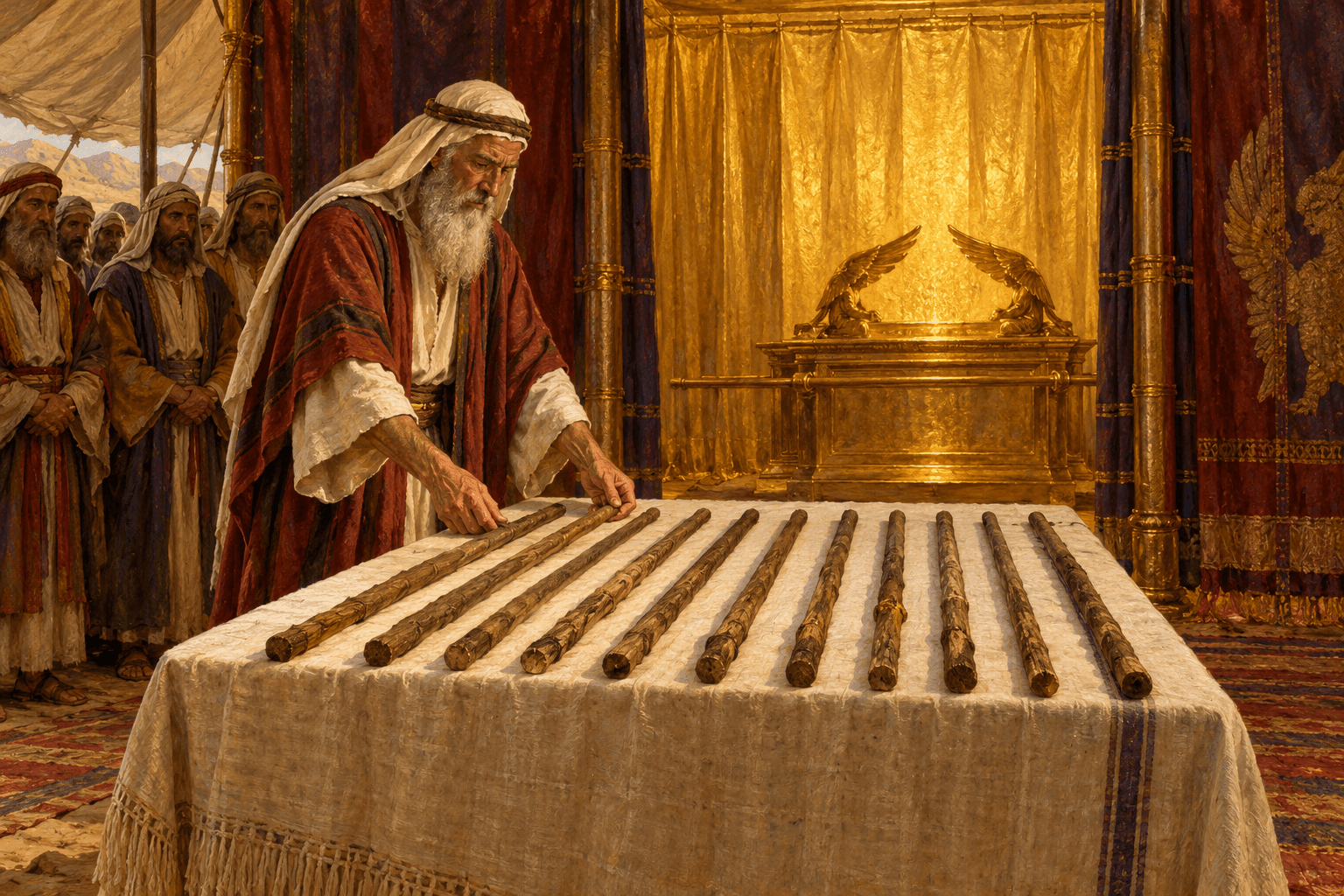
God wanted to affirm to all that the choosing of priests is His own personal concern. As the Apostle Paul says: “And no man taketh this honour unto himself, but he that is called of God, as was Aaron” (Hebrews 5:4). Moses took a rod from each tribe and wrote on each the name of the prince of the tribe, as though it represented the rod of headship or fatherhood of the tribe; and on the rod of the tribe of Levi he wrote the name of Aaron. When the rods were laid before the ark of the testimony in the tabernacle, they found on the morrow that Aaron’s rod had budded and blossomed, and had even yielded almonds. We note in this wonderful work:
First: the doubts raised by Korah and his company did not shake Aaron; rather, they established his work in the eyes of God and men. For temptations increase a man in glory. As Saint John Chrysostom says:
As in the case of Aaron: they rose up against him, and so confirmed his greatness, for the matter of his ordination was no longer a matter of question but of admiration. [124]
Second: God affirmed His concern to choose the priests Himself. As Saint Ambrose says:
So God Himself chose Aaron as priest, so that human will might have no place, but the grace of God might play the greatest part in choosing the priest. A man does not come forward to the priesthood of himself, nor by compulsion (from men), but receives it as a call from heaven. [125]
This is what moved the Church to pray to God in every liturgy, saying: “Grant to Your Church those who rightly divide the word of truth.” [126] He alone, who knows upright hearts, chooses who is fit for His service. And when God declared to Moses that the time of his departure had come, his last request was for his people: “Let the LORD, the God of the spirits of all flesh, set a man over the congregation” (Numbers 27:16). The aged prophet Moses, with his long experience in leadership, who knew all the princes and men of renown, did not want to choose; he asked the God of spirits, who knows the inner depths, to choose according to His divine will!
Third: Aaron, whose rod budded, symbolizes Christ the Lord, the great High Priest. Origen says:
Christ is the true great High Priest, and He alone is the one whose rod, which is the cross, budded, and even blossomed and produced fruits for all the believers. [127]
Fourth: Aaron’s rod that budded symbolizes the Virgin Mary, who gave birth to the incarnate Son of God, for she offered us the Fruit of life. Like the rod, she could not give birth of herself; but having entered into the sphere of God’s grace, she offered us the holy Son of God incarnate in her womb. Therefore the Church sings in the Sunday Theotokia:
Truly you are greater than Aaron’s rod; you are full of grace. The rod is a symbol of her virginity: she conceived the Son of the Most High, the Word Himself, and bore Him without the seed of man!
In this way Aaron’s rod came to point to the universal Church, of which the Virgin is the most perfect member; for Christ has come to dwell in us, and we have carried Him as a fruit of life within us, we who were like dry rods without life. And what I say of every member of the Church I say all the more of the priest, who bears divine fruits in his service if he has received the priestly work from God and uses divine means in his service, not human ways.
2. The Fruit of the Almond
KJV · Verses 8–9
8 And it came to pass, that on the morrow Moses went into the tabernacle of witness; and, behold, the rod of Aaron for the house of Levi was budded, and brought forth buds, and bloomed blossoms, and yielded almonds. 9 And Moses brought out all the rods from before the Lord unto all the children of Israel: and they looked, and took every man his rod.
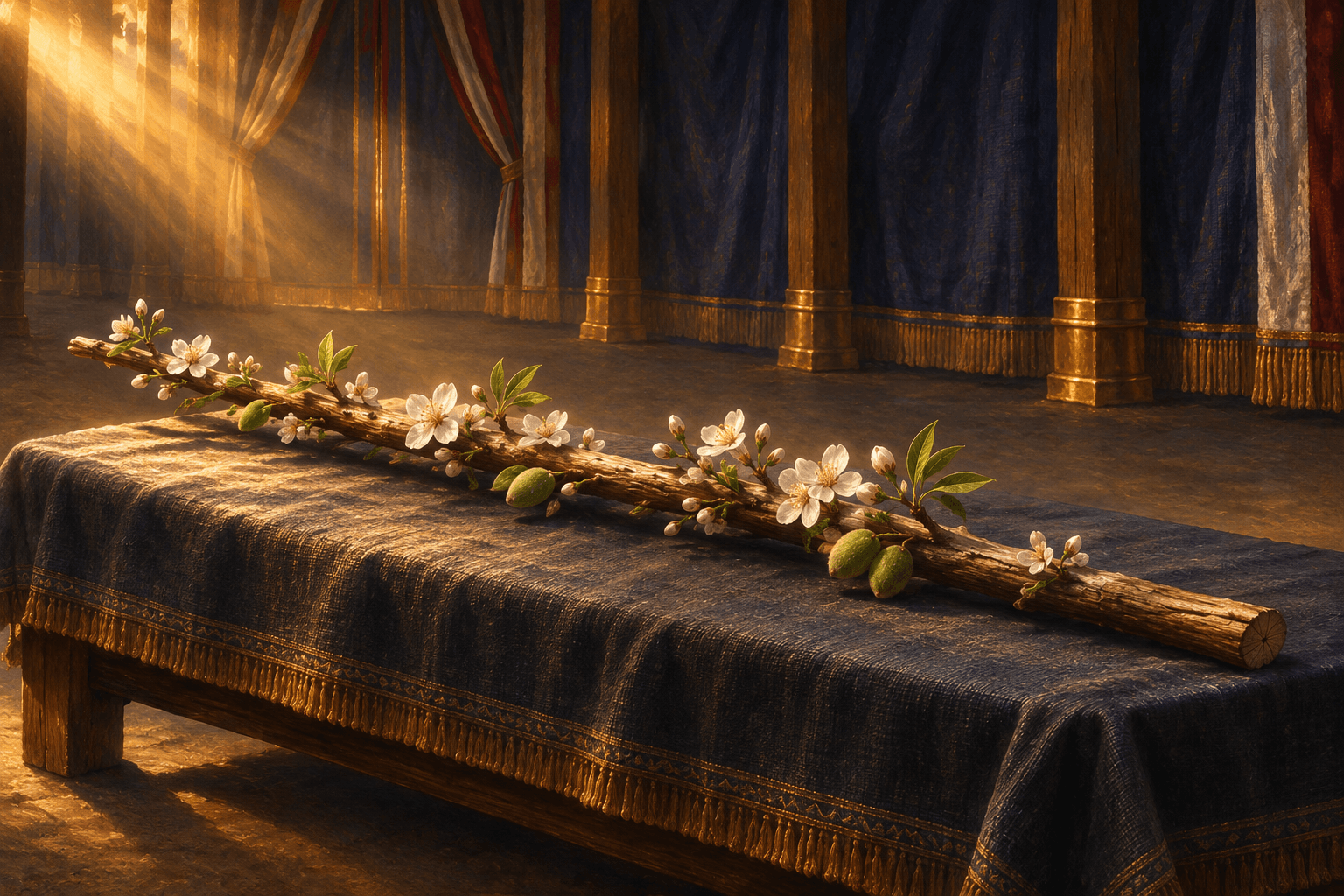
When the dry rod turned into a living branch bearing leaves, blossoms and almonds, the riches of God’s surpassing grace in His Church appeared in many respects, among them:
First: it bore a material, tangible witness to Aaron’s ordination as priest directly from heaven. Saint Gregory of Nyssa says:
The result was that one rod became a witness to the heavenly ordination, for it was distinguished from the other rods by a divine miracle. [128]
Second: this rod gave a living symbolic picture of the minister’s life. He becomes like the almond: on the outside it has a rough, woody shell, but inside it carries the sweetness of fatherhood and the tenderness of care, offering a delightful spiritual food to his children. Saint Ambrose [129] says that Aaron’s rod was wood on the outside but sweet inside. And Saint Gregory of Nyssa says:
It is fitting to perceive the kind of life that marks the priesthood through the fruit that Aaron’s rod produced; I mean the disciplined life, rough and dry in appearance, but containing within, in a hidden and invisible way, what can be eaten. This becomes evident when the fruit ripens, the hard shell is broken and the wood-like covering is removed from the food. [130]
Third: Origen sees in the almond produced by Aaron’s rod a reference to the interpretation of the word of God to which the priest is bound. The almond bears a bitter outer husk, which dries and falls while it is still on the tree; this husk points to the literal interpretation of the word of God, which is bitter and unprofitable, so we should leave it to enter into the depths of the word of God within and come to know its mysteries. In his view the Jews and the Gnostic heretics stumbled at Christ the Lord and at the Old Testament because they did not go beyond the literal interpretation of the word of God. Next comes the hard shell which we break to eat the almond; it represents the moral or behavioural interpretation, in which we practise the life of mortification and bodily labours, fasts, metanoias (prostrations) and so on. And the inner almond represents the spiritual or symbolic interpretation: entering behind the letters to meet Christ the Lord, the true food and the secret of our life. [131]
Fourth: Saint Ambrose sees in this rod a picture of God’s work in the believers in the Church of the New Testament, for he says:
In the ark of the covenant Aaron’s rod budded; for it is easy for God to make a flower spring up in the holy Church from us, who are like bundles of sticks. [132]
Origen [133] sees in it a symbolic picture of the four degrees of believers:
A) The dry rod became a green branch, that is, it bore life: a reference to confessing Christ the Lord, for by faith our souls pass from the state of death to life.
B) The rod produced leaves: a reference to the new birth and the grace of God through His Holy Spirit, who gives us the possibility of the new life in Christ Jesus our Lord through Baptism.
C) It gave blossoms: a reference to the life of continual growth after the new birth in Baptism.
D) It gave the fruits of righteousness, not only in its own life but also in the life of others. This is the almond: the fruit of witness to Christ the Lord and the work of preaching.
Origen holds that these four degrees appear in the words of Saint John the Beloved, who addressed the believers thus: “little children… children… young men… fathers” (1 John 2:12–14).
3. Aaron’s Rod and the Testimony
KJV · Verses 10–13
10 And the Lord said unto Moses, Bring Aaron's rod again before the testimony, to be kept for a token against the rebels; and thou shalt quite take away their murmurings from me, that they die not. 11 And Moses did so: as the Lord commanded him, so did he. 12 And the children of Israel spake unto Moses, saying, Behold, we die, we perish, we all perish. 13 Whosoever cometh any thing near unto the tabernacle of the Lord shall die: shall we be consumed with dying?
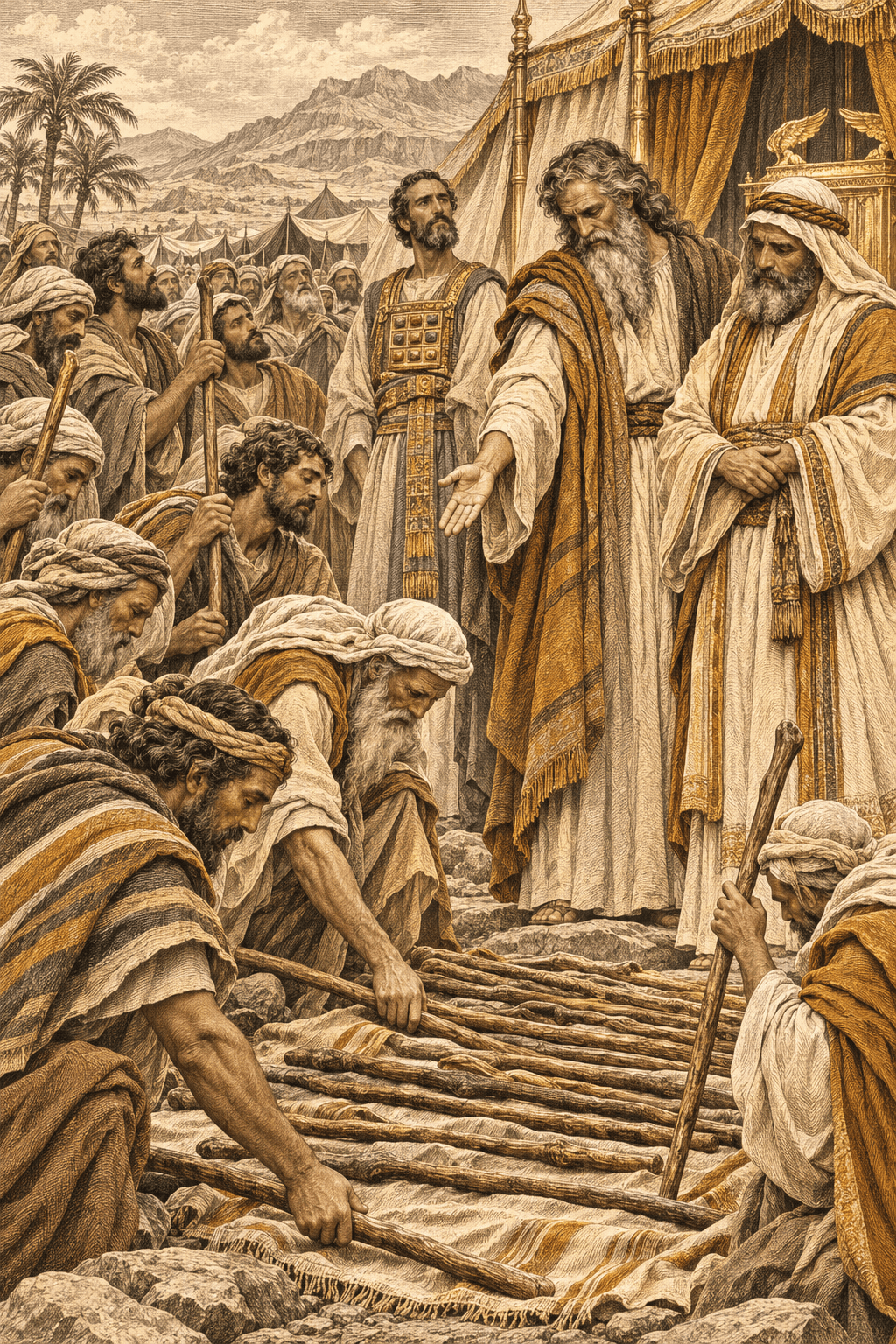
Placing Aaron’s rod before the testimony continually reminds Aaron and his sons that the blessings they received for the priestly work are from God, so that they should not become proud. It also reminds the people of this, so that they should not murmur. Besides this, the rod carried a prophecy of the divine Incarnation from Saint Mary the Virgin, something that ought to be continually before the eyes of the Church.
Notes and References
[124] St. John Chrysostom, Homilies on Acts 54.
[125] St. Ambrose, Epistle 63.48.
[126] The Coptic Liturgy of St. Basil.
[127] Origen, Homilies on Numbers 9.7.
[128] St. Gregory of Nyssa, The Life of Moses 2.284.
[129] St. Ambrose, Epistle 41.3.
[130] St. Gregory of Nyssa, The Life of Moses 2.285.
[131] For more on this, see our book The Fathers of the School of Alexandria: Origen (Holy Scripture), 1979 edition.
[132] St. Ambrose, Concerning Virgins 1.1.
[133] Origen, Homilies on Numbers 9.7.