
The people’s complaint was: “Whosoever cometh any thing near unto the tabernacle of the LORD shall die” (Numbers 17:13). The answer came in the previous chapter and in the chapter before us. In the previous one the Lord declares that one may draw near to God through the priestly and Levitical order; here He reveals the need for sanctification, without which no one can see God.
1. The Ashes of the Heifer and the Water of Purification
KJV · Verses 1–10
1 And the Lord spake unto Moses and unto Aaron, saying, 2 This is the ordinance of the law which the Lord hath commanded, saying, Speak unto the children of Israel, that they bring thee a red heifer without spot, wherein is no blemish, and upon which never came yoke: 3 And ye shall give her unto Eleazar the priest, that he may bring her forth without the camp, and one shall slay her before his face: 4 And Eleazar the priest shall take of her blood with his finger, and sprinkle of her blood directly before the tabernacle of the congregation seven times: 5 And one shall burn the heifer in his sight; her skin, and her flesh, and her blood, with her dung, shall he burn: 6 And the priest shall take cedar wood, and hyssop, and scarlet, and cast it into the midst of the burning of the heifer. 7 Then the priest shall wash his clothes, and he shall bathe his flesh in water, and afterward he shall come into the camp, and the priest shall be unclean until the even. 8 And he that burneth her shall wash his clothes in water, and bathe his flesh in water, and shall be unclean until the even. 9 And a man that is clean shall gather up the ashes of the heifer, and lay them up without the camp in a clean place, and it shall be kept for the congregation of the children of Israel for a water of separation: it is a purification for sin. 10 And he that gathereth the ashes of the heifer shall wash his clothes, and be unclean until the even: and it shall be unto the children of Israel, and unto the stranger that sojourneth among them, for a statute for ever.
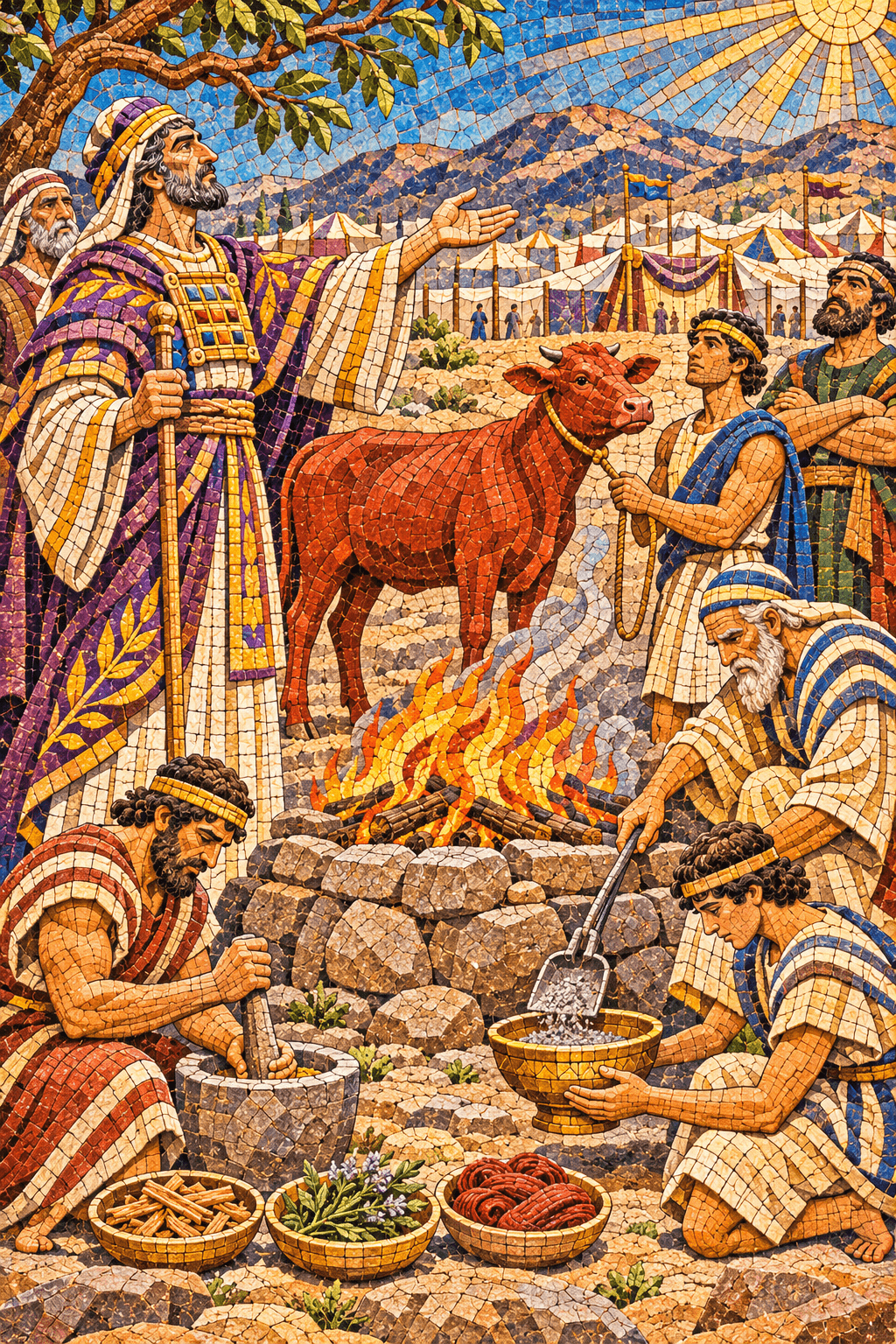
I do not want to go into the details of the sacrifices and burnt offerings in the Mosaic rite as symbols of aspects of the sacrifice of the cross; I leave this subject to our commentary on the Book of Leviticus, if the Lord permits and we live. But here I want to make clear that drawing near to the Lord’s tabernacle, or enjoying fellowship with Him and abiding in Him, will not take place except through the sacrifice of the cross and entering the waters of sanctification. In the rite before us God declares to Moses and Aaron “the ordinance of sanctification,” by preparing the ashes used in the waters of sanctification, or, as He calls it, “a water of separation” (9), that is, the water that cleanses from uncleanness and moves man from the state of defilement to the state of holiness.
This rite may be summed up as follows:
First: the heifer offered as a sin offering (9) is red, pointing to Christ the Lord, who offered His blood as an atonement for our sins, He of whom Isaiah the prophet speaks: “Who is this that cometh from Edom, with dyed garments from Bozrah? this that is glorious in his apparel, travelling in the greatness of his strength? I that speak in righteousness, mighty to save. Wherefore art thou red in thine apparel, and thy garments like him that treadeth in the winefat? I have trodden the winepress alone; and of the people there was none with me” (Isaiah 63:1–3). This is Christ the Lord, who entered into the sufferings of His own will, and passed through the winepress of divine wrath for us, bearing in His body the wages of our sins, offering us so great a salvation!
Second: “without spot, wherein is no blemish, and upon which never came yoke” (2). For our Lord Jesus Christ alone is without sin; there is no blemish in Him, and He never fell under the yoke of any sin. He rebuked the Jews, saying: “Which of you convinceth me of sin?” (John 8:46); and the Apostle Paul says: “For he hath made him to be sin for us, who knew no sin; that we might be made the righteousness of God in him” (2 Corinthians 5:21). Saint John Chrysostom says:
Yes, Christ Himself says: “And for their sakes I sanctify myself” (John 17:19); and He also says: “the prince of this world is judged” (John 16:11), showing that the One who was slain is without sin. [141]
Third: Eleazar the priest came forward to bring her forth without the camp, and she was slain before his face (3). She could not be presented to Aaron, because as high priest he did not go out of the camp; so she was presented to his son Eleazar. It is as though Christ the Lord, slain outside Jerusalem on the hill of Golgotha, was at the same moment within the Holy of Holies as High Priest, not separated from His Father and not leaving His heavens by His divinity! He is on the cross outside the camp for our sake, atoning for our sins, and He is in His Father’s bosom to join us to His righteousness.
The Apostle Paul says: “Wherefore Jesus also, that he might sanctify the people with his own blood, suffered without the gate. Let us go forth therefore unto him without the camp, bearing his reproach. For here have we no continuing city, but we seek one to come” (Hebrews 13:12–14). It is as though going out of the camp points to going out of the temporal city and longing to set out for the city to come, the heavenly Jerusalem, our mother.
Fourth: “And Eleazar the priest shall take of her blood with his finger, and sprinkle of her blood directly before the tabernacle of the congregation seven times” (4). What Eleazar does points to the priestly work of Christ the Lord, who sanctifies us with His blood, sprinkling the blood on the face of the Church, the true tabernacle of the congregation, so that she is sanctified and has boldness to lift up her face before the Father. The sprinkling of the blood seven times, though the slaughter took place once, points to the efficacy of the blood and the sacrifice: it was accomplished once, but it is a living and effective sacrifice, working through the generations to bring us to perfection. For the number 7 points to all the days of the week, and also to perfection, as though the sacrifice continues through the whole week of this world, effective with all its power for our perfecting. Therefore Saint John the Beloved saw Christ the Lord as a Lamb as it had been slain (Revelation 5:6): He is alive and does not die, but the efficacy of the blood does not cease. In the sacrament of the Eucharist we do not repeat the sacrifice of the cross again and again; we enter by the Holy Spirit into the effective sacrifice that stands without ceasing. [142]
Fifth: “And one shall burn the heifer in his sight; her skin, and her flesh, and her blood, with her dung, shall he burn” (5). When the sacrifice is burned we see nothing but the ashes used for cleansing the people from sin; and so, when Christ the Lord bore our sins, He died for us, turning our sins into ashes. The burning of the skin, the flesh, the blood and so on points to the certainty of Christ’s death according to the flesh, so that no one may say, like Mani, that He bore an imaginary body and entered into the sufferings with this imaginary body.
The priest’s casting cedar wood, hyssop and scarlet into its fire (6), things used in the rite of cleansing leprosy (Leviticus 4:6–7), points to the mingling of the ashes of the sacrifice with what was appointed for cleansing. The wood points to the cross, the hyssop to washing, and the scarlet to the blood.
Sixth: the rite links the ashes of the slain heifer, which entered into the sufferings of the fire to the end, with the water given to cleanse the congregation from uncleanness (9), as though it were a link between the sacrifice of the cross and the waters of Baptism. The Apostle says: “Buried with him in baptism, wherein also ye are risen with him” (Colossians 2:12).
Seventh: “And he that burneth her shall wash his clothes in water, and bathe his flesh in water, and shall be unclean until the even” (8); “And he that gathereth the ashes of the heifer shall wash his clothes, and be unclean until the even” (10). The rite wanted to affirm that Christ the Lord bore our sins: if the sacrifice of the cross is the secret of our cleansing, it bore the sins of the whole world!
2. The Need for Cleansing for Whoever Touches the Dead
KJV · Verses 11–13
11 He that toucheth the dead body of any man shall be unclean seven days. 12 He shall purify himself with it on the third day, and on the seventh day he shall be clean: but if he purify not himself the third day, then the seventh day he shall not be clean. 13 Whosoever toucheth the dead body of any man that is dead, and purifieth not himself, defileth the tabernacle of the Lord; and that soul shall be cut off from Israel: because the water of separation was not sprinkled upon him, he shall be unclean; his uncleanness is yet upon him.
“He that toucheth the dead body of any man shall be unclean seven days. He shall purify himself with it on the third day, and on the seventh day he shall be clean: but if he purify not himself the third day, then the seventh day he shall not be clean” (11–12).
Saint Augustine says:
The dead body, bereft of life, is not a sin; it signifies the sin of the soul bereft of righteousness. [143]
The death of the body was in ancient times a symbol of the sin that kills the soul; therefore if anyone touched a dead body, even if the dead was a saint or a priest, he became unclean.
That he was unclean seven days, that is, unclean all the days of the week, symbolizes that there is no cleansing from sin all the days of our sojourning unless these ashes and this water intervene! For there is no salvation for man from the defilement of sin without the sacrifice of the cross and renewal in the waters of Baptism.
The cleansing takes place on the third day by these waters, bound up with the ashes of the slain red heifer, pointing to cleansing by the waters of Baptism through the resurrection with Christ the Lord (the third day) by the efficacy of the cross. He affirms that whoever is not cleansed on the third day will not be cleansed on the seventh day, as though there is no justification for us unless we are united with Christ the Lord, risen from the dead. Our cleansing on the seventh day points to the continuation of the work of Christ’s resurrection in our temporal life, and its efficacy all the days of our sojourning until we pass over to our final resurrection.
Whoever does not accept Christ’s resurrection is not cleansed; he is counted as having defiled the tabernacle of the Lord, and that soul is cut off from the holy people (13). It is as though whoever does not bear the power of the Lord’s resurrection as the secret of his justification corrupts his body, the Lord’s dwelling; his soul dies, and he is not counted among the children of God.
3. The Rite of Cleansing
KJV · Verses 14–22
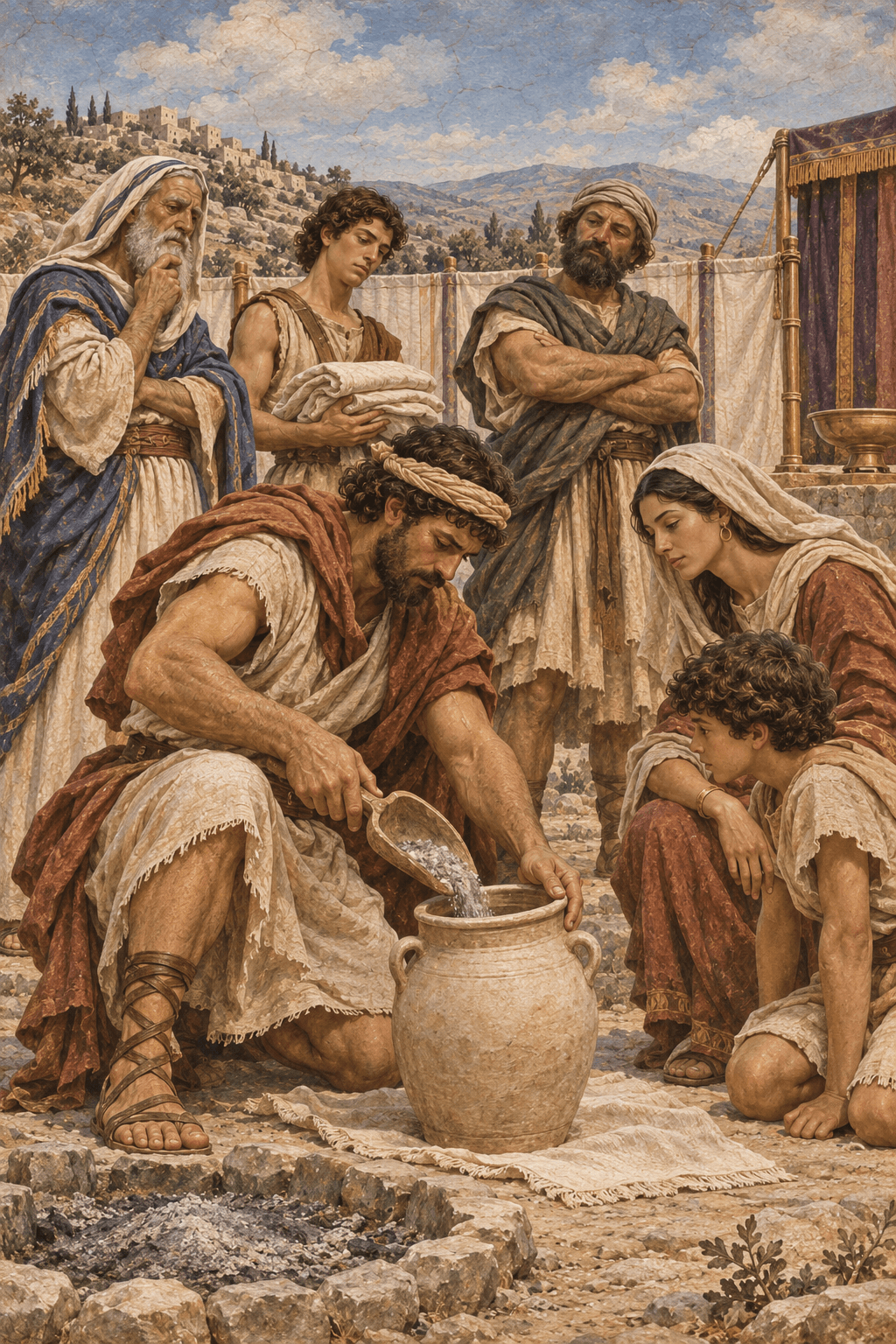
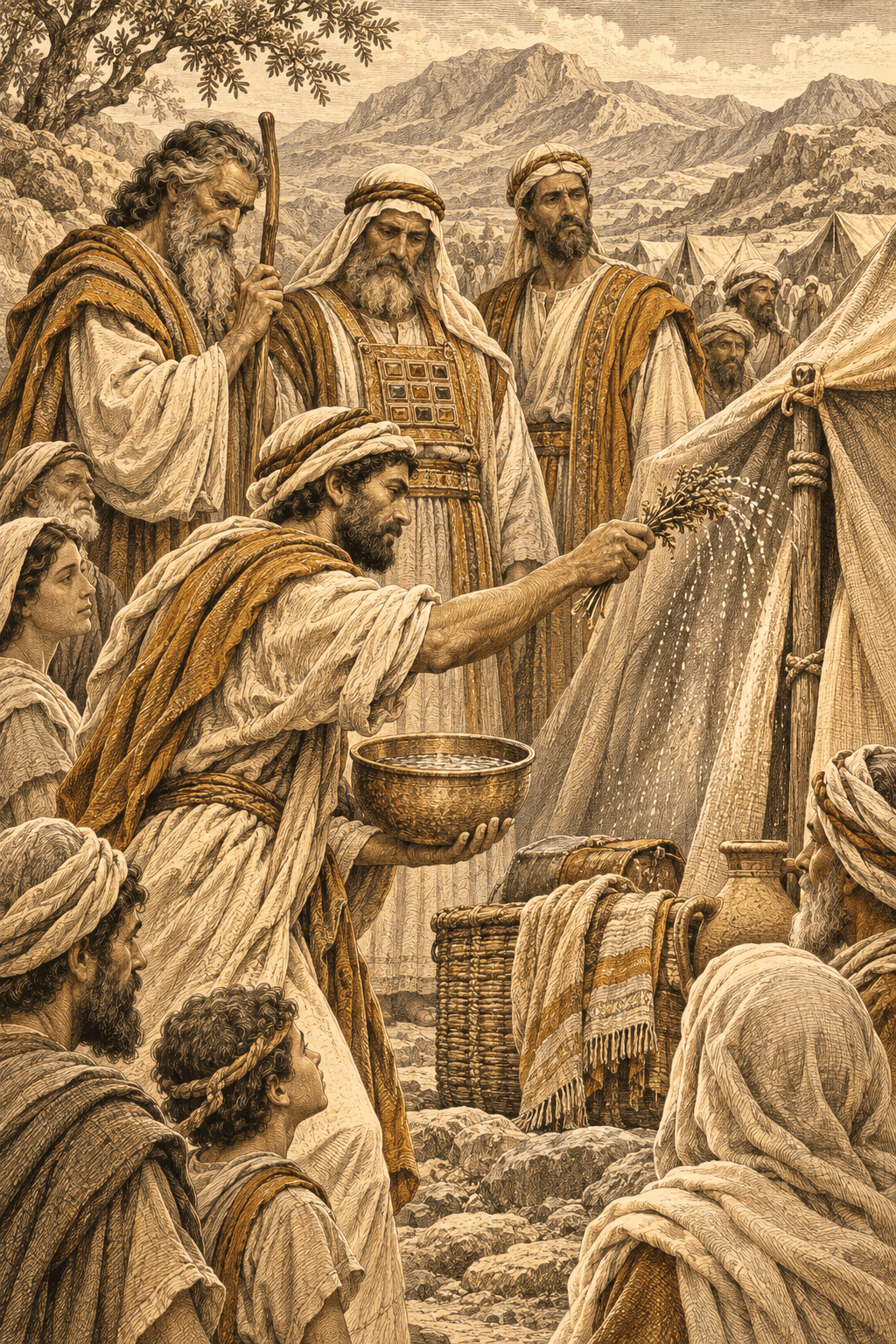
14 This is the law, when a man dieth in a tent: all that come into the tent, and all that is in the tent, shall be unclean seven days. 15 And every open vessel, which hath no covering bound upon it, is unclean. 16 And whosoever toucheth one that is slain with a sword in the open fields, or a dead body, or a bone of a man, or a grave, shall be unclean seven days. 17 And for an unclean person they shall take of the ashes of the burnt heifer of purification for sin, and running water shall be put thereto in a vessel: 18 And a clean person shall take hyssop, and dip it in the water, and sprinkle it upon the tent, and upon all the vessels, and upon the persons that were there, and upon him that touched a bone, or one slain, or one dead, or a grave: 19 And the clean person shall sprinkle upon the unclean on the third day, and on the seventh day: and on the seventh day he shall purify himself, and wash his clothes, and bathe himself in water, and shall be clean at even. 20 But the man that shall be unclean, and shall not purify himself, that soul shall be cut off from among the congregation, because he hath defiled the sanctuary of the Lord: the water of separation hath not been sprinkled upon him; he is unclean. 21 And it shall be a perpetual statute unto them, that he that sprinkleth the water of separation shall wash his clothes; and he that toucheth the water of separation shall be unclean until even. 22 And whatsoever the unclean person toucheth shall be unclean; and the soul that toucheth it shall be unclean until even.
The rite of cleansing with these waters may be summed up as follows:
First: “This is the law, when a man dieth in a tent: all that come into the tent, and all that is in the tent, shall be unclean seven days” (14). Before speaking of the manner of cleansing, He wanted first to bring out the seriousness of the situation, like a surgeon who, before putting the scalpel to the patient’s body, first shows him the corruption that has crept into his body, so that he will accept willingly the doctor’s hand reaching out to wound him and cut away something from his body. A dead body in a tent makes everyone who entered the tent, willingly or unwillingly, knowing of the dead body or not knowing, and also everyone who was inside the tent, counted unclean a whole week, even if the death was sudden and they had no guilt! Sin is hideous, exceedingly sinful; the Holy God cannot bear it, because it is contrary to His nature, whatever excuses we offer! Its hideousness also appears in their remaining unclean seven days, that is, all the days of their sojourning, a sign of their inability to cleanse themselves of it by themselves.
Second: “And every open vessel, which hath no covering bound upon it, is unclean” (15). Uncleanness does not stop at people; it extends to inanimate creation, so that an open vessel is counted unclean. Perhaps He wanted to set a health precaution, lest the dead man had been struck with an infectious disease and the infection pass to those around him through the vessels he used just before his death. On the spiritual side, these vessels represent the senses, such as the eyes, the mouth and so on: if the senses are open, without the covering of the Holy Spirit to control them, they are unclean and corrupt a man’s life.
The believer should strive to keep his senses guarded by the Holy Spirit, so that uncleanness from those dead in sins does not seep into his soul, his mind or his body. How much we need the covering of the Holy Spirit, which keeps our depths far from the germs of sin! Therefore the prophet cries: “Set a watch, O LORD, before my mouth; keep the door of my lips. Incline not my heart to any evil thing” (Psalm 141:3–4). Saint John Saba says:
Order your senses, brother, and watch over them, for through them the death of the inner man enters. Beware with this watchfulness, and look at what Saint Anthony said: Many have done great works, but because they did not do these works with discernment, they did not perceive the way of God, and they did not attain that pure faith. [144]
Third: having shown the hideousness of sin for whoever enters a tent where there is a dead body, and whoever is inside it, and for the open vessels in it, He began to make clear that it seeps into us not only through those who die inside the tent, but through the man slain with a sword in the open field, or the dead lying in the open, or bones, or even merely touching a grave (16).
The one who dies inside the tent usually does so because a disease has crept into his body, or because of old age. It is the state of one into whom sin creeps and attacks him secretly in his heart until it kills him, or the state of human weakness and spiritual old age, the fruit of neglect and spiritual lukewarmness. The one slain with the sword in the open field is the one whom sin attacks with all its violence in a moment and strikes down dead in the midst of his vitality and activity! The bones point to the state of the soul that has lived a long time in the death of sin, so that it has become dry bones scattered in the open or buried in a grave; no one cares for them, but people want to be rid of them. So this chapter depicts for us chronic spiritual disease that kills the soul, and offers it a remedy.
Fourth: the remedy is: “And for an unclean person they shall take of the ashes of the burnt heifer of purification for sin, and running water shall be put thereto in a vessel” (17). This is the work of the Church: she takes the sacrifice of the cross and offers it for the cleansing of the unclean through the living waters in a vessel (the baptismal font). Saint Justin says:
We must hasten to know which is the way to the forgiveness of sins and the hope of inheriting the promised good things. There is no other way but this: to come to know this Christ, to be washed in the fountain (Baptism) of which Isaiah spoke for the remission of sins, and so to begin to live in holiness. [145]
“And a clean person shall take hysop, and dip it in the water, and sprinkle it upon the tent, and upon all the vessels, and upon the persons that were there, and upon him that touched a bone, or one slain, or one dead, or a grave: And the clean person shall sprinkle upon the unclean on the third day, and on the seventh day” (18–19). Who is this clean person, if not Christ the Lord Himself, who works invisibly in Baptism? He is the One who baptizes by the hand of the priest. On this Saint John Chrysostom says:
The One who baptizes is the only-begotten Son of God, and not a man (a priest).
When you see the baptismal font and the hand of the priest touching your head, do not think of mere water, nor that it is the bishop’s hand on your head; for it is not a man who does this, but the grace of the Spirit, which sanctifies the nature of the water and touches your head together with the priest’s hand… [146]
The sprinkling of the water points to the Baptism which the Gentiles enjoy, as it is said in Isaiah the prophet: “So shall he sprinkle many nations; the kings shall shut their mouths at him: for that which had not been told them shall they see; and that which they had not heard shall they consider” (Isaiah 52:15), for they enjoyed the mystery of the new birth. And the Apostle Paul says: “Let us draw near with a true heart in full assurance of faith, having our hearts sprinkled from an evil conscience, and our bodies washed with pure water” (Hebrews 10:22). It is as though Baptism enters into the inner depths to wash the evil conscience, as it also sanctifies the body. This is what the law before us affirmed: for the clean man, whom the Apostle calls “an high priest over the house of God” (Hebrews 10:21), sprinkles the cleansing waters upon the tent, that is, upon the body, and upon all the vessels (18), that is, with all his energies, instincts and emotions, and upon the persons that were there, so that its effect extends to the souls hidden in the bodies. As Tertullian says:
Truly the flesh is washed that the soul may be cleansed; the flesh is anointed that the soul may be consecrated; the flesh is signed (with the cross) that the soul may be fortified; the flesh is overshadowed by the laying on of hands that the soul may be illumined by the (Holy) Spirit! [147]
Saint Cyprian speaks, commenting on this law, making clear that the sprinkling of the holy waters means salvation, that is, that a man enters into the way of salvation:
From this it appears that the sprinkling of water stands on an equal footing with the washing of salvation, which takes place in the Church, where the faith both of the receiver and of the giver is sound, and is fulfilled by the majesty of the Lord and the truth. [148]
Finally, He affirms that there is no enjoyment of cleansing on the seventh day unless a man is cleansed on the third day, that is, unless he is united with Christ the Lord, risen from the dead.
Notes and References
[141] St. John Chrysostom, Homilies on 1 Corinthians 38.3.
[142] See the author, Christ in the Sacrament of the Eucharist, 1973, pp. 43–63.
[143] St. Augustine, On the Good of Marriage 23.
[144] The author, Divine Love, p. 1032.
[145] St. Justin Martyr, Dialogue with Trypho 44.
[146] Whitaker, Documents of the Baptismal Liturgy, 1970, pp. 36, 38.
[147] Tertullian, On the Resurrection of the Flesh 8.
[148] St. Cyprian, Epistle 75 (Oxford edition 69).12.