
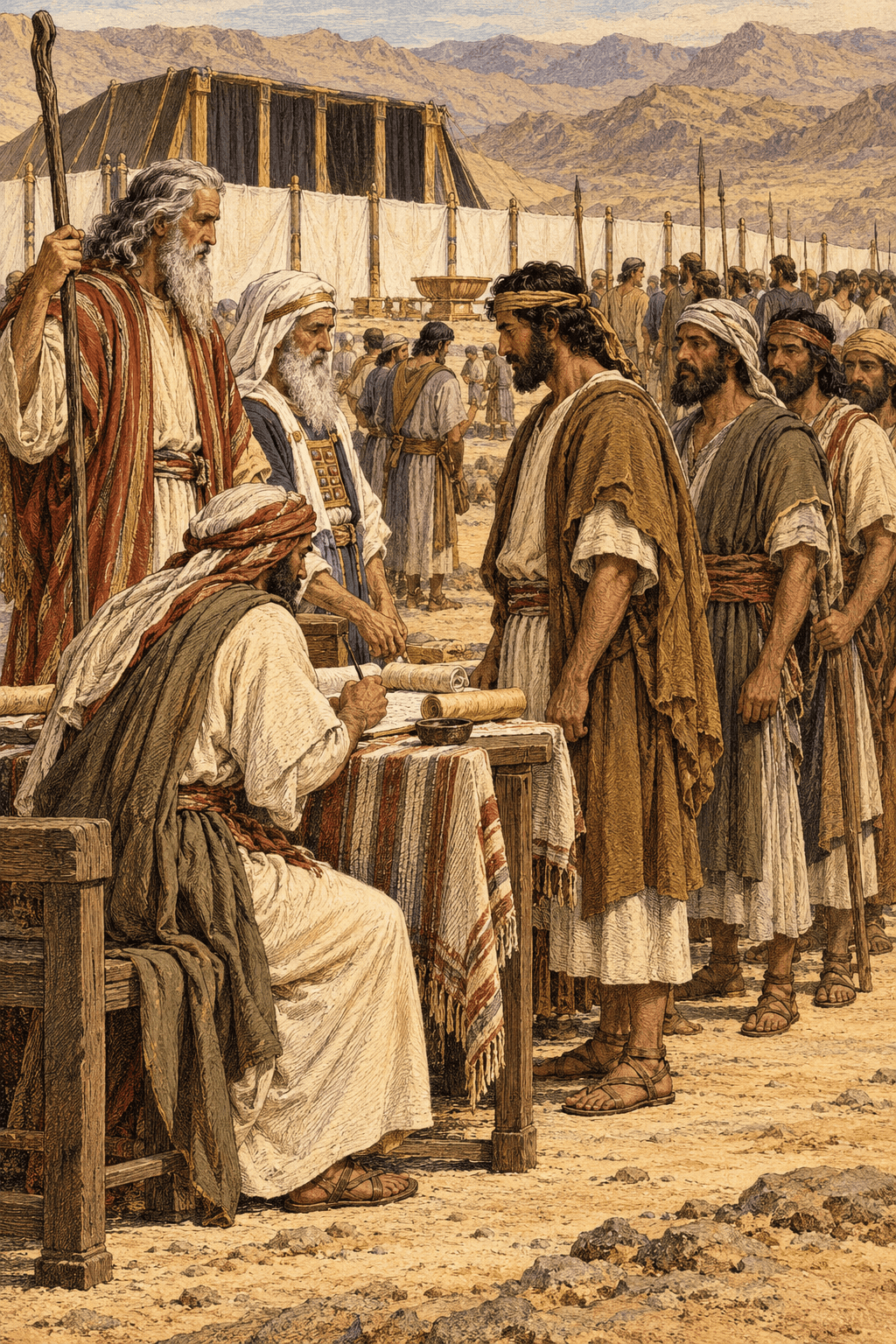
Having spoken of the Levites in general, He returns to set out in some detail the work of the three orders, fixing the age of service and taking a census of each order.
1. The Age of Service of the Levites
KJV · Verses 1–3
1 And the Lord spake unto Moses and unto Aaron, saying, 2 Take the sum of the sons of Kohath from among the sons of Levi, after their families, by the house of their fathers, 3 From thirty years old and upward even until fifty years old, all that enter into the host, to do the work in the tabernacle of the congregation.
In this chapter divine revelation affirms the age of service for the Levites seven times (Numbers 4:3, 23, 30, 35, 39, 43, 47): from thirty years old to fifty years old. Though in numbering them as the Lord’s firstborn the count began from a month old and upward, for the work He requires the age that is able to carry out what they are commanded, so that they offer God the best period of their life.
Among the Jews, the age of thirty is the age of manhood and maturity; therefore the priest or the prophet did not begin his work until he reached this age. Priests and prophets were usually brought up around the tabernacle or the temple, helping in some tasks, that is, being discipled, until they reached this age, when they took up the work and bore the responsibility.
If the working days are six days in the week, it is fitting for the Lord’s minister to be sanctified in all his five senses all the days of his work (6 × 5 = 30). So the number thirty points to the inner life of sanctification. The number 50 has its own holiness in both the Old and New Testaments, for it points to the state of pardon and release from debt or from sin. In the Old Testament, in the fiftieth year, that is, at the celebration of the Jubilee, a general and complete pardon took place: the slaves were freed, mortgaged lands were recovered and debtors were released, so that it became a year of rest. And on the day of Pentecost (the fiftieth day) the Holy Spirit came upon the disciples in the upper room, to give the Church a new heavenly nature, freed from sin and having the power to rise toward heavenly things. When Christ the Lord gave a parable about the forgiveness of debts, He said that a creditor had two debtors, the one owing five hundred and the other fifty, and he forgave them both (Luke 7:41–42). And when Abraham, the father of the fathers, began to intercede for Sodom and Gomorrah that the Lord might spare them, he asked whether, if there were fifty righteous, He would spare it (Genesis 18:24)… So this number came in Holy Scripture to represent the state of pardon. It is as though the Levites at this age are released from service on earth in order to prepare to go forth to the service of the heavenly temple: they leave the earnest to enjoy the fullness of glory.
In Numbers 8:24 the Levites are bound to begin work at the age of twenty-five, so as to spend five years under trial and discipleship before taking up the work. Origen holds that the number 25 points to complete sanctification, [23] since the number 5 points to the sanctification of the senses (5 × 5 = 25). In the days of David the prophet, as the work increased, the Levites began working at the age of twenty (1 Chronicles 23:24; Ezra 3:8), but they remained ten years in a period of discipleship, that is, until they reached thirty years of age. Saint John the Baptist began his preaching at thirty, and so did Christ the Lord. In the New Testament the Apostle Paul asked that the minister be “Not a novice” (1 Timothy 3:6), since priestly work requires maturity, wisdom and steadfastness; and the Apostle also required that they “first be proved” (1 Timothy 3:10).
2. The Organization of the Service among Them
KJV · Verses 4–20
4 This shall be the service of the sons of Kohath in the tabernacle of the congregation, about the most holy things: 5 And when the camp setteth forward, Aaron shall come, and his sons, and they shall take down the covering vail, and cover the ark of testimony with it: 6 And shall put thereon the covering of badgers' skins, and shall spread over it a cloth wholly of blue, and shall put in the staves thereof. 7 And upon the table of shewbread they shall spread a cloth of blue, and put thereon the dishes, and the spoons, and the bowls, and covers to cover withal: and the continual bread shall be thereon: 8 And they shall spread upon them a cloth of scarlet, and cover the same with a covering of badgers' skins, and shall put in the staves thereof. 9 And they shall take a cloth of blue, and cover the candlestick of the light, and his lamps, and his tongs, and his snuffdishes, and all the oil vessels thereof, wherewith they minister unto it: 10 And they shall put it and all the vessels thereof within a covering of badgers' skins, and shall put it upon a bar. 11 And upon the golden altar they shall spread a cloth of blue, and cover it with a covering of badgers' skins, and shall put to the staves thereof: 12 And they shall take all the instruments of ministry, wherewith they minister in the sanctuary, and put them in a cloth of blue, and cover them with a covering of badgers' skins, and shall put them on a bar: 13 And they shall take away the ashes from the altar, and spread a purple cloth thereon: 14 And they shall put upon it all the vessels thereof, wherewith they minister about it, even the censers, the fleshhooks, and the shovels, and the basons, all the vessels of the altar; and they shall spread upon it a covering of badgers' skins, and put to the staves of it. 15 And when Aaron and his sons have made an end of covering the sanctuary, and all the vessels of the sanctuary, as the camp is to set forward; after that, the sons of Kohath shall come to bear it: but they shall not touch any holy thing, lest they die. These things are the burden of the sons of Kohath in the tabernacle of the congregation. 16 And to the office of Eleazar the son of Aaron the priest pertaineth the oil for the light, and the sweet incense, and the daily meat offering, and the anointing oil, and the oversight of all the tabernacle, and of all that therein is, in the sanctuary, and in the vessels thereof. 17 And the Lord spake unto Moses and unto Aaron saying, 18 Cut ye not off the tribe of the families of the Kohathites from among the Levites: 19 But thus do unto them, that they may live, and not die, when they approach unto the most holy things: Aaron and his sons shall go in, and appoint them every one to his service and to his burden: 20 But they shall not go in to see when the holy things are covered, lest they die.
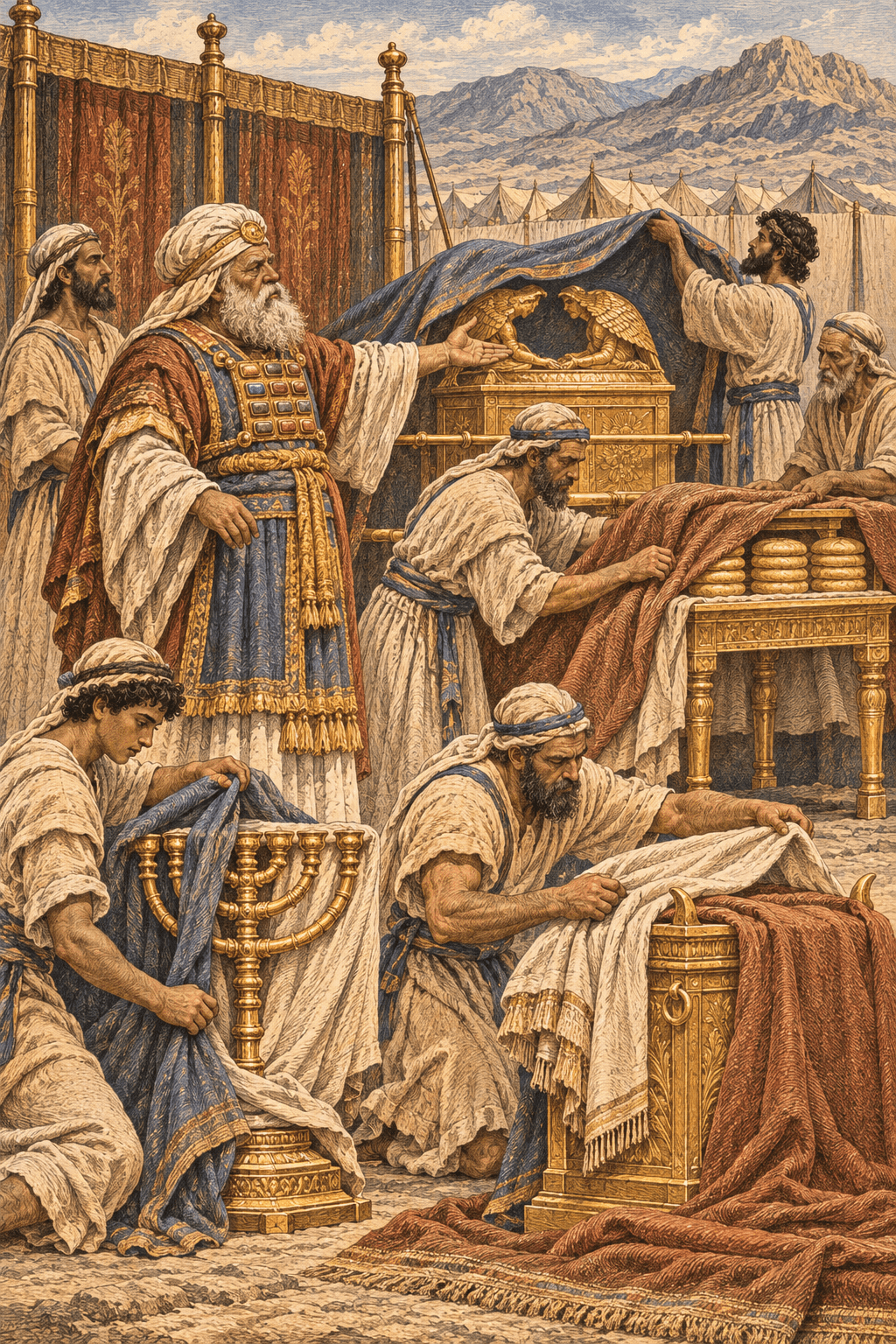
In this chapter God appears as the first One responsible for the service and all its arrangements, and for organizing the work among the ministers whom He appointed and called to the service. He fixed for each group its work, so that it would neither neglect it nor go beyond it. On the journey, Aaron (the high priest) and his sons (the priests) covered the holy things in the sanctuary with coverings whose material God fixed. There the work of the priests stopped, and the sons of Kohath carried these covered holy things on their shoulders. God warned against their going in to see the holy things or touch them before they were covered, lest they die, for He said to Moses and Aaron: “Cut ye not off the tribe of the families of the Kohathites from among the Levites: But thus do unto them, that they may live, and not die, when they approach unto the most holy things… But they shall not go in to see when the holy things are covered, lest they die” (18–20).
He also fixed what the sons of Gershon were to carry and what the sons of Merari were to carry… So every man is bound to know his work in the Church, neither boasting over others because of the responsibilities and gifts he has received, nor belittling himself because of what others do. For when he works faithfully and contentedly in what has been entrusted to him, he is crowned, and the work proceeds in completeness. What matters is not whether a man is a bishop, a priest, a deacon or one of the people, but that he be found faithful in the place where the Lord has put him. The Apostle Paul says: “And there are differences of administrations, but the same Lord. And there are diversities of operations, but it is the same God which worketh all in all” (1 Corinthians 12:5–6). On this Saint John Chrysostom says:
That you have received a smaller gift is for your benefit. So do not grieve as though you were rejected; for God did not do this to you out of contempt for you, nor because you are less than others, but He did it for your benefit. If a man bore a gift greater than his capacity, it would be useless and harmful to him. [24]
And the Spiritual Elder says:
We should not count the one who speaks of spiritual things great only because of the height of his understanding, and call the one who teaches children lacking in understanding. For there are many kinds of gifts, but one Spirit works in them all as He wills, giving each flock through its shepherd the pasture that suits it. So the one who interprets should not be puffed up over the one who is young in the faith. [25]
3. Carrying the Tabernacle and Its Furnishings
KJV · Verses 21–49
21 And the Lord spake unto Moses, saying, 22 Take also the sum of the sons of Gershon, throughout the houses of their fathers, by their families; 23 From thirty years old and upward until fifty years old shalt thou number them; all that enter in to perform the service, to do the work in the tabernacle of the congregation. 24 This is the service of the families of the Gershonites, to serve, and for burdens: 25 And they shall bear the curtains of the tabernacle, and the tabernacle of the congregation, his covering, and the covering of the badgers' skins that is above upon it, and the hanging for the door of the tabernacle of the congregation, 26 And the hangings of the court, and the hanging for the door of the gate of the court, which is by the tabernacle and by the altar round about, and their cords, and all the instruments of their service, and all that is made for them: so shall they serve. 27 At the appointment of Aaron and his sons shall be all the service of the sons of the Gershonites, in all their burdens, and in all their service: and ye shall appoint unto them in charge all their burdens. 28 This is the service of the families of the sons of Gershon in the tabernacle of the congregation: and their charge shall be under the hand of Ithamar the son of Aaron the priest. 29 As for the sons of Merari, thou shalt number them after their families, by the house of their fathers; 30 From thirty years old and upward even unto fifty years old shalt thou number them, every one that entereth into the service, to do the work of the tabernacle of the congregation. 31 And this is the charge of their burden, according to all their service in the tabernacle of the congregation; the boards of the tabernacle, and the bars thereof, and the pillars thereof, and sockets thereof, 32 And the pillars of the court round about, and their sockets, and their pins, and their cords, with all their instruments, and with all their service: and by name ye shall reckon the instruments of the charge of their burden. 33 This is the service of the families of the sons of Merari, according to all their service, in the tabernacle of the congregation, under the hand of Ithamar the son of Aaron the priest. 34 And Moses and Aaron and the chief of the congregation numbered the sons of the Kohathites after their families, and after the house of their fathers, 35 From thirty years old and upward even unto fifty years old, every one that entereth into the service, for the work in the tabernacle of the congregation: 36 And those that were numbered of them by their families were two thousand seven hundred and fifty. 37 These were they that were numbered of the families of the Kohathites, all that might do service in the tabernacle of the congregation, which Moses and Aaron did number according to the commandment of the Lord by the hand of Moses. 38 And those that were numbered of the sons of Gershon, throughout their families, and by the house of their fathers, 39 From thirty years old and upward even unto fifty years old, every one that entereth into the service, for the work in the tabernacle of the congregation, 40 Even those that were numbered of them, throughout their families, by the house of their fathers, were two thousand and six hundred and thirty. 41 These are they that were numbered of the families of the sons of Gershon, of all that might do service in the tabernacle of the congregation, whom Moses and Aaron did number according to the commandment of the Lord. 42 And those that were numbered of the families of the sons of Merari, throughout their families, by the house of their fathers, 43 From thirty years old and upward even unto fifty years old, every one that entereth into the service, for the work in the tabernacle of the congregation, 44 Even those that were numbered of them after their families, were three thousand and two hundred. 45 These be those that were numbered of the families of the sons of Merari, whom Moses and Aaron numbered according to the word of the Lord by the hand of Moses. 46 All those that were numbered of the Levites, whom Moses and Aaron and the chief of Israel numbered, after their families, and after the house of their fathers, 47 From thirty years old and upward even unto fifty years old, every one that came to do the service of the ministry, and the service of the burden in the tabernacle of the congregation. 48 Even those that were numbered of them, were eight thousand and five hundred and fourscore, 49 According to the commandment of the Lord they were numbered by the hand of Moses, every one according to his service, and according to his burden: thus were they numbered of him, as the Lord commanded Moses.
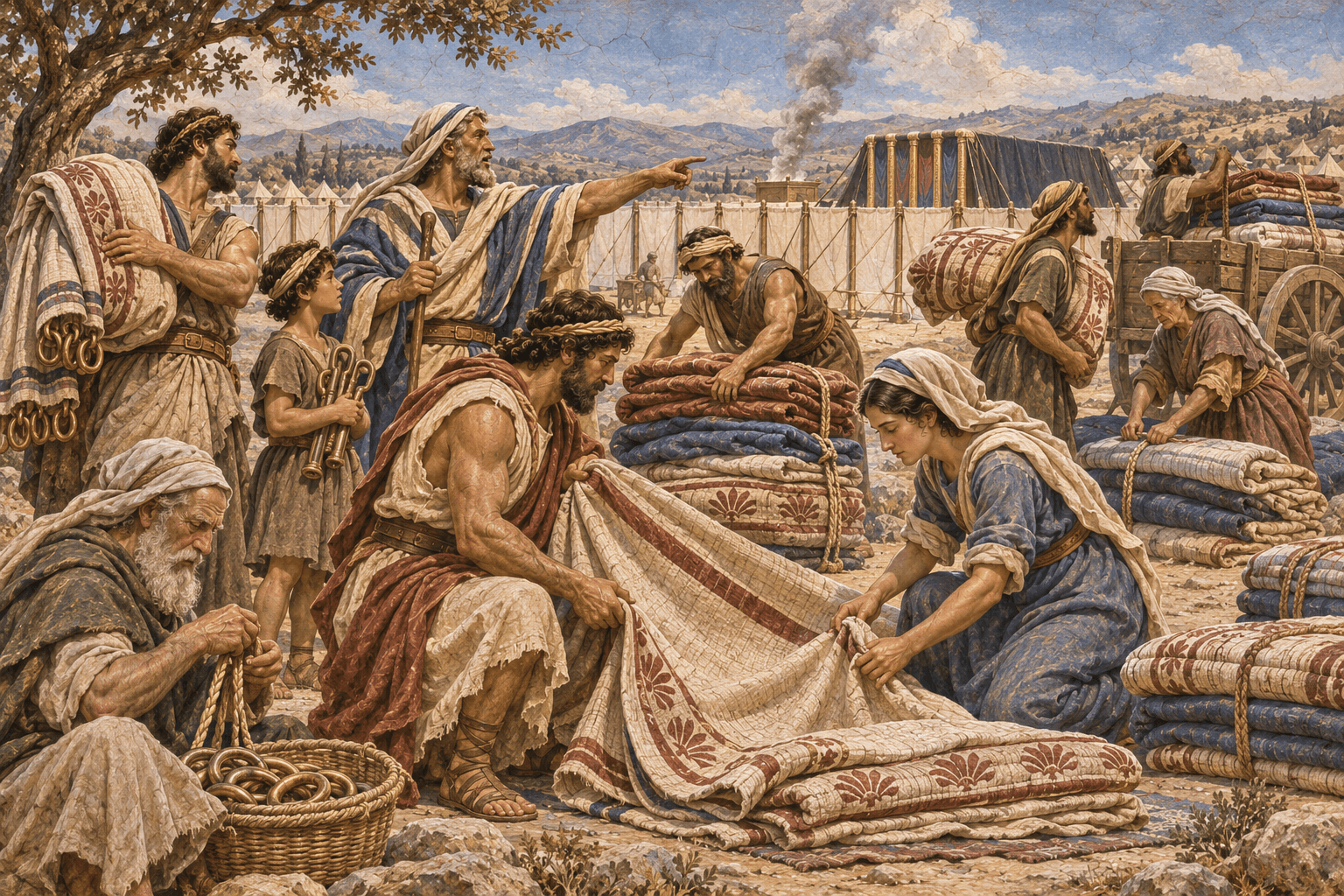
We have already seen how this work, “carrying the tabernacle and its furnishings,” was divided among the sons of Kohath, the sons of Gershon and the sons of Merari.
Origen comments on the holy things in the tabernacle, the ark of the covenant, the candlestick, the holy table, the altar of incense and so on, saying that all these point to groups of saints, and that their being carried on the shoulders of the sons of Kohath points to these saints being carried on the shoulders of the angels. He says:
Let us understand the tabernacle as the assembly of the saints who are included in God’s covenant. In it are people of greater merit, who have risen in righteousness and are called the candlestick. These, without doubt, are the apostles, who shine by their nearness to God… Others are called “the holy table,” for they carry the bread of God that renews and nourishes the soul hungering for righteousness (Matthew 5:6). Others are called the altar of incense: these are those who are occupied night and day with the worship of God in fasting and prayer, asking not only for themselves but for all the people. Those who have received these mysteries are called the ark of the covenant, for they have sure confidence and offer prayers, supplications and intercessions to reconcile God with men, and they entreat God for the people’s disobedience, hastening to the golden altar. Also, those who have been counted worthy of abundant knowledge and great riches of the knowledge of God become cherubim, for the word “cherub” means “fullness of knowledge”…
All those of whom we have spoken above through the various symbols must be carried on the shoulders. In my opinion, those who carry them are the angels, who are sent forth to minister for them who shall be heirs of salvation (Hebrews 1:14). Truly, when the tabernacle is folded up again, when we begin to enter the holy place to journey to the promised land, the angels support those who truly live as saints in the Holy of Holies.
And when God’s tabernacle is set up again, these are found carried on their shoulders and lifted up in their hands. Before this sight the prophet said by the Spirit: “For he shall give his angels charge over thee, to keep thee in all thy ways. They shall bear thee up in their hands, lest thou dash thy foot against a stone” (Psalm 91:11–12). [26]
4. The Covering of the Divine Holy Things
A) Since these holy things point to the believers, they remain uncovered within the holy place; but when they are carried, they must be covered. It is as though the believers ought to live a hidden life: their hearts open to God, living with God with open face, speaking with Him in boldness and friendship without hindrance; but before men they do not reveal the secrets of their hidden life. This is what Christ the Lord affirmed when He said: “Take heed that ye do not your alms before men, to be seen of them: otherwise ye have no reward of your Father which is in heaven… But thou, when thou prayest, enter into thy closet, and when thou hast shut thy door, pray to thy Father which is in secret; and thy Father which seeth in secret shall reward thee openly” (Matthew 6:1, 6).
He does not forbid common worship; He rejects its aim being display and vainglory, for He says, “to be seen of them” (Matthew 6:1)… The early Church shared daily in public worship in the temple (Acts 1:14), in psalms, praises and petitions, besides sharing in the sacrament of the Eucharist in the churches (Acts 2:46). But even in his common worship the believer should enter into a hidden relationship with God which even those standing beside him do not perceive.
Saint Augustine says:
Beware of walking in righteousness for this purpose, so that your happiness is centred on men’s looking at you. [27]
Abba Isaac, the disciple of Saint Anthony, has a beautiful comment on secret prayer. He says:
We pray with closed doors when we pray with closed lips, in quietness and complete silence, to Him who seeks hearts, not words. And we pray in secret when we keep hidden our petitions that come from our hearts and our fervent minds, revealing them to God alone, so that the opposing powers (the demons) cannot discover them. Therefore we must pray in complete silence, not only to avoid disturbing our brethren near us… but also to hide the meaning of our petitions from our enemies who watch us, especially at the time of prayer. In this way the commandment is fulfilled: “keep the doors of thy mouth from her that lieth in thy bosom” (Micah 7:5). [28]
B) God warned the Levites who were not priests against touching these holy things or seeing them; for God does not want anyone to know the holiness of our relationship with Him except His priests, who support us with their guidance and their prayers.
C) Origen sees in the covering of the holy things by the hands of the priests, before the sons of Kohath carried them, a symbol of the work of the priest, who knows the mysteries of God’s wisdom and understands them, but does not present them to the weak as they are, lest they perish; [29] rather, he presents them as far as they can bear.
D) Origen also sees in this a picture of the men of the Old Testament, who carried the divine holy things on their shoulders, but covered and veiled through shadows and symbols; while the true sons of Aaron, that is, the men of the New Testament, discovered the truth and knew its mysteries, and so knew the true Passover, the true Sabbath and the true circumcision… [30] Of this Isaiah the prophet says: “he will destroy in this mountain the face of the covering” (Isaiah 25:7).
E) The coverings carry beautiful meanings. Take, for example, the ark of the covenant, on which a covering of badgers’ skins was put, with a cloth wholly of blue spread over it (6). The ark of the covenant symbolizes the crucified Christ: though He appeared in weakness, hidden behind the skin, in truth He is wholly heavenly (blue). He appeared in weakness, though He is the Mighty One! The table of shewbread symbolizes our Lord Jesus, the Bread of life offered to mankind. Upon it they spread a cloth of blue (heavenly), then a cloth of scarlet (the sign of the blood), then a covering of badgers’ skins; as though the Lord is the heavenly Bread come down to us, who offers Himself broken for our sake (the scarlet), hidden from human eyes, so that we see Him as weak bread (the badgers’ skin).
I do not want to repeat what concerns the golden candlestick and the golden altar, for each of them is covered with a cloth of blue with a covering of badgers’ skins over it. The brazen altar alone is covered with a purple cloth, which is the garment of kings, and then a covering of badgers’ skins is spread over it. If the brazen altar points to the sacrifice of the cross, it is the royal throne through which the Lord reigns over the hearts of His believers.
Finally, Scripture mentions no covering for the laver, which points to Baptism, so that all may see it and all mankind may hasten to it!
Notes and References
[23] Origen, Homilies on Numbers 5.
[24] The author, Pastoral Love, 1965, p. 770.
[25] Ibid., p. 775.
[26] Origen, Homilies on Numbers 5.
[27] The author, The Sermon on the Mount according to Saint Augustine, 1981 edition, p. 162.
[28] The author, The Conferences of John Cassian 9.34.
[29] Origen, Homilies on Numbers 4.
[30] Ibid. 5.