
The fact that the tribe of Levi was not numbered with the rest of the tribes as men of war does not mean that they were exempt from work, or that they were to behave in an arrogant, aristocratic spirit. Rather, they were bound to spiritual work in place of the firstborn of the people. Divine revelation devotes several chapters to speaking of them, beginning with the punishment of some of them by death because of their wickedness.
1. The Punishment of the Wicked among Them
KJV · Verses 1–4
1 These also are the generations of Aaron and Moses in the day that the Lordspake with Moses in mount Sinai. 2 And these are the names of the sons of Aaron; Nadab the firstborn, and Abihu, Eleazar, and Ithamar. 3 These are the names of the sons of Aaron, the priests which were anointed, whom he consecrated to minister in the priest's office. 4 And Nadab and Abihu died before the Lord, when they offered strange fire before the Lord, in the wilderness of Sinai, and they had no children: and Eleazar and Ithamar ministered in the priest's office in the sight of Aaron their father.
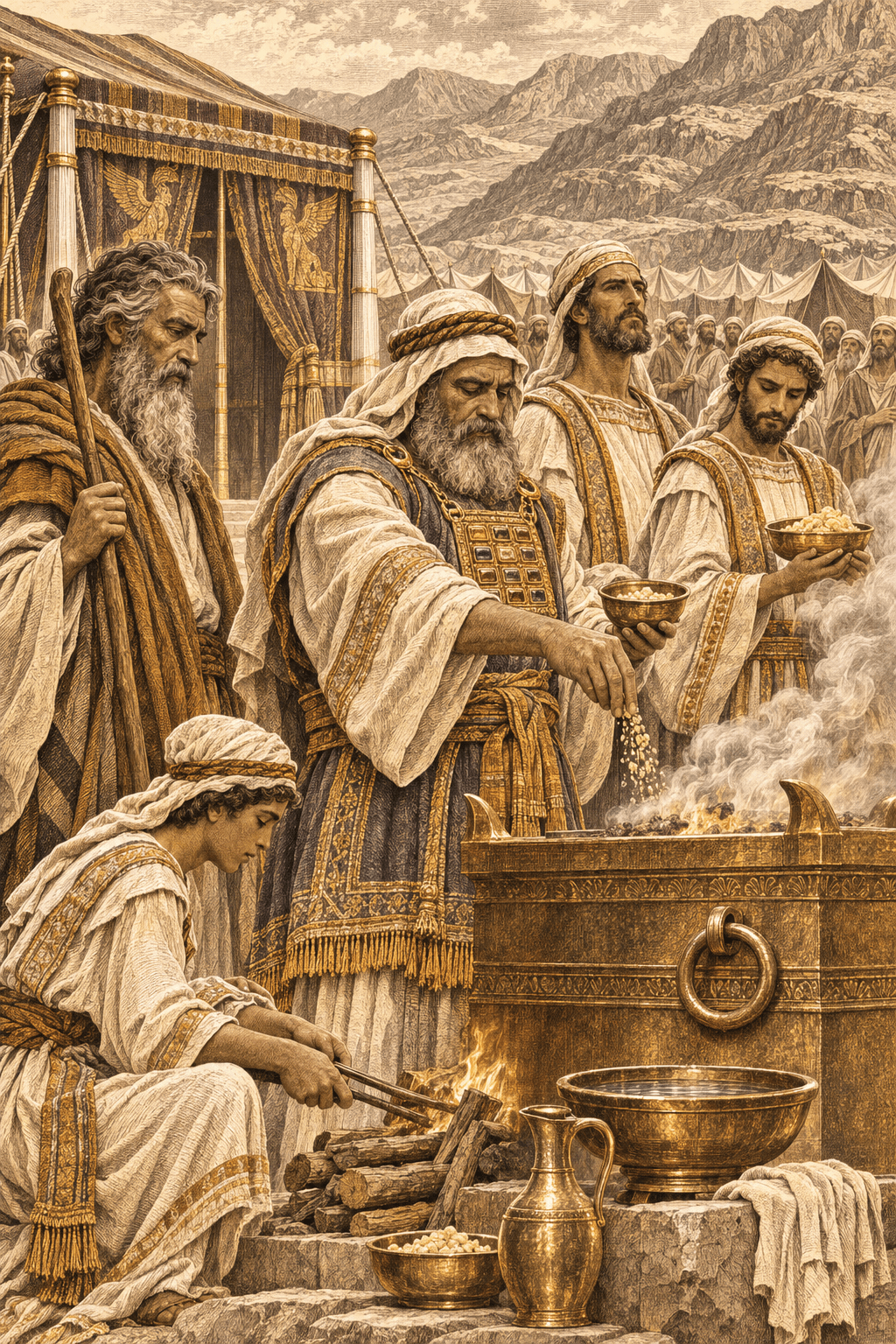
Nadab and Abihu, the sons of Aaron, fell by offering strange fire before the Lord, and they died and had no children; so the two younger brothers, Eleazar and Ithamar, ministered in the priest’s office in the sight of Aaron their father.
The name “Nadab” means “generous,” and “Abihu” means “He is my father.” For all the sweetness of their names, and although they were among the very few whom the Lord allowed to go up on Mount Sinai (Exodus 24:1) and were consecrated priests to the Lord (Exodus 28:1), they fell under the wrath of God and the curse, and lost even their temporal life because they broke the commandment (Leviticus 10:1–7; Numbers 26:61). They began in the Spirit but ended in the flesh. Neither their names, nor their title, nor their descent from Aaron, nor the Lord’s choosing them for priestly work interceded for them… On the contrary, all these things became the cause of their condemnation; for the more a man enjoys divine gifts, comes under the yoke of responsibility and gains knowledge, the more is required of him!
Some hold that they were drunk when they did this; for this reason God forbade the priests to enter the tabernacle of the congregation after drinking wine (Leviticus 10:9). Others hold that the secret of their deviation was that they served by their own will without the counsel of their father. Therefore the Lord commanded that the Levites stand before Aaron the priest to minister to him, as the two younger brothers ministered in the priest’s office in his sight (4–5); that is, the priests and Levites came to serve in a spirit of discipleship. Perhaps from the very beginning of the history of the Mosaic priesthood He wanted to declare the danger of priestly work if the spirit of pride and self-esteem enters into it, and each one walks after his own personal desire without discipleship. I say also: how much the Church in every age needs someone like Aaron, who bears the spirit of fatherhood not only for the people but also for the priests, who are discipled to the Lord Himself at his hands!
Finally, the Levites in fact played the role of deacons: they slaughtered, and the priests sprinkled the blood and burned the fat; they prepared the incense, and the priests offered it to the Lord. The deacon is a helper to the priest in all his spiritual service and pastoral work.
2. The Levites in Place of the Firstborn
KJV · Verses 5–13
5 And the Lord spake unto Moses, saying, 6 Bring the tribe of Levi near, and present them before Aaron the priest, that they may minister unto him. 7 And they shall keep his charge, and the charge of the whole congregation before the tabernacle of the congregation, to do the service of the tabernacle. 8 And they shall keep all the instruments of the tabernacle of the congregation, and the charge of the children of Israel, to do the service of the tabernacle. 9 And thou shalt give the Levites unto Aaron and to his sons: they are wholly given unto him out of the children of Israel. 10 And thou shalt appoint Aaron and his sons, and they shall wait on their priest's office: and the stranger that cometh nigh shall be put to death. 11 And the Lord spake unto Moses, saying, 12 And I, behold, I have taken the Levites from among the children of Israel instead of all the firstborn that openeth the matrix among the children of Israel: therefore the Levites shall be mine; 13 Because all the firstborn are mine; for on the day that I smote all the firstborn in the land of Egypt I hallowed unto me all the firstborn in Israel, both man and beast: mine shall they be: I am the Lord.
How sweet are the divine words concerning the Levites: “they are wholly given unto him out of the children of Israel” (9). God, in His love for man, always wants to enter into dealings with him in which there is giving and taking. As God declares His love for us by giving, He grants us the opportunity to return love for love by taking from our hands. He had given this people their existence and their life, and had brought them out of the land of bondage, so that they all owed Him their whole life; therefore He left them room for an exchange of love, and accepted from them this tribe as the people’s gift to God! He declares always, in every generation, that He is in need and thirsty, asking for man’s gift to Him, not because of any lack in the divine resources, but in order to enter into a relationship of shared love with man. He never accepts to give without taking, lest man feel his littleness and his inability to express his love for God.
In the earlier books He often spoke of firstfruits, tithes and vows; and now He declares His acceptance of the firstborn of the people by accepting “the tribe of Levi” as the people’s gift to Him. Now, why did He choose this tribe? And what does He mean by considering it the firstborn of the people?
Why Was the Tribe of Levi Chosen in Place of the Firstborn of the People?
“And the LORD spake unto Moses, saying, And I, behold, I have taken the Levites from among the children of Israel instead of all the firstborn that openeth the matrix among the children of Israel: therefore the Levites shall be mine; Because all the firstborn are mine…” (11–13).
Levi was not Jacob’s firstborn son, but his third son, after Reuben and Simeon. It is as though God wanted to affirm to His people from the beginning that the birthright does not rest on a bodily basis, that is, on age, but on readiness and worthiness. Christ the Lord came as the Firstborn of all mankind, though He became incarnate in the fullness of time; and the first Adam lost his birthright, for he brought death to mankind instead of blessing. So, as Levi passed over his brothers Reuben and Simeon, the second Adam, Christ the Lord, passed over the first Adam, as He also passed over the receiver of the Law, Moses the prophet, the first leader of the people… And the Lord is presented as Firstborn of believing mankind, being the only beloved Son of the Father.
On this Origen says:
Does this not teach us that those who are counted firstborn before God are not the firstborn according to bodily birth, but those whom God has chosen because of their good disposition? This is what happened with Jacob, the second man: God counted him firstborn, and he received the blessings of the birthright (Genesis 27:1–29), thanks to his father’s blindness by divine permission, because of the good disposition of his heart which God saw in him, for it is said: “For the children being not yet born, neither having done any good or evil… As it is written, Jacob have I loved, but Esau have I hated” (Malachi 1:2–3; Romans 9:11–13). So the Levites were not firstborn according to the flesh, but they were established as firstborn… [17]
We have already spoken of the firstborn as a symbol of Christ the Lord, the Firstborn, and how the commandment concerning the firstborn appeared as the first commandment immediately after the people came out (Exodus 13:2). [18] Note here that God speaks of the Levites, who are His firstborn, as being “from among the children of Israel” (12). He accepted them as a gift from the people, being in the midst of mankind as one of them, for Scripture says: “there standeth one among you, whom ye know not” (John 1:26).
The birthright of Christ the Lord differs from the birthright of men. In ancient times, when Jacob enjoyed the birthright, he deprived his brother Esau of it; and when the Levites became firstborn, Reuben lost his birthright… But Christ the Lord, coming into the world as Firstborn, opened the door to all mankind to enjoy the birthright through Him, that is, by union with Him. He founded “the church of the firstborn” and counted His believers firstborn… We are not like Esau, grieving and weeping because Jacob took his birthright from him; rather, we rejoice and exult because our Jesus has opened to us the door of the birthright.
Finally, the Lord’s words, “And thou shalt take the Levites for me (I am the LORD) instead of all the firstborn” (41), reveal the position of the minister as a ransom for those he serves. The Lord accepted him in place of the firstborn so that he might serve God’s people and bear their labours, their pains and their weaknesses, in order to bring them in Christ Jesus to the divine bosom. He is a ransom who longs to die so that all may live!
3. The Division of the Work
KJV · Verses 14–38
14 And the Lord spake unto Moses in the wilderness of Sinai, saying, 15 Number the children of Levi after the house of their fathers, by their families: every male from a month old and upward shalt thou number them. 16 And Moses numbered them according to the word of the Lord, as he was commanded. 17 And these were the sons of Levi by their names; Gershon, and Kohath, and Merari. 18 And these are the names of the sons of Gershon by their families; Libni, and Shimei. 19 And the sons of Kohath by their families; Amram, and Izehar, Hebron, and Uzziel. 20 And the sons of Merari by their families; Mahli, and Mushi. These are the families of the Levites according to the house of their fathers. 21 Of Gershon was the family of the Libnites, and the family of the Shimites: these are the families of the Gershonites. 22 Those that were numbered of them, according to the number of all the males, from a month old and upward, even those that were numbered of them were seven thousand and five hundred. 23 The families of the Gershonites shall pitch behind the tabernacle westward. 24 And the chief of the house of the father of the Gershonites shall be Eliasaph the son of Lael. 25 And the charge of the sons of Gershon in the tabernacle of the congregation shall be the tabernacle, and the tent, the covering thereof, and the hanging for the door of the tabernacle of the congregation, 26 And the hangings of the court, and the curtain for the door of the court, which is by the tabernacle, and by the altar round about, and the cords of it for all the service thereof. 27 And of Kohath was the family of the Amramites, and the family of the Izeharites, and the family of the Hebronites, and the family of the Uzzielites: these are the families of the Kohathites. 28 In the number of all the males, from a month old and upward, were eight thousand and six hundred, keeping the charge of the sanctuary. 29 The families of the sons of Kohath shall pitch on the side of the tabernacle southward. 30 And the chief of the house of the father of the families of the Kohathites shall be Elizaphan the son of Uzziel. 31 And their charge shall be the ark, and the table, and the candlestick, and the altars, and the vessels of the sanctuary wherewith they minister, and the hanging, and all the service thereof. 32 And Eleazar the son of Aaron the priest shall be chief over the chief of the Levites, and have the oversight of them that keep the charge of the sanctuary. 33 Of Merari was the family of the Mahlites, and the family of the Mushites: these are the families of Merari. 34 And those that were numbered of them, according to the number of all the males, from a month old and upward, were six thousand and two hundred. 35 And the chief of the house of the father of the families of Merari was Zuriel the son of Abihail: these shall pitch on the side of the tabernacle northward. 36 And under the custody and charge of the sons of Merari shall be the boards of the tabernacle, and the bars thereof, and the pillars thereof, and the sockets thereof, and all the vessels thereof, and all that serveth thereto, 37 And the pillars of the court round about, and their sockets, and their pins, and their cords. 38 But those that encamp before the tabernacle toward the east, even before the tabernacle of the congregation eastward, shall be Moses, and Aaron and his sons, keeping the charge of the sanctuary for the charge of the children of Israel; and the stranger that cometh nigh shall be put to death.
God divided the sons of Levi into three orders besides the priests, and fixed their positions and their work. As we said before, they surrounded the tabernacle in the shape of a cross. On the east side were Aaron and his priests with Moses the prophet; on the south (the right wing) dwelt the sons of Kohath; on the north (the left wing) dwelt the sons of Merari; and at the base (the west) dwelt the sons of Gershon. This is the cross surrounding the tabernacle, which lies in the middle of the whole congregation, which completes a huge cross.
Here we see at the head of the cross (the east) Moses, Aaron and his priests, pointing to Christ the Lord, Head of the Church, who is the Word of God (symbolized by Moses, the receiver of the Law) and the great High Priest (Aaron). In other words, through the cross we touch Christ the Lord, who gave us the divine commandment engraved with practical love through the pure Blood, and His atoning intercession through His eternal priesthood. The base of the cross is inhabited by the sons of Gershon, that is, the sons of “the cast out,” “the exile” or “the stranger”; for the cross came to pass and became “unto the Jews a stumblingblock, and unto the Greeks foolishness” (1 Corinthians 1:23). The right wing is inhabited by the sons of Kohath, that is, the sons of “the assembly,” where enmity is broken and fellowship with God and men comes to dwell, so that the heavenly are united with the earthly, and the nations and peoples gather together. In the left wing dwell the sons of Merari, pointing to the bitterness which the Lord endured for our sake!
The work was divided among the three orders of the Levites as follows:
First, the sons of Gershon: although Gershon was Levi’s firstborn, he came after Kohath, for the latter had preference according to the readiness of his heart, not according to bodily birth. The sons of Gershon were not counted priests but helpers to them. They kept the tabernacle, the tent, its covering, the hanging (curtain) for the door of the tabernacle of the congregation, the hangings of the court, and so on. Their number was 7,500 males. Two wagons and four oxen were assigned to them to help them on the journey. They branched into two families, the Libnites and the Shimites, and thirteen cities were given to them in the promised land (Joshua 21:27–33).
Second, the sons of Kohath: from them came Moses and Aaron, who received the priesthood, he and his sons. The rest received the work of helping the priests and had preference over the other orders. They kept the ark, the table, the candlestick, the two altars, the vessels of the sanctuary wherewith they minister, the veil and all its service. On the journey they carried these holy things on their shoulders after the priests had covered them; therefore no wagons or oxen were given to them. Their number was 8,600 males, more than the other two divisions. They were divided into four families: the Amramites, the Izeharites, the Hebronites and the Uzzielites. The sons of Aaron, the Kohathites, had thirteen cities in Canaan (Joshua 21:4), and the rest of the sons of Kohath ten cities (Joshua 21:5, 21). They were among the companies that David arranged for praise (1 Chronicles 25–26), and among those who helped bring the ark to Jerusalem (1 Chronicles 15:5), and they obtained honour and riches.
Third, the sons of Merari: they were charged with keeping the boards of the tabernacle, its bars, its pillars, its sockets and all its vessels, and the pillars of the court, and so on. Since these things were heavy, four wagons and eight oxen were given to them. Their number was 6,200 males. They were divided into two families, the Mahlites and the Mushites, and in Canaan twelve cities were assigned to them (Joshua 21:7, 34, 40; 1 Chronicles 6:63, 77, 81).
Origen [19] saw in these three orders, together with Aaron and his priests, a picture of the four heavenly orders, for it is said in the Epistle to the Hebrews: “But ye are come unto mount Sion, and unto the city of the living God, the heavenly Jerusalem, and to an innumerable company of angels, To the general assembly and church of the firstborn, which are written in heaven” (Hebrews 12:22–23). In his view heaven has four orders (Mount Sion; the city of God, the heavenly Jerusalem; an innumerable company of angels; the church of the firstborn which are written in heaven). He says:
Strive with all your strength to grow and advance in your works, your life, your habits, your faith and your manner of conduct, until you reach the church of the firstborn which are written in heaven. If you cannot, then reach a lower degree… If you cannot draw near to the innumerable company of angels and climb this degree, at least reach the city of the living God, the heavenly Jerusalem; and if you are not able to reach this, at least try to head toward Mount Sion, so that you may be saved on the mountain (Genesis 19:17). [20]
4. The Numbering of the Levites
KJV · Verses 39–43
39 All that were numbered of the Levites, which Moses and Aaron numbered at the commandment of the Lord, throughout their families, all the males from a month old and upward, were twenty and two thousand. 40 And the Lord said unto Moses, Number all the firstborn of the males of the children of Israel from a month old and upward, and take the number of their names. 41 And thou shalt take the Levites for me (I am the Lord) instead of all the firstborn among the children of Israel; and the cattle of the Levites instead of all the firstlings among the cattle of the children of Israel. 42 And Moses numbered, as the Lord commanded him, all the firstborn among the children of Israel. 43 And all the firstborn males by the number of names, from a month old and upward, of those that were numbered of them, were twenty and two thousand two hundred and threescore and thirteen.
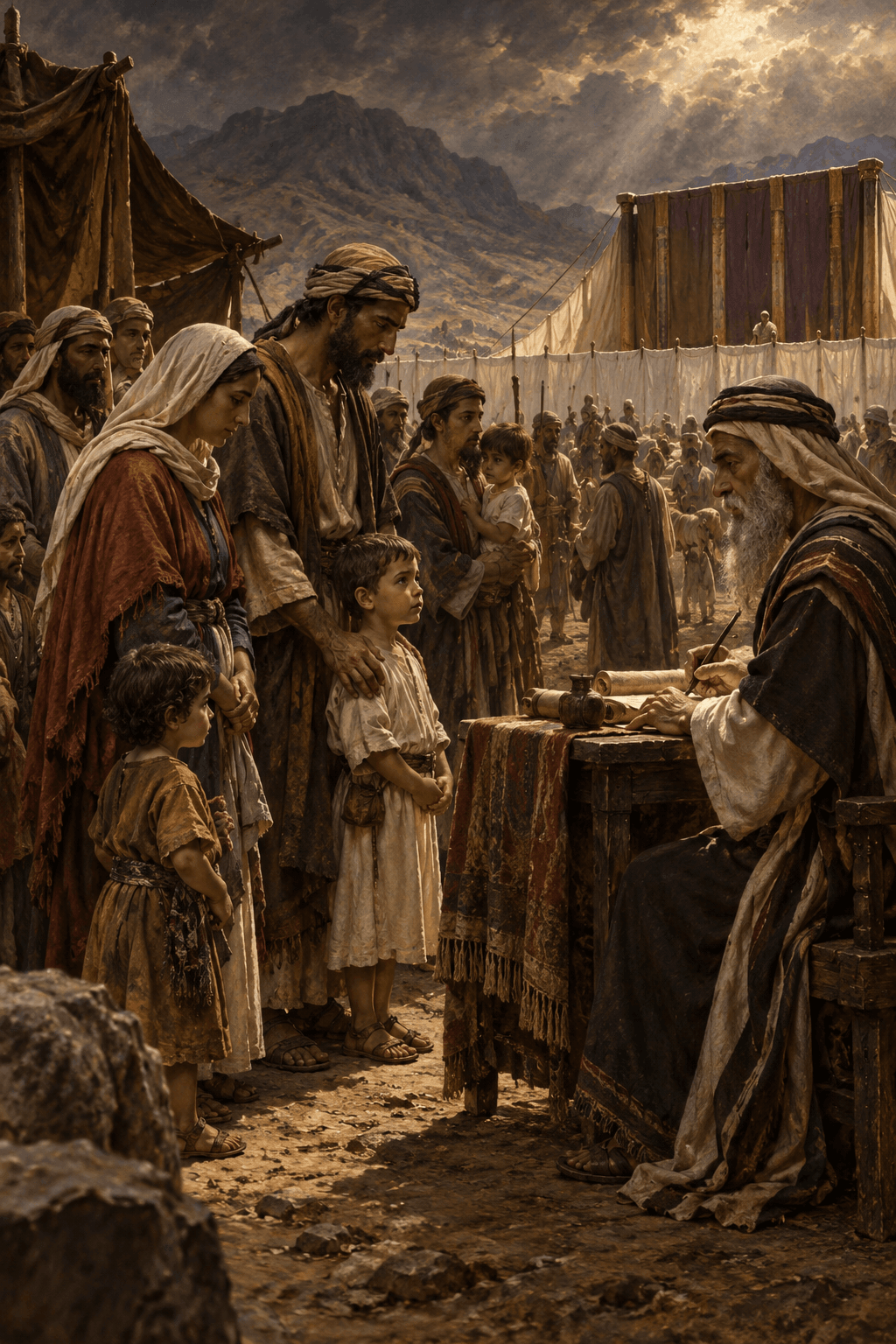
God commanded that the males of the Levites from a month old and upward be numbered, and their number was 22,000. Origen holds that the number 22 is the number of the Hebrew letters, and also the number of the fathers from Adam to Jacob, the root of the tribes. And since the number 1,000 points to the heavenly or spiritual life, the Levites by this number represent the spiritual language (22 letters): through their service all the tribes find it possible to have their names written in heaven. They represent all the letters, so that no one finds an excuse for not having his name registered. On the other hand, they represent the spiritual fathers from whose loins God’s people came.
5. Paying a Ransom for the Excess
KJV · Verses 44–51
44 And the Lord spake unto Moses, saying, 45 Take the Levites instead of all the firstborn among the children of Israel, and the cattle of the Levites instead of their cattle; and the Levites shall be mine: I am the Lord. 46 And for those that are to be redeemed of the two hundred and threescore and thirteen of the firstborn of the children of Israel, which are more than the Levites; 47 Thou shalt even take five shekels apiece by the poll, after the shekel of the sanctuary shalt thou take them: (the shekel is twenty gerahs:) 48 And thou shalt give the money, wherewith the odd number of them is to be redeemed, unto Aaron and to his sons. 49 And Moses took the redemption money of them that were over and above them that were redeemed by the Levites: 50 Of the firstborn of the children of Israel took he the money; a thousand three hundred and threescore and five shekels, after the shekel of the sanctuary: 51 And Moses gave the money of them that were redeemed unto Aaron and to his sons, according to the word of the Lord, as the Lord commanded Moses.
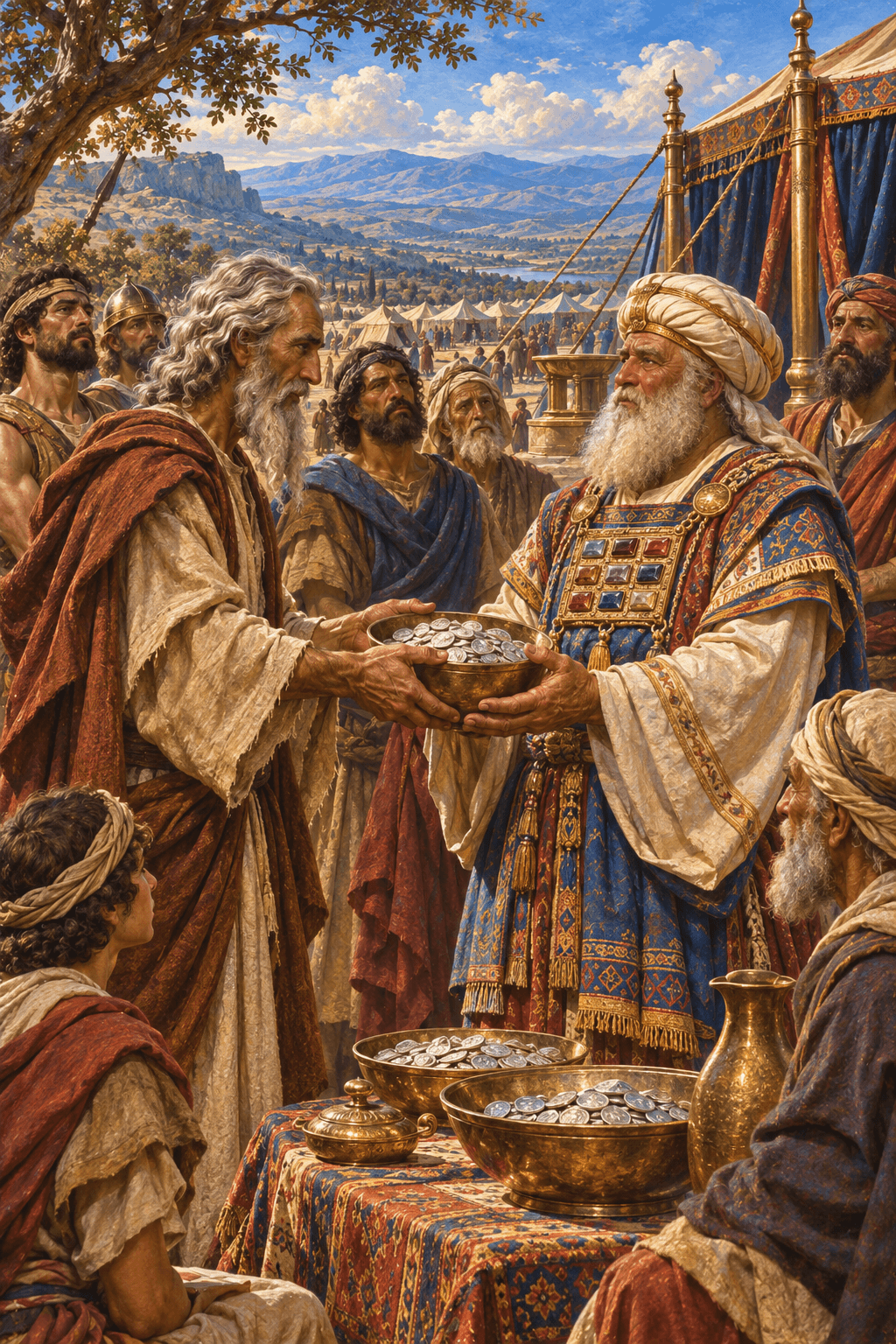
When the firstborn of the people were numbered, their number was found to be 22,273, that is, 273 more than the Levites who were numbered. So they were bound to offer five shekels as a ransom for each person, given to Aaron and his sons.
Most likely this number of firstborn, 22,273, represents the firstborn who were born after the Exodus. The excess, “273,” points to the nine months in which the child dwells in its mother’s womb (9 × 30 = 270), with 3 days added, the symbol of the resurrection from the dead, as we saw in our commentary on the Book of Exodus. [21] It is as though these redeemed ones are the multitude of mankind who came into the world after being formed in the womb and enjoyed the resurrection with Christ the Lord, that is, they are born bodily and born spiritually. Origen [22] holds that the number 273 is the sum of 270 plus 3, saying that the child remains in the womb nine months and is usually born on the third day of the tenth month.
The five shekels paid as a ransom point to the sanctification of all five senses, so that all may become wise virgins who enter with the Bridegroom into eternal joy (Matthew 25).
Notes and References
[17] Origen, Homilies on Numbers 3.1.
[18] See our commentary on the Book of Exodus, chapter 13.
[19] Origen, Homilies on Numbers 3.
[20] Ibid.
[21] See the author’s The Book of Exodus, 1981.
[22] Origen, Homilies on Numbers 4.