
If leprosy points to uncleanness and sin, the law of purification came to examine carefully the leper or one suspected of it, and the priest was not to give his judgment hastily, lest anyone be harmed. Now, if someone has been healed of leprosy, the matter needs a long rite and long, strict procedures, so that the priest may make sure of his cleansing and be able to bring him into the holy congregation anew. For sin, however small it seems, deprives a person of his membership in the holy congregation, and his return requires a cost of this magnitude, which the only Son offered to His Father on the cross. As Saint Justin Martyr says:
Let leprosy be understood as a symbol of sin, and the things slain as a symbol of Him who was slain for us. [180]
1. The Rite of Cleansing on the First Day
KJV · Verses 1–8
1 And the Lord spake unto Moses, saying, 2 This shall be the law of the leper in the day of his cleansing: He shall be brought unto the priest: 3 And the priest shall go forth out of the camp; and the priest shall look, and, behold, if the plague of leprosy be healed in the leper; 4 Then shall the priest command to take for him that is to be cleansed two birds alive and clean, and cedar wood, and scarlet, and hyssop: 5 And the priest shall command that one of the birds be killed in an earthen vessel over running water: 6 As for the living bird, he shall take it, and the cedar wood, and the scarlet, and the hyssop, and shall dip them and the living bird in the blood of the bird that was killed over the running water: 7 And he shall sprinkle upon him that is to be cleansed from the leprosy seven times, and shall pronounce him clean, and shall let the living bird loose into the open field. 8 And he that is to be cleansed shall wash his clothes, and shave off all his hair, and wash himself in water, that he may be clean: and after that he shall come into the camp, and shall tarry abroad out of his tent seven days.
He Shall Be Brought unto the Priest
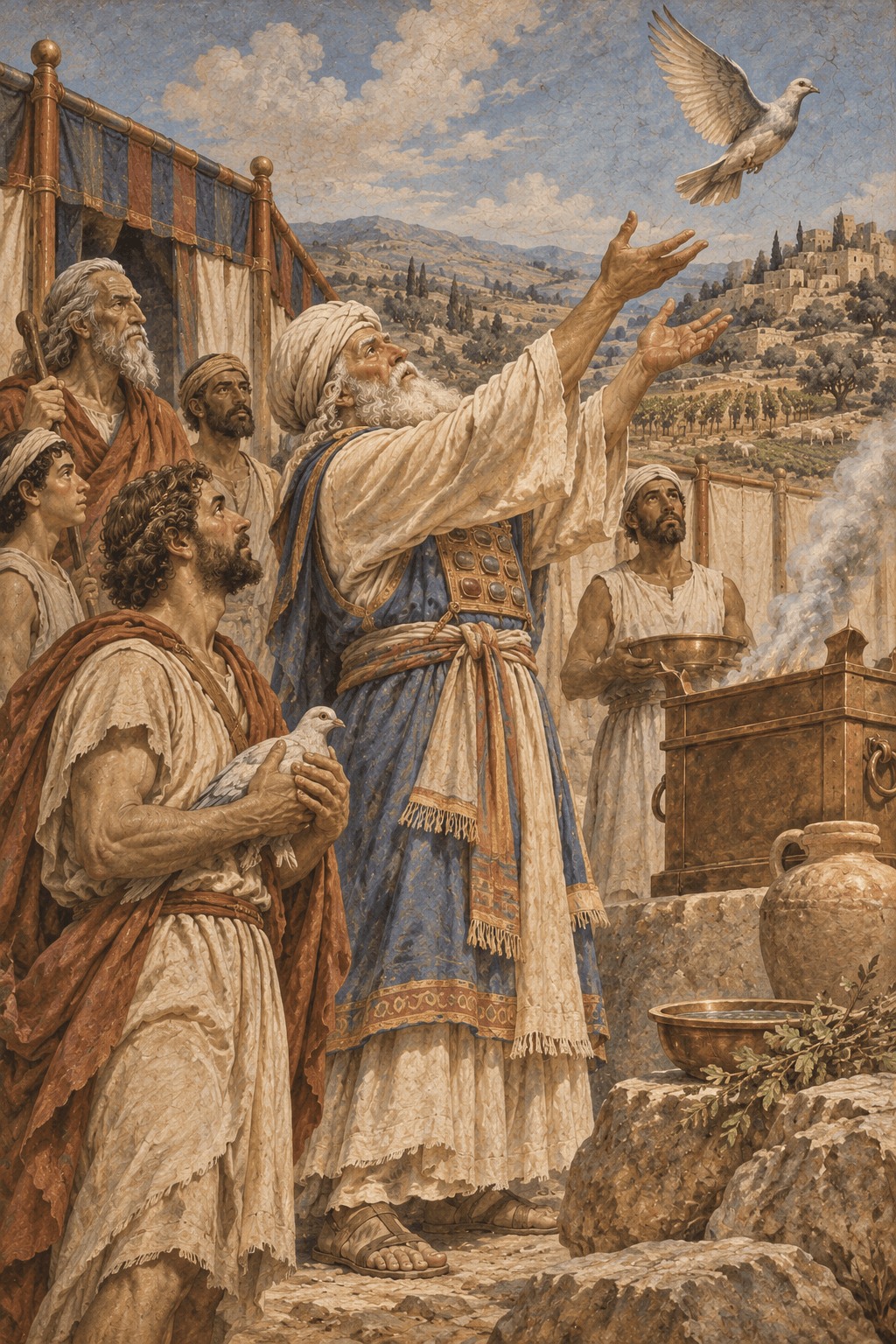
He did not say “he shall come to the priest,” but “he shall be brought unto the priest” (2). The leper who has been cleansed cannot come to the priest directly at the time he wants; one of his relatives or acquaintances informs the priest of his case… Perhaps this points to the role of the Church in bringing every soul to the great High Priest, our Lord Jesus Christ. If our relationship with the Father is in His Son, who lifts us to the Father’s embrace and lets us enjoy the fellowship of His eternal glories, this only begotten Son is the Christ of the Church, her Head, and her Bridegroom. We know Him in a personal, inner, and deep relationship through our awareness of our membership in the Church, His holy body. We cannot know Christ as individuals isolated from the holy congregation, but as members of this congregation, interacting with it even in our hidden closet; and the congregation works in us and presents us to her Bridegroom, the Saviour of the world.
The leper who enjoys the rite of cleansing when he is brought to the priest is the paralytic whom the Church, represented by the four men, carried to the Lord Christ. The bishop, the priest, the deacon, and the people carry him, so that all present him to the Saviour; and we hear the Evangelist say: “And Jesus seeing their faith said unto the sick of the palsy; Son, be of good cheer; thy sins be forgiven thee” (Matthew 9:2). He enjoys the forgiveness of sins and release from the bonds of the palsy, or the cleansing of leprosy, as a personal gift given him by the One who loves him, through His Church, which carries him by her prayers and presents him to Him in love. So Saint Cyprian says:
Whoever remains outside the Church is outside the camp of Christ. [181]
He cannot have God for his Father who has not the Church for his mother. [182]
The Priest Goes Forth to Him
If the Church, in love and faith, carries the leper to her heavenly Priest to be cleansed of his sins, she cannot bring the leper into the camp; the priest goes out to him to bring him with himself into the camp. In other words, if in love we long for every soul to enter spiritual membership in the Church, or the new life that became ours in the Lord on a heavenly level, this work is in truth the very work of our Lord Jesus Himself, who goes forth to the soul to raise it from its death through the waters of baptism by His Holy Spirit, a holy member in His body. As Origen says:
Since the leper cannot enter the camp, He who is able to go outside the camp goes out to him, declaring: “I came forth from the Father, and am come into the world” (John 16:28). [183]
I say truly, how much every priest needs to be hidden in the great heavenly High Priest, our Lord Jesus, so that, as he presents the soul to Him, our Lord Himself may go forth into the depths of this soul’s heart, go out to it to bring it into His resurrection, let it enjoy His life, and give it His glories. Let us as human beings be hidden in Him who alone can draw the soul by His Holy Spirit, wash it, and sanctify it for Himself!
The Two Birds
“Then shall the priest command to take for him that is to be cleansed two birds alive and clean, and cedar wood, and scarlet, and hyssop” (4).
At the declaration of a leper’s cleansing two living, clean sparrows or birds were offered for him, with a piece of cedar wood about a foot and a half long and of medium thickness, and a piece of woollen cloth dyed scarlet, with a bunch of the hyssop plant. Perhaps the two birds here play the same role as the two goats in the rite of the great Day of Atonement (Leviticus 16), when one is slain and the other let go alive into the wilderness, pointing to the Lord Christ, who on the one hand was slain on the cross for our sins, and on the other went forth into the wilderness of our life risen from the dead, to raise us with Him and bring us into the embrace of His heavenly Father. So in the cleansing of the leper one bird is killed in an earthen vessel over running water (5), pointing to the slaying of the Lord Christ, who bore our humanity as an earthen vessel, giving us in it His precious blood and the water that flowed from His side for our cleansing. The other, living bird, dipped in the blood of the slain bird (6) and let loose alive into the open field (7), points to the Lord Christ risen from the dead, carrying for us His holy blood to make atonement for us.
Saint Justin Martyr speaks of these two birds:
He is likened to a bird because He is understood to be from above, from heaven. The living bird is dipped in the blood of the dead one and let go, because the living Word of God was crucified and died in the temple (of the body), as one who suffers, though God does not suffer. [184]
The Cedar Wood
If the leprosy of sin corrupts man and destroys his life completely, offering cedar wood, which does not rot, points to our union with the wood of the cross, which removes our corruption from us eternally, so that no evil strikes us, but in God’s eyes we become like a tree planted by the rivers of the waters of the Holy Spirit, whose leaf does not wither. Origen says:
Without the wood of the cross it is impossible to be cleansed of the leprosy of sin; so we resort to the wood of the Saviour, of which the Apostle says: “And having spoiled principalities and powers, he made a shew of them openly, triumphing over them in it” (Colossians 2:15). [185]
And Saint John Chrysostom says:
The cross renewed the world and guided it, drove out error and restored the truth, made earth heaven and men angels. Through it the demons are no longer fearful, but trifling and despised; through it death is no longer death but sleep, for he who fights against us has been cast down under our feet. [186]
The Scarlet and the Hyssop
Origen says:
The scarlet is the image of the holy blood that gushed from His side at the piercing of the spear (John 19:34)… and it is the helper in salvation, as is found in the divine books when Tamar gave birth: “And it came to pass, when she travailed, that the one put out his hand: and the midwife took and bound upon his hand a scarlet thread, saying, This came out first” (Genesis 38:28); and also when Rahab the harlot received the spies and took the promise from them (Joshua 2:18). [187]
Origen has another interpretation of the scarlet. Besides its scarlet color, which points to the blood, it is used in dyeing cloth to change its color, so that the cloth takes a new color other than its original one. This points to the fire, which bears two marks, as though two colors: on the one hand it gives light, and on the other it burns. So the Lord Christ came to cast fire on the earth (Luke 12:49); by this fire He lights every man that comes into the world (John 1:9), and sets our hearts burning when He opens the Scriptures before us, for it is the fire of enlightenment and of inner burning. [188]
We have already spoken of the scarlet and the hyssop in more than one place. [189] We mention here what Saint John Chrysostom said about our being washed and sprinkled with the spiritual, not material, scarlet and hyssop:
These were not sprinkled with scarlet wool or with hyssop. Why? Because the washing here is not bodily, but spiritual, and the blood was spiritual. How? It did not flow from the body of irrational animals, but from a body prepared by the (Holy) Spirit. With this blood not Moses but Christ sprinkled us, through the word that was spoken: “This is my blood of the new testament… for the remission of sins.” This word, instead of the hyssop, was dipped in the blood and sprinkled us all. There the washing of the body was outward, because the cleansing was bodily; but here the cleansing is spiritual: it enters into the soul and washes it… There the sprinkling was done on the surface only, and the one sprinkled washed off the traces of the blood… But with the soul it is not so, for the blood mingles with its being, making it vigorous and pure, and leading it to the very beauty that is unapproachable. [190]
Saint Augustine gives us a comment on the hyssop:
Hyssop, as we know, is a lowly herb, but it is used for healing. It is said that its root clings to the rock; so it symbolizes the cleansing of the heart. Let the root of your love hold fast to your Rock (the Lord Christ), and be humble like your God, that you may be glorified in your glorified God. You are sprinkled with hyssop when the humility of Christ washes you. Do not despise this herb, but remember its medicinal effect… We are used to hearing from physicians that hyssop is used to treat the sick, to cleanse the lungs. If the swelling of the lung carries pride, for a person breathes out pride, as was said of Saul the persecutor that he was proud, going to bind the Christians and “breathing out threatenings” (Acts 9:1). He was breathing out slaughter, that is, breathing out blood, for his lungs were not clean. [191]
Let us then have the roots of the hyssop that cling to the Rock, so that the enemy does not overcome us despite our weakness as a poor and lowly herb; and let us be washed with hyssop and use it to cleanse our breasts of all pride and haughtiness, bearing within us the humility of our Lord Jesus, so that we too may be glorified with Him.
The Running Water
“And the priest shall command that one of the birds be killed in an earthen vessel over running water” (5).
The Lord Christ took our nature in order to dwell among us, offering His blood as an atonement for our sins. He is like the bird slain in an earthen vessel, that is, He dies for us in the body, and pours out living water.
Running (living) water is water taken from a flowing river or a used, not stagnant, spring. This living water is joined to the blood as the mystery of cleansing. As Origen says:
The water is taken for cleansing and for fulfilling the mysteries by the water and the blood that flow from the Saviour’s side (John 19:34), as John affirms in his epistle that the cleansing is prepared in the water, the blood, and the Spirit (1 John 5:6, 8). [192]
Sprinkling the One to Be Cleansed with Blood and Water
“And he shall sprinkle upon him that is to be cleansed from the leprosy seven times, and shall pronounce him clean, and shall let the living bird loose into the open field” (7).
If we are cleansed by the blood and the water, they must be sprinkled on the sinner seven times for him to be cleansed, that is, he remains enjoying their work all the days of his life (the number seven points to the seven days of the week). It is as if the cleansing, though it begins in the waters of baptism, remains a continual, unbroken work.
Saint Jerome says:
When you came to the priest, rend your garments completely; what seemed sound when covered appeared leprous when uncovered. The priest made you look at your sins and see your leprosy, and brought you back to the congregation of God through the blood and the water: through the blood, that is, the passion of Christ, and the water, that is, baptism. And as you are healed, the word is fulfilled in you: “Purge me with hyssop, and I shall be clean: wash me, and I shall be whiter than snow” (Psalm 51:7). You are still in Egypt (symbolically) to this day as long as you have not come to the blood and the water; so you will not be saved! Do you want to be saved from the destroying angel in Egypt? Take some hyssop, dip it in the blood, and sprinkle it on the posts of your door; and when the destroyer sees the blood on your forehead, he will not touch you. [193]
Washing His Clothes
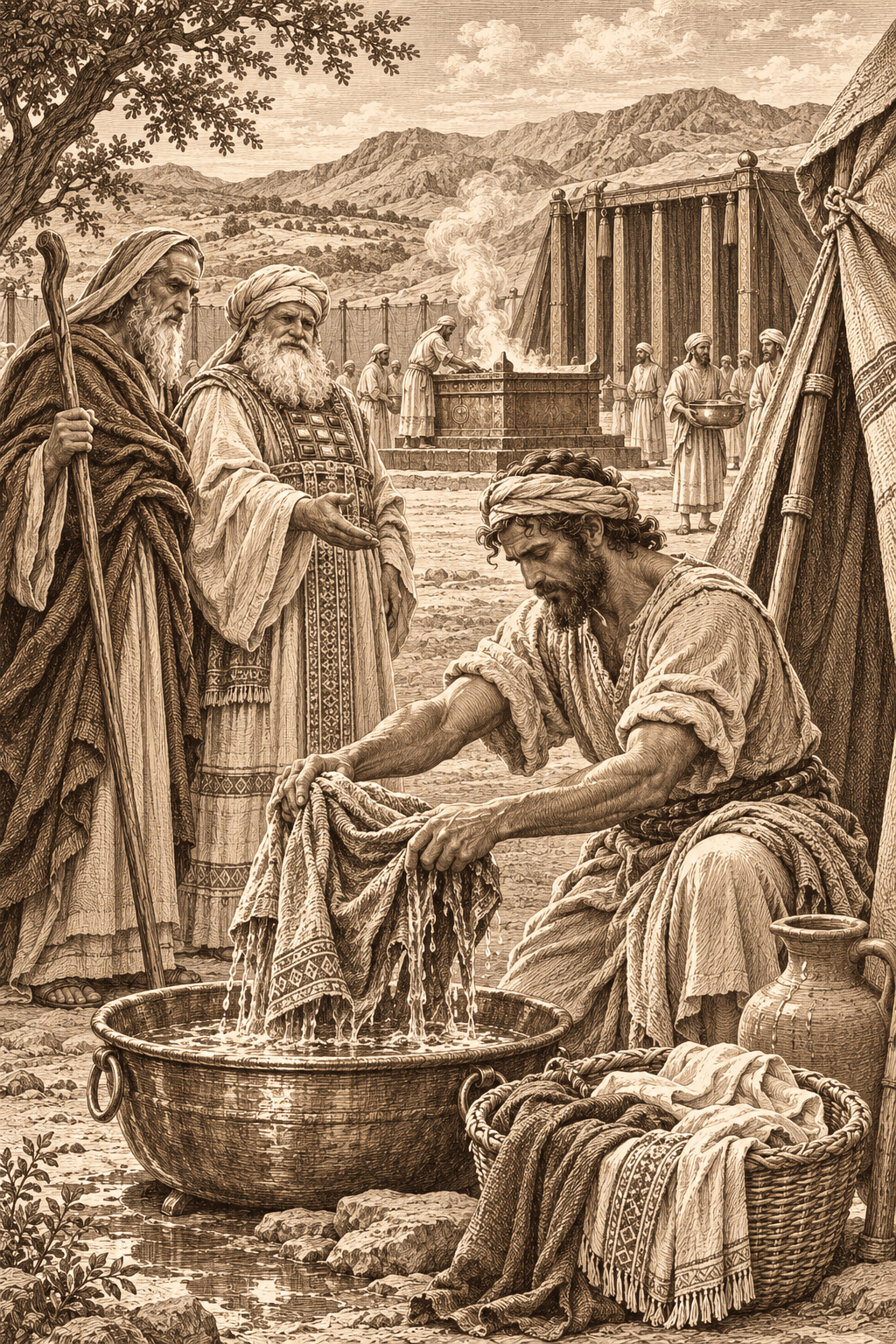
No doubt the leper took off his rent clothes (Leviticus 13:45) before meeting the priest. Now, having been sprinkled with the blood and the water several times, there is no need to change his clothes; it is enough to wash them. We exchange our old man once in the waters of baptism; but having put it off, we need nothing more than to wash the garment with the tears of repentance. As the Lord Christ said to Saint Peter when he wanted to be washed: “He that is washed needeth not save to wash his feet, but is clean every whit” (John 13:10).
If the clothes point to the body with all its senses, feelings, and longings, God does not want to destroy the body or wipe out its senses and abilities, but asks that they be washed and sanctified for His kingdom. The body is not an enemy to the believer as long as it is subject to the Spirit of the Lord, but is an instrument of righteousness working for God (Romans 6:13), “a living sacrifice, holy, acceptable unto God” (Romans 12:1).
The Law asked the leper at his cleansing to wash his clothes and also to wash himself (9). As Origen says:
In truth every defilement and every filth must be removed not only from his clothes but also from his body, so that no traces remain in him of the leprosy that has left him. [194]
Shaving His Hair
Origen distinguishes between the hair of the sinner and the hair of the righteous. The sinner’s hair points to the dead works that spring from the evil lusts of his flesh, for it is without spirit and without blood; [195] so at his cleansing he must shave it, declaring that he abandons everything that springs from his evil past, thoughts, words, and deeds, which are dead sins. But the righteous bears spiritual wisdom as hair springing from his sanctified body; so no razor should come upon the head of the Nazarite (Numbers 6:5; 1 Samuel 1:11), and it is said of him: “His leaf also shall not wither; and whatsoever he doeth shall prosper” (Psalm 1:3), and as the Lord Christ said to His disciples: “the very hairs of your head are all numbered” (Matthew 10:30). “This means that all their works, words, and thoughts are kept before the Lord, for they are righteous and holy; but the sinners, on the contrary, must have all their works, words, and thoughts removed. This is what He meant by saying that he shall shave off all his hair and be clean.” [196]
Abiding outside His Tent
“And after that he shall come into the camp, and shall tarry abroad out of his tent seven days” (8).
After completing all the previous rites of cleansing with blood and water, washing his clothes, shaving his hair, and washing himself, he enters the camp but stays seven days outside his tent. If the tent points to his body (2 Corinthians 5:1, 4), then when we enjoy salvation and are washed in the blood of our Lord Jesus Christ, and put away our evil works, words, and thoughts like hair we shave, we enter the camp, that is, we are counted members of the body of Christ, the holy Church of God and His camp; yet we remain outside our tent, that is, we live as those above the demands of the body. All the days of our sojourn we feel ourselves strangers even to our body, until the eighth day comes, the great day of the Lord, when we enjoy entering a spiritual, heavenly body suited to the new life. As the Apostle Paul says: “It is sown a natural body; it is raised a spiritual body… And as we have borne the image of the earthy, we shall also bear the image of the heavenly” (1 Corinthians 15:44, 49).
2. The Rite of Cleansing on the Seventh Day
KJV · Verses 9
9 But it shall be on the seventh day, that he shall shave all his hair off his head and his beard and his eyebrows, even all his hair he shall shave off: and he shall wash his clothes, also he shall wash his flesh in water, and he shall be clean.
On the first day of his cleansing he had already shaved all his hair, washed his clothes, and washed himself; now on the seventh day he repeats the same work. Why?
A) Perhaps what happened on the first day points to what the believer enjoys at the beginning of his membership in the Church, when he entered the waters of baptism, received sonship to God, and became clean in God’s eyes. What happens on the seventh day points to his need to renew the work of baptism, not by repeating it but by continual repentance, as long as he is in the body, subject to time. A person remains all the time of his life, until the seventh day, that is, until its end, struggling without ceasing to renew the covenant he made with God in the waters of baptism by the Holy Spirit. In the Church’s eyes, baptism is the beginning of life and not its end, the beginning of struggle in the Lord and not its end. As Saint Gregory of Nyssa says: “He who receives the laver of regeneration is like a young soldier given a place among the wrestlers, but he has not yet proved himself worthy of the service.” [197] And Saint Mark the Ascetic says: “Holy baptism is a perfect work and gives us perfection, but it does not perfect a man who neglects to carry out the commandments.” [198] And Saint Jacob of Serugh says: “You who are baptized in the waters and have become brothers of the only Son, do not insult Him by your carnal works. Do not mingle with the harlot instead of Him. Purify your souls of faults, that you may mingle with His Father.” [199]
B) Perhaps the rite practiced on the seventh day points to putting off what is temporal all the days of our sojourn until the last breath, that is, until the seventh day; so that when the eighth day comes, the great day of the Lord, or our entry into paradise, there is no trace in us of anything temporal, earthly, or carnal, but all in us appears new.
C) Origen sees in shaving the hair of the head a symbol of removing every thought in us contrary to the faith of the Church concerning the Head, Jesus Christ, so that there is no thought in us foreign to the divine teaching of the Church. Shaving the beard points to the renewal of a person’s youth, the return to the life of childhood, so that the believer lives by the Holy Spirit in an unceasing spiritual renewal and a youth that no old age of weakness touches. Shaving the eyebrows points to removing the spirit of pride by the humility and meekness of the Lord Christ, so that we do not have the haughty brow.
3. The Rite of Cleansing on the Eighth Day
KJV · Verses 10–20
10 And on the eighth day he shall take two he lambs without blemish, and one ewe lamb of the first year without blemish, and three tenth deals of fine flour for a meat offering, mingled with oil, and one log of oil. 11 And the priest that maketh him clean shall present the man that is to be made clean, and those things, before the Lord, at the door of the tabernacle of the congregation: 12 And the priest shall take one he lamb, and offer him for a trespass offering, and the log of oil, and wave them for a wave offering before the Lord: 13 And he shall slay the lamb in the place where he shall kill the sin offering and the burnt offering, in the holy place: for as the sin offering is the priest's, so is the trespass offering: it is most holy: 14 And the priest shall take some of the blood of the trespass offering, and the priest shall put it upon the tip of the right ear of him that is to be cleansed, and upon the thumb of his right hand, and upon the great toe of his right foot: 15 And the priest shall take some of the log of oil, and pour it into the palm of his own left hand: 16 And the priest shall dip his right finger in the oil that is in his left hand, and shall sprinkle of the oil with his finger seven times before the Lord: 17 And of the rest of the oil that is in his hand shall the priest put upon the tip of the right ear of him that is to be cleansed, and upon the thumb of his right hand, and upon the great toe of his right foot, upon the blood of the trespass offering: 18 And the remnant of the oil that is in the priest's hand he shall pour upon the head of him that is to be cleansed: and the priest shall make an atonement for him before the Lord. 19 And the priest shall offer the sin offering, and make an atonement for him that is to be cleansed from his uncleanness; and afterward he shall kill the burnt offering: 20 And the priest shall offer the burnt offering and the meat offering upon the altar: and the priest shall make an atonement for him, and he shall be clean.
“And on the eighth day he shall take two he lambs without blemish, and one ewe lamb of the first year without blemish, and three tenth deals of fine flour for a meat offering, mingled with oil, and one log of oil” (10).
On the eighth day the cleansing is completed; on it circumcision was fulfilled (the eighth day after the birth of a male child). And on the eighth day, the first of the new week, the Lord Christ rose from the dead, giving us His righteousness…
For the first time the cleansed leper does a work himself, for he “shall take two he lambs…” and offers these sacrifices to the priests; in the previous days others did the work. It is as if the believer, when through the spiritual cleansing he enjoys membership in the Church, must enter into the positive work of building up, through his enjoyment of the Lord’s resurrection and the new, risen life (on the eighth day).
The sacrifices and offerings are five:
A) A he lamb without blemish offered as a trespass offering, with which the priest makes atonement for his sins… This is the beginning of the work: confessing our trespasses and believing in the Crucified as the forgiver of trespass.
B) A ewe lamb of the first year as a sin offering. Choosing a female points to the work of bearing: it is not enough for a person to believe that his sins are taken away; he must believe in God, the Giver of fruit. Offering the ewe here, as Origen says, means that the soul “gives birth to good works and is rich in the fruit of righteousness.” [200]
C) Another he lamb without blemish, which the priest offers as a burnt offering, the Father’s delight. The believer, enjoying the cross, sees not only the forgiveness of his trespasses and sins, but is united with the Crucified to offer his life as a burnt offering to God. In the trespass and sin offerings he declares his rejection of sin and trespass and his longing for good works; in the burnt offering he declares his practice of virtue in the Lord, that is, he goes forth in love to the positive side. For the poor man it was enough to offer a lamb as a trespass offering, with two turtledoves or two young pigeons for the sin and burnt offerings (21–22).
D) Three tenth deals of fine flour mingled with oil. As Origen says: “From this is understood the impossibility of cleansing outside the mystery of the Trinity.” [201] If we saw in the offering of flour (chapter 2) a reference to the person of the Lord Christ, as the Church’s offering to the Father and at the same time the Father’s gift to the Church, for He gives her the life of His Son as a gift, and we enjoy His body and blood given for us as the mystery of her abiding in Him and her enjoyment of eternal life, then the number 3 points to our accepting faith in the Holy Trinity, whom we come to know through our grasp of the mystery of the incarnation of the Word and His crucifixion. Its being mingled with oil means that no one can accept the mystery of the Trinity, nor say of Christ that He is Lord, except by the oil of the Holy Spirit. Perhaps the number 3 also points to the resurrection with Christ; as we are cleansed, we offer the meat offering through the Lord’s resurrection, to accept also the Lord risen from the dead as the source of true spiritual fullness.
E) A log of oil, to anoint the sick person and pour upon him; for our cleansing is fulfilled through the sacrifice of the cross by the work of the Holy Spirit, with whom we were anointed in the sacrament of the holy chrism. The log is a measure for liquids holding about a third of a liter, and the oil was pure olive oil.
When the one to be cleansed brings these sacrifices and offerings to the priest, the priest does the following:
A) The priest and the cleansed leper stand before the Lord at the door of the tabernacle of the congregation, for the Lord Christ, the great High Priest, comes forward as the Door by which we enter the tabernacle of the congregation; that is, through Him we enjoy membership in the Church, or membership in His holy body. The Jewish teachers hold that the priest stands at the door of the tabernacle on the inside, while the cleansed leper stands outside the door.
B) Two priests take part in the rite together. As the one to be cleansed stands before the trespass offering, lays his hand on it, and kills it, two priests receive the blood: one receives it in a vessel to take it to the altar and sprinkle it on the side of the altar; the second receives the blood in his hand to stand before the cleansed leper, [202] and puts some of it upon the tip of his right ear, upon the thumb of his right hand, and upon the great toe of his right foot (14). Origen says:
The final cleansing contains the purifying of the ear, so that the sense of hearing may be clean and pure; and so the right hand, that our works may be clean, not mixed with defilement or wrinkle; and our feet must be clean, to walk toward good works alone and be led to them, and not go after youthful sins. [203]
As we come forward to our great High Priest, may we see Him stretch out His holy hand to anoint all our senses and the members of our body with His Holy Spirit through the sacrament of the holy chrism, so that we may always have the holy ear that hears His voice and responds to His commandment, the pure hand lifted up as an evening sacrifice and working for His kingdom, and the upright foot that goes toward heaven without hindrance until we settle there.
Rabbi Judah [204] holds that the priest put the blood on the three places (the ear, the thumb, and the great toe) at the same time, and that if the leper had lost one of these members he could not be cleansed.
C) The priest takes some of the log of oil and pours it into the palm of his own left hand, and sprinkles of it seven times before the Lord, toward the Holy of Holies. Of the rest of the oil in his hand the priest puts upon the tip of the right ear of the one to be cleansed, upon the thumb of his right hand, and upon the great toe of his right foot, upon the blood of the trespass offering, that is, he puts the oil on the same place he put the blood. The remnant of the oil in his hand he pours upon the head of the one to be cleansed, and the priest makes atonement for him before the Lord (15–18).
This oil points to the Holy Spirit, whom the Lord Christ gives His Church from His Father so that she may sprinkle Him on her children to sanctify them. So Origen calls it “the gift of the grace of the Holy Spirit.” The matter does not stop at cleansing from sin by blood and water; one must enjoy being filled with the Holy Spirit, by whom the believer enjoys the best robe and the ring of sonship (Luke 15:22), and enjoys reconciliation with the Father and abiding in sonship to Him. [205]
D) The priest offers the sin offering and makes atonement for the one to be cleansed from his uncleanness, then kills the burnt offering… So the cleansing of the leper is accomplished through “the Spirit, and the water, and the blood,” as the Apostle says: “And there are three that bear witness in earth, the Spirit, and the water, and the blood: and these three agree in one” (1 John 5:8).
4. The Rite of Cleansing for the Poor
KJV · Verses 21–32
21 And if he be poor, and cannot get so much; then he shall take one lamb for a trespass offering to be waved, to make an atonement for him, and one tenth deal of fine flour mingled with oil for a meat offering, and a log of oil; 22 And two turtledoves, or two young pigeons, such as he is able to get; and the one shall be a sin offering, and the other a burnt offering. 23 And he shall bring them on the eighth day for his cleansing unto the priest, unto the door of the tabernacle of the congregation, before the Lord. 24 And the priest shall take the lamb of the trespass offering, and the log of oil, and the priest shall wave them for a wave offering before the Lord: 25 And he shall kill the lamb of the trespass offering, and the priest shall take some of the blood of the trespass offering, and put it upon the tip of the right ear of him that is to be cleansed, and upon the thumb of his right hand, and upon the great toe of his right foot: 26 And the priest shall pour of the oil into the palm of his own left hand: 27 And the priest shall sprinkle with his right finger some of the oil that is in his left hand seven times before the Lord: 28 And the priest shall put of the oil that is in his hand upon the tip of the right ear of him that is to be cleansed, and upon the thumb of his right hand, and upon the great toe of his right foot, upon the place of the blood of the trespass offering: 29 And the rest of the oil that is in the priest's hand he shall put upon the head of him that is to be cleansed, to make an atonement for him before the Lord. 30 And he shall offer the one of the turtledoves, or of the young pigeons, such as he can get; 31 Even such as he is able to get, the one for a sin offering, and the other for a burnt offering, with the meat offering: and the priest shall make an atonement for him that is to be cleansed before the Lord. 32 This is the law of him in whom is the plague of leprosy, whose hand is not able to get that which pertaineth to his cleansing.
The rite is practiced with full exactness for the poor man as for the rich, carrying the same meanings, for the cleansing of the soul in God’s eyes does not differ whether it is the soul of a rich man or a poor man. But the poor man offers sacrifices and offerings that do not burden him: one lamb as a trespass offering, two turtledoves or two young pigeons as the sin and burnt offerings, one tenth deal of fine flour mingled with oil, and a log of oil.
God accepts these humble offerings, giving the poor man the same gift He grants the rich without distinction; for God seeks the heart and the inner fruit, not the giving in itself.
5. The Leprosy of Houses
KJV · Verses 33–57
33 And the Lord spake unto Moses and unto Aaron, saying, 34 When ye be come into the land of Canaan, which I give to you for a possession, and I put the plague of leprosy in a house of the land of your possession; 35 And he that owneth the house shall come and tell the priest, saying, It seemeth to me there is as it were a plague in the house: 36 Then the priest shall command that they empty the house, before the priest go into it to see the plague, that all that is in the house be not made unclean: and afterward the priest shall go in to see the house: 37 And he shall look on the plague, and, behold, if the plague be in the walls of the house with hollow strakes, greenish or reddish, which in sight are lower than the wall; 38 Then the priest shall go out of the house to the door of the house, and shut up the house seven days: 39 And the priest shall come again the seventh day, and shall look: and, behold, if the plague be spread in the walls of the house; 40 Then the priest shall command that they take away the stones in which the plague is, and they shall cast them into an unclean place without the city: 41 And he shall cause the house to be scraped within round about, and they shall pour out the dust that they scrape off without the city into an unclean place: 42 And they shall take other stones, and put them in the place of those stones; and he shall take other morter, and shall plaister the house. 43 And if the plague come again, and break out in the house, after that he hath taken away the stones, and after he hath scraped the house, and after it is plaistered; 44 Then the priest shall come and look, and, behold, if the plague be spread in the house, it is a fretting leprosy in the house; it is unclean. 45 And he shall break down the house, the stones of it, and the timber thereof, and all the morter of the house; and he shall carry them forth out of the city into an unclean place. 46 Moreover he that goeth into the house all the while that it is shut up shall be unclean until the even. 47 And he that lieth in the house shall wash his clothes; and he that eateth in the house shall wash his clothes. 48 And if the priest shall come in, and look upon it, and, behold, the plague hath not spread in the house, after the house was plaistered: then the priest shall pronounce the house clean, because the plague is healed. 49 And he shall take to cleanse the house two birds, and cedar wood, and scarlet, and hyssop: 50 And he shall kill the one of the birds in an earthen vessel over running water: 51 And he shall take the cedar wood, and the hyssop, and the scarlet, and the living bird, and dip them in the blood of the slain bird, and in the running water, and sprinkle the house seven times: 52 And he shall cleanse the house with the blood of the bird, and with the running water, and with the living bird, and with the cedar wood, and with the hyssop, and with the scarlet: 53 But he shall let go the living bird out of the city into the open fields, and make an atonement for the house: and it shall be clean. 54 This is the law for all manner of plague of leprosy, and scall, 55 And for the leprosy of a garment, and of a house, 56 And for a rising, and for a scab, and for a bright spot: 57 To teach when it is unclean, and when it is clean: this is the law of leprosy.
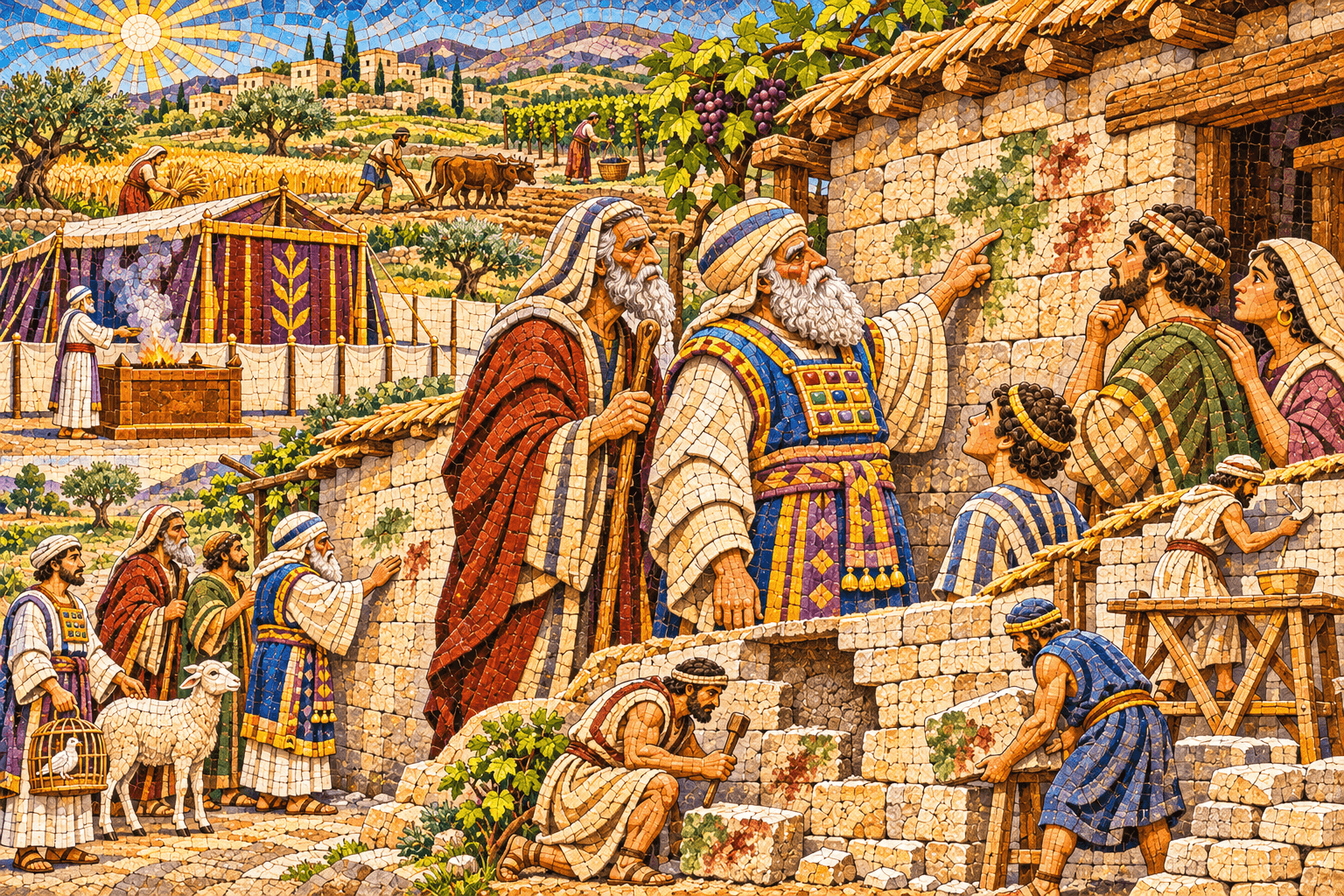
God gave the Jews the law concerning the leprosy of houses while they were still in the wilderness dwelling in tents, declaring His care even for their houses, which they had not yet dwelt in. If God commands us not to be anxious for the morrow, it is to declare His own care for our morrow.
Here the priest plays the role of the engineer, in a primitive age for the Jews, to make sure of the people’s houses so that their lives are not exposed to danger. If a person saw in his house traces of damp or seepage on the walls, inclining to red or green, or areas lower than the wall, that is, eaten away, the priest intervened as follows:
A) The house was emptied of everything in it before the priest went in (36).
B) The priest looked at the signs, went out of the house, and shut it up seven days.
C) If he saw that the plague had spread, he commanded that the infected stones be taken out and cast outside the city into an unclean place, where there was filth, carcasses of animals, and so on. Then they scraped around the plague and cast the dust of the plaster also outside the city into an unclean place.
D) They restored it and put on new plaster. If the plague came again and broke out after the restoration, the whole house was broken down.
E) If the plague had not spread, it was counted healed, and the cleansing was done with two birds, cedar wood, scarlet, and hyssop, as in the case of the leper…
Notice in this rite that the priest did not hasten to judge, so that no one would lose his house except after making sure of the seriousness of the situation… Perhaps in this is a symbol of God’s longsuffering with us, His dwelling. He does not quickly sentence us to be broken down but gives us opportunities for repentance, like the gardener who intercedes for the tree and gives it time, year after year, digging about it and dunging it, that it may bear fruit and not be cut down (Luke 13:6–9).
Notes and References
[180] Ante-Nicene Fathers, vol. 1, p. 301.
[181] St. Cyprian, Ep. 40, to Cornelius.
[182] St. Cyprian, On the Unity of the Church 6.
[183] Origen, In Lev. hom. 8:10.
[184] Ante-Nicene Fathers, vol. 1, p. 301.
[185] Origen, In Lev. hom. 8:10.
[186] St. John Chrysostom, In Matt. hom. 54:7.
[187] Origen, In Lev. hom. 8:10.
[188] Origen, In Exod. hom. 13:4.
[189] See the author’s commentary on the Book of Joshua.
[190] St. John Chrysostom, In Hebr. hom. 16:5.
[191] St. Augustine, On Ps. 51.
[192] Origen, In Lev. hom. 8:10.
[193] St. Jerome, On Ps., hom. 17.
[194] Origen, In Lev. hom. 8:11.
[195] Origen, In Exod. hom. 13:5.
[196] Origen, In Lev. hom. 8:11.
[197] St. Gregory of Nyssa, PG 46:429C.
[198] The Philokalia (Arabic), p. 90.
[199] St. Jacob of Serugh, Memra on Holy Baptism.
[200] Origen, In Lev. hom. 8:11.
[201] Ibid.
[202] The source leaves this note without a reference.
[203] Origen, In Lev. hom. 8:11.
[204] Edersheim, The Temple, p. 360.
[205] Origen, In Lev. hom. 8:11.