
If God cared for the health of the woman who gives birth and commanded her to rest for a period under care, in the law of the leper He cares for His people so that the infection of disease does not pass among them; He cares even for their clothes, so that the moth does not pass from garment to garment.
The Disease of Leprosy
“Leprosy” in modern medicine is a serious skin disease which in some of its grave stages reaches the wasting away of some of the body’s extremities and the disfigurement of a person, besides its danger of spreading infection quickly. Perhaps what the Old Testament mentions under the name “leprosy” does not mean one particular disease, but everything that can cause infection, not only among people but even among household goods, like the passing of the moth from garment to garment and of the worm from wood to wood, and so on.
One may see a kind of harshness in the ruling on the leper under the Mosaic Law, such as isolating him from the congregation and counting him unclean until he is healed… But we find even in modern societies, despite the surpassing progress medicine has reached in this century, that those with skin diseases are isolated in hospitals or sanatoriums far from the dwellings, and even the physicians fear that the infection will pass to them.
In the mind of the Jews leprosy was bound up with sin, because of the seriousness of the disease for health, the disfigurement of the body, and the speed with which it spreads. So the Lord sometimes used it for discipline, as He did with Miriam the sister of Moses because of her words against her brother (Numbers 12:10), with Gehazi when his heart went after Naaman the Syrian seeking silver and gold and he lied to Elisha the prophet (2 Kings 5:27), and with King Uzziah for usurping the office of the priesthood (2 Chronicles 26:16–21).
Like sin, the Jews, as the other nations, had no means of delivering themselves from leprosy; all felt the need of divine intervention to be saved from it. So healing from it was counted a cleansing, as from uncleanness or the effects of sin, as was said of Naaman the Syrian when he was cleansed of it in the waters of the Jordan (2 Kings 5:10–14), and when the Lord Christ Himself said: “the lepers are cleansed” (Matthew 11:5), and when a leper entreated Him: “Lord, if thou wilt, thou canst make me clean,” and He answered: “I will; be thou clean” (Matthew 8:2–3).
Now we begin to speak of leprosy and some conditions that affect man’s body and his clothes.
1. A Rising, a Scab, or a Bright Spot
KJV · Verses 1–8
1 And the Lord spake unto Moses and Aaron, saying, 2 When a man shall have in the skin of his flesh a rising, a scab, or bright spot, and it be in the skin of his flesh like the plague of leprosy; then he shall be brought unto Aaron the priest, or unto one of his sons the priests: 3 And the priest shall look on the plague in the skin of the flesh: and when the hair in the plague is turned white, and the plague in sight be deeper than the skin of his flesh, it is a plague of leprosy: and the priest shall look on him, and pronounce him unclean. 4 If the bright spot be white in the skin of his flesh, and in sight be not deeper than the skin, and the hair thereof be not turned white; then the priest shall shut up him that hath the plague seven days: 5 And the priest shall look on him the seventh day: and, behold, if the plague in his sight be at a stay, and the plague spread not in the skin; then the priest shall shut him up seven days more: 6 And the priest shall look on him again the seventh day: and, behold, if the plague be somewhat dark, and the plague spread not in the skin, the priest shall pronounce him clean: it is but a scab: and he shall wash his clothes, and be clean. 7 But if the scab spread much abroad in the skin, after that he hath been seen of the priest for his cleansing, he shall be seen of the priest again. 8 And if the priest see that, behold, the scab spreadeth in the skin, then the priest shall pronounce him unclean: it is a leprosy.
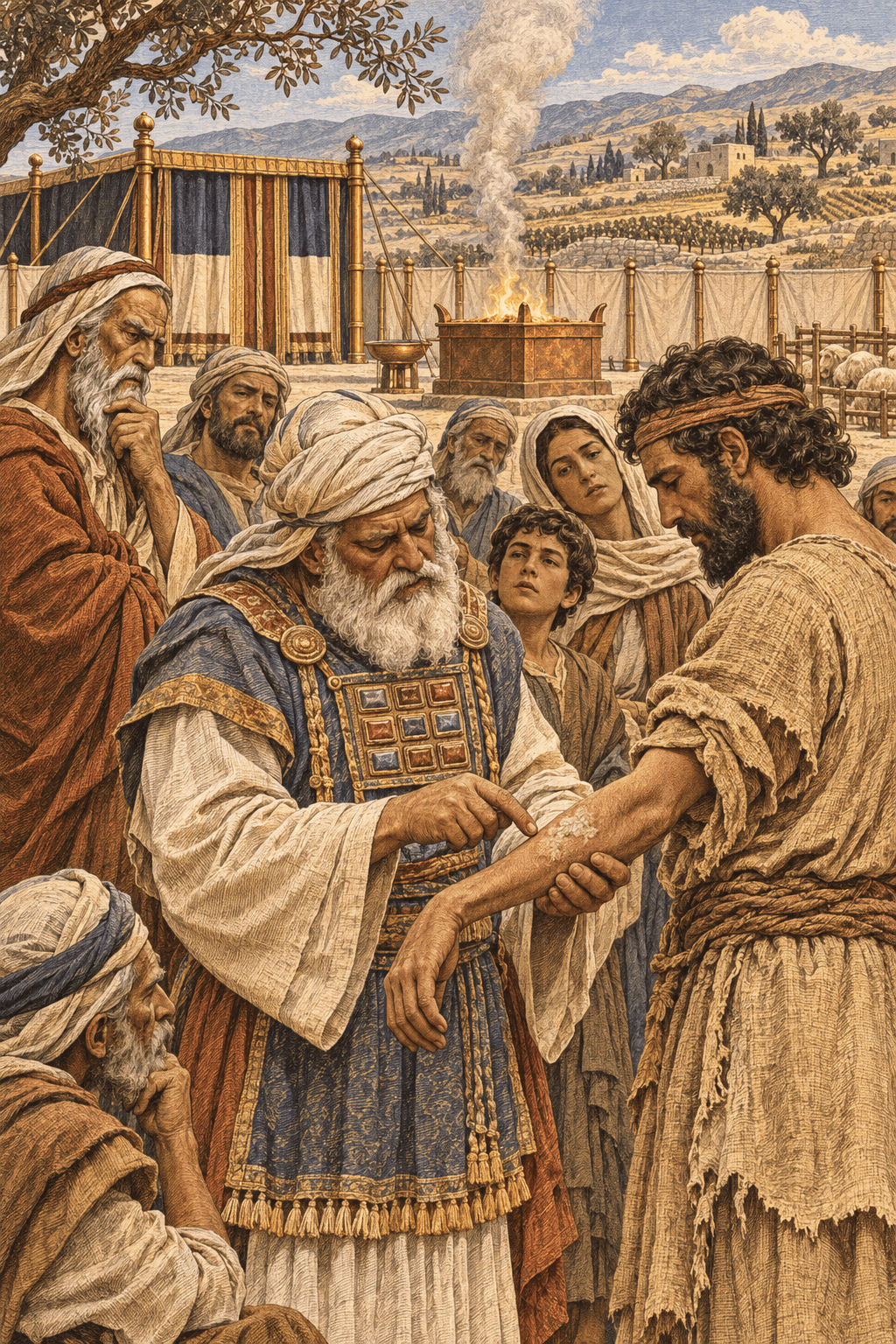
By “a rising” is usually meant here a swelling or tumor; by “a scab,” a red patch on the skin with a crust; and by “a bright spot,” a patch of different color in a person’s skin. Since it was feared that the person might have a skin disease, He distinguished between two cases.
In the first case, if the hair in the plague had turned white and the color of the spot differed from the rest of the body, it was judged “a plague of leprosy” (3), and the person was counted unclean and isolated from the congregation, so as not to infect it.
In the second case, when the plague was a white bright spot in the skin of his flesh, not deeper than the skin in appearance, that is, this part was not lower than the rest of the body, and its hair had not turned white, the person was shut up seven days, and the priest looked on him on the seventh day. If the plague had not spread but stayed, he was shut up seven more days; and if it still had not spread, the priest pronounced him clean, counting it “a scab,” that is, merely a mark of no danger, or merely a crust. Even so, the person washed his clothes because he had been suspected and under examination… a reference to our need to be washed even from the appearance of sin. But if the plague had spread, he was pronounced unclean as bearing a plague of leprosy.
Origen gives a symbolic interpretation of this case:
When a person is struck by a bodily wound, a mark usually remains after the wound heals, called “a rising,” and a person is rarely healed without leaving a mark of the wound. Now, passing from the shadow of the Law to the truth, I consider that a soul wounded by sin, even if healed, shows a rising where the wound was. This rising is seen not by the Lord alone, but also by those who have received the grace of discerning the diseases of the soul, and of distinguishing the souls wholly healed of every kind of painful wound from those still bearing the marks of the old disease as a rising in them. [166]
There are people whose rising reveals that they have an incurable spiritual disease, hard to heal, as the prophet says: “From the sole of the foot even unto the head there is no soundness in it; but wounds, and bruises, and putrifying sores: they have not been closed, neither bound up, neither mollified with ointment” (Isaiah 1:6). And as Jeremiah the prophet says: “For thus saith the LORD, Thy bruise is incurable, and thy wound is grievous. There is none to plead thy cause, that thou mayest be bound up: thou hast no healing medicines. All thy lovers have forgotten thee; they seek thee not; for I have wounded thee with the wound of an enemy, with the chastisement of a cruel one, for the multitude of thine iniquity; because thy sins were increased. Why criest thou for thine affliction? thy sorrow is incurable for the multitude of thine iniquity: because thy sins were increased, I have done these things unto thee” (Jeremiah 30:12–15). Yet if God reveals how far the soul has come into bitterness because of an incurable disease, the sinless Lord Christ came bearing our sins and accepting our wounds in Himself, giving us the remedy by His precious blood. If because of sin we have become struck with a plague of spiritual leprosy, counted unclean and driven outside the camp, He went outside the camp bearing the cross of our shame. That is why, after God declared through Jeremiah the wounds that had struck us, He at once said: “For I will restore health unto thee, and I will heal thee of thy wounds, saith the LORD” (Jeremiah 30:17). And again: “Behold, I will bring it health and cure, and I will cure them, and will reveal unto them the abundance of peace and truth. And I will cause the captivity of Judah and the captivity of Israel to return” (Jeremiah 33:6–7).
We notice in the law of the leper as a whole that it bound the priest to be exact in the matter before giving judgment, to wait and be patient lest anyone be harmed. This befits every priest and every one in authority: that no one be hasty in judging others, but that we work in the spirit of wisdom and longsuffering, yet without slackness at the expense of the truth.
We notice in this chapter the repetition of the word “deeper” (Leviticus 13:3–4, 20, 21, 25, 26, 30, 31, 32, 34), concerning the plague that strikes a person’s skin. As Origen says: “Truly every vice in the soul is on a lower level than all the virtues.” [167] In other words, the thermometer of the spiritual life that reveals the plague of sin shows that it brings the soul down to the dust and makes it low and earthly in its thoughts and longings; while true virtue in Christ Jesus lifts the soul to heaven, so that it says truly: “For our conversation is in heaven” (Philippians 3:20).
2. An Old Leprosy in the Skin
KJV · Verses 9–17
9 When the plague of leprosy is in a man, then he shall be brought unto the priest; 10 And the priest shall see him: and, behold, if the rising be white in the skin, and it have turned the hair white, and there be quick raw flesh in the rising; 11 It is an old leprosy in the skin of his flesh, and the priest shall pronounce him unclean, and shall not shut him up: for he is unclean. 12 And if a leprosy break out abroad in the skin, and the leprosy cover all the skin of him that hath the plague from his head even to his foot, wheresoever the priest looketh; 13 Then the priest shall consider: and, behold, if the leprosy have covered all his flesh, he shall pronounce him clean that hath the plague: it is all turned white: he is clean. 14 But when raw flesh appeareth in him, he shall be unclean. 15 And the priest shall see the raw flesh, and pronounce him to be unclean: for the raw flesh is unclean: it is a leprosy. 16 Or if the raw flesh turn again, and be changed unto white, he shall come unto the priest; 17 And the priest shall see him: and, behold, if the plague be turned into white; then the priest shall pronounce him clean that hath the plague: he is clean.
In the previous case the matter needed the sick person to be shut up to discover the disease; in this case there is no need for that, for the sick person bears the signs of the disease clearly and surely: there is a white rising that has turned the hair white, and there is “quick raw flesh in the rising” (10), that is, the ordinary flesh or ordinary skin color appears amid the white patches. The Greek translation says “of living color,” that is, the color of the ordinary flesh. Here the priest does not shut up the sick person but pronounces him unclean at once.
But if the whole skin is covered with whiteness from the head to the feet, that person is not unclean but clean. If raw flesh appears in him, he is unclean; and if the plague turns again and becomes white, that is, the whole skin becomes white again, he is counted clean.
Perhaps from the standpoint of health He wanted, in a simple way, to distinguish between one with a serious skin disease, in whose skin there are white patches that have turned the hair in that area white, so that he bears an infectious disease, and one whose whole body has become white, with no patch of the ordinary body color, which is not a disease dangerous to others.
What does this law mean spiritually?
The first, who bears the signs of the disease clearly and whom the priest pronounces unclean, points to the sinner who commits sin boldly and openly. He is counted a leper and driven outside the camp, not to remain driven out in his uncleanness, but to realize the truth of his position in the faith and feel the need for the Physician, who awaits his call to heal him and bring him back to the holy camp after cleansing him.
This sick person, bearing in parts of his body the clear signs of the disease while raw flesh remains, points to the person who halts between two opinions: he gives himself up to sin to work in him with all its power, and at the same time tries to satisfy his conscience with the formalities of worship or giving, and so loses his aim and the simplicity of his heart.
As for the second man, wholly covered from head to feet with no raw flesh in him, some hold that he points to the person who has realized the truth of his position as a sinner and felt that his nature is wholly corrupted. By this confession and his return to God in repentance, he finds our Lord Jesus Christ, the great High Priest, waiting to heal him and lay him on His shoulders, and not cast him out.
Origen holds that the one wholly covered from head to feet is one who has fallen into a mental illness that has taken from him all ability to think and act; such a person is not held accountable for any sin he commits. But if raw (living) color appears in him, that is, his mind returns to him and he is treated for his illness, and he sins, we must speak with him about repentance, that he may be cleansed of his uncleanness.
3. A Boil That Was Healed
KJV · Verses 18–23
18 The flesh also, in which, even in the skin thereof, was a boil, and is healed, 19 And in the place of the boil there be a white rising, or a bright spot, white, and somewhat reddish, and it be shewed to the priest; 20 And if, when the priest seeth it, behold, it be in sight lower than the skin, and the hair thereof be turned white; the priest shall pronounce him unclean: it is a plague of leprosy broken out of the boil. 21 But if the priest look on it, and, behold, there be no white hairs therein, and if it be not lower than the skin, but be somewhat dark; then the priest shall shut him up seven days: 22 And if it spread much abroad in the skin, then the priest shall pronounce him unclean: it is a plague. 23 But if the bright spot stay in his place, and spread not, it is a burning boil; and the priest shall pronounce him clean.
This case is closer to the first. The first bears the trace of wounds that struck the body and were healed, so that a rising, a scab, or a bright spot appears; here it is the trace of a boil, an abscess, an ulcer in the skin, or the like, that struck the person… So the picture of the situation comes close to the first case.
If a white or bright spot appeared on a person’s body where a boil had been, and the hair had turned white and the plague was deeper than the rest of the skin, the person was counted unclean. If it was not so, the priest shut him up seven days to see whether the mark had stopped, and then he was counted clean; but if it spread, he was counted unclean.
Origen sees in the boil that strikes the soul the boiling of unclean desires and old thoughts that rob the soul of its spiritual health… If these things pass away, the soul must be examined, lest the disease be hidden within without treatment and return to the soul again.
4. A Hot Burning in the Skin
KJV · Verses 24–28
24 Or if there be any flesh, in the skin whereof there is a hot burning, and the quick flesh that burneth have a white bright spot, somewhat reddish, or white; 25 Then the priest shall look upon it: and, behold, if the hair in the bright spot be turned white, and it be in sight deeper than the skin; it is a leprosy broken out of the burning: wherefore the priest shall pronounce him unclean: it is the plague of leprosy. 26 But if the priest look on it, and, behold, there be no white hair in the bright spot, and it be no lower than the other skin, but be somewhat dark; then the priest shall shut him up seven days: 27 And the priest shall look upon him the seventh day: and if it be spread much abroad in the skin, then the priest shall pronounce him unclean: it is the plague of leprosy. 28 And if the bright spot stay in his place, and spread not in the skin, but it be somewhat dark; it is a rising of the burning, and the priest shall pronounce him clean: for it is an inflammation of the burning.
After speaking of the traces of wounds and of boils, He now speaks of the traces of a burn by fire. As Origen says:
See that the soul has not been burned by the fire of “the fiery darts of the wicked” (Ephesians 6:16), and that it has not been burned by your embracing the fire of human (carnal) love. This is the burning of the inflammations of fire; but what is more dangerous is embracing the fire of the desire for human glory and the burning of anger and agitation. [168]
5. A Plague upon the Head or the Beard
KJV · Verses 29–37
29 If a man or woman have a plague upon the head or the beard; 30 Then the priest shall see the plague: and, behold, if it be in sight deeper than the skin; and there be in it a yellow thin hair; then the priest shall pronounce him unclean: it is a dry scall, even a leprosy upon the head or beard. 31 And if the priest look on the plague of the scall, and, behold, it be not in sight deeper than the skin, and that there is no black hair in it; then the priest shall shut up him that hath the plague of the scall seven days: 32 And in the seventh day the priest shall look on the plague: and, behold, if the scall spread not, and there be in it no yellow hair, and the scall be not in sight deeper than the skin; 33 He shall be shaven, but the scall shall he not shave; and the priest shall shut up him that hath the scall seven days more: 34 And in the seventh day the priest shall look on the scall: and, behold, if the scall be not spread in the skin, nor be in sight deeper than the skin; then the priest shall pronounce him clean: and he shall wash his clothes, and be clean. 35 But if the scall spread much in the skin after his cleansing; 36 Then the priest shall look on him: and, behold, if the scall be spread in the skin, the priest shall not seek for yellow hair; he is unclean. 37 But if the scall be in his sight at a stay, and that there is black hair grown up therein; the scall is healed, he is clean: and the priest shall pronounce him clean.
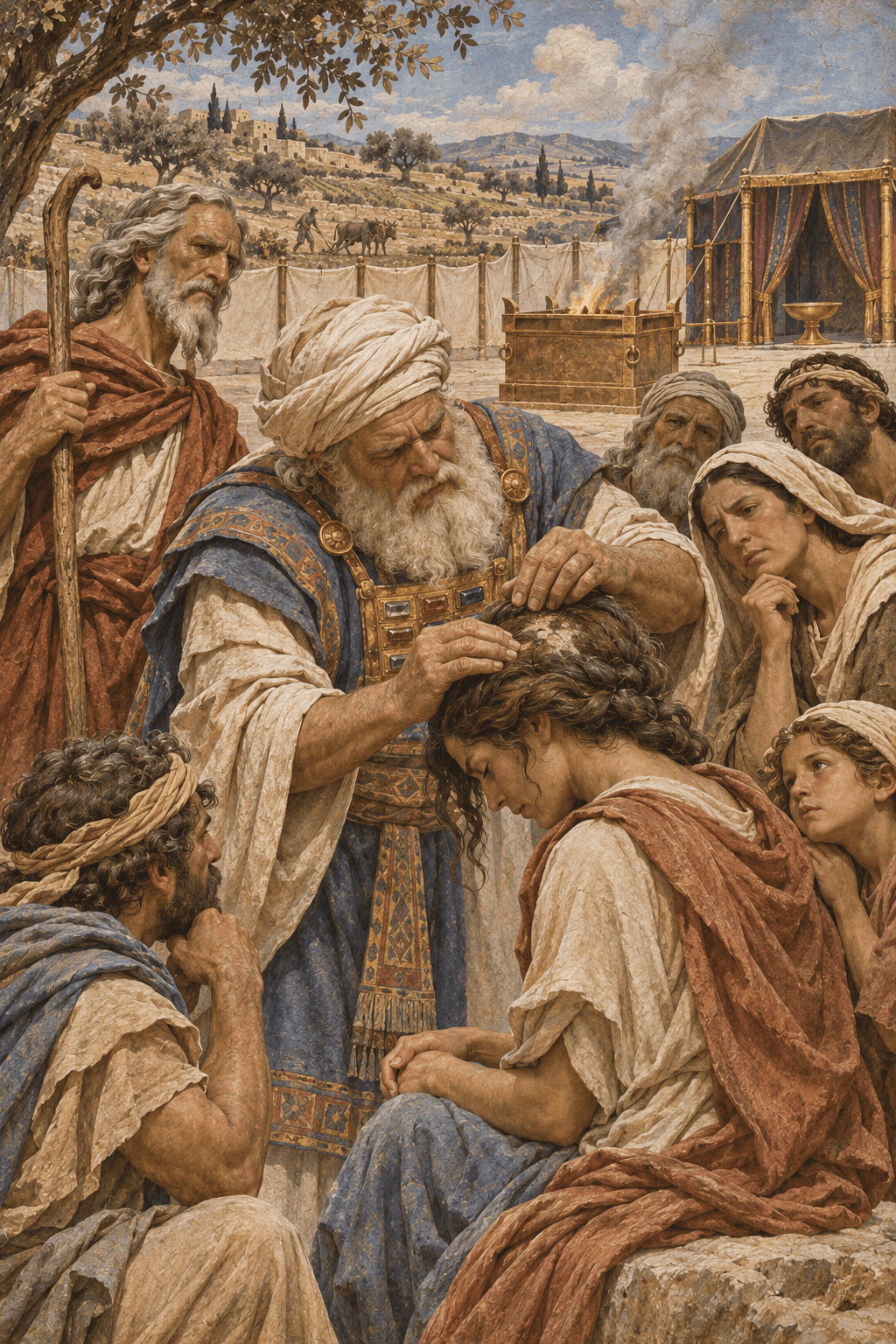
By the “dry scall” here is meant a kind of scab or skin disease whose symptoms are the disappearance of the black hair and the appearance of yellow hair in its place without stopping, with its marks on the skin of the head.
What does He mean by the plague that strikes a man in his head? If the Lord Christ is the head of the man, as the Apostle Paul says (1 Corinthians 11:3), what strikes us here means what touches our faith in the Lord Christ. As for what strikes a man in his beard, Origen holds that it is the plague that strikes the priests, especially if one of them falls into a sin of youth and loses the dignity of the priesthood, symbolized by the beard. [169]
As for the plague that strikes a woman in her head: if the man is the head of the woman (1 Corinthians 11:3), this plague means the sins that touch her relationship with her husband. Origen [170] holds that this plague is the corrupt teachings about married life, like the teachings of Valentinus, Marcion, and others, who look on marriage as uncleanness.
6. Bright Spots That Are White
KJV · Verses 38–39
38 If a man also or a woman have in the skin of their flesh bright spots, even white bright spots; 39 Then the priest shall look: and, behold, if the bright spots in the skin of their flesh be darkish white; it is a freckled spot that groweth in the skin; he is clean.
By the white bright spots is meant the appearance of the marks of vitiligo (a freckled spot).
7. One Whose Hair Is Fallen off His Head
KJV · Verses 40–44
40 And the man whose hair is fallen off his head, he is bald; yet is he clean. 41 And he that hath his hair fallen off from the part of his head toward his face, he is forehead bald: yet is he clean. 42 And if there be in the bald head, or bald forehead, a white reddish sore; it is a leprosy sprung up in his bald head, or his bald forehead. 43 Then the priest shall look upon it: and, behold, if the rising of the sore be white reddish in his bald head, or in his bald forehead, as the leprosy appeareth in the skin of the flesh; 44 He is a leprous man, he is unclean: the priest shall pronounce him utterly unclean; his plague is in his head.
The Law distinguishes between natural, non-diseased conditions and skin diseases that strike the head and carry infection. One whose hair has fallen off his whole head is counted bald; one whose hair has fallen from the front of his head is counted forehead-bald; both are natural, clean conditions. But if a kind of scab strikes the head, with a white reddish rising appearing as may happen in the rest of the body, he is counted to have leprosy and is pronounced unclean.
Origen sees in the head whose hair falls naturally the soul that abandons its dead works by nature and leaves them, so it is clean; but if other hair appears in their place, it means the soul seeks honor after being cleansed, so it is counted unclean and leprous. [171]
8. The Ruling on the Leper
KJV · Verses 45–46
45 And the leper in whom the plague is, his clothes shall be rent, and his head bare, and he shall put a covering upon his upper lip, and shall cry, Unclean, unclean. 46 All the days wherein the plague shall be in him he shall be defiled; he is unclean: he shall dwell alone; without the camp shall his habitation be.
Since leprosy is seen as a symbol of sin and its fruit, the ruling on the leper whose uncleanness was declared was hard, depriving him of the taste of life and isolating him completely from the holy congregation. Its terms were these:
A) His clothes rent. Women were exempted from this term and the next, out of modesty. Why are the leper’s clothes rent? Many hide the disease of their body by caring to wear precious and beautiful clothes, so the disease remains at work in the body, covered by deceiving appearances. So Saint John Chrysostom warned us against hypocrisy as the embroidered garment that the sick soul puts on, which distracts it from treating its true inner disease. And Origen says:
Whoever has a disease in his soul, that is, a hidden evil, must not sew up his clothes and cover the shame of his sin. As one whose clothes are rent shows the nakedness of the shame of his body, so one heaped with sins should not cover his shame with the veil of words, that is, the veil of excuses, lest he become like “whited sepulchres, which indeed appear beautiful outward, but are within full of dead men’s bones, and of all uncleanness” (Matthew 23:27). [172]
If the garment points to the body, [173] and so God did not allow the soldiers to rend the garment of the Lord Christ but they cast lots for it, so that the Church, His body, might remain untorn, then rending the leper’s clothes declares the effect of sin as causing rents and divisions in the Church, the body of Christ. Every sin a person commits, even if he thinks it does not harm others and is done secretly, in truth touches the garment of Christ and rends it… It is enough that it tears this sinner’s soul from its true membership in the holy body, if he persists in his evil.
B) His head bare. If the rent garment declares the sinner’s crime against the Church, which by his sin he rends and divides, the bare head declares the crime he commits against the Lord Christ, who is the head of the man (1 Corinthians 11:3). If our repentance, our spiritual growth, and our life with God glorify our Christ, every sin we commit causes His name to be blasphemed because of us. Origen has another comment on the bare head:
Even if the fault is in the head, that is, we have committed an insult against the Lord, or the fault touches faith in Him, let us not cover it but reveal it to all, so that the sinner, by the intercession of all, their entreaties, and their counsel, may confess and receive forgiveness. [174]
C) His upper lip covered. While He asks that the sick body be exposed by rending the clothes and baring the head, He asks that the upper lip, that is, the mouth, be covered. The soul struck with the leprosy of sin must listen to the commandment and not teach others, even if he is a priest, for He rebukes him (Psalm 50:16). Origen says:
The sinner must close his mouth; for how can one who does not teach himself teach others?! (Romans 2:21). That is why He commanded that the mouth of the evildoer, who has lost the freedom of speech, be covered. [175]
Our fathers warned us against service with the mouth without action; we should speak to others by our life in the Lord and our fellowship with Him, not utter polished words without works. [176]
D) His dwelling outside the camp and his crying “Unclean, unclean.” The rabbis’ words about lepers declare that they looked on them as dead, [177] with no right to life among the holy congregation; so they were excluded from the camp of Israel. The Talmudists in later ages understood that the cities had been surrounded by walls since the days of Joshua as a sign of their sanctification; so the leper went outside the wall as a sign of his death and his deprivation of the fellowship of holy life. If he tried to force his way in, he was liable to forty stripes, for every place he entered was counted unclean… Later they were allowed to enter a certain place in the synagogue within certain limits, entering before the crowd of worshippers came and leaving after the worshippers left the synagogue. [178]
Origen comments on the leper’s dwelling outside the camp:
Every uncleanness casts a person outside the assembly of the righteous; it banishes him far from the congregation and isolates him from the place of the saints. [179]
His crying “Unclean, unclean” points to his inner and outer uncleanness, or the uncleanness of soul and body together.
9. The Plague of Leprosy in Garments and Skins
KJV · Verses 47–59
47 The garment also that the plague of leprosy is in, whether it be a woollen garment, or a linen garment; 48 Whether it be in the warp, or woof; of linen, or of woollen; whether in a skin, or in any thing made of skin; 49 And if the plague be greenish or reddish in the garment, or in the skin, either in the warp, or in the woof, or in any thing of skin; it is a plague of leprosy, and shall be shewed unto the priest: 50 And the priest shall look upon the plague, and shut up it that hath the plague seven days: 51 And he shall look on the plague on the seventh day: if the plague be spread in the garment, either in the warp, or in the woof, or in a skin, or in any work that is made of skin; the plague is a fretting leprosy; it is unclean. 52 He shall therefore burn that garment, whether warp or woof, in woollen or in linen, or any thing of skin, wherein the plague is: for it is a fretting leprosy; it shall be burnt in the fire. 53 And if the priest shall look, and, behold, the plague be not spread in the garment, either in the warp, or in the woof, or in any thing of skin; 54 Then the priest shall command that they wash the thing wherein the plague is, and he shall shut it up seven days more: 55 And the priest shall look on the plague, after that it is washed: and, behold, if the plague have not changed his colour, and the plague be not spread; it is unclean; thou shalt burn it in the fire; it is fret inward, whether it be bare within or without. 56 And if the priest look, and, behold, the plague be somewhat dark after the washing of it; then he shall rend it out of the garment, or out of the skin, or out of the warp, or out of the woof: 57 And if it appear still in the garment, either in the warp, or in the woof, or in any thing of skin; it is a spreading plague: thou shalt burn that wherein the plague is with fire. 58 And the garment, either warp, or woof, or whatsoever thing of skin it be, which thou shalt wash, if the plague be departed from them, then it shall be washed the second time, and shall be clean. 59 This is the law of the plague of leprosy in a garment of woollen or linen, either in the warp, or woof, or any thing of skins, to pronounce it clean, or to pronounce it unclean.

The Lord declared His care for His people even concerning clothes. If corruption struck a garment in the warp (the lengthwise threads of the weave) or the woof (the crosswise threads), or in things of skin, the priest examined it and marked its place, and on the seventh day examined it again. If he saw it had spread, he burned the garment or the thing, so that the corruption would not spread to others. If it had not spread, the matter was repeated after washing it and leaving it seven more days, to be sure the plague was not spreading…
Notes and References
[166] Origen, In Lev. hom. 8:5.
[167] Ibid. 8:10.
[168] Ibid. 8:8.
[169] Ibid. 8:9.
[170] Ibid.
[171] Ibid. 8:10.
[172] Ibid.
[173] See Fr. Tadros Yacoub Malaty, The Gospel according to Matthew, 1983.
[174] Origen, In Lev. hom. 8:10.
[175] Ibid.
[176] See Fr. Tadros Yacoub Malaty, Pastoral Love, 1965, pp. 652–662.
[177] A. Edersheim, The Temple, p. 356.
[178] The source leaves this note without a reference.
[179] Origen, In Lev. hom. 8:10.