
From here (Exodus 12:37–19:2) Moses the prophet describes the departure from Rameses and lays down the rules for the Passover and the conditions under which strangers may share in this feast (Exodus 12:43–51), and the law of sanctifying every firstborn (Exodus 13). He also speaks of the following events:
- The crossing of the Red Sea (Exodus 14).
- The song of salvation (Exodus 15).
- The bitter waters, the manna, and the quails (Exodus 15–16).
- The smitten rock (Exodus 17).
- The victory over Amalek (Exodus 17).
- The visit of Jethro his father-in-law (Exodus 18).
1. The Passover, Center of the Book
KJV · Verses 1–2
1 And the Lord spake unto Moses and Aaron in the land of Egypt saying, 2 This month shall be unto you the beginning of months: it shall be the first month of the year to you.
The Passover is a turning point in the history of the ancient people: through it they passed from the land of bondage into the wilderness, setting out toward the land of promise. Therefore the Passover lamb, with all its rites, carried a special meaning. It is held in the first month of the year (2); they keep it every year as an ordinance for ever (14); the whole congregation is bound to it (6). It also carried a spiritual meaning touching the life of the church community in its relationship with God. The Passover lamb was not merely a memorial of a historical story that happened in the past, but represents a present and lasting work of God in the life of His people. The feast of the Passover also meant a personal relationship between each member of the community and God Himself. This concerns the symbolic Passover lamb. But since the Lord Christ offered Himself as a true “Passover” for the whole world, His sufferings, crucifixion, burial, and resurrection have become a lasting and continual Passover in the life of the Church. The Church keeps it not only once a year, but in every Divine Liturgy, and she experiences its power in her daily life. This divine Paschal work has become the meditation of every true believer; through it he passes from glory to glory, to enter by the Holy Spirit into the bosom of the Father.
This is what has made chapters 11 and 12 of the Book of Exodus the center of the whole book, and, without exaggeration, of the whole Old Testament, just as the crucifixion and resurrection of the Lord Christ are the center of the Gospel. Therefore I have seen a pressing need to offer a careful and, as far as possible, brief study of the Passover lamb in the light of the traditions known at that time, in the light of Jewish tradition, and through the sufferings of the Lord, His crucifixion, and His resurrection, so that we may know its effect in the life of the universal Church and in the life of each of her members.
The Passover and the Ancient Traditions
In the days of the first Adam, his two sons offered two different offerings. Abel, as a hunter, offered a blood sacrifice as an atonement for his sins, which he no doubt received from his parents; and Cain, as a farmer, offered of the fruits of the ground. In any case, mankind received these two practices and distorted their image as it turned away from the divine path. The nomadic tribes of the world came to smear their tents with the sign of blood, believing that it drove away evil spirits so that they would not harm them. The tribes that worked in agriculture had a different tradition: they abstained from leavened bread for a few days at the beginning of the new harvest, so that the leaven of the old harvest would not enter the flour of the new… In this way they thought they began a new year with new food and a new life.
It should be noted that these two rites (sprinkling blood and abstaining from leaven) have a pure origin in faith, but mankind turned them away from their path of faith; then the rite of the Passover came to restore both rites to their right path anew.
The Passover carried the rite of “the sign of the blood” with the meaning of reconciliation between God and man through the blood of the Redeemer. The believer feels that, like the nomads, he lives as a stranger, having no place here in which to settle; he is always passing over, in continual movement toward the Jerusalem above. He anoints the lintel and the two side posts, that is, his mind and his heart, not to drive away evil spirits, but to pass over with all his mind and feelings into the eternal embrace through his union with the Savior, trampling the powers of evil under his feet.
The second rite, that of unleavened bread and the removal of all leaven from his house, concerns the life of the believer. Though he is in continual movement toward heavenly things and in a state of sojourning on earth, he feels in his depths that he is leaning on the Lord’s breast, resting in the heart of God, working in the Lord’s vineyard in the new land. So he eats unleavened bread seven days, that is, all the days of his week, or all the days of his life, eating the new food that does not grow old. He enjoys the new life continually, feeds on the bread of angels, and sings the new song, saying with the Apostle: “Behold, all things are become new” (2 Corinthians 5:17).
Wonderfully, from the earliest ages the Church, in celebrating the feast of the Passover, “the Resurrection,” practiced two rites that complete each other and go together: the baptism of the catechumens and the Eucharist. [132] On the night of the feast the bishop baptizes the catechumens, so that they bear the sign of the blood on their inner foreheads and in their hearts, enjoying reconciliation with God in His Son Jesus Christ through His Holy Spirit. They enjoy the Spirit of adoption, who helps them pass over toward the divine glories. Then they come forward with the rest of the faithful to share in the other rite, the Eucharist, where the Church struggling on earth appears as if, in the midst of her struggle, she is settled around the eternal altar of God. She eats the new unleavened bread continually, enjoying the holy Body and Blood, which neither grow old nor age.
This is our new Passover, of which the old Passover was a shadow and a symbol.
A Personal Passover
God commanded that the whole congregation offer the Passover, for it is the Passover of the whole Church united with her Bridegroom; and later He required that it be offered in Jerusalem and nowhere else, the place where His name was called, for it is the Lord’s Passover.
This living communal picture did not ignore the personal side of each member of the community; rather, it emphasized it through the member’s union with the community. God did not only command that the blood be sprinkled on every house, but bound every man and woman to eat it roast with fire. Eating is a sign of the personal relationship and of personal participation in the practice of the rite. Very small children and infants could not share in the eating, but they were present at the rite and rejoiced in it; indeed, they were saved from destruction through the faith of their parents who shared in eating the Passover lamb.
The matter did not stop at the passing over of the community as a whole and of each member in it, men, women, elders, and children. Even after the passing over, when they kept it every year through the generations, everyone who shared in the celebration was considered to have personally enjoyed the communion of faith with those who were saved, and to have received a share in the work of freedom which the earlier fathers lived. So in the Book of Exodus He says: “Thou shalt keep the feast of unleavened bread… for in it thou camest out from Egypt” (Exodus 23:15), addressing each member of the community as though he himself had come out of Egypt. And in Deuteronomy He says: “Observe the month of Abib, and keep the passover unto the LORD thy God: for in the month of Abib the LORD thy God brought thee forth out of Egypt by night” (Deuteronomy 16:1). This is a commandment addressed to every believer through the generations, as though he had come out with his fathers by night…
This is also what Jewish tradition affirmed. For example, the Haggadah [133] says: “Not our ancestors alone did He save; but in saving them He saved us too with them. For not one enemy only has stood against us to destroy us! The Holy One, blessed be He, saves us from their hands!”
So the celebration of the Passover, even in sound Jewish thought, carried an inner direction touching the believer’s life and his personal relationship with God through his union with the community. This is the very thing the Church means when she celebrates the new Passover: that every believer may enter into the enjoyment of the new risen life, through his passing over and settling in the bosom of God, as a living member of the holy community.
From the Law to the Messiah
The Passover supper among the Jews had its own rite, which chapter 12 of Exodus records for us, together with some other traditions that included prayers of blessing, praises, and certain psalms recorded in the Mishnah. [134] I have given a summary of these before. [135] This feast was rich in memories and promises that carried God’s care for man, especially through the salvation offered by the Messiah. They knew this night as the yearly memorial of the creation of the world, of the circumcision of Abraham, of the sacrifice of Isaac, of Joseph’s release from prison, of the awaited deliverance from captivity, of the appearing of the Messiah, of the coming of Moses and Elijah, of the resurrection of the fathers, and of the end of the world… [136] Therefore the Lord Christ offered Himself as a Passover for the world at the feast of the Passover, to declare that the reality swallows up the symbol and brings it to the fulfillment of its purpose.
Saint Melito of Sardis [137] says:
The mystery of the Pascha is fulfilled in the body of the Lord… For He was led as a lamb and slain as a sheep, saving us from the bondage of the world (Egypt) and setting us free from the bondage of the devil as from Pharaoh, sealing our souls with His Spirit and the members of our body with His blood…
He is the One who saved us from bondage to freedom, from darkness to light, from death to life, from oppression to the eternal kingdom…
He is the One who is the Pascha (passing over) of our salvation…
He is the silent Lamb… who was taken from the flock, led to the slaughter in the evening, and buried at night.
For this reason the feast of unleavened bread was bitter, as your Scripture says: You shall eat unleavened bread with bitter herbs. Bitter for you are the nails that were used; bitter is the tongue that blasphemed; bitter is the false witness you spoke against Him…
He also says:
Consider this, beloved: how the mystery of the Pascha is new and old, eternal and temporary, incorruptible and corruptible, immortal and mortal! It is old according to the Law, but new according to the Logos (the divine Word); temporary through the figure, eternal through grace; corruptible through the slaughter of the lambs, incorruptible through the life of the Lord… So the sacrifice of the lambs, the rite of the Pascha, and the letter of the Law have been fulfilled in Christ Jesus. In place of the Law came the Logos: the old became new, the commandment became grace, and the figure became reality. [138]
From the Earthly Passover to the Heavenly Passover
Saint Hippolytus of Rome says:
The Jews keep the earthly Passover, denying the heavenly Passover. But we keep the heavenly Passover, passing over the earthly. The Passover they kept was a figure of the salvation of the firstborn of the Jews. The firstborn of the Egyptians died, but the firstborn of the Jews did not perish, because they were under the protection of the figure, the blood of the Paschal victim. But the Passover we keep brings about salvation for all people, beginning with the firstborn, who are saved and enjoy life completely. [139]
Saint Ambrose says:
Now, as you celebrate the holy Pascha (Passover), you must know, brethren, what the Pascha is… Pascha means passing over, and the feast was called by this name because in this feast the Son of God passed from this world to His Father.
What profit is it to you to celebrate the feast of the Passover if you do not imitate Him whom you worship… passing over from the darkness of evil deeds to the light of virtue, and from the love of this world to the love of the heavenly home?! For there are many who celebrate this holy feast and honor it duly, yet they do so unworthily because of their wickedness, for they do not pass over this world to their Father, that is, they do not pass over the lusts of this world and the pleasures of the flesh to the love of heaven. How wretched are such Christians, still under the dominion of the devil, rejoicing in this evil…
For this reason I warn you, my brethren, to celebrate the feast of the Passover as is fitting, that is, you must pass over. Whoever among you is still in sin, let him sanctify this feast by passing over from evil deeds to the life of virtue. And whoever among you walks in a holy life, let him pass over from virtue to virtue, so that there is no one among you who does not pass over. [140]
Saint Athanasius the Apostolic spoke much in his Paschal letters of passing over from the temporal Passover to the heavenly Passover. For example:
And now, my beloved, the devil (Pharaoh), that tyrant against the whole world, has been slain. So we do not draw near to a temporal feast but to a lasting, heavenly feast, declaring it not in shadows (and the letter) but in truth. For they, after being filled with the flesh of a dumb lamb, accomplished the feast, and having anointed their doorposts with the blood, they escaped the destroyer. But now, as we eat “the Word of the Father” and our hearts are anointed with the blood of the New Covenant, we know the grace which the Savior gives us, who said: “Behold, I give unto you power to tread on serpents and scorpions, and over all the power of the enemy” (Luke 10:19). For death no longer reigns, but life rules in place of death, for the Lord says: “I am… the life” (John 14:6). So everything is filled with joy and gladness, as it is written: “The LORD reigneth; let the earth rejoice” (Psalm 97:1).
We must come to the feast with zeal and gladness, so that, beginning here with joy, our souls may long for the heavenly feast. If we keep the feast here diligently, we shall without doubt receive the perfect joy that is in heaven, as the Lord says: “With desire I have desired to eat this passover with you before I suffer: For I say unto you, I will not any more eat thereof, until it be fulfilled in the kingdom of God” (Luke 22:15–16).
For those who keep the feast in purity, the Passover is their heavenly food.
Let us not keep the feast in an earthly way, but as those who keep a feast in heaven with the angels. Let us glorify God by a life of chastity, righteousness, and the other virtues! Let us rejoice, not in ourselves but in the Lord, so that we may be with the saints! [141]
2. The Rite of the Passover
KJV · Verses 3–28
3 Speak ye unto all the congregation of Israel, saying, In the tenth day of this month they shall take to them every man a lamb, according to the house of their fathers, a lamb for an house: 4 And if the household be too little for the lamb, let him and his neighbour next unto his house take it according to the number of the souls; every man according to his eating shall make your count for the lamb. 5 Your lamb shall be without blemish, a male of the first year: ye shall take it out from the sheep, or from the goats: 6 And ye shall keep it up until the fourteenth day of the same month: and the whole assembly of the congregation of Israel shall kill it in the evening. 7 And they shall take of the blood, and strike it on the two side posts and on the upper door post of the houses, wherein they shall eat it. 8 And they shall eat the flesh in that night, roast with fire, and unleavened bread; and with bitter herbs they shall eat it. 9 Eat not of it raw, nor sodden at all with water, but roast with fire; his head with his legs, and with the purtenance thereof. 10 And ye shall let nothing of it remain until the morning; and that which remaineth of it until the morning ye shall burn with fire. 11 And thus shall ye eat it; with your loins girded, your shoes on your feet, and your staff in your hand; and ye shall eat it in haste: it is the Lord's passover. 12 For I will pass through the land of Egypt this night, and will smite all the firstborn in the land of Egypt, both man and beast; and against all the gods of Egypt I will execute judgment: I am the Lord. 13 And the blood shall be to you for a token upon the houses where ye are: and when I see the blood, I will pass over you, and the plague shall not be upon you to destroy you, when I smite the land of Egypt. 14 And this day shall be unto you for a memorial; and ye shall keep it a feast to the Lord throughout your generations; ye shall keep it a feast by an ordinance for ever. 15 Seven days shall ye eat unleavened bread; even the first day ye shall put away leaven out of your houses: for whosoever eateth leavened bread from the first day until the seventh day, that soul shall be cut off from Israel. 16 And in the first day there shall be an holy convocation, and in the seventh day there shall be an holy convocation to you; no manner of work shall be done in them, save that which every man must eat, that only may be done of you. 17 And ye shall observe the feast of unleavened bread; for in this selfsame day have I brought your armies out of the land of Egypt: therefore shall ye observe this day in your generations by an ordinance for ever. 18 In the first month, on the fourteenth day of the month at even, ye shall eat unleavened bread, until the one and twentieth day of the month at even. 19 Seven days shall there be no leaven found in your houses: for whosoever eateth that which is leavened, even that soul shall be cut off from the congregation of Israel, whether he be a stranger, or born in the land. 20 Ye shall eat nothing leavened; in all your habitations shall ye eat unleavened bread. 21 Then Moses called for all the elders of Israel, and said unto them, Draw out and take you a lamb according to your families, and kill the passover. 22 And ye shall take a bunch of hyssop, and dip it in the blood that is in the bason, and strike the lintel and the two side posts with the blood that is in the bason; and none of you shall go out at the door of his house until the morning. 23 For the Lord will pass through to smite the Egyptians; and when he seeth the blood upon the lintel, and on the two side posts, the Lord will pass over the door, and will not suffer the destroyer to come in unto your houses to smite you. 24 And ye shall observe this thing for an ordinance to thee and to thy sons for ever. 25 And it shall come to pass, when ye be come to the land which the Lord will give you, according as he hath promised, that ye shall keep this service. 26 And it shall come to pass, when your children shall say unto you, What mean ye by this service? 27 That ye shall say, It is the sacrifice of the Lord's passover, who passed over the houses of the children of Israel in Egypt, when he smote the Egyptians, and delivered our houses. And the people bowed the head and worshipped. 28 And the children of Israel went away, and did as the Lord had commanded Moses and Aaron, so did they.
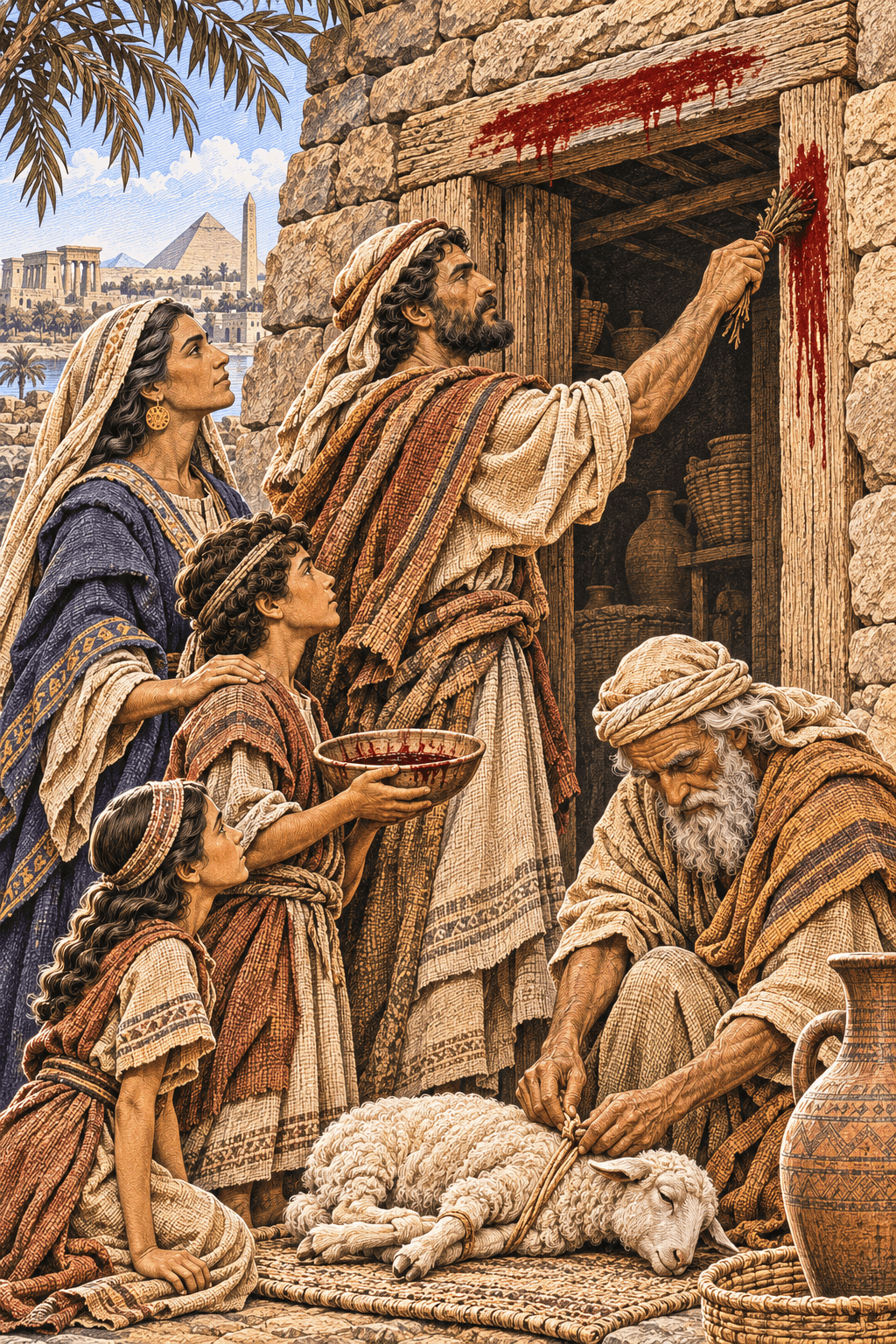
Saint Melito of Sardis sees that the Law was an introduction to the covenant of grace, not only through commandments and words, but also through figures. He says:
Words and (ritual) deeds, beloved, have no meaning if they are cut off from what they symbolize. [142]
This is in fact the mind of the Church, in an evangelical spirit, which the Church received from the beginning of her mission.
Now we speak of the rite of the Passover as it is given in the Book of Exodus and what it symbolizes, with the help of the Gospel texts and the writings of the fathers:
1. Why Was It at Night?
The Lord says to Moses: “About midnight will I go out into the midst of Egypt” (Exodus 11:4), and He affirms in Deuteronomy: “For in the month of Abib the LORD thy God brought thee forth out of Egypt by night” (Deuteronomy 16:1). Saint Hippolytus gives us a reason for this:
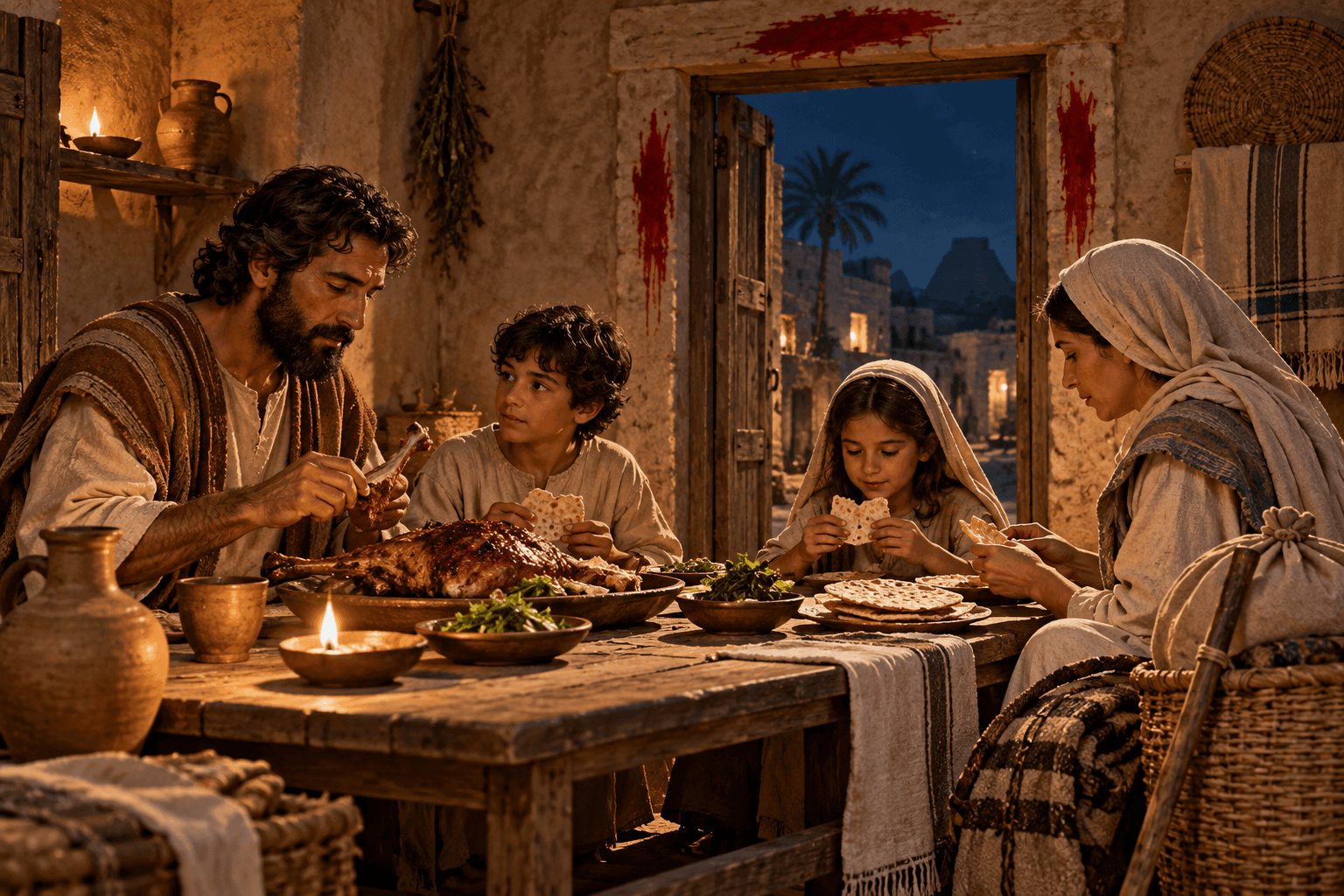
The plague was carried out in the dark, at night, because under the shadow of night, away from the clear light of day, justice is done upon the demons and their dark crimes: “And I will shew wonders in the heavens and in the earth, blood, and fire, and pillars of smoke. The sun shall be turned into darkness, and the moon into blood” (Joel 2:30–31). It is as if, at night, where Satan dwells in darkness, the Lord slays him in his den, while he is secure, with no one resisting him; and he perishes, and all his works with him. The Lord, “our new Passover,” gave up His spirit at the end of the day and entered Hades by night, to loose the bonds of those held captive in darkness and bring them out to the light of Paradise, which has no darkness! [143]
2. In the Month of Abib, the First of the Months
The Lord spoke to Moses and Aaron, saying: “This month shall be unto you the beginning of months: it shall be the first month of the year to you” (2). It is as if in every Passover they enter a new year, to live in a state of continual renewal of heart in Christ Jesus, the Sacrifice. As the Lord Christ, “our Passover,” is the Head of creation and its Firstborn, this month became the firstborn of times and the beginning of the new life, as the Apostle says: “Therefore we are buried with him by baptism into death: that like as Christ was raised up from the dead by the glory of the Father, even so we also should walk in newness of life” (Romans 6:4). As Saint Hippolytus says:
This means that for us the sacrifice of the true Passover is the beginning of eternal life. [144]
Saint Athanasius the Apostolic [145] sees that the symbolic Passover came at the beginning of the months, but the Lord (the true Passover) came at the end of the ages (Hebrews 9:26), to declare that He is the end and goal of the Law (Romans 10:4).
Note that “Abib” means “an ear of grain”; it is as if through the Passover the soul becomes the Lord’s ear of grain, that is, His harvest.
3. Kept Until the Tenth Day
This (3) pointed to the entry of the Lord Christ into Jerusalem, to remain kept until He offered Himself as a Passover for us. The choice of the tenth day points to His coming after the Law (the Ten Commandments), to fulfill the commandment which man had broken, and to give us the ability to carry it out.
4. Offered on the Fourteenth Day
On the fourteenth day (6) the moon is full. Since the sun is a symbol of the Lord Christ and the moon of the Church, it is as if through “Christ our passover” (1 Corinthians 5:7) the enlightenment of the Church is completed and her splendor declared.
The days of keeping are five (the 10th to the 14th of Abib). They represent the five beginnings of the world in the history of salvation: with Adam the human race began; with Noah the world began after the flood; Abraham began as the father of the faithful, and from his loins came the people of God; with Moses the world began under the written Law; and finally Christ came on the fifth day to begin the covenant of grace, in which He offered Himself as a Passover, effective in all five eras.
The five days also point to the effectiveness of the true Passover for all who work in any of the five hours of the day, that is, those who began work at the first, third, sixth, ninth, or eleventh hour.
5. Inviting the Next Neighbor
This invitation (4) points to the call of the Gentiles, as the “neighbor” who also enjoys the sacrifice of the true Passover.
6. A Lamb Without Blemish
It was required (5) to be either a lamb, a symbol of meekness, as Isaiah the prophet says: “He was oppressed, and he was afflicted, yet he opened not his mouth: he is brought as a lamb to the slaughter” (Isaiah 53:7); or of the goats, which were offered as a sin offering according to the Law (Numbers 7:16).
Christ the Savior was called the Lamb, for it is said in the Book of Jeremiah: “But I was like a lamb or an ox that is brought to the slaughter; and I knew not that they had devised devices against me, saying, Let us destroy the tree with the fruit thereof, and let us cut him off from the land of the living, that his name may be no more remembered” (Jeremiah 11:19). Isaiah the prophet said of Him: “He is brought as a lamb to the slaughter, and as a sheep before her shearers is dumb, so he openeth not his mouth” (Isaiah 53:7)… When Saint John the Baptist saw Him, he said: “Behold the Lamb of God, which taketh away the sin of the world” (John 1:29). And in heaven Saint John the Theologian saw Him: “And in the midst of the elders, stood a Lamb as it had been slain” (Revelation 5:6).
As for its being whole and without blemish, it is because the Lord Christ is holy and without blemish, able to atone for our sins by His own blood (Hebrews 9:14). Saint Hippolytus of Rome says:
For Christ alone is without blemish in every virtue and without fault in any matter, offering all righteousness from beginning to end, for He said of Himself: “For thus it becometh us to fulfil all righteousness” (Matthew 3:15). [146]
As the Apostle says, we were redeemed “with the precious blood of Christ, as of a lamb without blemish and without spot” (1 Peter 1:19).
Its being a male points to His headship, as the Bridegroom of all the faithful (2 Corinthians 11:2), for “he that hath the bride is the bridegroom” (John 3:29).
“Of the first year” (5), that is, young, without the weakness of old age, untouched by age; He remains ever new in our life, though He is the Ancient of Days, the Eternal.
7. The Whole Assembly of the Congregation of Israel Shall Kill It
On one side, this (6) was fulfilled in the person of the Lord Christ, of whom it is said: “For of a truth against thy holy child Jesus, whom thou hast anointed, both Herod, and Pontius Pilate, with the Gentiles, and the people of Israel, were gathered together” (Acts 4:27). On the other side, the Lord came forward Himself to offer Himself as a sacrifice of love for us. Therefore Saint John Chrysostom says:
It was not so with Christ, for He was not commanded to do this; He came forward of Himself and became so, offering Himself as a sacrifice and an offering to God. [147]
Though there were many families offering lambs, all shared in one sacrifice. But the Lord Christ offered Himself as one Passover, atoning for all nations and peoples, gathering all around Him as in one house. On this Saint Hippolytus says:
As the houses of the Hebrews were many, yet counted as one house, so, however many the churches in a city or a village, they represent one Church, Christ, who is complete and undivided in the various houses; for Paul himself says that we are one in Christ. [148]
It was also required that they not carry it outside the house. On this Saint Hippolytus says:
For the assembly is one, the house is one. It is the one Church in which the holy Body of Christ is eaten; outside this one house, that is, the Church, the Body is not carried. Whoever eats it in another place is punished as a wicked man and a thief. [149]
8. Killed in the Evening
This (6) points to the Lord Christ’s offering Himself as a Passover for the world in the fullness of time.
9. Striking the Blood on the Lintel and the Two Side Posts
He speaks (7) of the power of the blood, saying: “When I see the blood, I will pass over you” (13), for “without shedding of blood is no remission” (Hebrews 9:22).
No doubt many Egyptians saw the lambs being slain and the blood sprinkled, mocked them, and perished. And if a Hebrew had tied the lamb at the door instead of slaying it, he too would have perished; for there is no salvation for us except through the death of the Lord Christ and the shedding of His blood for us. Therefore He says: “Verily, verily, I say unto you, Except a corn of wheat fall into the ground and die, it abideth alone” (John 12:24).
The blood of the lamb was a symbol of the blood of the Lord Christ, without which there is no salvation. As Lactantius says: “The Hebrews alone were saved by the sign of the blood, not because the blood of the lamb in itself had power for the salvation of men, but because it was a figure of things to come.” [150]
Saint Hippolytus of Rome speaks of the power of the sign of the blood, saying:
It is placed in the houses as in souls, in which the Spirit of the Lord finds His holy dwelling. [151]
He also says:
The blood on the lintel is as on the Church, and on the two side posts as on the two peoples (the Jews and the Gentiles).
Saint Gregory of Nyssa sees that sprinkling the blood in this way on the lintel and the two side posts points to the sanctification of the soul in its three aspects, the rational, the emotional, and the spiritual, [152] that is, the sanctification of the whole person, with all his powers of thought, his longings, his emotions, and his inner feelings.
So the fathers saw in the sign of the blood the sanctification of the universal Church and of the human soul as a member of this Church.
Note that the blood was not sprinkled on the threshold, so that it would not be trodden underfoot, for the Apostle says: “Of how much sorer punishment, suppose ye, shall he be thought worthy, who hath trodden under foot the Son of God, and hath counted the blood of the covenant, wherewith he was sanctified, an unholy thing, and hath done despite unto the Spirit of grace?” (Hebrews 10:29). As for our struggle to enjoy the fruit of this blood, Saint Athanasius the Apostolic says:
We must prolong our prayers, fasts, and vigils, so that we may anoint the front of our houses with the precious blood, and the destroyer may flee. [153]
10. Using Hyssop
“And ye shall take a bunch of hyssop, and dip it in the blood that is in the bason, and strike the lintel and the two side posts with the blood that is in the bason” (22).
Scholars have not reached a definite opinion about the hyssop plant, but the traditional view among the Jews is that it is thyme. In Holy Scripture it was used for cleansing from leprosy (Leviticus 14:4, 6), from sin (Psalm 51:7), from plague in a house (Leviticus 14:49–52), and for ritual purification (Numbers 19:18). It was also used to lift up the sponge of vinegar offered to the Lord on the Cross (John 19:29). It is said that hyssop is a fragrant plant that grows in walls and in rocks.
Saint Augustine sees that:
Hyssop is a lowly, humble herb, yet its roots are deep and strong. It is as if it enters by its roots into love and is rooted in it, to comprehend with all saints what is the breadth, and length, and depth, and height (Ephesians 3:17–18), and to know the Cross of our Lord. [154]
It is as if through the blood flowing from boundless love we are sanctified: the leprosy of sin is removed from us, we are healed of our diseases, our souls are cleansed, and we share with Christ in His sufferings on the Cross.
11. They Shall Eat It Roast with Fire
A) The rite (8–9) does not stop at sprinkling the blood; the faithful are bound to eat the flesh roast with fire, to be united with the Lord Christ, who passed through divine justice for us, saying: “My heart is like wax; it is melted in the midst of my bowels. My strength is dried up like a potsherd; and my tongue cleaveth to my jaws” (Psalm 22:14–15).
B) We do not stop at faith in the suffering Lord Christ, who passed through the fire for us; we are also bound to partake of His Body and Blood, given for us, so that we may have fellowship with Him in His sufferings and know the power of His resurrection. In this way we abide in Him and He in us (John 6:56).
C) Saint Gregory of Nyssa sees that the food of the Passover is “fervent, burning faith.” [155] Origen speaks of it, saying:
Let us have a fervent spirit, and hold fast to the fiery words which God gives us, as He gave them to Jeremiah the prophet, saying: “I will make my words in thy mouth fire” (Jeremiah 5:14). Let us see that the flesh of the Lamb is well cooked, so that those who share in it may say that Christ was speaking in us: “Did not our heart burn within us, while he talked with us by the way, and while he opened to us the scriptures?” (Luke 24:32). [156]
D) It was the custom to roast the lamb on two crossed spits, which symbolize the Cross.
12. Eat Not of It Raw, nor Sodden with Water
He wants us (9) to enjoy the divine Word aflame with fire; we are not to eat of it raw or sodden with water, that is, not to receive it in a watery, lukewarm way, but to receive it with a fervent spirit, earnest in enjoying it. He wants us to receive faith in the Cross through suffering, not in a spirit of slackness and laxity.
13. His Head with His Legs and the Purtenance Thereof
When we partake of our new Passover (9), we enter into the head, the legs, and the inward parts, that is, we come to know the love of Christ, that we may grasp its height (the head), its depth (the legs), and its breadth (the inward parts), and find that it surrounds us on every side.
Saint Hippolytus of Rome [157] sees that the head is the Law, which began to reveal “the mystery of the Passover”; the legs are the disciples, who went out to preach peace upon the mountains of Zion; and the inward parts are the Passover itself, which we have known through the Law and the Gospel.
14. With Unleavened Bread
Leaven (8) points to malice and wickedness (1 Corinthians 5:7–8) and to hypocrisy. Therefore Saint Ambrose advises us:
If in the celebration of the Passover it was the custom of old to eat unleavened bread for seven days, so every Christian must eat of the Body of the true Lamb, that is, Christ, and live a holy and simple life all the days of his life, that is, through the seven days. Beware of the old leaven; do not remain in it, my brethren, as the Apostle warns us: “Purge out therefore the old leaven” (1 Corinthians 5:7), that is, be cleansed of the old way of life. If you turn away from all the evil that is signified by the old leaven, and keep with faith what you pledged in baptism, then you will be true Christians! [158]
Saint Athanasius the Apostolic comments on the words of the Apostle, “Therefore let us keep the feast, not with old leaven, neither with the leaven of malice and wickedness; but with the unleavened bread of sincerity and truth” (1 Corinthians 5:8), saying:
Putting off the old man and his deeds, let us put on the new man, which after God is created (Ephesians 4:22, 24), and meditate on the law of God day and night, with a humble mind and a pure conscience. Let us cast away from us all hypocrisy and deceit, keeping far from all pride and cunning. Let us pledge ourselves to the love of God and the love of our neighbor, that we may become a new creation, partaking of new wine… So let us keep the feast as is fitting. [159]
Some fathers, such as Origen, see that the old Passover was bound up with unleavened bread so that the faithful would not be leavened with the leaven of the world, while they waited for the new leaven of the kingdom of God (Matthew 13:33).
Note that the Lord Christ used leavened bread in the mystery of the Eucharist, because He bore our sins in His body.
15. With Bitter Herbs They Shall Eat It
A) Saint Jerome sees that God forbade the use of honey in the offerings, and at the same time commanded that the Passover lamb be eaten with bitter herbs (8), as if He does not want us to live pampered, but to endure tribulation in the world. [160]
B) The bitter herbs remind the people of the bitterness of the bondage of sin, from which they are set free through the Passover lamb.
C) The bitter herbs point to our duty to come to the mystery of the new Passover with bitterness of heart and contrition of spirit for our sins. When our mouth is made bitter because of sin, our heart is filled with the sweetness of the Body and Blood of the Lord. In other words, there is no enjoyment of the mystery of the Eucharist without repentance and confession.
16. Let Nothing of It Remain Until the Morning
This (10) points to the mystery of the Passover as the mystery of “the new life.” Our Church has been careful not to keep the divine mysteries to the next day.
17. Neither Shall Ye Break a Bone Thereof
This (46) points to the Lord Christ: when they came to break His legs, they found that He was already dead, so they did not break them, “that the scripture should be fulfilled, A bone of him shall not be broken” (John 19:36). Saint Hippolytus sees that by this we can recognize His resurrection (John 20:27): He rose bearing the marks of His wounds, but it was not fitting for Him to rise with broken legs.
As the bones of the Lord were not broken, so we must receive “the Word of God,” which we eat aflame with fire, without breaking its bones, that is, without understanding it in a deadly, literal, human way; we understand it through the Spirit, who builds up.
And as the bones of the Passover are not broken, so the righteous who are united with the Lord Christ, their Passover, do not have their bones broken, for the psalmist says: “He keepeth all his bones: not one of them is broken” (Psalm 34:20). Saint Augustine [161] says that the psalmist is not speaking of bones in the literal sense, but means the living faith that is not broken. He points to the right-hand thief, whose leg bones were broken, but the Lord kept the bones of his soul, for he held fast to faith in moments of bitter distress, and so was counted worthy to enter Paradise, kept in the hands of God.
18. Eating It Ready to Depart
It was required that they eat it thus: “With your loins girded, your shoes on your feet, and your staff in your hand; and ye shall eat it in haste: it is the LORD’S passover” (11).
Saint John Chrysostom [162] gives two interpretations of these words:
The first interpretation is the historical one: the Jews remember that they are departing, and by this act it is as if they say: “We are ready for the journey. Behold, we are going out of Egypt to the land of promise. Behold, we are going out.” This people was known for much forgetfulness, so He gave them this commandment so that they would not forget the purpose of the Passover.
The second interpretation is the symbolic one. He says: We too, when we partake of the Passover, which is Christ (1 Corinthians 5:7)… ought to partake of it shod and girded. Why? So that we too may be ready for our going out and our departure. Let everyone who partakes of this Passover not look to Egypt (the world) but to heaven, gazing toward “Jerusalem which is above” (Galatians 4:26)… For girding is part of the soul’s departure. See what God says to a righteous man: “Gird up now thy loins like a man; for I will demand of thee, and answer thou me” (Job 38:3). This He also said to all the prophets, and to Moses too, asking him to be girded. Indeed, God Himself appeared to Ezekiel girded (Ezekiel 9:11, Septuagint), and the angels also appear girded (Revelation 15:6), since they are soldiers… So let us gird ourselves to stand with courage… and let us not fear, for the leader of our going out is Jesus, not Moses.
So they ate it as people waiting to depart and pass over from the land of bondage, heading toward the land of promise, ready in their bodies (the girdle), their hands (the staff), and their feet (the shoes). This is the meaning of preparation for the mystery of the Eucharist: we partake longing to pass over to where Christ is seated.
The girded loins point to restraining the lusts and pleasures of the body, so that a person walks not according to the passions of his body but according to the heavenly desires of the Spirit. Therefore, speaking of the monk’s girdle, Saint John Cassian says:
Let the soldier of Christ, protected by a girdle wrapped around him, know that he is not only preparing his mind to accept any work in the monastery, and that his movement should not be hindered by his clothes… but that his use of a girdle of dead leather means that he bears the mortification of all his members which contain the seeds of lust and impurity, so that he always knows the commandment of the Gospel: “Mortify therefore your members which are upon the earth; fornication, uncleanness, inordinate affection, evil concupiscence” (Colossians 3:5). [163]
The shoe on the foot points to what happened with Moses the prophet: he put off the shoe made from the skin of dead animals so that he could enjoy the bush burning with fire. But here he wears a shoe of another kind, the shoe of the Lord, of which our teacher John the Baptist said he was not worthy to stoop down and unloose its latchet. So let us have the shoe of the Lord, that as He walked we may walk in His shoe, not fearing the thorns of this life, nor the violence and might of Pharaoh, but crushing all the powers of evil under our feet. As Saint Ambrose says:
Whoever celebrates the Lord’s Passover and keeps the feast of the Lamb must have his feet protected against the attacks of the spiritual wild beasts and the bites of the serpent. [164]
The staff in our hands is the rod of God, which was also called the rod of Moses and the rod of Aaron… We lean on the power of God unto salvation (the Cross), hold the rod of the commandment (Moses), and practice spiritual worship (Aaron).
Some of the fathers see in the staff “hope,” on which the soul leans on its journey toward heaven, to drive away the devil’s crushing threats, as a traveller drives away dogs with his staff.
Finally, Saint Athanasius the Apostolic speaks of preparing for this journey, saying:
Our Lord Jesus Christ is the true Light, who in place of the staff is our scepter, and in place of unleavened bread is the Bread that came down from heaven (John 6:50). In short, the Lord leads us by all these to His Father. [165]
As for eating the Passover in haste (11), Saint Hippolytus says:
Whoever draws near to this great Body must be watchful and fasting. [166]
That is, ready to set out.
19. They Shall Keep It an Ordinance for Ever
This (14) affirms the eternal work of the Passover, and also keeps the ancient people waiting for the coming of the true Passover, whose blood sanctifies for ever.
20. There Shall No Stranger Eat Thereof
It was required (43, 48) that the uncircumcised not share in it; only the circumcised share. So no one can enjoy communion in the holy mysteries except one who has received the spiritual circumcision, that is, baptism, and has become a son of God, with the right of union with Him in Christ Jesus.
In the sixth of his Paschal letters, Pope Athanasius the Apostolic says:
The deceitful man, impure of heart, in whom there is nothing pure… is certainly a stranger to the saints and counted unworthy to eat the Passover, for no stranger shall eat thereof. Therefore when Judas thought he was keeping the Passover while plotting deceit against the Savior, he became a stranger to the city which is above and far from the apostolic company; for the Law commanded that the Passover be eaten with fitting care, but while he was eating, Satan pierced him and entered his soul (John 13:27). [167]
21. It Is the LORD’S Passover
Holy Scripture (11) distinguishes between “the Lord’s Passover” and “the Passover of the Jews.” In the Law it does not say “your Passover” or “the Passover of the Jews,” but always says “the LORD’S passover,” attributing the Passover to Him. But when the people fell into evil and lived without repentance, He no longer called it His, but theirs, [168] saying: “Your new moons and your appointed feasts my soul hateth” (Isaiah 1:14).
Origen noted that this happens in every kind of worship. He calls the Sabbath “a sabbath of the LORD,” and in the Book of Numbers He says: “My offering, and my bread for my sacrifices made by fire, for a sweet savour unto me, shall ye observe to offer unto me in their due season” (Numbers 28:2). He also calls the people “my people”; but when they turned away from worshipping Him, He said to Moses: “Go, get thee down; for thy people, which thou broughtest out of the land of Egypt, have corrupted themselves” (Exodus 32:7), for they were no longer the people of God but the people of Moses.
3. The Departure of the People
KJV · Verses 29–51
29 And it came to pass, that at midnight the Lord smote all the firstborn in the land of Egypt, from the firstborn of Pharaoh that sat on his throne unto the firstborn of the captive that was in the dungeon; and all the firstborn of cattle. 30 And Pharaoh rose up in the night, he, and all his servants, and all the Egyptians; and there was a great cry in Egypt; for there was not a house where there was not one dead. 31 And he called for Moses and Aaron by night, and said, Rise up, and get you forth from among my people, both ye and the children of Israel; and go, serve the Lord, as ye have said. 32 Also take your flocks and your herds, as ye have said, and be gone; and bless me also. 33 And the Egyptians were urgent upon the people, that they might send them out of the land in haste; for they said, We be all dead men. 34 And the people took their dough before it was leavened, their kneadingtroughs being bound up in their clothes upon their shoulders. 35 And the children of Israel did according to the word of Moses; and they borrowed of the Egyptians jewels of silver, and jewels of gold, and raiment: 36 And the Lord gave the people favour in the sight of the Egyptians, so that they lent unto them such things as they required. And they spoiled the Egyptians. 37 And the children of Israel journeyed from Rameses to Succoth, about six hundred thousand on foot that were men, beside children. 38 And a mixed multitude went up also with them; and flocks, and herds, even very much cattle. 39 And they baked unleavened cakes of the dough which they brought forth out of Egypt, for it was not leavened; because they were thrust out of Egypt, and could not tarry, neither had they prepared for themselves any victual. 40 Now the sojourning of the children of Israel, who dwelt in Egypt, was four hundred and thirty years. 41 And it came to pass at the end of the four hundred and thirty years, even the selfsame day it came to pass, that all the hosts of the Lord went out from the land of Egypt. 42 It is a night to be much observed unto the Lord for bringing them out from the land of Egypt: this is that night of the Lord to be observed of all the children of Israel in their generations. 43 And the Lord said unto Moses and Aaron, This is the ordinance of the passover: There shall no stranger eat thereof: 44 But every man's servant that is bought for money, when thou hast circumcised him, then shall he eat thereof. 45 A foreigner and an hired servant shall not eat thereof. 46 In one house shall it be eaten; thou shalt not carry forth ought of the flesh abroad out of the house; neither shall ye break a bone thereof. 47 All the congregation of Israel shall keep it. 48 And when a stranger shall sojourn with thee, and will keep the passover to the Lord, let all his males be circumcised, and then let him come near and keep it; and he shall be as one that is born in the land: for no uncircumcised person shall eat thereof. 49 One law shall be to him that is homeborn, and unto the stranger that sojourneth among you. 50 Thus did all the children of Israel; as the Lord commanded Moses and Aaron, so did they. 51 And it came to pass the selfsame day, that the Lord did bring the children of Israel out of the land of Egypt by their armies.
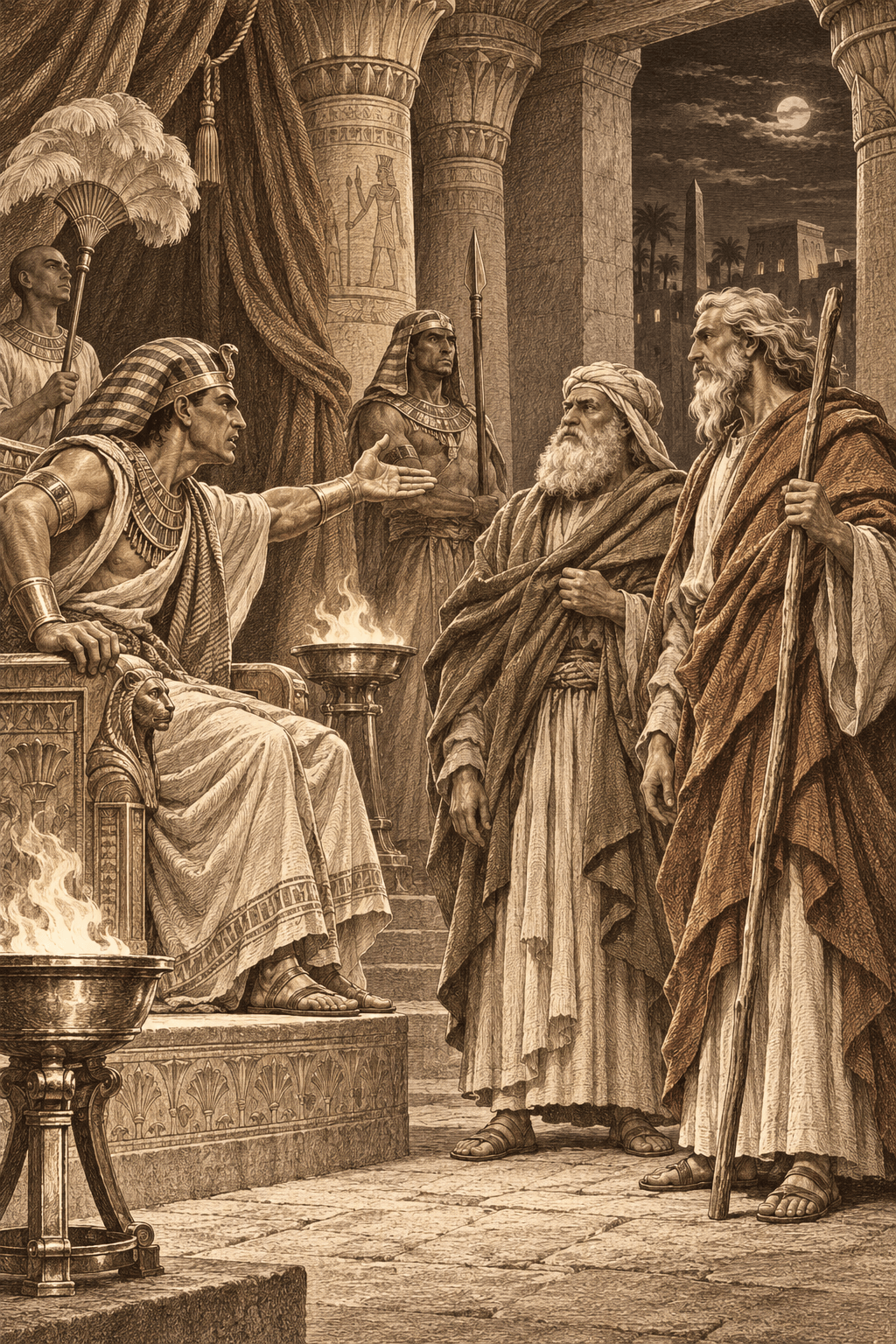
The Going Out of the People
Pharaoh called Moses and Aaron and said to them: “Rise up, and get you forth from among my people… and go, serve the LORD, as ye have said. Also take your flocks and your herds, as ye have said, and be gone; and bless me also” (31–32). And the Egyptians urged them to go out…
So God works in our life: He not only calls us to pass over to Him, and not only kindles the longing in our heart to pass over, but if we persevere to the end, He makes even those who resist us push us to pass over.
The people asked the Egyptians for gold, silver, and raiment, and they gave them. We have seen that this was by divine permission, as a compensation for the wages the Egyptians had robbed them of in the days of forced labor and building houses for them for nothing. It also carried a symbol of sanctifying the energies and feelings that had been used for sin, to become instruments of the righteousness of God. [171] Saint Gregory of Nyssa sees in this act a symbolic picture of the work of the Church, which borrowed from the world its philosophies and sciences and profited from them:
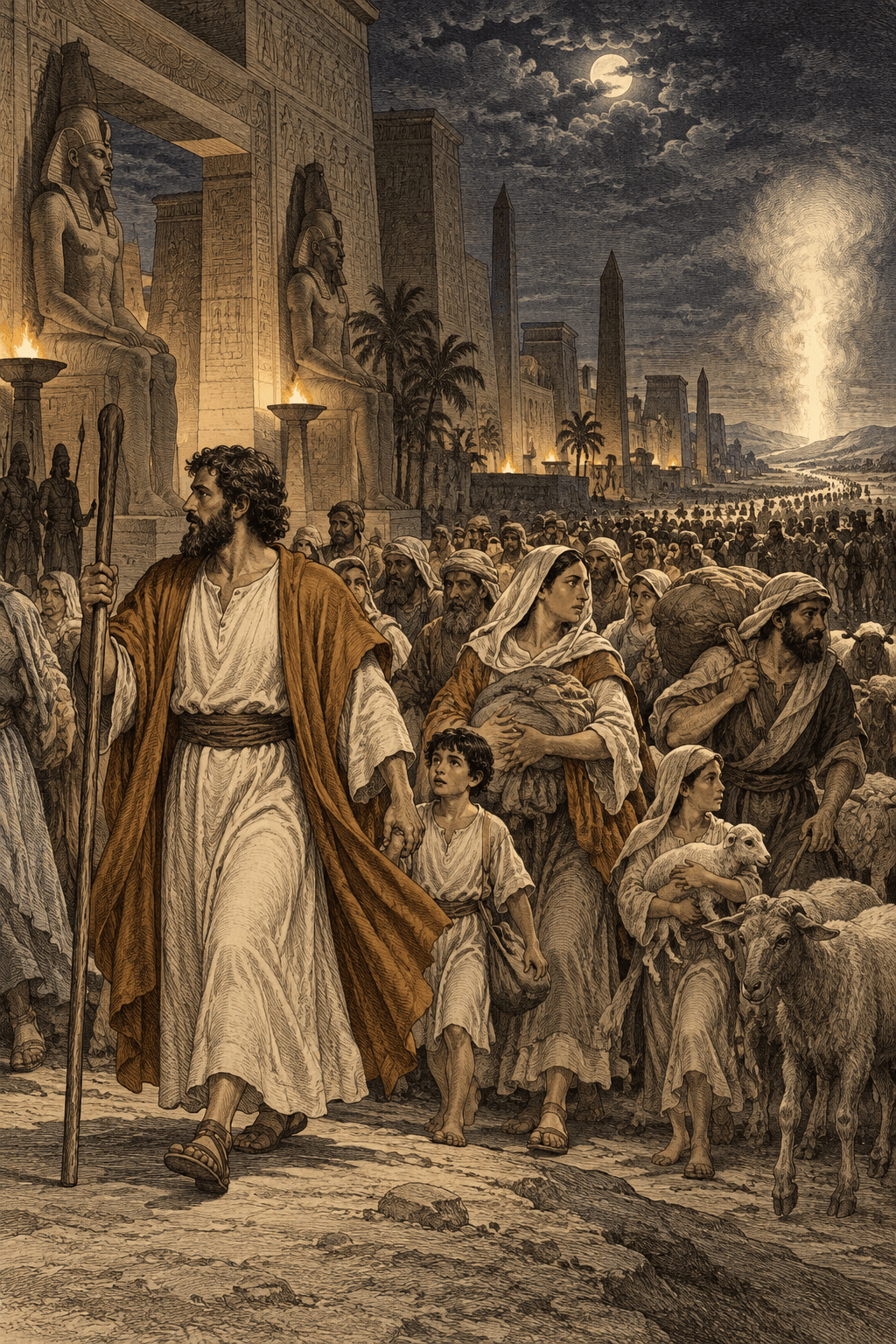
These things become profitable when the mystery of the divine temple is adorned with the riches of the mind. [172]
Many have brought their secular learning to the Church of God as a kind of offering. Among them is Basil the Great, who sought the Egyptian wealth on every side in his youth and dedicated this wealth to God for the adornment of the Church, the true tabernacle of meeting. [173]
The Stations of the Journey
Origen spoke much of the stations of this journey as carrying the features of the soul’s setting out from the land of bondage to the Jerusalem above. God willing, we will try to speak of these stations during our study of this book and of the Book of Numbers.
Rameses: This is the starting point of the journey; from it the people set out to Succoth. For Origen, “Rameses” means “the land of corruption.” It is as if the beginning of the way is a person’s going out from “the land of corruption,” from the provocations of sin and evil; for we cannot enjoy the journey of salvation while we surrender to the places of sin. On this he says:
If you want the Lord to be your leader, going before you in the pillar of cloud, and the rock to go before you, and to eat the spiritual manna and enjoy the spiritual drink, then set out from Rameses: “Lay not up for yourselves treasures upon earth, where moth and rust doth corrupt, and where thieves break through and steal” (Matthew 6:19). And the Lord speaks clearly, saying: “If thou wilt be perfect, go and sell that thou hast, and give to the poor… and come and follow me” (Matthew 19:21). This is the meaning of setting out from Rameses and following Christ. [174]
Succoth: For Origen this means “tents.” It is as if the believer, having left the provocations of sin, must look on his life here as a sojourn. As Origen says:
When you shake off the rust of corruption and depart from the field of vice, you dwell in tents, which we do not wish to put off, but to be clothed upon (2 Corinthians 5:4). He dwells in tents who runs toward God free, without fetters or burdens. [175]
The Number of Those Who Went Out
“About six hundred thousand on foot that were men, beside children” (37).
This number carries a symbol of the passing over of the Church, for it is made up of 6 × 100 × 1000.
The number 6 points to the perfection of human work, for in six days God created the world, and on the sixth day He made man, the most perfect of God’s creatures on earth. It is as if man goes out bearing the fullness of his human abilities, his thoughts, motives, feelings, emotions, and gifts, consecrating his body and spirit perfectly to God. The number 100 points to the completeness of the number of the community; it is as if the whole Church should set out, leaving no living member who does not go out with her toward God. As for the number 1000, as we saw in our commentary on the Book of Revelation, [176] it signifies the heavenly life… It is as if the Church goes out with all her children, with all their spiritual and bodily energies, setting out toward the Jerusalem above with a heavenly mind and a heavenly life.
Their being called “on foot that were men” means that the Church is in continual movement toward heaven, with a spirit of struggle and perseverance without despair; she knows no stopping in her passing over.
The words “beside children” point to their being men who bear continual spiritual fruit.
Notes and References
[132] Fr. Tadros Yacoub Malaty, Saint Cyril of Jerusalem (Arabic).
[133] “Haggadah” means “narration”; here the author describes it as a work containing an interpretation of the Law from which rules of conduct are drawn (see Fr. Tadros Yacoub Malaty, Tradition and Orthodoxy, Arabic, 1980, p. 29).
[134] The Mishnah means “repetition” or “the second law.” It is a collection of the oral legal Jewish tradition, compiled by Rabbi Judah the Prince around A.D. 200, and includes the opinions of the rabbis and teachers (Fr. Tadros Yacoub Malaty, Tradition and Orthodoxy, p. 28).
[135] Fr. Tadros Yacoub Malaty, Christ in the Mystery of the Eucharist (Arabic, 1973), pp. 89–91.
[136] Ibid., p. 93.
[137] A churchman of the second century.
[138] Melito of Sardis, Paschal Homily.
[139] Hippolytus of Rome, The Spiritual Pasch.
[140] Fr. Tadros Yacoub Malaty, Divine Love (Arabic).
[141] Fr. Tadros Yacoub Malaty, Divine Love, pp. 643, 605, 646, 648.
[142] Melito of Sardis, Paschal Homily.
[143] Hippolytus, The Paschal History.
[144] Hippolytus, The Spiritual Pasch.
[145] The Paschal Letters of St. Athanasius the Apostolic, trans. Fr. Tadros Yacoub Malaty and Amal Ibrahim (Arabic, 1967), p. 170.
[146] Hippolytus, The Spiritual Pasch.
[147] St. John Chrysostom, In Joan. hom. 14.
[148] Hippolytus, The Spiritual Pasch.
[149] Hippolytus, The Paschal History.
[150] Lactantius, Divine Institutes 4:26.
[151] Hippolytus, The Paschal History.
[152] Gregory of Nyssa, Life of Moses 2:96.
[153] St. Athanasius, Paschal Letters 3–6.
[154] St. Augustine, On Christian Doctrine 2:41.
[155] Gregory of Nyssa, Life of Moses 2:109.
[156] Origen, Commentary on John 13.
[157] Hippolytus, The Paschal History.
[158] Fr. Tadros Yacoub Malaty, Divine Love, p. 640.
[159] Fr. Tadros Yacoub Malaty, Divine Love, p. 641.
[160] St. Jerome, Epistle 128:2.
[161] St. Augustine, On Psalm 34.
[162] St. John Chrysostom, In Eph. hom. 23.
[163] St. John Cassian, Institutes 1:11.
[164] St. Ambrose, Conc. Rep. 2:3.
[165] St. Athanasius the Apostolic, The Paschal Letters, trans. Fr. Tadros Yacoub Malaty and Amal Ibrahim (Arabic, 1967), p. 169.
[166] Hippolytus, The Paschal History.
[167] St. Athanasius, Paschal Letters 6:11.
[168] Cf. Origen, Commentary on John 12; Athanasius, Paschal Letters 6:2.
[171] See the commentary on chapter 3 (section 7); Tertullian, Against Marcion 4:24.
[172] Gregory of Nyssa, Life of Moses 2:115.
[173] Ibid. 2:116.
[174] Origen, In Exod. hom. 5:2.
[175] Ibid.
[176] Fr. Tadros Yacoub Malaty, The Revelation of St. John the Theologian (Arabic, 1980).