
This chapter speaks of:
- In the wilderness of Sin (1).
- The people’s murmuring (2–3).
- The quails and the manna (4–21).
- The law of the Sabbath (22–31).
- The pot of manna (32–36).
1. In the Wilderness of Sin
KJV · Verses 1
1 And they took their journey from Elim, and all the congregation of the children of Israel came unto the wilderness of Sin, which is between Elim and Sinai, on the fifteenth day of the second month after their departing out of the land of Egypt.
In the Book of Exodus it says: “And they took their journey from Elim, and all the congregation of the children of Israel came unto the wilderness of Sin” (1). The Book of Numbers explains in more detail: “And they removed from Elim, and encamped by the Red sea. And they removed from the Red sea, and encamped in the wilderness of Sin” (Numbers 33:10–11).
Origen sees that Elim means “the rams,” though some think it means “the trees.” In his opinion the rams represent the leaders of the flock, the twelve disciples (the wells of water) and the seventy apostles (the palm trees). These, through Christ Jesus, led the people to the shore of the Red Sea (Numbers 33:10), but on the side full of safety, for they had crossed it once, and in it the devil and his soldiers perished. Now “they can look at the sea and see its waves, but they do not fear its movements or its storms.” [222]
The holy congregation set out from the Red Sea and encamped in the wilderness of Sin, the place where God first sent down manna for the people. Perhaps its site today is Debbet er-Ramleh, a mound of sand at the foot of Jebel et-Tih.
Origen sees that “Sin” means “a bush” or “a trial.” [223] Just as God’s first appearance to Moses was in the bush, to reveal to him the mystery of the divine Incarnation, so in Sin God gave His people manna for the first time, also a sign of the Lord Christ who came down from heaven to satisfy the human soul. Its meaning “trial” reminds us that where there are revelations we must have the spirit of discernment (1 Corinthians 2:15), lest the enemy of good deceive us with his trials, in which he sometimes appears as an angel of light (2 Corinthians 11:14), to lead astray, if possible, even the faithful.
2. The People Murmur
KJV · Verses 2–3
2 And the whole congregation of the children of Israel murmured against Moses and Aaron in the wilderness: 3 And the children of Israel said unto them, Would to God we had died by the hand of the Lord in the land of Egypt, when we sat by the flesh pots, and when we did eat bread to the full; for ye have brought us forth into this wilderness, to kill this whole assembly with hunger.
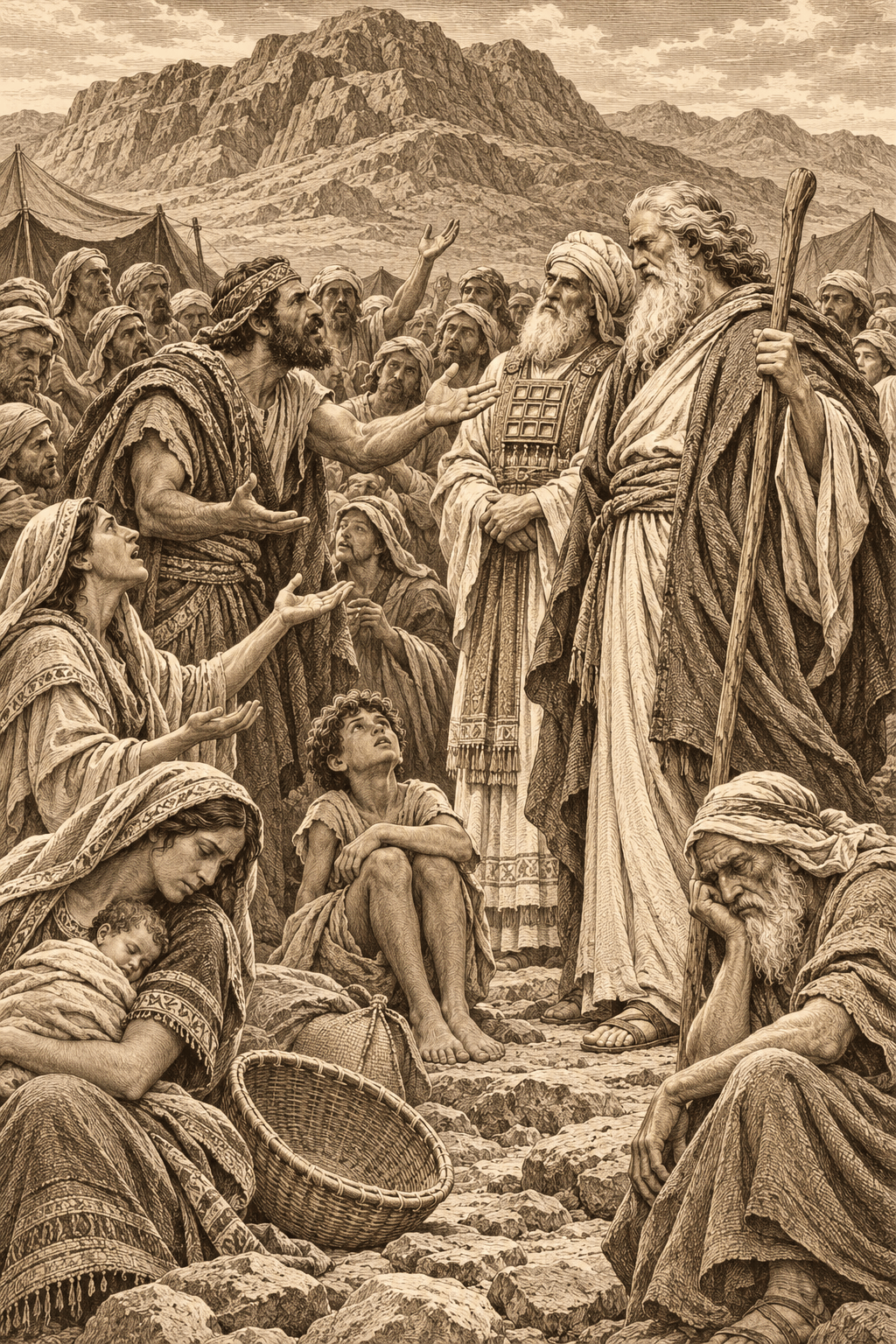
A month after their going out from the land of bondage, they offered God murmuring instead of a song of thanksgiving and praise, for they said to Moses and Aaron: “Would to God we had died by the hand of the LORD in the land of Egypt, when we sat by the flesh pots, and when we did eat bread to the full; for ye have brought us forth into this wilderness, to kill this whole assembly with hunger” (3).
Scripture says that “in their hearts” they “turned back again into Egypt” (Acts 7:39). Truly, they had tasted the bitterness of bondage and humiliation, had experienced a foretaste of the land of promise, and had lived the life of victory and triumph; yet many times they longed for the smell of the flesh pots, for “the lust of the flesh, and the lust of the eyes, and the pride of life” (1 John 2:16). Before the pleasure of base sin a person forgets God’s blessings and graces, desiring humiliation rather than freedom!
Many fathers have warned us against “the demon of gluttony,” lest our god become our belly. As Saint John Chrysostom says:
The Jews remembered the flesh pots, and the great tyranny of the belly appeared. [224]
When Abba Evagrius spoke of the devil’s wars through the eight evil thoughts, he considered “gluttony” the first of these thoughts. [225] Saint John Climacus calls the stomach a tyrant master, and says:
Be master of your stomach before it masters you. He who feeds his gluttony and hopes to overcome the spirit of fornication is like one who tries to put out a fire with oil. [226]
And Father John of Kronstadt says: “Be fully assured that the enemy attacks the heart through the fullness of the belly.”
That is on one side. On the other, murmuring was part of the nature of this people; it dominated their hearts, and they justified it for one reason or another. So Saint John Chrysostom compares them to little children who find every excuse to grumble and run away from school, saying:
The wilderness was a school for them; and like children who have been long in school and want to leave it, these wanted to return to Egypt, weeping and saying: We are lost, we are dead! (3). [227]
Hunger was not the cause of the murmuring; it was their nature. Even after this fresh daily food, for which they did not labor, was given them, as Saint Jerome says:
They despised the food of angels and sighed for the flesh of Egypt. Moses fasted forty days and forty nights on Mount Sinai, showing that man does not live by bread alone, but by the word of God. The Lord says that the people were filled and made idols. Moses received the Law written by the finger of God with an empty stomach; but the people ate and drank and rose up to play before the golden calf, preferring the Egyptian calf to the majesty of the Lord. Truly, the labor of so many days was lost through one hour of fullness. [228]
3. The Quails and the Manna
KJV · Verses 4–21
4 Then said the Lord unto Moses, Behold, I will rain bread from heaven for you; and the people shall go out and gather a certain rate every day, that I may prove them, whether they will walk in my law, or no. 5 And it shall come to pass, that on the sixth day they shall prepare that which they bring in; and it shall be twice as much as they gather daily. 6 And Moses and Aaron said unto all the children of Israel, At even, then ye shall know that the Lord hath brought you out from the land of Egypt: 7 And in the morning, then ye shall see the glory of the Lord; for that he heareth your murmurings against the Lord: and what are we, that ye murmur against us? 8 And Moses said, This shall be, when the Lord shall give you in the evening flesh to eat, and in the morning bread to the full; for that the Lord heareth your murmurings which ye murmur against him: and what are we? your murmurings are not against us, but against the Lord. 9 And Moses spake unto Aaron, Say unto all the congregation of the children of Israel, Come near before the Lord: for he hath heard your murmurings. 10 And it came to pass, as Aaron spake unto the whole congregation of the children of Israel, that they looked toward the wilderness, and, behold, the glory of the Lord appeared in the cloud. 11 And the Lord spake unto Moses, saying, 12 I have heard the murmurings of the children of Israel: speak unto them, saying, At even ye shall eat flesh, and in the morning ye shall be filled with bread; and ye shall know that I am the Lord your God. 13 And it came to pass, that at even the quails came up, and covered the camp: and in the morning the dew lay round about the host. 14 And when the dew that lay was gone up, behold, upon the face of the wilderness there lay a small round thing, as small as the hoar frost on the ground. 15 And when the children of Israel saw it, they said one to another, It is manna: for they wist not what it was. And Moses said unto them, This is the bread which the Lord hath given you to eat. 16 This is the thing which the Lord hath commanded, Gather of it every man according to his eating, an omer for every man, according to the number of your persons; take ye every man for them which are in his tents. 17 And the children of Israel did so, and gathered, some more, some less. 18 And when they did mete it with an omer, he that gathered much had nothing over, and he that gathered little had no lack; they gathered every man according to his eating. 19 And Moses said, Let no man leave of it till the morning. 20 Notwithstanding they hearkened not unto Moses; but some of them left of it until the morning, and it bred worms, and stank: and Moses was wroth with them. 21 And they gathered it every morning, every man according to his eating: and when the sun waxed hot, it melted.
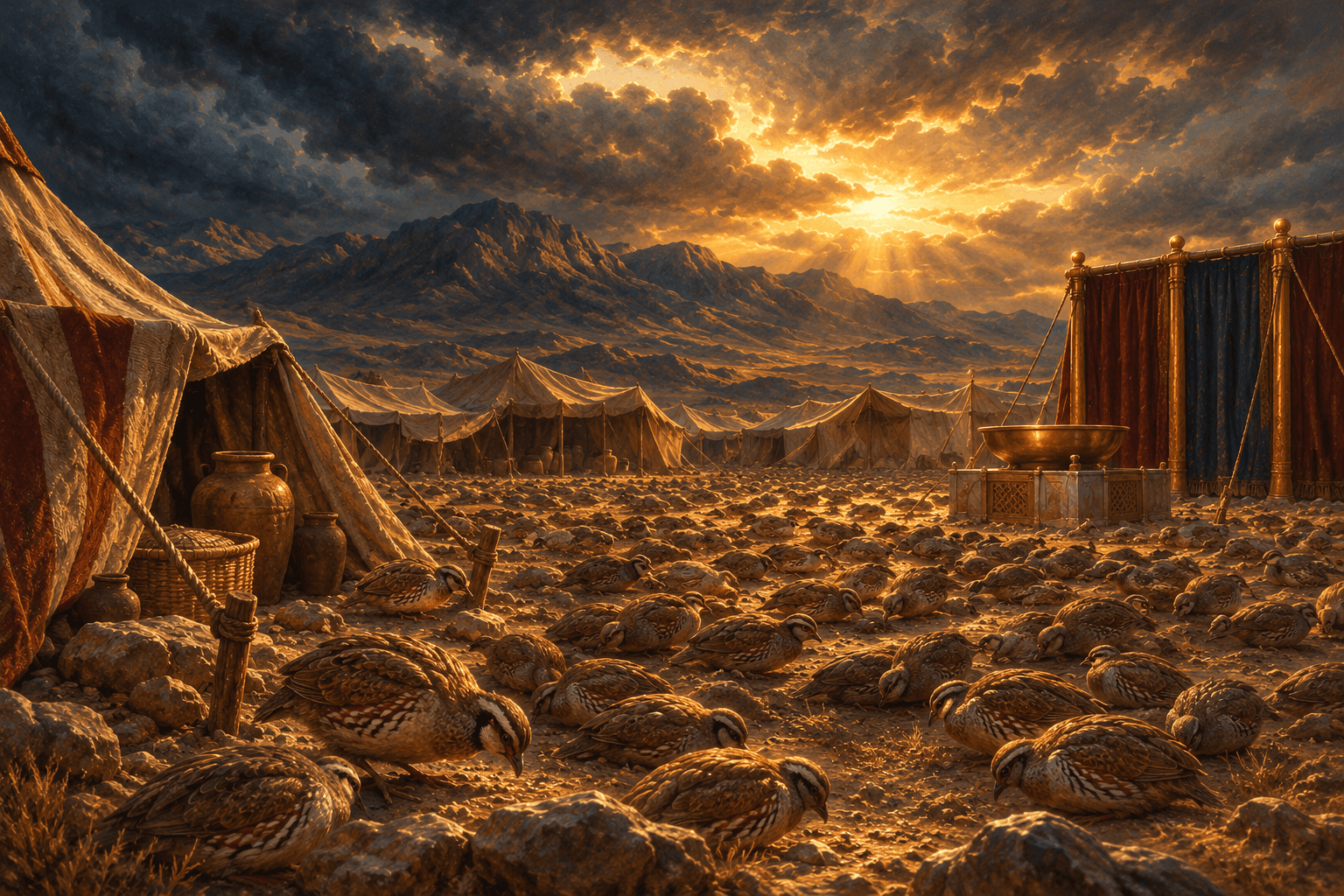
The people murmured, and Moses had no material treasures to satisfy their hunger. But since he had accepted the reproach of Christ, esteeming it greater riches than the treasures in Egypt (Hebrews 11:26), the Lord did not leave him and his people in need of anything. As Saint Ambrose says:
Moses counted the treasures of Egypt loss for himself, showing in his life the reproach of the Lord’s Cross. He was not rich when he had abundant money (in Pharaoh’s palace), nor was he poor when he was in want of food, unless he thought himself less happy when he needed daily food to satisfy his people. But He gave him from heaven the manna, the food of angels, a sign of great good and blessedness… and a stream of flesh rained upon him to satisfy the multitudes. [229]
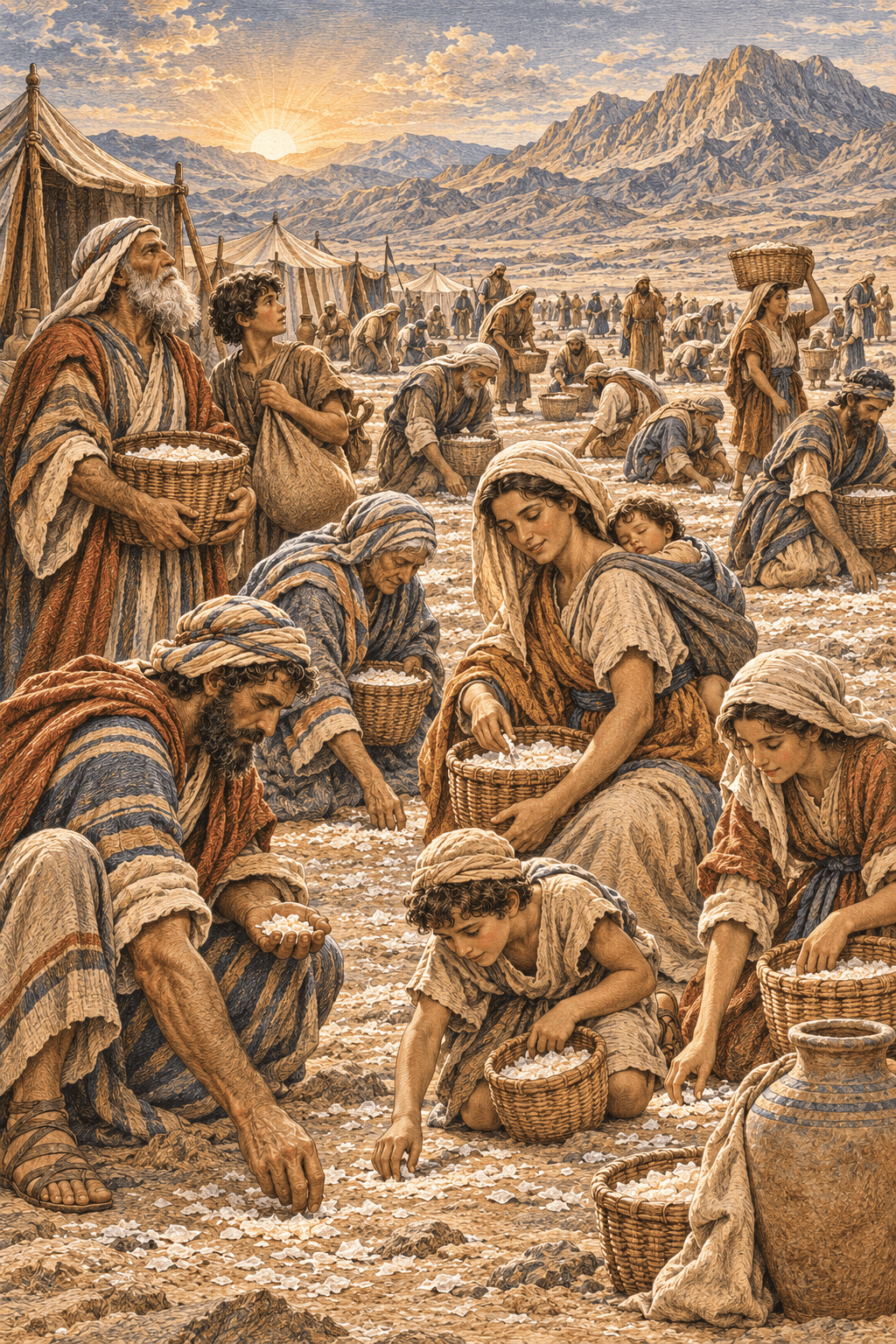
This manna points to the Lord Christ, who gave His holy Body as food for the soul, for He said: “Verily, verily, I say unto you, Moses gave you not that bread from heaven; but my Father giveth you the true bread from heaven. For the bread of God is he which cometh down from heaven, and giveth life unto the world… Your fathers did eat manna in the wilderness, and are dead. This is the bread which cometh down from heaven… if any man eat of this bread, he shall live for ever: and the bread that I will give is my flesh, which I will give for the life of the world” (John 6:32–33, 49–51).
The following is a simple comparison between the old manna and the new manna:
A) After the crossing, the people needed to eat a new food, different from the food of the land of bondage, which would satisfy each one of them. We too, having entered a new covenant, have been given by the Lord a true spiritual food, which can satisfy the soul and grant it eternal life.
Wonderfully, the manna began to come down on the people on Sunday, as is clear from the Lord’s words to Moses: “And it shall come to pass, that on the sixth day they shall prepare that which they bring in; and it shall be twice as much as they gather daily” (5). The day of preparation for the Sabbath (Friday) was the sixth day on which the manna came down, so it began to come down on Sunday. By the resurrection of the Lord Christ from the dead at dawn on Sunday, He gave us His Body risen from the dead, the mystery of the resurrection of our souls and bodies. Sunday became the weekly feast of the Church, on which we enjoy the heavenly manna.
B) The manna fell from heaven (4), and each one took as much as he needed, “every man according to his eating” (18), and all were satisfied. The Lord Christ, the Word of God, came down from heaven and offered Himself as the mystery of fullness for all. He offered Himself as milk for babes and as strong meat for the mature, so as to leave no soul in want or hunger.
C) Those who took the manna without faith, disobeying the commandment and keeping it for the next day, found that it bred worms and stank. So whoever partakes of the Lord’s Body without faith and unworthily carries in himself the savour of death instead of the life and sweetness which the faithful taste when they enjoy it. The word of God is like the manna: it is a mystery of life for the repentant faithful and a mystery of destruction for those who persist in unbelief. On this Origen says:
In the manna now there is the sweetness of honey for the faithful, and worms for the unbelievers. The Word of God (the Lord Christ) refutes evil thoughts, pricks the conscience of sinners with sharp goads, and kindles fire in the hearts of those who open to Him, so that they say: “Did not our heart burn within us, while… he opened to us the scriptures?” (Luke 24:32). On the other hand, He is a fire that burns the thorns on the bad ground. [230]
Whoever gathers manna to keep it without eating it, that is, walks against the commandment and without faith, is like one who studies Holy Scripture and comes to know the Christian faith in a theoretical way; his faith is dead, as our teacher James the Apostle says (James 2:14–17, 26). On this Origen says:
If the unbeliever takes the word of God and does not eat it (that is, live by it), but hides it, worms are bred in it. [231]
D) Moses the prophet said: “The LORD shall give you in the evening flesh to eat, and in the morning bread to the full” (8). What is this evening but the last times, or the fullness of time, in which the Word of God took flesh, offering Himself for us to eat and be satisfied! By His coming in the fullness of time, in the midst of the darkness in the evening, He shone His light upon us; our evening was turned into day, and we entered a new morning, in which He gave us a new bread with which believing humanity is satisfied.
Again he says: “At even, then ye shall know that the LORD hath brought you out from the land of Egypt: And in the morning, then ye shall see the glory of the LORD” (6–7). What is this evening but those moments in which the Lord Christ gave up His spirit into the hands of the Father, when darkness covered the face of the earth, and He brought us out of the bondage of the devil and set free those who were in Hades?! And what is this morning in which we saw the glory of the Lord but the dawn of Sunday, on which He rose from the dead and gave us the power and joy of His resurrection?!
E) The people did not know the manna, for “they wist not what it was” (15); and the people were perplexed about the truth of the Lord Christ (1 Corinthians 2:8).
F) The manna came down around the tents, which point to our bodies; and the Lord Christ came to our dwellings and in our flesh, becoming as one of us.
G) The manna came down after the people murmured; and the Lord Christ came after enmity had arisen between us and God, as Paul the Apostle says: “When we were enemies, we were reconciled to God by the death of his Son” (Romans 5:10). By sending the manna God declared His love and kindness, in spite of His people’s murmuring against Him; and the coming of the Lord Christ to us is a sign of God’s care and infinite love.
H) The manna is described as “white” (31), and the garments of the holy Lord Christ became “exceeding white as snow” (Mark 9:3).
I) The taste of the manna was “like wafers made with honey” (31), and the Lord Christ, “His mouth is most sweet: yea, he is altogether lovely” (Song of Solomon 5:16).
J) The people gathered the manna “every morning” (21)… and our fellowship with our Lord Jesus Christ is renewed every day, and our meeting with Him is very early: “Those that seek me early shall find me” (Proverbs 8:17).
K) The manna was gathered, ground, beaten, and cooked to become fit to eat (Numbers 11:8); and the Lord Christ came incarnate, was crucified, suffered, and died, and became food and a mystery of life for whoever eats Him (Mark 14:22–24).
L) When the people despised the manna, God struck them with a very great plague (Numbers 11:33); and whoever eats the Body of the Lord unworthily eats judgment to himself (1 Corinthians 11:27–29).
Finally, when we speak of the manna we find in it a living picture of fullness and contentment, but without excess luxury or gluttony. Saint John Chrysostom says:
We have only one stomach to fill. But you who want to feed it with excessive luxury offer it what it wants to be rid of. Just as those who gathered (manna) more than they should found that they had gathered worms and stench, not manna, so those who live in luxury, greed, gluttony, and drunkenness gather for themselves corruption, not delicious food. [232]
4. The Law of the Sabbath
KJV · Verses 22–31
22 And it came to pass, that on the sixth day they gathered twice as much bread, two omers for one man: and all the rulers of the congregation came and told Moses. 23 And he said unto them, This is that which the Lord hath said, To morrow is the rest of the holy sabbath unto the Lord: bake that which ye will bake to day, and seethe that ye will seethe; and that which remaineth over lay up for you to be kept until the morning. 24 And they laid it up till the morning, as Moses bade: and it did not stink, neither was there any worm therein. 25 And Moses said, Eat that to day; for to day is a sabbath unto the Lord: to day ye shall not find it in the field. 26 Six days ye shall gather it; but on the seventh day, which is the sabbath, in it there shall be none. 27 And it came to pass, that there went out some of the people on the seventh day for to gather, and they found none. 28 And the Lord said unto Moses, How long refuse ye to keep my commandments and my laws? 29 See, for that the Lord hath given you the sabbath, therefore he giveth you on the sixth day the bread of two days; abide ye every man in his place, let no man go out of his place on the seventh day. 30 So the people rested on the seventh day. 31 And the house of Israel called the name thereof Manna: and it was like coriander seed, white; and the taste of it was like wafers made with honey.
Whoever gathered extra manna for the next day gathered worms and stench, and became the object of God’s displeasure and the anger of Moses the prophet. But when the day of preparation for the Sabbath came, all were bound to gather twice as much. This was a sign of gathering and keeping for the great day of rest. As Saint Gregory of Nyssa says:
This (preceding) day is the present life, in which we prepare ourselves for the things to come. [233]
What do we prepare for the life to come? The Apostle says: “For he that soweth to his flesh shall of the flesh reap corruption; but he that soweth to the Spirit shall of the Spirit reap life everlasting” (Galatians 6:8). Origen says:
On the sixth day we must gather and store what is enough for the next day. If you gather good works here, if you store up here treasures of righteousness, mercy, and godliness, they will be your food in the age to come. Do you not hear in the Gospel that he who gained ten talents received in return ten cities, and he who gained five talents received five cities (Luke 19:17–19)? This is what the Apostle tells us in another way: “Whatsoever a man soweth, that shall he also reap” (Galatians 6:7). [234]
He also says:
Whatever was stored for the Sabbath did not spoil, nor did worms come in it, but it remained sound. But if you store up for the present life out of love for this world, worms will be bred in you. [235]
5. The Pot of Manna
KJV · Verses 32–36
32 And Moses said, This is the thing which the Lord commandeth, Fill an omer of it to be kept for your generations; that they may see the bread wherewith I have fed you in the wilderness, when I brought you forth from the land of Egypt. 33 And Moses said unto Aaron, Take a pot, and put an omer full of manna therein, and lay it up before the Lord, to be kept for your generations. 34 As the Lord commanded Moses, so Aaron laid it up before the Testimony, to be kept. 35 And the children of Israel did eat manna forty years, until they came to a land inhabited; they did eat manna, until they came unto the borders of the land of Canaan. 36 Now an omer is the tenth part of an ephah.
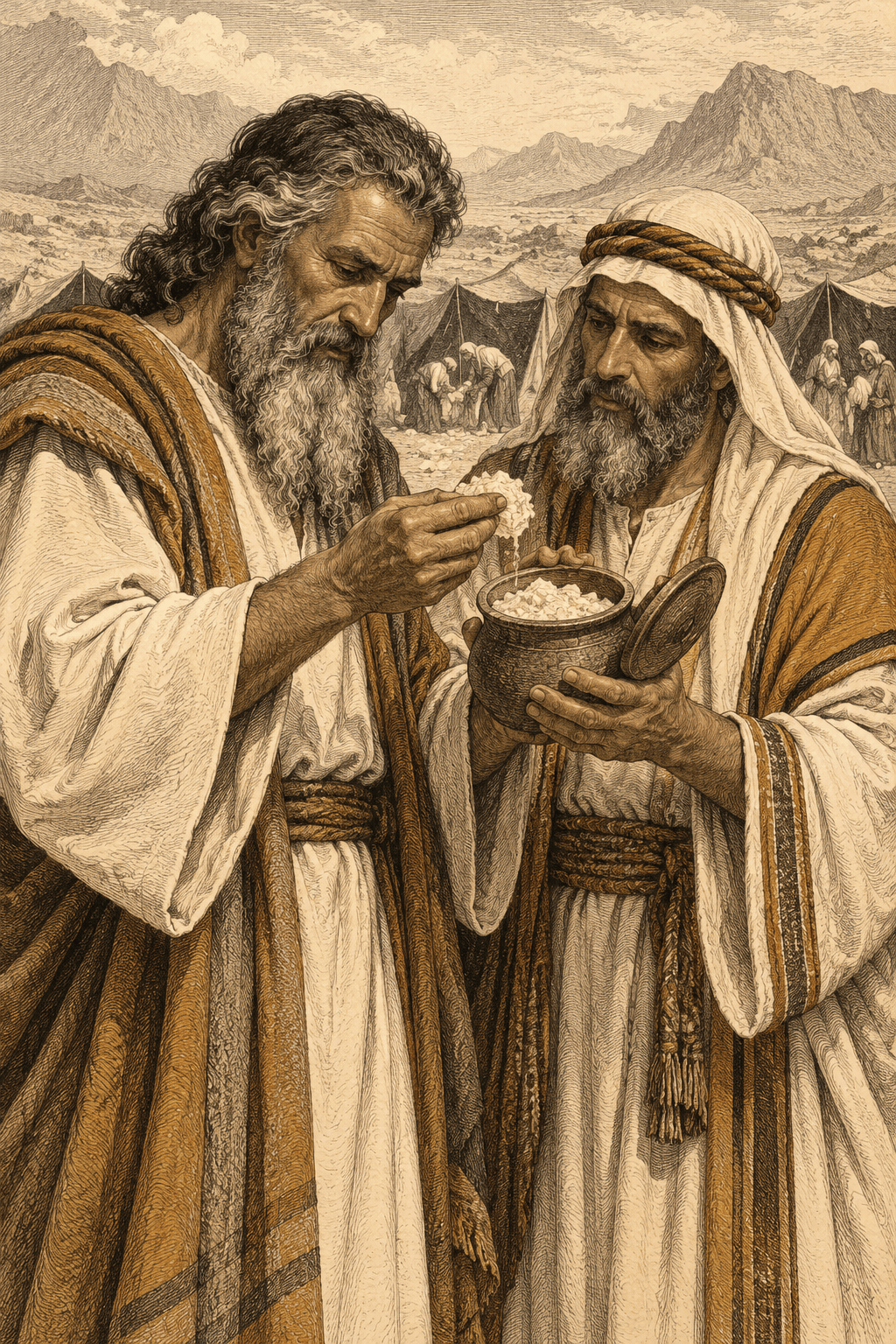
Moses commanded Aaron to take a pot and put an omer full of manna in it, and lay it up before the Lord (33); later it was placed in the ark of the covenant (Hebrews 9:4). It remained a memorial of God’s work with them, and bears symbolic witness to the coming of the Lord Christ, the true manna that came down from heaven. The Church has seen in the pot a symbol of Saint Mary, who bore the Lord Christ in her womb.
Notes and References
[222] Origen, In Num. hom. 27.
[223] Ibid.
[224] St. John Chrysostom, In Matt. hom. 8:6.
[225] Evagrius, To Anatolius, On the Eight Thoughts.
[226] St. John Climacus, The Ladder of Divine Ascent, Step 14.
[227] St. John Chrysostom, In Col. hom. 4.
[228] St. Jerome, Against Jovinianus 2:15.
[229] St. Ambrose, Duties of the Clergy 2:4.
[230] Origen, In Exod. hom. 7:8.
[231] Ibid.
[232] St. John Chrysostom, In 1 Cor. hom. 20:5.
[233] Gregory of Nyssa, Life of Moses 2:144.
[234] Origen, In Exod. hom. 7:5.
[235] Ibid. 7:6.