
This chapter contains:
- The song of victory (1–19).
- Miriam the singer (20–21).
- From Marah to Elim (22–27).
1. The Song of Victory
KJV · Verses 1–19
1 Then sang Moses and the children of Israel this song unto the Lord, and spake, saying, I will sing unto the Lord, for he hath triumphed gloriously: the horse and his rider hath he thrown into the sea. 2 The Lord is my strength and song, and he is become my salvation: he is my God, and I will prepare him an habitation; my father's God, and I will exalt him. 3 The Lord is a man of war: the Lord is his name. 4 Pharaoh's chariots and his host hath he cast into the sea: his chosen captains also are drowned in the Red sea. 5 The depths have covered them: they sank into the bottom as a stone. 6 Thy right hand, O Lord, is become glorious in power: thy right hand, O Lord, hath dashed in pieces the enemy. 7 And in the greatness of thine excellency thou hast overthrown them that rose up against thee: thou sentest forth thy wrath, which consumed them as stubble. 8 And with the blast of thy nostrils the waters were gathered together, the floods stood upright as an heap, and the depths were congealed in the heart of the sea. 9 The enemy said, I will pursue, I will overtake, I will divide the spoil; my lust shall be satisfied upon them; I will draw my sword, my hand shall destroy them. 10 Thou didst blow with thy wind, the sea covered them: they sank as lead in the mighty waters. 11 Who is like unto thee, O Lord, among the gods? who is like thee, glorious in holiness, fearful in praises, doing wonders? 12 Thou stretchedst out thy right hand, the earth swallowed them. 13 Thou in thy mercy hast led forth the people which thou hast redeemed: thou hast guided them in thy strength unto thy holy habitation. 14 The people shall hear, and be afraid: sorrow shall take hold on the inhabitants of Palestina. 15 Then the dukes of Edom shall be amazed; the mighty men of Moab, trembling shall take hold upon them; all the inhabitants of Canaan shall melt away. 16 Fear and dread shall fall upon them; by the greatness of thine arm they shall be as still as a stone; till thy people pass over, O Lord, till the people pass over, which thou hast purchased. 17 Thou shalt bring them in, and plant them in the mountain of thine inheritance, in the place, O Lord, which thou hast made for thee to dwell in, in the Sanctuary, O Lord, which thy hands have established. 18 The Lord shall reign for ever and ever. 19 For the horse of Pharaoh went in with his chariots and with his horsemen into the sea, and the Lord brought again the waters of the sea upon them; but the children of Israel went on dry land in the midst of the sea.
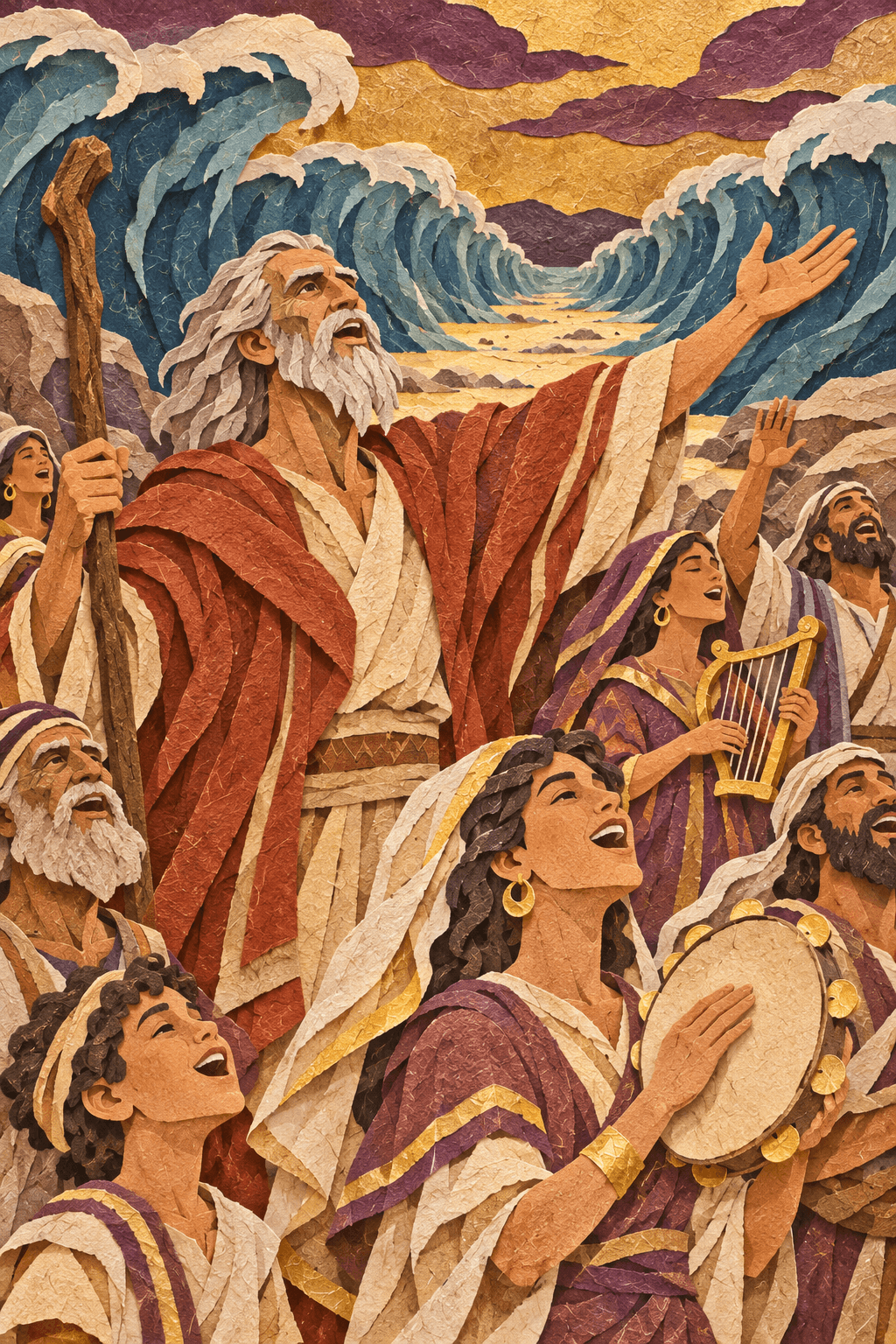
This song symbolizes the song of the redeemed in heaven, whom God has saved and brought over from the world to heaven; it is sung there with the Lord Christ (Revelation 15:3).
Therefore the Church has placed it in the daily Psalmody as “the First Hoos,” [197] to assure her children of the necessity of praising God and offering continual thanks for His work of salvation with us, for He grants us daily victory over the devil and his soldiers, not by our human arm, but through the work of His grace in us.
Note that Moses and the people did not utter praise until after they had been baptized and had seen God’s wonderful salvation. So, through baptism, when we are buried with our crucified Christ and rise with Him in newness of life, our inner tongue is opened to praise the Lord and thank Him.
This song became a living part of Moses’ life. When Pope Athanasius the Apostolic spoke in one of his letters about the Christian feast of the Passover, he said that the saints spend their whole life as those who rejoice in the feast: one finds his rest in prayer, like David the prophet; another gives glory to God through songs of praise, like Moses; and others worship with perseverance, like the great Samuel and the blessed Elijah. [198]… It is as if, by this song, Moses became an example of the life of praise to God.
This song carries beautiful expressions and meanings that would need a separate book, but here I will be content to present some of its passages:
“I will sing unto the LORD, for he hath triumphed gloriously: the horse and his rider hath he thrown into the sea” (1).
The song begins by glorifying the Lord, who was glorified by the Cross, where He trampled the devil and all his powers, to set free those he had taken captive… It is a sweet song which the Christian sings every day when he sees sin fall by the Cross under his feet. As Saint Athanasius the Apostolic says:
Let us sing with Moses… and praise with psalms, as we see the sin that was in us thrown into the sea, while we pass over into the wilderness. [199]
“They sank into the bottom as a stone” (5).
Saint Gregory of Nyssa [200] says that the person who walks in the virtuous life is light in weight, but the wicked person is heavy and sinks in the waters. Virtue is light and floats on the waters, and those who walk in its way fly as a cloud, and as the doves with their small wings (Isaiah 60:8); but sin is heavy, like lead (Zechariah 5:7).
The saint took this thought from his teacher, Origen of Alexandria, who said:
Why did they sink? Because they were not of the stones from which children are raised up to Abraham; they were lovers of low places and of liquids (fluid things), seeking pleasure… and fleeing from reality. Therefore it is said of them: “They sank as lead in the mighty waters” (10). So sinners carry a weight of evils, to which Zechariah the prophet pointed, saying: “And, behold, there was lifted up a talent of lead: and this is a woman that sitteth in the midst of the ephah” (Zechariah 5:7). When he asked who she was, he was told: “This is wickedness” (Zechariah 5:8). Therefore it is said of the wicked that they sank as lead in the mighty waters… But the saints do not sink; they walk on the waters… for there is no weight of sin in them to make them sink. Our Lord and Savior walked on the waters (Matthew 14:25), He who in truth knows no sin; and His disciple Peter walked, though he was a little afraid, for his heart was not wholly pure, but he carried within him some lead… Therefore the Lord said to him: “O thou of little faith, wherefore didst thou doubt?” (Matthew 14:31). He who is saved is saved “yet so as by fire” (1 Corinthians 3:15), so that if lead is found in him, it is melted. [201]
So the wicked are like stones that refused to accept the work of the Holy Spirit in them to become children of Abraham, and like lead that sinks in the waters, that is, they sink in pleasures; but the saints are like gold refined by fire.
“Thy right hand, O LORD, is become glorious in power: thy right hand, O LORD, hath dashed in pieces the enemy” (6).
Saint Ambrose [202] sees the work of the Holy Trinity clearly in this song. In this phrase he confesses the Son, who is “the right hand of the Lord”; and shortly after he speaks of the work of the Holy Spirit: “Thou didst blow with thy wind, the sea covered them” (10), He who works in the mystery of “baptism,” destroying evil and saving the children of God. [203]
“The enemy said, I will pursue, I will overtake, I will divide the spoil; my lust shall be satisfied upon them; I will draw my sword, my hand shall destroy them” (9).
This is the work of the devil: continual terror and persecution. Therefore, when Pope Athanasius defended his flight from the face of the Arians who persecuted him, he cited this verse and commented on it:
The Lord commanded us to flee, and the saints fled. But persecution is an evil, the work of the devil, which he wants to practice against all. [204]
In a discourse of Saint Anthony in the book of Pope Athanasius the Apostolic about him, he says:
The demons deceive the righteous with their boasts… But even in this we must not fear the appearance nor pay attention to his words, for the devil is a liar and speaks not one word of truth. He speaks very much and shows such great boldness, but without doubt, like leviathan, he is caught by the Savior with a hook (Job 41:1). [205]
The enemy tried to use the same method with the Lord Christ, thinking he could cut off His name from the land of the living; but the enemy’s threats did not shake the heart of the Lord Christ, but crushed the enemy himself.
“Who is like unto thee, O LORD, among the gods?” (11).
There is none like God in His power and His love, and in His nature as incomprehensible, invisible, and unchangeable, without beginning or end. He who has no likeness has given us, by adoption, to be counted His children, that we may become like Him, as John the Apostle says: “Beloved, now are we the sons of God, and it doth not yet appear what we shall be: but we know that, when he shall appear, we shall be like him; for we shall see him as he is” (1 John 3:2).
“Thou stretchedst out thy right hand, the earth swallowed them” (12).
Origen comments on this phrase:
Today the earth swallows the wicked. Do you not see that the earth swallows whoever has nothing but earthly thoughts and deeds…?! He desires the earth and places all his hope in it; he does not lift his eyes to heaven, nor think of the life to come, nor fear the judgment of God, nor seek His promises in eternity; he is always thinking of present things, running after earthly things. If you see such a man, say that the earth has swallowed him. If you see a man poured out on the desires and lusts of the flesh, and see his spirit without strength because the flesh dominates his whole life, say that the earth has swallowed this man.
One more thing remains for me, for it is said: “Thou stretchedst out thy right hand, the earth swallowed them.” The Lord stretched out His hand and the earth swallowed them. Consider the Lord stretching out His hands over this treacherous people, who cried, Crucify Him, crucify Him… and He punished them with death… [206]
The earth swallowed proud Pharaoh, who thought he would destroy the people of God. But to those whom Hades had swallowed the Lord Christ descended; He descended into the lower parts of the earth (Ephesians 4:9) to bring them out of its depths and lift them up, not to the surface of the earth, but into the dwelling of His holiness.
“Till thy people pass over, O LORD, till the people pass over, which thou hast purchased” (16).
Moses the prophet repeated “till thy people pass over” to declare that the goal of the work is salvation and passing over into eternity, and to affirm that those who pass over are one people from two origins, Jewish and Gentile.
“Thou shalt bring them in, and plant them in the mountain of thine inheritance” (17).
Origen says:
God does not want to plant us in Egypt (the love of the world), nor in corrupt and evil places, but wants to establish us in the mountain of His inheritance. Do not the words “Thou shalt bring them in, and plant them” seem as though He speaks of children whom He leads to school to be educated in every kind of learning… Let us understand that He does not plant it in the valleys but on the mountains, in high and lofty places. He does not want to leave those who came out of Egypt in the depths, but leads them from the world to faith. He wants to establish them on the heights. He wants us to dwell on high, not to crawl on the earth. He does not want His vine to touch the ground with its fruit, but to grow without its branches being entangled with any shrub, cleaving to the high and lofty cedars of God (Psalm 80:10). The cedars of God, in my view, are the prophets and apostles; if we, the vine which God brought out of Egypt, cleave to them, our branches grow with their branches. If we lean on them, we become branches planted with the bonds of mutual love, and we shall without doubt bring forth much fruit. [207]
“In the Sanctuary, O Lord, which thy hands have established” (17).
Origen says:
What is the sanctuary which no man set up, but the Lord established? “Wisdom hath builded her house” (Proverbs 9:1). This concerns the Incarnation of the Lord, for the body He took was not of the seed of man; the building was raised in the Virgin, as Daniel prophesied: “A stone was cut out without hands… and the stone… became a great mountain” (Daniel 2:34–35). This is the sanctuary which appeared in the flesh, which was cut out without hands, that is, not made by man. [208]
“But the children of Israel went on dry land in the midst of the sea” (19).
Origen says:
If you too are of the (new) Israel, you can walk on dry land in the midst of the sea. If you find yourself in the midst of a crooked and perverse generation, you shine among them as lights in the world, holding forth the word of life, that I may rejoice (Philippians 2:15–16). You may walk among sinners without the waters of sin touching you; you may walk in the midst of this world without the waters of lust turning back upon you… Whoever follows Christ walks like Him (on the waters), and the waters are a wall to him on his right hand and on his left (Exodus 14:22). He walks on dry land until he reaches freedom, singing to the Lord the song of victory: “I will sing unto the LORD, for he hath triumphed gloriously” (1). [209]
2. Miriam the Singer
KJV · Verses 20–21
20 And Miriam the prophetess, the sister of Aaron, took a timbrel in her hand; and all the women went out after her with timbrels and with dances. 21 And Miriam answered them, Sing ye to the Lord, for he hath triumphed gloriously; the horse and his rider hath he thrown into the sea.
Saint Jerome sees in Miriam, the sister of Aaron, as a spiritual leader of the women of that time, a living picture of the work of women in the Church: one who consecrates her life to praising the Lord and teaching others this work. In a letter he sent to the widow Furia, who had thought of marrying and then gave up the idea, he wrote:
Miriam taught her companions to be musicians, but for Christ; to play the lyre, but for the Savior. She spends day and night in this work, and so makes oil for the lamps, and makes ready, waiting for the coming of the Bridegroom. [210]
Saint Ambrose also saw in her a symbolic picture of the Church, ever singing to the Lord. In his discourse on virgins he said:
Was she not a figure of the virgin Church, with a spotless spirit, gathering the devout multitudes to sing the divine hymns?! For we hear that there were virgins devoted to this in the temple at Jerusalem?! [211]
In the same discourse [212] he also spoke of what Miriam did with the women, that they represent the chariot of heaven, and that the heavenly ones rejoiced when they saw the earthly ones going out and setting forth toward heaven.
3. From Marah to Elim
KJV · Verses 22–27
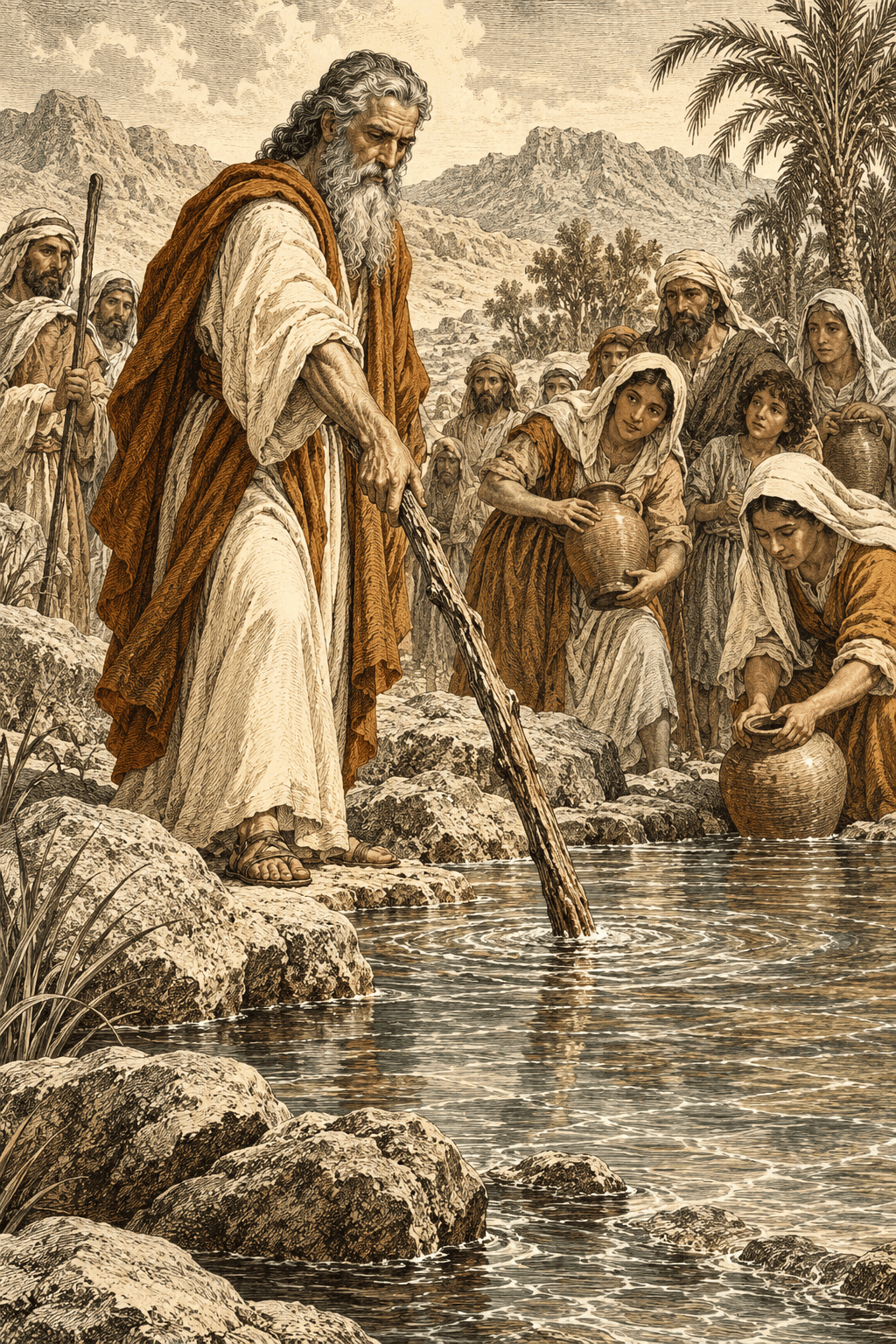
22 So Moses brought Israel from the Red sea, and they went out into the wilderness of Shur; and they went three days in the wilderness, and found no water. 23 And when they came to Marah, they could not drink of the waters of Marah, for they were bitter: therefore the name of it was called Marah. 24 And the people murmured against Moses, saying, What shall we drink? 25 And he cried unto the Lord; and the Lord shewed him a tree, which when he had cast into the waters, the waters were made sweet: there he made for them a statute and an ordinance, and there he proved them, 26 And said, If thou wilt diligently hearken to the voice of the Lord thy God, and wilt do that which is right in his sight, and wilt give ear to his commandments, and keep all his statutes, I will put none of these diseases upon thee, which I have brought upon the Egyptians: for I am the Lord that healeth thee. 27 And they came to Elim, where were twelve wells of water, and threescore and ten palm trees: and they encamped there by the waters.
The way of the wilderness is a way of entering into many tribulations; or rather, it is the way of experiencing God’s work in our life in the midst of sufferings, and of the opening of the heart toward heavenly things.
No sooner had the people crossed and rejoiced and exulted than their joys turned into bitterness and distress. They felt thirst and murmured against Moses (24), for they found bitter water that could not satisfy them. Moses the prophet cast the tree into the bitter waters, and they were made sweet.
What are these bitter waters but the commandments of the Law, which gave man bitterness because of his inability to carry them out? But the Lord Christ, the Tree of Life, [213] entered into the commandment, made the Law spiritual, and made it refreshing to the soul. On this Origen says:
The cup of the Law is bitter… But if we cast into it the tree of the wisdom of Christ, who reveals to us how we should understand circumcision and the sabbaths, keep the law of leprosy, and distinguish between the unclean and the clean, then the waters of Marah become sweet, and the letter of the Law is turned into the sweetness of the spiritual meaning; then the people of God can drink. [214]
He also says:
If anyone wants to drink from the letter of the Law apart from the Tree of Life, that is, apart from the mysteries of the Cross, apart from faith in Christ and spiritual understanding, he perishes from the terrible bitterness. Paul understood this truth and said: “The letter killeth” (2 Corinthians 3:6), that is, the bitter waters kill if they are drunk as they are, before they become sweet. [215]
And he says:
When the wood of the Cross entered into the commandment it made it sweet, for it came to be carried out spiritually, and so these same commandments became for life. [216]
Many of the fathers see in the tree a symbol of the Cross, which works in the waters of baptism, so that our life is turned from bitterness to sweetness, and instead of the works of the old man that we bore, we enjoy the new nature which has become ours in Christ Jesus. [217]
Saint Ambrose says:
Marah was a spring of very bitter water; when Moses cast the tree into it, it became sweet water. For water without the preaching of the Cross of the Lord is of no use for the salvation to come. But after it has been consecrated by the mystery of the saving Cross, it becomes fit for use in the spiritual font and the cup of salvation. For as Moses the prophet cast the wood into that spring, so also the priest pronounces over the baptismal font the testimony of the Cross of the Lord, and the water becomes sweet through the work of grace. [218]
Saint Gregory of Nyssa sees in the wood “the mystery of the resurrection” through the Cross of the Lord, by which the virtuous life, with its struggle and bitterness, is turned into an easy and sweet life. He says:
The person who leaves behind the (Egyptian) pleasures which he served before crossing the sea finds that the life which seemed to him hard and unacceptable without these pleasures, when the wood is cast into it, that is, when he receives the mystery of the resurrection which begins with the wood (by the wood, of course, the Cross is understood), then the virtuous life becomes sweet through hope in the things to come, even sweeter and more pleasant than what the senses experience through pleasures. [219]
If Marah carried a sign of the Law made spiritual by the Cross, and of baptism with the work of the Cross and the power of the resurrection in it, the people had to pass from Marah to Elim (27), that is, pass from the Law to the New Covenant. There they found twelve wells of water and seventy palm trees, a sign of the twelve disciples and the seventy apostles.
On this Origen says:
God did not intend to bring the people to Elim from the beginning, where there are twelve wells of water wholly free from all bitterness, and where there is a place of rest in the shade of the palm trees… When the bitterness of the Law is made sweet by the tree of life (Proverbs 3:18), then we understand the Law spiritually, and the passing over from the Old Covenant to the New is accomplished. In this way we reach the twelve apostolic wells of water, and at the same time we find seventy palm trees… It is not enough for the people of God to drink the waters of Marah after they have been made sweet by the tree of life, and through the loftiness of the Cross have lost the bitterness of the letter; for the Old Covenant alone is not enough to drink, but we must come to the New Covenant to drink from it without difficulty… [220]
Saint Gregory of Nyssa says:
The mystery of the wood, through which the waters of virtue become delightful to the thirsty, leads us to the twelve springs of water and the seventy trees, that is, to the teachings of the Gospel. [221]
Notes and References
[197] The word “hoos” means a hymn or song of praise.
[198] St. Athanasius, Paschal Letters 14.
[199] St. Athanasius, Paschal Letters 3.
[200] Gregory of Nyssa, On Virginity 18.
[201] Origen, In Exod. hom. 6.
[202] St. Ambrose, On the Holy Spirit 3:10.
[203] St. Ambrose, On the Mysteries 3.
[204] St. Athanasius, Apology for His Flight.
[205] St. Athanasius, Life of Antony 24.
[206] Origen, In Exod. hom. 6.
[207] Origen, In Exod. hom. 6:10.
[208] Ibid. 6:12.
[209] Ibid. 6:14.
[210] St. Jerome, Epistle 54:14.
[211] St. Ambrose, Concerning Virgins 1:3.
[212] Ibid. 2:2.
[213] The Old Testament often points to the Lord Christ as a branch or shoot of a tree (Isaiah 53:2; 11:1; Zechariah 6:12; Jeremiah 23:5).
[214] Origen, In Exod. hom. 7:1.
[215] Ibid.
[216] Ibid. 7:2.
[217] Justin, Dialogue 86; Cyril of Jerusalem, Catechetical Lectures 13:20; Aphrahat, Demonstrations 21:10; Gregory of Nyssa, Adv. eos qui differunt baptismum.
[218] Fr. Tadros Yacoub Malaty, Divine Love (Arabic), p. 859, from St. Ambrose, On the Mysteries 3.
[219] Gregory of Nyssa, Life of Moses 2:132.
[220] Origen, In Exod. hom. 7:3.
[221] Gregory of Nyssa, Life of Moses 2:133.