
This chapter speaks of:
- At Rephidim (1).
- The people’s murmuring (2–4).
- The rock that gushed with water (5–7).
- The war with Amalek (8–16).
1. At Rephidim
KJV · Verses 1
1 And all the congregation of the children of Israel journeyed from the wilderness of Sin, after their journeys, according to the commandment of the Lord, and pitched in Rephidim: and there was no water for the people to drink.
Scripture says: “And all the congregation of the children of Israel journeyed from the wilderness of Sin, after their journeys, according to the commandment of the LORD, and pitched in Rephidim: and there was no water for the people to drink” (1). The Book of Numbers speaks in more detail (Numbers 33:12–14): they journeyed from the wilderness of Sin to Dophkah, from Dophkah to Alush, and from there to Rephidim. In the Book of Exodus he wanted to speak of Rephidim directly after the wilderness of Sin, to connect the trial of drink (the rock that gushed with water) with the trial of food (the manna and the quails). The Book of Numbers speaks in more detail, and there Origen sees that these places have a special meaning touching the believer’s journey as he sets out from bondage into the glorious liberty of the children of God.
The word Dophkah, [236] in his opinion, means “health.” [237] It is as if the soul that enters into God’s revelations with wisdom and discernment and is purified through trial (Sin) passes into a state of inner peace, or health. The word Alush, in his opinion, means “works.” Therefore he says:
Do not be surprised that works follow health, for when the soul enjoys health as a gift from the Lord, it does its works with joy and without weariness, and it is said to it: “For thou shalt eat the labour of thine hands: happy shalt thou be, and it shall be well with thee” (Psalm 128:2). [238]
After works it sets out for Rephidim, [239] which in his opinion means “sound discernment” or “sound judgment,” where the soul judges all things spiritually, “yet he himself is judged of no man” (1 Corinthians 2:15).
Origen sees that the congregation went out “after their journeys” (1), that is, divided into four stages, with good order and arrangement. It went out from Sin until it reached Rephidim; that is, it went out from trial with good arrangement until it reached “good discernment” and sound judgment. Or, in his words:
Whoever comes out of trial with good arrangement will appear on the day of judgment sound (of sound judgment), or in health, without the wounds of trial, as it is written in the Revelation: “To him that overcometh will I give to eat of the tree of life, which is in the midst of the paradise of God” (Revelation 2:7). He who “will guide his affairs with discretion” (Psalm 112:5) reaches sound judgment. [240]
2. The People Murmur
KJV · Verses 2–4
2 Wherefore the people did chide with Moses, and said, Give us water that we may drink. And Moses said unto them, Why chide ye with me? wherefore do ye tempt the Lord? 3 And the people thirsted there for water; and the people murmured against Moses, and said, Wherefore is this that thou hast brought us up out of Egypt, to kill us and our children and our cattle with thirst? 4 And Moses cried unto the Lord, saying, What shall I do unto this people? they be almost ready to stone me.
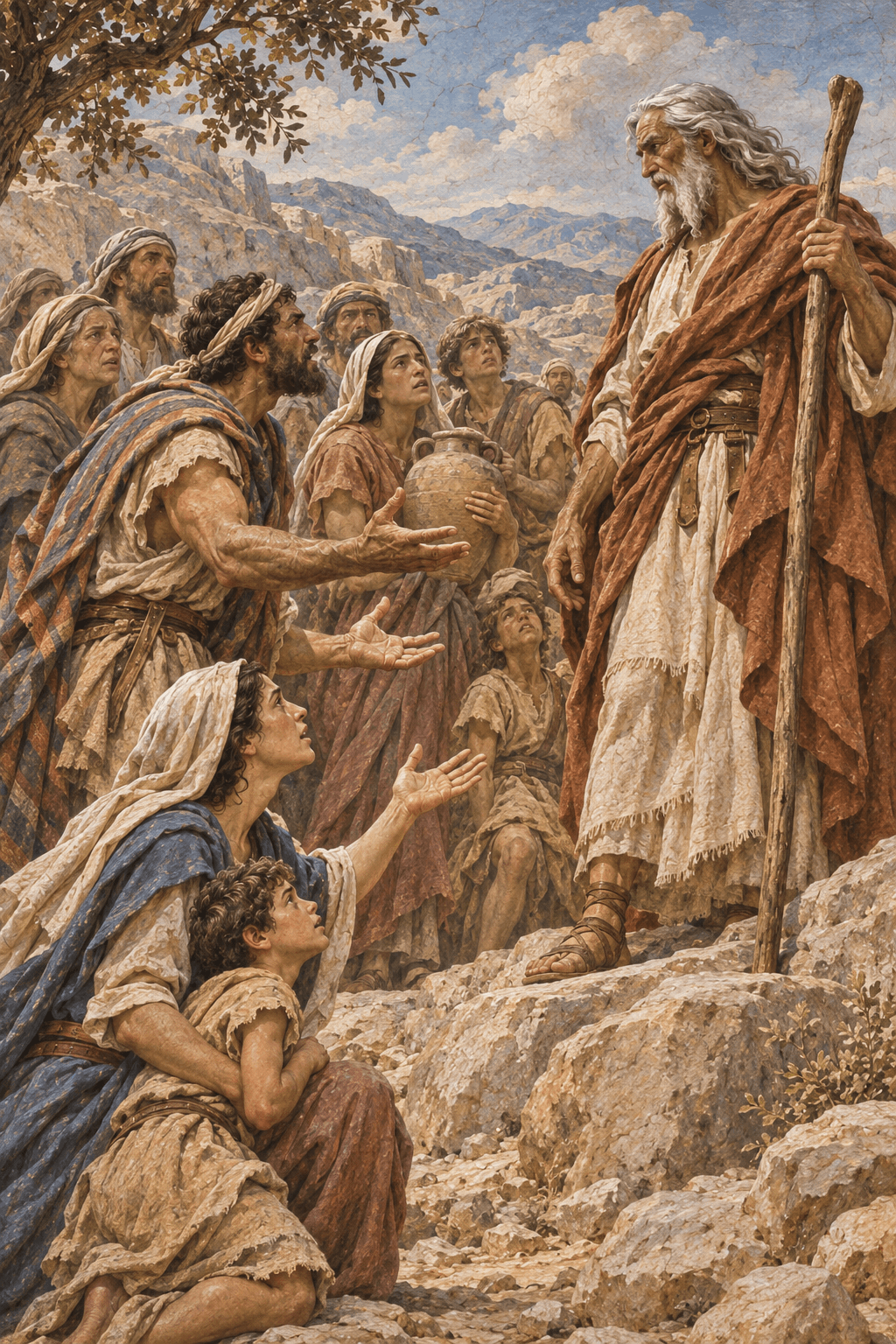
At Rephidim too the people murmured against Moses, saying: “Wherefore is this that thou hast brought us up out of Egypt, to kill us and our children and our cattle with thirst?” (3). This time Moses cried out with his heart as with his tongue, saying: “What shall I do unto this people? they be almost ready to stone me” (4).
In the wilderness, thoughts of murmuring may rise up in you when distress grows heavy; but let yours be the heart and tongue of Moses, and cry out to God, who brings water out of the rock!
Moses cried to God, believing that divine grace surpasses all the capacities of nature, for God is able in one way or another to quench the thirst of this people. The life of Moses, with all the extraordinary divine works it contained, came to represent the work of grace in the Church. As Saint Ambrose says:
Grace has greater power than nature. Moses lifts his rod and the sea is divided; he touches the rock and the waters gush out; he casts the wood into the bitter waters and they become sweet… This is the work of the Holy Spirit in the Church, beyond nature. [241]
3. The Rock That Gushed with Water
KJV · Verses 5–7
5 And the Lord said unto Moses, Go on before the people, and take with thee of the elders of Israel; and thy rod, wherewith thou smotest the river, take in thine hand, and go. 6 Behold, I will stand before thee there upon the rock in Horeb; and thou shalt smite the rock, and there shall come water out of it, that the people may drink. And Moses did so in the sight of the elders of Israel. 7 And he called the name of the place Massah, and Meribah, because of the chiding of the children of Israel, and because they tempted the Lord, saying, Is the Lord among us, or not?
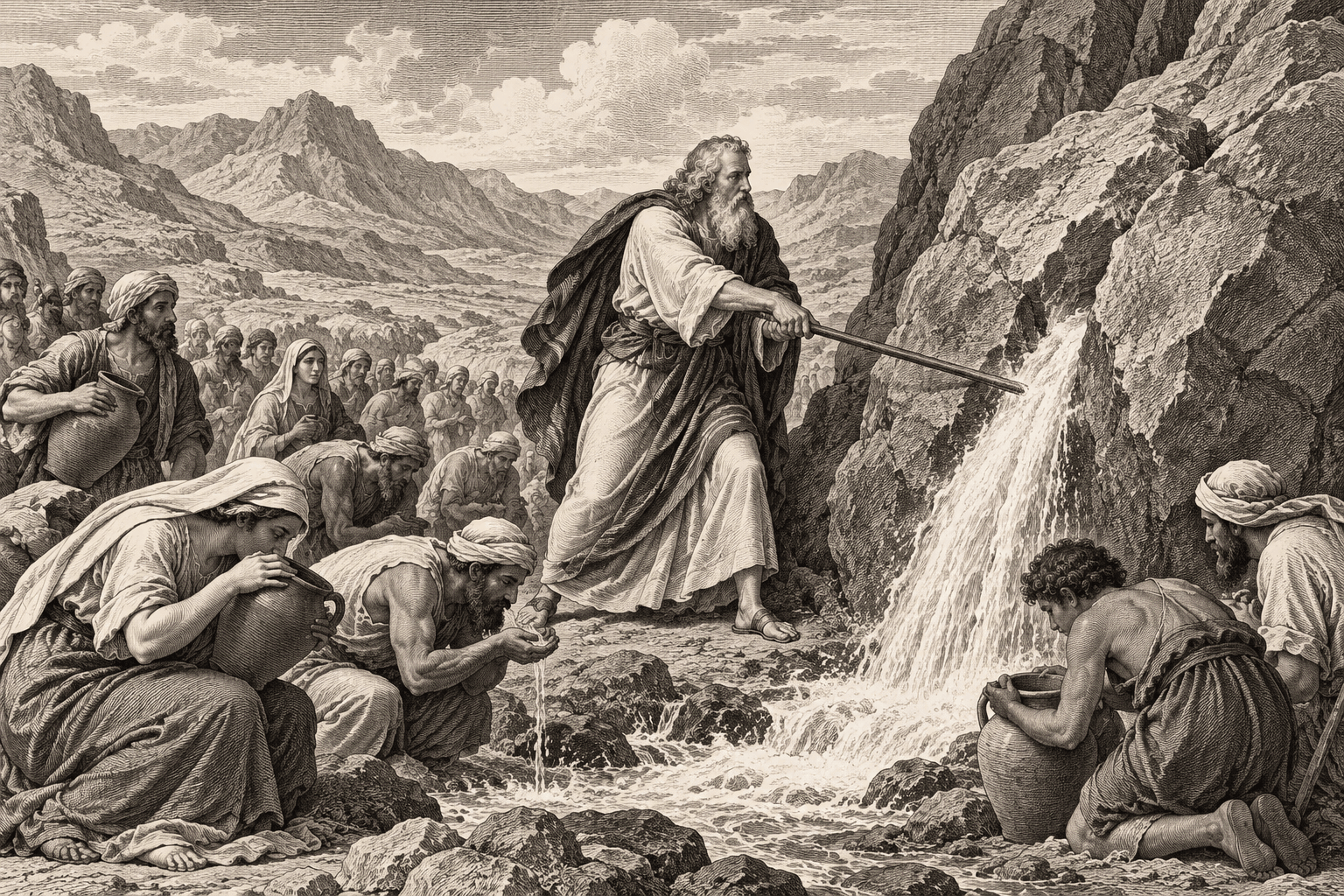
First: The rock points to the Lord Christ, as Paul the Apostle says: “And did all eat the same spiritual meat; And did all drink the same spiritual drink: for they drank of that spiritual Rock that followed them: and that Rock was Christ” (1 Corinthians 10:3–4). The water that gushed out is the Holy Spirit, whom the Lord gave us as the mystery of our comfort, our sanctification, and our fellowship with the Father in His Son.
The symbolism of the rock for the Lord Christ is summed up in the following:
A) The people enjoyed the waters of the rock after they had crossed the Red Sea, Pharaoh and his helpers had been slain, and they had drunk of the waters of Marah and the springs of Elim and enjoyed its palm trees… So no one comes to know the mystery of Christ and drink from the springs of the Holy Spirit except after he has passed through the waters of baptism, renouncing the devil and all his evil works, enjoying the Law made sweet through the Cross, that is, not through its deadly letter but in its spirit, and believing in the work of the disciples (the twelve springs) and the apostles (the seventy palm trees)… As Saint Gregory of Nyssa says:
Whoever leaves the Egyptians (symbolically, the love of the world) behind him drowned in the waters, tastes the sweetness through the wood, enjoys the apostolic springs, and rests in the shade of the palm trees, is able to receive God. For the rock here, as the Apostle says, is Christ, who is hard and unyielding to unbelievers; but for the one who uses the rod of faith He becomes a fountain that quenches his thirst and overflows in those who receive Him, for He said: “We will come unto him, and make our abode with him” (John 14:23). [242]
B) The rock quenched the thirst of all the thirsty. This was a symbol of the springs of the New Covenant which the Lord Christ opened, calling those who thirst after righteousness to come and drink of the living water (John 7:37–39). Wonderfully, the psalmist saw in the rock a living symbol, so we find him saying: “With honey out of the rock should I have satisfied thee” (Psalm 81:16). Saint Augustine comments on this, saying:
He brought them water out of the rock in the wilderness, not honey. Honey is wisdom, which holds the first place in the sweetness of the foods of the heart…! How many people are satisfied with this honey and cry out: It is sweet; there is nothing better or sweeter than it that we can think of or speak of! [243]
C) The people could not drink from this spring unless it was struck with the rod. So we could not have known how to drink from the springs of God’s infinite love and receive the Holy Spirit in us, unless the Lord Christ had been struck, bearing through divine justice the price of our sins on the Cross. As the rock was struck openly and once, so the Lord was hung on the Cross before the people (Luke 23:48) and was offered once for the whole world (Hebrews 7:27), where He poured out for us blood and water (John 19:34), as atonement and cleansing for everyone who believes in Him.
D) The Lord said to Moses: “Go on before the people, and take with thee of the elders of Israel; and thy rod, wherewith thou smotest the river, take in thine hand, and go. Behold, I will stand before thee there upon the rock in Horeb…” (5–6). Calling the elders to accompany Moses as he struck the rock and the waters gushed out carries a symbol that the Law (Moses) was not alone in bearing witness to the Cross; the patriarchs and all the prophets also shared with the Law in bearing witness to the work of redemption through the Cross.
Second: The psalmist says: “He clave the rocks in the wilderness, and gave them drink as out of the great depths” (Psalm 78:15). Here he does not say “the rock” but “rocks.” Perhaps he points to another symbol: the faithful, whose hearts had before become stony and dry, have springs of life gushing in them through the Cross, not only to be satisfied themselves, but to overflow upon others.
On the last day, that great day of the feast (John 7:37–38), when the high priest stood pouring out water before the people to declare God’s work in their life, Jesus stood and cried, saying: “If any man thirst, let him come unto me, and drink. He that believeth on me, as the scripture hath said, out of his belly shall flow rivers of living water.”
4. The War with Amalek
KJV · Verses 8–16
8 Then came Amalek, and fought with Israel in Rephidim. 9 And Moses said unto Joshua, Choose us out men, and go out, fight with Amalek: to morrow I will stand on the top of the hill with the rod of God in mine hand. 10 So Joshua did as Moses had said to him, and fought with Amalek: and Moses, Aaron, and Hur went up to the top of the hill. 11 And it came to pass, when Moses held up his hand, that Israel prevailed: and when he let down his hand, Amalek prevailed. 12 But Moses hands were heavy; and they took a stone, and put it under him, and he sat thereon; and Aaron and Hur stayed up his hands, the one on the one side, and the other on the other side; and his hands were steady until the going down of the sun. 13 And Joshua discomfited Amalek and his people with the edge of the sword. 14 And the Lord said unto Moses, Write this for a memorial in a book, and rehearse it in the ears of Joshua: for I will utterly put out the remembrance of Amalek from under heaven. 15 And Moses built an altar, and called the name of it Jehovahnissi: 16 For he said, Because the Lord hath sworn that the Lord will have war with Amalek from generation to generation.
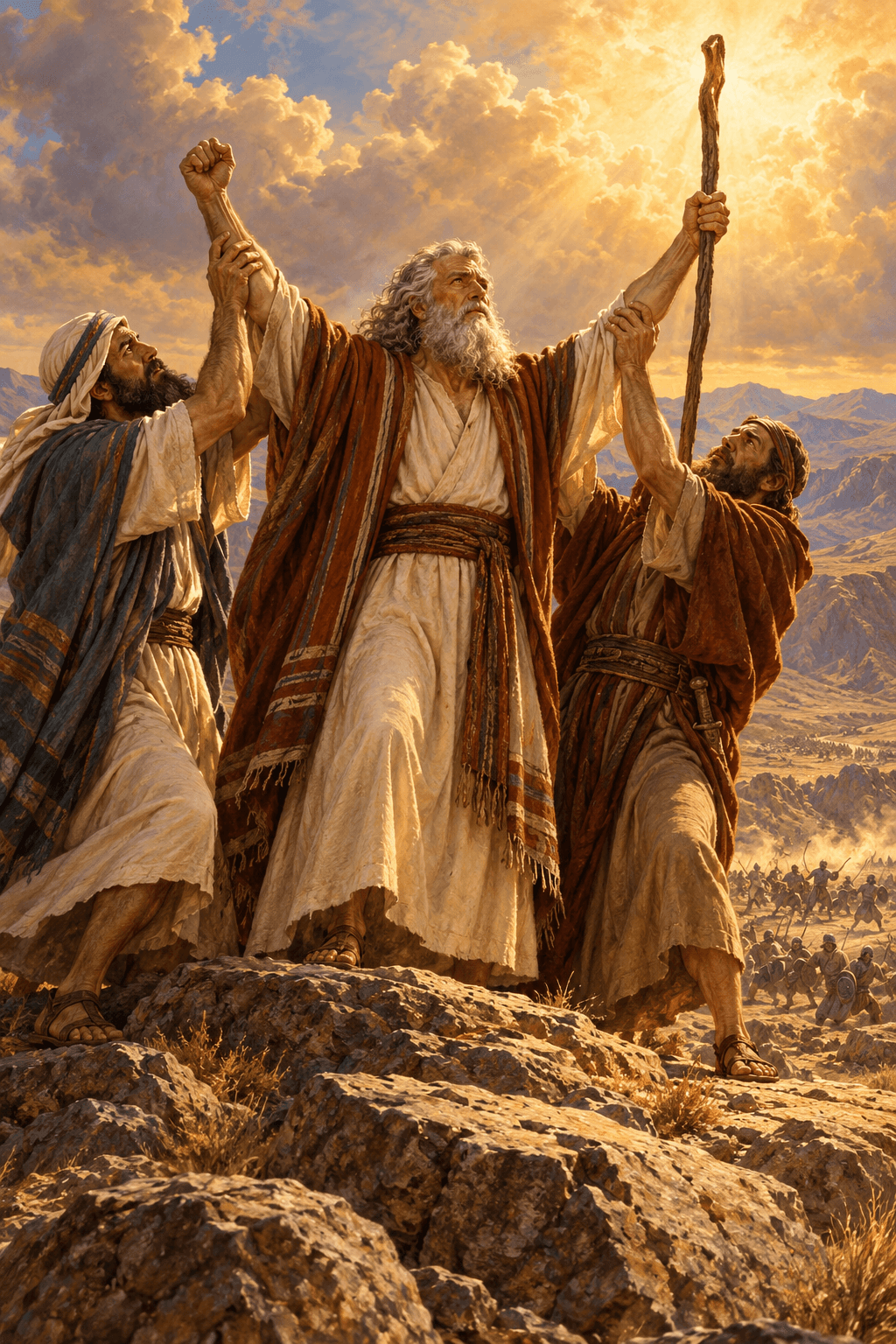
This is the first time the people entered into open war with another people. Before, when Pharaoh and his army wanted to fight the people, the orders given were: “Stand still, and see the salvation of the LORD… The LORD shall fight for you, and ye shall hold your peace” (Exodus 14:13–14). But now, having enjoyed the crossing of the Red Sea and received from God all their fullness, the manna, the quails, and the rock that gushed with water, they were bound to fight, yet not by their human strength, but through God’s work in them. This war was a symbol of the spiritual war between the kingdom of God and the kingdom of the devil, in which victory comes to the children of God through the Cross. In this war we notice the following:
A) We would have expected Moses, in the first open war, to cry out kneeling or lying prostrate on the ground… but we see him stretching out his hands in the form of a cross, a symbol of the victory of the Cross. On this Tertullian says in his answer to the Jews:
I am amazed that while Joshua was fighting with Amalek, Moses was praying sitting with outstretched hands, although he was in critical circumstances and should rather have prayed with bended knees, hands beating the breast, and face prostrate on the ground… But it was necessary for him to bear the figure of the Cross, so that Joshua might win the battle by the Cross. [244]
Father Victorinus says:
When Moses saw the harshness of that people, he lifted up his hands on the Sabbath, binding himself symbolically to the Cross. [245]
And Saint Cyprian the martyr says:
Joshua overcame Amalek by this sign of the Cross, through Moses. [246]
Commenting on this event, Origen says:
When Christ stretched out His hands on the Cross, He embraced the whole world. [247]
B) Moses on the top of the hill symbolizes the Lord Christ, who was crucified on the hill of Golgotha; and Joshua with the men of war struggling against Amalek symbolizes the Church’s continual struggle against sin. It is as if the Church shares with Christ in His Cross through her union with Him and her daily struggle, so that we say with Paul the Apostle: “I am crucified with Christ: nevertheless I live; yet not I, but Christ liveth in me… by whom the world is crucified unto me, and I unto the world” (Galatians 2:20; 6:14).
C) Hur was not as great as Moses the prophet, yet Moses could not have kept his hands lifted up without Aaron and Hur… So every believer realizes his place in the divine work, and no one should belittle his gifts, however worthless they may seem.
D) The lifting up of Moses’ hands also points to the life of perseverance to the end. As Origen says:
When Moses lifts up his hands, Amalek is defeated; and when he lowers them after he grows tired, to give them rest, Amalek prevails. So let us too lift up our hands in the power of the Cross of Christ, and lift up prayer “every where, lifting up holy hands, without wrath and doubting” (1 Timothy 2:8), so that we may be worthy of God’s help. This is what James the Apostle urges us to, saying: “Resist the devil, and he will flee from you” (James 4:7). So let us begin with full faith, and the devil will not only flee far from us, but will also be crushed under our feet, as Pharaoh was drowned in the sea and swallowed by the depths of the abyss. [248]
In another homily he speaks at greater length of lifting up the hands for victory over Amalek, saying:
Lifting up the hands is lifting up all works toward God, so that they are not base or earthly, but work for the glory of God and heaven. He lifts up his hands who lays up treasure in heaven (Matthew 6:20–21), for where your treasure is, there will your heart be also, and there will your eyes and your hands be…! He lifts up his hands who says: “Let the lifting up of my hands be as the evening sacrifice” (Psalm 141:2); by this Amalek is defeated. But the Apostle commands us to lift up “holy hands, without wrath and doubting” (1 Timothy 2:8), and he also says: “Lift up the hands which hang down, and the feeble knees; And make straight paths for your feet” (Hebrews 12:12–13).
If the people keep the Law (the commandment), Moses lifts up his hands and the enemy is defeated; but if they do not keep it, it is Amalek who prevails. For we wrestle “against principalities, against powers, against the rulers of the darkness of this world, against spiritual wickedness in high places” (Ephesians 6:12).
If you want to overcome, lift up your hands, lift up your works, and do not spend your life on earth… Lift up your hands toward God and keep the commandment of the Apostle, “Pray without ceasing” (1 Thessalonians 5:17), and what is written will be fulfilled: “Now shall this company lick up all that are round about us, as the ox licketh up the grass of the field” (Numbers 22:4). This means that the people of God (the company) use their tongue and their voice (lick) more than their hands and their weapons; by pouring out their prayers to God they defeat their enemy… This is the way of victory over the enemy (sin) in the battle. [249]
E) When the people had overcome Amalek, Moses went up the mountain to receive the Law, after great preparations on the part of the people and the priests (Exodus 19:10–15, 22). It is as if, after every victory over sin, that is, over the Amalek who fights him, the believer is called by the Lord to rise up the mountain of the knowledge of God, to receive from His hands a deeper understanding and knowledge of the mysteries of the divine commandment. It is as if our knowledge does not rest merely on reading and searching in books and sermons, but much more on the life of struggle against sin by the Cross.
F) Though Moses the prophet did not enter the war with Amalek in a material, tangible way, through the sanctification of his life to God and his bearing the sign of the Cross he was the secret of the people’s victory and triumph. Saint Ambrose comments on this:
When Moses was silent he was crying out (Exodus 14:15); when he stood at rest he was fighting. For he not only fought, but overcame his enemies without coming near them. The more he was at rest and others held up his hands, the more he worked than the others; for his lifted hands overcame the enemy, and without him those who were in the battle could not have overcome. So Moses spoke while silent and fought while at rest! Did he have greater works than what he did when he was in solitude receiving the Law in forty days on the mountain (Exodus 24:18)? In that solitude he met the One who was not far from him and spoke with Him! [250]
Notes and References
[236] Some think it means “cattle market”; its present site is perhaps Serabit el-Khadim, or a place near Wadi Maghara.
[237] Origen, In Num. hom. 27.
[238] Origen, In Num. hom. 27; In Exod. hom. 11.
[239] Some think it means “wide places”; it is a town perhaps in Wadi Refayid, north-west of Jebel Musa.
[240] Origen, In Exod. hom. 11.
[241] St. Ambrose, On the Mysteries 9.
[242] Gregory of Nyssa, Life of Moses 2:136.
[243] St. Augustine, On Psalm 81.
[244] Tertullian, An Answer to the Jews 10.
[245] Victorinus, On the Creation of the World.
[246] A.N.F., vol. 5, p. 524.
[247] Origen, In Exod. hom. 11:4.
[248] Origen, In Exod. hom. 3:3.
[249] Ibid. 11:4.
[250] St. Ambrose, Duties of the Clergy 3:1.