
This chapter speaks of:
- Jethro meets Moses the prophet (1–7).
- A conversation in God (8–12).
- Jethro’s counsel (13–27).
1. Jethro Meets Moses the Prophet
KJV · Verses 1–7
1 When Jethro, the priest of Midian, Moses' father in law, heard of all that God had done for Moses, and for Israel his people, and that the Lord had brought Israel out of Egypt; 2 Then Jethro, Moses' father in law, took Zipporah, Moses' wife, after he had sent her back, 3 And her two sons; of which the name of the one was Gershom; for he said, I have been an alien in a strange land: 4 And the name of the other was Eliezer; for the God of my father, said he, was mine help, and delivered me from the sword of Pharaoh: 5 And Jethro, Moses' father in law, came with his sons and his wife unto Moses into the wilderness, where he encamped at the mount of God: 6 And he said unto Moses, I thy father in law Jethro am come unto thee, and thy wife, and her two sons with her. 7 And Moses went out to meet his father in law, and did obeisance, and kissed him; and they asked each other of their welfare; and they came into the tent.
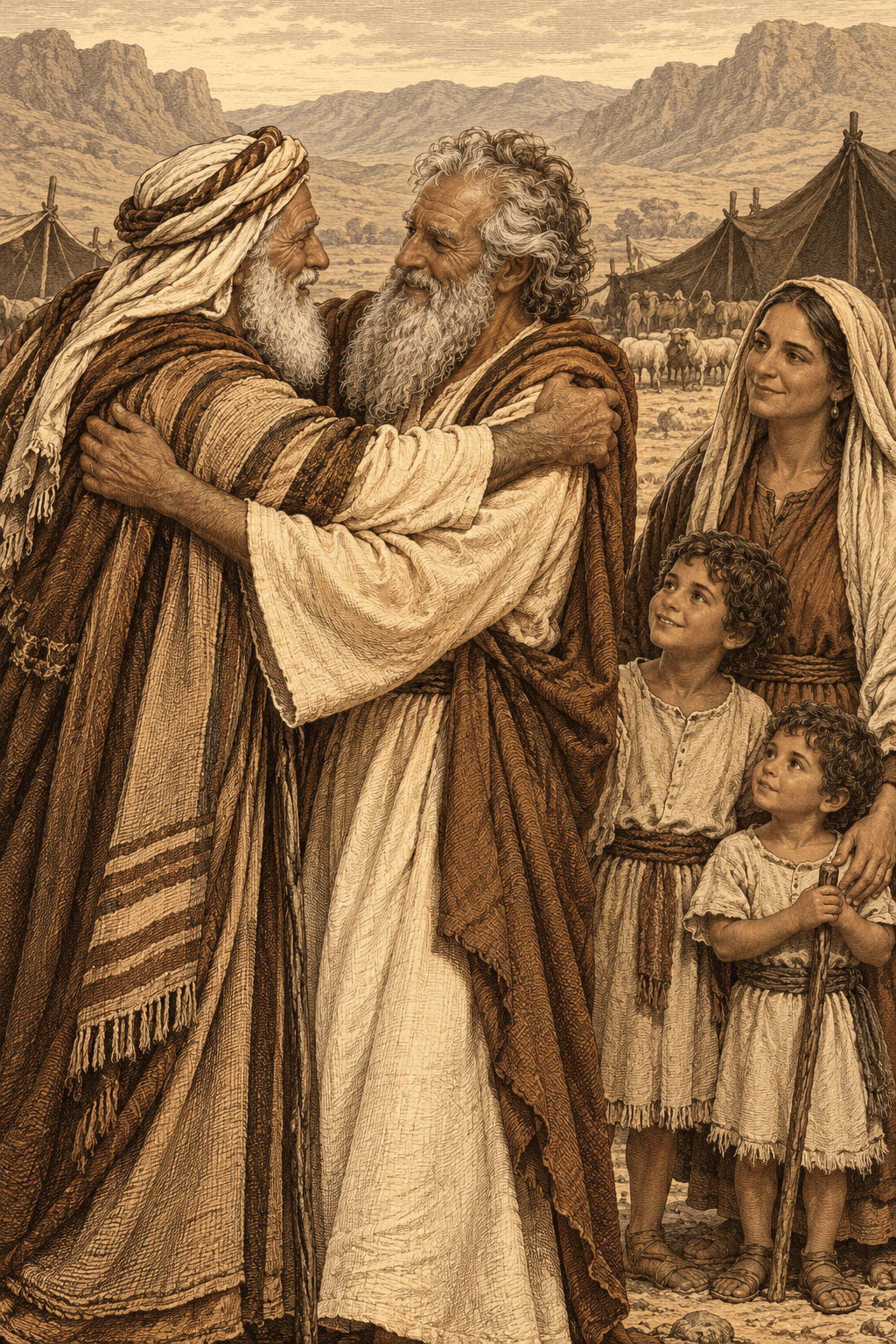
“When Jethro, the priest of Midian, Moses’ father in law, heard of all that God had done for Moses, and for Israel his people” (1). Perhaps he heard from his daughter Zipporah, who had accompanied Moses all the way and crossed the Red Sea with him. When she came near her father’s dwelling, she went to him preaching God’s wonderful works, and brought her father, the pagan priest, to hear and see the work of God, so that he offered “a burnt offering and sacrifices for God” (12).
If Jethro came with his heart glorifying God for His works of salvation, Moses too, the great among the prophets, to whom all these wonders had been given, met his father-in-law with all humility… “And Moses went out to meet his father in law, and did obeisance, and kissed him” (7). Prophecy did not teach him to be haughty toward others, but to be humble before his father-in-law, the pagan priest. Perhaps by his humility he also won him to the knowledge of God’s works.
2. A Conversation in God
KJV · Verses 8–12
8 And Moses told his father in law all that the Lord had done unto Pharaoh and to the Egyptians for Israel's sake, and all the travail that had come upon them by the way, and how the Lord delivered them. 9 And Jethro rejoiced for all the goodness which the Lord had done to Israel, whom he had delivered out of the hand of the Egyptians. 10 And Jethro said, Blessed be the Lord, who hath delivered you out of the hand of the Egyptians, and out of the hand of Pharaoh, who hath delivered the people from under the hand of the Egyptians. 11 Now I know that the Lord is greater than all gods: for in the thing wherein they dealt proudly he was above them. 12 And Jethro, Moses' father in law, took a burnt offering and sacrifices for God: and Aaron came, and all the elders of Israel, to eat bread with Moses' father in law before God.
This meeting was distinguished by being in the Lord; it did not stray from glorifying His name. It was also marked by spiritual joy, for Scripture says: “And Jethro rejoiced for all the goodness which the LORD had done to Israel” (9); “And Jethro said, Blessed be the LORD” (10); and he testified of Him that He “is greater than all gods” (11); and he “took a burnt offering and sacrifices for God” (12).
How beautiful are the meetings that move entirely within the circle of the Lord and His wonderful works of salvation! They fill the heart with joy, loose the tongue in praise, and win even unbelievers to the faith.
The matter did not stop there, for Scripture says: “And Aaron came, and all the elders of Israel, to eat bread with Moses’ father in law before God” (12)… It is as if Jethro knew God as a friend, so that even in his eating and drinking he felt himself to be before God.
Origen comments on this:
Everything the saints do, they do before God; but the sinner flees from the face of God. For it is written of Adam that after he sinned he hid himself from the presence of God (Genesis 3:8)… and Cain, bearing God’s curse for killing Abel, went out from the presence of the LORD (Genesis 4:16)… So he who is unworthy of that face flees from the face of God. [251]
Nor is this limited to good things; even when the saints sin, they sin before God, so they quickly repent. As Origen says:
Those who receive the knowledge of God abundantly and drink in His divine teachings, even if they sin, do so in God’s presence and before Him, as the prophet says: “And done this evil in thy sight” (Psalm 51:4)… The advantage of one who sins before God is that he is quick to repent, for he says, “I have sinned”; but he who flees from the face of God cannot repent or be cleansed of his sins. Here appears the difference between the one who sins before God and the one who flees from God with his sins. [252]
3. Jethro’s Counsel
KJV · Verses 13–27
13 And it came to pass on the morrow, that Moses sat to judge the people: and the people stood by Moses from the morning unto the evening. 14 And when Moses' father in law saw all that he did to the people, he said, What is this thing that thou doest to the people? why sittest thou thyself alone, and all the people stand by thee from morning unto even? 15 And Moses said unto his father in law, Because the people come unto me to enquire of God: 16 When they have a matter, they come unto me; and I judge between one and another, and I do make them know the statutes of God, and his laws. 17 And Moses' father in law said unto him, The thing that thou doest is not good. 18 Thou wilt surely wear away, both thou, and this people that is with thee: for this thing is too heavy for thee; thou art not able to perform it thyself alone. 19 Hearken now unto my voice, I will give thee counsel, and God shall be with thee: Be thou for the people to God-ward, that thou mayest bring the causes unto God: 20 And thou shalt teach them ordinances and laws, and shalt shew them the way wherein they must walk, and the work that they must do. 21 Moreover thou shalt provide out of all the people able men, such as fear God, men of truth, hating covetousness; and place such over them, to be rulers of thousands, and rulers of hundreds, rulers of fifties, and rulers of tens: 22 And let them judge the people at all seasons: and it shall be, that every great matter they shall bring unto thee, but every small matter they shall judge: so shall it be easier for thyself, and they shall bear the burden with thee. 23 If thou shalt do this thing, and God command thee so, then thou shalt be able to endure, and all this people shall also go to their place in peace. 24 So Moses hearkened to the voice of his father in law, and did all that he had said. 25 And Moses chose able men out of all Israel, and made them heads over the people, rulers of thousands, rulers of hundreds, rulers of fifties, and rulers of tens. 26 And they judged the people at all seasons: the hard causes they brought unto Moses, but every small matter they judged themselves. 27 And Moses let his father in law depart; and he went his way into his own land.
First: When Jethro saw Moses bearing all the responsibility alone, judging every matter great and small from morning until evening, he advised him to appoint rulers of thousands, rulers of hundreds, rulers of fifties, and rulers of tens: able men, such as fear God, men of truth, hating covetousness, to judge the people at all seasons, while the great matters would be brought to him. And Moses obeyed his father-in-law.
The fathers see in Moses’ attitude true heroism in his humility, for Saint John Chrysostom says:
God says of Moses: “Now the man Moses was very meek, above all the men which were upon the face of the earth” (Numbers 12:3). There was none more humble than he. Though he was the leader of so great a people, and had drowned the king of the Egyptians (Pharaoh) and all his army in the Red Sea like flies, and had worked such great wonders in Egypt, at the Red Sea, and in the wilderness, and had received so great a Law, yet he felt himself an ordinary man; and as a son-in-law he was humbler than his father-in-law. He took counsel from him without anger. He did not say to him: What is this? Do you come to me with your counsel after I have accomplished all these great achievements? These are the feelings of most people: a man may offer good counsel, but it is despised because of the lowliness of his position. But Moses did not do so; in the humility of his mind he acted well.
Moses despised the royal court (Hebrews 11:24–26) because of his true humility, for sound thinking and a lofty spirit are the fruit of humility. What loftiness and what greatness, that Moses despised the royal palace and the royal table! For among the Egyptians kings were honored as gods and enjoyed wealth and treasures beyond reckoning. But he left all these, casting away the scepter of Egypt, and hastened to cleave to the enslaved and those weighed down with toil, who spent all their strength in clay and brickmaking, those whom his own servants loathed. He ran to them and preferred them to their masters! Truly every humble person bears a lofty and great spirit… for humility comes from a great mind and a lofty soul! [253]
Elsewhere Saint John Chrysostom says:
Moses left this story, his accepting his father-in-law’s counsel, to the world, engraved as on a pillar, for he knew that it was useful to many… If Moses learned from his father-in-law fitting things that he did not perceive, how much more does this happen within the Church?! (that is, each one benefits from the others). How did it happen that the unbeliever perceived things which the spiritual man did not perceive?!… [254]
Origen sees in this a symbolic picture of the Church’s use of the sciences and philosophies of the world; she is not hostile to them, but benefits from them with wisdom. He says:
When I consider Moses, full of God, to whom God spoke face to face, accepting the counsel of Jethro his father-in-law, the priest of Midian, I am overcome with amazement and admiration. Scripture says: “So Moses hearkened to the voice of his father in law, and did all that he had said” (24). He did not object, nor did he say to him: God speaks to me, and the words of heaven direct my actions; how can I accept the advice of a man, and a pagan man, a stranger to the people of God?! But he listened to him and did all that he told him. He did not look at who was speaking to him, but listened to the words themselves. So if we too meet wise words spoken by pagans, let us not reject them because of their source, excusing ourselves that we have received the Law from God, and so be puffed up with pride and despise the words of the wise… Moses, who was very meek above all men (Numbers 12:3), accepted counsel from a man lesser than himself, giving an example of humility to the rulers of the people and an image of the mystery to come. [255]
Second: If we turn to the Book of Numbers, we see Moses saying to the Lord: “Wherefore hast thou afflicted thy servant? and wherefore have I not found favour in thy sight, that thou layest the burden of all this people upon me? Have I conceived all this people? have I begotten them?” (Numbers 11:11–12).
Moses should not have found the work of shepherding heavy, for God is the true Shepherd and the invisible Father who shepherds His children. Therefore, when God asked Moses to choose seventy men, He said to him: “And I will come down and talk with thee there: and I will take of the spirit which is upon thee, and will put it upon them; and they shall bear the burden of the people with thee, that thou bear it not thyself alone” (Numbers 11:17). It is as if the Lord, who gives to Moses, took from him to give to his helpers…
We do not deny the importance of putting the spiritual energies in the Church to work; but not in a spirit of murmuring, nor with the feeling that we are the ones bearing the burdens of the people… Rather, we carry the blessing of our sharing with the Lord Christ, the High Priest and the hidden Bishop of our souls (1 Peter 2:25), who bears the weaknesses of all!
Notes and References
[251] Origen, In Exod. hom. 11:5.
[252] Ibid.
[253] St. John Chrysostom, In 1 Cor. hom. 1:4.
[254] St. John Chrysostom, In 2 Cor. hom. 18:3.
[255] Origen, In Exod. hom. 11:6.