
In this part of the book, concerning the giving of the divine commandment (the Law) and the declaration of the worship of God, we are given:
- The preparation for the Law (chapters 19–20).
- The civil and criminal law (chapters 21–23).
- The making of a covenant between God and man (chapter 24).
- The ark and worship (chapters 25–34).
- The tabernacle, its contents, and its consecration (chapters 35–40).
This chapter speaks of the need for the Law, the Law of Sinai (1–2), the purpose of the Law (3–6), the preparation for the Law (7–15), a conversation with God (16–19), and a warning to the people and the priests (20–25).
1. The Need for the Law
KJV · Verses 1–2
1 In the third month, when the children of Israel were gone forth out of the land of Egypt, the same day came they into the wilderness of Sinai. 2 For they were departed from Rephidim, and were come to the desert of Sinai, and had pitched in the wilderness; and there Israel camped before the mount.
It was not possible for one who had come out of the land of bondage and was walking the way of the barren wilderness to reach the land of promise and settle in Jerusalem without receiving the divine Law, or the commandment. Therefore the psalmist cries out in the land of his sojourning: “I am a stranger in the earth: hide not thy commandments from me” (Psalm 119:19).
The people received the Mosaic Law, which was given to them in a way that suited their spiritual childhood, yet at the same time carried in its depths the mysteries of “the divine Word.” For what is the Law but the word of God, who alone is the Leader, the Savior, the Enlightener, and the One who satisfies the soul? He leads it to the bosom of the Father and brings it into His divine glories. Therefore Saint Mark the Ascetic says: “The commandment carries within it the Lord Christ; whoever enters into its depths and lives it in the Spirit meets the divine Word Himself.” And Origen says: “In its depths the soul discovers her heavenly Bridegroom and enters with Him into His chamber.”
In Psalm 119 (118) the psalmist speaks of the divine Law as a support for him in his sojourning, and sees in it:
A) The secret of his joy amid the pains of the wilderness: “I will delight myself in thy statutes: I will not forget thy word” (Psalm 119:16); “And I will delight myself in thy commandments, which I have loved” (Psalm 119:47); “How sweet are thy words unto my taste! yea, sweeter than honey to my mouth!” (Psalm 119:103).
B) The secret of his praise and the exultation of his soul: “Thy statutes have been my songs in the house of my pilgrimage” (Psalm 119:54).
C) The secret of his inner riches: “The law of thy mouth is better unto me than thousands of gold and silver” (Psalm 119:72).
D) A leader and guide for the soul amid the harassment of enemies: “Thy word have I hid in mine heart, that I might not sin against thee” (Psalm 119:11); “The bands of the wicked have robbed me: but I have not forgotten thy law” (Psalm 119:61); “Unless thy law had been my delights, I should then have perished in mine affliction” (Psalm 119:92).
E) The secret of his life: “My soul cleaveth unto the dust: quicken thou me according to thy word” (Psalm 119:25).
F) The secret of enlightenment: “Thy word is a lamp unto my feet, and a light unto my path” (Psalm 119:105); “Make thy face to shine upon thy servant; and teach me thy statutes” (Psalm 119:135).
Finally, the commandment presents to us, in its spirit and depths, the person of the Savior, the Bridegroom of the soul who satisfies her. Therefore he says: “I have seen an end of all perfection: but thy commandment is exceeding broad” (Psalm 119:96).
The Law of Sinai
The Book of Exodus fixes the beginning of the receiving of the Law in the third month after the going out, and the place of receiving it as “Sinai,” where the people camped before Mount Sinai (1–2).
The number “3” (the third month), as we said before, points to the resurrection of the Lord Christ, the divine Word, on the third day. It is as if God wants us to meet Him through the commandment in the glory of the resurrection, so that we do not see it as commands and prohibitions, nor as written laws, statutes, and rules, but as a mystery of resurrection for us into the divine glories. Through the resurrection the commandment, with all its cross and toil, becomes sweet and delightful; its narrow way is turned into an easy yoke and a light burden, and a fellowship in the sufferings of Christ for the enjoyment of the fellowship of His glories.
The choice of the place, “Mount Sinai,” was also not without meaning. In the opinion of Origen, “Sinai” also means what “the wilderness of Sin” means, which we said means “a bush” or “a trial,” where a person must have the spirit of sound discernment so as not to fall into trial through deceptive visions (the bush). In his opinion “Sinai” means that the soul has begun to acquire “just judgment” through receiving the divine Law, or the commandment, and so becomes able to enjoy the divine mysteries and the heavenly visions. [256]
2. The Purpose of the Law
KJV · Verses 3–6
3 And Moses went up unto God, and the Lord called unto him out of the mountain, saying, Thus shalt thou say to the house of Jacob, and tell the children of Israel; 4 Ye have seen what I did unto the Egyptians, and how I bare you on eagles' wings, and brought you unto myself. 5 Now therefore, if ye will obey my voice indeed, and keep my covenant, then ye shall be a peculiar treasure unto me above all people: for all the earth is mine: 6 And ye shall be unto me a kingdom of priests, and an holy nation. These are the words which thou shalt speak unto the children of Israel.
Before God spoke of the purpose of the Law, He declared His practical love for the people, saying: “I bare you on eagles’ wings, and brought you unto myself” (4). It is as if He wanted to make clear that mutual love is the foundation of this Law. He loved us and carried us by the Holy Spirit (the eagles’ wings) and brought us to Himself, that is, into His divine embrace, that we may experience the depths of His love and come to know His fatherhood.
This is the purpose of the Law: “Then ye shall be a peculiar treasure unto me above all people: for all the earth is mine: And ye shall be unto me a kingdom of priests, and an holy nation” (5–6). Though He has no need, for all the earth is His, He wants us to be His own, to have the boldness of sons, a priestly kingdom and a holy nation consecrated to Him, bearing His nature as the Holy One.
3. The Preparation for the Law
KJV · Verses 7–15
7 And Moses came and called for the elders of the people, and laid before their faces all these words which the Lord commanded him. 8 And all the people answered together, and said, All that the Lord hath spoken we will do. And Moses returned the words of the people unto the Lord. 9 And the Lord said unto Moses, Lo, I come unto thee in a thick cloud, that the people may hear when I speak with thee, and believe thee for ever. And Moses told the words of the people unto the Lord. 10 And the Lord said unto Moses, Go unto the people, and sanctify them to day and to morrow, and let them wash their clothes, 11 And be ready against the third day: for the third day the Lord will come down in the sight of all the people upon mount Sinai. 12 And thou shalt set bounds unto the people round about, saying, Take heed to yourselves, that ye go not up into the mount, or touch the border of it: whosoever toucheth the mount shall be surely put to death: 13 There shall not an hand touch it, but he shall surely be stoned, or shot through; whether it be beast or man, it shall not live: when the trumpet soundeth long, they shall come up to the mount. 14 And Moses went down from the mount unto the people, and sanctified the people; and they washed their clothes. 15 And he said unto the people, Be ready against the third day: come not at your wives.
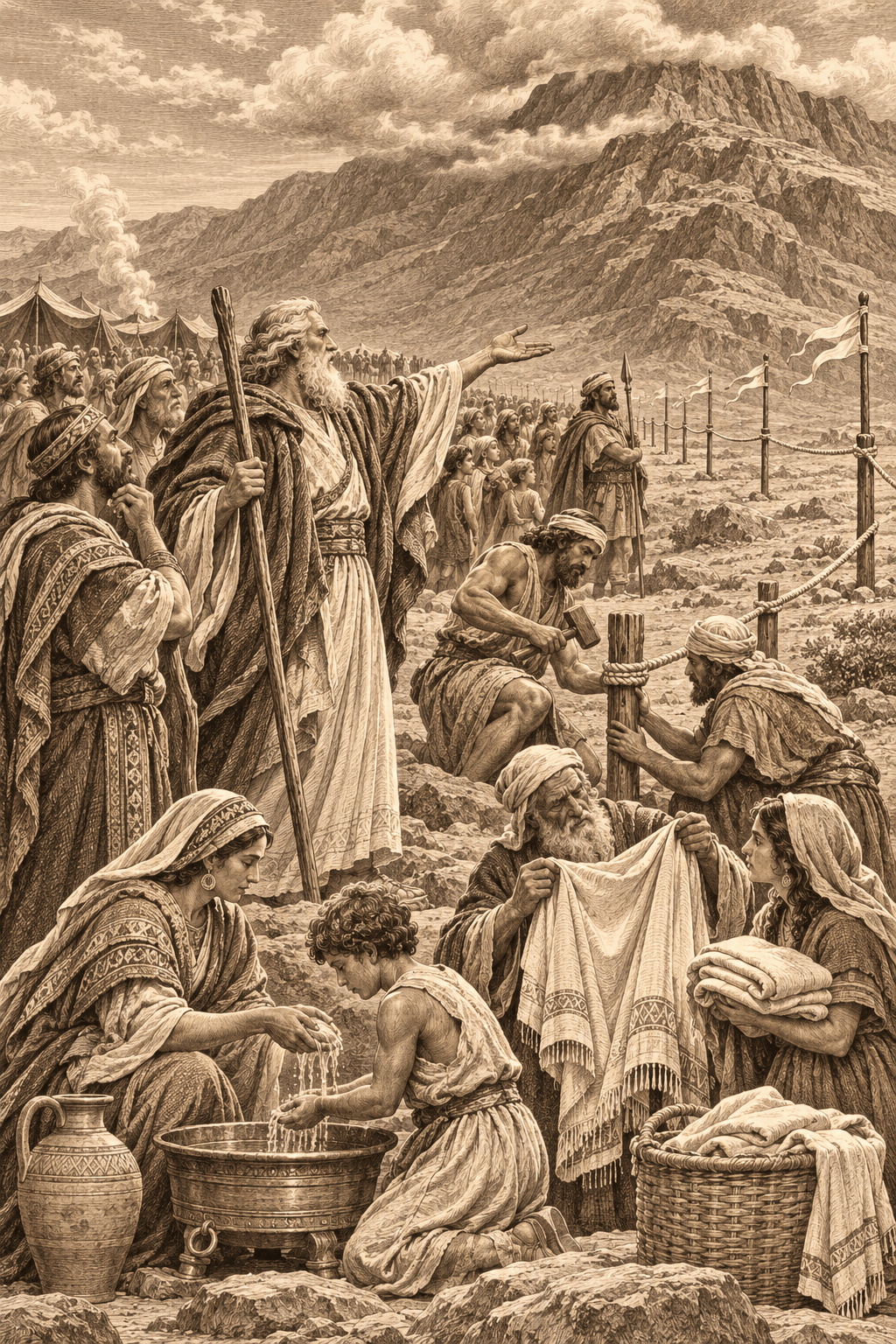
First: Moses called the elders of the people and set before them the words which the Lord had commanded, as if presenting to them the covenant God wanted to make with His people. The people declared their acceptance of the covenant, for “all the people answered together, and said, All that the LORD hath spoken we will do” (8). God does not bind us to the covenant unless we first declare our acceptance of it!
Sadly, they accepted the covenant in word but rejected it in deed, so the Law profited them nothing. [257]… They said, “All that the LORD hath spoken we will do,” but they broke the commandment and violated the covenant, until the Savior came, who alone can fulfill the will of the Lord and His commandment in perfection; and in Him we too become perfect and not breakers of the Law.
Second: The Lord asked Moses to sanctify the people and have them wash their clothes, and be ready against the third day, “for the third day the LORD will come down in the sight of all the people upon mount Sinai” (10–11). As it was in the third month after their going out, they were bound to prepare for the Lord’s coming down before them on the third day… So this book carries continual assurances of receiving the power of the resurrection within us. The people could not have benefited from the commandment had they not come to know the possibility of carrying it out through Christ risen from the dead, who gives the new nature able to carry out the divine commandment.
Sanctification and washing of clothes reveal the need for outward and inward preparation for ascending the mountain of knowledge (as Moses did) and coming to know the divine mysteries.
Origen says:
If you come with filthy garments, you will hear this word: “Friend, how camest thou in hither not having a wedding garment?” (Matthew 22:12). So no one can hear the word of God unless he is first sanctified, so as to be “holy both in body and in spirit” (1 Corinthians 7:34), washing his garments so as to enter, after a little while, to the Bridegroom’s table, eat the flesh of the Lamb, and drink the cup of salvation. No one enters this table with filthy garments; and Wisdom has commanded this elsewhere: “Let thy garments be always white” (Ecclesiastes 9:8). You washed your garments once when you received the grace of baptism, and your body was purified; you were rid of all filthiness of flesh and spirit. “What God hath cleansed, that call not thou common” (Acts 10:15). [258]
Speaking of the duties of priests, Saint Ambrose says:
Learn, O priest and Levite, what it means to wash your garments. Your body must be pure so that you may come to the mysteries. If the people were forbidden to approach the sacrifice unless they washed their garments, will you require this of others while there is defilement in your heart and body, and dare to offer an offering on their behalf?! [259]
Pope Athanasius sees in this preparation a symbol of entering the virtuous life, without which Moses could not enter into the presence of God and receive the Law. He says:
Through virtue a man enters in to God, as Moses did in the thick cloud where God was; but through vice a man goes out from the presence of the Lord, as happened with Cain when he killed his brother (Genesis 4:16), for he went out from the presence of the Lord when his soul was troubled. [260]
The command was explicit: “Be ready against the third day: come not at your wives” (15). This was not because the marriage relationship carries anything of defilement, but for the consecration of all energies and the full occupation of the mind in waiting for the commandment… The fathers saw in this command a sign of chastity in bodily relations, and of not practicing them in a lustful way, so that the soul may be able to rise with Moses on the mountain of knowledge and come to know God. Speaking of virginity, Saint Gregory of Nyssa says: “If you long for God to reveal Himself to you, why do you not hear Moses commanding the people to abstain from marital relations, that they might be taken up to the vision of God?!”
As the people of old received the word of God engraved on the two tablets by abstaining from marital relations and by washing, so the Church has laid on her children that they abstain from the marriage bed on the night before they receive “the divine Word.” She has also set a beautiful rite of washing the priests’ hands before receiving the Lamb, in which the priest examines himself concerning the purity of his soul and his inner readiness for the service. [261]
Third: The Lord warns the people, saying: “Take heed to yourselves, that ye go not up into the mount, or touch the border of it: whosoever toucheth the mount shall be surely put to death… whether it be beast or man, it shall not live: when the trumpet soundeth long, they shall come up to the mount” (12–13). So that the inner Moses may ascend the mountain of knowledge and enjoy the divine mysteries, we must not allow the senses that are occupied with material things, such as sight and hearing, to rise with us, nor the animal lusts. In this way no man or beast goes up with us; Moses alone ascends, that is, our inner man alone, so that he may enjoy what “eye hath not seen, nor ear heard, neither have entered into the heart of man” (1 Corinthians 2:9). Our inner man rises to touch what is greater than the senses and sensible things… that is, divine things themselves!
So do not allow any man or beast within you to hinder you from seeing God on the holy mountain within you and speaking with Him face to face!
As for His saying, “When the trumpet soundeth long, they shall come up to the mount” (13), it means that when the inner man enjoys the vision of God, hears the divine voice, and speaks with Him directly, then our senses, longings, and emotions rise up, so that all these are sanctified in the Lord. The things that were before a hindrance to life with God become holy to the Lord and instruments of righteousness for God.
4. A Conversation with God
KJV · Verses 16–19
16 And it came to pass on the third day in the morning, that there were thunders and lightnings, and a thick cloud upon the mount, and the voice of the trumpet exceeding loud; so that all the people that was in the camp trembled. 17 And Moses brought forth the people out of the camp to meet with God; and they stood at the nether part of the mount. 18 And mount Sinai was altogether on a smoke, because the Lord descended upon it in fire: and the smoke thereof ascended as the smoke of a furnace, and the whole mount quaked greatly. 19 And when the voice of the trumpet sounded long, and waxed louder and louder, Moses spake, and God answered him by a voice.
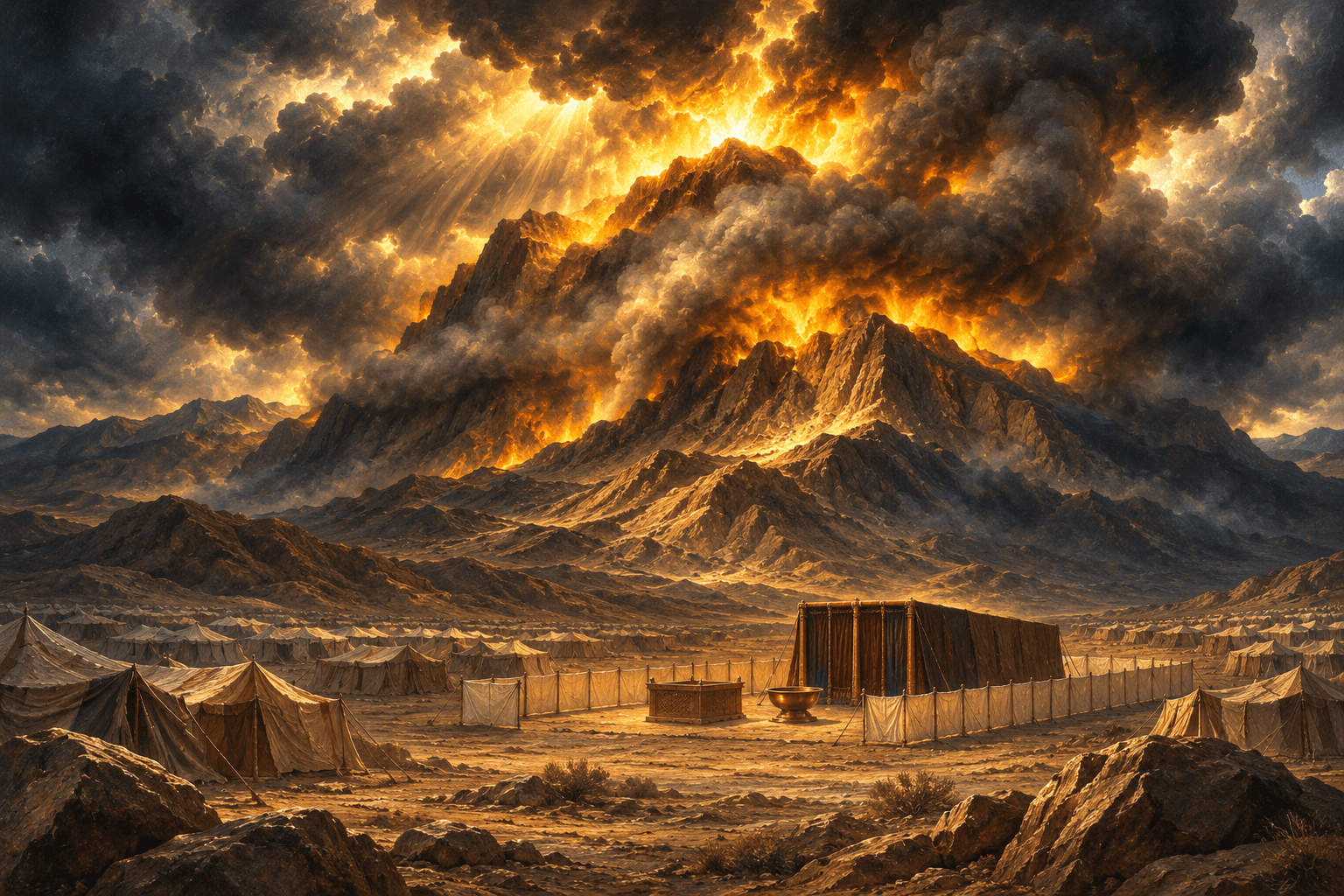
First: The fathers compare the people’s meeting with God in the Old Covenant with their meeting with Him in the New. In the Old Covenant Moses set bounds for the people on every side, so that they would not go up into the mount or touch its border: “Whosoever toucheth the mount shall be surely put to death: There shall not an hand touch it, but he shall surely be stoned, or shot through; whether it be beast or man, it shall not live” (12–13)…
So they were forbidden to approach the mountain or touch it; whoever touched it was put to death in a painful way, by stoning or shooting, and no one of the people was to touch him, lest he be defiled by him!! But in the New Covenant the Word of God Himself came and sat on the mountain (Matthew 5–7), and sinners gathered around Him as His children. He opens His door to all, asking them to be His sons!
In the Old Covenant there were thunders and lightnings, a thick cloud, and the voice of the trumpet exceeding loud, so that all the people in the camp trembled (16)… “And they said unto Moses, Speak thou with us, and we will hear: but let not God speak with us, lest we die” (Exodus 20:19)… But in the New Covenant the Lord spoke with a quiet, gentle voice to draw all to Himself. As Saint Augustine says:
There the Law was given outwardly, so that the wicked might be terrified; here it is given inwardly, for their justification. [262]
Of old He dealt with mankind as little children, who hear the fearful voice so as to be afraid; but in the New Covenant He speaks to us as mature sons, wanting us as His friends and beloved.
Comparing the two calls, the old, with its narrow bounds, fear, and trembling, and the new, with its call open to all, Saint John Chrysostom says:
He has called us to heaven, called us to the table of the great and wonderful King; shall we linger and hesitate instead of hastening and running to it?! Then what hope have we of our salvation? We cannot excuse ourselves by our weakness, nor by our nature; it is sloth alone that makes us unworthy! [263]
Thanks be to God, who has opened before us the way of the holy mountain and made His Word call us all without exception, not to receive the Law engraved on two tablets of stone, but to give us His living Word within us and His commandment engraved on our hearts!
Second: God used the voice of a trumpet exceeding loud, so that all the people in the camp trembled… “And when the voice of the trumpet sounded long, and waxed louder and louder, Moses spake, and God answered him by a voice” (16, 19).
Why was the voice of the trumpet used? Pope Athanasius the Apostolic answers:
Trumpets stir up wakefulness and awe in a person more than any other sound or instrument. This method was used to teach them, since they were still children. [264]
Saint Gregory of Nyssa sees that the voice of the trumpet symbolizes the preaching of the divine Incarnation, which the prophets trumpeted to announce to mankind the nearness of His coming. But when the apostles came and rose to the summit of the holy mountain, “the voice of the trumpet… waxed louder and louder” (19); [265] that is, they proclaimed Him with more power, until their voice reached the ends of the inhabited world and their message the end of the world (Psalm 19:4).
Third: The Lord came down on Mount Sinai as a consuming fire. He was speaking with Moses while the mountain smoked: “And the smoke thereof ascended as the smoke of a furnace, and the whole mount quaked greatly” (18).
The psalmist says of God: “A fire goeth before him” (Psalm 97:3), for He Himself is a consuming fire, and His ministers around Him and before Him are a flaming fire (Psalm 104:4). They burn whatever is wood, hay, or stubble, and purify whatever is gold, silver, or precious stones.
Fourth: The Lord says to Moses: “Lo, I come unto thee in a thick cloud” (9), and indeed, “on the third day in the morning… there were thunders and lightnings, and a thick cloud upon the mount” (16). And Holy Scripture says: “And Moses drew near unto the thick darkness where God was” (Exodus 20:21). So what is this cloud and thick darkness which Moses approached to hear the voice of the Lord?
Saint Jerome answers this question in his comment on the psalmist’s words, “Clouds and darkness are round about him” (Psalm 97:2). He says:
Two things surround the Lord: clouds and darkness. I think it is the same cloud mentioned in the Gospel: “A bright cloud overshadowed them” (Matthew 17:5). This happened when the Lord was transfigured and the disciples fell on their faces before Him, and a bright cloud overshadowed them.
I think it resembles the cloud of which it is said elsewhere: “Thy faithfulness (truth) reacheth unto the clouds” (Psalm 36:5), that is, the truth of the Lord, of which it is said in the Gospel: “I am the way, the truth, and the life” (John 14:6). God, who is Christ, reaches even to the clouds, that is, to the apostles and prophets, those who were like the clouds which He commanded not to rain on Israel (Isaiah 5:6). This agrees with what is in the Book of Judges, where the fleece of wool was dry while the rain came down on the rest of the earth (Judges 6:37–40). This means that Israel became dry while the rain came down on the whole world.
“Clouds and darkness are round about him.” “Behold, the LORD rideth upon a swift cloud, and shall come into Egypt” (Isaiah 19:1). Do you know what this means? The Lord is coming, the Lord the Savior is coming to Egypt where we live, coming to the land of darkness where Pharaoh is; but He comes only riding upon a swift cloud. What is this swift cloud? I think it is Saint Mary, who conceived the Son without human seed. This swift cloud came into the world and brought with her the Creator of the world. What does Isaiah say? “The LORD… shall come into Egypt: and the idols of Egypt shall be moved at his presence.” The Lord is coming, and the idols of Egypt are greatly terrified, strike against one another, and are broken. This is the cloud that destroyed the temple of Serapis in Alexandria; no commander destroyed it, but the cloud that came to Alexandria (bearing Christ)…
We have come to know the cloud; let us now look for the darkness. The Lord is in the darkness: He is in the light and in the darkness too. He is in the light for beginners, with whom He speaks plainly; but to the advanced He speaks in a mystical way. He does not speak with the apostles as with the crowds, for He speaks with the apostles mystically. What does He say? “He that hath ears to hear, let him hear” (Luke 8:8). This is the meaning of “darkness round about him,” that is, mysteries are around Him. Therefore it says in the Book of Exodus that all the people stood below, but Moses alone went up Mount Sinai into the darkness of a thick cloud; for all the people of God were not able to come to know the mysteries, but Moses alone was able to understand. Therefore Scripture says: “He made darkness his secret place” (Psalm 18:11). [266]
5. A Warning to the People and the Priests
KJV · Verses 20–25
20 And the Lord came down upon mount Sinai, on the top of the mount: and the Lord called Moses up to the top of the mount; and Moses went up. 21 And the Lord said unto Moses, Go down, charge the people, lest they break through unto the Lord to gaze, and many of them perish. 22 And let the priests also, which come near to the Lord, sanctify themselves, lest the Lord break forth upon them. 23 And Moses said unto the Lord, The people cannot come up to mount Sinai: for thou chargedst us, saying, Set bounds about the mount, and sanctify it. 24 And the Lord said unto him, Away, get thee down, and thou shalt come up, thou, and Aaron with thee: but let not the priests and the people break through to come up unto the Lord, lest he break forth upon them. 25 So Moses went down unto the people, and spake unto them.
God called Moses to warn the people and the priests, lest they break through to the mountain and many of them perish (21), and lest the Lord break forth upon the priests (22)! The mountain had become a holy of holies by the Lord’s coming down upon it; so the Lord feared for His people and His priests, lest they perish because of their curiosity and their breaking into the awesome divine holy places!
No one went up but Moses and Aaron: Moses as representing the divine Word, and Aaron as representing the priesthood of the Lord Christ. For Christ alone, the divine Word and the Priest, enters into the divine holy places, and without Him we perish!
Notes and References
[256] Origen, In Num. hom. 27.
[257] St. John Chrysostom, In Matt. hom. 67.
[258] Origen, In Exod. hom. 11:7.
[259] St. Ambrose, Duties of the Clergy 1:50.
[260] St. Athanasius, Paschal Letters 10:4.
[261] See our book Christ in the Mystery of the Eucharist (Arabic, 1973).
[262] St. Augustine, On the Spirit and the Letter 29.
[263] St. John Chrysostom, In Eph. hom. 3.
[264] St. Athanasius, Paschal Letters 1:2.
[265] Gregory of Nyssa, Life of Moses 2:158.
[266] St. Jerome, On the Psalms, hom. 24.