
This chapter speaks of two other tables of the covenant (1–4), the Lord’s descending and speaking with Moses (5–10), the two conditions of the renewal (11–26), Moses’ fast (27–28), and the shining of Moses’ face (29–35).
1. Two Other Tables of the Covenant
KJV · Verses 1–4
1 And the Lord said unto Moses, Hew thee two tables of stone like unto the first: and I will write upon these tables the words that were in the first tables, which thou brakest. 2 And be ready in the morning, and come up in the morning unto mount Sinai, and present thyself there to me in the top of the mount. 3 And no man shall come up with thee, neither let any man be seen throughout all the mount; neither let the flocks nor herds feed before that mount. 4 And he hewed two tables of stone like unto the first; and Moses rose up early in the morning, and went up unto mount Sinai, as the Lord had commanded him, and took in his hand the two tables of stone.
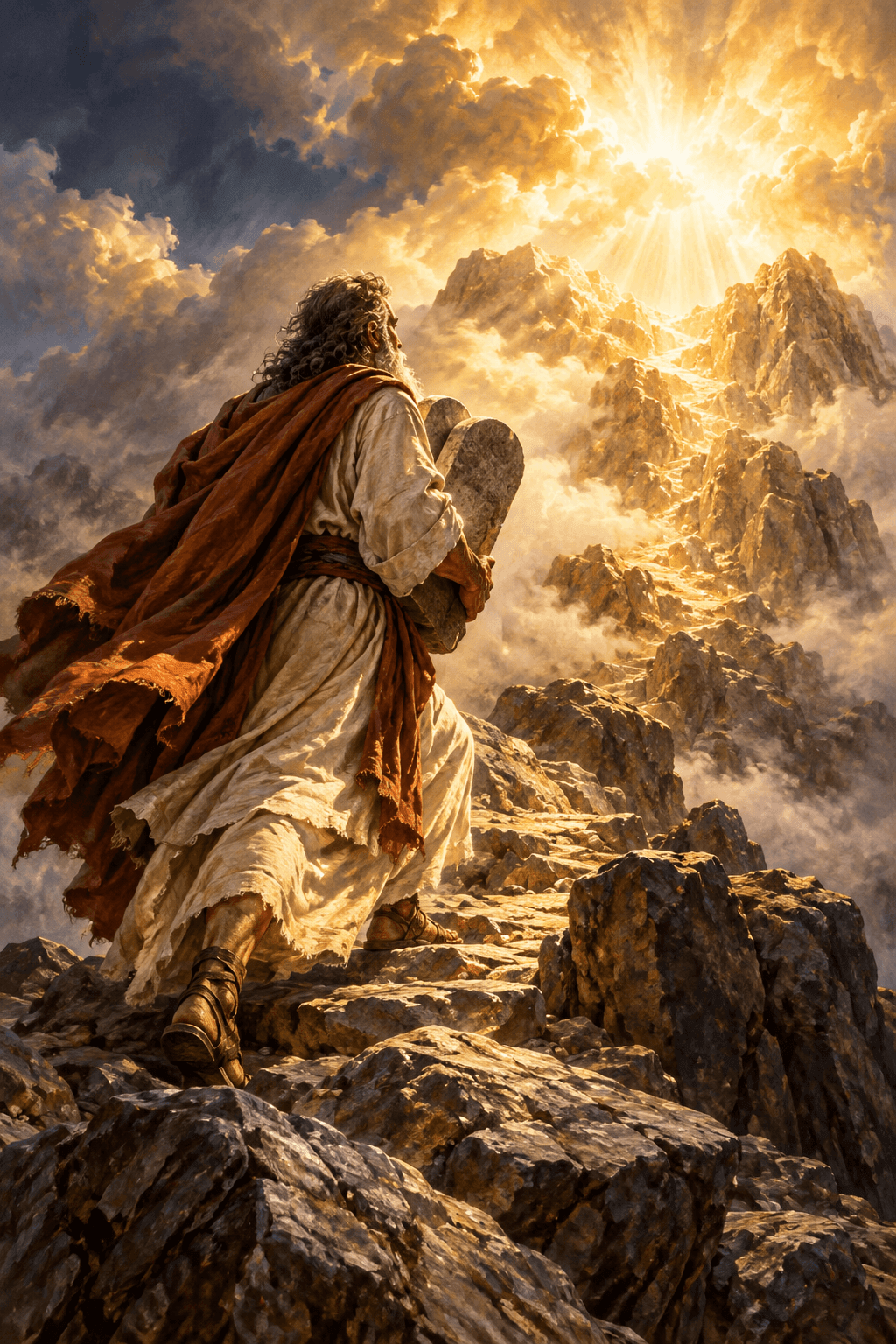
The first time, God gave the two tables hewn and with the commandments engraved on them. But this time God asked Moses to hew two tables like the first, and God would write on them. God renewed the covenant with His fallen people, but the people lost the two tables that were the work of God.
2. The Lord Descends and Speaks with Moses
KJV · Verses 5–10
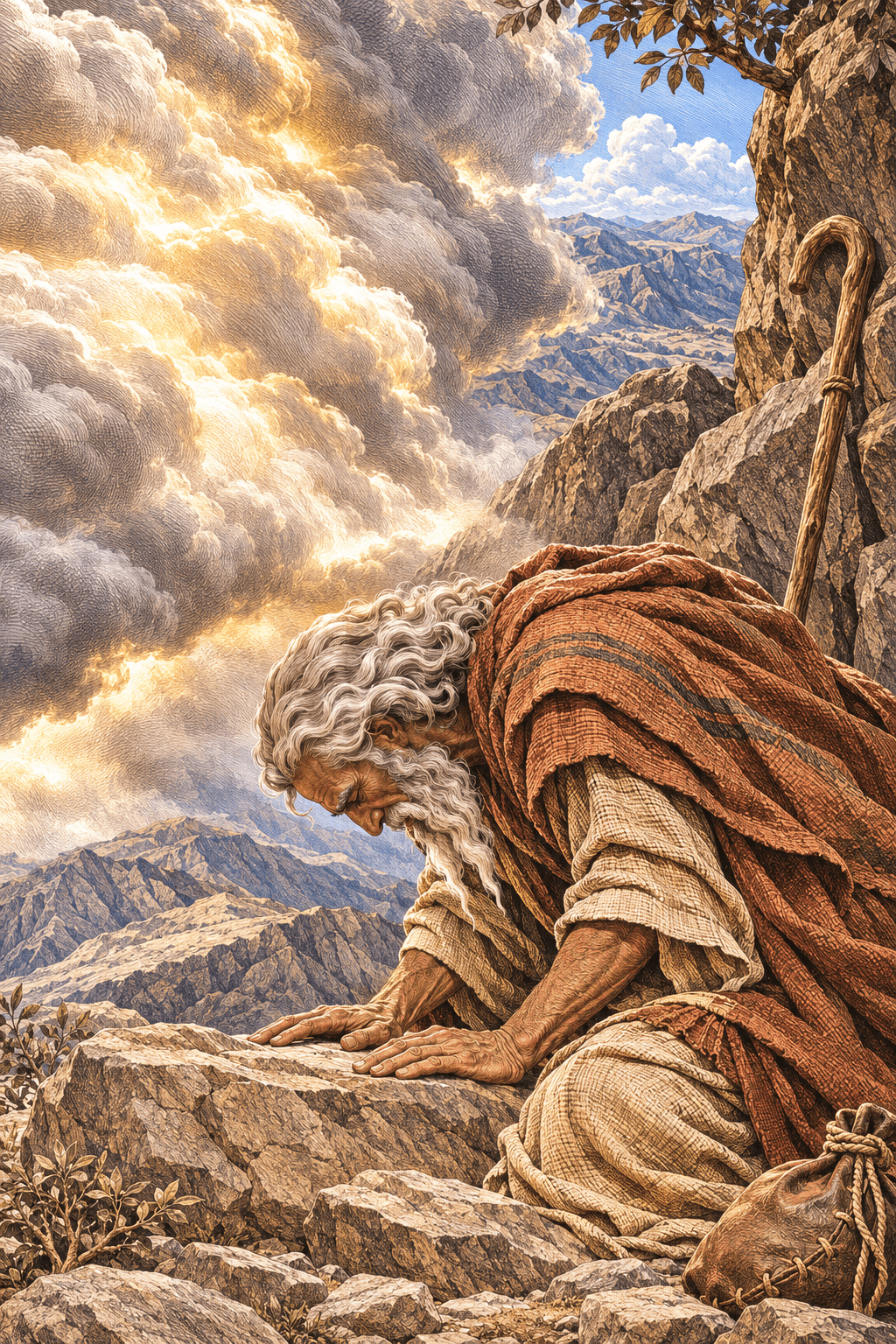
5 And the Lord descended in the cloud, and stood with him there, and proclaimed the name of the Lord. 6 And the Lord passed by before him, and proclaimed, The Lord, The Lord God, merciful and gracious, longsuffering, and abundant in goodness and truth, 7 Keeping mercy for thousands, forgiving iniquity and transgression and sin, and that will by no means clear the guilty; visiting the iniquity of the fathers upon the children, and upon the children's children, unto the third and to the fourth generation. 8 And Moses made haste, and bowed his head toward the earth, and worshipped. 9 And he said, If now I have found grace in thy sight, O Lord, let my Lord, I pray thee, go among us; for it is a stiffnecked people; and pardon our iniquity and our sin, and take us for thine inheritance. 10 And he said, Behold, I make a covenant: before all thy people I will do marvels, such as have not been done in all the earth, nor in any nation: and all the people among which thou art shall see the work of the Lord: for it is a terrible thing that I will do with thee.
God fulfilled His promise to Moses, “And it shall come to pass, while my glory passeth by…” (Exodus 33:22), for we see here that “the LORD passed by before him” (6). The Lord declared His nature: “The LORD, The LORD God, merciful and gracious, longsuffering, and abundant in goodness and truth, Keeping mercy for thousands, forgiving iniquity and transgression and sin, and that will by no means clear the guilty; visiting the iniquity of the fathers upon the children, and upon the children’s children, unto the third and to the fourth generation” (6–7).
He also fulfills His promise: “I will proclaim the name of the LORD before thee; and will be gracious to whom I will be gracious, and will shew mercy on whom I will shew mercy” (Exodus 33:19). He has made clear what it means that He is gracious to whom He will be gracious and shows mercy on whom He will show mercy. It is not, as it may appear at first sight, that God shows partiality, having mercy on whom He wills even if he is unrepentant, and hardening whom He wills even if he is repentant! Rather, His judgments are above human thought: He has mercy when He sees that a person has offered repentance, or longs to repent. Behold, He now declares His mercy by renewing the covenant, yet not without justice, but after they offered true repentance, stripped off their ornaments (Exodus 33:6), and mourned (Exodus 33:4).
His saying, “I will shew mercy on whom I will shew mercy,” resembles the words of Paul the Apostle: “I have planted, Apollos watered; but God gave the increase” (1 Corinthians 3:6). Truly God gives growth to His vineyard, the Church; but does God work without the shepherds planting and watering the vineyard?! Or do the shepherds stop working because God gives the increase?! They do what they can, but there is no life without Him! So we offer repentance, but there is mercy not because of any righteousness in us, but because of God, who has mercy on whom He has mercy. As Saint Augustine says:
Whoever thinks there is unrighteousness in God because He justly disciplines one who deserves it, or prolongs His patience and mercy… is foolish. [439]
Paul the Apostle used this phrase in his Epistle to the Romans, saying: “What shall we say then? Is there unrighteousness with God? God forbid. For he saith to Moses, I will have mercy on whom I will have mercy, and I will have compassion on whom I will have compassion. So then it is not of him that willeth, nor of him that runneth, but of God that sheweth mercy” (Romans 9:14–16). What does this mean? That we do not will or run because He is the One who shows mercy or hardens as He wills?! Impossible. The Apostle wants to affirm that God’s mercy is free and His love is because of His nature. He gives to those who will to repent and run to Him, but it is not because of them; it is because of His love, His mercy, and His free salvation. In this chapter the Apostle wanted to make clear that if the Lord accepted Israel and had mercy on them of old, it was no merit of theirs; and if the Gentiles desired salvation and believed, it is no merit of theirs either. God who had mercy on Israel before has mercy on all the nations now, so Israel has no right to object!! For Hosea the prophet prophesied in the name of the Lord: “I will call them my people, which were not my people; and her beloved, which was not beloved” (Romans 9:25), not at the expense of the old people, but because the old people refused and the nations accepted! [440]
As for His saying that He visits the iniquity of the fathers upon the children, we explained it before when speaking of the commandments (chapter 20).
When Moses heard the voice of the Lord, he “made haste, and bowed his head toward the earth, and worshipped” (8), offering submission and repentance on behalf of the whole people. So the Lord renewed the covenant, saying: “Behold, I make a covenant…” (10).
3. The Two Conditions of the Renewal
KJV · Verses 11–26
11 Observe thou that which I command thee this day: behold, I drive out before thee the Amorite, and the Canaanite, and the Hittite, and the Perizzite, and the Hivite, and the Jebusite. 12 Take heed to thyself, lest thou make a covenant with the inhabitants of the land whither thou goest, lest it be for a snare in the midst of thee: 13 But ye shall destroy their altars, break their images, and cut down their groves: 14 For thou shalt worship no other god: for the Lord, whose name is Jealous, is a jealous God: 15 Lest thou make a covenant with the inhabitants of the land, and they go a whoring after their gods, and do sacrifice unto their gods, and one call thee, and thou eat of his sacrifice; 16 And thou take of their daughters unto thy sons, and their daughters go a whoring after their gods, and make thy sons go a whoring after their gods. 17 Thou shalt make thee no molten gods. 18 The feast of unleavened bread shalt thou keep. Seven days thou shalt eat unleavened bread, as I commanded thee, in the time of the month Abib: for in the month Abib thou camest out from Egypt. 19 All that openeth the matrix is mine; and every firstling among thy cattle, whether ox or sheep, that is male. 20 But the firstling of an ass thou shalt redeem with a lamb: and if thou redeem him not, then shalt thou break his neck. All the firstborn of thy sons thou shalt redeem. And none shall appear before me empty. 21 Six days thou shalt work, but on the seventh day thou shalt rest: in earing time and in harvest thou shalt rest. 22 And thou shalt observe the feast of weeks, of the firstfruits of wheat harvest, and the feast of ingathering at the year's end. 23 Thrice in the year shall all your menchildren appear before the Lord God, the God of Israel. 24 For I will cast out the nations before thee, and enlarge thy borders: neither shall any man desire thy land, when thou shalt go up to appear before the Lordthy God thrice in the year. 25 Thou shalt not offer the blood of my sacrifice with leaven; neither shall the sacrifice of the feast of the passover be left unto the morning. 26 The first of the firstfruits of thy land thou shalt bring unto the house of the Lord thy God. Thou shalt not seethe a kid in his mother's milk.
As the Lord makes a covenant with the people after their fall into idol worship, He gives them two basic conditions:
A) A negative condition: to destroy sin in all its forms, for He says: “Take heed to thyself, lest thou make a covenant with the inhabitants of the land whither thou goest, lest it be for a snare in the midst of thee: But ye shall destroy their altars, break their images, and cut down their groves: For thou shalt worship no other god: for the LORD, whose name is Jealous, is a jealous God” (12–14). As we said before, the people could not distinguish between sin and sinners, so destroying everything connected with the sinners was a symbol of destroying sin in our life.
B) A positive condition: fleeing from evil is not enough; the positive side is necessary in the covenant, such as keeping the feasts, offering the firstborn, and sanctifying the day of the Lord (18–26)… things that set a person’s heart aflame with the fire of the love of God and give him joy and rest! We have already spoken of these things.
4. Moses’ Fast
KJV · Verses 27–28
27 And the Lord said unto Moses, Write thou these words: for after the tenor of these words I have made a covenant with thee and with Israel. 28 And he was there with the Lord forty days and forty nights; he did neither eat bread, nor drink water. And he wrote upon the tables the words of the covenant, the ten commandments.
The covenant was joined with fasting, for “he was there with the LORD forty days and forty nights; he did neither eat bread, nor drink water” (28).
Since he was with the Lord, he needed no bread or water, for the Lord was his fullness and the secret of his being satisfied. We saw before that the number 40 points to temporal life; it is as if a person, in his enjoyment of the delight of the commandment and fellowship with the Word of God, should spend his life far from the life of luxury.
5. The Shining of Moses’ Face
KJV · Verses 29–35
29 And it came to pass, when Moses came down from mount Sinai with the two tables of testimony in Moses' hand, when he came down from the mount, that Moses wist not that the skin of his face shone while he talked with him. 30 And when Aaron and all the children of Israel saw Moses, behold, the skin of his face shone; and they were afraid to come nigh him. 31 And Moses called unto them; and Aaron and all the rulers of the congregation returned unto him: and Moses talked with them. 32 And afterward all the children of Israel came nigh: and he gave them in commandment all that the Lord had spoken with him in mount Sinai. 33 And till Moses had done speaking with them, he put a vail on his face. 34 But when Moses went in before the Lord to speak with him, he took the vail off, until he came out. And he came out, and spake unto the children of Israel that which he was commanded. 35 And the children of Israel saw the face of Moses, that the skin of Moses' face shone: and Moses put the vail upon his face again, until he went in to speak with him.
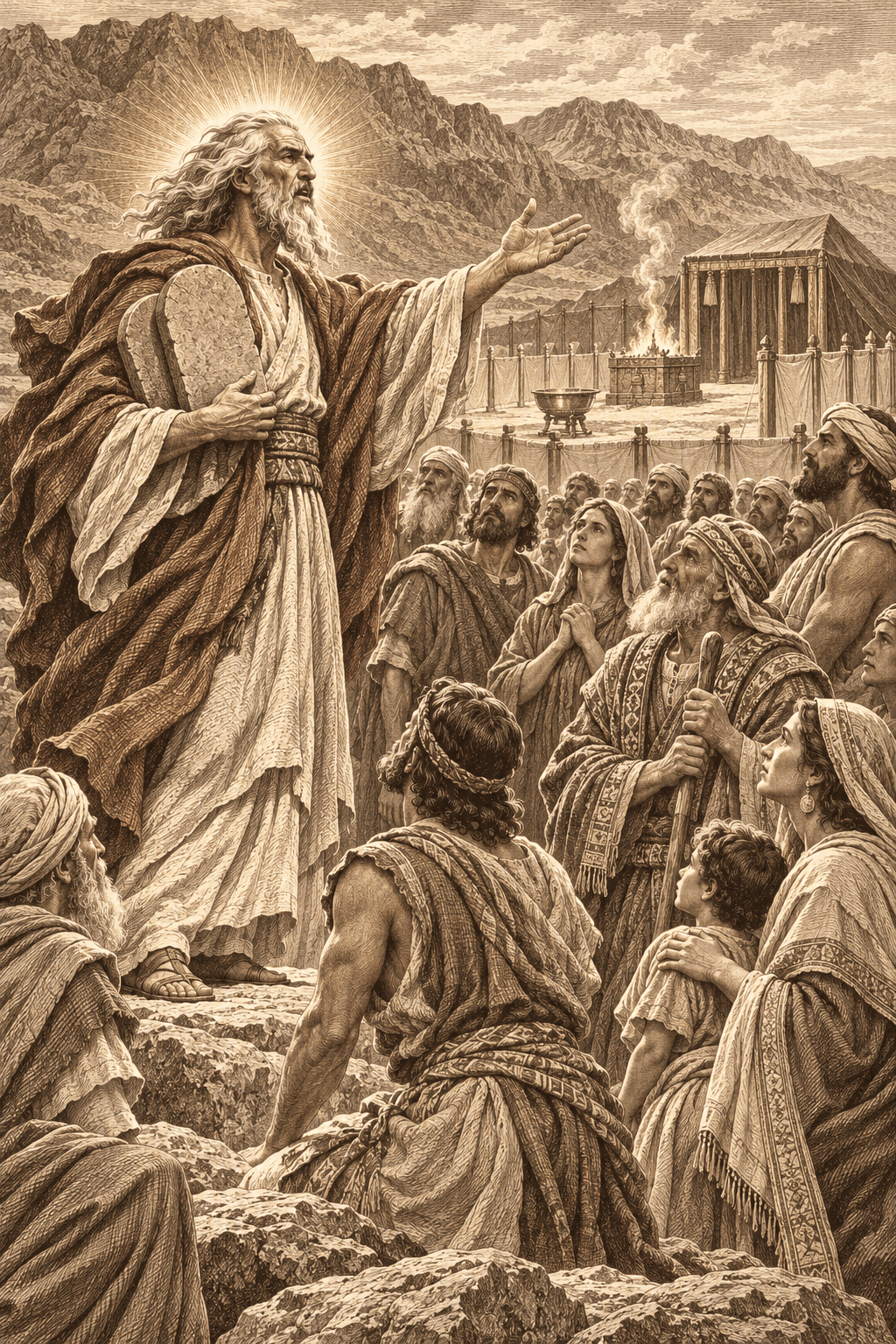
As Moses stood before God, “the skin of his face shone while he talked with him” (29), something that had not happened in all the previous years, during his meeting with Him in the burning bush, or at receiving the Ten Commandments the first time, or the Law… It is as if God wanted to reward him this time for his great love for his people. If out of love he accepted that his name be blotted out of the eternal book, by love his face shone while he was still on earth! This is the splendor and glory of the true life of love!
Saint Clement of Alexandria sees in the shining of Moses’ face a symbol of the gnostic, that is, the person of true, practical knowledge, who is glorified here on earth as happened with Moses, so that his body bears the marks of the righteous soul. [441]
Tertullian sees in this event a declaration of God’s work in the resurrection: if Moses was glorified in his own eyes, so that the people could not look at his shining face, so will our state be in the resurrection. [442]
As for the veil which Moses put on when he spoke with the people, so that he could stand among them and speak to them, it is the veil which the Lord Christ removed by our receiving His grace (2 Corinthians 3:13–14). As Saint Paul says, the veil still remains upon the Jews, on their unbelieving hearts (2 Corinthians 3:15), so they cannot perceive the mysteries of the Law and its hidden spirit!
Origen speaks of this veil:
If we read carelessly, without zeal for understanding or perception, the whole of Scripture is covered with the veil, even the Gospels and the Epistles. [443]
Some of you come right after the reading, and some do not discuss what they hear, nor speak of it. These do not remember the commandments of the divine Law, which say: “Ask thy father, and he will shew thee; thy elders, and they will tell thee” (Deuteronomy 32:7). Some do not wait until the end of the reading in the church, and others do not care whether the readings have been read or not… I say of these that when Moses is read, not only is a veil put on, but a wall and a fence are put in their heart. [444]
Study is not enough to know the Holy Scriptures; we must entreat the Lord and beseech Him day and night, until the Lamb of the tribe of Judah comes, takes the sealed book, and looses its seals (Revelation 5:5). He it is who, when He opened the Scriptures to His two disciples, set their hearts aflame, so that they said: “Did not our heart burn within us… while he opened to us the scriptures?” (Luke 24:32). May the Lord have compassion on us now, for it is said: “Now the Lord is that Spirit: and where the Spirit of the Lord is, there is liberty” (2 Corinthians 3:17), so that the freedom of knowledge may be established and we may be saved from the bondage of the veil. Therefore the Apostle added: “But we all, with open face beholding… the glory of the Lord” (2 Corinthians 3:18)… But how can we find this freedom if we are still slaves to the world, money, and the lusts of the flesh?! [445]
Notes and References
[439] St. Augustine, Enchiridion 98.
[440] I will return to explain this matter in more detail in our commentary on the Epistle of Paul the Apostle to the Romans, if the Lord wills.
[441] Clement of Alexandria, Stromata 6:12.
[442] Tertullian, On the Resurrection of the Flesh 55.
[443] Origen, In Exod. hom. 12:4.
[444] Ibid. 12:2.
[445] Ibid. 12:4.