
The people’s fall into the worship of the golden calf was no small matter. So we saw God hasten to send Moses down to them, telling him to let Him alone to consume them; and Moses interceded with Him. When Moses returned to the foot of the mountain and saw the people fallen into sin, he broke the two tables and disciplined the people bitterly. Then he interceded for them again, asking either to be saved with his people or to perish with them, and the Lord accepted the intercession… New discussions were necessary, ending with the renewal of the covenant which the people had broken by their sin, embodied in the breaking of the two tables. This is what we see in chapters 33 and 34.
Chapter 33 contains: a divine reproach to the people (1–6); Moses’ tent as a tabernacle of meeting (7–11); entreating God (12–17); and the divine friendship (18–23).
1. A Divine Reproach to the People
KJV · Verses 1–6
1 And the Lord said unto Moses, Depart, and go up hence, thou and the people which thou hast brought up out of the land of Egypt, unto the land which I sware unto Abraham, to Isaac, and to Jacob, saying, Unto thy seed will I give it: 2 And I will send an angel before thee; and I will drive out the Canaanite, the Amorite, and the Hittite, and the Perizzite, the Hivite, and the Jebusite: 3 Unto a land flowing with milk and honey: for I will not go up in the midst of thee; for thou art a stiffnecked people: lest I consume thee in the way. 4 And when the people heard these evil tidings, they mourned: and no man did put on him his ornaments. 5 For the Lord had said unto Moses, Say unto the children of Israel, Ye are a stiffnecked people: I will come up into the midst of thee in a moment, and consume thee: therefore now put off thy ornaments from thee, that I may know what to do unto thee. 6 And the children of Israel stripped themselves of their ornaments by the mount Horeb.
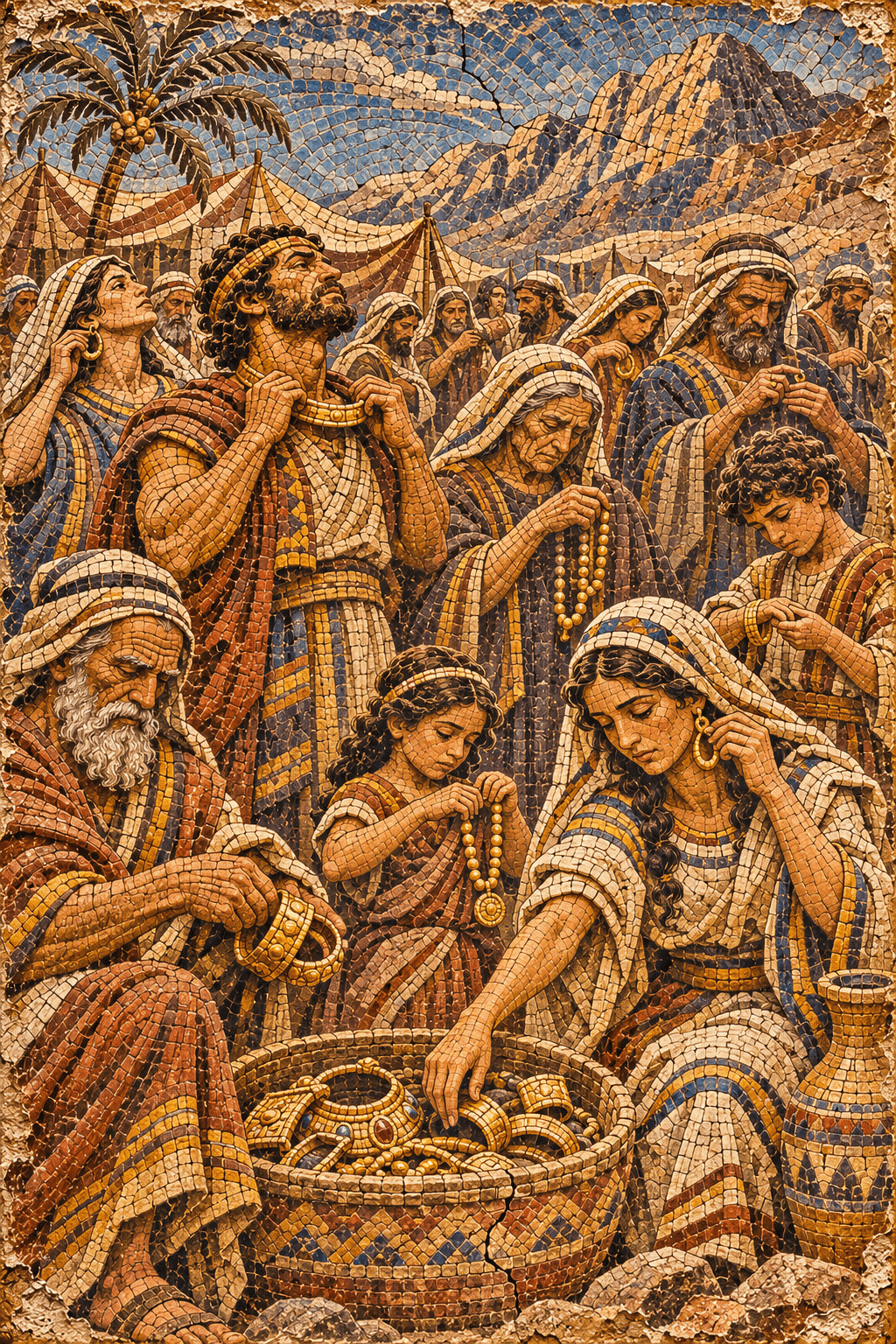
God accepted the intercession of His servant Moses and assured him that He remains faithful in spite of men’s unfaithfulness, for He says to him: “Depart, and go up hence, thou and the people which thou hast brought up out of the land of Egypt, unto the land which I sware unto Abraham, to Isaac, and to Jacob, saying, Unto thy seed will I give it” (1). He fulfills His promises as He pledged to their fathers, but He changes the way of fulfilling them, for we notice in His words:
A) He still bears pain concerning this people. He does not call them “my people,” nor does He speak in the language of the earlier friendship… perhaps so that the people would not take sin lightly and exploit God’s love and mercies.
B) He no longer dwells in their midst Himself, for He says: “And I will send an angel before thee… for I will not go up in the midst of thee; for thou art a stiffnecked people: lest I consume thee in the way” (2–3). He sends “an angel” to defend them, support them, and guide them; this is not the Angel of whom He spoke in chapter 23, who is the second Hypostasis, for He says, “for my name is in him” (Exodus 23:21). God withdrew from the midst of the people, for what fellowship is there between God and a stiffnecked man (3)? God does not accept it, and fellowship cannot be realized thus; nor can man bear it, for He says: “Say unto the children of Israel, Ye are a stiffnecked people: I will come up into the midst of thee in a moment, and consume thee” (5). It is as if it is of God’s mercy toward them that He not go up in their midst while they are still in their sin!
C) The Lord opened the door of hope before Moses and the people by speaking of repentance, saying: “Therefore now put off thy ornaments from thee, that I may know what to do unto thee” (5). It is as if He says to them: Put off your reliance on yourselves, leave the lusts of your body, and give Me an opportunity to work in your midst!
2. Moses’ Tent as a Tabernacle of Meeting
KJV · Verses 7–11
7 And Moses took the tabernacle, and pitched it without the camp, afar off from the camp, and called it the Tabernacle of the congregation. And it came to pass, that every one which sought the Lord went out unto the tabernacle of the congregation, which was without the camp. 8 And it came to pass, when Moses went out unto the tabernacle, that all the people rose up, and stood every man at his tent door, and looked after Moses, until he was gone into the tabernacle. 9 And it came to pass, as Moses entered into the tabernacle, the cloudy pillar descended, and stood at the door of the tabernacle, and the Lord talked with Moses. 10 And all the people saw the cloudy pillar stand at the tabernacle door: and all the people rose up and worshipped, every man in his tent door. 11 And the Lord spake unto Moses face to face, as a man speaketh unto his friend. And he turned again into the camp: but his servant Joshua, the son of Nun, a young man, departed not out of the tabernacle.
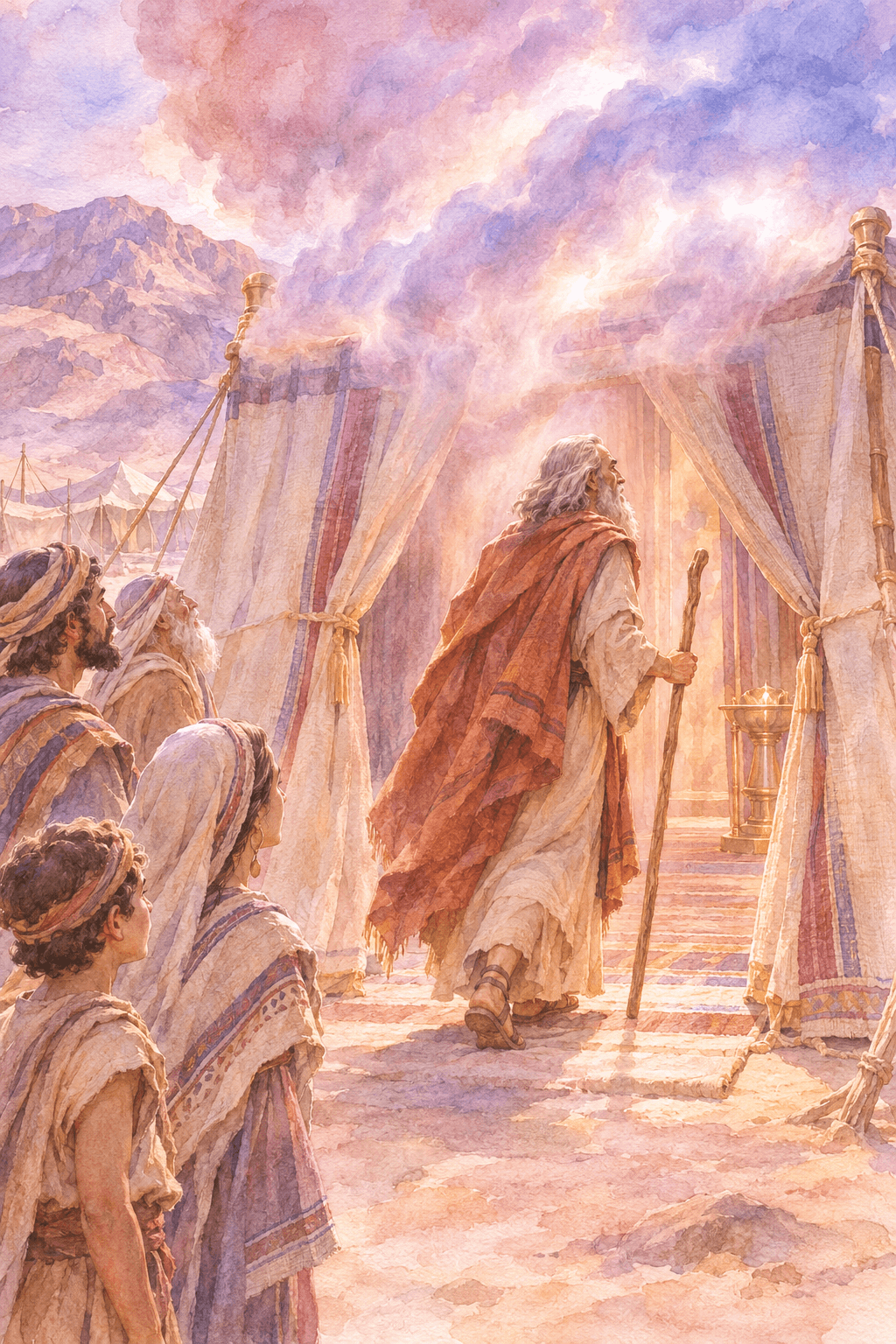
The people mourned and stripped themselves of their ornaments (4–6) as a sign of their holy sorrow and repentance. But God no longer met with Moses inside the camp, which had been defiled by this hideous sin; so Moses was bound to take a tent and pitch it without the camp, afar off, and he called it the tabernacle of the congregation (7).
This is not the tabernacle of meeting which God commanded Moses to make, for it had not yet been made; it is Moses’ own tent for his worship, that is, his chamber of prayer. He went out with it far from evil, so that he might meet God within it, and God spoke to him “face to face, as a man speaketh unto his friend” (11).
This does not mean that Moses saw the face of God; the phrase here means that God spoke to Moses directly and with a clear, audible voice, not as with the people, who stood afar off, each at the door of his tent, and saw the pillar of cloud descending at the door of the tabernacle. Through his love for God and for his people, Moses entered into a special friendship with God. Saint John Chrysostom says:
Since Moses was meek and very gentle, as it is said of him, “Now the man Moses was very meek, above all the men which were upon the face of the earth” (Numbers 12:3), he was acceptable to God and the object of His love, so that it is said that he spoke with God face to face and mouth to mouth, as one speaks to his friend. [428]
By this tent God prepared the people for the tabernacle of meeting which Moses would set up according to the divine command. They saw the glory of God at the door of the tent, and they worshipped, every man at his tent door (10); indeed they came to revere Moses, so that when he went out to the tent every man stood at his tent door and looked after Moses until he went into the tent (8). They perceived the holiness of meeting with God and the holiness of God’s servants!
As the young Joshua was a disciple of Moses, especially on the holy mountain of knowledge, where he accompanied him but did not ascend with him to its summit (Exodus 24:13), here he became his disciple in the spirit of worship, for it says: “And he turned again into the camp: but his servant Joshua, the son of Nun, a young man, departed not out of the tabernacle” (11). Discipleship does not stop at knowledge; it must be mingled with the life of godly worship.
Perhaps leaving Joshua in the tent was also to support Moses: when Moses went out of the tent for the service, Joshua remained in the tent praying for him. It is as if preaching and worship complete each other; there is no success in service except by the spirit of prayer and worship.
Father Aphrahat [429] sees that Joshua the son of Nun’s not departing from the tent means his commitment to the life of virginity. In that tent no women served, nor did a woman approach it; if the women wanted to pray they prayed at the door and did not enter. But Joshua remained in the tent, consecrating his whole life to worship, not occupied even with family life.
3. Entreating God
KJV · Verses 12–17
12 And Moses said unto the Lord, See, thou sayest unto me, Bring up this people: and thou hast not let me know whom thou wilt send with me. Yet thou hast said, I know thee by name, and thou hast also found grace in my sight. 13 Now therefore, I pray thee, if I have found grace in thy sight, shew me now thy way, that I may know thee, that I may find grace in thy sight: and consider that this nation is thy people. 14 And he said, My presence shall go with thee, and I will give thee rest. 15 And he said unto him, If thy presence go not with me, carry us not up hence. 16 For wherein shall it be known here that I and thy people have found grace in thy sight? is it not in that thou goest with us? so shall we be separated, I and thy people, from all the people that are upon the face of the earth. 17 And the Lord said unto Moses, I will do this thing also that thou hast spoken: for thou hast found grace in my sight, and I know thee by name.
Moses the prophet knew how to deal with God in a spirit of humility together with the boldness of love and daring… He seized every opportunity; he let no opportunity pass without entering further into the divine embrace, taking by force mercy and love for himself and his people! Therefore the Lord Himself says: “The kingdom of heaven suffereth violence, and the violent take it by force” (Matthew 11:12).
After God forgave this people’s hideous sin, and returned to speak with Moses face to face in the temporary tabernacle of meeting outside the camp, Moses began to reproach the Lord with daring and humility: “See, thou sayest unto me, Bring up this people: and thou hast not let me know whom thou wilt send with me. Yet thou hast said, I know thee by name, and thou hast also found grace in my sight” (12). It is as if Moses says to the Lord: Do You need me to entreat You for Your people? Who sent the other?! You commanded me to bring up this people; will You leave me?! You told me that You know me by my name and that I have found grace in Your sight; so hear me, and do not leave me alone in the leadership.
With boldness he says to God, “See” (12); with boldness he says to Him, “Thou hast said, I know thee by name,” and in the Septuagint, “I know thee above all.” God knows all, for He knows everything; but knowing here is not understanding and perceiving, but the knowledge of acceptance and friendship, as the Apostle says, “The Lord knoweth them that are his” (2 Timothy 2:19); but to those who do evil the Lord says, “I never knew you” (Matthew 7:23). [430]
Again, in the boldness of true love he says to Him: “Shew me now thy way, that I may know thee” (13). If You as God have known me by my name and graced me with this, allow me to know the way of Your dealings of love with Your people, that I too may know You! As You know me by my name, I want to know You by Your name, not with the knowledge of understanding and perception, but with the knowledge of love and friendship!
Again, with boldness he repeats in his speech with God the words “thy people” (13, 16), as if he says to Him: If You call them “the people,” they belong to You, and You, O Lord, have set them apart for Yourself, and all the peoples know this.
Finally, after entering into this great boldness, he says to the Lord: “If thy presence go not with me, carry us not up hence” (15). We will accept no substitute for You, and we will not rest without You! Before this love and this boldness the Lord says to Moses: “My presence shall go with thee, and I will give thee rest… I will do this thing also that thou hast spoken” (14, 17). Who can so take hold of the heart of God that God longs to give him rest, and what the servant speaks the Creator does?!
Would that in every work and before every act we cry with Moses, saying: “If thy presence go not with me, carry us not up hence.” The face (presence) of God here points to the second Hypostasis, who became man and came among us, leading our life and bringing us up into the embrace of the Father.
4. The Divine Friendship
KJV · Verses 18–23
18 And he said, I beseech thee, shew me thy glory. 19 And he said, I will make all my goodness pass before thee, and I will proclaim the name of the Lord before thee; and will be gracious to whom I will be gracious, and will shew mercy on whom I will shew mercy. 20 And he said, Thou canst not see my face: for there shall no man see me, and live. 21 And the Lord said, Behold, there is a place by me, and thou shalt stand upon a rock: 22 And it shall come to pass, while my glory passeth by, that I will put thee in a clift of the rock, and will cover thee with my hand while I pass by: 23 And I will take away mine hand, and thou shalt see my back parts: but my face shall not be seen.
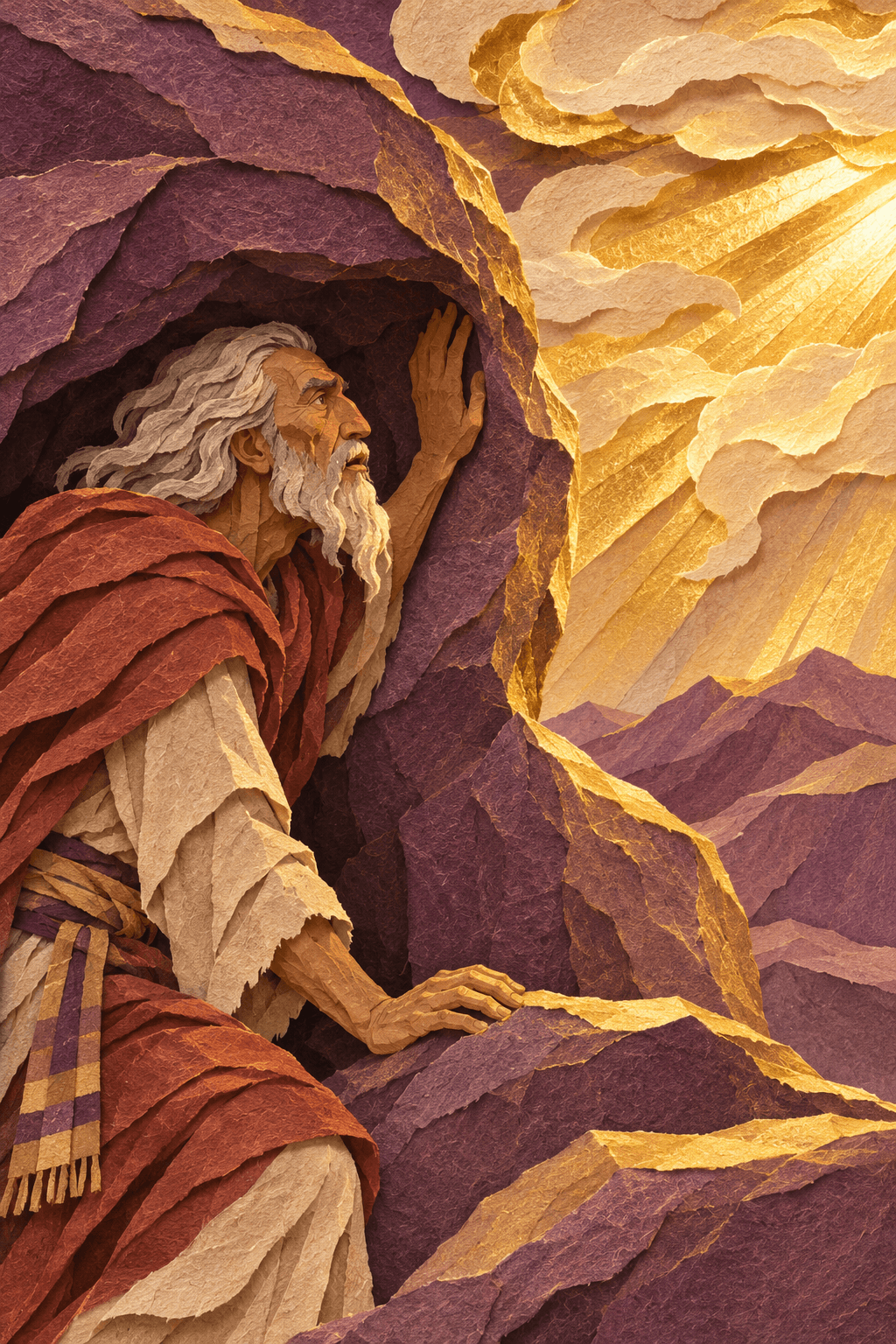
Moses’ requests of his God did not stop. Truly things had returned to what they had been before the people sinned by worshipping the calf; God had promised to do what Moses asked, and His presence would go in their midst. But Moses covets God’s infinite gifts, and he asked boldly: “I beseech thee, shew me thy glory” (18).
Moses took courage and asked God what no one before had dared to ask. His heart burning with the fire of divine love, he wanted to see God as He is… What would happen?! He wanted to know the Incomprehensible and see the Invisible… The Lord’s answer to him was: “I will make all my goodness pass before thee, and I will proclaim the name of the LORD before thee; and will be gracious to whom I will be gracious, and will shew mercy on whom I will shew mercy. [431]… Thou canst not see my face: for there shall no man see me, and live” (19–20).
It is as if God answers Moses: You have asked something you cannot bear. I am not stingy toward My creation; I give you all My benefits and good things, I declare My name to you, and I am gracious and merciful. I give everything to man; but My face man cannot see and live! This bare, perfect vision of the Godhead is above all human capacity!
Moses’ request, “Shew me thy glory,” is a clear declaration that our knowledge of God does not come by human wisdom, but by the power of God, for Saint Clement of Alexandria says:
Moses was convinced that God is not known by human wisdom… and he was bound to enter into the thick darkness (the cloud) where the voice of God was, to attain to the thoughts concerning the existence of the incomprehensible and invisible God. God is not in darkness or in a place; He is above place and time and above all attributes. [432]
He also says:
By saying this he indicated very clearly that God cannot be learned of from man, nor expressed in words, but we know Him through His power. [433]
The invisible God reveals Himself within the soul as much as she is able to see; but the essence of His Godhead no one can behold, for no one knows the Father as He is except the Son (Matthew 11:27; John 6:46). Saint John Chrysostom sees that all the visions the patriarchs and prophets enjoyed were by way of God’s condescension, revealing Himself as much as they could bear; even the heavenly creation in all its orders sees God thus. The Son alone knows the essence of the Father; He became incarnate not to reveal the divine essence, but to reveal Himself through the manhood. [434]
When Philip asked the Lord Christ, “Lord, shew us the Father, and it sufficeth us,” the Lord answered him: “He that hath seen me hath seen the Father” (John 14:8–9). The Lord’s answer, as Saint John Chrysostom says:
was something like this: It is impossible for you to see Him or to see Me. For Philip thought that he knew God through sight, and counted that he had known Christ by seeing Him, so he wanted to know the Father thus. But Jesus made clear to him that he had not yet seen even Christ Himself. [435]
We see Him here through His work in us; we are conformed to Him and become His own and His friends. In this way we behold Him, not in the essence of His Godhead, but through the relationship of love and fellowship with Him. Saint Clement of Alexandria says:
It is clear that no one in this life can perceive God clearly; but “the pure in heart… shall see God” (Matthew 5:8), when they reach the final perfection. [436]
Finally the Lord answered Moses’ question, saying: “Behold, there is a place by me, and thou shalt stand upon a rock: And it shall come to pass, while my glory passeth by, that I will put thee in a clift of the rock, and will cover thee with my hand while I pass by: And I will take away mine hand, and thou shalt see my back parts: but my face shall not be seen” (21–23).
This speech points [437] to the divine Incarnation. His saying, “Behold, there is a place by me,” is as if He means: I have fulfilled your request as much as you can bear, for I carry you into the mystery of the Incarnation, so that you stand upon the rock, that is, rest upon the Lord Christ (the true Rock). His saying, “thou shalt see my back parts,” points to the end of the ages, when God passes over the world declaring His love, and we see God through the divine Incarnation, as one who, in the covering of the hand of God (Christ), sees the glory of the Godhead (in the cleft of the rock), and says with John the Apostle: “And we beheld his glory, the glory as of the only begotten of the Father” (John 1:14).
Saint Basil the Great has a spiritual interpretation of the Lord’s answer, for he says:
What does He mean by saying, “There is a place by me,” except the contemplation in the Spirit? When Moses was in it, he was able to see God appearing to him in a way that enabled him to know Him. This is the place of true worship, for He said: “Take heed to thyself that thou offer not thy burnt offerings in every place that thou seest: But in the place which the LORD shall choose” (Deuteronomy 12:13–14). What then is the spiritual burnt offering? The sacrifice of praise. In what place do we offer it, if not in the Holy Spirit?! From whom did we learn this? From Christ Himself, who said: “The true worshippers shall worship the Father in spirit and in truth” (John 4:23). And when Jacob saw this place he said: “Surely the LORD is in this place” (Genesis 28:16). The Spirit is the place of the saints, and the saints are a place proper to the Spirit, for they offer themselves as a dwelling for God and are called the temple of God. And as Paul speaks of Christ as speaking in the presence of God, so he speaks in the Spirit of mysteries, and the Spirit also speaks in him. [438]
Notes and References
[428] St. John Chrysostom, In Matt. hom. 78:4.
[429] Aphrahat, Demonstration 6:5, On Monks.
[430] Gregory of Nyssa, On the Making of Man 20:1.
[431] See the commentary on this saying in the next chapter (section 2).
[432] Clement of Alexandria, Stromata 2:2.
[433] Ibid. 5:11.
[434] St. John Chrysostom, In Joan. hom. 15:1.
[435] St. John Chrysostom, In Joan. hom. 74:1.
[436] Clement of Alexandria, Stromata 5:1. We have dealt with the subject of the vision of God more fully in our book Saint John Chrysostom (Arabic, 1968), in the chapter on his thought and theology.
[437] St. Ambrose, On the Holy Spirit 3:5.
[438] St. Basil, On the Holy Spirit 62.