
These chapters (Exodus 35–40) give a detailed picture of the making of the tabernacle, its erection, and its consecration, when God revealed His glory in it. We have already spoken of the tabernacle and its furnishings (Exodus 25–27; 30–31), so here I will offer only the following brief remarks.
1. Why Are the Details of the Tabernacle Repeated at Length?
KJV · Verses 1–3
1 And Moses gathered all the congregation of the children of Israel together, and said unto them, These are the words which the Lord hath commanded, that ye should do them. 2 Six days shall work be done, but on the seventh day there shall be to you an holy day, a sabbath of rest to the Lord: whosoever doeth work therein shall be put to death. 3 Ye shall kindle no fire throughout your habitations upon the sabbath day.
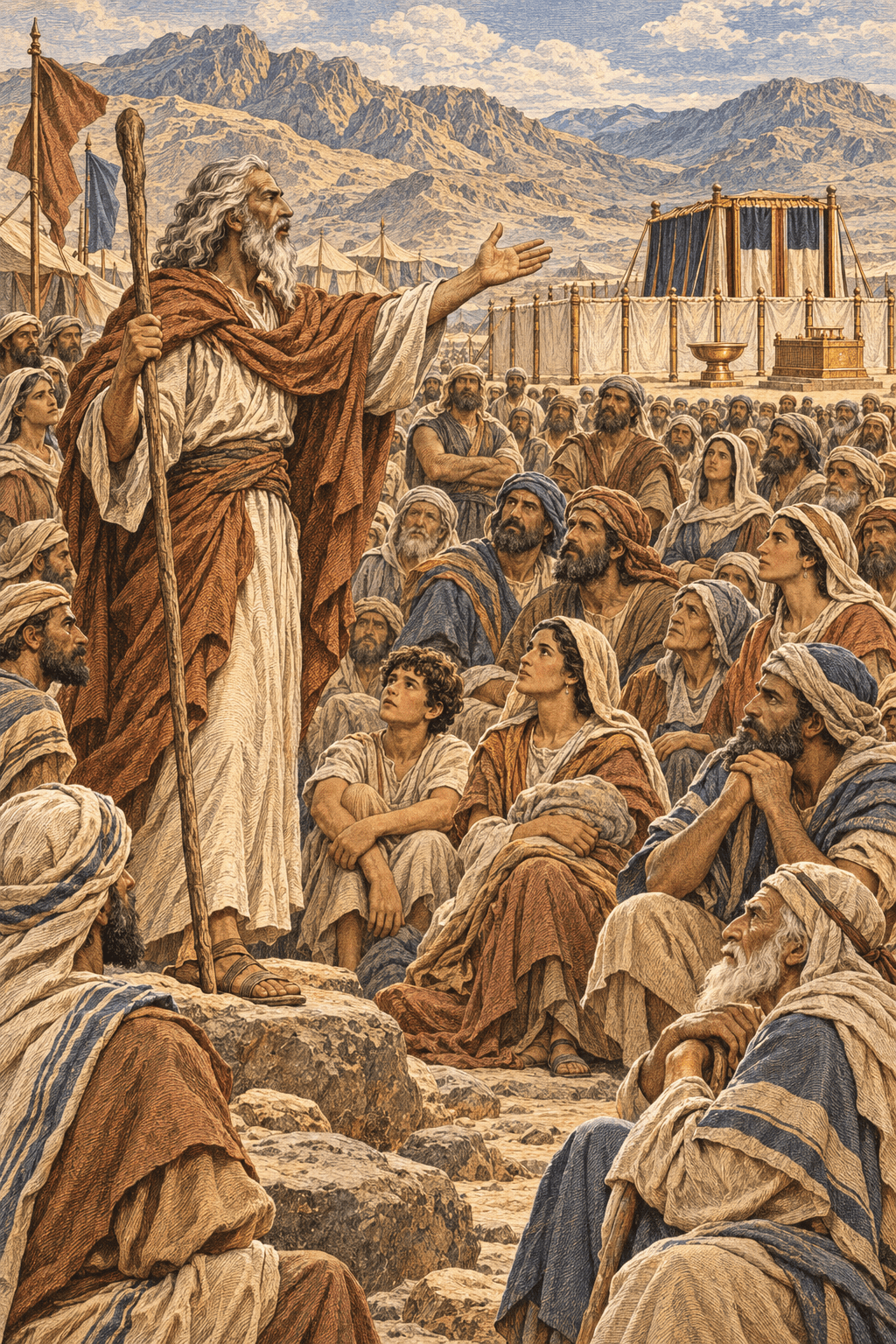
A) The Holy Scripture wanted to affirm that the craftsmen kept the strictest accuracy in making the tabernacle and all its furnishings, according to the pattern which God commanded Moses. For God, who cares to set up a spiritual dwelling within us, wants us to be exact in carrying out the commandment.
B) Recording the acts of obedience which this people performed, so that they became a living part of the word of God, declares to us that through acts of obedience our life is written in the book of life, and immortality is written for us.
2. The Offerings
KJV · Verses 4–29
4 And Moses spake unto all the congregation of the children of Israel, saying, This is the thing which the Lord commanded, saying, 5 Take ye from among you an offering unto the Lord: whosoever is of a willing heart, let him bring it, an offering of the Lord; gold, and silver, and brass, 6 And blue, and purple, and scarlet, and fine linen, and goats' hair, 7 And rams' skins dyed red, and badgers' skins, and shittim wood, 8 And oil for the light, and spices for anointing oil, and for the sweet incense, 9 And onyx stones, and stones to be set for the ephod, and for the breastplate. 10 And every wise hearted among you shall come, and make all that the Lordhath commanded; 11 The tabernacle, his tent, and his covering, his taches, and his boards, his bars, his pillars, and his sockets, 12 The ark, and the staves thereof, with the mercy seat, and the vail of the covering, 13 The table, and his staves, and all his vessels, and the shewbread, 14 The candlestick also for the light, and his furniture, and his lamps, with the oil for the light, 15 And the incense altar, and his staves, and the anointing oil, and the sweet incense, and the hanging for the door at the entering in of the tabernacle, 16 The altar of burnt offering, with his brasen grate, his staves, and all his vessels, the laver and his foot, 17 The hangings of the court, his pillars, and their sockets, and the hanging for the door of the court, 18 The pins of the tabernacle, and the pins of the court, and their cords, 19 The cloths of service, to do service in the holy place, the holy garments for Aaron the priest, and the garments of his sons, to minister in the priest's office. 20 And all the congregation of the children of Israel departed from the presence of Moses. 21 And they came, every one whose heart stirred him up, and every one whom his spirit made willing, and they brought the Lord's offering to the work of the tabernacle of the congregation, and for all his service, and for the holy garments. 22 And they came, both men and women, as many as were willing hearted, and brought bracelets, and earrings, and rings, and tablets, all jewels of gold: and every man that offered offered an offering of gold unto the Lord. 23 And every man, with whom was found blue, and purple, and scarlet, and fine linen, and goats' hair, and red skins of rams, and badgers' skins, brought them. 24 Every one that did offer an offering of silver and brass brought the Lord's offering: and every man, with whom was found shittim wood for any work of the service, brought it. 25 And all the women that were wise hearted did spin with their hands, and brought that which they had spun, both of blue, and of purple, and of scarlet, and of fine linen. 26 And all the women whose heart stirred them up in wisdom spun goats' hair. 27 And the rulers brought onyx stones, and stones to be set, for the ephod, and for the breastplate; 28 And spice, and oil for the light, and for the anointing oil, and for the sweet incense. 29 The children of Israel brought a willing offering unto the Lord, every man and woman, whose heart made them willing to bring for all manner of work, which the Lord had commanded to be made by the hand of Moses.
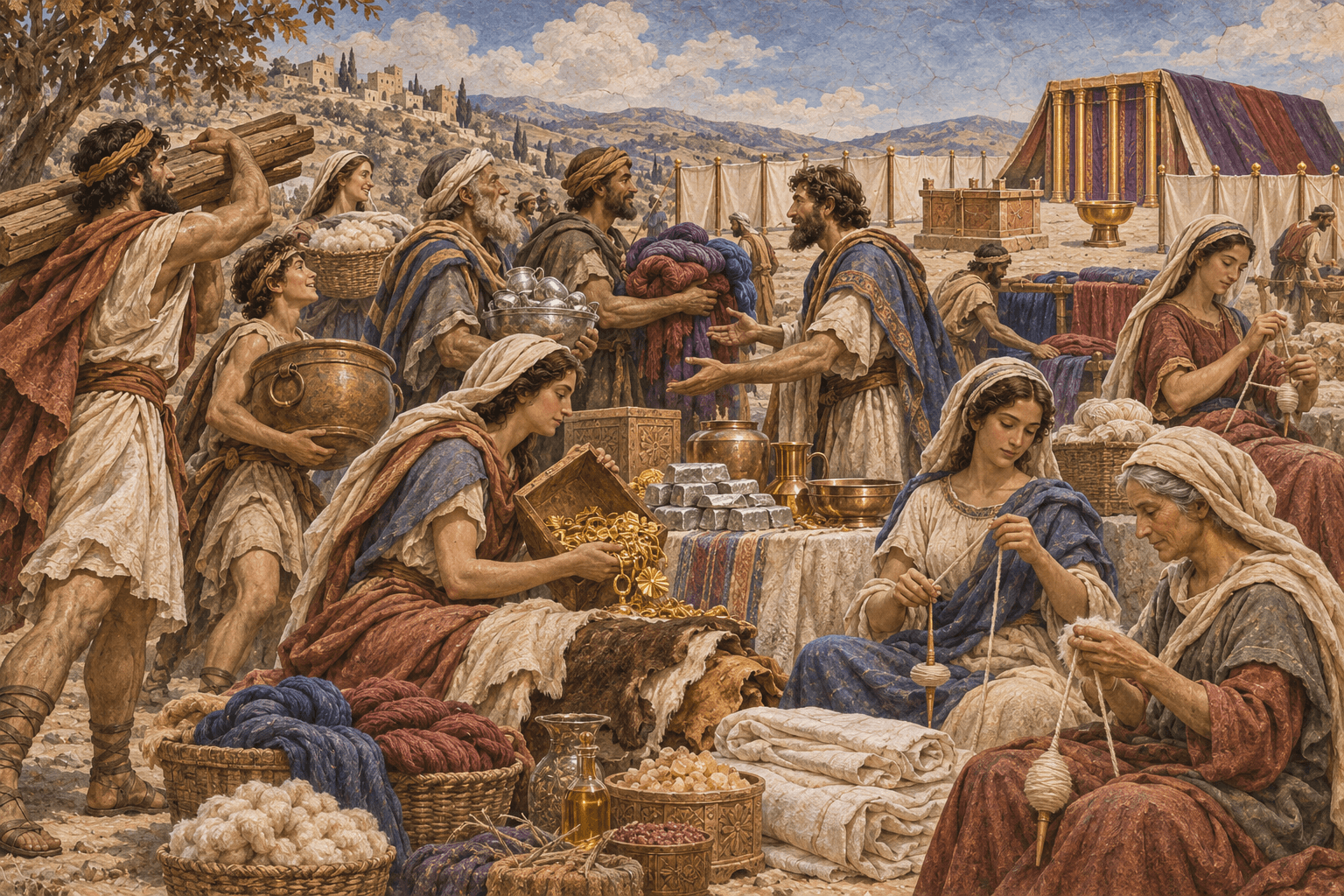
We saw before the saying of Scripture, “Take ye from among you an offering unto the LORD” (Exodus 35:5). It carried an inner offering, in which a person offers his life, heart, feelings, and mind. That is why the offerings were varied; yet we do not find “lead” among them, because it points to sin. Instead we find gold, silver, and brass… even goats’ hair, rams’ skins, and badgers’ skins, which point to the life of mortification and the control of the lusts of the body.
Scripture affirms: “And they came, both men and women, as many as were willing hearted” (Exodus 35:22). This partnership in giving points to the partnership of the soul with the body, and of the mind with the feelings, that is, the sanctification of the whole person as one unity. As Origen says:
The women are good when they obey their husbands, meaning that the body is good when it does not rebel against the spirit but obeys it and works in harmony with it. [446]
Just as the body can destroy the soul by resisting it through evil lusts, so that both are deprived together of the divine glories, so by its submission it works with the soul, under the leadership of the Lord Christ through His Holy Spirit, so that both receive the heavenly crown together. And as Origen says, when soul and body are in harmony and united in the spiritual work, God dwells in the person, as the Lord said: “For where two or three are gathered together in my name, there am I in the midst of them” (Matthew 18:20).
On the other hand, we also find in this work a living picture of the living Church, in which men work with women and the elders take part too… everyone offers something; there is no idle or barren one among the members of the body of the Lord Christ.
The rulers took on the offering of onyx stones and stones to be set for the ephod and the breastplate, and spice and oil for the light, for the anointing oil, and for the sweet incense (Exodus 35:27–28). These rulers point to the work of leadership, so they offered the stones we spoke of before, which point to carrying the people on the shoulders and the breast to bring them into the temple of the Lord with a fatherly spirit, bearing responsibility for them and praying for them! They also fill the lamp with oil, so that their practical life may shine with the light of a living, practical faith, and they bear witness to God before everyone. They offer the anointing oil, so that their works may be anointed by the Holy Spirit. As for the incense and the spices, the secret of their success is “unceasing prayer” and offering their life as a sacrifice of love, a sweet savour of incense before God.
3. Wisdom in Working and Giving
KJV · Verses 30–35
30 And Moses said unto the children of Israel, See, the Lord hath called by name Bezaleel the son of Uri, the son of Hur, of the tribe of Judah; 31 And he hath filled him with the spirit of God, in wisdom, in understanding, and in knowledge, and in all manner of workmanship; 32 And to devise curious works, to work in gold, and in silver, and in brass, 33 And in the cutting of stones, to set them, and in carving of wood, to make any manner of cunning work. 34 And he hath put in his heart that he may teach, both he, and Aholiab, the son of Ahisamach, of the tribe of Dan. 35 Them hath he filled with wisdom of heart, to work all manner of work, of the engraver, and of the cunning workman, and of the embroiderer, in blue, and in purple, in scarlet, and in fine linen, and of the weaver, even of them that do any work, and of those that devise cunning work.
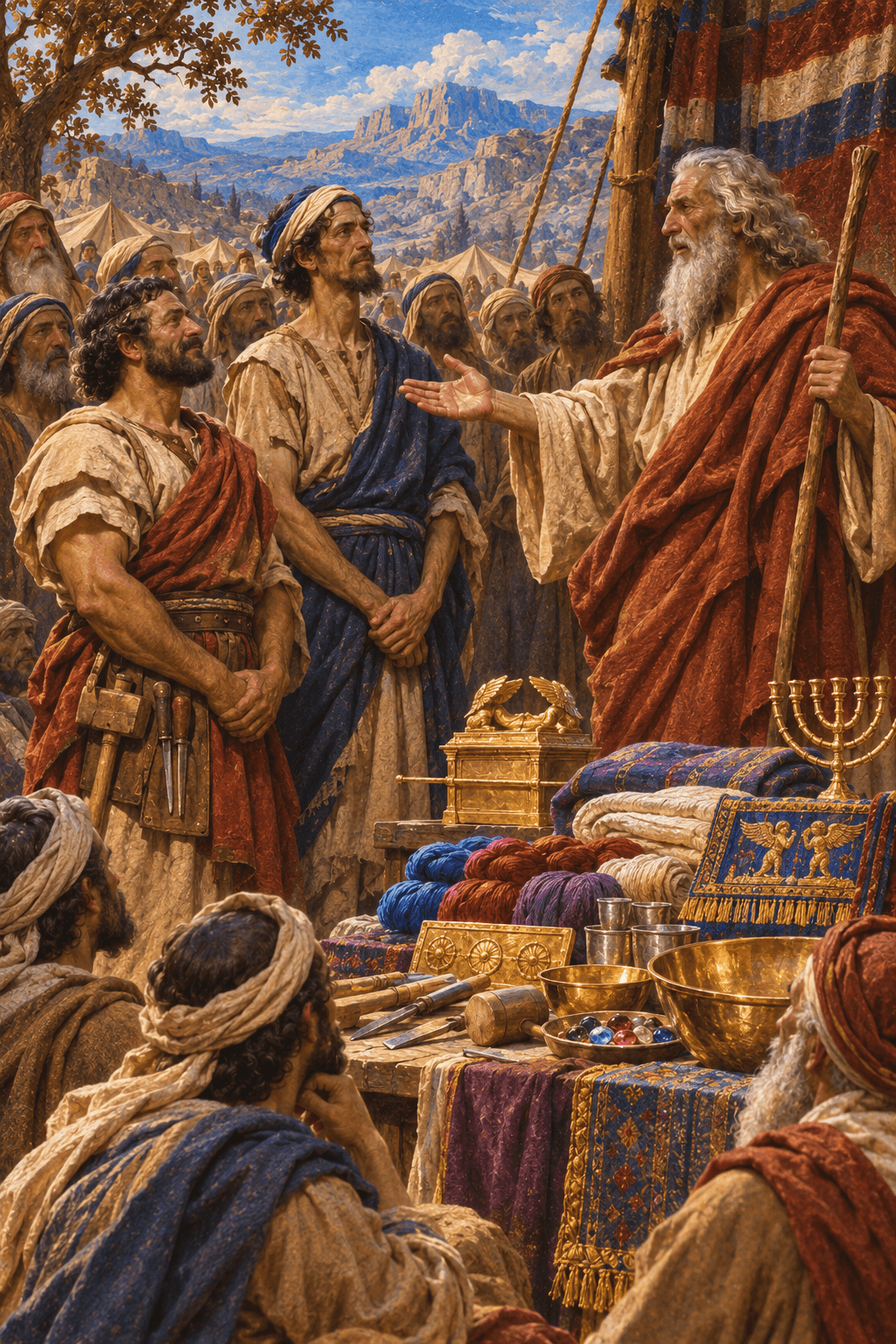
Since we possess the materials of the tabernacle, we must have wisdom in building it. As Origen says:
What does it profit you to possess these materials if you cannot use them, and do not know how to bring out their value at the right time and in the fitting way?! Therefore we should strive to become wise, so that we can use the things we learn from the Holy Scriptures at their proper time and put them in their proper place, and so build the dwelling of God and adorn it. [447]
4. Giving Early in the Morning
The people brought their gifts every morning (Exodus 36:3), and the craftsmen offered their work, not with a passing zeal but with a persevering, constant spirit, until there was more than enough. This is the picture of the working life that offers the Lord its inner life and its works every morning, that is, early, and does not wait to offer the Lord whatever is left of it at the end of the day.
It gives Him first place in all its life: God first, before every person and before every work! That is why Wisdom (the Lord) says: “I love them that love me; and those that seek me early shall find me” (Proverbs 8:17). And the Psalmist says: “O God, thou art my God; early will I seek thee: my soul thirsteth for thee, my flesh longeth for thee in a dry and thirsty land, where no water is; To see thy power and thy glory, so as I have seen thee in the sanctuary” (Psalm 63:1–2).
Their offering their gifts in the morning does not only mean that they gave out of their need; they also gave with joy and gladness, without hesitation or delay, as if they were following the example of Mary Magdalene, who went out early in the morning carrying the spices of love to meet the Lord Christ risen from the dead.
5. The Dedication of the Tabernacle
When the people obeyed God’s commands with all exactness, the tabernacle was set up, and God, whom the heavens and the earth cannot contain, accepted it as a dwelling for Himself among His people!
It was a joyful day, for the priests were ordained and the whole tabernacle and its furnishings were dedicated. “Then a cloud covered the tent of the congregation, and the glory of the LORD filled the tabernacle. And Moses was not able to enter into the tent of the congregation, because the cloud abode thereon, and the glory of the LORD filled the tabernacle” (Exodus 40:34–35). Here Moses, with all the boldness he had attained before God, was unable to enter the tabernacle, because the cloud abode on it and the glory of the Lord filled the tabernacle. It is as if he wanted to declare to his people that he had presented the symbol complete and left the way to the only begotten Son, who is in the bosom of the Father. He alone enters the Holy of Holies, carrying us in Himself, so that we may enjoy the cloud of the Holy Spirit that fills the dwelling, and through Him enter into the glory of the Lord and the fellowship of His glories forever.
Notes and References
[446] Origen, In Exod. hom. 13:5.
[447] Ibid. 13:7.