
Though Jacob was greatly troubled and afraid of his meeting with his brother Esau, God prepared his heart for this meeting by appearing to his uncle Laban, assuring him that He was his keeper and the Disposer of his life. And on the way God appeared to him and allowed him to wrestle with Him, so as to give him a new name, which the Church of the Old Covenant would bear through the generations.
1. Jacob with the Angels of God
KJV · Verses 1–2
1 And Jacob went on his way, and the angels of God met him. 2 And when Jacob saw them, he said, This is God's host: and he called the name of that place Mahanaim.
If Laban returned with his brethren to his land, on which he had set his heart, Jacob in turn set out with his family and all his possessions toward Canaan — as though setting out toward the heavenly Canaan, toward the land of promise; therefore the angels of God met him. Jacob represents the Church sojourning on earth, setting out with her heart, her members, and all she has toward the Father’s bosom by the Holy Spirit, through her union in Christ Jesus her Head and her abiding in Him. She walks hidden in her Christ and supported also by His host (the angels of God). This is what Jacob saw, for he said: “This is God’s host”… We walk in a divine procession, accompanied by the angels who love our salvation.
It seems the number of angels was huge, so that Jacob called them “God’s host,” and he called the place “Mahanaim,” which means “two camps” or “two hosts,” for Jacob with his people represented a visible army, and the angels guarding them represented an invisible divine army. Origen the scholar sees that when the Church, which gathers those who fear the Lord, assembles together, the angels of God who encamp around those who fear Him also assemble, so that with the visible Church there is an invisible church of angels… All gather together in Christ Jesus, the cornerstone, who unites those on earth with the heavenly ones. Thus the Church becomes “Mahanaim,” that is, two camps (or two hosts) united together.
2. Jacob Sends Messengers to His Brother
KJV · Verses 3–8
3 And Jacob sent messengers before him to Esau his brother unto the land of Seir, the country of Edom. 4 And he commanded them, saying, Thus shall ye speak unto my lord Esau; Thy servant Jacob saith thus, I have sojourned with Laban, and stayed there until now: 5 And I have oxen, and asses, flocks, and menservants, and womenservants: and I have sent to tell my lord, that I may find grace in thy sight. 6 And the messengers returned to Jacob, saying, We came to thy brother Esau, and also he cometh to meet thee, and four hundred men with him. 7 Then Jacob was greatly afraid and distressed: and he divided the people that was with him, and the flocks, and herds, and the camels, into two bands; 8 And said, If Esau come to the one company, and smite it, then the other company which is left shall escape.
If God gave Jacob two lessons — the first through His appearing to Laban, who was coming to do him harm, and stopping him from this deed; and the second through the appearance of God’s angels to him — Jacob in his human weakness feared his brother’s anger, so he sent messengers to him to test his feeling toward him. Esau was in the land of Seir, in the country of Edom, and both names belong to Esau himself: he was called Seir, that is, “hairy,” and Edom means “red” or “bloody” (Genesis 25:25). Perhaps the region was called Seir because of the abundance of trees, as though like hair covering the body. The land of Seir extended from the Gulf of Aqaba to the Dead Sea; it belonged to the Horites (Genesis 14:6), and Esau took possession of it.
Jacob sent the messengers with a message of entreaty without consulting the Lord or asking His help… though in his message he used a spirit of love and humility, calling his brother “my lord.”
Esau heard the message; and being very rich, he went out to meet his brother with four hundred men of his servants. This terrified Jacob’s heart, and he was distressed (7). So he thought of dividing his company into two bands, so that if Esau attacked the first band the other might escape; and he also thought of offering a gift of love to appease his brother.
Jacob is not to be blamed for his arrangement of the matter, especially since he acted with wisdom and humility; but he is to be blamed for not consulting the Lord!
3. Jacob Takes Refuge in the God of His Father
KJV · Verses 9–12
9 And Jacob said, O God of my father Abraham, and God of my father Isaac, the Lord which saidst unto me, Return unto thy country, and to thy kindred, and I will deal well with thee: 10 I am not worthy of the least of all the mercies, and of all the truth, which thou hast shewed unto thy servant; for with my staff I passed over this Jordan; and now I am become two bands. 11 Deliver me, I pray thee, from the hand of my brother, from the hand of Esau: for I fear him, lest he will come and smite me, and the mother with the children. 12 And thou saidst, I will surely do thee good, and make thy seed as the sand of the sea, which cannot be numbered for multitude.
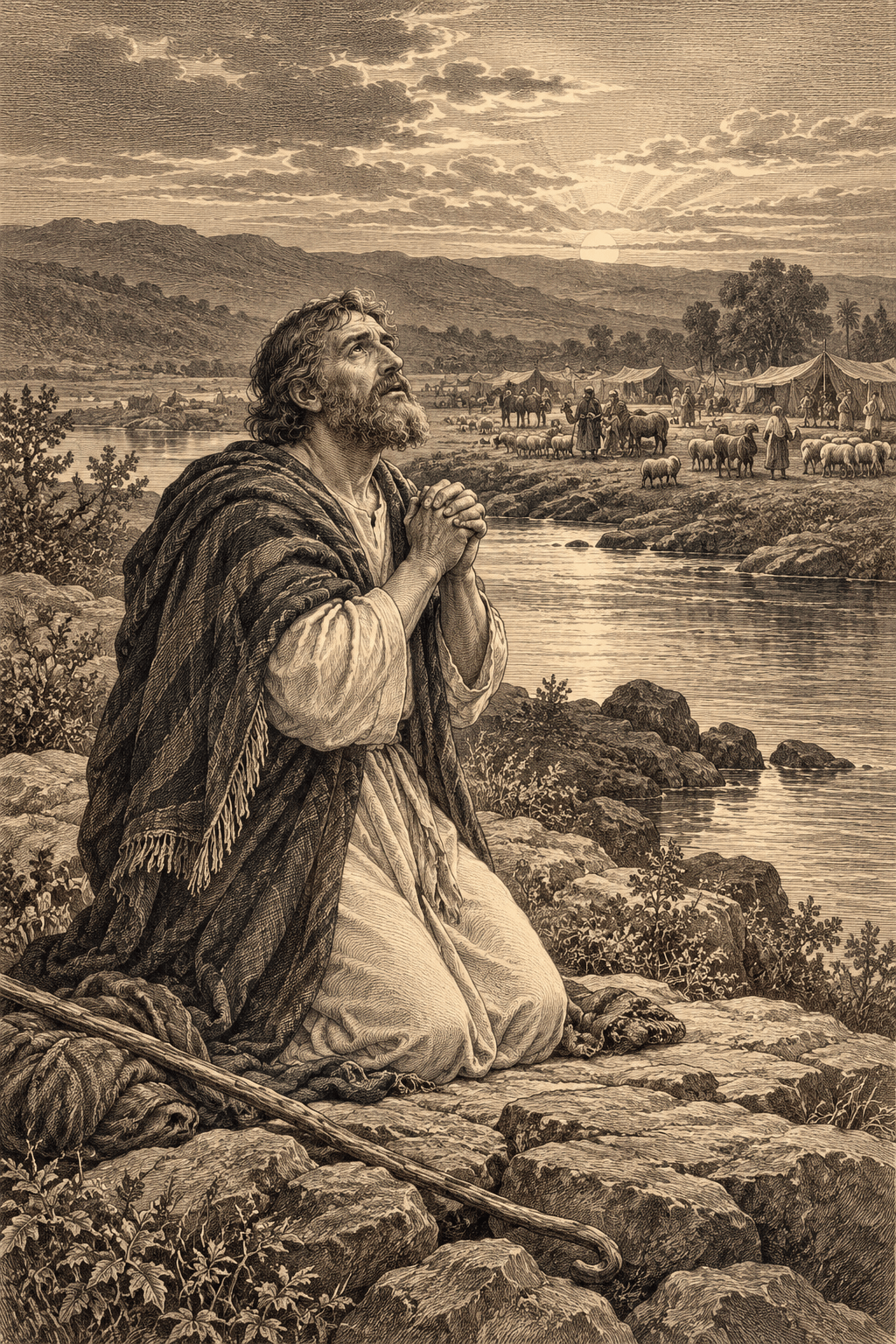
When Jacob was distressed and feared his brother Esau, he took refuge in God through prayer, and his prayer came strong and effective, for it was marked by the following:
First: He speaks with God through a personal relationship, calling Him: “O God of my father Abraham, and God of my father Isaac” (9). He does not speak with God as a God withdrawn from mankind, nor as a lover of mankind in general, but as a Father to him and his family. How beautiful it is for a person to feel he is on the level of a personal relationship with God — something that appeared clearly in the life of Saint Augustine, so that he said in one of his soliloquies that he imagined as though there were no one in the world but God and himself: God gives him all love, and he returns this love by offering his whole heart to God.
Second: He reminds God of His promises: “the LORD which saidst unto me, Return unto thy country, and to thy kindred, and I will deal well with thee” (9). God rejoices in His children who insist on the fulfillment of the divine promises and hold fast to them with the boldness of sonship.
Third: In his prayers he feels weakness before the riches of God’s surpassing love, as though ashamed to ask for anything more, saying: “I am not worthy of the least of all the mercies, and of all the truth, which thou hast shewed unto thy servant” (10). What he now asks is an extension of the enjoyment of the riches of God’s practical love, which he had tasted and melted in! He does not ask as one who has a right, or as one asking God to repay him for a good work he did; but he asks Him to give him as He had accustomed him all his former days, for He was and still is rich and generous in His giving to him.
Fourth: Jacob says: “for with my staff I passed over this Jordan; and now I am become two bands” (10). When Jacob left his father’s house he went out empty-handed, owning nothing but a staff in his hand; and now he returns with two great bands. He is like the believer who has set out from the world bearing in his heart his staff, that is, his cross, as the secret of his strength; through this divine staff that has become his, he becomes in God’s eyes like two great hosts, for he is sanctified in his spirit as in his body, and the spirit offers all its energies as the body offers all its senses sanctified in the Lord!
Father Caesarius of Arles sees in the picture of Jacob going out with a staff and returning with two bands a symbolic picture of the Lord Christ, saying:
Jacob used his staff to acquire his wife, but Christ carried the wood of the cross to save the Church. [390]
Finally: After relating God to himself and his family, after reminding Him of His divine promises, declaring his right to the promises not from righteousness he had done but from the increasing riches of God’s love, and after speaking of the side of faith concerning the efficacy of the cross (his staff), he finally asked Him to deliver him! May we not present our problems, troubles, and needs until after offering a sacrifice of thanksgiving to God, enjoying a friendly conversation with Him, and recounting His wonderful works with us!
4. Jacob Sends a Gift to His Brother
KJV · Verses 13–23
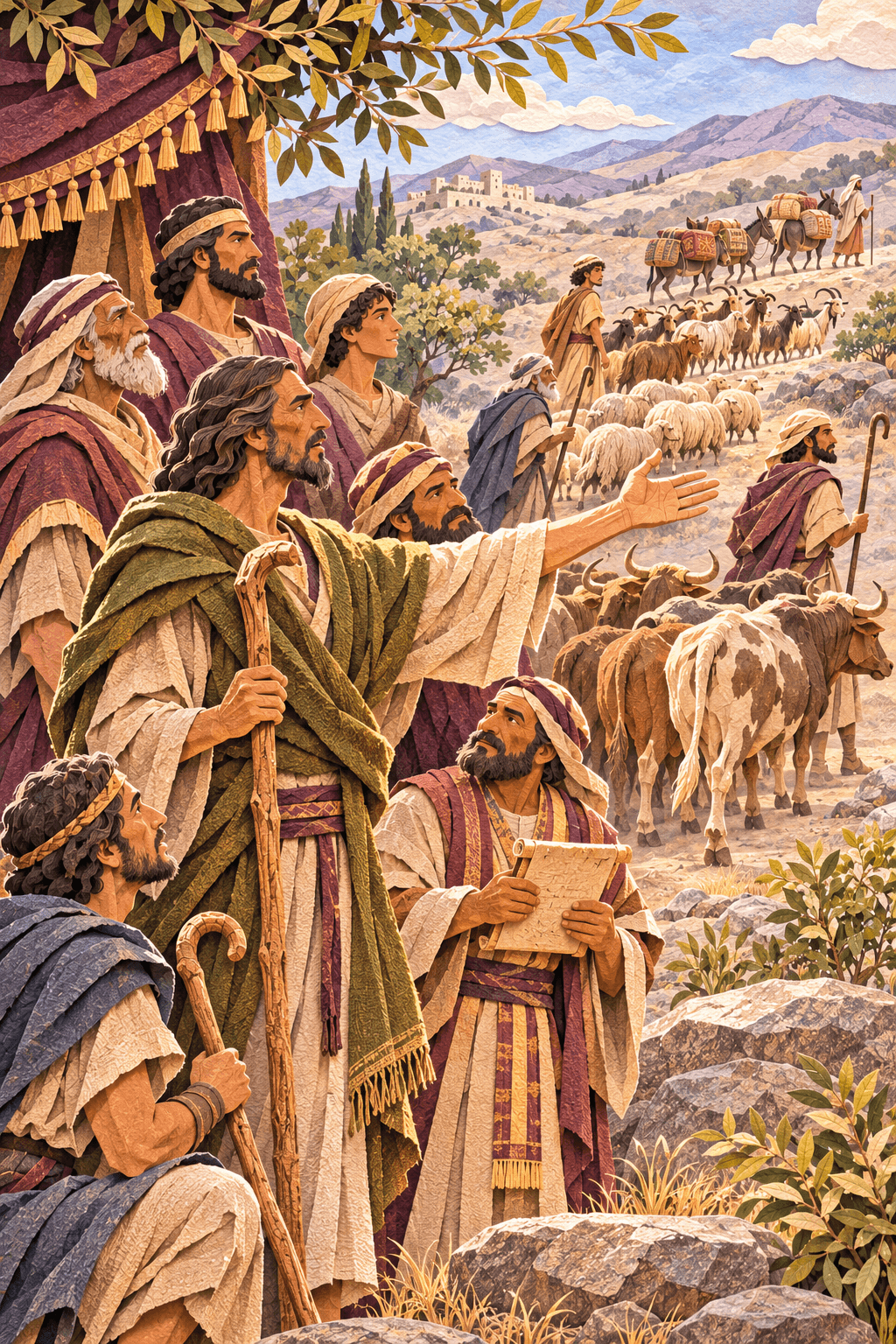
13 And he lodged there that same night; and took of that which came to his hand a present for Esau his brother; 14 Two hundred she goats, and twenty he goats, two hundred ewes, and twenty rams, 15 Thirty milch camels with their colts, forty kine, and ten bulls, twenty she asses, and ten foals. 16 And he delivered them into the hand of his servants, every drove by themselves; and said unto his servants, Pass over before me, and put a space betwixt drove and drove. 17 And he commanded the foremost, saying, When Esau my brother meeteth thee, and asketh thee, saying, Whose art thou? and whither goest thou? and whose are these before thee? 18 Then thou shalt say, They be thy servant Jacob's; it is a present sent unto my lord Esau: and, behold, also he is behind us. 19 And so commanded he the second, and the third, and all that followed the droves, saying, On this manner shall ye speak unto Esau, when ye find him. 20 And say ye moreover, Behold, thy servant Jacob is behind us. For he said, I will appease him with the present that goeth before me, and afterward I will see his face; peradventure he will accept of me. 21 So went the present over before him: and himself lodged that night in the company. 22 And he rose up that night, and took his two wives, and his two womenservants, and his eleven sons, and passed over the ford Jabbok. 23 And he took them, and sent them over the brook, and sent over that he had.
With wisdom Jacob sent his brother a gift of love to quench the flame of anger that had been kindled some twenty years before, acquiring his love in return for about 580 head of sheep, cattle, she-asses, and so on… He sent the gift in portions, each gift followed by another, so as to capture his brother’s heart.
And with the gift he offered humility, asking the bearers of the gifts to say: “They be thy servant Jacob’s; it is a present sent unto my lord Esau: and, behold, also he is behind us” (18); “and say ye moreover, Behold, thy servant Jacob is behind us. For he said, I will appease him with the present that goeth before me, and afterward I will see his face; peradventure he will accept of me” (20).
May we, if possible, live peaceably with all men, winning each one as a friend with the things of this passing world, and with the spirit of humility that lifts us up in the eyes of God, the angels, and people too!
Finally, Jacob took his two wives, his two maids, and his eleven sons, and passed over the ford Jabbok, that is, the river Jabbok, which means “gushing.” It is one of the tributaries of the Jordan, about 23 miles north of the Dead Sea, now called the Zarqa.
5. Jacob Wrestles with God
KJV · Verses 24–32
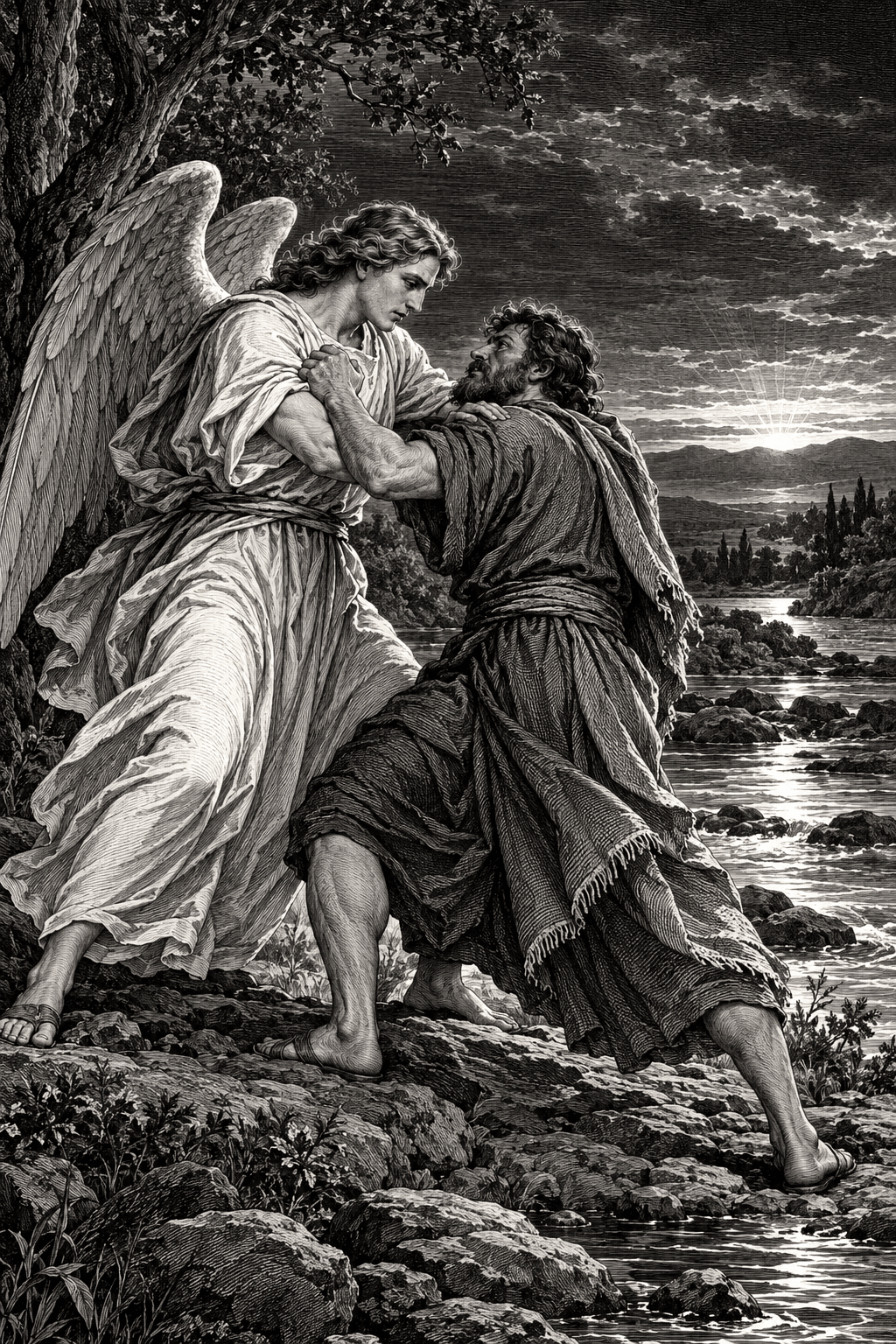
24 And Jacob was left alone; and there wrestled a man with him until the breaking of the day. 25 And when he saw that he prevailed not against him, he touched the hollow of his thigh; and the hollow of Jacob's thigh was out of joint, as he wrestled with him. 26 And he said, Let me go, for the day breaketh. And he said, I will not let thee go, except thou bless me. 27 And he said unto him, What is thy name? And he said, Jacob. 28 And he said, Thy name shall be called no more Jacob, but Israel: for as a prince hast thou power with God and with men, and hast prevailed. 29 And Jacob asked him, and said, Tell me, I pray thee, thy name. And he said, Wherefore is it that thou dost ask after my name? And he blessed him there. 30 And Jacob called the name of the place Peniel: for I have seen God face to face, and my life is preserved. 31 And as he passed over Penuel the sun rose upon him, and he halted upon his thigh. 32 Therefore the children of Israel eat not of the sinew which shrank, which is upon the hollow of the thigh, unto this day: because he touched the hollow of Jacob's thigh in the sinew that shrank.
“And Jacob was left alone; and there wrestled a man with him until the breaking of the day” (24).
When Jacob and his family had crossed the river Jabbok, he went apart for solitude, as though preparing for the meeting with Esau through his meeting with God. A man appeared to him — most scholars hold that it was an angel in the form of a man, and not the Word of God — but he represents the divine presence, for Jacob says: “for I have seen God face to face, and my life is preserved” (30), and it was said to him: “for as a prince hast thou power with God and with men, and hast prevailed” (28).
“And when he saw that he prevailed not against him, he touched the hollow of his thigh; and the hollow of Jacob’s thigh was out of joint, as he wrestled with him” (25). That is, the angel saw that Jacob in his striving did not surrender but kept wrestling all night… so that the angel appeared as one overcome and the man as the victor. So he struck him on the hollow of his thigh with a light blow — some translations even say “touched the hollow of his thigh” — and Jacob insisted, “I will not let thee go, except thou bless me” (26), for he perceived that he was a heavenly being.
Saint Augustine comments on this, saying:
Why did Jacob wrestle with him and hold him fast? Because “the kingdom of heaven suffereth violence, and the violent take it by force” (Matthew 11:12). Why did he wrestle…? That he might hold Him with toil; for what we gain after struggle we hold fast all the more. [391]
He also says:
The man prevailed and the angel was defeated. The victorious man holds the angel to say: I will not let thee go, except thou bless me. What a great mystery! The defeated one stands to bless the victor! He is defeated because He willed it, that He might appear weak in the flesh, though in His majesty He is strong; for He was crucified through weakness and rose by power (2 Corinthians 13:4). [392]
It is as though what happened with Jacob shortly before his meeting with Esau, to overcome him by love, points to the work of the Lord Christ, who came as one weak, bearing our nature, taking the last place, numbered with the transgressors, and bearing the shame of the cross as one defeated; but He, risen from the dead, blesses our nature and renews it in Himself!
Saint Ambrose sees that what befell Jacob, when his thigh was put out of joint, points to his fellowship in the sufferings of the Lord Christ, who would come incarnate through his seed. He says:
In his seed he recognizes the heir of his flesh, and through the dislocation of the hollow of his thigh he foreknows the sufferings of his heir. [393]
The struggle ended with a mutual question. The angel asked Jacob his name, not because he did not know the name, but to change it to a new name befitting him as a striver, saying to him: “Thy name shall be called no more Jacob, but Israel: for as a prince hast thou power with God and with men, and hast prevailed” (28). As Saint Clement of Alexandria says:
He gave him the new name for the new people. [394]
It is as though this gift was not given to Jacob in his own person, but to all the people of God as a sign of their spiritual striving.
Jacob called the place where this struggle took place “Peniel,” that is, “the face of God,” for he counted himself blessed to have seen God face to face and his life preserved… And as the sun rose, Jacob set out to catch up with his family, strengthened by these visions and this striving.
Notes and References
[390] Caesarius of Arles, Serm. 87:2.
[391] Augustine, On Ps. 148.
[392] Ibid. 80.
[393] Ambrose, On Belief in the Resurrection 2:100.
[394] Clement of Alexandria, Instr. (Paedagogus) 1:7.