
If Jacob prepared for meeting his brother Esau by prayer, by offering gifts, and by dividing his family into two bands, God on His part prepared Esau’s heart, kindling in him feelings of brotherhood and inflaming his longing to meet his brother.
1. The Meeting of the Two Brothers
KJV · Verses 1–16
1 And Jacob lifted up his eyes, and looked, and, behold, Esau came, and with him four hundred men. And he divided the children unto Leah, and unto Rachel, and unto the two handmaids. 2 And he put the handmaids and their children foremost, and Leah and her children after, and Rachel and Joseph hindermost. 3 And he passed over before them, and bowed himself to the ground seven times, until he came near to his brother. 4 And Esau ran to meet him, and embraced him, and fell on his neck, and kissed him: and they wept. 5 And he lifted up his eyes, and saw the women and the children; and said, Who are those with thee? And he said, The children which God hath graciously given thy servant. 6 Then the handmaidens came near, they and their children, and they bowed themselves. 7 And Leah also with her children came near, and bowed themselves: and after came Joseph near and Rachel, and they bowed themselves. 8 And he said, What meanest thou by all this drove which I met? And he said, These are to find grace in the sight of my lord. 9 And Esau said, I have enough, my brother; keep that thou hast unto thyself. 10 And Jacob said, Nay, I pray thee, if now I have found grace in thy sight, then receive my present at my hand: for therefore I have seen thy face, as though I had seen the face of God, and thou wast pleased with me. 11 Take, I pray thee, my blessing that is brought to thee; because God hath dealt graciously with me, and because I have enough. And he urged him, and he took it. 12 And he said, Let us take our journey, and let us go, and I will go before thee. 13 And he said unto him, My lord knoweth that the children are tender, and the flocks and herds with young are with me: and if men should overdrive them one day, all the flock will die. 14 Let my lord, I pray thee, pass over before his servant: and I will lead on softly, according as the cattle that goeth before me and the children be able to endure, until I come unto my lord unto Seir. 15 And Esau said, Let me now leave with thee some of the folk that are with me. And he said, What needeth it? let me find grace in the sight of my lord. 16 So Esau returned that day on his way unto Seir.
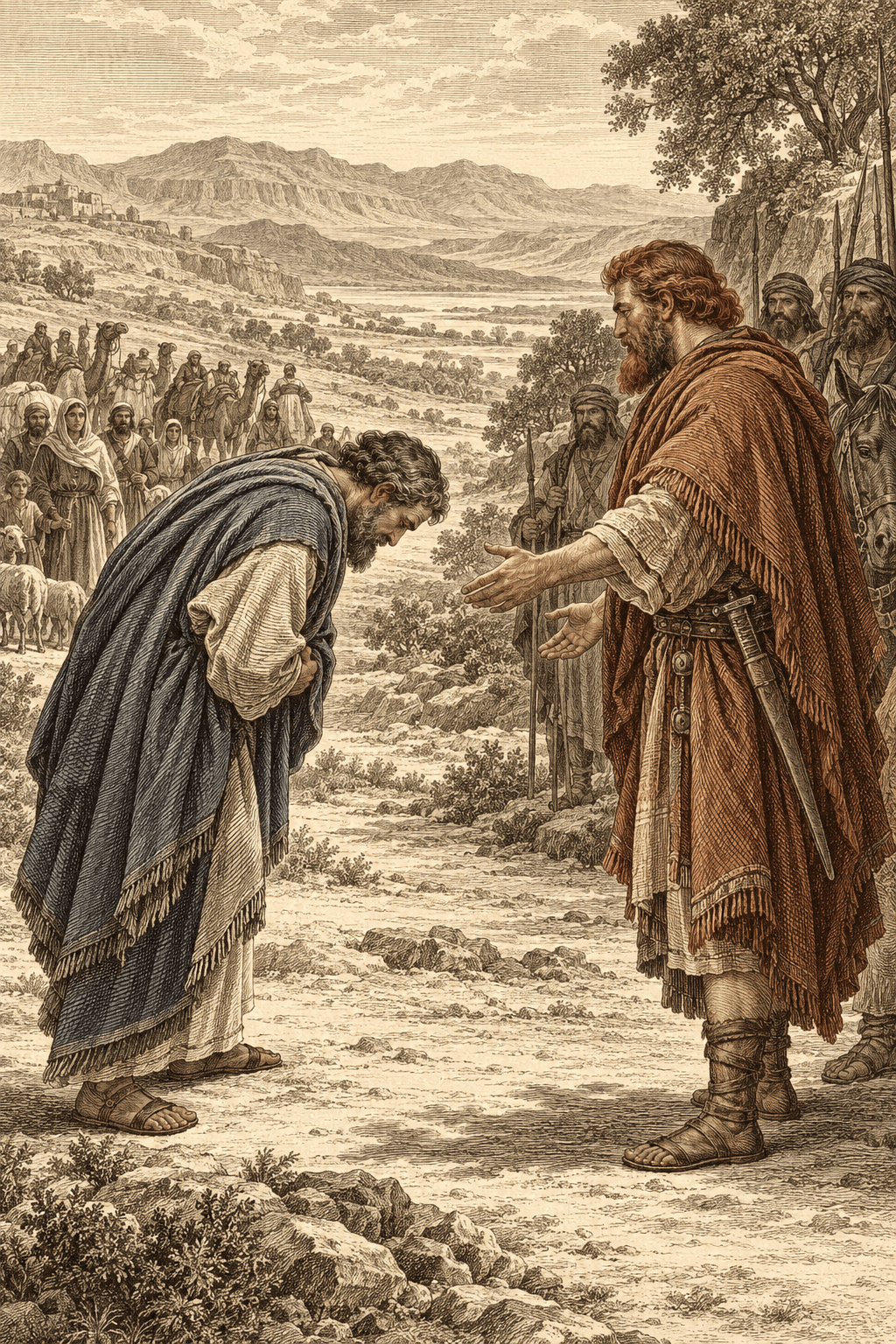
Jacob looked and saw his brother coming from afar with his men, and he was afraid. He arranged his family thus: the procession began with the two maids and their children, then Leah and her children, and finally Rachel and her son Joseph; but he himself went before them all and bowed himself to the ground seven times before meeting Esau. This arrangement revealed Jacob’s heart: on one side he put Rachel, beloved to him, with her son at the end of the procession, to give them a greater chance than all to escape if Esau and his men attacked; and he himself went before all, as though offering himself as a ransom for all, even for his two maids. So it befits the Christian to bear this spirit, the spirit of self-giving for all, so as to be like his Master, the Lord Christ, who goes before the sheep as the Good Shepherd who gives His life for the rational sheep.
Jacob led the procession not in a spirit of arrogance and violence but in a spirit of humility, for he bowed to his brother seven times, a sign of perfect submission. And the Lord Christ, the heavenly Bridegroom of the Church and her Head, led the procession of victory by His humility, for He emptied Himself, took the form of a servant, and became obedient unto death, even the death of the cross (Philippians 2:6–8). Being the only-begotten Son of God, “yet learned he obedience by the things which he suffered” (Hebrews 5:8). And though He is one with His Father, He fasted, prayed, and knelt, offering submission to Him in our name and on our behalf, so that our worship is accepted in Him.
Though Jacob had taken the birthright and the blessing and enjoyed God’s promises to his father Abraham and his father Isaac, Scripture did not overlook the goodness of heart and tenderness of feeling his brother bore, which appeared through the following acts:
First: When Esau saw his brother, his heart yearned toward him, for Scripture says: “And Esau ran to meet him, and embraced him, and fell on his neck, and kissed him: and they wept” (4)… as though he had forgotten the past with all its grudge and envy!
Second: He revealed his love by asking with brotherly familiarity about the great number who came with Jacob; and here Jacob confesses that it is the grace of God who gives all things.
Third: It seems Esau was not comfortable receiving the gift Jacob offered him, but wished rather to host him and his family and servants with all his flock… Jacob met these feelings with a spirit of humility and wisdom, saying to him: “if now I have found grace in thy sight, then receive my present at my hand” (10) — as though apologizing for the past and asking him to declare his good pleasure toward him by accepting the gift. And with wisdom he says: “for therefore I have seen thy face, as though I had seen the face of God, and thou wast pleased with me” (10); I have seen in you the image of God, who meets us with love and declares His good pleasure and love toward His servants. Jacob urged Esau to accept the gift, and he accepted it.
Fourth: When Jacob excused himself, saying that his children were tender and his flocks weary, so that he must move slowly, and asked Esau to go on before them, Esau wished to leave some of his men to support and guide him.
2. Jacob at Succoth and Shechem
KJV · Verses 17–20
17 And Jacob journeyed to Succoth, and built him an house, and made booths for his cattle: therefore the name of the place is called Succoth. 18 And Jacob came to Shalem, a city of Shechem, which is in the land of Canaan, when he came from Padanaram; and pitched his tent before the city. 19 And he bought a parcel of a field, where he had spread his tent, at the hand of the children of Hamor, Shechem's father, for an hundred pieces of money. 20 And he erected there an altar, and called it EleloheIsrael.
Jacob journeyed to “Succoth,” which means “booths.” Many places bore this name, such as the Succoth where the Jews set up booths after their exodus from Egypt, near Rameses (Exodus 12:37), and a Succoth west of the Jordan; but Succoth here lies east of the Jordan, about a mile south of the river Jabbok.
After Succoth he went on to Shechem in the land of Canaan (see Genesis 12:6). In some translations it is said: “And Jacob came to Shalem, a city of Shechem” (18), that is, to Shalem on the border of the lands of Shechem the son of Hamor. There he bought a field from the children of Hamor for a hundred pieces of money (the “kesitah” was a coin of high value (Job 42:11), which some translate as “lamb,” perhaps because a lamb was pictured on this coin).
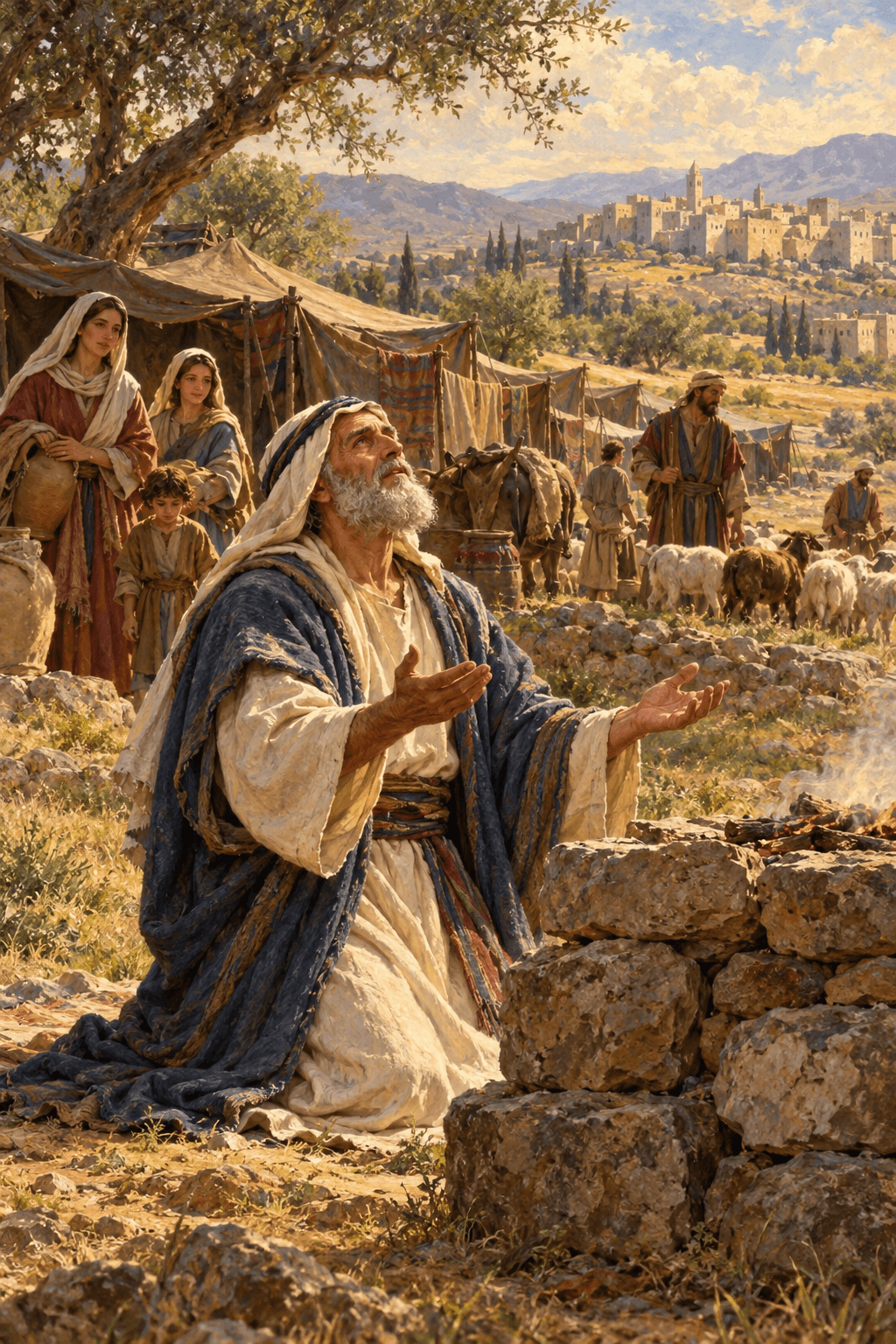
In any case, the first thing Jacob did on his return to the land of Canaan was to build an altar to the Lord, for it is said: “And he erected there an altar, and called it El-elohe-Israel” (20), that is, he called it “God, the God of Israel,” for he had come to settle in the bosom of God through the holy sacrifice.
May we have in our heart an altar to the Lord, so that our depths become the spiritual Canaan in which God is manifested through the sacrifice of the cross!