
Once the census had been taken as God Himself had asked, God gave a very precise arrangement for the camp, which they were to keep while pitching their tents as well as when setting out on their journeys through the wilderness.
1. The Arrangement and the Standards
KJV · Verses 1–2
1 And the Lord spake unto Moses and unto Aaron, saying, 2 Every man of the children of Israel shall pitch by his own standard, with the ensign of their father's house: far off about the tabernacle of the congregation shall they pitch.
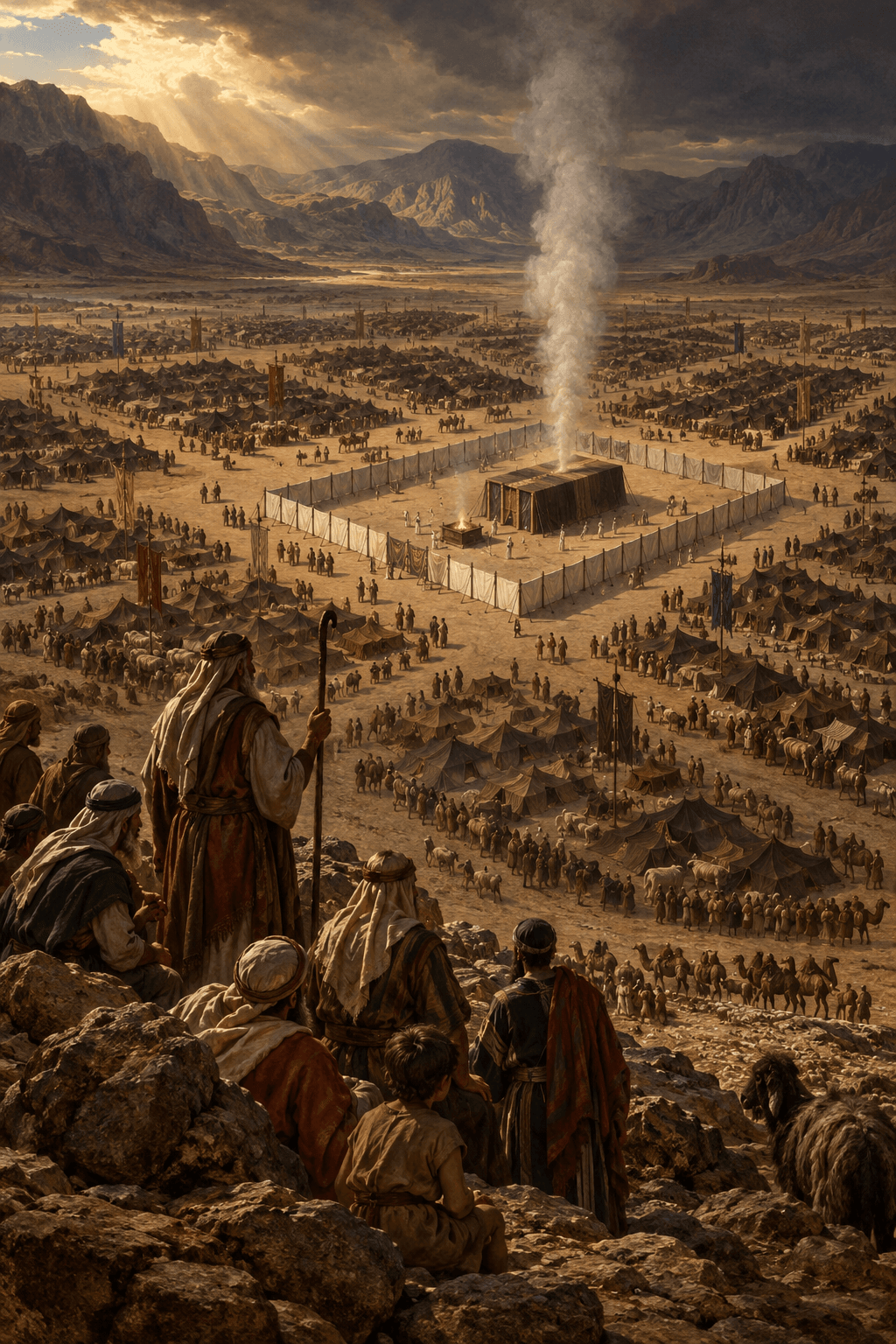
He divided the tribes, apart from the tribe of Levi, into four divisions. Each division was called a camp and consisted of three tribes under the leadership of one particular tribe, after which the camp was named. Note that the tribe of Joseph was divided into two tribes, the tribe of Ephraim and the tribe of Manasseh, to complete the number twelve after the tribe of Levi was set apart.
The first division was called the camp of Judah; its place was in the east, at the head of the procession. Following it in setting out came the southern division, or the right wing, which was the camp of Reuben. After these two the centre itself set out, that is, the tribe of the Levites, the ministers and bearers of the tabernacle, who pitched their tents around the tabernacle on every side. Then came the rear of the procession, the western camp or the camp of Ephraim; and last of all the left or northern wing, which was the camp of Dan.
Origen comments on this arrangement of the camp, saying:
I find a great subject for meditation in the Book of Numbers: the distribution of the tribes, the distinction of ranks, the grouping of the tribes and the arrangement of the whole camp. For me these form great mysteries, thanks to the Apostle Paul, who sowed in us the seeds of the spiritual sense. [7]
We note the following in this arrangement:
First: the appearance of the camp as a whole represents a cross moving toward the promised land. In the centre is the tabernacle of the congregation, surrounded by the priests and Levites in the shape of a cross around it; and the rest of the tribes form a great cross containing about two million people, men, women, children and elders: in the east the camp of Judah, in the west the camp of Ephraim, in the south the camp of Reuben, and in the north the camp of Dan. This moving cross represents the holy Church, the body of the crucified Christ, always moving forward from the land of bondage toward the heavenly Jerusalem, and at the same time carrying within her the cross of the Lord Himself, which grants her the power of the resurrection.
Remarkably, when Origen looked at this scene he did not speak of the cross; rather, he saw in such a great arrangement a symbol of the surpassing order of the Church on the great day of the Lord. He says:
Let us look at the meaning of the mysteries set in the reckoning of the numbers and the different places mentioned. Let us look steadily at the resurrection of the dead. At the moment of Christ’s coming, those who remain alive on the earth will not go before those who have fallen asleep (1 Thessalonians 4:15); all will be united together and caught up in the clouds to meet the Lord. Thus we perceive the corruption of this earthly place, the dwelling of the dead, and we shall all be in the air, as the Apostle says… and we shall be carried to chosen places, for it is said: “In my Father’s house are many mansions” (John 14:2). These places, or this glory, are given according to the merits of each man’s works, as the Apostle Paul affirms, saying of the resurrection: “every man in his own order” (1 Corinthians 15:23). Each one’s name is registered according to his spiritual measure: one is registered in the tribe of Reuben because he imitates Reuben in his habits, character, works and manner of life; another is registered in the tribe of Simeon because of his obedience; [8] a third in the tribe of Levi because he fulfilled his priestly duties well or attained perfection in them; another has his name registered in the tribe of Judah because of his royal dispositions, for each man is led to the tribe that distinguishes him through his works and character. So there are ranks in the resurrection, as we understand from the Apostle’s words, and their image appears clearly in this Book of Numbers. Indeed, the position of the tabernacle among the tribes in the midst of the congregation is a picture of what things will be like in the resurrection. [9]
Second: Origen sees in the appearance of the camp, under this divine arrangement, a living picture of the Church of the New Testament, which is also bound to walk in a spirit of order and arrangement, not only in her worship but also in her conduct. The soul carries in its depths an order befitting it as a member of the holy Church. Order also extends to the life and conduct of the priests, so that they live as ministers of God burning with fire.
It is as though order is not a routine task to which we are bound, but a life with its own power within, as in outward conduct, in the life of the community as in the life of each of its members, whether priest or layman!
Origen says:
“And the LORD spake unto Moses and unto Aaron, saying, Every man of the children of Israel shall pitch by his own standard, with the ensign of their father’s house: far off about the tabernacle of the congregation shall they pitch” (1–2). Moses asked that every man in the camp go forward according to his rank, according to his standard (his sign) for his father’s house. And the Apostle Paul says: “Let all things be done decently and in order” (1 Corinthians 14:40). Does this not show that the Spirit who spoke through Moses is the very One who spoke through the Apostle Paul? Moses commanded them to march in the camp in order, and the Apostle taught that all things in the Church be done “in order.” Moses, who served the Law, commanded that order be kept in the camp; and Paul the Apostle, the minister of the Gospel, wants the Christian to keep order not only in his conduct but even in his dress, for he says: “In like manner also, that women adorn themselves in modest apparel” (1 Timothy 2:9).
They (Moses and Paul) want order to be kept not only in the fulfilment of duties and in dress; they mean “the order of the soul”…
It often happens that a man with low and base thoughts, who delights in earthly material things, cunningly obtains a high priestly rank and mounts the teachers’ chair, while another, a spiritual man free from preoccupation with temporal things, able to judge all things and judged of no man (1 Corinthians 2:15), holds the lowest rank in the priesthood or is counted among the people. Such a thing despises the teachings of the Law and the Gospel, and there is no order in it!
We too, when we are anxious and troubled about eating and drinking and are busy only with temporal things, giving God no more than an hour or two a day to go to church to pray and hear the word of God, while we work to satisfy our temporal needs and please the stomach, are paying no heed to the teaching that says, “Every man… shall pitch by his own standard (according to his rank),” or to the words, “Let all things be done decently and in order.” For the order that Christ the Lord set is that we seek first the kingdom of God and His righteousness (Matthew 6:33), believing that all these things shall be added unto us. In this way each one pitches (by his standard) according to his rank.
Do you think that those who are called presbyters and boast of belonging to the priesthood walk according to their rank as befits them? Likewise, do the deacons walk according to their rank? Why then do we sometimes hear people blaspheme, saying, “Look at this bishop, or this presbyter, or this deacon!”? Is it not because they see the priest or the minister of God falling short in the duties of his rank, behaving contrary to the priestly and Levitical rank? And what shall I say of the virgins and ascetics who are entrusted with religious services? If they fall short in their commitment to modesty and gravity, does not Moses accuse them, saying: Let every man walk according to his rank (by his standard)? For whoever knows his rank and understands what befits it weighs his works and orders his words, his conduct and even his clothing as befits the requirements of the rank to which he belongs, so that we may not hear God’s words: “the name of God is blasphemed among the Gentiles through you” (Romans 2:24). [10]
Thus Origen sees order as a life that touches our life as children of God, and touches the life of the Church, so that she may live with the mind of Christ Jesus!
Third: the Lord says to Moses and Aaron: “Every man… shall pitch by his own standard, with the ensign of their father’s house” (2). What is this ensign, or sign, by which every believer must pitch, if not the cross of our Lord Jesus Christ, where we sit at the feet of the Crucified, so that we do not stray in our spiritual struggle from our true spiritual goal, which is meeting the Lord of glory Himself and being with Him and in Him?
At the sign, the cross of the Lord, the brethren meet together in a life of fellowship and love, where each one feels that he is a member with his brother in the one Head, our Lord Jesus Christ.
On the historical side, some hold that each tribe had its own standard, so that each camp had three standards, since it included three tribes. Each tribe gathered at its standard so that every man might know his place in the procession and keep it. It is said that each standard bore a precious stone belonging to the tribe; in this way the whole congregation became like the breastplate of the high priest, in which twelve precious stones were set in four rows, three stones in each row (Exodus 39:10–14), with the names of the tribes engraved on them. So their names appeared on the stones in the presence of the Lord in the Holy of Holies, on the breast of the high priest. It is as though the whole congregation in the Old Testament represents the holy Church, which has become precious stones on the breast of the Lord of glory Jesus, the great High Priest and Bishop of our souls, who brings us into His Father’s bosom, so that we are there with Him, through Him and in Him forever. [11]
Others hold that each of the four camps had a single standard: the camp of Judah’s standard bore the sign of the lion, Reuben’s the sign of a man, Ephraim’s the sign of the calf, and Dan’s the sign of the eagle. In this way we see, through the symbol, what Ezekiel the prophet saw: the fiery chariot of God, or the cherubim burning with fire who bear the divine throne. It is as though the congregation has become God’s holy chariot, resembling the cherubim. [12]
From what is said in the Book of Joshua (Joshua 3:4) it is understood that the closest distance between the tabernacle and the dwellings was 2,000 cubits, that is, 1,000 yards, a little more than a mile.
Fourth: Origen sees in the standard by which each man was bound to stand a symbol of the mark that distinguishes one believer’s soul from another; for just as each bodily face has its own features, and the voice as well, so does the soul. He says:
On the other hand, see what is meant by the words “every man… by his own standard (sign).” In my opinion the signs are the marks that distinguish a man from others. All men are alike, but there are particular marks that distinguish each one from another: the features of the face, the stature, the bearing and the clothing. These marks distinguish Paul from Peter.
Sometimes a man does not need to appear for us to see the mark that distinguishes him; he is known through a mark other than bodily sight, such as the voice and the tones of the throat. So I believe that souls have distinguishing marks. Some have very sweet and pleasant movements, quiet, calm and just; others are marked by agitation, boasting, harshness, violence and fierce anger. You find one soul watchful, wise and discerning, aware and active, and another sluggish, slack, careless and heedless… I can affirm that there are differences between human souls just as there are differences in the features of the face…
To make clear the differences between the marks (of souls), we offer this comparison. Those who have learned to read and write know well the twenty-four letters of Greek… and they use the letters they have; but the letter alpha (a) as Peter writes it differs from the way Paul writes it. Every man has his own mark that distinguishes him in writing the letters… This clear example applies to the movements of the mind and soul, which are means of action. If we look at the parchments, we find, for example, that the spirit of Paul inclines to purity, and so does the spirit of Peter; but Paul’s purity has its own marks, and so does Peter’s, though purity is one. The purity of the one requires keeping the body under and bringing it into subjection in fear (1 Corinthians 9:27), while the purity of the other carries no fear. So too justice has its features in Paul and its features in Peter, and so also wisdom and all the virtues. The virtues are one, and we enjoy them from the Spirit of God, but there are personal differences…
A man can pass in good works from a lower mark to a higher one, and to a still higher one. If we understand that all the Law contains is “a shadow of good things to come” (Hebrews 10:1)… then at the moment of the resurrection there will be a difference between the merits of men, for “one star differeth from another star in glory” (1 Corinthians 15:41). We can pass from a lower mark to a higher one, and to one still higher, until we are equal to the brightest stars; for human nature can grow in this life to attain not only the glory of the stars but even the brightness of the sun, for it is written: “Then shall the righteous shine forth as the sun in the kingdom of their Father” (Matthew 13:43). [13]
Fifth: God says to Moses: “Every man… shall pitch by his own standard, with the ensign of their father’s house” (2). So every believer was bound to meet his brethren at his standard by his earthly father’s house, that is, the tribe to which he belonged. But we, in holy Baptism, have received a new Father, the heavenly Father. If we sit at the feet of the Crucified, He brings us into the bosom of His Father, who has become our Father.
2. The Head of the Procession: “The East”
KJV · Verses 3–9
3 And on the east side toward the rising of the sun shall they of the standard of the camp of Judah pitch throughout their armies: and Nahshon the son of Amminadab shall be captain of the children of Judah. 4 And his host, and those that were numbered of them, were threescore and fourteen thousand and six hundred. 5 And those that do pitch next unto him shall be the tribe of Issachar: and Nethaneel the son of Zuar shall be captain of the children of Issachar. 6 And his host, and those that were numbered thereof, were fifty and four thousand and four hundred. 7 Then the tribe of Zebulun: and Eliab the son of Helon shall be captain of the children of Zebulun. 8 And his host, and those that were numbered thereof, were fifty and seven thousand and four hundred. 9 All that were numbered in the camp of Judah were an hundred thousand and fourscore thousand and six thousand and four hundred, throughout their armies. These shall first set forth.
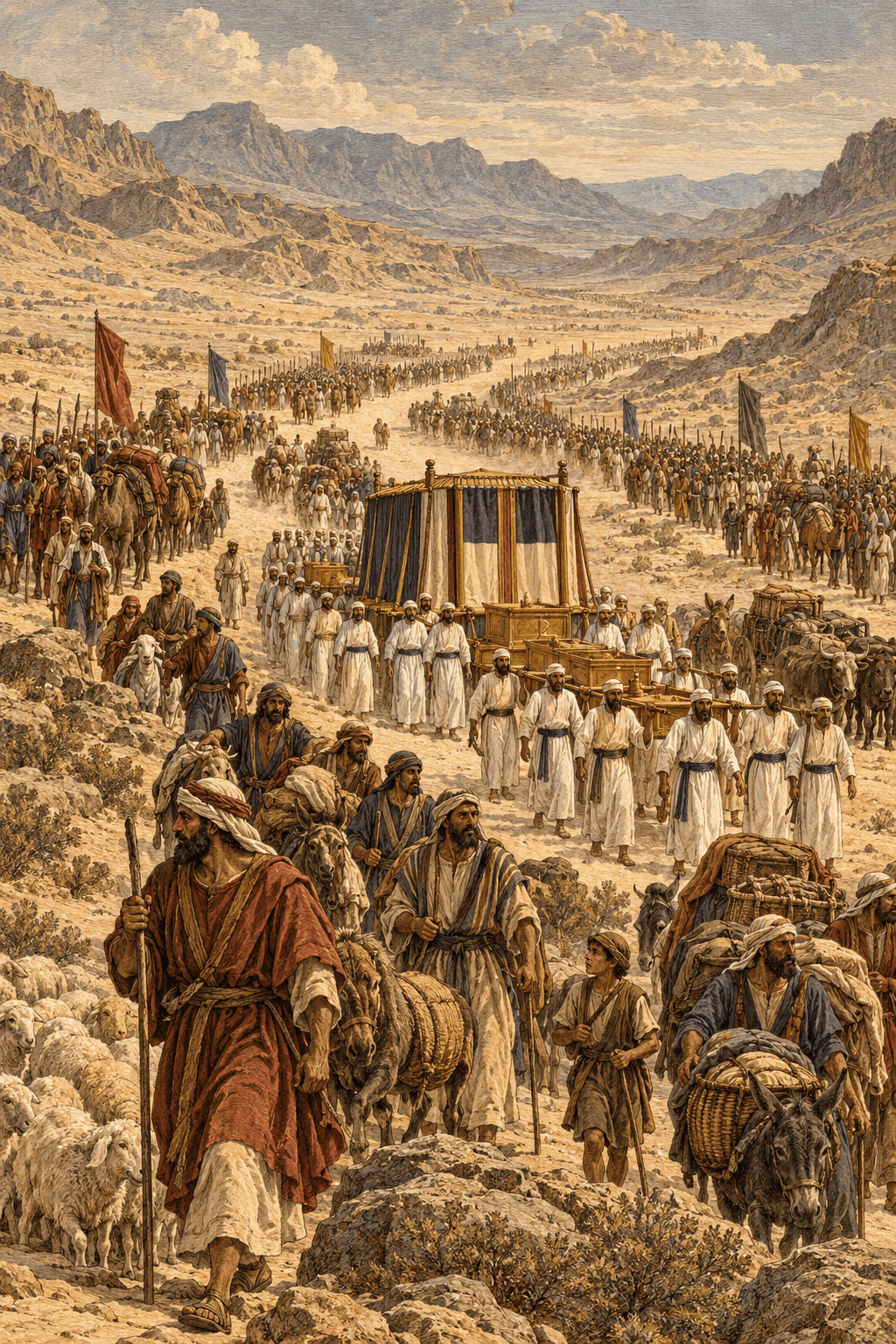
We said that the procession took the shape of a cross: in the centre was the tabernacle, with the Levites and priests around it in the shape of a small cross, and then the four camps, one camp on each side. Their order according to the march was as follows (tribe, number, head, mother):
A) The camp of Judah (east):
- Judah: 74,600; Nahshon; Leah.
- Issachar: 54,400; Nethaneel; Leah.
- Zebulun: 57,400; Eliab; Leah.
B) The camp of Reuben (south):
- Reuben: 46,500; Elizur; Leah.
- Simeon: 59,300; Shelumiel; Leah.
- Gad: 45,650; Eliasaph; Zilpah, Leah’s handmaid.
The Levites (in the midst of the camps): Levi, 22,000, not numbered with them; Leah.
C) The camp of Ephraim (west):
- Ephraim: 40,500; Elishama; Rachel.
- Manasseh: 32,200; Gamaliel; Rachel.
- Benjamin: 35,400; Abidan; Rachel.
D) The camp of Dan (north):
- Dan: 62,700; Ahiezer; Bilhah, Rachel’s handmaid.
- Asher: 41,500; Pagiel; Zilpah, Leah’s handmaid.
- Naphtali: 53,400; Ahira; Bilhah, Rachel’s handmaid.
We note in this arrangement:
First: the leaders of the camps are at the front: Nahshon, leader of the camp of Judah; Elizur, leader of the camp of Reuben; Elishama, leader of the camp of Ephraim; and Ahiezer, leader of the camp of Dan. This was not mere chance; it carried the secret of the strength of the camp, which had taken the shape of the cross.
At the head Judah took the lead. As Origen says:
The tribe of Judah, the royal tribe, was placed in the east because our Lord sprang up (Hebrews 7:14). [14]
In the east appears Christ the Lord, who came forth from the tribe of Judah, leading us toward the kingdom of light. As for the head of the camp, Nahshon, which means “serpent,” it is because the mystery of the cross is the mystery of crushing the old serpent, according to God’s promise to Eve that the seed of the woman would bruise the serpent’s head.
The right arm of the cross is represented by the camp of Reuben under the leadership of Elizur, which means “my God is a rock” or “my God is a wall”; for if by the cross the head of the serpent is crushed, it is so that the believers may enter into God as a rock or a wall for their protection. The left arm is represented by the camp of Dan under the leadership of Ahiezer, which means “my brother is a helper.” It is as though on the cross the Lord stretches out His hands: with the right He declares that in Him is our salvation, as our Rock, and with the left He grants us the spirit of fellowship with one another in Him. The right arm declares our relationship with God, and the left arm our relationship with one another, that is, with mankind. The base of the cross is represented by the camp of Ephraim under the leadership of Elishama, that is, “God hears,” as though the foundation of the cross is that the Father hears us in His Son, and accepts our love, our obedience and our offerings in Christ Jesus the Beloved.
In short, the Church, having become the camp of the Lord, or the body of the crucified Christ, finds at her head Christ the King, the conqueror of the serpent; at the right arm the Rock in which we take refuge; at the left brotherly love; and at His feet she sits to hear the Father, while He hears her voice and accepts her.
Second: the camp bore a symbolic picture of the heavenly Jerusalem as Saint John saw it (Revelation 21), with three gates on each side, as though there is no entry into it except through faith in the Holy Trinity. So, wherever you turned in the camp, you would find three tribes together in one camp, though each tribe had its own distinguishing features. As Origen says:
We find in the four divisions the number three, because it is in the name of the Father, the Son and the Holy Spirit, and no other, that the inhabitants of the four corners of the world are numbered, who call upon the name of God and “shall sit down with Abraham, and Isaac, and Jacob, in the kingdom of heaven” (Matthew 8:11). These are facts that cannot be ignored. [15]
3. The Right Wing: “The South”
KJV · Verses 10–16
10 On the south side shall be the standard of the camp of Reuben according to their armies: and the captain of the children of Reuben shall be Elizur the son of Shedeur. 11 And his host, and those that were numbered thereof, were forty and six thousand and five hundred. 12 And those which pitch by him shall be the tribe of Simeon: and the captain of the children of Simeon shall be Shelumiel the son of Zurishaddai. 13 And his host, and those that were numbered of them, were fifty and nine thousand and three hundred. 14 Then the tribe of Gad: and the captain of the sons of Gad shall be Eliasaph the son of Reuel. 15 And his host, and those that were numbered of them, were forty and five thousand and six hundred and fifty. 16 All that were numbered in the camp of Reuben were an hundred thousand and fifty and one thousand and four hundred and fifty, throughout their armies. And they shall set forth in the second rank.
In the arrangement of the camp, kinship between the tribes was observed as far as possible. At the front were Judah, Issachar and Zebulun, sons of Leah; in the right wing Reuben, Simeon and Gad, the first two sons of Leah and the third of Zilpah, Leah’s handmaid; in the west Ephraim and Manasseh, the sons of Joseph, and Benjamin, of Rachel; and in the north Dan, Naphtali and Asher, the sons of the two handmaids.
4. The Centre of the Procession: “The Levites”
KJV · Verses 17
17 Then the tabernacle of the congregation shall set forward with the camp of the Levites in the midst of the camp: as they encamp, so shall they set forward, every man in his place by their standards.
If this people had become a holy nation by accepting faith in the living God, then the tribe of Levi, wholly given to spiritual work, is the holy tribe, devoted to the service of the tabernacle and to carrying it, surrounding it on every side in the midst of the congregation. It is as though it were a symbol of Christ the Lord, the only-begotten Son, who dwelt in the midst of mankind to bring it into His divine holy places, so that they may enjoy His Father’s bosom, interceding for them with His precious blood through the sacrifice of His cross.
On this Origen says:
The Levites were settled in their midst around the tabernacle of God, because they are nearer to God… It seems that the sons of the Levites were arrayed in a circle on every side in the midst of the children of Israel, mingled with the others and interspersed among them… Seek the tabernacle of God, where Jesus entered to prepare the way for us (Hebrews 6:20; 7:25; 9:24), appearing before the face of God and interceding for us. [16]
5. The Rear of the Procession: “The West”
KJV · Verses 18–24
18 On the west side shall be the standard of the camp of Ephraim according to their armies: and the captain of the sons of Ephraim shall be Elishama the son of Ammihud. 19 And his host, and those that were numbered of them, were forty thousand and five hundred. 20 And by him shall be the tribe of Manasseh: and the captain of the children of Manasseh shall be Gamaliel the son of Pedahzur. 21 And his host, and those that were numbered of them, were thirty and two thousand and two hundred. 22 Then the tribe of Benjamin: and the captain of the sons of Benjamin shall be Abidan the son of Gideoni. 23 And his host, and those that were numbered of them, were thirty and five thousand and four hundred. 24 All that were numbered of the camp of Ephraim were an hundred thousand and eight thousand and an hundred, throughout their armies. And they shall go forward in the third rank.
This is the camp of Ephraim, which set out directly after the Levites.
6. The Left Wing: “The North”
KJV · Verses 25–31
25 The standard of the camp of Dan shall be on the north side by their armies: and the captain of the children of Dan shall be Ahiezer the son of Ammishaddai. 26 And his host, and those that were numbered of them, were threescore and two thousand and seven hundred. 27 And those that encamp by him shall be the tribe of Asher: and the captain of the children of Asher shall be Pagiel the son of Ocran. 28 And his host, and those that were numbered of them, were forty and one thousand and five hundred. 29 Then the tribe of Naphtali: and the captain of the children of Naphtali shall be Ahira the son of Enan. 30 And his host, and those that were numbered of them, were fifty and three thousand and four hundred. 31 All they that were numbered in the camp of Dan were an hundred thousand and fifty and seven thousand and six hundred. They shall go hindmost with their standards.
This is the camp of Dan, the last to set out…
7. The Conclusion of the Arrangement
KJV · Verses 32–34
32 These are those which were numbered of the children of Israel by the house of their fathers: all those that were numbered of the camps throughout their hosts were six hundred thousand and three thousand and five hundred and fifty. 33 But the Levites were not numbered among the children of Israel; as the Lordcommanded Moses. 34 And the children of Israel did according to all that the Lord commanded Moses: so they pitched by their standards, and so they set forward, every one after their families, according to the house of their fathers.
He concludes by affirming that what God commanded Moses and Aaron was indeed carried out.
Notes and References
[7] Origen, Homilies on Numbers 1.3.
[8] For the name “Simeon” means “one who hears” or “obedient.”
[9] Ibid.
[10] Ibid. 2.1.
[11] See our commentary on the breastplate in our book “The Book of Exodus,” 1980, chapter 39.
[12] See the commentary on the fiery chariot in our book “The Book of Ezekiel,” 1981, chapter 1.
[13] Ibid. 2.2.
[14] Ibid. 2.2.
[15] Ibid. 2.2.
[16] Ibid., Homily 3.