
As the people drew near to entering the land of promise, Satan devised a new war, not through commanders and soldiers but through Balaam the prophet; not with visible weapons, but by asking that a curse come upon them so that they would not prosper on the way. It is the last arrow Satan shot to fight them before they crossed the Jordan. Divine revelation took care to set out the matter in great detail, though it is still considered a riddle by many.
1. The Character of Balaam the Son of Beor
When Balak the son of Zippor, king of Moab, saw the danger surrounding him, instead of preparing for war with a military plan, he resorted to Balaam to curse the people so that they would be defeated before him.
Who is this Balaam? To what people did he belong? Was he a true prophet or a soothsayer? Who was speaking with him: God, or a heathen god?
First: as to his race, it is clear that he was not of God’s people. He was settled in the region, and it seems he had a long past in supernatural works which the king knew well, for he says to him: “for I wot that he whom thou blessest is blessed, and he whom thou cursest is cursed” (Numbers 22:6). Balaam had practised works in which he had succeeded. In the king’s words to him about the people he wanted him to curse, it appears clearly that Balaam had no relation to that people, for he says to him: “Behold, there is a people come out of Egypt, which covereth the face of the earth” (Numbers 22:11).
Balaam says to the king: “And now, behold, I go unto my people: come therefore, and I will advertise thee what this people shall do to thy people in the latter days” (Numbers 24:14). It is as though he speaks of three peoples: Balaam’s people, the king’s people, and the people who would deal with the king’s people. What does Balaam mean by “my people”…? Most likely Balaam was from the neighbouring nations allied with Moab at that time, such as the Midianites, a people much given to wandering in the desert, who were on good terms with Moab at that time; therefore the king sought the help of the elders of Midian. Or perhaps by “my people” Balaam meant the community among whom he lived, as a local people settled around this man in submission to him and loyalty before his fame and extraordinary powers.
Second: was Balaam a true prophet or a soothsayer?
Some hold that Balaam was a true prophet who had dealings with God, so that he usually consulted Him before any action. Holy Scripture repeats such phrases as: “And God came unto Balaam” (Numbers 22:9); “And God said unto Balaam” (Numbers 22:12); “Then the LORD opened the eyes of Balaam, and he saw the angel of the LORD” (Numbers 22:31); “And the LORD met Balaam, and put a word in his mouth” (Numbers 23:16)… And Balaam uttered five divine prophecies of the utmost splendour (Numbers 23–24).
According to those who hold this view, it is not strange that a Gentile should worship God; in the apostolic age there was Cornelius, who worshipped God devoutly (Acts 10:31), for the grace of God is not limited to a particular nation, but works in the soul that seeks the Lord with a heart full of sincerity.
They argue for the genuineness of his prophecy: if he were a sorcerer or soothsayer, why would God insist that he not curse the people, since what comes out of the mouth of Satan and his followers against God’s children is worthless! As for Balaam’s having sinned, and repeatedly, and his life ending with a great crime he committed against God and His children, they hold that the word “prophet” does not mean a permanent office which, once given to a man, accompanies him all his life; the spirit of prophecy may be given to a man for a time to accomplish a divine plan and heavenly purposes, after which this spirit is taken from him. Moreover, the prophets themselves had their faults, not only in their personal lives but sometimes in their ministry, if they acted of themselves, as happened with Nathan the prophet when David the prophet told him he would build a house for the Lord, and he answered of himself: “Go, do all that is in thine heart; for the LORD is with thee” (2 Samuel 7:1–3). But Nathan corrected the situation the next day, when the Lord revealed to him that David would not build the house, but his son (2 Samuel 7:4–16).
The early Church, through her Fathers, saw in Balaam a sorcerer and soothsayer whom God used to accomplish a divine message and heavenly purposes; for it is not strange that “Out of the eater came forth meat, and out of the strong came forth sweetness.” The following is a summary of the Fathers’ view of the character of Balaam and the events around him:
A) Saint Gregory of Nyssa holds that Balaam was a sorcerer bearing demonic power. The king called him to curse the people, and God wanted to make clear Satan’s inability to harm God’s children: even if he wants to curse, he is obliged to bless; and if he wants to revile, he finds in them no room for reviling. So too the demons were obliged to bear witness to Christ the Lord that He is the Holy One of God, and they spoke the truth though their nature is full of lies; the Lord did not want their witness to Him, but He allowed it to declare the victory of the holy life even over the slanders of the demons.
The saint says:
The sorcerer was called as an ally against those who were attacking. History says that this sorcerer was a soothsayer and diviner, drawing his harmful power of divination from the works of demons to fight enemies. The ruler asked him to curse those who live with God; but what happened was that the curse was turned into a blessing. We perceive from the past events we have considered (the magicians of Egypt during the ten plagues) that sorcery has no power against those who live in virtue; on the contrary, those fortified with divine help overcome every attack…
In the history of the Gospel the company of demons, “Legion,” was ready to resist the authority of the Lord. But when He who has authority over all things drew near to them, Legion saluted His surpassing authority and did not hide the truth that by His divinity He would punish the wrongdoers in due time. The voices of the demons came out thus: “I know thee who thou art, the Holy One of God”; “art thou come hither to torment us before the time?” This happened before, when the demonic power accompanied Balaam the soothsayer and taught him that God’s people cannot be overcome…
Truly, whoever wants to curse those who walk in virtue utters nothing against them and does not curse; rather, the curse is turned into a blessing. What we mean is that shameful rebuke will not come near those who live in virtue. For how can one be reviled for covetousness who owns nothing? Or how can one be accused of extravagance who lives in solitude, far from others? Or be accused of luxury who is moderate in his habits? Or be accused of other blameworthy things when he practises their opposites? For these (who walk in virtue) present their lives without blame, so that, as the Apostle says, “he that is of the contrary part may be ashamed, having no evil thing to say of you” (Titus 2:8). Then he who was called to curse him says: “How shall I curse, whom God hath not cursed?” That is, how shall I revile one who has left no room at all for reviling him? For evil cannot penetrate his life, because he looks toward God. [196]
It is as though God allowed this matter of Balaam before the people entered the land of promise to declare that the man fortified in God, justified by the blood of Christ the Lord and burning with God’s Holy Spirit, as he rises toward the heavenly Jerusalem, cannot be cursed or slandered even by the demons; rather, the divine light shines in him, and all bear witness to him! Perhaps this is why the Apostle Paul required, in choosing a bishop, that he have a good report not only from those within but also from those without.
We ought not to defend ourselves even against Satan himself; let us leave the holy life that is ours in Christ Jesus our Lord to bear witness for us and support us.
B) Scripture says: “And the elders of Moab and the elders of Midian departed with the rewards of divination in their hand; and they came unto Balaam” (Numbers 22:7). They carried the wages of divination and sorcery, which Balaam did not refuse; rather, he lodged the men so as to bring them word again (Numbers 22:8). Origen says:
There are things which Holy Scripture describes as the rewards of divination; in the tradition of the heathen they are called tripods and cauldrons, or other similar names, consecrated to this work and used in divination. [197]
Elsewhere we find Balaam asking Balak to build him seven altars on the high places of Baal (Numbers 22:41; 23:1), to offer sacrifices to Baal; and after offering the sacrifices he went to a high place, that perhaps God might answer him (Numbers 23:2).
Balaam says in his second prophecy: “Surely there is no enchantment against Jacob, neither is there any divination against Israel” (Numbers 23:23), as though his powers of divination had stopped completely.
Origen holds that Balaam was a sorcerer who wanted to practise his divination by sorcery, but God intervened, not because he deserved it, but to declare His care for His people. He says:
Usually the demons came when Balaam took the rewards of divination; but he saw the opposite: the demons fled and God came. For this reason he said that he would ask God, since he no longer saw the demons that used to obey him. God Himself came to meet Balaam, not because he deserved the visit, but so that the spirits that used to come to him to bring curses and harm by sorcery might flee, affirming His watchfulness over His people. [198]
C) God is accustomed to deal with men according to their circumstances and in the language they understand. So you hear that in the temple of Apollo a priest of the idol bore witness that the heathen god declared his helplessness because of the Incarnate One, and this became a door among the heathen to accepting the faith. As for this sorcerer, Origen says that he was famous and had many disciples, who preserved his prophecies in the lands of the East; and from them the Magi learned of Christ the Lord, for it is said in them: “there shall come a Star out of Jacob, and a Sceptre shall rise out of Israel” (Numbers 24:17). So when the star appeared to them, they perceived the prophecy and knew that it had been fulfilled; and so they were better than the Jewish people, who did not listen to the words of the prophets in their hands. According to the writings, they perceived the commandment Balaam had left, that the time had come, and they hastened to seek Him and worship Him, showing the greatness of their faith by honouring this little Child-King. [199]
Third: who was speaking with him? Was it truly God, or a heathen god…? I leave the answer to this question to the discussion in section 3, “God Appears to Balaam.”
2. Balak’s First Invitation to Him
KJV · Verses 1–8
1 And the children of Israel set forward, and pitched in the plains of Moab on this side Jordan by Jericho. 2 And Balak the son of Zippor saw all that Israel had done to the Amorites. 3 And Moab was sore afraid of the people, because they were many: and Moab was distressed because of the children of Israel. 4 And Moab said unto the elders of Midian, Now shall this company lick up all that are round about us, as the ox licketh up the grass of the field. And Balak the son of Zippor was king of the Moabites at that time. 5 He sent messengers therefore unto Balaam the son of Beor to Pethor, which is by the river of the land of the children of his people, to call him, saying, Behold, there is a people come out from Egypt: behold, they cover the face of the earth, and they abide over against me: 6 Come now therefore, I pray thee, curse me this people; for they are too mighty for me: peradventure I shall prevail, that we may smite them, and that I may drive them out of the land: for I wot that he whom thou blessest is blessed, and he whom thou cursest is cursed. 7 And the elders of Moab and the elders of Midian departed with the rewards of divination in their hand; and they came unto Balaam, and spake unto him the words of Balak. 8 And he said unto them, Lodge here this night, and I will bring you word again, as the Lord shall speak unto me: and the princes of Moab abode with Balaam.
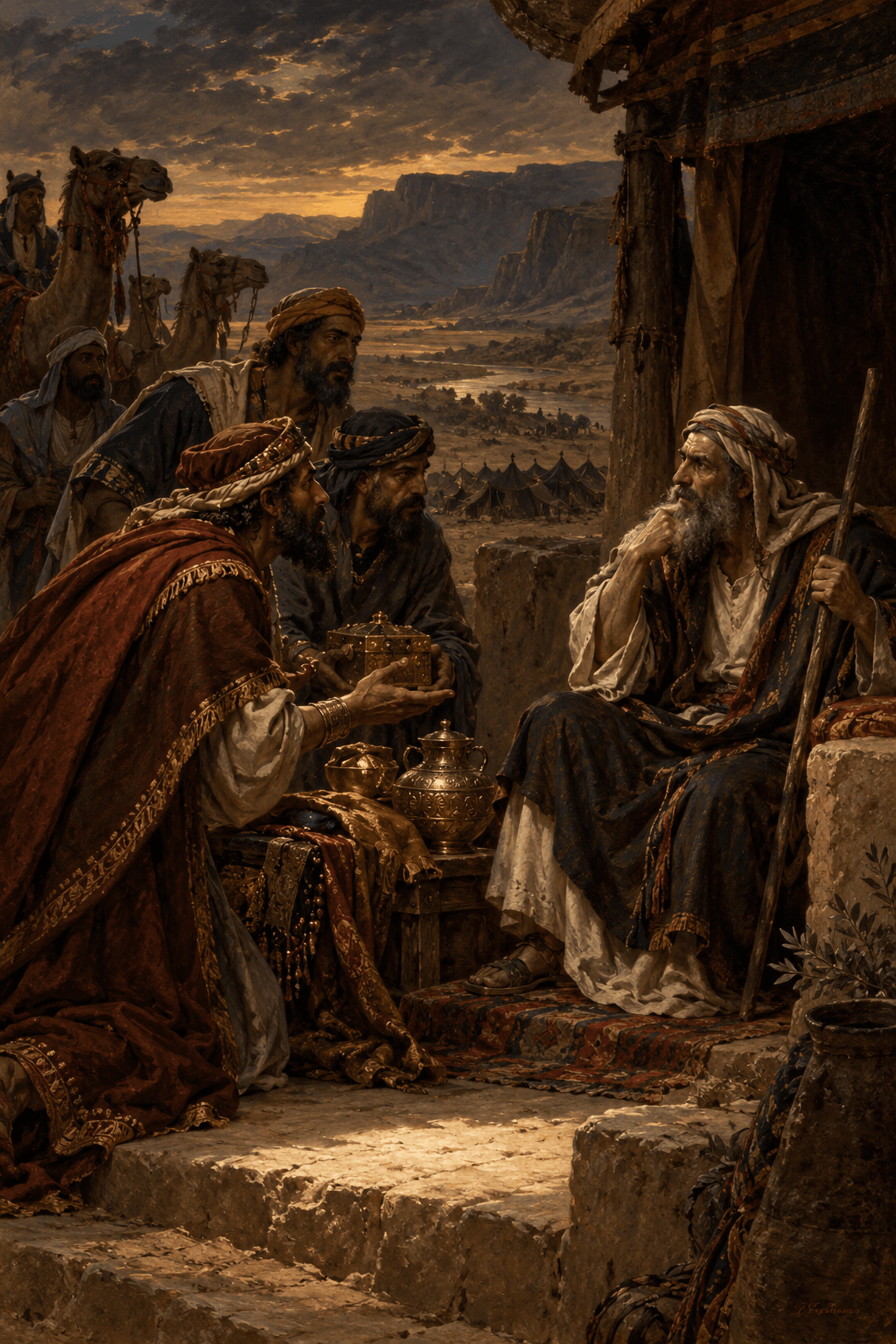
When Balak the son of Zippor, king of Moab, saw what had happened with the Amorites, he was sore afraid of the people and said to the elders of Midian: “Now shall this company lick up all that are round about us, as the ox licketh up the grass of the field” (4). Why did Balak use this comparison? Origen says:
Without the least doubt, because the ox, as it licks up the grass of the field, uses its tongue like a sickle and cuts everything it finds. So this people was like the ox that fights with mouth and lips, using its weapons, which are the words (of worship) and prayers. Knowing this, Balak sent messengers to Balaam, to meet words with words and prayers with prayers. [200]
Balak perceived that the secret of this people’s strength lay not in its material weapons, but in the presence of the Lord, the secret of blessing, in their midst. Therefore, instead of preparing an army to fight it, he sent messengers, offered many gifts and made promises, so that Balaam would come and curse this people and so take away from it the blessing, the secret of its strength. Origen says:
War threatens you, O King Balak son of Zippor, and six hundred thousand armed men are taking control of your land; so you must prepare your weapons, gather your army and think about war, so that you may advance in strength against the enemy who is still far off… But the king sent to Balaam, ignoring the war, putting all his hope in the words Balaam would utter and the curses he would shoot like arrows. He tries to win by Balaam’s words against the people whom the royal army could not overcome… It is strange conduct; where and when have we seen such a thing? What king, facing a certain battle, forgets the war and ignores his army, resorting to the services of divination! [201]
He sent to him, inviting him: “Behold, there is a people come out from Egypt: behold, they cover the face of the earth, and they abide over against me: Come now therefore, I pray thee, curse me this people; for they are too mighty for me: peradventure I shall prevail, that we may smite them, and that I may drive them out of the land: for I wot that he whom thou blessest is blessed, and he whom thou cursest is cursed” (5–6).
Origen says:
Balaam was famous for his magic arts; there was none like him in harmful sorcery. He brings no blessing by his rites, but has the power to curse; for where demons are invoked they curse and do not bless… Truly they had observed that many armies had been defeated by his curses, and the king hoped to achieve this result by his curses, which he could not achieve by iron and weapons. He had this certainty, with renewed experience before him. Balak left all the means and methods of war to send messengers and say: Behold, there is a people come out from Egypt: behold, they cover the face of the earth, and they abide over against me.
In my opinion the king was strongly driven. It seems to me that he had learned that the children of Israel won victory over their enemies by prayer, not by weapons, by supplications more than by iron. They never used weapons against Pharaoh, for it was said to them: “The LORD shall fight for you, and ye shall hold your peace” (Exodus 14:14). And in the battle against Amalek the power of weapons was not as effective as the prayers of Moses: when Moses lifted up his hands toward God, Amalek was defeated, and when he let down his hands, defeat came upon Israel (Exodus 17). Surely Balak king of Moab had heard of these things, for it is written: “The people shall hear, and be afraid: sorrow shall take hold on the inhabitants of Palestina. Then the dukes of Edom shall be amazed; the mighty men of Moab, trembling shall take hold upon them; all the inhabitants of Canaan shall melt away” (Exodus 15:14–15). So the news had reached them, as Moses had prophesied earlier in his song at the crossing of the Red Sea. Moab had learned that this people conquers by prayers and fights its adversaries with the mouth, not the sword. He considered the matter and said to himself: Since weapons cannot resist the prayers and supplications of this people, I must find supplications, weapons of the lips and prayers that can overcome them. [202]
The king sent his messengers in haste to bring Balaam to curse the people, saying to him: “for I wot that he whom thou blessest is blessed, and he whom thou cursest is cursed” (6). Origen says:
I think the king did not know whether those whom Balaam blessed were blessed; he says this, it seems to me, to flatter him and win him over to achieve his purposes by magnifying and exalting his art. For sorcery does not know how to bless, since the demons do not know how to do good. Isaac and Jacob know how to bless, and so do all the saints; but the wicked do not know how to bless. [203]
3. God Appears to Balaam
KJV · Verses 9–13
9 And God came unto Balaam, and said, What men are these with thee? 10 And Balaam said unto God, Balak the son of Zippor, king of Moab, hath sent unto me, saying, 11 Behold, there is a people come out of Egypt, which covereth the face of the earth: come now, curse me them; peradventure I shall be able to overcome them, and drive them out. 12 And God said unto Balaam, Thou shalt not go with them; thou shalt not curse the people: for they are blessed. 13 And Balaam rose up in the morning, and said unto the princes of Balak, Get you into your land: for the Lord refuseth to give me leave to go with you.
When the messengers arrived, Balaam asked them to lodge with him until he consulted the Lord and answered them. “And God came unto Balaam… And God said unto Balaam, Thou shalt not go with them; thou shalt not curse the people: for they are blessed” (9, 12).
Here many stand perplexed: who came to Balaam and spoke with him the word of truth? Was it truly God, or did God compel Balaam’s gods to speak the truth even against their will?
Before entering into the discussion, I want to make clear that what was declared to Balaam was a word of truth, whether the speaker was God Himself directly or the spirit with whom Balaam was in contact. For God wanted to declare and reveal His care; so the matter came from God, regardless of the means. Many of the Fathers held that the speaker was most likely Balaam’s own god and not the true God, but God used him. Among these are Origen and Saints Basil, Ambrose and Gregory of Nyssa.
Saint Gregory of Nyssa says:
Balaam too, being a soothsayer and seer, practising divination, brought in the teaching of demons and the divination of sorcery; and it is said of him in Scripture that he received counsel from God. [204]
for He was, in this sense, his god. Saint Ambrose says:
Remember what Balaam brought against you, seeking the help of the art of sorcery; but I compelled him not to harm you. [205]
And Saint Basil says:
Balaam too was a soothsayer and seer; since the oracles were in his hands when he received teachings from the demons by the arts of divination, Holy Scripture described him as having received counsel from God. [206]
The saint goes on to make clear that Holy Scripture speaks of men according to common usage; therefore it calls idols gods. Origen spoke of this matter at some length; I try to summarize it in the following lines.
Origen [207] holds that when the name of the Lord, or God, is written in Hebrew as “Jehovah,” the true God Himself is meant; but when it is written otherwise, it admits both possibilities. For the Apostle Paul said: “For though there be that are called gods, whether in heaven or in earth, (as there be gods many, and lords many,) But to us there is but one God, the Father, of whom are all things, and we in him; and one Lord Jesus Christ, by whom are all things, and we by him” (1 Corinthians 8:5–6)… For this reason Origen doubts that God Himself appeared to Balaam, since “Jehovah” is not mentioned. Moreover, in the words: “thou shalt not curse the people: for they are blessed” (12), why did He not say, “Do not curse My people”? In all the long conversations the Lord had with Balaam, He never used this expression, “My people”!!!
In any case, the command came from God Himself that Balaam should not curse God’s people, whether it came through Him directly or He compelled his gods to say it. It is God’s surpassing care for His children.
4. The Invitation Repeated
KJV · Verses 14–21
14 And the princes of Moab rose up, and they went unto Balak, and said, Balaam refuseth to come with us. 15 And Balak sent yet again princes, more, and more honourable than they. 16 And they came to Balaam, and said to him, Thus saith Balak the son of Zippor, Let nothing, I pray thee, hinder thee from coming unto me: 17 For I will promote thee unto very great honour, and I will do whatsoever thou sayest unto me: come therefore, I pray thee, curse me this people. 18 And Balaam answered and said unto the servants of Balak, If Balak would give me his house full of silver and gold, I cannot go beyond the word of the Lord my God, to do less or more. 19 Now therefore, I pray you, tarry ye also here this night, that I may know what the Lord will say unto me more. 20 And God came unto Balaam at night, and said unto him, If the men come to call thee, rise up, and go with them; but yet the word which I shall say unto thee, that shalt thou do. 21 And Balaam rose up in the morning, and saddled his ass, and went with the princes of Moab.
When Balaam refused to go with Balak’s messengers, he sent again greater men, “princes of Moab” (14), and tempted him with money, saying to him: “For I will promote thee unto very great honour, and I will do whatsoever thou sayest unto me: come therefore, I pray thee, curse me this people” (17). He answered firmly: “If Balak would give me his house full of silver and gold, I cannot go beyond the word of the LORD my God, to do less or more” (18). It is a decisive and strong answer that rebukes believers. As Christ the Lord says, the children of this world have become wiser than the children of the kingdom (Luke 16:8). Divine revelation recorded it for our rebuke, as God rebuked Jonah the prophet through a heathen man, who said to him: “What meanest thou, O sleeper? arise, call upon thy God, if so be that God will think upon us, that we perish not” (Jonah 1:6).
Despite this strong answer, his heart inclined toward the earthly reward. Instead of answering them with what the Lord had told him the first time, he asked them to stay a night, to hear the Lord’s voice a second time, as though he hoped He would change His mind. Therefore the Lord allowed him to go down, according to the desire of his heart. God often answers us according to the crookedness of our heart, if we insist on our request. Origen comments on this conduct of Balaam, saying:
He wants to hear; for the greedy man cannot easily refuse gain. What does he hear from God this time? “If the men come to call thee, rise up, and go with them” (20). The Lord left him to his own desire, so that he might profit, and so that what is written might be fulfilled in him: “So I gave them up unto their own hearts’ lust: and they walked in their own counsels” (Psalm 81:12). At the same time the plan of the divine will was accomplished… Since the lust for material gain ruled his heart, the word of God was not put in his heart but in his mouth. Wonderful and great is the word of God! Since the prophecies kept within the bounds of Israel could not reach the Gentiles, God used Balaam, in whom the Gentiles trusted, so that they might know the hidden mysteries of Christ, and He offered them a precious treasure, not through the heart and spirit but rather through the mouth and speech. [208]
5. Balaam on the Way
KJV · Verses 22–35
22 And God's anger was kindled because he went: and the angel of the Lordstood in the way for an adversary against him. Now he was riding upon his ass, and his two servants were with him. 23 And the ass saw the angel of the Lord standing in the way, and his sword drawn in his hand: and the ass turned aside out of the way, and went into the field: and Balaam smote the ass, to turn her into the way. 24 But the angel of the Lord stood in a path of the vineyards, a wall being on this side, and a wall on that side. 25 And when the ass saw the angel of the Lord, she thrust herself unto the wall, and crushed Balaam's foot against the wall: and he smote her again. 26 And the angel of the Lord went further, and stood in a narrow place, where was no way to turn either to the right hand or to the left. 27 And when the ass saw the angel of the Lord, she fell down under Balaam: and Balaam's anger was kindled, and he smote the ass with a staff. 28 And the Lord opened the mouth of the ass, and she said unto Balaam, What have I done unto thee, that thou hast smitten me these three times? 29 And Balaam said unto the ass, Because thou hast mocked me: I would there were a sword in mine hand, for now would I kill thee. 30 And the ass said unto Balaam, Am not I thine ass, upon which thou hast ridden ever since I was thine unto this day? was I ever wont to do so unto thee? and he said, Nay. 31 Then the Lord opened the eyes of Balaam, and he saw the angel of the Lordstanding in the way, and his sword drawn in his hand: and he bowed down his head, and fell flat on his face. 32 And the angel of the Lord said unto him, Wherefore hast thou smitten thine ass these three times? behold, I went out to withstand thee, because thy way is perverse before me: 33 And the ass saw me, and turned from me these three times: unless she had turned from me, surely now also I had slain thee, and saved her alive. 34 And Balaam said unto the angel of the Lord, I have sinned; for I knew not that thou stoodest in the way against me: now therefore, if it displease thee, I will get me back again. 35 And the angel of the Lord said unto Balaam, Go with the men: but only the word that I shall speak unto thee, that thou shalt speak. So Balaam went with the princes of Balak.
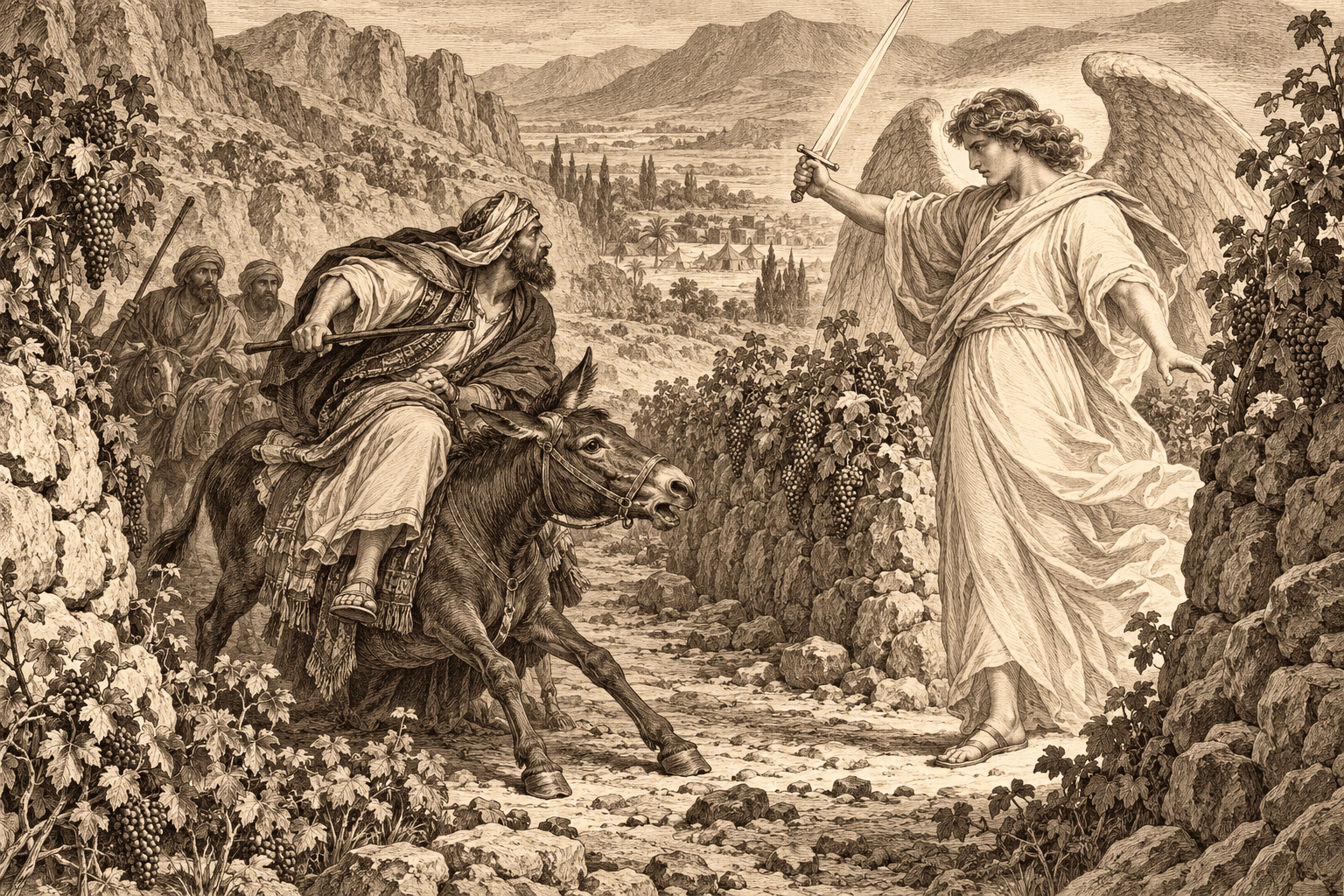
The Lord spoke with Balaam according to the desire of his heart, turned toward material things; or, as He said by the mouth of Ezekiel the prophet: “Every man… that setteth up his idols in his heart, and putteth the stumblingblock of his iniquity before his face, and cometh to the prophet; I the LORD will answer him that cometh according to the multitude of his idols” (Ezekiel 14:4). He commanded him to go with the men, the “princes of Moab”; and when Balaam did so, “God’s anger was kindled because he went: and the angel of the LORD stood in the way for an adversary against him. Now he was riding upon his ass, and his two servants were with him. And the ass saw the angel of the LORD standing in the way, and his sword drawn in his hand: and the ass turned aside out of the way, and went into the field: and Balaam smote the ass, to turn her into the way” (22–23).
The incident of Balaam and his ass, which spoke rebuking him, is unique and wonderful. The secret of God’s using this dumb animal to rebuke Balaam has many meanings:
First: Origen says:
The Lord opened the mouth of the ass (28), so that the ass might become his judge: by the voice of the dumb animal He put to shame the one who thought himself a god and wise. [209]
Second: when the Lord opened the mouth of the ass and she said to Balaam, “What have I done unto thee, that thou hast smitten me these three times?” (28), Balaam showed no sign of astonishment, but answered: “Because thou hast mocked me: I would there were a sword in mine hand, for now would I kill thee” (29). He entered into a dialogue with her because Balaam, as a soothsayer, was accustomed to speaking with birds and dumb animals; therefore the Lord rebuked him by the same means he was accustomed to in his sorcery and divination. Saint Gregory of Nyssa says:
History gives us testimony about divination by watching birds, when it says of the person referred to that he had the power of divination and received counsel from birds… Such a man learns things through what he is accustomed to, namely by the braying of his ass. He was accustomed to receive counsel from the voices of irrational animals under demonic influence; therefore Scripture clearly described what the ass uttered. In this way Scripture showed that, instead of reason, they received teaching through irrational animals. By paying attention to the ass he learned of the things that had deceived him, and knew that the power of those against whom he had been hired could not be overcome. [210]
Third: the story carried symbolic meanings. The angel who appeared to the ass points to the angel of the Lord who went before His people (Exodus 32:34), whom the ass saw and Balaam could not see. The ass, as Origen holds, [211] points to the simple Church, which formerly carried Balaam, whose name means “a vain people.” She formerly carried everything vain; but Christ the Lord sent His two disciples to her to loose her and bring her to Him, and He rode on her (Mark 11:2). The disciples loosed her from her bonds so that the Lord might mount her and bring her into the holy city, the heavenly Jerusalem (Hebrews 12:22). In this way the prophet’s word was fulfilled: “Rejoice greatly, O daughter of Zion; shout, O daughter of Jerusalem: behold, thy King cometh unto thee: he is just, and having salvation; lowly, and riding upon an ass, and upon a colt the foal of an ass” (Zechariah 9:9).
What did the ass do? “And when the ass saw the angel of the LORD, she thrust herself unto the wall, and crushed Balaam’s foot against the wall: and he smote her again” (25). When the truth appears to her, she cannot bear Balaam; she brings him into the narrow way and presses on his feet, so that he can no longer walk or ride her, but leaves her so that the Lord may mount and reign in His Church.
6. His Reception in Moab
KJV · Verses 36–41
36 And when Balak heard that Balaam was come, he went out to meet him unto a city of Moab, which is in the border of Arnon, which is in the utmost coast. 37 And Balak said unto Balaam, Did I not earnestly send unto thee to call thee? wherefore camest thou not unto me? am I not able indeed to promote thee to honour? 38 And Balaam said unto Balak, Lo, I am come unto thee: have I now any power at all to say any thing? the word that God putteth in my mouth, that shall I speak. 39 And Balaam went with Balak, and they came unto Kirjathhuzoth. 40 And Balak offered oxen and sheep, and sent to Balaam, and to the princes that were with him. 41 And it came to pass on the morrow, that Balak took Balaam, and brought him up into the high places of Baal, that thence he might see the utmost part of the people.
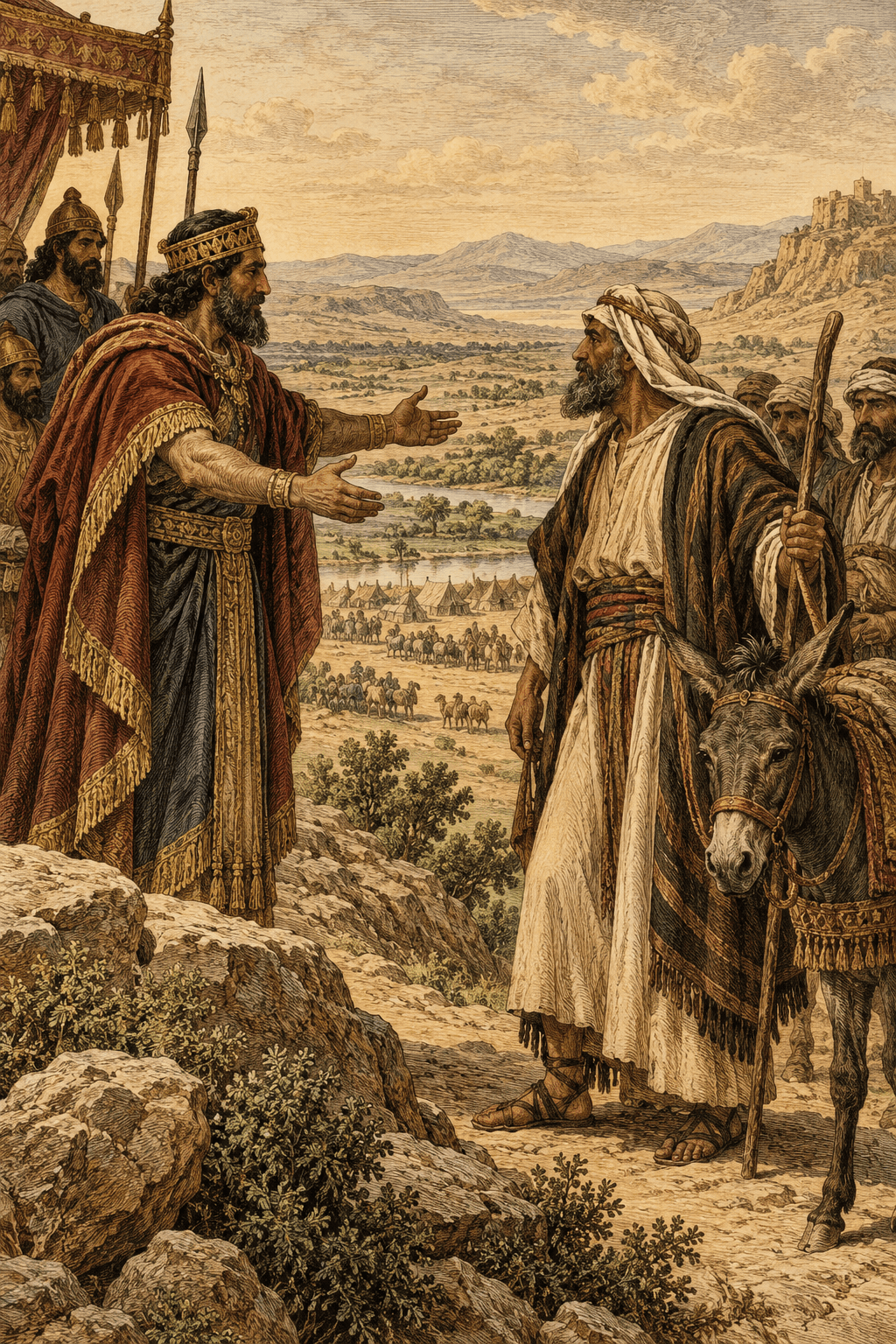
The king himself went out to meet him, and in reproach said to him: “Did I not earnestly send unto thee to call thee? wherefore camest thou not unto me? am I not able indeed to promote thee to honour?” (37).
Notes and References
[196] St. Gregory of Nyssa, The Life of Moses 2.292, 294–296.
[197] Origen, Homilies on Numbers 13.
[198] Ibid.
[199] Ibid.
[200] Origen, Homilies on Numbers 13.
[201] Ibid.
[202] Ibid.
[203] Ibid.
[204] St. Gregory of Nyssa, On the Holy Trinity.
[205] St. Ambrose, Epistle 41.24.
[206] St. Basil, Epistle 139.6 (as cited in the source).
[207] Origen, Homilies on Numbers 14.
[208] Ibid.
[209] Ibid.
[210] St. Gregory of Nyssa, The Life of Moses 2.293.
[211] Origen, Homilies on Numbers 13, 14.