
The matter did not stop at the murmuring of the people themselves; it seeped into some of the Levites and princes, who wanted to usurp the priesthood, accusing Moses and Aaron of lifting themselves up over the people and setting themselves apart from the rest of the congregation.
1. Korah and His Company
KJV · Verses 1–3
1 Now Korah, the son of Izhar, the son of Kohath, the son of Levi, and Dathan and Abiram, the sons of Eliab, and On, the son of Peleth, sons of Reuben, took men: 2 And they rose up before Moses, with certain of the children of Israel, two hundred and fifty princes of the assembly, famous in the congregation, men of renown: 3 And they gathered themselves together against Moses and against Aaron, and said unto them, Ye take too much upon you, seeing all the congregation are holy, every one of them, and the Lord is among them: wherefore then lift ye up yourselves above the congregation of the Lord?
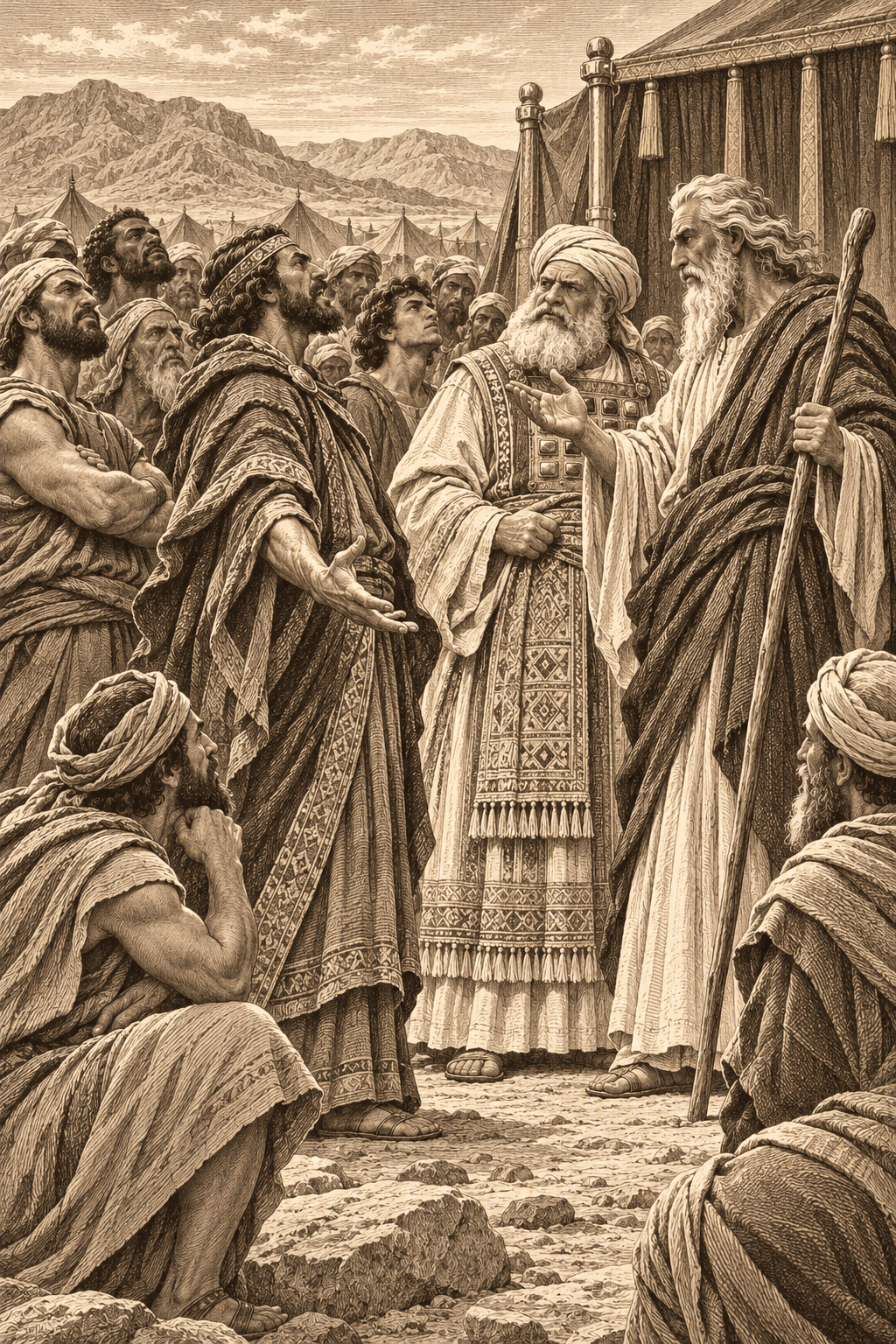
Korah, Dathan and Abiram wanted to usurp the priesthood, and with them two hundred and fifty princes of the congregation, men of renown, saying: “seeing all the congregation are holy, every one of them, and the LORD is among them: wherefore then lift ye up yourselves above the congregation of the LORD?” (3). They saw in Moses’ receiving the prophecy and Aaron’s receiving the high priesthood a distinction setting them apart from the holy congregation, and they wanted the priesthood to be common, not limited to one tribe rather than another or one man rather than others.
If the common people are usually struck with the spirit of murmuring because of eating, drinking and the lusts of the body, the men of renown and the great are attacked with a harsher and more bitter blow, namely “pride.” Korah, one of the sons of Kohath, whom the Lord distinguished by carrying the spiritually precious divine holy things, was driven by pride to usurp the priesthood, not to serve others but out of thirst for honour, for he said to Moses and Aaron: “wherefore then lift ye up yourselves above the congregation of the LORD?” It is as though he looked at the ranks of the Church not as service and fatherhood but as domination and honour!
Korah was able to stir up Dathan and Abiram and two hundred and fifty princes of the people, men of renown, and even stirred up the whole congregation against Moses and Aaron. Sadly, heretics and schismatics from the Church are usually men of renown and gifts, which turn them aside to tearing down instead of building up, and to division instead of unity.
The end of the proud Korah, and of Dathan and Abiram too, was that the earth split open and swallowed them alive; that is, they went down into the pit. Therefore Saint Gregory of Nyssa comments:
Holy Scripture teaches us, I think, that when a man lifts himself up in arrogance, he ends by falling beneath the earth! So it is not without reason that pride is defined as an ascent downward. [108]
If those who lift themselves above others in some way sink downward, as the earth opened its mouth to swallow them, then no one can dispute the definition of pride as a base fall. [109]
If you see a man who presents himself as pure, rising above the passion of pleasures, and with great zeal counting himself better than others, thirsting for the priesthood, be sure that what you see is a man fallen to the earth by his towering pride. [110]
Saint Clement of Rome comments on the attitude of these men thus:
Envy brought Dathan and Abiram down alive into Hades, because they stirred up sedition against Moses the servant of God. [111]
It is better for a man to confess his sins than to harden his heart, as the hearts of those who rose up against Moses the servant of God were hardened; their punishment was public, for they went down alive into Hades, and death swallowed them up. [112]
2. Moses’ Response
KJV · Verses 4–14
4 And when Moses heard it, he fell upon his face: 5 And he spake unto Korah and unto all his company, saying, Even to morrow the Lord will shew who are his, and who is holy; and will cause him to come near unto him: even him whom he hath chosen will he cause to come near unto him. 6 This do; Take you censers, Korah, and all his company; 7 And put fire therein, and put incense in them before the Lord to morrow: and it shall be that the man whom the Lord doth choose, he shall be holy: ye take too much upon you, ye sons of Levi. 8 And Moses said unto Korah, Hear, I pray you, ye sons of Levi: 9 Seemeth it but a small thing unto you, that the God of Israel hath separated you from the congregation of Israel, to bring you near to himself to do the service of the tabernacle of the Lord, and to stand before the congregation to minister unto them? 10 And he hath brought thee near to him, and all thy brethren the sons of Levi with thee: and seek ye the priesthood also? 11 For which cause both thou and all thy company are gathered together against the Lord: and what is Aaron, that ye murmur against him? 12 And Moses sent to call Dathan and Abiram, the sons of Eliab: which said, We will not come up: 13 Is it a small thing that thou hast brought us up out of a land that floweth with milk and honey, to kill us in the wilderness, except thou make thyself altogether a prince over us? 14 Moreover thou hast not brought us into a land that floweth with milk and honey, or given us inheritance of fields and vineyards: wilt thou put out the eyes of these men? we will not come up.
“And when Moses heard it, he fell upon his face” (4). Since he had received his mission from God, he could not act except by returning to Him in humility and contrition. While the heart of Korah and his company was lifted up in pride, Moses humbled himself greatly, as though humility distinguishes the true minister from the false.
Moses committed the matter into God’s hands, asking them, according to the desire of their hearts, to offer incense, after he had warned them against usurping the priestly work (10). Korah, in the pride of his heart, came forward with the two hundred and fifty princes to offer incense; but Dathan and Abiram refused to come to meet Moses, accusing him of making himself a prince over the people and of bringing them into the wilderness to kill them, and not bringing them into the land flowing with milk and honey.
3. Setting Apart the True Priesthood
KJV · Verses 15–19
15 And Moses was very wroth, and said unto the Lord, Respect not thou their offering: I have not taken one ass from them, neither have I hurt one of them. 16 And Moses said unto Korah, Be thou and all thy company before the Lord, thou, and they, and Aaron, to morrow: 17 And take every man his censer, and put incense in them, and bring ye before the Lord every man his censer, two hundred and fifty censers; thou also, and Aaron, each of you his censer. 18 And they took every man his censer, and put fire in them, and laid incense thereon, and stood in the door of the tabernacle of the congregation with Moses and Aaron. 19 And Korah gathered all the congregation against them unto the door of the tabernacle of the congregation: and the glory of the Lord appeared unto all the congregation.
…Moses was not zealous for himself; he was zealous for the Lord’s priesthood, which was being usurped, and for God’s people, who were exposed to murmuring because of their words.
4. The Chastisement of the Pretenders
KJV · Verses 20–35
20 And the Lord spake unto Moses and unto Aaron, saying, 21 Separate yourselves from among this congregation, that I may consume them in a moment. 22 And they fell upon their faces, and said, O God, the God of the spirits of all flesh, shall one man sin, and wilt thou be wroth with all the congregation? 23 And the Lord spake unto Moses, saying, 24 Speak unto the congregation, saying, Get you up from about the tabernacle of Korah, Dathan, and Abiram. 25 And Moses rose up and went unto Dathan and Abiram; and the elders of Israel followed him. 26 And he spake unto the congregation, saying, Depart, I pray you, from the tents of these wicked men, and touch nothing of their's, lest ye be consumed in all their sins. 27 So they gat up from the tabernacle of Korah, Dathan, and Abiram, on every side: and Dathan and Abiram came out, and stood in the door of their tents, and their wives, and their sons, and their little children. 28 And Moses said, Hereby ye shall know that the Lord hath sent me to do all these works; for I have not done them of mine own mind. 29 If these men die the common death of all men, or if they be visited after the visitation of all men; then the Lord hath not sent me. 30 But if the Lord make a new thing, and the earth open her mouth, and swallow them up, with all that appertain unto them, and they go down quick into the pit; then ye shall understand that these men have provoked the Lord. 31 And it came to pass, as he had made an end of speaking all these words, that the ground clave asunder that was under them: 32 And the earth opened her mouth, and swallowed them up, and their houses, and all the men that appertained unto Korah, and all their goods. 33 They, and all that appertained to them, went down alive into the pit, and the earth closed upon them: and they perished from among the congregation. 34 And all Israel that were round about them fled at the cry of them: for they said, Lest the earth swallow us up also. 35 And there came out a fire from the Lord, and consumed the two hundred and fifty men that offered incense.
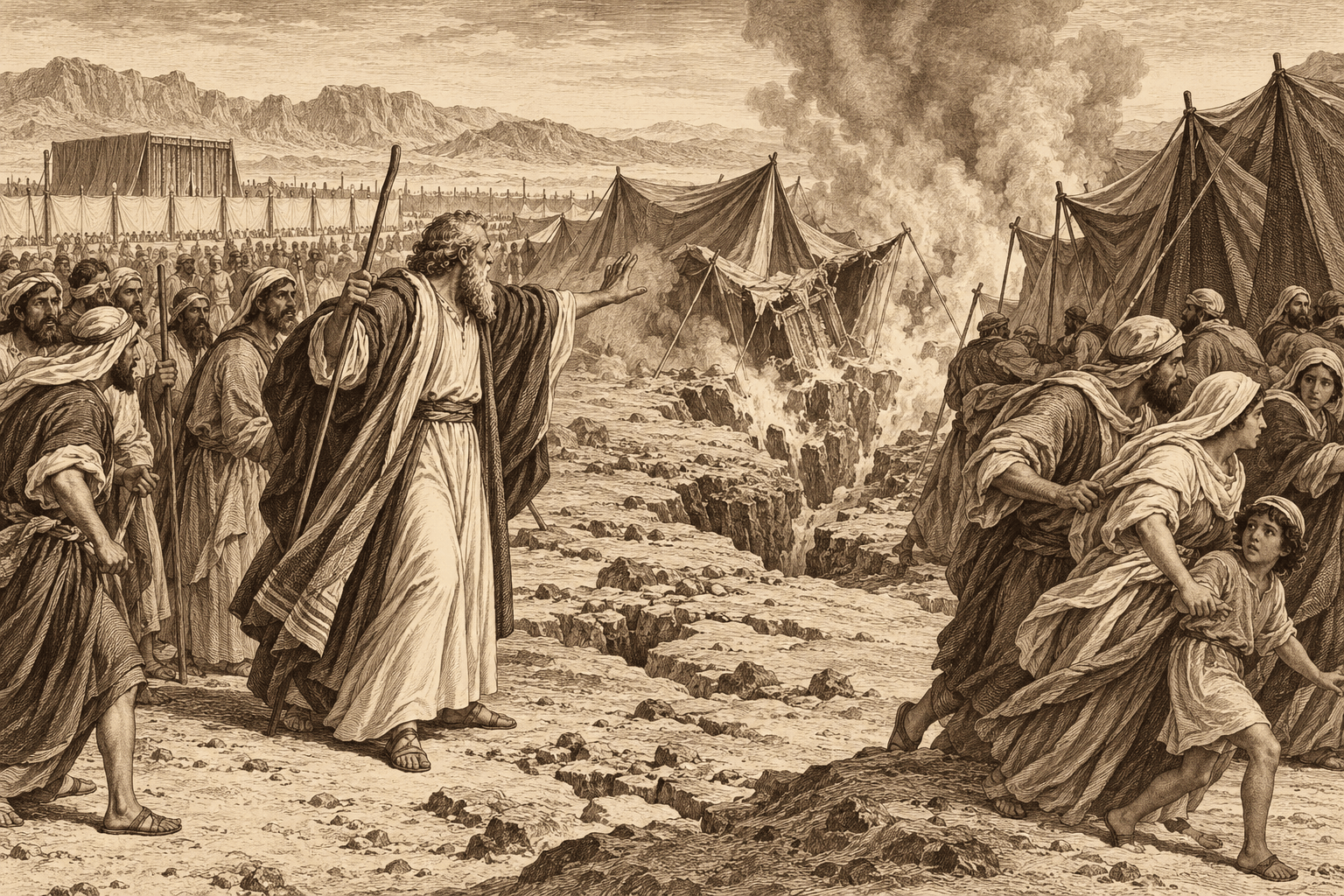
The congregation separated from the dwelling of Korah, Dathan and Abiram, and the earth opened and swallowed the men and all that was theirs, wives and little ones, and they went down alive into the pit. As for the two hundred and fifty princes, fire came out from the Lord and consumed them.
Nothing grieves the heart of God like usurping the priestly work and stirring up division in the Church. Therefore the chastisement of Korah and his company was the harshest kind of chastisement: the earth split open to swallow them, as though they had become among the demons who go down beneath the earth! Saint Irenaeus says:
Truly the heretics bring strange fire to the altar of God, that is, they bring strange teachings; therefore they are burned by fire from heaven, as happened with Nadab and Abihu (Leviticus 10:1–2). But whoever stands against the truth and stirs up others against the Church of God goes down among those in Hades, swallowed up by an earthquake, as happened with Korah, Dathan and Abiram. And those who split the Church and tear apart her unity receive the same punishment that fell upon Jeroboam (1 Kings 14:10). [113]
Saint Cyprian has a comment on this matter, speaking of heretics and those who cause schism. He says:
Korah, Dathan and Abiram knew the same God whom Aaron the priest and Moses knew; they lived under the same Law as they and the same faith; they called upon the one true God and asked Him in worship. Yet because they transgressed the ministry of their office against Aaron the priest, who had received the true priesthood… and claimed for themselves the authority to offer sacrifice, they were smitten with a divine stroke and fell at once under punishment for their unlawful conduct and for offering sacrifices full of blasphemy, unlawful and against divine truth; and their earlier standing could not excuse them from punishment or profit them. [114]
Saint Cyprian holds that the violence and severity of the chastisement were to teach those who would come after them. [115] So God uses severity at the beginning of every breaking of a particular commandment, to declare the bitterness of breaking it and to warn the coming generations in a material, tangible way.
Saint Cyprian also has a comment on this matter, warning us against the sin of murmuring:
It befits us, beloved brethren, not to murmur, but to bear with patience and courage all that happens; for it is written: “The sacrifices of God are a broken spirit: a broken and a contrite heart, O God, thou wilt not despise” (Psalm 51:17); and it is said in the Book of Deuteronomy: “for the LORD your God proveth you, to know whether ye love the LORD your God with all your heart and with all your soul” (Deuteronomy 13:3)… [116]
As for the two hundred and fifty princes, since they burned incense unworthily, fire came down from the Lord and consumed them.
Why did the Lord command the congregation to separate from them? Saint Cyprian answers:
The Lord commanded Moses that the people separate from them, lest by mingling with the wicked they fall with them into evil. [117]
And why did the earth swallow the wicked men, their wives, their children and their little ones? It represents the uprooting of all the roots of sin working in the soul (the men), the body (the women) and man’s energies and gifts (the little ones). For when sin corrupts the soul, the body, man’s energies, his feelings, his emotions and so on, man loses everything!
Saints Jerome and Augustine noted that Korah means “Calvary.” So, though Korah died in his sin with his wife and children, he had blessed descendants, the sons of the Bridegroom crucified on Calvary. They became a company for praising the Lord, and their psalms are all full of joy. Saint Augustine says:
The sons of Korah are the sons of the Bridegroom crucified in the place of Calvary. [118]
And Saint Jerome says:
Every psalm in whose title the sons of Korah are mentioned is a joyful psalm, with nothing of sorrow in it. For though the Lord punished Korah, Dathan and Abiram because they resisted Moses, the sons of Korah, since they did not resist like their father, were blessed with eternal joy. [119]
5. The Censers of Korah and His Company
KJV · Verses 36–40
36 And the Lord spake unto Moses, saying, 37 Speak unto Eleazar the son of Aaron the priest, that he take up the censers out of the burning, and scatter thou the fire yonder; for they are hallowed. 38 The censers of these sinners against their own souls, let them make them broad plates for a covering of the altar: for they offered them before the Lord, therefore they are hallowed: and they shall be a sign unto the children of Israel. 39 And Eleazar the priest took the brasen censers, wherewith they that were burnt had offered; and they were made broad plates for a covering of the altar: 40 To be a memorial unto the children of Israel, that no stranger, which is not of the seed of Aaron, come near to offer incense before the Lord; that he be not as Korah, and as his company: as the Lord said to him by the hand of Moses.
Though God chastised the false priests, the usurpers of the priesthood, He regarded the censers used to offer incense in His holy name as having become holy. Therefore He asked Moses the prophet to have these brazen censers beaten out and the brazen altar covered with them.
Why did the Lord command this? Origen answers that the censers point to Holy Scripture, which heretics and schismatics misuse, and so offer rejected incense. It is as though the fault lies not in the censers or the incense, but in the one who uses them. That they were of brass and not of gold or silver (Psalm 12:6) is because they give the echo of words without the power of the Spirit, as the Apostle Paul says: “I am become as sounding brass, or a tinkling cymbal” (1 Corinthians 13:1).
When the censers are beaten out and the altar covered with them, the brightness and splendour of the altar appear all the more; the evil deed is declared, the truth is revealed from falsehood, and sound faith from heresies. Origen says:
Who would perceive that light is good unless he had experienced the darkness of night? And who would value the sweetness of honey unless he had tasted something bitter…? So too the glory of faithful priests cannot shine except by the appearance of the punishment of the wicked. As we have read, every righteous man appears greatest before God by comparison with others, for it is written of Noah that he was “a just man and perfect in his generations” (Genesis 6:9). This shows that no man is perfect in an absolute way; he is counted righteous “in his generations,” declared righteous by comparison with others. In my view, as for Lot, the more the corruption of Sodom grew from day to day, the greater Lot’s righteousness became. And in the book before us, at the sending of the spies to the land of promise, when the ten drove the people to despair… while the other two, Caleb and Joshua, announced the good news and encouraged the people (Numbers 14:6) to go on with strong resolve, they received an imperishable reward from the Lord… The strength of their spirits would not have shone with such greatness had not the cowardice of the other ten, full of shame, appeared. I say all this for the sake of the censers of the guilty: they had to be placed on the altar so that the glory of the righteous might appear higher by comparison with the baseness of these. In this way the censers become an example for the coming generations, so that no one becomes proud and self-confident and takes the high-priestly dignity without receiving it from God… nor is the position seized by bribery; rather, one rises according to the conscience of his merits, according to the will of God. [120]
6. The People Murmur
KJV · Verses 41–50
41 But on the morrow all the congregation of the children of Israel murmured against Moses and against Aaron, saying, Ye have killed the people of the Lord. 42 And it came to pass, when the congregation was gathered against Moses and against Aaron, that they looked toward the tabernacle of the congregation: and, behold, the cloud covered it, and the glory of the Lord appeared. 43 And Moses and Aaron came before the tabernacle of the congregation. 44 And the Lord spake unto Moses, saying, 45 Get you up from among this congregation, that I may consume them as in a moment. And they fell upon their faces. 46 And Moses said unto Aaron, Take a censer, and put fire therein from off the altar, and put on incense, and go quickly unto the congregation, and make an atonement for them: for there is wrath gone out from the Lord; the plague is begun. 47 And Aaron took as Moses commanded, and ran into the midst of the congregation; and, behold, the plague was begun among the people: and he put on incense, and made an atonement for the people. 48 And he stood between the dead and the living; and the plague was stayed. 49 Now they that died in the plague were fourteen thousand and seven hundred, beside them that died about the matter of Korah. 50 And Aaron returned unto Moses unto the door of the tabernacle of the congregation: and the plague was stayed.
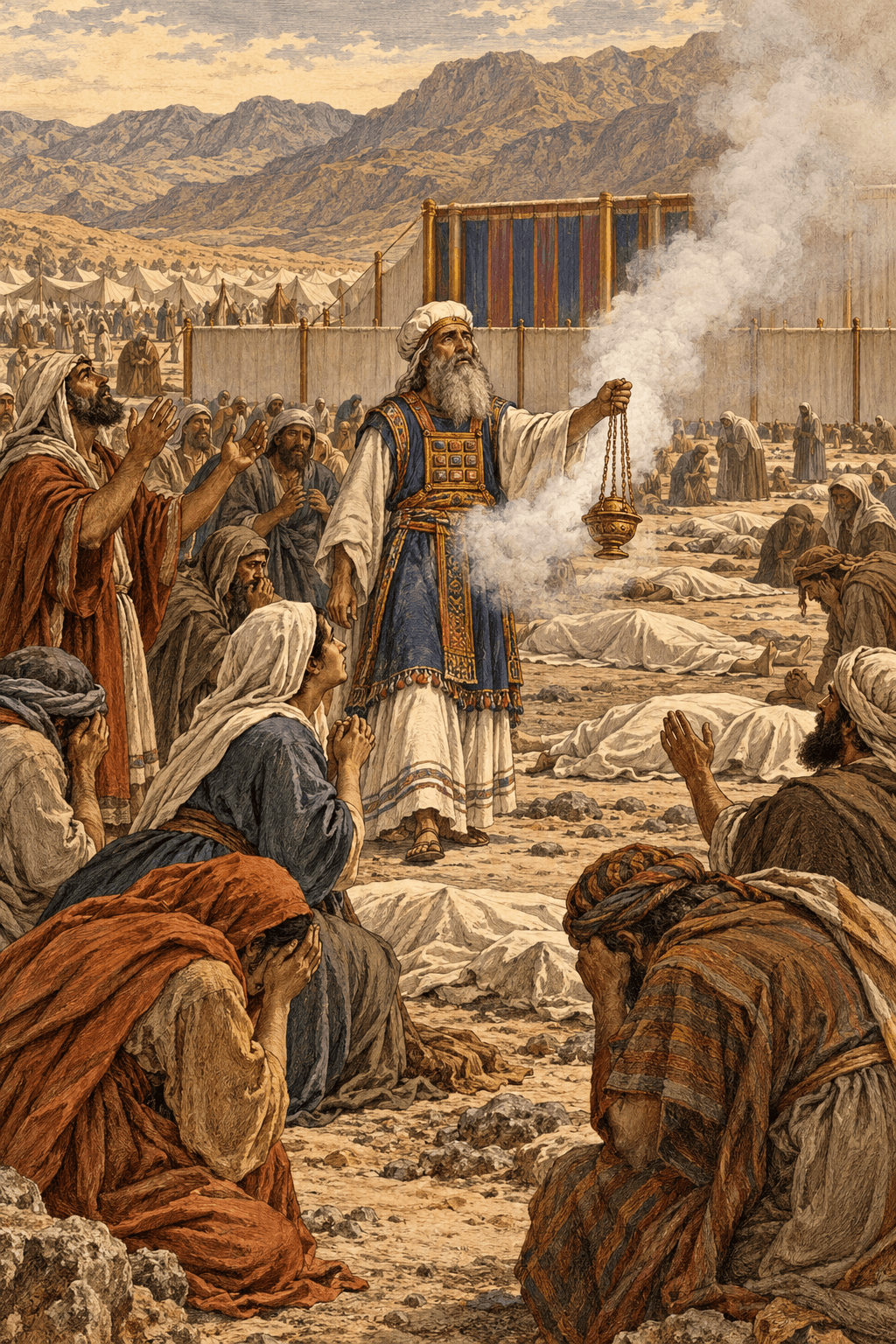
Once again the people murmured against Moses and Aaron because of the Lord’s chastisement of these men who had usurped the priestly work. All were stirred up against Moses and Aaron and accused them of murder (41). This reveals, first, how great the influence of Korah and his company was on the whole congregation, so that it was not restrained despite the divine chastisement it had seen coming from heaven (fire) and from the earth (opening its mouth); and it also reveals the nature of this people, or the nature of man outside grace: he is always murmuring.
When the whole people was in this bitter state, He asked Moses and Aaron to get up from among the congregation, that He might consume it in a moment (45). But the two fell on their faces before God; the glory of the Lord appeared, and Moses interceded for his people, asking Aaron to offer incense quickly in the midst of the congregation so that the plague would stop!
I do not want to repeat that this book, while revealing the murmuring nature of man, reveals the heart of Moses, burning with love and always interceding for his people.
We note the following in these events:
First: when harm drew near to Moses and Aaron from the people, the cloud covered the tabernacle and the glory of the Lord appeared. Origen says:
The glory of the Lord would not have appeared to them had they not become a target of persecution and hardship, with danger surrounding them until they came near to death. So do not hope to see the glory of the Lord while you sleep in rest! Was it not in the midst of these difficulties that the Apostle too was counted worthy to see the glory of God? Do you not remember that more than once he entered into afflictions, labours and prisons (2 Corinthians 11:23–27), was beaten with rods three times, was stoned once, suffered shipwreck, and endured perils in the sea, perils of waters, perils of robbers, perils among false brethren? The more the sufferings abound, the more the glory of God appears to those who endure them courageously. [121]
Second: the intercession of Moses and Aaron for the people, and the Lord’s answer to them, point to the work of the divine word or commandment (Moses, the receiver of the Law) and the work of worship (Aaron the priest) in our life. In Christ Jesus, the Word of God and the great High Priest, we enjoy salvation, and the divine wrath is taken away from us, if we hold fast to His commandments and practise worship as is fitting.
Third: Moses loved his opponents and persecutors, and asked Aaron the priest to hasten and offer incense in the midst of the congregation for their salvation. It is as though Moses, who represents the age of the Law, carried in himself the power of the Gospel: love for enemies (Matthew 5:44).
Fourth: Aaron stood between the dead and the living, offering incense to stop the work of death in the life of the living. These were happy moments that Aaron lived when he stood as a symbol of Christ, the Conqueror of death. As Saint Ambrose says:
What of Aaron? When was he more blessed than at the time when he stood between the living and the dead, and by his presence stopped death from passing from the bodies of the dead to the life of the living? [122]
Fifth: incense appears here as a symbol of prayer; therefore Malachi the prophet prophesies of its offering in the Church of the New Testament, saying: “and in every place incense shall be offered unto my name, and a pure offering” (Malachi 1:11). And Saint John saw in the heavenly worship an angel offering incense in a golden censer (Revelation 8:3–4). [123]
Notes and References
[108] St. Gregory of Nyssa, The Life of Moses 2.280.
[109] Ibid. 2.281.
[110] Ibid. 2.283.
[111] St. Clement of Rome, First Epistle to the Corinthians 4.11–12.
[112] Ibid. 51.3–4.
[113] St. Irenaeus, Against Heresies 4.16.2.
[114] St. Cyprian, Epistle 75.8.
[115] Ibid.
[116] St. Cyprian, Treatises 7.11.
[117] St. Cyprian, Epistle 67.3.
[118] St. Augustine, On Psalm 47.
[119] St. Jerome, Homilies on the Psalms 16.
[120] Origen, Homilies on Numbers 9.1.
[121] Origen, Homilies on Numbers 9.2.
[122] St. Ambrose, On the Duties of the Clergy 2.4 (11).
[123] For a study of incense and censing, see our book The Church, the House of God, 1979, pp. 373–380.