
Not long after the princes had presented offerings of joy to God, on the level of the whole congregation and of each tribe, the people murmured, turning back to their old lusts.
1. Fire Breaks Out in the Camp
KJV · Verses 1–3
1 And when the people complained, it displeased the Lord: and the Lordheard it; and his anger was kindled; and the fire of the Lord burnt among them, and consumed them that were in the uttermost parts of the camp. 2 And the people cried unto Moses; and when Moses prayed unto the Lord, the fire was quenched. 3 And he called the name of the place Taberah: because the fire of the Lordburnt among them.

“And when the people complained, it displeased the LORD: and the LORD heard it; and his anger was kindled” (1). This is the nature of the old man in us: it is constantly complaining and murmuring without any real cause. At the very time when the Lord had given the Law, commanded the making of the tabernacle with all its attachments and vessels so as to dwell in their midst, organized the camp for them and set up for them the rite of the ordination of the Levites, when all were joyful and exulting, bringing offerings to the Lord, a complaint arose within them. The cause of this complaint was the emptiness of the heart: sin had robbed it of its inner peace, so it looked for any excuse for murmuring and anxiety.
If the Book of Numbers is, as we said, the book of the wilderness, then in the wilderness, as God meets man, He declares to him His commandment, His benefits and His continual care; and at the same time man is exposed before God and before himself with all his inner weaknesses. In the wilderness the murmurings were repeated: once immediately after they crossed the Red Sea and offered the song of victory (Exodus 15:24); again after the bitter waters were turned into sweet, when they longed to have died in the land of bondage by the flesh pots, eating bread, rather than this divine work (Exodus 16:3); and a third time after He had given them the free manna (Exodus 17:2), and so on… It is as though after every gift, no sooner had they rejoiced in it a little than they felt hunger and emptiness and fell into murmuring. In truth this book is the book that reveals the weaknesses of human nature, not only in the life of the congregation as a whole, but even in the life of the greatest spiritual leader, the great Moses the prophet, to whom the Lord Himself bore witness that he was faithful in all His house (Numbers 12:7); in the life of his sister Miriam the singer, who became leprous and delayed the procession a whole week (Numbers 12); and also Aaron; besides Korah, Dathan and Abiram with the princes of the people (Numbers 16); and also the heathen prophet Balaam (Numbers 22–25)… I say it is the book that has exposed the wounds of human nature, so that each of us may hear what the king of Babylon heard: that he was weighed in the balances and found wanting.
Truly, how much we need the wilderness, so that we may perceive God’s dealings with us, and perceive the depths of our weaknesses within us, and take refuge in Him!
Revelation tells us of the fruit of this murmuring: “and the fire of the LORD burnt among them, and consumed them that were in the uttermost parts of the camp. And the people cried unto Moses; and when Moses prayed unto the LORD, the fire was quenched” (1–2). Before, God had been very gentle with them, giving them their request without chastisement; but now He allowed His fire to burn at the edge of the camp. Before, they had no long experience with God, and He treated them as little children; but now that He had overwhelmed them with all these blessings for more than a year, and granted them His dwelling in their midst through the holy tabernacle, His anger was kindled to chastise them!
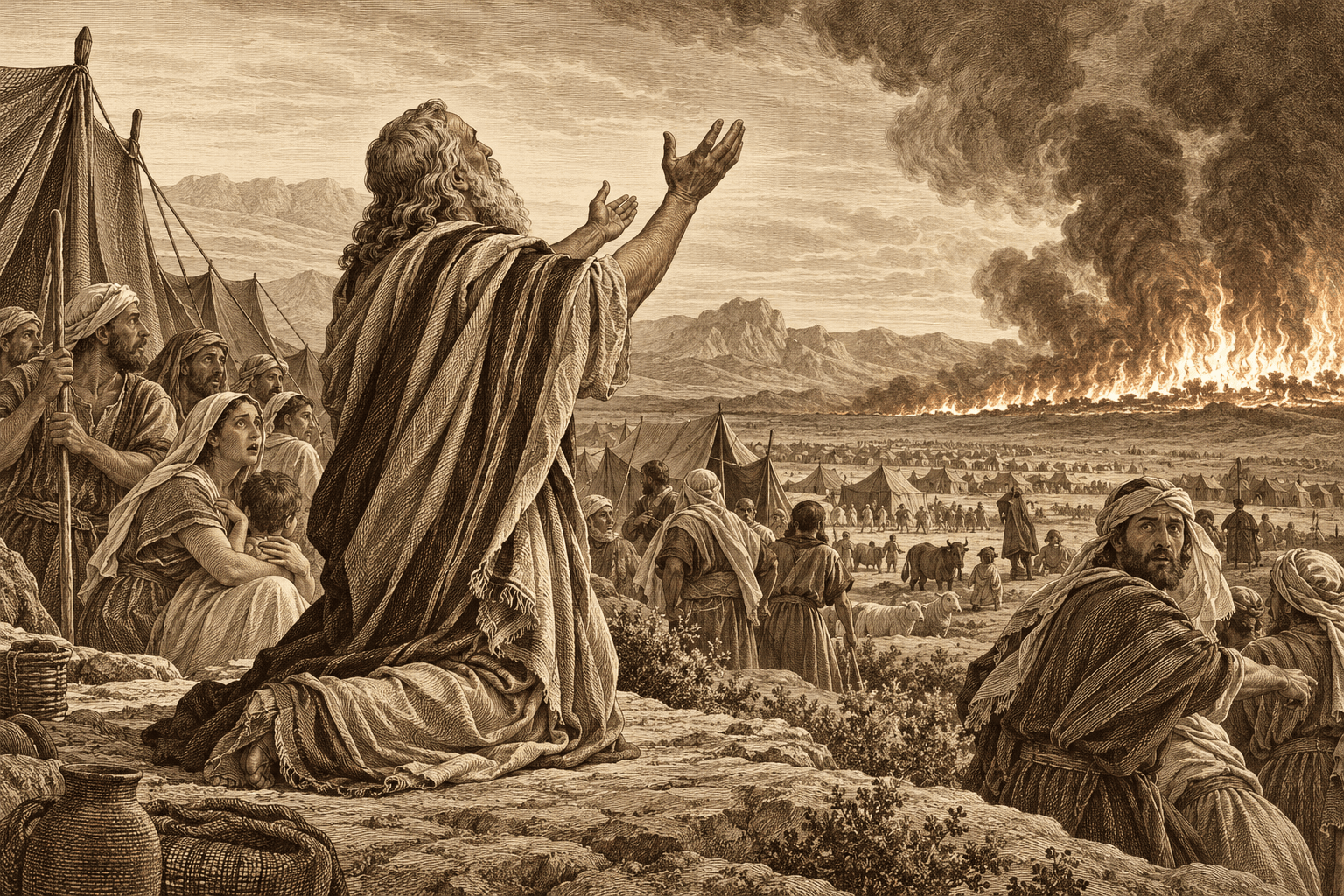
The murmuring was at first hidden in the heart, but the Lord, the Searcher of hearts, heard their hidden thoughts, for it is said that the people complained “and the LORD heard it” (1). So the Lord allowed the fire to burn at the edge of the camp, as though He wanted to reveal in a material, tangible way the work of the fire of inner evil in the soul. He wanted to expose the weakness in order to give an opportunity for repentance, so that the corruption would not remain hidden within without remedy. As for the fire burning at the edge of the camp, that is the farthest distance from the tabernacle; perhaps it was in that place that the first flame of murmuring broke out, for the farther a man is from God, the more his heart is opened to evil.
In the midst of the distress the love and faithful care of Moses the prophet shine out, for he cried to the Lord and the fire was quenched. This is the work of the loving shepherd: to intercede for his children before God, and the Lord answers him!
Lest the people forget this event and fall again into murmuring, the place was called “Taberah,” which means “burning.”
2. The Lust for Flesh
KJV · Verses 4–9
4 And the mixt multitude that was among them fell a lusting: and the children of Israel also wept again, and said, Who shall give us flesh to eat? 5 We remember the fish, which we did eat in Egypt freely; the cucumbers, and the melons, and the leeks, and the onions, and the garlick: 6 But now our soul is dried away: there is nothing at all, beside this manna, before our eyes. 7 And the manna was as coriander seed, and the colour thereof as the colour of bdellium. 8 And the people went about, and gathered it, and ground it in mills, or beat it in a mortar, and baked it in pans, and made cakes of it: and the taste of it was as the taste of fresh oil. 9 And when the dew fell upon the camp in the night, the manna fell upon it.
The Lord made clear how the flame of the fire of lust broke out in this people, saying: “And the mixt multitude that was among them fell a lusting” (4). This mixed multitude that kindled this fire were those who came out with them from Egypt (Exodus 12:38) and were among them, most likely Egyptians. These stirred up everyone, so that they wept and lusted for flesh. This mixed multitude represents the foreign thought that enters the soul and corrupts its depths. For this reason the Lord asked the people, when they entered a city, to destroy it utterly, as a symbol of leaving no trace of sin in our mind, lest sin return and rise up in us again.
This mixed multitude enters the life of the Church to corrupt her freedom in Christ Jesus our Lord and humiliate her with the bondage of sin, for the Apostle says: “And that because of false brethren unawares brought in, who came in privily to spy out our liberty which we have in Christ Jesus, that they might bring us into bondage: To whom we gave place by subjection, no, not for an hour; that the truth of the gospel might continue with you” (Galatians 2:4–5). So we should imitate the Apostle, and not yield to their voice for a single hour, lest we turn back to lusting after the flesh pots of the land of bondage; rather, let us remain always in the freedom of the truth of the Gospel.
And Jude the Apostle speaks to us of this mixed multitude, saying: “For there are certain men crept in unawares, who were before of old ordained to this condemnation, ungodly men, turning the grace of our God into lasciviousness, and denying the only Lord God, and our Lord Jesus Christ” (Jude 4). The work of this mixed multitude, which crept in stealthily among the believers, is to corrupt the work of divine grace in our life and bring us into lasciviousness and unbelief.
How much we need to be cleansed of this mixed multitude, whether on the level of the holy community, lest the corrupt leaven leaven the whole lump, or on the level of the member, lest the believer’s mind or heart be corrupted through leniency with a foreign thought or a sin that seems trivial and small. Therefore Scripture warns us: “Take us the foxes, the little foxes, that spoil the vines” (Song of Solomon 2:15).
The small mixed multitude was able to turn these millions back in their hearts to the land of bondage. While God wanted for His people a holy, free life, and separated them from that land with no return, now they were weeping, saying: “Who shall give us flesh to eat? We remember the fish, which we did eat in Egypt freely; the cucumbers, and the melons, and the leeks, and the onions, and the garlick: But now our soul is dried away: there is nothing at all, beside this manna, before our eyes” (4–6).
How strange is man in his ingratitude to God! The people remember the free fish, which were most likely the small fish given to slaves, and they lust after the cucumbers, the melons, the leeks, the onions and the garlic; and they do not remember the floggings, the strokes of the whips, the loss of freedom, the stripping away of their humanity and their humiliation in making bricks under every kind of pressure. Truly, sin remains the object of many people’s lust despite the humiliation and bondage it brings.
Saint John Chrysostom marvels at this people’s behaviour, saying:
If they left it after these things had happened (the works of harsh bondage), and still remembered Egypt with its harsh bondage and longed to return to their former tyrant, what would it have been if they had not been treated with such barbarity? [39]
Their sin did not stop at remembering the pleasure of the past and forgetting its humiliation; they looked on God’s heavenly gift with contempt, saying: “But now our soul is dried away.” This is the voice of mankind in every age: it seeks the passing pleasure of the body as though it were perfect freedom and the secret of joy, while God’s spiritual gift is in their eyes dryness, deprivation and distress. They despise the divine gift for the sake of enjoying passing bodily pleasure. On this Saint Jerome says:
They despised the bread of angels and lamented for the flesh of Egypt. Moses fasted on Mount Sinai forty days and forty nights, showing that man does not live by bread alone, but by the word of God. [40]
The fault was not in the flesh, nor in asking for it, but in despising God’s gift and in lusting with murmuring!
3. Moses Finds the Responsibility Too Heavy
KJV · Verses 10–15
10 Then Moses heard the people weep throughout their families, every man in the door of his tent: and the anger of the Lord was kindled greatly; Moses also was displeased. 11 And Moses said unto the Lord, Wherefore hast thou afflicted thy servant? and wherefore have I not found favour in thy sight, that thou layest the burden of all this people upon me? 12 Have I conceived all this people? have I begotten them, that thou shouldest say unto me, Carry them in thy bosom, as a nursing father beareth the sucking child, unto the land which thou swarest unto their fathers? 13 Whence should I have flesh to give unto all this people? for they weep unto me, saying, Give us flesh, that we may eat. 14 I am not able to bear all this people alone, because it is too heavy for me. 15 And if thou deal thus with me, kill me, I pray thee, out of hand, if I have found favour in thy sight; and let me not see my wretchedness.
In our discussion of Moses the prophet in the Book of Exodus (chapter 32), we saw his shining image as he held back God’s wrath from His people; but here we see moments of weakness that this great one among the prophets passed through. He accuses God as though He had wronged him and burdened him beyond what he could bear, so that he wished God would kill him outright rather than see with his own eyes this calamity that had come upon his people. In his moments of weakness Moses the prophet thought that it was he who had conceived this people and given birth to it and was bound to it, providing for them and carrying their burdens… as though God did not shepherd His people!
“Then Moses heard the people weep throughout their families, every man in the door of his tent: and the anger of the LORD was kindled greatly; Moses also was displeased. And Moses said unto the LORD, Wherefore hast thou afflicted thy servant? and wherefore have I not found favour in thy sight, that thou layest the burden of all this people upon me? Have I conceived all this people? have I begotten them, that thou shouldest say unto me, Carry them in thy bosom, as a nursing father beareth the sucking child, unto the land which thou swarest unto their fathers?… And if thou deal thus with me, kill me, I pray thee, out of hand, if I have found favour in thy sight; and let me not see my wretchedness” (10–15).
Had Moses forgotten that if he bore fatherhood toward this whole people and was bound to carry it in his bosom, he received this fatherhood as a gift from God, who alone is the Father of all mankind and who holds His people in His bosom?
In any case, the Lord accepted this reproach from Moses, despite the great weakness it carried, for there was in it a strong love toward his children… Therefore God intervened to remove the spirit of murmuring from the life of the people, after giving Moses the prophet the opportunity to choose seventy men to support him in the spiritual work… Then He went on to praise him, saying: “Now the man Moses was very meek, above all the men which were upon the face of the earth” (Numbers 12:3).
4. The Choice of the Seventy Elders
KJV · Verses 16–25
16 And the Lord said unto Moses, Gather unto me seventy men of the elders of Israel, whom thou knowest to be the elders of the people, and officers over them; and bring them unto the tabernacle of the congregation, that they may stand there with thee. 17 And I will come down and talk with thee there: and I will take of the spirit which is upon thee, and will put it upon them; and they shall bear the burden of the people with thee, that thou bear it not thyself alone. 18 And say thou unto the people, Sanctify yourselves against to morrow, and ye shall eat flesh: for ye have wept in the ears of the Lord, saying, Who shall give us flesh to eat? for it was well with us in Egypt: therefore the Lord will give you flesh, and ye shall eat. 19 Ye shall not eat one day, nor two days, nor five days, neither ten days, nor twenty days; 20 But even a whole month, until it come out at your nostrils, and it be loathsome unto you: because that ye have despised the Lord which is among you, and have wept before him, saying, Why came we forth out of Egypt? 21 And Moses said, The people, among whom I am, are six hundred thousand footmen; and thou hast said, I will give them flesh, that they may eat a whole month. 22 Shall the flocks and the herds be slain for them, to suffice them? or shall all the fish of the sea be gathered together for them, to suffice them? 23 And the Lord said unto Moses, Is the Lord'S hand waxed short? thou shalt see now whether my word shall come to pass unto thee or not. 24 And Moses went out, and told the people the words of the Lord, and gathered the seventy men of the elders of the people, and set them round about the tabernacle. 25 And the Lord came down in a cloud, and spake unto him, and took of the spirit that was upon him, and gave it unto the seventy elders: and it came to pass, that, when the spirit rested upon them, they prophesied, and did not cease.
When Moses found the responsibility too heavy, God asked him to gather seventy men whom he knew to be the elders of the people and officers over them (16), to stand with him in the work, so that he would not bear the burden of the people alone (17).
God used the moments of weakness in His prophet to build up the congregation. He set up the seventy elders so that the order of the Church would be complete, not only with the prophet, the high priest, the priests, the Levites and the princes of the tribes, but also with seventy elders from the laity, on whom He bestowed His Holy Spirit so that they might share in the governing. It is as though from of old God wanted to affirm the role of the laity, if the expression is permitted, whether through the princes of the tribes or the seventy elders.
While He left Moses free to choose the seventy elders, He bound him to choose those who were truly elders and officers of the people (16). An elder is not made by many years or grey hair, but by wisdom and knowledge. Therefore Saint Jerome wrote in one of his letters:
My beloved brother, do not value my merit by the number of my years; for grey hair is not wisdom, but wisdom is good as grey hair. Solomon says: “But wisdom is the gray hair unto men” (Wisdom 4:9). Moses, in choosing the seventy elders to be with him, was bound to choose those whom he knew to be truly elders, not according to their age but according to their discernment. For Daniel judged elders while he was a child, and as a boy condemned the impurity of elders (the story of Susanna). [41]
The Lord says to Moses: “and I will take of the spirit which is upon thee, and will put it upon them; and they shall bear the burden of the people with thee, that thou bear it not thyself alone” (17). What did the Lord mean by these words? Some hold that by this Moses lost something of the brightness of his crown; for God is the One who works, whether Moses is alone or the seventy elders are with him; the work does not change, for God is the hidden Shepherd. Had these men not been chosen, Moses would have laboured more, and his crown would have grown brighter. What God would have done through Moses alone, He now does through him and with him the seventy men. Yet these words do not mean that Moses lost anything of God’s power or that anything was taken from him; they mean that God, who gave Moses to work by His Spirit, gave to these men too, so that they walk with him in one spirit. Origen says:
Moses, by the spirit that was upon him, was like a very bright lamp, from which God lit the seventy others, spreading the brightness of the first to the other lamps without weakening the source. [42]
And Saint Augustine says:
This means: I will give them the Holy Spirit whom I gave to you before. [43]
Origen comments on the coming of the Holy Spirit upon the seventy elders thus:
The Spirit, as it is in Holy Scripture, does not come upon just any man, but upon the saints and the blessed, for He comes upon the pure in heart (Matthew 5:8), who are cleansed from sin. On the contrary, the Spirit does not dwell in a body over which sin rules, even if He dwelt in that body for a time. The Holy Spirit cannot bear partnership with the spirit of evil; for without doubt, at the moment of sin, the spirit of evil is within the sinner’s soul, playing its part in it. When we give room to the spirit of evil to enter, and receive him in us with defiled thoughts and unclean desires, the Holy Spirit, full of grief and distress, is driven out of us, if I may dare to use this expression. Therefore the Apostle gives the counsel: “And grieve not the holy Spirit of God, whereby ye are sealed unto the day of redemption” (Ephesians 4:30)… By sin we make the Holy Spirit grieve, and through a good and holy life we prepare a place for the Holy Spirit to work in us. [44]
We cannot accept this opinion as it stands, especially in the New Testament. For through Christ the Lord, the representative of mankind, we have come to receive the Holy Spirit within us through the two sacraments of Baptism and Chrismation (Myron): Baptism prepares us to be a holy temple for Him, and by the Myron the Spirit comes upon us and abides in us. Through Christ Jesus, the only Son, from whom alone the Holy Spirit will never be separated, because He is His Spirit, we too have become a temple of the Spirit, who sanctifies us continually: if we sin He is grieved, but He does not leave us. Saint Philoxenus holds that the Spirit of the Lord does not leave the believer except when he denies the faith. He sees the Holy Spirit as like a physician who never despairs of healing the sick man, but stays with him to support him and heal him.
Saint Philoxenus says:
There is no sin, whether in deed or in thought, that can destroy the temple of God. There is a difference between sins committed in deed and apostasy from God. For if we commit a sin, our faith in God remains sound, and we do not lose our sonship to God; like a son by nature who, however much he sins against his father and angers him, is not deprived of being called a son. However much the son sins and commits faults, this does not make him lose his dignity as a son, especially if his father does not aim to deprive him of it…
It may be said that the Holy Spirit leaves us because of certain sins, and when we repent of them He returns to us… What is this talk? If the Spirit left us, who would work in us so that we repent of our sins? For repentance does not happen without the Holy Spirit; and all that we do in fasting, vigil, prayer, almsgiving, rebuke of the heart, repentant tears and sighing, we do by the power of the Holy Spirit…
So the Holy Spirit dwells in us, that is, in those who have been baptized; yet He does not force by power any man who wants to sin, but teaches him and warns him against falling.
It is not true to say that the Spirit leaves the soul at the hour of sin and returns at the hour of repentance, so making Him weak, hesitant and cowardly, standing far off watching us, waiting for us to repent of our sins and return to the state of justification so that He may dwell in us again. Most surely, what benefit would it be to me if He returned and dwelt in me when I am justified, while at the hour of my fall He did not stand beside me to stretch out a helping hand and set me on my feet?
Whoever puts on the Spirit in the waters of Baptism puts Him on and does not take Him off except by apostasy from the faith. For if a man puts on the Spirit by faith, then by denying the faith the Holy Spirit leaves the soul; for faith and apostasy are opposites, like light and darkness. [45]
Many hold that the Holy Spirit never leaves the believer, not only when he sins but even when he apostatizes from the faith; therefore, if he returns to the Church again, Baptism and the anointing with the Myron are not repeated. Among those who hold this view is Saint Augustine. [46]
Returning to the seventy elders: without doubt these men had a relationship with Moses the prophet and had perceived much of God’s works with him; but they could not support him or accompany him in the work unless the Lord gave them the power of the Spirit working in Moses the prophet. It is as though discipleship in its truth is not merely imitating the teacher or copying his actions and conduct; in its essence it is discipleship to the Lord Himself through the teacher, so that the disciple may bear the Spirit of the Lord Himself, who works in the teacher.
5. Eldad and Medad Prophesy
KJV · Verses 26–29
26 But there remained two of the men in the camp, the name of the one was Eldad, and the name of the other Medad: and the spirit rested upon them; and they were of them that were written, but went not out unto the tabernacle: and they prophesied in the camp. 27 And there ran a young man, and told Moses, and said, Eldad and Medad do prophesy in the camp. 28 And Joshua the son of Nun, the servant of Moses, one of his young men, answered and said, My lord Moses, forbid them. 29 And Moses said unto him, Enviest thou for my sake? would God that all the Lord'S people were prophets, and that the Lord would put his spirit upon them!
They were most likely brothers. The first was called Eldad, that is, “whom the Lord loves,” and the second Medad, that is, “beloved.” Moses had chosen them among the seventy elders, but they did not go out with the rest of the elders round about the tabernacle; they remained in the camp, and the Spirit came upon them and they prophesied like the rest of the elders.
God allowed this to affirm to the people that the Spirit who came upon the elders is the gift of God Himself and not the gift of Moses; therefore He gave it even to those who were not present. In this way the words “took of the spirit that was upon him, and gave it unto the seventy elders” (25) would not be misunderstood.
Saint Cyril of Jerusalem comments on this matter, saying:
Joshua the son of Nun, who succeeded Moses, was astonished, and came to him and asked: Have you not heard that Eldad and Medad prophesy? They were called and did not come. My lord Moses, forbid them! Moses answered: I cannot forbid them, for this grace is from heaven. No! Far be it from me to hinder them; rather, I give thanks to God for it. I do not think you said this out of envy. Are you jealous for my sake because they prophesy and you do not yet prophesy? Wait for the proper time. Would God that all the LORD’S people were prophets, and that the LORD would put his spirit upon them!
He said this prophetically: “that the LORD would put his spirit upon them”… He hinted in a mystery at what was to happen among us on the day of Pentecost, for the Holy Spirit Himself came down among us. [47]
It is as though what happened to Eldad and Medad was a prophecy of the coming of God’s Holy Spirit upon the Church of the Gentiles, which was formerly outside the camp: the Lord joined to Himself those who were formerly outside.
Once more Saint Cyril of Jerusalem comments on this matter thus:
Not that the Holy Spirit was divided, but He distributed His grace according to the vessels and the capacity of those who received. Sixty-eight elders were present and prophesied, but Eldad and Medad were not present. From this it appears that it was not Moses who gave the gift, but the Spirit who worked. Eldad and Medad, who were called though they were not present, prophesied too. [48]
Perhaps God chose these two elders in particular to receive this divine grace because the name of the first means “whom the Lord loves” and the second “beloved,” as though the gift of the Holy Spirit is the gift of love, which God gave His Church because of His love for her. She is His beloved, receiving His Spirit, who sanctifies her and prepares her as a heavenly bride to enter His eternal bridechamber and share His eternal glories.
6. God Feeds His People
KJV · Verses 30–35
30 And Moses gat him into the camp, he and the elders of Israel. 31 And there went forth a wind from the Lord, and brought quails from the sea, and let them fall by the camp, as it were a day's journey on this side, and as it were a day's journey on the other side, round about the camp, and as it were two cubits high upon the face of the earth. 32 And the people stood up all that day, and all that night, and all the next day, and they gathered the quails: he that gathered least gathered ten homers: and they spread them all abroad for themselves round about the camp. 33 And while the flesh was yet between their teeth, ere it was chewed, the wrath of the Lord was kindled against the people, and the Lord smote the people with a very great plague. 34 And he called the name of that place Kibrothhattaavah: because there they buried the people that lusted. 35 And the people journeyed from Kibrothhattaavah unto Hazeroth; and abode at Hazeroth.
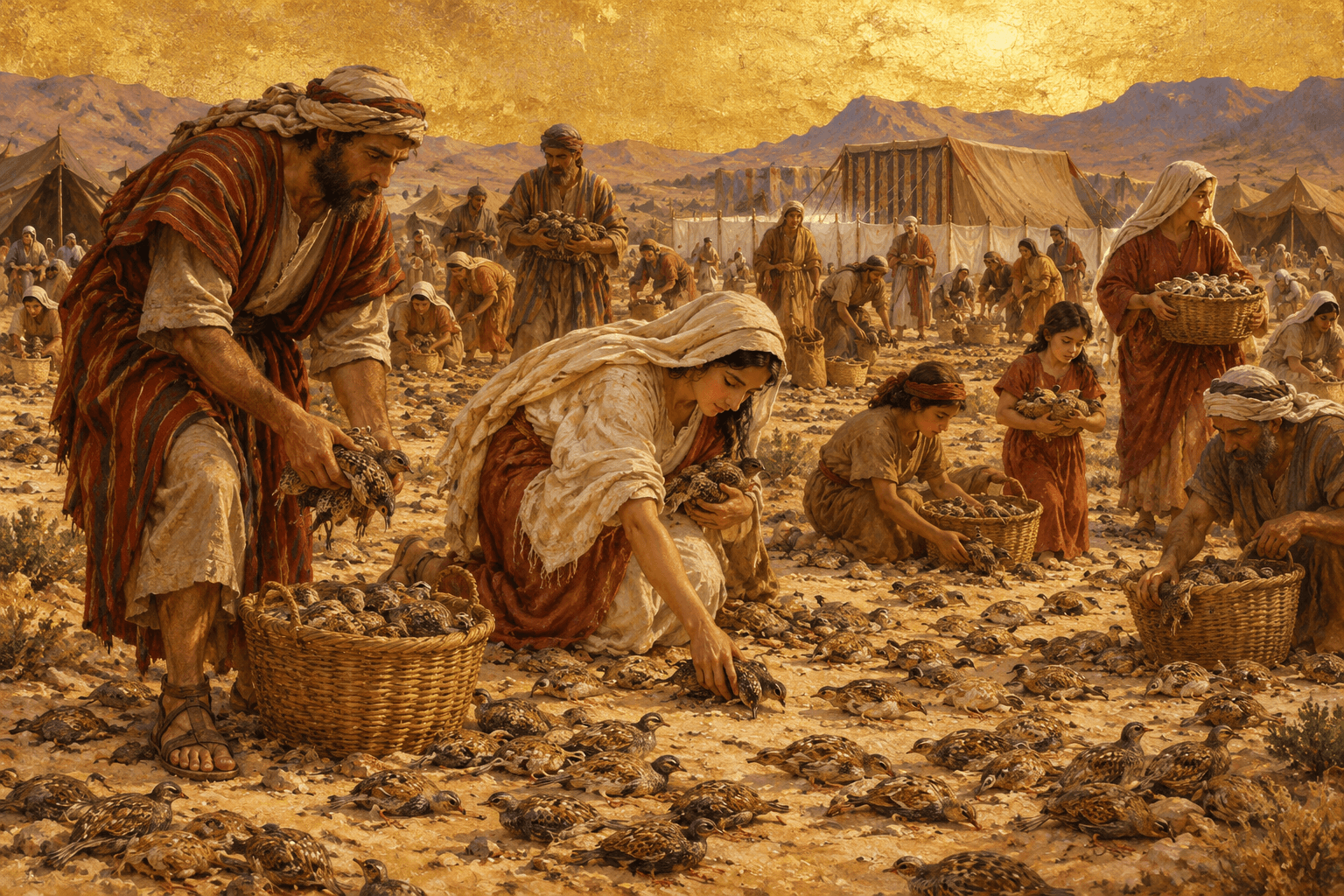
Moses the prophet found the matter hard when God commanded that the people sanctify themselves so that He might give them their heart’s desire, and they would eat flesh not one day, nor two days, nor five days, neither ten days, nor twenty days, but a whole month (19–20). If the number of footmen was about six hundred thousand, besides the women, the children and the Levites… so that their total reached about two million people, how could all these eat flesh in the wilderness for a whole month? Moses said: “Shall the flocks and the herds be slain for them, to suffice them? or shall all the fish of the sea be gathered together for them, to suffice them?” (22). It is as though he were saying that the matter would need the slaughter of all the cattle or the catching of all the fish of the sea… But the Lord answered him: “Is the LORD’S hand waxed short? thou shalt see now whether my word shall come to pass unto thee or not” (23). The Lord satisfied them with flesh, not by slaughtering cattle nor by catching fish, but He sent them a small bird, the “quail,” which He drove toward the camp by a wind. So God gives us more than we ask, beyond what we request, and in a way we do not expect, declaring that His hand is not shortened, saying: “Not by might, nor by power, but by my spirit, saith the LORD of hosts” (Zechariah 4:6).
Some see in God’s action that a man ought to satisfy all his child’s needs and deprive him of nothing, so that he will not lust after anything; for God satisfied the people and gave them more than they asked. But the opposite view holds that if a man grows used to a life of luxury in his childhood, he cannot give it up. [49]
God gave them flesh in abundance; and as they fell upon it greedily and with lust, the anger of the Lord was kindled against them and He smote them with a very great plague (33), not because they ate flesh, but because of the lust that had taken hold of them.
Before we end the chapter, let us mention Origen’s comment on the words of revelation: “And Moses went out, and told the people the words of the LORD” (24):
As long as Moses listens to the words of the Lord and receives the teachings, he is within, living in a more secret retreat; but when he speaks with the multitudes he cannot remain within, and Scripture says that he went out… I think Paul also did this. He was within when he said: “we speak wisdom among them that are perfect: yet not the wisdom of this world, nor of the princes of this world” (1 Corinthians 2:6). See how Paul was within, looking at the inner mysteries of divine wisdom while receiving these teachings. But when he goes out to the people, hear what he teaches: “Let no corrupt communication proceed out of your mouth” (Ephesians 4:29); “Let him that stole steal no more” (Ephesians 4:28), and so on. These words and those like them are the Apostle’s teachings, which he utters when he goes out to teach the people, as Moses the prophet did. [50]
Notes and References
[39] St. John Chrysostom, Homilies on the Statues 6.8.
[40] St. Jerome, Against Jovinianus 2.15.
[41] St. Jerome, Epistle 58.1.
[42] Origen, Homilies on Numbers 6.2.
[43] St. Augustine, On the Trinity 5.15.
[44] Origen, Homilies on Numbers 6.3.
[45] See St. Philoxenus, Quench Not the Spirit (Arabic translation and commentary by Dr. George Bebawi, June 1981).
[46] See the author, The Holy Spirit between the New Birth and Continual Renewal, 1981.
[47] St. Cyril of Jerusalem, Catechetical Lectures 16.26.
[48] Ibid. 16.25.
[49] St. Jerome, Epistle 128.2.
[50] Origen, Homilies on Numbers 6.1.