
God commanded Moses the prophet to make two trumpets of silver, to be used for calling the assembly, for the journeying of the camps, in war and at the feasts. The trumpets were the language in which the priests spoke, so that all would know what they should do. By certain notes the heads of the congregation knew that they were called to assemble, and by others the whole congregation knew that it was called to assemble. There was a particular note for the camp of Judah to begin to move, by which they also knew the direction of the march; a particular note for the camp of Reuben to move; and so on… The note for war was different from that for celebrating a feast.
1. The Two Silver Trumpets
KJV · Verses 1–10
1 And the Lord spake unto Moses, saying, 2 Make thee two trumpets of silver; of a whole piece shalt thou make them: that thou mayest use them for the calling of the assembly, and for the journeying of the camps. 3 And when they shall blow with them, all the assembly shall assemble themselves to thee at the door of the tabernacle of the congregation. 4 And if they blow but with one trumpet, then the princes, which are heads of the thousands of Israel, shall gather themselves unto thee. 5 When ye blow an alarm, then the camps that lie on the east parts shall go forward. 6 When ye blow an alarm the second time, then the camps that lie on the south side shall take their journey: they shall blow an alarm for their journeys. 7 But when the congregation is to be gathered together, ye shall blow, but ye shall not sound an alarm. 8 And the sons of Aaron, the priests, shall blow with the trumpets; and they shall be to you for an ordinance for ever throughout your generations. 9 And if ye go to war in your land against the enemy that oppresseth you, then ye shall blow an alarm with the trumpets; and ye shall be remembered before the Lord your God, and ye shall be saved from your enemies. 10 Also in the day of your gladness, and in your solemn days, and in the beginnings of your months, ye shall blow with the trumpets over your burnt offerings, and over the sacrifices of your peace offerings; that they may be to you for a memorial before your God: I am the Lord your God.
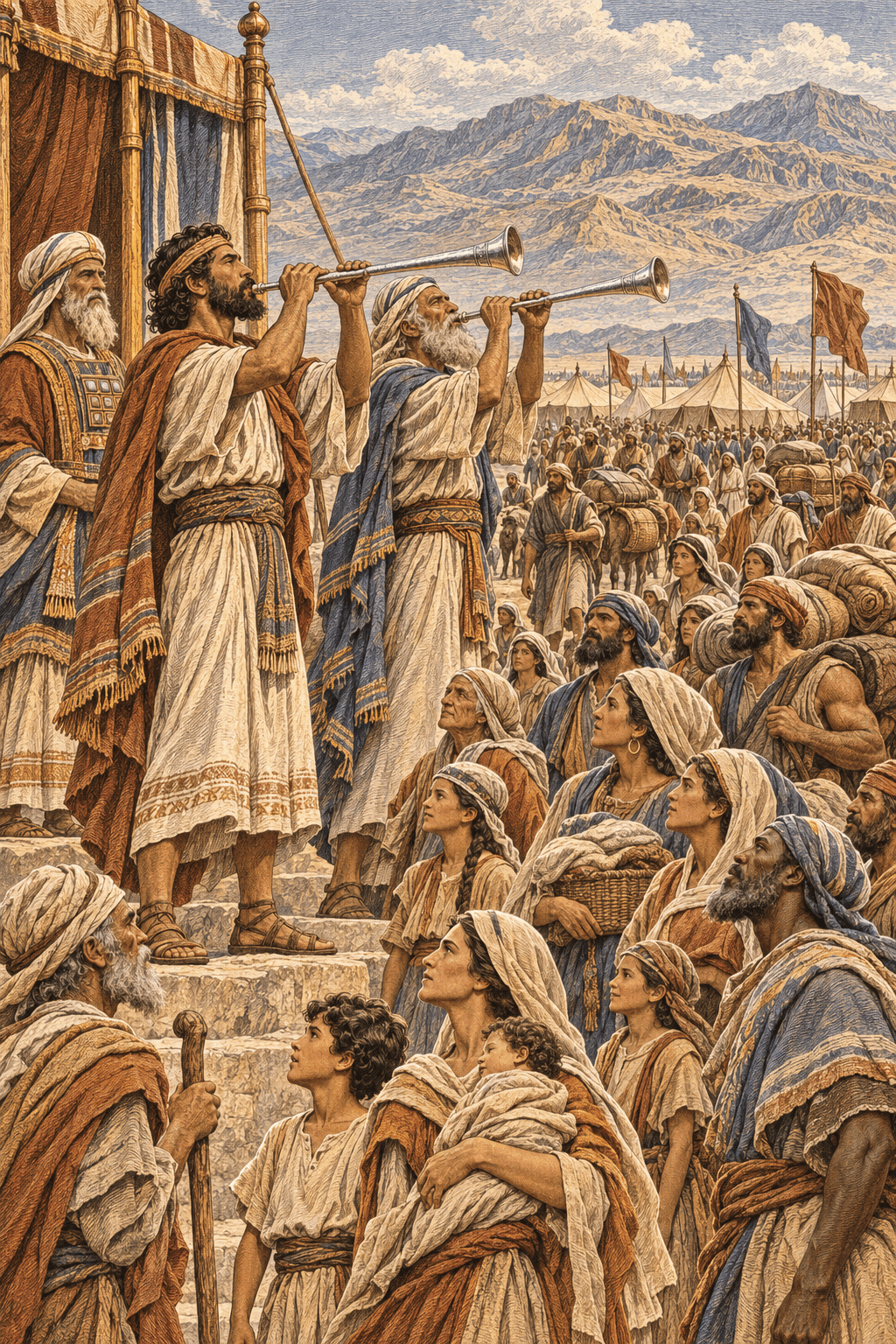
The trumpets were made of silver because silver points to the word of God, as the Psalmist says: “The words of the LORD are pure words: as silver tried in a furnace of earth, purified seven times” (Psalm 12:6). This is the language of the priests: to speak the word of God continually, urging God’s children to gather in the spirit of fellowship, or urging them to struggle as they journey through the wilderness of this world. It is the secret of their victory in their spiritual warfare, and the secret of their joy and the exultation of their heart in their feast, which continues without ceasing.
Saint Jerome speaks of these two trumpets, saying:
We read in the Book of Numbers of two kinds of trumpets: one a long trumpet of silver, and the other a horn (cornet). These two kinds appear in the words: “With trumpets and sound of cornet” (Psalm 98:6). Hear what they symbolize. The long silver trumpet is the word of God and His true promises, like refined silver, pure of dross, purified seven times (Psalm 12:6). The horn represents the word of God in all its authority, for in Holy Scripture the horn points to kingdom and authority, as it is written: “And hath raised up an horn of salvation for us” (Luke 1:69). [35]
Pope Athanasius the Apostolic speaks of the importance of the trumpets in the Old Testament, saying:
When any of you hears the Law commanding respect for the trumpets, let him not think this a trivial matter or of little importance; it is something wonderful and fearful. For trumpets stir up in a man watchfulness and awe more than any other sound or instrument. This method was used to teach them, since they were still children… And lest these proclamations be taken as merely human proclamations, their sounds were like those that took place on the mount (Exodus 19:16), when they trembled there; and then the Law was given to them to keep. [36]
Saint Ambrose made clear that blowing the trumpets, that is, the word of preaching the Gospel, belongs to the priests, saying:
Not everyone blows the trumpet or calls others to the holy assembly; this privilege was granted to the priests alone. The ministers of God blow the trumpets, so that whoever hears the sound and comes here, where the glory of the Lord is, and resolves to hasten early to the tabernacle of witness, may behold the divine works and be counted worthy of the divine places, which is the inheritance of all for his seed. [37]
In the New Testament the Church has used bells in place of trumpets; we have already spoken of them. [38]
2. The Journey of the People
KJV · Verses 11–28
11 And it came to pass on the twentieth day of the second month, in the second year, that the cloud was taken up from off the tabernacle of the testimony. 12 And the children of Israel took their journeys out of the wilderness of Sinai; and the cloud rested in the wilderness of Paran. 13 And they first took their journey according to the commandment of the Lordby the hand of Moses. 14 In the first place went the standard of the camp of the children of Judah according to their armies: and over his host was Nahshon the son of Amminadab. 15 And over the host of the tribe of the children of Issachar was Nethaneel the son of Zuar. 16 And over the host of the tribe of the children of Zebulun was Eliab the son of Helon. 17 And the tabernacle was taken down; and the sons of Gershon and the sons of Merari set forward, bearing the tabernacle. 18 And the standard of the camp of Reuben set forward according to their armies: and over his host was Elizur the son of Shedeur. 19 And over the host of the tribe of the children of Simeon was Shelumiel the son of Zurishaddai. 20 And over the host of the tribe of the children of Gad was Eliasaph the son of Deuel. 21 And the Kohathites set forward, bearing the sanctuary: and the other did set up the tabernacle against they came. 22 And the standard of the camp of the children of Ephraim set forward according to their armies: and over his host was Elishama the son of Ammihud. 23 And over the host of the tribe of the children of Manasseh was Gamaliel the son of Pedahzur. 24 And over the host of the tribe of the children of Benjamin was Abidan the son of Gideoni. 25 And the standard of the camp of the children of Dan set forward, which was the rereward of all the camps throughout their hosts: and over his host was Ahiezer the son of Ammishaddai. 26 And over the host of the tribe of the children of Asher was Pagiel the son of Ocran. 27 And over the host of the tribe of the children of Naphtali was Ahira the son of Enan. 28 Thus were the journeyings of the children of Israel according to their armies, when they set forward.
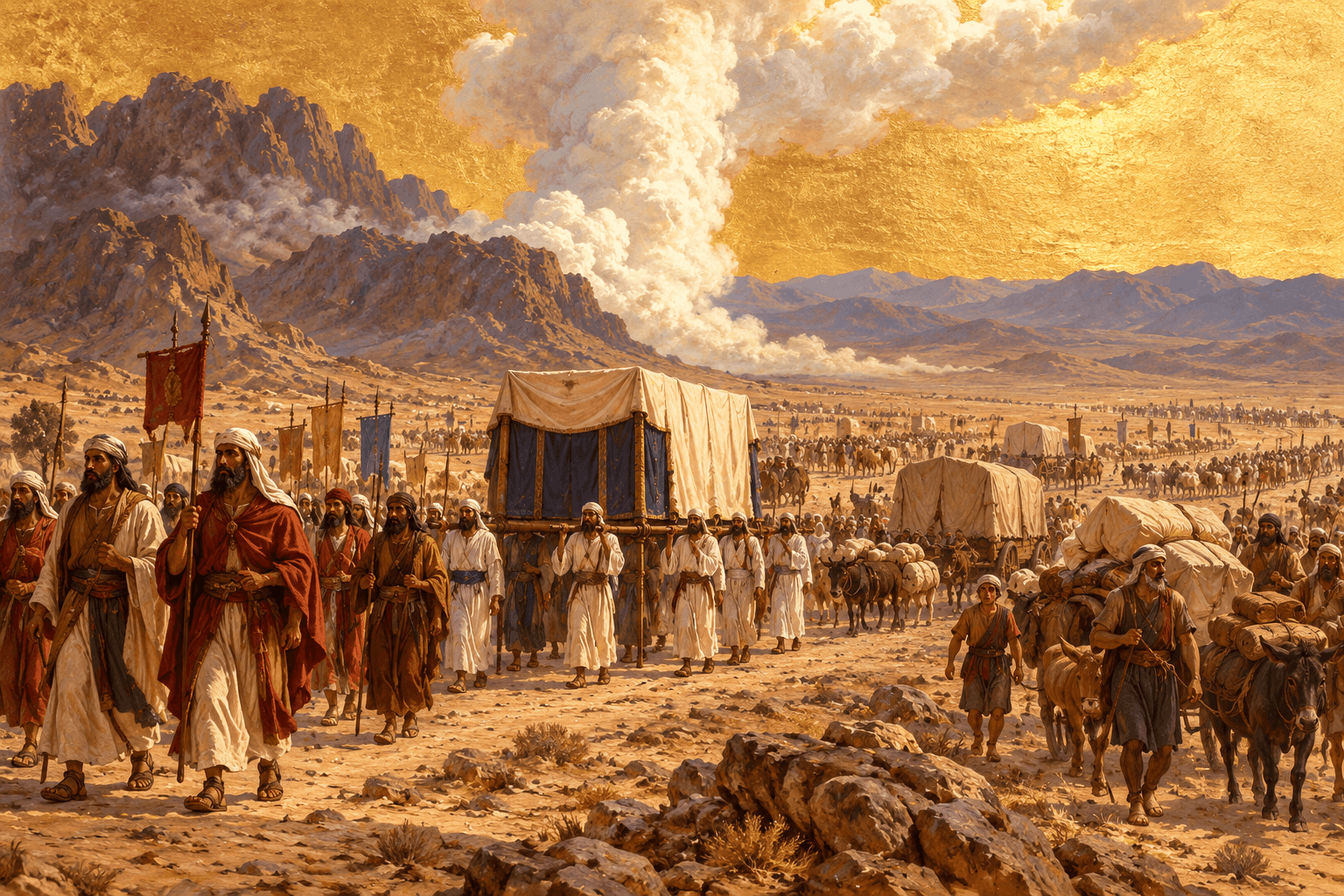
From Sinai to Moab (Numbers 10:11–21:35). The journey began from Mount Sinai after God had spoken with His servant Moses, handed him the Law, and commanded him to set up the tabernacle with its furnishings, especially the ark of the covenant, which came to represent the divine presence.
Divine revelation gives us a sample of God’s leading of His people during the journey. The cloud was taken up from the tabernacle and moved toward the wilderness of Paran, and the priests blew the trumpet (the trumpet for the journeying of the camps is mentioned in this same chapter, Numbers 10:2), so that the procession began as the Lord commanded, in precise order. The whole church set out in the shape of a cross, as we said before. It began with the standard of the camp of Judah, which consisted of three tribes, each tribe led by its prince; then the camp of Reuben; then the Levites journeyed in the middle; then the camp of Ephraim; and last of all the camp of Dan.
3. The Invitation to Moses’ Father-in-law to Join Them
KJV · Verses 29–32
29 And Moses said unto Hobab, the son of Raguel the Midianite, Moses' father in law, We are journeying unto the place of which the Lord said, I will give it you: come thou with us, and we will do thee good: for the Lord hath spoken good concerning Israel. 30 And he said unto him, I will not go; but I will depart to mine own land, and to my kindred. 31 And he said, Leave us not, I pray thee; forasmuch as thou knowest how we are to encamp in the wilderness, and thou mayest be to us instead of eyes. 32 And it shall be, if thou go with us, yea, it shall be, that what goodness the Lordshall do unto us, the same will we do unto thee.
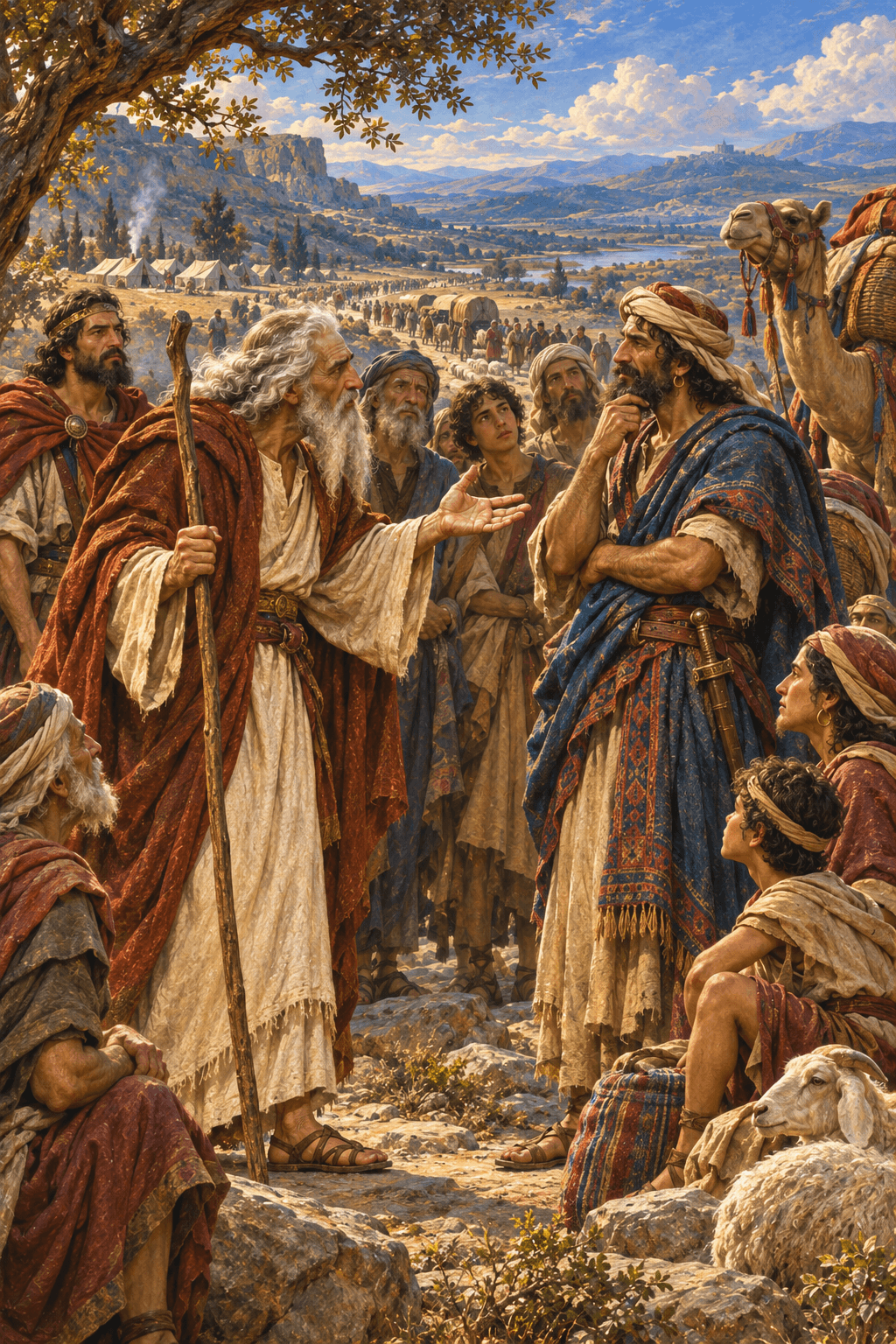
Moses the prophet rejoiced in this procession, full of joy and heading toward the promised land. In his joy he invited Hobab the son of Raguel the Midianite, his father-in-law, who is Jethro himself; though some hold that he was his son, because Jethro had been obliged to return on account of his old age (Exodus 18:27).
Moses said to Hobab: “We are journeying unto the place of which the LORD said, I will give it you: come thou with us, and we will do thee good: for the LORD hath spoken good concerning Israel… Leave us not, I pray thee; forasmuch as thou knowest how we are to encamp in the wilderness, and thou mayest be to us instead of eyes” (29–31). The opening of Moses’ heart, so that this man of a foreign race might share in what the Lord had promised His people, was a sign of the acceptance of the Gentiles into the Church of the New Testament, to enjoy God’s promises.
We hear no answer from Hobab after Moses repeated the invitation to him. Perhaps his silence means that he agreed and accepted the invitation, for we hear of members of the family of Moses’ father-in-law in Canaan (Judges 1:16; 1 Samuel 15:6).
This invitation of Moses carried prophecy, breadth of heart and love; but it also carried a kind of weakness, for there was in it a courtesy toward his relatives according to the flesh, something that is hard to remove from human beings, even if they are prophets. They are affected by personal factors. Truly, how hard it is for churchmen, however high their priestly rank or spiritual stature, to give up the personal factor entirely in their life and service. But I want to record here that Moses the prophet, in many situations, was free from any influence of personal factors or family relationships, as we shall see in this study.
On the other hand, despite the divine assurances to Moses that it is God who leads His people and supports them at every step, he says to Hobab: “Leave us not, I pray thee; forasmuch as thou knowest how we are to encamp in the wilderness, and thou mayest be to us instead of eyes” (31)… He wanted him to be eyes for them in the wilderness, though it was God who was leading them!
4. The Ark of the Covenant Goes Before Them
KJV · Verses 33–36
33 And they departed from the mount of the Lord three days' journey: and the ark of the covenant of the Lord went before them in the three days' journey, to search out a resting place for them. 34 And the cloud of the Lord was upon them by day, when they went out of the camp. 35 And it came to pass, when the ark set forward, that Moses said, Rise up, Lord, and let thine enemies be scattered; and let them that hate thee flee before thee. 36 And when it rested, he said, Return, O Lord, unto the many thousands of Israel.
At the beginning of the journey they went three successive days; for we cannot set out in the wilderness from Mount Sinai toward the promised land unless we carry within us the power of the Lord’s resurrection, since the number 3, as we saw in the commentary on the Book of Exodus, points to the resurrection. Without the resurrection the journey is violent, harsh, very bitter and even impossible; but with the Lord’s resurrection its labours are turned into gladness and its pains become a source of comfort.
Here, for the first time, the role of the ark of the covenant stands out as the representative of the divine presence going before the procession (33). This was not a going before in place, for it was in the middle of the congregation; nor in time, for the Kohathites moved with it in the third position, after the camp of Judah and the camp of Reuben. It moved with an invisible movement, as a hidden Leader and the secret of the strength and sanctification of the journey.
Wonderfully, revelation records for us: “And it came to pass, when the ark set forward, that Moses said, Rise up, LORD, and let thine enemies be scattered; and let them that hate thee flee before thee” (35). Perhaps Moses saw in the setting forward of the ark the power of the Lord’s resurrection, since it moved after Judah and Reuben, that is, in the third movement after the two camps: he saw the Lord risen on the third day, scattering the powers of Satan, of sin and of the kingdom of darkness. And if we regard each camp with its three tribes as moving in three movements, then the place of the ark is the eighth (the tribes of the camp of Judah, 3; the tribes of the camp of Reuben, 3; Moses, Aaron and the priests, 1; the Kohathites bearing the ark of the covenant, 1). And Christ the Lord rose on the eighth day of the previous week, or the first day of the new week.
The Church has taken up this prayer to use at the end of the Litany of the Assemblies, as though the secret of the blessing of the people and of the assemblies is the resurrection of Christ the Lord, the Conqueror of death and evil!
Notes and References
[35] St. Jerome, Homilies on the Psalms 25.
[36] St. Athanasius, Festal Letters 1.2.
[37] St. Ambrose, On Belief in the Resurrection 2.111.
[38] The author, The Church, the House of God, 1969, pp. 415–418.