
Having given the previous laws touching the life of the whole congregation, people and priests, He now gives laws special to the priests, so that they may practice the holy life that befits them as priests of the Holy Lord (6), who offer Him the offerings (6–8), and as spiritual leaders (8); for the greater the responsibility, the more exact the life a person is bound to.
1. The Priests and Cases of Death
KJV · Verses 1–6
1 And the Lord said unto Moses, Speak unto the priests the sons of Aaron, and say unto them, There shall none be defiled for the dead among his people: 2 But for his kin, that is near unto him, that is, for his mother, and for his father, and for his son, and for his daughter, and for his brother. 3 And for his sister a virgin, that is nigh unto him, which hath had no husband; for her may he be defiled. 4 But he shall not defile himself, being a chief man among his people, to profane himself. 5 They shall not make baldness upon their head, neither shall they shave off the corner of their beard, nor make any cuttings in their flesh. 6 They shall be holy unto their God, and not profane the name of their God: for the offerings of the Lord made by fire, and the bread of their God, they do offer: therefore they shall be holy.
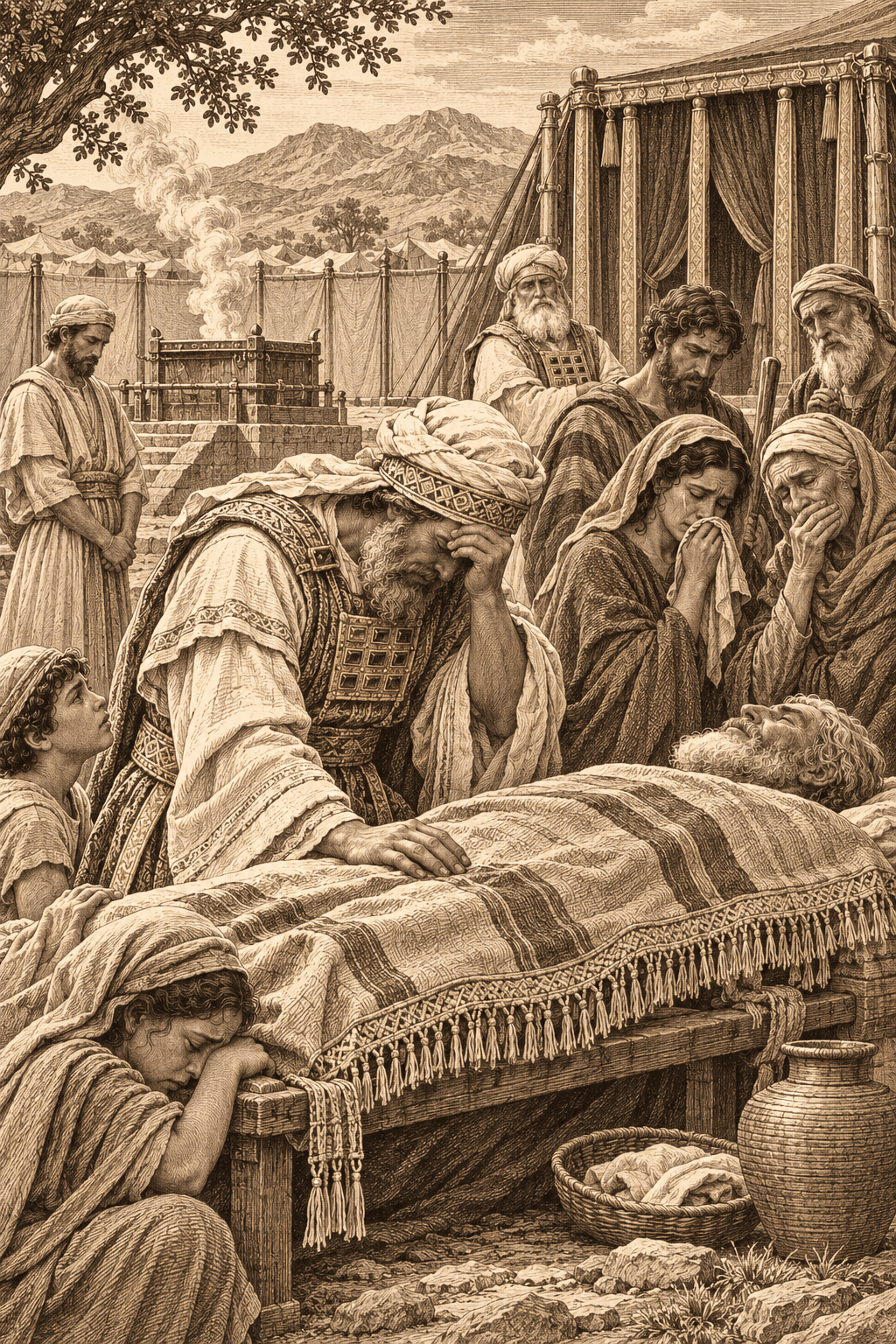
It befits the priest, having received fatherhood in Christ Jesus, to rise above special human feelings and see in all his children, brothers, and beloved ones without distinction. As Saint John Chrysostom says:
Since the priest is the steward of God, he must care for all men, as a father of the whole world. [263]
Through this general fatherhood even the law of the Old Testament asked him not to grieve over the death of one of his relatives and be defiled “for the dead among his people” (1), except for father, mother, son, daughter, brother, and an unmarried sister (2–3).
The Lord of glory gave this law with an evangelical mind when He said: “Let the dead bury their dead” (Matthew 8:22; Luke 9:60), for the servant should not be troubled even by these family duties for the sake of his service to the whole congregation. As Tertullian says: “He consecrates himself to God… I think it befits the Nazarite and the one who has received the office of the priesthood to be inspired to preach the kingdom of God…” [264]
According to the Mosaic Law the priest does not touch any dead person of his relatives except the closest ones we mentioned; and even in his grief over these he should not practice the pagan customs forbidden even to the people, such as shaving the hair of the head to make himself bald, shaving off the corner of the beard, and cutting the flesh. If these things do not befit the people, how much more the priest who offers the offerings of the Lord made by fire (6) and serves the holy things!
2. The Priests and Marriage
KJV · Verses 7–8
7 They shall not take a wife that is a whore, or profane; neither shall they take a woman put away from her husband: for he is holy unto his God. 8 Thou shalt sanctify him therefore; for he offereth the bread of thy God: he shall be holy unto thee: for I the Lord, which sanctify you, am holy.
According to the Mosaic Law the priest may not marry a harlot, even if she repented, nor a profane woman nor a divorced woman… so that he and his wife may be blameless in the eyes of God and people, being a good example for the people. The high priest may not even marry a widow but marries a virgin, for he points to the Lord Christ, the great High Priest, who has acquired the Church as a chaste virgin for Himself (2 Corinthians 11:2).
3. The Fall of a Priest’s Daughter
KJV · Verses 9
9 And the daughter of any priest, if she profane herself by playing the whore, she profaneth her father: she shall be burnt with fire.
Since the priest receives many divine graces, he, his wife, and his children must be blameless; every wrong one of them commits is punished with a harsher sentence than an ordinary person falls under. As Saint Cyril of Alexandria says: “In the case of the priest’s family the punishment is increased, ‘For unto whomsoever much is given, of him shall be much required’ (Luke 12:48).” [265]
4. Laws Special to the High Priest
KJV · Verses 10–15
10 And he that is the high priest among his brethren, upon whose head the anointing oil was poured, and that is consecrated to put on the garments, shall not uncover his head, nor rend his clothes; 11 Neither shall he go in to any dead body, nor defile himself for his father, or for his mother; 12 Neither shall he go out of the sanctuary, nor profane the sanctuary of his God; for the crown of the anointing oil of his God is upon him: I am the Lord. 13 And he shall take a wife in her virginity. 14 A widow, or a divorced woman, or profane, or an harlot, these shall he not take: but he shall take a virgin of his own people to wife. 15 Neither shall he profane his seed among his people: for I the Lord do sanctify him.
The high priest, or “the high priest among his brethren” as He calls him here (10), since he symbolizes the Lord Christ, our great High Priest, was subject to laws special to him, among them:
A) “And he that is the high priest among his brethren, upon whose head the anointing oil was poured, and that is consecrated to put on the garments, shall not uncover his head, nor rend his clothes” (10).
He may not uncover his head, anointed with the anointing oil, for the anointed head points to the Lord Christ (see the interpretation of Leviticus 2). It is as if, having received Christ Jesus within us, we hide Him in our depths, saying: “I held him, and would not let him go, until I had brought him into my mother’s house, and into the chamber of her that conceived me” (Song of Solomon 3:4). It is the garden that bears within it its Christ, the tree of life, the fountain filled with the waters of life, the fountain that does not run dry, because the Lord of glory is within it! Let our Bridegroom be within us as in “a garden inclosed… a spring shut up, a fountain sealed” (Song of Solomon 4:12)… we rejoice in Him, are united with Him, and share His inner glories!
As for not rending the garments, the garment points to the Church, with which the Lord Christ clothes Himself. Let the Church remain one without schism, for her Bridegroom is one!
B) “Neither shall he go in to any dead body, nor defile himself for his father, or for his mother” (11). He means that he does not touch a dead person even if it is his father or mother… Since he is a symbol of the Lord Christ, as the Giver of life he has no share with death; if He touches the dead, death cannot bear His touch but flees…!
So the Apostle Paul, bearing within him the Lord Christ, who has no fellowship with death or Hades, said boldly: “O death, where is thy sting? O grave, where is thy victory? The sting of death is sin; and the strength of sin is the law. But thanks be to God, which giveth us the victory through our Lord Jesus Christ” (1 Corinthians 15:55–57).
C) “Neither shall he go out of the sanctuary, nor profane the sanctuary of his God; for the crown of the anointing oil of his God is upon him” (12). He means that while he is performing his service in the house of God he may not go out of the tabernacle of the congregation nor stop the work for any reason, even if the nearest of his kin dies; for his leaving the service is counted a contempt of this holy work and a despising of the glory with which the anointing on his head adorned him.
Saint Jerome comments on this law:
Surely, as we believe in Christ, we carry Him within us; and because of the anointing oil we have received, we must not leave the temple, that is, not abandon our Christian work, nor go outside and be entangled in the works of the unbelieving Gentiles, but remain always within as servants obedient to the will of the Lord. [266]
Saint John Chrysostom [267] sees in this law a living picture of the believer’s heart, which becomes holy to God and His dwelling (compare 1 Corinthians 6:19), so that no human works are practiced in it, but what is divine. So every word that comes from his mouth comes from God; no unclean word comes out of him, and he does not delight in jesting and much laughter. In other words, as we are justified by our Lord Jesus Christ, we become a dwelling for the High Priest, who does not leave us, for we are His sanctuary, and our conduct is His conduct in us and through us.
In the same sense Abba Nesteros says: “This means that He (the Lord Christ) does not go out of his heart, for He promised to dwell in it forever…” [268]
D) “And he shall take a wife in her virginity” (13). It is required that his wife be a virgin of his own people (14). Some interpreters have concluded that the high priest was bound to be the husband of one wife, taking her as a virgin. This woman is a firstborn, as the Apostle says: “the church of the firstborn, which are written in heaven” (Hebrews 12:23). She is of his own people and not a foreigner, for in the waters of baptism we have become the body of Christ; we are not foreigners to Him, but members of His body, and He has given us His Holy Spirit dwelling in us!
5. The Priests and Bodily Blemishes
KJV · Verses 16–24
16 And the Lord spake unto Moses, saying, 17 Speak unto Aaron, saying, Whosoever he be of thy seed in their generations that hath any blemish, let him not approach to offer the bread of his God. 18 For whatsoever man he be that hath a blemish, he shall not approach: a blind man, or a lame, or he that hath a flat nose, or any thing superfluous, 19 Or a man that is brokenfooted, or brokenhanded, 20 Or crookbackt, or a dwarf, or that hath a blemish in his eye, or be scurvy, or scabbed, or hath his stones broken; 21 No man that hath a blemish of the seed of Aaron the priest shall come nigh to offer the offerings of the Lord made by fire: he hath a blemish; he shall not come nigh to offer the bread of his God. 22 He shall eat the bread of his God, both of the most holy, and of the holy. 23 Only he shall not go in unto the vail, nor come nigh unto the altar, because he hath a blemish; that he profane not my sanctuaries: for I the Lord do sanctify them. 24 And Moses told it unto Aaron, and to his sons, and unto all the children of Israel.
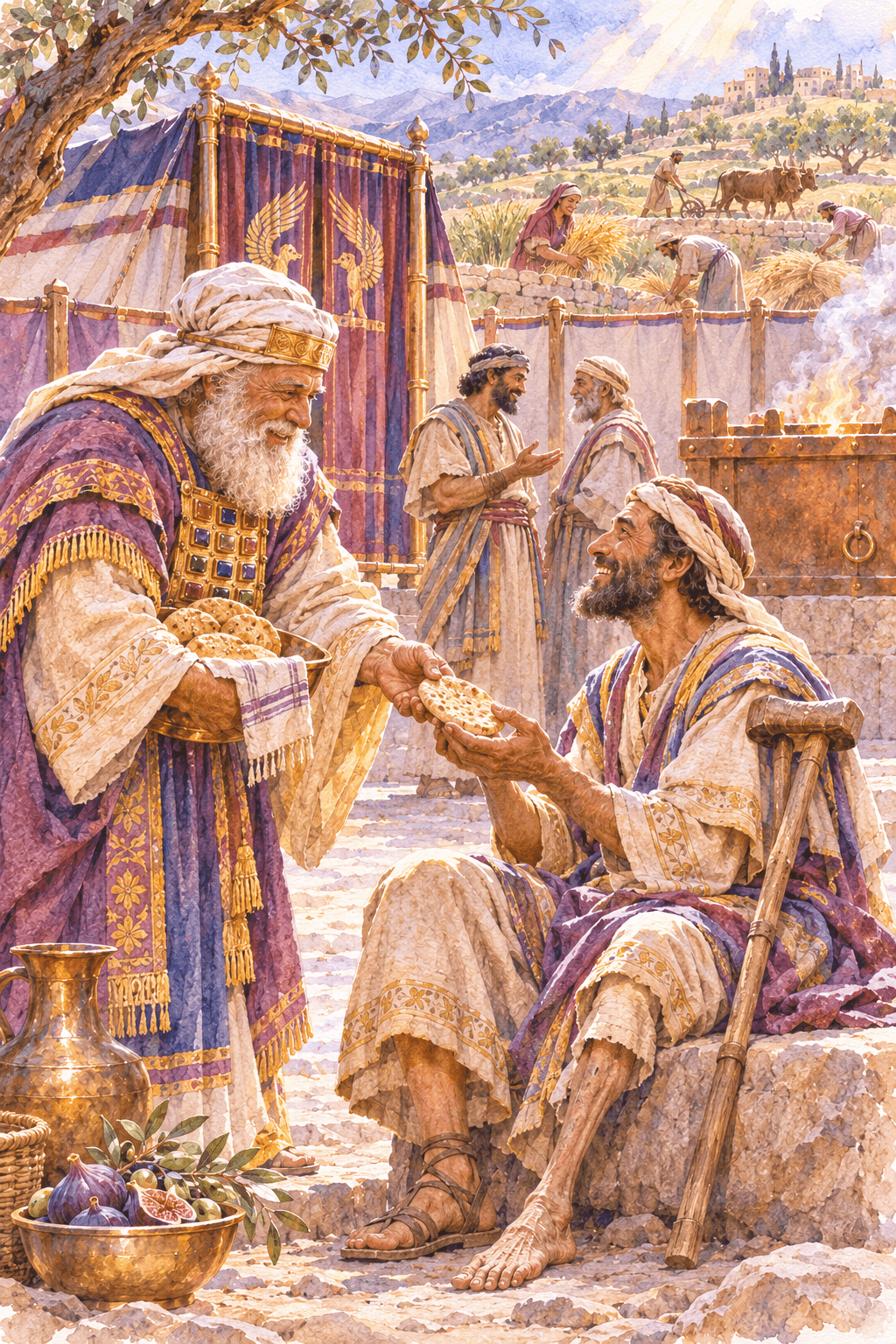
The Law required that the priest who practices the priestly works, such as offering the sacrifice and the incense, have no blemish: he may not be blind or lame, nor have a flat nose or anything superfluous, nor be crookbacked or a dwarf, nor have a blemish in his eye, nor be scurvy or scabbed, nor have his stones broken (18–20). So when the sons of the priests reached the lawful age to take up the priestly work, the elders, members of the council of the Sanhedrin, examined them and set apart those without blemish for the full priestly work; whoever had a blemish did some simple priestly works, such as kindling the fire, and so on.
In the New Testament Paul the Apostle required that the bishop be blameless (1 Timothy 3:2) and have a good report of them which are without (1 Timothy 3:7). Pope Gregory the Great saw in the law before us a symbolic understanding of the conditions of the priest: one must not accept the spiritually blind, lame, flat-nosed… Here are extracts from his words in his discourse on “Pastoral Care”:
The blind is he who does not know the light of heavenly contemplation. He whom the darkness of the present world has overtaken cannot perceive the light to come, because he does not long for it; so he does not know how to step or where he is going. Therefore Hannah the prophetess said: “He will keep the feet of his saints, and the wicked shall be silent in darkness” (1 Samuel 2:9).
The lame is he who truly knows the way but cannot walk in it steadily because of his sick soul; since he cannot rise by his ugly habits to the level of virtue, he lacks the strength to walk according to his will. So Saint Paul the Apostle said: “Wherefore lift up the hands which hang down, and the feeble knees; And make straight paths for your feet, lest that which is lame be turned out of the way; but let it rather be healed” (Hebrews 12:12–13).
The flat-nosed is he who is unable to discern. By the sense of smell we distinguish sweet odors from foul ones; this sense truly points to the sense of discernment by which we choose virtue and reject vice. So it was said in praise of the Church, the bride: “Thy nose is as the tower of Lebanon” (Song of Solomon 7:4). The holy Church perceives fully by discernment the temptations raised against her for various reasons, and knows beforehand, from the top of her tower, the battles of evil about to occur.
Anything superfluous… Some people are always busy with curious questions more than is needed; they do not confess that they are foolish, but trust themselves excessively. So Scripture added: “or any thing superfluous.” Clearly the large, bent nose expresses an excess of discernment, and this excess mars the perfection and beauty of this sense.
The man that is brokenfooted or brokenhanded is he who cannot at all walk in the way of God, having been completely stripped of a share in good works. In this he differs from the lame, who can share in good works, though with difficulty; but the broken one has been completely stripped of them.
The crookbacked is he who groans under the weight of worldly cares, so that he cannot lift his eyes to what is above, but fixes them on the footstool, where the lowest things are. If he hears glad news of the dwelling of the heavenly Father, under the weight of his evil habits he cannot lift up the face of his heart, nor even rise in his thought, which worldly cares have bound to the earth. Of this man the Psalmist David says: “I am troubled; I am bowed down greatly” (Psalm 38:6). And God incarnate says of such, rejecting their iniquities: “And that which fell among thorns are they, which, when they have heard, go forth, and are choked with cares and riches and pleasures of this life, and bring no fruit to perfection” (Luke 8:14).
The one with a blemish in his eye is he whose natural sight shines with the knowledge of the truth, but his eyes have been darkened by carnal works. In the bleared eye the pupil is sound, but the eyelids weaken and swell because of the discharges and wither because of the flow of tears, so that the pupil of the eye is weakened. Some weaken their insight by the carnal life; they had the ability to discern the good, but their insight was darkened by their habit of doing iniquity. To such the angel says: “anoint thine eyes with eyesalve, that thou mayest see” (Revelation 3:18). If we anoint our eyes with eyesalve to see, we strengthen the eyes of our understanding with the medicines of good works, to see the brightness of the true light.
The one with a white spot in his eye is he who is deprived of beholding the true light because of his blindness, driven by the claim of wisdom and goodness. The pupil of the eye sees if it is black; but if there is white in it, it sees nothing. Clearly, when a person realizes that he is foolish and sinful, he understands with the powers of his mind how bright the inner light is; but when he attributes to himself the shining of wisdom and goodness, he shuts out from himself the surpassing light of knowledge, and in the pride of his self-glory he strives in vain to perceive the brightness of the divine light, for it is said of some: “Professing themselves to be wise, they became fools” (Romans 1:22).
The scurvy is he who is always ruled by the wantonness of the flesh. In scurvy the inner heat spreads out on the skin; this condition represents lust exactly. So when the enticement of the heart is translated into deeds, we can say that the inner heat breaks out as scurvy breaks out on the skin, and the visible harm to the body corresponds to this reality. For lust, if it is not subdued in thought, rules in deed. So Paul was concerned to cleanse it as though it were scurvy on the skin, saying: “There hath no temptation taken you but such as is common to man” (1 Corinthians 10:13). It is as if he wants to make clear that as humans we must suffer temptations of thought; but if they overcome us in the midst of our war with them and settle in our hearts, this is from Satan.
The scabbed is he whose mind covetousness has spoiled. If this covetousness is not controlled in small things, it will rule over his whole life. The scab invades the body but causes no pain; it spreads over the sick person without troubling him, but mars the beauty of the members. So covetousness, while it fills its victim’s mind with pleasure, defiles it; and as it sets before the mind things to acquire, it stirs it to hatred and enmity. It causes no pain because it promises the sick soul many abundant things as the price of sin. The beauty of the members is marred because greed mars the beauty of virtue; the whole body is truly corrupted when vices fill a person’s soul. So Saint Paul rightly says: “For the love of money is the root of all evil” (1 Timothy 6:10).
The one with broken stones, though he does not commit uncleanness, groans under the yoke of constant, excessive thinking about it; and though he has never been defiled in deed, his heart is enchanted with the play of lust without any prick of conscience. This disease happens when an inner fluid enters the testicle, causing discomfort and an ugly swelling. So the one with broken stones is he who gives free rein to his thought in the things that stir lust, and so carries in his heart a base burden which his soul cannot throw off; and at the same time he lacks the strength to rise to the open practice of good works, for he groans under the weight of his hidden shameful deeds. So let everyone who has one of the blemishes mentioned refrain from offering the bread of the Lord; for no one can atone for the sins of others as long as his own defects rule over him. [269]
Notes and References
[263] Fr. Tadros Yacoub Malaty, Pastoral Love, 1965, p. 312.
[264] Tertullian, Against Marcion 4:23.
[265] Printed as “Strom. 2:23” (a work of Clement of Alexandria), though the source attributes the saying to St. Cyril of Alexandria.
[266] St. Jerome, Ep. 39:4.
[267] St. John Chrysostom, In 2 Cor. hom. 2:8.
[268] St. John Cassian, Conferences 14:10.
[269] St. Gregory the Great, Pastoral Care (Arabic trans. George Fahmy Hanna), Church of St. George, Sporting.