
When God entered into a covenant with His people, He gave them His holy house, the tabernacle of the congregation or the temple, as a holy place where the people gathered at the feasts declaring their joy in the Holy God dwelling among them. To it everyone who fell into sin or uncleanness resorted, to find in it a fountain of cleansing.
After speaking of clean and unclean foods, He gave the laws of purification, beginning with the purification of a woman who has given birth. Though children are a divine gift, man’s life was corrupted by sin through the first disobedience; so there came to be a need to purify the woman who gives birth, as there is a need to purify one who touches the dead. It is as if man has been bound to uncleanness in his birth as in his death, and needs the new birth and death with the crucified Lord to live holy to Him.
1. The Uncleanness of the Mother
KJV · Verses 1–5
1 And the Lord spake unto Moses, saying, 2 Speak unto the children of Israel, saying, If a woman have conceived seed, and born a man child: then she shall be unclean seven days; according to the days of the separation for her infirmity shall she be unclean. 3 And in the eighth day the flesh of his foreskin shall be circumcised. 4 And she shall then continue in the blood of her purifying three and thirty days; she shall touch no hallowed thing, nor come into the sanctuary, until the days of her purifying be fulfilled. 5 But if she bear a maid child, then she shall be unclean two weeks, as in her separation: and she shall continue in the blood of her purifying threescore and six days.
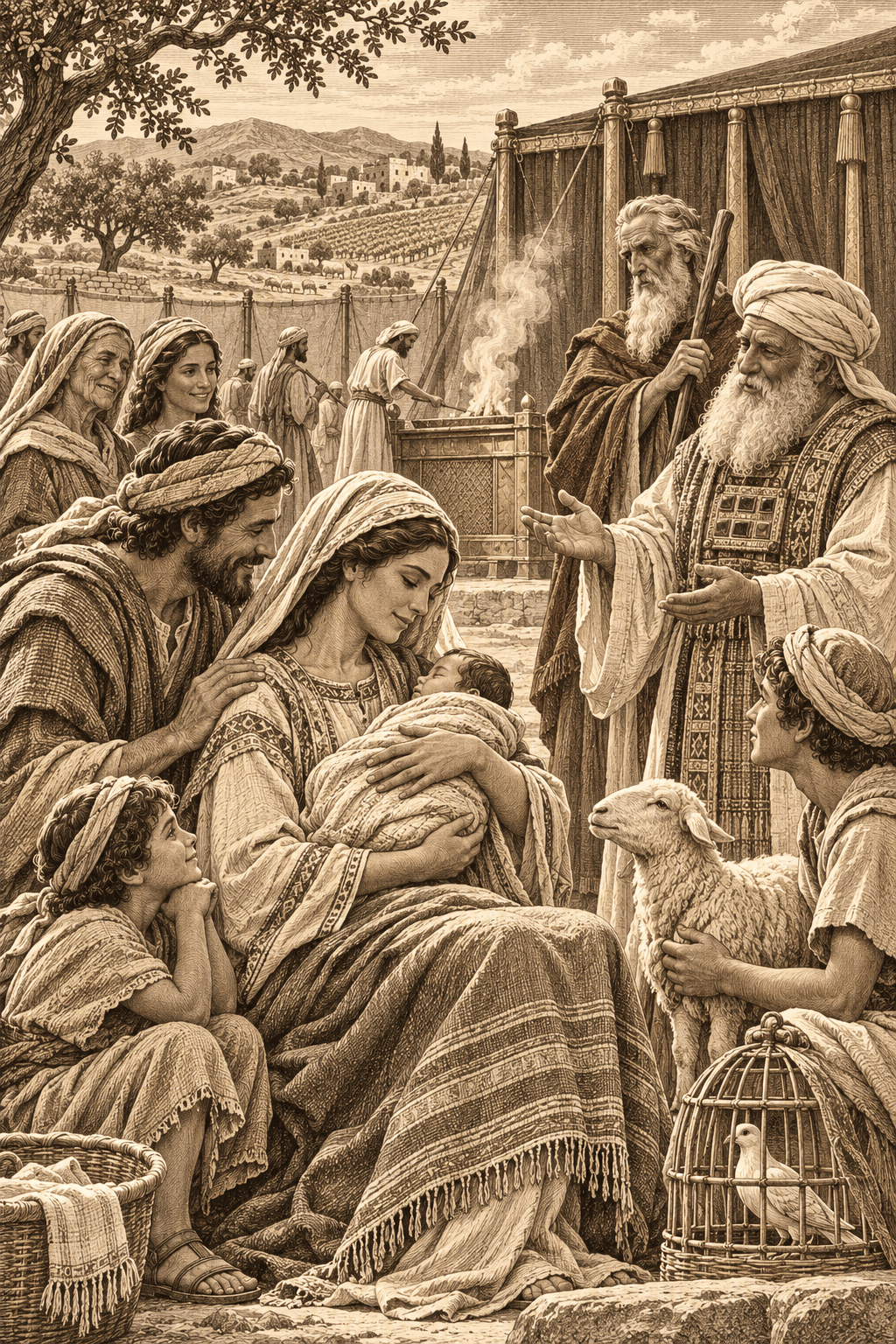
According to the Mosaic Law a woman was counted unclean seven days if she bore a male, until the child was circumcised on the eighth day, and two weeks if she bore a female, being “according to the days of the separation for her infirmity” (2), that is, counted as one in her monthly sickness. It is called “her infirmity” because of the toils and pains that accompany childbirth. She continued thirty-three days in the blood of her purifying if the child was a male, and sixty-six days if it was a female, then offered a burnt offering with a sin offering after forty days if the child was a male, or eighty days if it was a female, to make atonement for the mother.
Why was the woman who had just given birth counted unclean according to the Mosaic Law?
A) Because she issues blood after childbirth, and the Law counts every body that has an issue, whether man or woman, as unclean (Leviticus 15). This is not because blood in itself is uncleanness, but so that the person stops all work and cares for his health until he is fully healed. Origen sees in this law, as in the law of the cleansing of the leper, that God appears to His people as a Physician caring for their healing, giving us a medicine not from the juice of herbs, as the physicians did in that time, but giving us a deep spiritual understanding of His divine words for the healing of our souls. He says:
Jesus the heavenly Physician comes into this congregation, which is the Church, to look on the company of the sick lying there. He sees here a woman who has become unclean through childbirth, and sees there a leper put outside the camp because of the uncleanness of his leprosy, seeking healing and cleansing. Since Jesus is the Physician, being the Word of God, He gives the sick a remedy not extracted from herbs, but gives the hidden meaning of His words. Truly we look at the remedy found in the Holy Scriptures as in the fields with negligence, not realizing the power of these texts, and we despise them as though they were worthless and useless. But a few know Christ as the Physician of souls; each of them gathers from these books read in the Church, as from the plains and mountains, the herbs of salvation, and learns the meaning of the words, so that when the soul is struck with languor it is healed by the power of these great herbs and their inner juice. [162]
B) God created man, blessed him, and gave him to be fruitful, multiply, and fill the earth (Genesis 1:28); but by his disobedience man fell under the penalty, so childbirth came to be accompanied by pains and toils, though it is a blessing from the Lord. Perhaps this law, declaring the uncleanness of the woman who gives birth, draws attention, amid the joy over the newborn, to the sin that has crept into us from father to son. So the Psalmist cries out: “Behold, I was shapen in iniquity; and in sin did my mother conceive me” (Psalm 51:5). As Eliphaz the Temanite said to righteous Job: “What is man, that he should be clean? and he which is born of a woman, that he should be righteous?” (Job 15:14). And the Apostle Paul says plainly: “Wherefore, as by one man sin entered into the world, and death by sin; and so death passed upon all men, for that all have sinned” (Romans 5:12); and: “[We] were by nature the children of wrath” (Ephesians 2:3).
C) Perhaps by this law He wanted to affirm that the mother is not counted clean until she offers a blood sacrifice… a symbol of the need for the blood of the Lord Christ, which cleanses from all sin (1 John 1:7), so that every newborn may enjoy belonging to the holy congregation in the Lord, the new Israel.
D) God wanted to declare the holiness of His people, so He commanded them to keep away from everything that mars the purity of soul or body, so that outward purity might be a true mirror reflecting inward purity.
To return to the woman who conceives and bears a male child: she remains forty days to complete the days of her purifying. Seven days she is counted unclean, the child being circumcised on the eighth day, and she remains thirty-three days in the blood of her purifying.
As for the circumcision of the male on the eighth day, we have already spoken of it in our study of the Book of Genesis (chapter 17). Circumcision was known among some peoples as a work of purification, so it is called in Arabic tuhur, “purification.”
Origen notes that the Greek text in the Septuagint is “If a woman have conceived seed, and born,” to distinguish between women who give birth through the seed of man and the Virgin, who conceived without the seed of man. Women bear the weight of the Law; but the Virgin came as an exception, giving birth without conceiving by the seed of man. She bore Him who accepted to bow under the Law to redeem those under the Law, as the Apostle says: “But when the fulness of the time was come, God sent forth his Son, made of a woman, made under the law, To redeem them that were under the law, that we might receive the adoption of sons” (Galatians 4:4–5).
Calling the Virgin Mary “a woman” is not strange. Every male, when he reaches maturity, is called a man even if he is not married, and every female is counted a woman when she reaches maturity even if she is not married, as the servant said to Abraham: “Peradventure the woman will not be willing to follow me unto this land: must I needs bring thy son again unto the land from whence thou camest?” (Genesis 24:5), meaning by “the woman” a virgin girl.
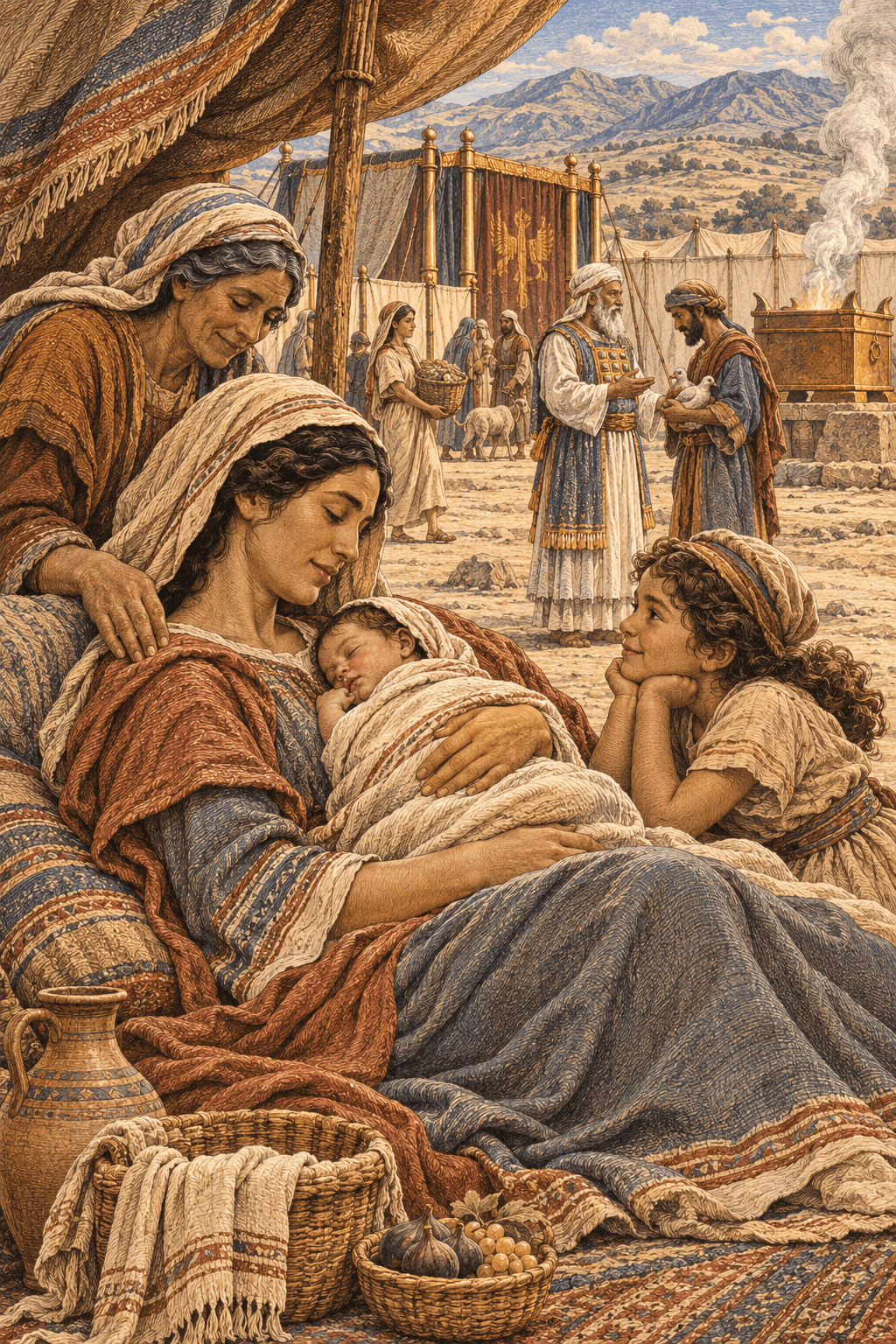
Origen gives an extreme comment on this law. He sees in the sense of the uncleanness of the woman who gives birth a declaration of the uncleanness of the newborn, male or female, and that it does not befit the saints to rejoice in remembering their birthday, but rather to curse it:
We find none of the saints keeping a feast on his birthday or making a great banquet on it, and none rejoices on the birthday of his son or daughter; only sinners rejoice in this. In the Old Testament Pharaoh king of Egypt kept his birthday (Genesis 40:20), and in the New Testament Herod also kept it (Mark 6:21); and in both cases blood flowed as a sign of honoring their birthdays: the head of the chief baker was cut off (Genesis 40:22), and also the head of the holy prophet John in prison (Mark 6:27). But the saints not only do not keep their birthdays, but, being full of the Holy Spirit, they curse that day. For a great prophet, I mean Jeremiah, who was sanctified (from the womb), says: “Cursed be the day wherein I was born” (Jeremiah 20:14)… [163]
Origen goes on with his discussion… Perhaps his exaggeration in the matter reveals his view, marked by some bitterness toward the body, which cannot be accepted after the Lord took our body and blessed our nature in Himself. As for his citing the Christians of his time as not celebrating their birthdays, I think this is due to the Christians’ joy in baptism as a new spiritual birth; so they replaced the celebration of the birthday with the commemoration of the day of their baptism.
Returning to the law of purification of the woman who gives birth: in the first period (7 days or 14 days) the woman is counted unclean; in the following period (33 days or 66 days) she is counted as going on the way of her purification, so whoever touches her or serves her is not counted unclean, but she may not go to the house of the Lord.
Origen comments on the first seven days, in which the woman who gives birth is counted unclean:
During the seven days she remains separated from everything clean, until the seven days pass “in the blood of her uncleanness,” and the thirty-three days in the blood of her purifying… On the eighth day the child is circumcised, and she becomes clean… We see in this week a symbol of the present life, for in one week the creation of the world was finished; it is as if, as long as we are in the body, we cannot be perfectly clean until the eighth day comes, that is, the coming of the age to come. [164]
We can say that the soul is like a woman who has given birth in her first week as long as she is bound to the world, and so is unclean; but when she goes forth to the eighth day, that is, to the eschatological thought, and enjoys the heavenly life, she is counted clean while still in the world. It is as if the eighth day is not a time we wait for, but a life we live, or a heavenly state we are in.
Some may ask: why was the period doubled for the birth of a daughter?
A) In our earlier studies we often saw the male pointing to the soul and the female to the body. [165] If the soul needs spiritual purification (in the waters of baptism), the body, though it enjoys purity together with the soul in the waters of baptism, needs a doubled effort after baptism, for it bears a weight that must be controlled and subdued.
B) This distinction did not mean a distinction between the sexes, for the sacrifice offered for the boy is the same as that offered for the girl, and as the Apostle says, there is neither male nor female, for all are one in Christ Jesus (Galatians 3:28; Colossians 3:11). The difference in the period perhaps carries a rebuke of the devil’s seduction of our mother Eve.
2. The Rite of Purification
KJV · Verses 6–8
6 And when the days of her purifying are fulfilled, for a son, or for a daughter, she shall bring a lamb of the first year for a burnt offering, and a young pigeon, or a turtledove, for a sin offering, unto the door of the tabernacle of the congregation, unto the priest: 7 Who shall offer it before the Lord, and make an atonement for her; and she shall be cleansed from the issue of her blood. This is the law for her that hath born a male or a female. 8 And if she be not able to bring a lamb, then she shall bring two turtles, or two young pigeons; the one for the burnt offering, and the other for a sin offering: and the priest shall make an atonement for her, and she shall be clean.
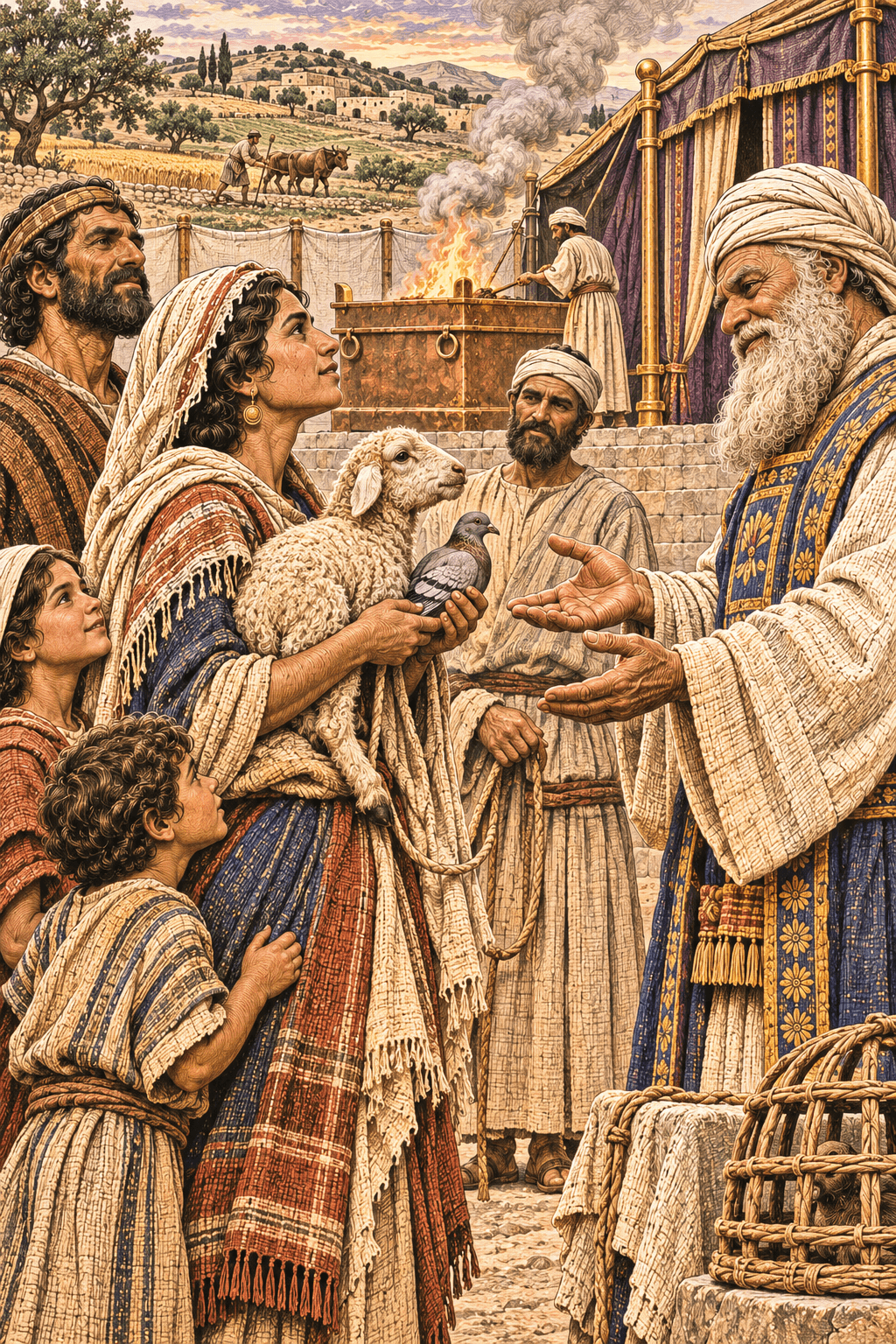
When the days of purifying were fulfilled, that is, after the forty or eighty days, the woman who had given birth brought two kinds of sacrifices: a lamb of the first year for a burnt offering, and a young pigeon or a turtledove for a sin offering. If she could not afford this, she offered two turtledoves or two young pigeons, the one for a burnt offering and the other for a sin offering.
We notice in this offering the following:
A) It is not enough that the days of her purifying be completed for her to be counted clean. Time cannot wipe out sin or remove uncleanness; there is always need of the blood, which is able to cleanse from all sin.
B) The two sacrifices are joined together: the burnt offering, which is a delight to the Lord, with the sin offering… It is as if in our cleansing by the precious blood, joy and gladness mingle with the forgiveness of sin.
C) The burnt offering, which is for joy, each person offers according to his means: it may be a lamb of the first year or a bird. But the sin offering is one for all, for the poor as for the rich, so that all may be able to offer it without distinction between rich and poor.
Wonderfully, Saint Mary, having conceived the Lord Christ, who though He was rich became poor that He might make us rich (2 Corinthians 8:9), offered the offering of the poor. By practicing the rite she declared her submission to the Law, though she bore no uncleanness, but bore the Holy One in her womb… She bore Him who of His own will submitted Himself under the Law to redeem those under the Law; so she too did not set herself above the rite of the Law, but fulfilled it (Luke 2:24).
Notes and References
[162] Origen, In Lev. hom. 8:1.
[163] Ibid. 8:3.
[164] Ibid. 8:4.
[165] See Fr. Tadros Yacoub Malaty, The Book of Exodus, 1981.