
Having handed on the deposit through his struggle, the spiritual leader Joshua, at the moment of his departure from this world, also received the divine farewell message to deliver to God’s people, and set up a stone of witness at the sanctuary of the Lord, reminding them of God’s works with them before he departed from them in the body.
1. God’s dealings with them (1–13).
2. The sanctification of the human will (14–25).
3. Setting up a stone of witness (26–28).
4. The death of Joshua (29–33).
1. God’s Dealings with Them
KJV · Verses 1–13
1 And Joshua gathered all the tribes of Israel to Shechem, and called for the elders of Israel, and for their heads, and for their judges, and for their officers; and they presented themselves before God. 2 And Joshua said unto all the people, Thus saith the Lord God of Israel, Your fathers dwelt on the other side of the flood in old time, even Terah, the father of Abraham, and the father of Nachor: and they served other gods. 3 And I took your father Abraham from the other side of the flood, and led him throughout all the land of Canaan, and multiplied his seed, and gave him Isaac. 4 And I gave unto Isaac Jacob and Esau: and I gave unto Esau mount Seir, to possess it; but Jacob and his children went down into Egypt. 5 I sent Moses also and Aaron, and I plagued Egypt, according to that which I did among them: and afterward I brought you out. 6 And I brought your fathers out of Egypt: and ye came unto the sea; and the Egyptians pursued after your fathers with chariots and horsemen unto the Red sea. 7 And when they cried unto the Lord, he put darkness between you and the Egyptians, and brought the sea upon them, and covered them; and your eyes have seen what I have done in Egypt: and ye dwelt in the wilderness a long season. 8 And I brought you into the land of the Amorites, which dwelt on the other side Jordan; and they fought with you: and I gave them into your hand, that ye might possess their land; and I destroyed them from before you. 9 Then Balak the son of Zippor, king of Moab, arose and warred against Israel, and sent and called Balaam the son of Beor to curse you: 10 But I would not hearken unto Balaam; therefore he blessed you still: so I delivered you out of his hand. 11 And you went over Jordan, and came unto Jericho: and the men of Jericho fought against you, the Amorites, and the Perizzites, and the Canaanites, and the Hittites, and the Girgashites, the Hivites, and the Jebusites; and I delivered them into your hand. 12 And I sent the hornet before you, which drave them out from before you, even the two kings of the Amorites; but not with thy sword, nor with thy bow. 13 And I have given you a land for which ye did not labour, and cities which ye built not, and ye dwell in them; of the vineyards and oliveyards which ye planted not do ye eat.
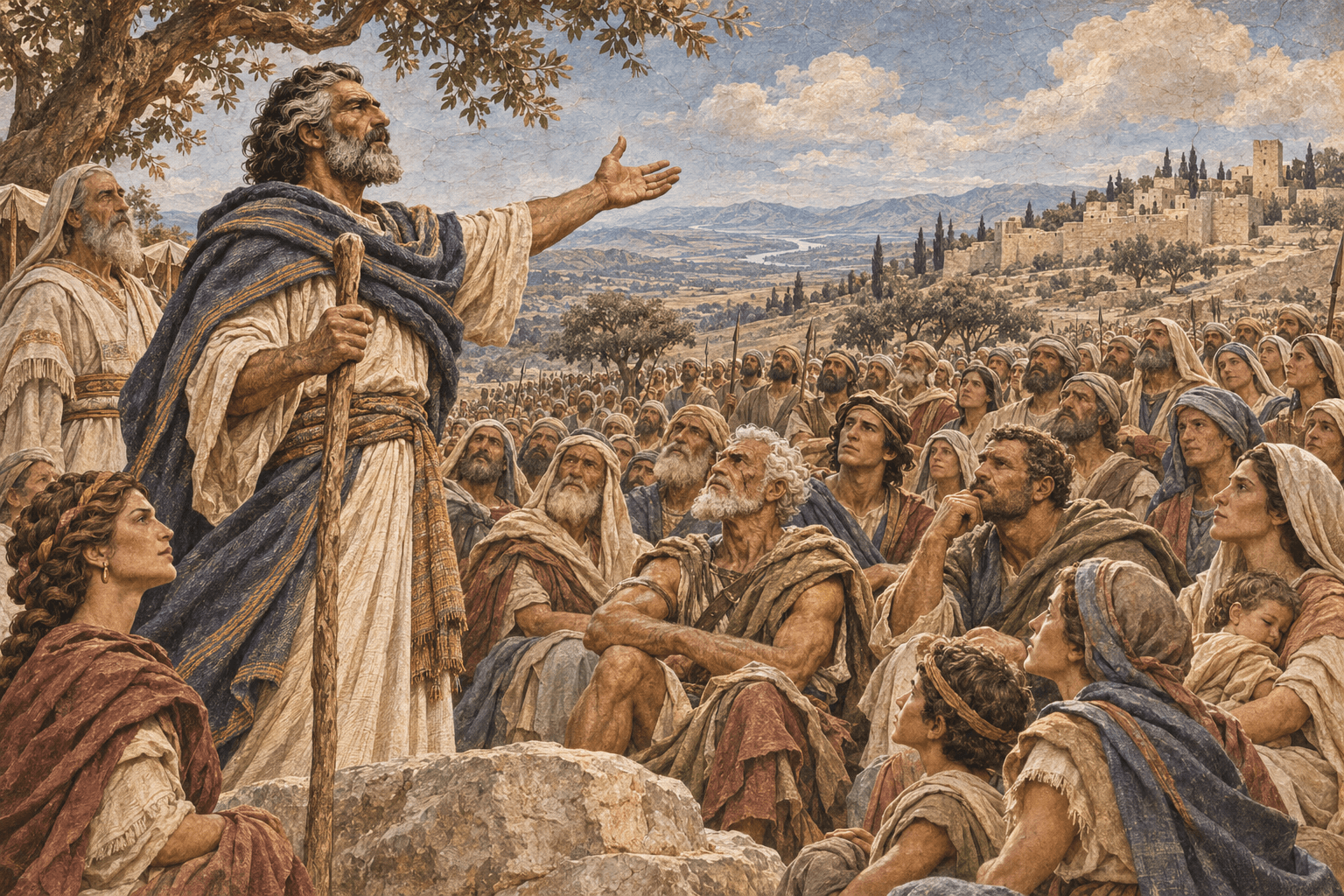
After Joshua had spoken with his men with complete frankness, giving them all that was in his heart before his departure, he called again the elders of Israel, their heads, their judges and their officers, to present themselves before the Lord; and Joshua spoke to all the people the divine words immediately before his departure, in which God affirms His faithfulness in fulfilling His promises. He had promised Abraham, the father of the fathers, when He called him and led him through all the land of Canaan as a stranger and sojourner, assuring him that He would give it to him in the person of his seed; and behold, today His promise is fulfilled.
He brought them out of the land of Pharaoh and led them across the Red Sea, in which Pharaoh and his soldiers were drowned, and delivered them from the hands of the Amorites, the Perizzites, the Canaanites, the Hittites, the Girgashites, the Hivites and the Jebusites, and so on …
Joshua the son of Nun brought out that Abraham received the promises although his father served other gods. It is as if he wished to assure them that their belonging to wicked fathers or to saints would not profit or harm them; what profits them is their obedience to the Lord, and what harms them is their disobedience to Him. Saint John Chrysostom says:
“This counsel I give you … Let us not make the wickedness of our fathers an excuse to hide behind; for when we are careful, nothing of this hinders us. Even Abraham’s father was an unbeliever, yet he did not inherit his wickedness, but became dear to God! [251]”
The Lord says to them: “And I sent the hornet before you, which drave them out from before you, even the two kings of the Amorites; but not with thy sword, nor with thy bow. And I have given you a land for which ye did not labour, and cities which ye built not, and ye dwell in them; of the vineyards and oliveyards which ye planted not do ye eat” [12–13].
What does He mean by the hornets which He sent before them? Perhaps He meant the Egyptians, who attacked this region some time before the Hebrews came, crushing the power of the kings and preparing the way for them. All of history, and indeed all events, proceed according to an invisible divine plan working for our salvation. God’s care is transcendent and beyond all understanding! God permitted Pharaoh’s attack, and the believers did not know that it was for their sake, so that they might enjoy the inheritance without toil!
2. The Sanctification of the Human Will
KJV · Verses 14–25
14 Now therefore fear the Lord, and serve him in sincerity and in truth: and put away the gods which your fathers served on the other side of the flood, and in Egypt; and serve ye the Lord. 15 And if it seem evil unto you to serve the Lord, choose you this day whom ye will serve; whether the gods which your fathers served that were on the other side of the flood, or the gods of the Amorites, in whose land ye dwell: but as for me and my house, we will serve the Lord. 16 And the people answered and said, God forbid that we should forsake the Lord, to serve other gods; 17 For the Lord our God, he it is that brought us up and our fathers out of the land of Egypt, from the house of bondage, and which did those great signs in our sight, and preserved us in all the way wherein we went, and among all the people through whom we passed: 18 And the Lord drave out from before us all the people, even the Amorites which dwelt in the land: therefore will we also serve the Lord; for he is our God. 19 And Joshua said unto the people, Ye cannot serve the Lord: for he is an holy God; he is a jealous God; he will not forgive your transgressions nor your sins. 20 If ye forsake the Lord, and serve strange gods, then he will turn and do you hurt, and consume you, after that he hath done you good. 21 And the people said unto Joshua, Nay; but we will serve the Lord. 22 And Joshua said unto the people, Ye are witnesses against yourselves that ye have chosen you the Lord, to serve him. And they said, We are witnesses. 23 Now therefore put away, said he, the strange gods which are among you, and incline your heart unto the Lord God of Israel. 24 And the people said unto Joshua, The Lord our God will we serve, and his voice will we obey. 25 So Joshua made a covenant with the people that day, and set them a statute and an ordinance in Shechem.
If the Book of Joshua contains God’s transcendent dealings with His people so that they might inherit and possess, it is because He offers divine love so that they may receive it with love on their part. He does not ask for their worship as a compulsory, coercive duty, but asks for love that comes forth through the perfect freedom of man. For God sanctifies human freedom as a living image of God, and a declaration of God’s righteousness and His practical love … He seeks man not as a slave but as a free son: “And if it seem evil unto you to serve the Lord, choose you this day whom ye will serve …” [15].
And when Joshua offered himself as an example, saying, “But as for me and my house, we will serve the Lord,” they answered and said: “God forbid that we should forsake the Lord, to serve other gods” [16].
Again Joshua wished that their worship of God should spring from complete freedom, for he says to the people: “Ye cannot serve the Lord: for he is an holy God; he is a jealous God; he will not forgive your transgressions nor your sins” [19], assuring them that if they served Him but not in a holy life, they would bring chastisement on themselves, and if they chose strange gods, that would be their portion … And the people affirmed again: “Nay; but we will serve the Lord” [21].
Saint John Chrysostom speaks of the freedom of the will:
“God does not force us, nor does the grace of the Spirit compel our wills; but God calls us and waits for us to come to Him in complete freedom; and when we draw near, He gives us all His help. [252]”
“God does not compel those who do not want Him, but He draws those who are willing. [253]”
“The Creator made our nature its own master. In His mercy He always grants us His help, and He perceives what is hidden in the depths of the heart. He entreats us, counsels us, forbids us and warns us against evil conduct, but He imposes nothing on us by force. He offers the fitting remedies, leaving the whole matter to the decision of the patient himself. [254]”
3. Setting Up a Stone of Witness
KJV · Verses 26–28
26 And Joshua wrote these words in the book of the law of God, and took a great stone, and set it up there under an oak, that was by the sanctuary of the Lord. 27 And Joshua said unto all the people, Behold, this stone shall be a witness unto us; for it hath heard all the words of the Lord which he spake unto us: it shall be therefore a witness unto you, lest ye deny your God. 28 So Joshua let the people depart, every man unto his inheritance.
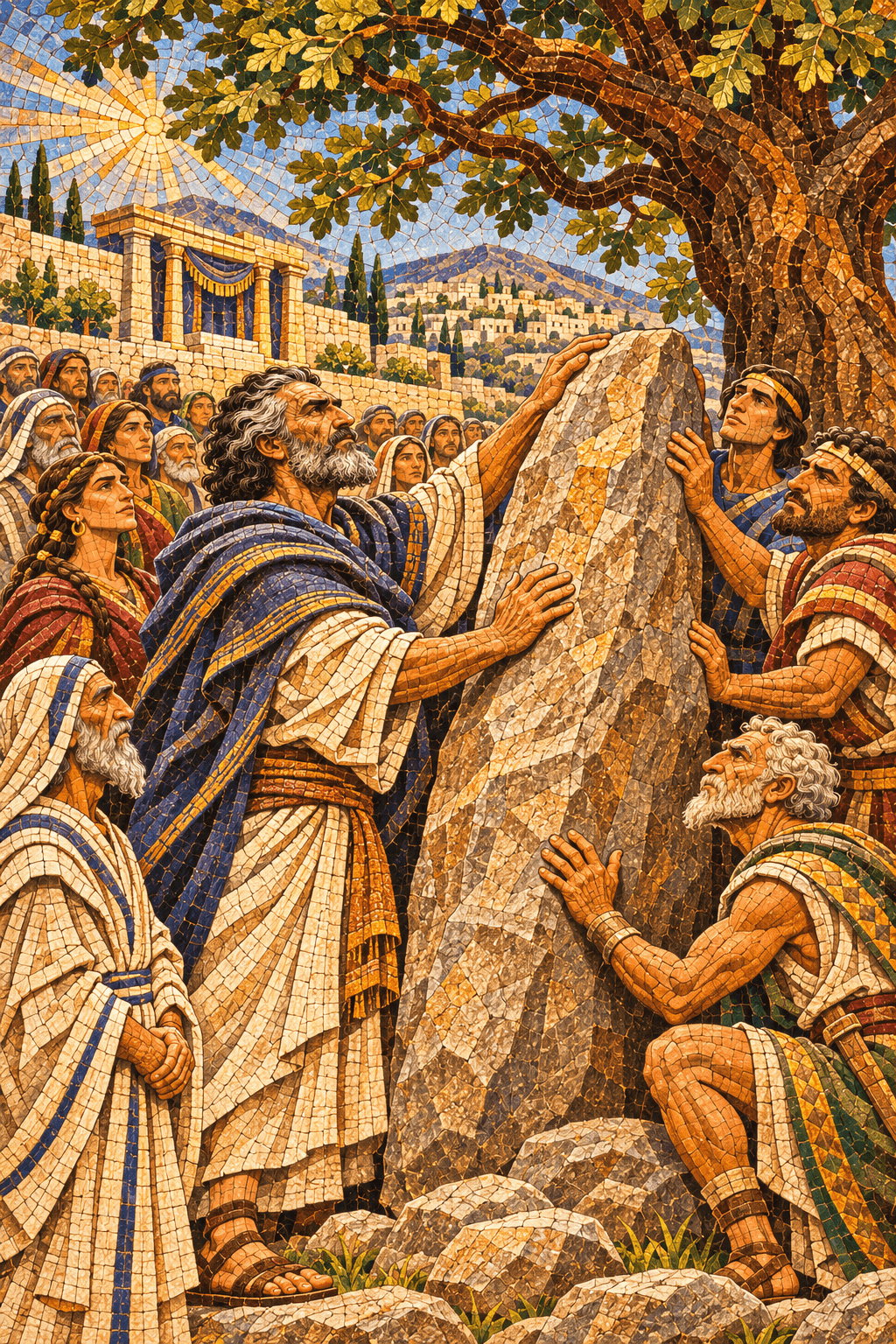
When Joshua had made a covenant with the people that day, in which they affirmed their commitment to worship the Lord alone in complete freedom and choice, he “took a great stone, and set it up there under an oak, that was by the sanctuary of the Lord” [26]. Saint Basil the Great says:
“Joshua the son of Nun set up a stone as a witness to his words, as Jacob before him had made a heap of stones a witness to his words (Genesis 31:45–47) … Perhaps he thought that the stones themselves would speak by the power of God to put the disobedient to shame, or at least that the conscience of each one would be put to shame by the force of the warning. [255]”
Saint Cyprian sees the stone of witness here as pointing to the Lord Christ Himself. [256] Holy Scripture has often spoken to us of the Lord Christ as the living Stone on which His Church stands, [257] the Stone which the builders rejected and which has become the head of the corner … Daniel the prophet saw it become a mountain (Daniel 2:31–35), the mountain of which Isaiah the prophet says that it is revealed in the last days, and the nations come to it and the righteous go up on it (Isaiah 2:2–4).
4. The Death of Joshua
KJV · Verses 29–33
29 And it came to pass after these things, that Joshua the son of Nun, the servant of the Lord, died, being an hundred and ten years old. 30 And they buried him in the border of his inheritance in Timnathserah, which is in mount Ephraim, on the north side of the hill of Gaash. 31 And Israel served the Lord all the days of Joshua, and all the days of the elders that overlived Joshua, and which had known all the works of the Lord, that he had done for Israel. 32 And the bones of Joseph, which the children of Israel brought up out of Egypt, buried they in Shechem, in a parcel of ground which Jacob bought of the sons of Hamor the father of Shechem for an hundred pieces of silver: and it became the inheritance of the children of Joseph. 33 And Eleazar the son of Aaron died; and they buried him in a hill that pertained to Phinehas his son, which was given him in mount Ephraim.
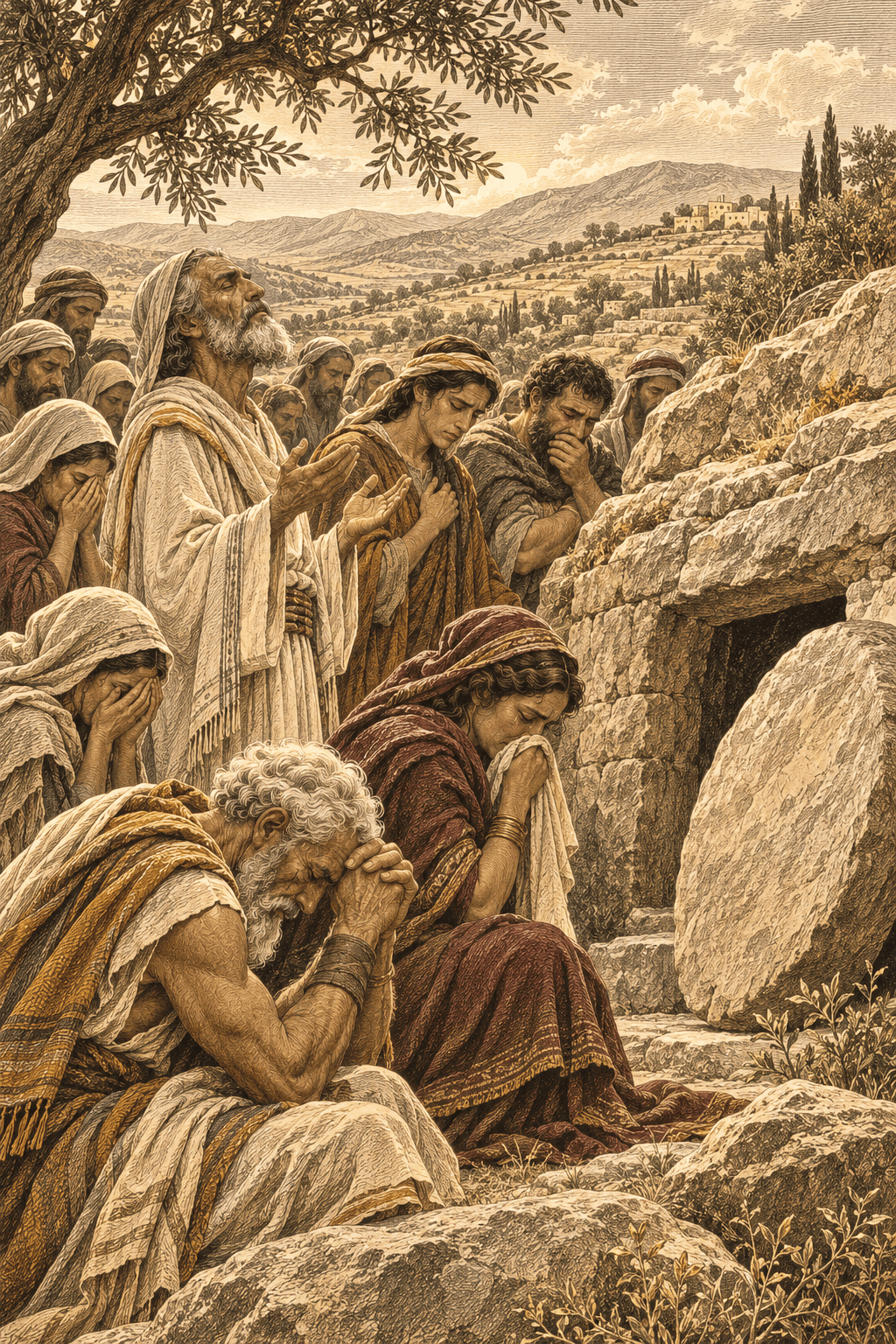
This book opened with the death of Moses, without which it was not possible to cross over and enjoy the inheritance; and it closes with the death of Joshua, for without His death and resurrection salvation would not be accomplished.
The book declares the death of Joshua, the burial of the bones of Joseph, and the death of Eleazar the high priest. If Joshua points to Jesus the Savior, then by His death the bones of Joseph came to rest, which had long awaited that day. For Joseph had said to his brethren: “I die: and God will surely visit you, and bring you out of this land unto the land which he sware to Abraham, to Isaac, and to Jacob.” And Joseph took an oath of the children of Israel, saying:
“God will surely visit you, and ye shall carry up my bones from hence” (Genesis 50:24–25) — to the land of the inheritance. It is as if he represents the Church sojourning here, which will not rest completely until our bodies rise on the great day, to stand where the new Joshua stands, but in a new nature befitting eternity. As for the death of Eleazar, whose name means “my God helps,” the high priest, it points to the Lord Christ, who by His death went forth as High Priest — our God who helps us by His blood, interceding for us before His Father, presenting us as members of His holy body.
Notes and References
[251] John Chrysostom, Homilies on Matthew 8.
[252] John Chrysostom, De verbis habentes [as given in the source].
[253] John Chrysostom, On the Changing of Names, PG 51:143.
[254] John Chrysostom, Homilies on Genesis, PG 53:158, 159.
[255] Basil the Great, On the Holy Spirit 13.
[256] Cyprian, Treatise 12, to Quirinus 2:16.
[257] Isaiah 28:16; Psalm 118:21–26; Zechariah 3:8–9; Deuteronomy 27:8.