
The work of the successful shepherd centers on handing on the deposit of faith, living and practical, through his ministry, so that the generations receive from him the spirit of right faith, translated into living, fervent worship and practical conduct in the Lord … Here is Joshua at the end of his life calling all Israel, their elders, their heads, their judges and their officers, to hand on to them farewell commandments that matched his faith, his worship and his practical conduct; therefore these commandments had their power … Truly the mission of the Church is to keep the deposit of faith, so as to hand it on through the generations as living thought, spiritual worship and conduct in the Lord.
1. Reminding them of the works of the Lord (1–5).
2. Reminding them of the commandments of the Lord (6–8).
3. Stirring up the spirit of hope (9–11).
4. Warning them against spiritual relapse (12–16).
1. Reminding Them of the Works of the Lord
KJV · Verses 1–5
1 And it came to pass a long time after that the Lord had given rest unto Israel from all their enemies round about, that Joshua waxed old and stricken in age. 2 And Joshua called for all Israel, and for their elders, and for their heads, and for their judges, and for their officers, and said unto them, I am old and stricken in age: 3 And ye have seen all that the Lord your God hath done unto all these nations because of you; for the Lord your God is he that hath fought for you. 4 Behold, I have divided unto you by lot these nations that remain, to be an inheritance for your tribes, from Jordan, with all the nations that I have cut off, even unto the great sea westward. 5 And the Lord your God, he shall expel them from before you, and drive them from out of your sight; and ye shall possess their land, as the Lord your God hath promised unto you.
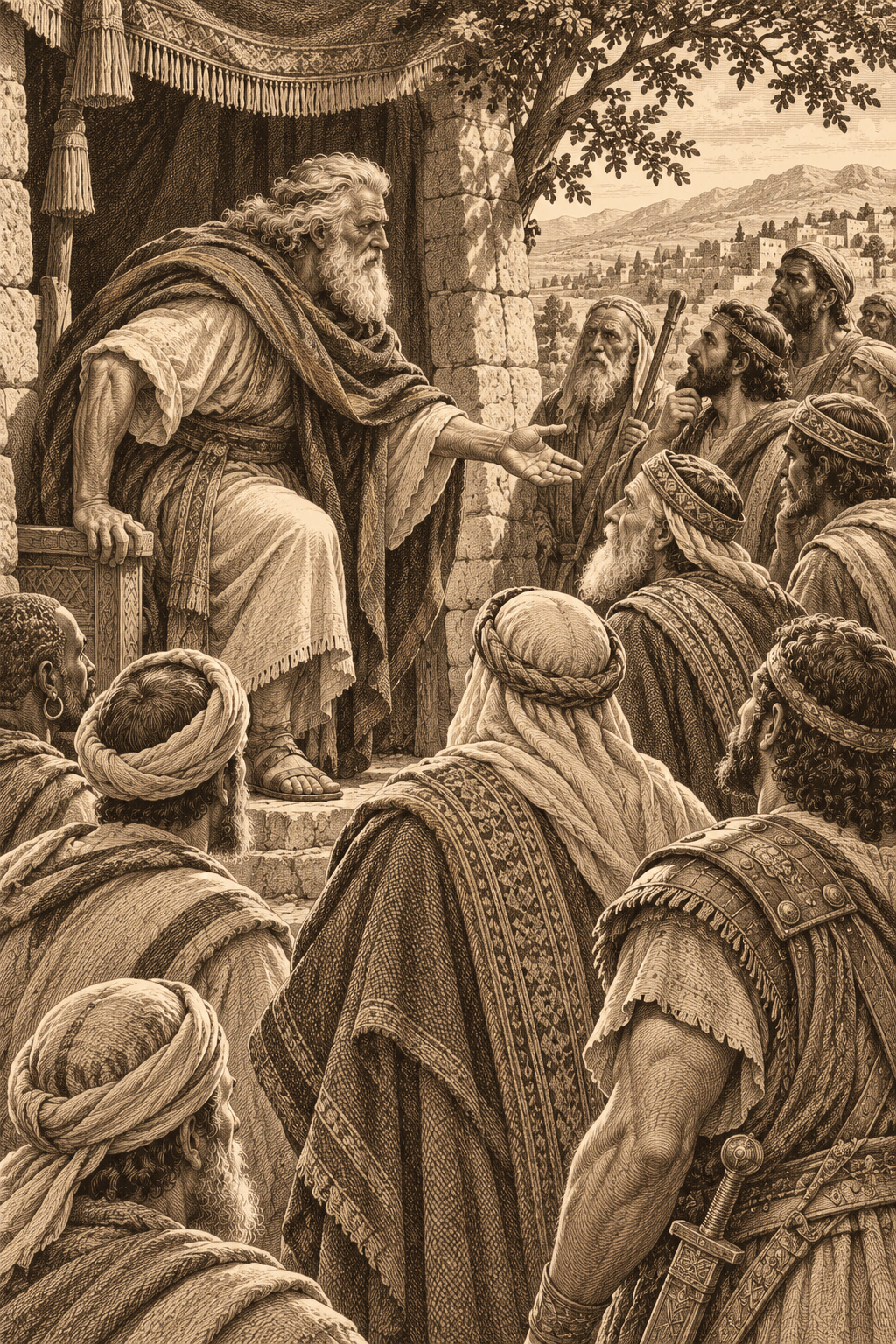
How beautiful it is when the shepherd forgets himself even in the last moments of his life! Joshua did not remind them of his faithfulness in shepherding them, nor of his bearing their burdens, nor of his watching over them; rather, he fixed their eyes on God, who worked wonders with them, fought for them and took care to give them the inheritance. When the shepherd’s heart burns for the salvation of his brethren, longing to see them in eternal glory greater than himself, he does not speak of himself but of God’s saving work, to kindle every heart with the love of God and send every soul toward heavenly things, longing to receive its share in the eternal inheritance.
2. Reminding Them of the Commandments of the Lord
KJV · Verses 6–8
6 Be ye therefore very courageous to keep and to do all that is written in the book of the law of Moses, that ye turn not aside therefrom to the right hand or to the left; 7 That ye come not among these nations, these that remain among you; neither make mention of the name of their gods, nor cause to swear by them, neither serve them, nor bow yourselves unto them: 8 But cleave unto the Lord your God, as ye have done unto this day.
The Lord’s words to Joshua when he received the spiritual leadership were:
“Be strong and of a good courage … Only be thou strong and very courageous … Have not I commanded thee? Be strong and of a good courage” (Joshua 1:6–7, 9). These divine words kept ringing in Joshua’s ears and working in his heart; he repeated them with his tongue, kept them in his mind and embraced them in his heart as the divine treasure he guarded. And now, at the moment of his departure from the world, he finds nothing more precious than to hand on the deposit he received as it is, offering it with his tongue as he offered it to them through his life.
He says: “Be ye therefore very courageous to keep and to do all that is written in the book of the law of Moses, that ye turn not aside therefrom to the right hand or to the left” [6].
The essence of tradition, or holy handing on, is that we offer the next generation the word of God without deviation, as we received it and lived it, as the generations received it and lived it in a living way. Here Joshua offers what he received from Moses, the book of the law, to stir up in them the spirit of hope and strength: “Be ye therefore very courageous.”
Here we wish to affirm that the tradition we receive and hand on is not something new alongside the Gospel; in its essence it is the holy Gospel, declared in the book we have received, in the life of worship we practice, and in practical conduct and our dealings with others.
3. Stirring Up the Spirit of Hope
KJV · Verses 9–11
9 For the Lord hath driven out from before you great nations and strong: but as for you, no man hath been able to stand before you unto this day. 10 One man of you shall chase a thousand: for the Lord your God, he it is that fighteth for you, as he hath promised you. 11 Take good heed therefore unto yourselves, that ye love the Lord your God.
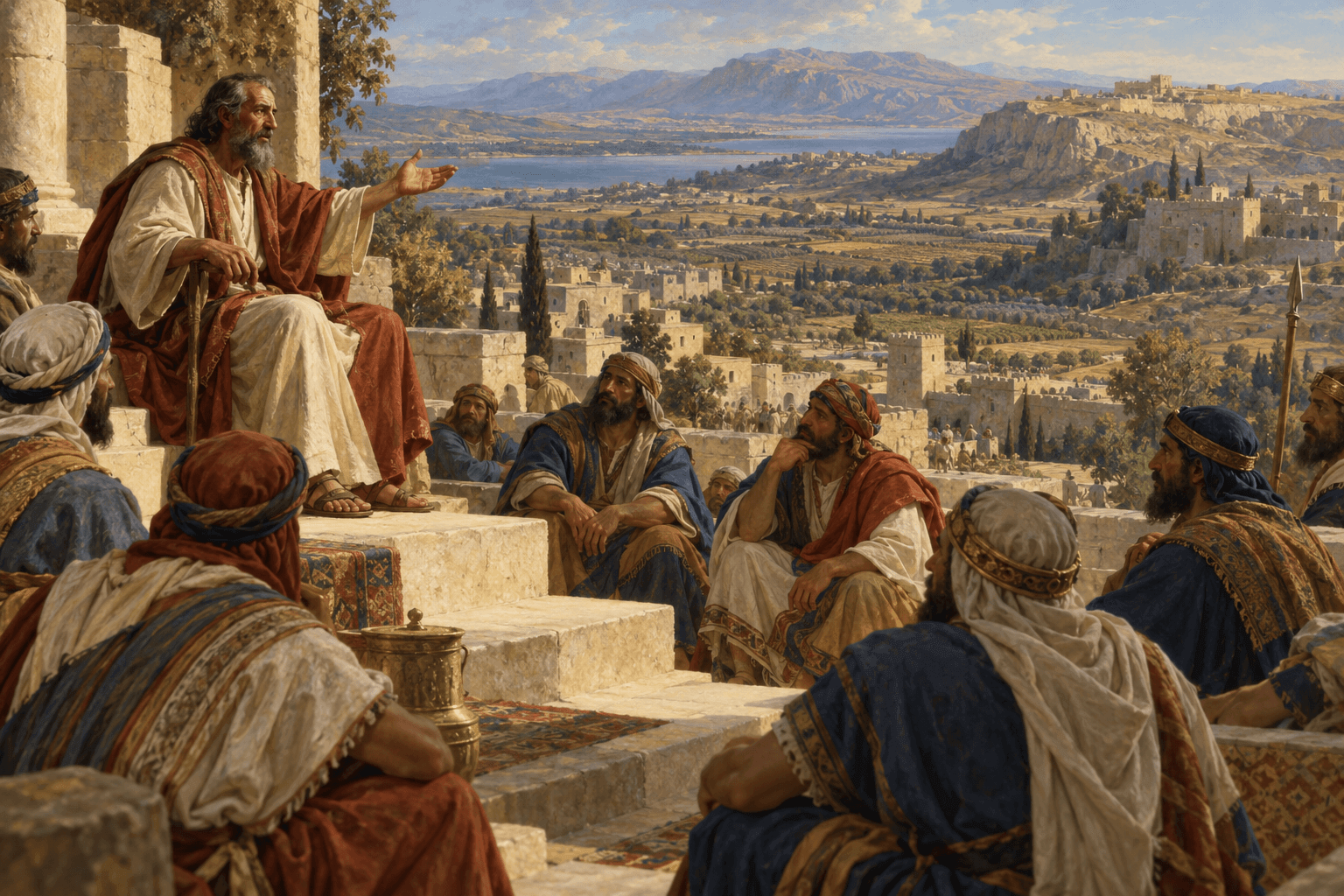
The work of church tradition, or holy handing on, does not stop at handing on Holy Scripture isolated from the church life that bears witness to the Gospel. It should be offered as a book inspired by the Spirit, living and effective, declared in the life of the Church, especially in her spirit full of hope. This is what we sense in the farewell words of Joshua the son of Nun, as he stirs up in his hearers the spirit he himself had experienced and lived, saying: “For the Lord hath driven out from before you great nations and strong: but as for you, no man hath been able to stand before you unto this day. One man of you shall chase a thousand: for the Lord your God, he it is that fighteth for you, as he hath promised you. Take good heed therefore unto yourselves, that ye love the Lord your God” [9–11].
He stirs up in them the spirit of hope through the experience they had lived: that God had driven out from before them great and strong nations … It is good for a person to remember his unceasing weaknesses so as to walk in the spirit of humility; but at the same time he should not be ungrateful for God’s works with him, for He has driven out from before him great and strong sins that dominated him for a time! Let us thank Him for His benefits to us, so that He may complete them with us.
On this Mar Isaac the Syrian says: “There is no gift without increase except that which is without thanksgiving.” That is why many err when they confess their sins and weaknesses without also confessing God’s work with them! Saint Augustine affirms that we should confess from two angles: thanking God for His benefits and accusing ourselves for our weaknesses. He says:
“We confess either in praising Him or in accusing ourselves, and both are a good confession: whether in blaming ourselves, who are not without sin, or in praising God, who is without sin. [246]”
Saint Ambrose says:
“Beware lest you resist His commandments and fall into what the disobedient Jews fell into, to whom He said: ‘We have piped unto you, and ye have not danced; we have mourned to you, and ye have not wept’ (Luke 7:32). [247]”
Let us then hear the Lord’s joyful pipe and dance spiritually, praising Him for the abundance of His benefits, He who drove out nations from our inner hearts; and let us hear His mourning over our sins and weep, so that He may have compassion on us and drive out every stray remnant within our souls!
Having presented a realistic picture of God’s work with us to stir up hope in us, Joshua affirmed again: “As for you, no man hath been able to stand before you unto this day” [9]. It is as if he repeats God’s promise to him at the beginning of his leadership:
“There shall not any man be able to stand before thee all the days of thy life” (Joshua 1:5). This divine promise was to Joshua, but in truth it is a promise to the whole people through all generations … a divine promise renewing our hope in the Lord, who defends us and lets no one have authority to stand in our way unless it is given him from above, as the Lord Christ said to Pilate: “Thou couldest have no power at all against me, except it were given thee from above” (John 19:11).
What does “One man of you shall chase a thousand” mean? If the number 1000, as we said earlier, points to heavenly or spiritual things, here it points to what Paul the Apostle expressed:
“spiritual wickedness in high places” (Ephesians 6:12). If, because of our weakness, compared with the devil’s power, we are counted as one against a thousand, in the Lord the thousand cannot stand before us; we chase them away by the Lord who defends us. This is the faith of Elisha the prophet, who said to his servant Gehazi, when the king of Syria sent horses and chariots against him: “Fear not: for they that be with us are more than they that be with them” (2 Kings 6:16).
And Elisha prayed and said: “Lord, I pray thee, open his eyes, that he may see. And the Lord opened the eyes of the young man; and he saw: and, behold, the mountain was full of horses and chariots of fire round about Elisha” (2 Kings 6:17). Let us not fear the devil and all his soldiers, for the Lord our God fights for us until He brings us into the fullness of His eternal glory. Truly the devil is terrifying in the violence of his tricks and the weight of the sins that press on man; but he has no authority over us if we walk in the Lord and carry within us the fiery Spirit of God, for then we have authority to tread on serpents and scorpions and all the powers of the enemy.
Saint John Chrysostom speaks of the believer’s power in facing the devil, his temptations and his violence: “If Satan sees you bound to heaven and watchful, he will never dare to look at you.” [248] And: “A pure life shuts the mouth of Satan himself and makes him dumb.” [249]
The secret of our hope is the Lord our God, whose love we must return with love: “Take good heed therefore unto yourselves, that ye love the Lord your God” [11].
4. Warning Them against Spiritual Relapse
KJV · Verses 12–16
12 Else if ye do in any wise go back, and cleave unto the remnant of these nations, even these that remain among you, and shall make marriages with them, and go in unto them, and they to you: 13 Know for a certainty that the Lord your God will no more drive out any of these nations from before you; but they shall be snares and traps unto you, and scourges in your sides, and thorns in your eyes, until ye perish from off this good land which the Lord your God hath given you. 14 And, behold, this day I am going the way of all the earth: and ye know in all your hearts and in all your souls, that not one thing hath failed of all the good things which the Lord your God spake concerning you; all are come to pass unto you, and not one thing hath failed thereof. 15 Therefore it shall come to pass, that as all good things are come upon you, which the Lord your God promised you; so shall the Lord bring upon you all evil things, until he have destroyed you from off this good land which the Lord your God hath given you. 16 When ye have transgressed the covenant of the Lord your God, which he commanded you, and have gone and served other gods, and bowed yourselves to them; then shall the anger of the Lord be kindled against you, and ye shall perish quickly from off the good land which he hath given unto you.
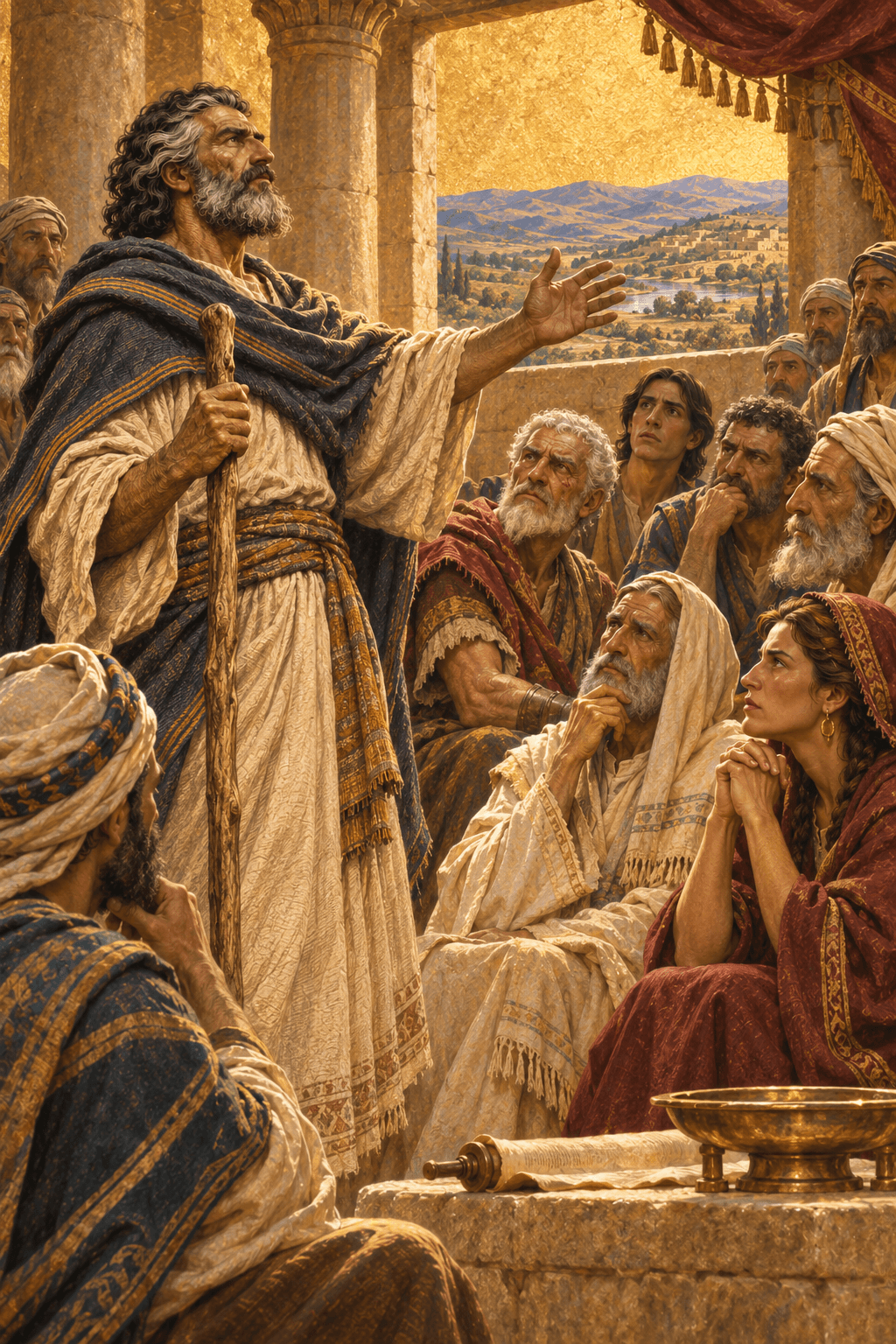
Having spoken of the positive aspects — revealing God’s love for them, declared through His unceasing works with them, and His divine commandments as their support and the secret of their hope — he began to speak to them of the negative side: their obligation to beware of spiritual relapse, lest their spiritual victory in the Lord turn into a shameful defeat because of their attachment to sins and abominations instead of cleaving to the Lord, the secret of victory.
He says: “Else if ye do in any wise go back, and cleave unto the remnant of these nations, even these that remain among you, and shall make marriages with them, and go in unto them, and they to you: know for a certainty that the Lord your God will no more drive out any of these nations from before you; but they shall be snares and traps unto you, and scourges in your sides, and thorns in your eyes, until ye perish from off this good land which the Lord your God hath given you” [12–13].
When these nations, with their violent abominations, were at the height of their strength, the people felt their need of God’s care, and the Lord fought for them. But when the remnant of the nations was among them as weak servants paying tribute, the danger became imminent, for they would enter into marriage relationships with them, and the believers would turn aside from the worship of God to paganism and its abominations.
In the same way we say: when sin attacks a person with all its violence, he takes refuge in God and has authority over it; but when it creeps into him humbly, entering his heart through weakness as simple things without authority, a person is often deceived and loses God’s conquering power! Let us fear the sins that we think simple and slight, for they are more able to capture the soul than those we think great and grave!
When by the Lord we drive out the abominations, let us leave no remnant of them in the heart to beguile and deceive us, so as to draw our heart away from God and rob us of the secret of our life!
When we accept sin and enter into relationships with it like marriage relationships, God hands us over to it to humble us, so that the very desire of our hearts becomes the secret of our destruction. It becomes for us a snare and a trap into which we fall; while we think we are gaining something, behold, we are in captivity, inside the traps, without strength. While we think it offers us pleasure and joy, behold, it falls on our sides like scourges, so that we know no rest on our right side or our left.
Finally, it is like thorns in the eyes, robbing a person of his spiritual insight and depriving him of seeing the inner divine light … It does not leave us until we perish from the good land which God has given us, that is, we lose all goodness in the body and lose all its energies and feelings!
To encourage them to struggle so as to remain firm in the good land they had received, and to crush every remaining remnant of the abominations, he says to them: “Behold, this day I am going the way of all the earth” [14]. It is as if he says to them that the days are shortened, and we shall all pass from this world … this is the way of all the earth. The sense of being strangers supports the soul in its struggle, for we realize that every lust passes away and every temporal matter ends; so the soul does not work for its temporal life so much as it cares for its salvation and the enjoyment of the life that abides forever.
That is why Saint John Climacus says: “Someone has said that we cannot spend a single day in true worship unless we regard it as the end of our whole life.” [250]
Notes and References
[246] Augustine, quoted in Fr. Tadros Y. Malaty, Pastoral Love (Arabic), p. 382.
[247] Ambrose, quoted ibid., p. 365.
[248] John Chrysostom, On the Incomprehensible Nature of God, Homily 4.
[249] John Chrysostom, quoted in Brotherly Love (Arabic), 1964 ed., p. 84.
[250] John Climacus, The Ladder, Step 24:6 [as given in the source].