
If the land west of the Jordan represents the Church of the New Testament, Judah holds the place of preeminence, being the tribe from which the Son of God came incarnate; so the lot came first to him. Caleb the son of Jephunneh also had a portion in the midst of the children of Judah …
1. The portion of Judah (1–12).
2. Caleb and Kirjath-arba (13–14).
3. Caleb and Kirjath-sepher (Debir) (15–19).
4. The names of the cities (20–62).
5. The Jebusites remain among them (63).
1. The Portion of Judah
KJV · Verses 1–12
1 This then was the lot of the tribe of the children of Judah by their families; even to the border of Edom the wilderness of Zin southward was the uttermost part of the south coast. 2 And their south border was from the shore of the salt sea, from the bay that looketh southward: 3 And it went out to the south side to Maalehacrabbim, and passed along to Zin, and ascended up on the south side unto Kadeshbarnea, and passed along to Hezron, and went up to Adar, and fetched a compass to Karkaa: 4 From thence it passed toward Azmon, and went out unto the river of Egypt; and the goings out of that coast were at the sea: this shall be your south coast. 5 And the east border was the salt sea, even unto the end of Jordan. And their border in the north quarter was from the bay of the sea at the uttermost part of Jordan: 6 And the border went up to Bethhogla, and passed along by the north of Betharabah; and the border went up to the stone of Bohan the son of Reuben: 7 And the border went up toward Debir from the valley of Achor, and so northward, looking toward Gilgal, that is before the going up to Adummim, which is on the south side of the river: and the border passed toward the waters of Enshemesh, and the goings out thereof were at Enrogel: 8 And the border went up by the valley of the son of Hinnom unto the south side of the Jebusite; the same is Jerusalem: and the border went up to the top of the mountain that lieth before the valley of Hinnom westward, which is at the end of the valley of the giants northward: 9 And the border was drawn from the top of the hill unto the fountain of the water of Nephtoah, and went out to the cities of mount Ephron; and the border was drawn to Baalah, which is Kirjathjearim: 10 And the border compassed from Baalah westward unto mount Seir, and passed along unto the side of mount Jearim, which is Chesalon, on the north side, and went down to Bethshemesh, and passed on to Timnah: 11 And the border went out unto the side of Ekron northward: and the border was drawn to Shicron, and passed along to mount Baalah, and went out unto Jabneel; and the goings out of the border were at the sea. 12 And the west border was to the great sea, and the coast thereof. This is the coast of the children of Judah round about according to their families.
In the division of the land of Gilead east of the Jordan, which they possessed through the law (that is, in the time of Moses), the lot began with Reuben, because he was the firstborn according to the flesh. But here, since the distribution points to the inheritance of the New Testament, there is no obligation to the birthright of the flesh, but to the firstfruits of the Spirit. That is why the lot fell first to the royal tribe, “the tribe of Judah,” from which our Lord Jesus Christ came according to the flesh, “the Lion of the tribe of Juda” (Revelation 5:5).
The birthright of the flesh had to disappear so that the birthright of the Spirit might appear, declaring that our Lord Jesus occupies the place of preeminence as the Firstborn of mankind in place of the first, carnal Adam. Holy Scripture prepared for this by many symbols: Jacob taking the birthright in place of Esau, the firstborn according to the flesh; Isaac, the son of the promise, in place of Ishmael, the firstborn according to the flesh; and so on … Now that we have crossed the Jordan and the new land has become our inheritance, our spiritual Firstborn goes before us as the Leader of the whole Church, granting her His attribute, for through Him she too has become “the church of the firstborn.”
The birthright of the Spirit in the New Testament does not deprive others of the grace of the birthright, as in the flesh, where the one born first alone holds it!
Let us not ask for our place to be among the tribe of Reuben, who rent his clothes (Genesis 37:29) and lost his birthright, but in the spiritual tribe of Judah, by abiding in the Lion that came from it, so that we may be worthy to receive the first portion of the inheritance of the New Testament. Let us come forward with Judah to Joshua to receive our portion in Him, and take our lot after the war has ceased and we have enjoyed peace, and it is said of our body: “The land rested from war”!
Divine inspiration made clear the boundaries of Judah’s portion on every side, which carries deep spiritual meanings. Here we repeat what Origen says: “Despite our inability to understand and explain every mystery, we try to do so to the extent that the grace of God grants us.” [221]
On one side, the border of Judah’s portion reached “to the border of Edom the wilderness of Zin southward” [1]. In our study of the Book of Ezekiel we saw that Edom is taken from “Adam,” which means “earthy” or “bloody,” and that by Edom is meant Esau, or Seir. [222] It points to the enemy of good, who brings our heart down to the dust so that we live with an earthly mind, and to his bloodthirsty nature that loves to fight us. Saint Augustine says:
“Do not expect safety, for the enemy pursues you continually. If his wrath is not open, he works by cunning. That is why he has been called the lion and the dragon: a lion for the wrath he shows, and a dragon for the cunning he hides. [223]”
So though we enjoy the inheritance in Christ, the enemy stands at the borders like Edom on the border of Judah, lying in wait at the gates, longing to rob us of our heavenly nature and bring us down to the love of earthly things. He stands as an adversary seeking our destruction, and he does not rest except by shedding our blood spiritually.
The boundaries of Judah’s portion begin by revealing the border of Edom and the wilderness of Zin, the latter pointing to temptation. [224] One cannot cross into the land of Judah and enjoy its inheritance without first passing through the wilderness of temptations. The way is narrow and strait, surrounded by unceasing temptations; but all this only strengthens our struggle, as we sing amid tears:
“In the multitude of my thoughts within me thy comforts delight my soul” (Psalm 94:19). In the midst of affliction the Lord reveals Himself as the secret of our true, eternal rest. That is why Saint Augustine says: “Temptations and afflictions, however many, are a way for you to perfection, not a way to perdition.” He also says:
“The cluster hangs on the vine and the olive on its mother tree, and as long as they are on their mother they enjoy the open air. But neither does the cluster become wine nor the olive oil unless the stones of the press pass over it. Such is the state of men whom God has called before the ages to make them like His Son, who appeared especially in His passion as a precious vine. [225]”
Scripture continues to speak of Judah’s borders: “And their south border was from the shore of the salt sea, from the bay that looketh southward: and it went out to the south side to Maaleh-acrabbim, and passed along to Zin, and ascended up on the south side unto Kadesh-barnea, and passed along to Hezron, and went up to Adar, and fetched a compass to Karkaa” [2–3]. It is as if he says that whoever wants to enjoy the royal tribe first passes through these bitter places, until he crosses into the inheritance in safety.
Let him pass Edom and Zin, and cross the salt sea and the ascent of Acrabbim! What does “the salt sea” mean, if not overcoming the turmoil and revolutions of life? In the waters of the salt sea lurks the sea dragon (Psalm 104:26), which the Lord Christ crushed by entering the waters to crucify it in its own home! So let us crush the dragon through our crucifixion with our Lord Jesus Christ, and cross the land of our inheritance in peace.
“The ascent of Acrabbim” also points to the enemy’s warfare against us, for “Acrabbim” in Hebrew means “scorpions,” and God has given us authority to tread on serpents and scorpions and over all the power of the enemy, and nothing shall hurt us (Luke 10:19). Origen says:
“If we wish to enter the inheritance of the tribe of Judah, we must practice this kind of ascent, treading on scorpions and crushing them; these are what cut off the way and flee. It is without doubt the way Ezekiel took, for the Lord says to him: ‘Thou dost dwell among scorpions’ (Ezekiel 2:6). [226]”
These are the regions surrounding the inheritance of Judah: continual temptations (Zin), turmoil (the salt sea), the warfare of Satan like scorpions (the ascent of Acrabbim), and his ferocity (Edom). But the interior is exceedingly joyful and delightful, for there we meet the waters of En-shemesh, the spring of the sun [7], and Jerusalem, the city of the great King and the symbol of the heavenly life.
Origen says:
“What does this sun mean? It is the one of which it is written: ‘But unto you that fear my name shall the Sun of righteousness arise’ (Malachi 4:2). If you begin to pass beyond the salt sea, you find yourself in the land of Judah, where the spring of the sun is. What is this spring? Certainly the one of which Jesus said: ‘But whosoever drinketh of the water that I shall give him shall never thirst; but the water that I shall give him shall be in him a well of water springing up into everlasting life’ (John 4:14). And when we meet the spring of the sun of which we have spoken, we find the city, as it is written that there is a ‘Beth-shemesh’ [10]. It is said that in Egypt too there is a ‘house of the sun’; but the city of Egypt took the name ‘sun’ from the one which the heavenly Father makes to rise on the evil and on the good (Matthew 5:45), while the city of Judah belongs to the saints alone, for it is the city of God, in which is the spring; for ‘there is a river, the streams whereof shall make glad the city of God, the holy place of the tabernacles of the most High’ (Psalm 46:4). [227]”
We can also distinguish between the Beth-shemesh of Egypt and that within the borders of Judah. The first exists within the soul that worships the stone statue of the sun, which has the image of the sun without its light or splendor. But the Beth-shemesh of Judah represents the soul that has become a house for the Sun of Righteousness, that is, a temple of the Lord who illumines our life, in which the spring of the waters of the Holy Spirit overflows. Ezekiel says:
“Afterward he brought me again unto the door of the house; and, behold, waters issued out from under the threshold of the house eastward … at the south side of the altar” (Ezekiel 47:1). This is what the Book of Joshua called “the waters of En-shemesh,” that is, the waters that spring forth through the house of Christ, the Sun of Righteousness!
Though Jerusalem came into the inheritance of the tribe of Benjamin (Joshua 18:28), it lay on the border of the two tribes, especially since they later formed an independent kingdom (the kingdom of Judah), and Judah enjoyed dwelling in Jerusalem [63]. Of it Saint Augustine says: “This earthly Jerusalem is a shadow of the heavenly Jerusalem.” [228] God chose Jerusalem as the place where His name dwells (1 Kings 11:13; 2 Kings 21:4), the holy city in which the throne of God abides (Jeremiah 3:16–17, etc.), and a sign of His dwelling among His people.
Therefore, when He chastises His people, He threatens it with destruction and ruin (Jeremiah 9:11; 13:9, 27; Ezekiel 4–5; Micah 3:12). The prophets spoke of it as the center of the messianic work, to which all the nations return (Isaiah 2:2, etc.; 60:1, etc.; 66:18–20; Micah 4:1–3; Haggai 2:7, etc.). In the New Testament the Lord Christ declared His longing for the salvation of the city; and in the early Church, after the descent of the Holy Spirit, it became a center of Christianity, where the apostles and disciples met … But the eyes of the believers were turned more toward the heavenly Jerusalem (Galatians 4:26; Hebrews 12:22; Revelation 14:1; Revelation 21) as the goal of their worship. [229]
Wonderfully, Scripture describes Judah’s inheritance thus: “This is the coast of the children of Judah round about according to their families” [12]. Judah enjoyed not only the spiritual birthright and the waters of En-shemesh, but also that his border should be “round about.” We know that the circle points to eternity, where we have neither starting point nor end … What Judah inherited is eternal life, that is, the enjoyment of the heavenly mark that is above all the bounds of the world.
It is as if whoever enters this tribe spiritually, by his union with the Lion that came from it, sets out to what is above the temporal inheritance and rises above all earthly things, so that his heart and all his border become “round about”!
Truly the tribe of Judah, as a royal tribe, carried strength within it by bearing the heavenly nature, even though enemies surrounded it on every side: Moab on the east, Edom on the south, Amalek on the southwest though at a distance, and the Philistines on the west!
2. Caleb and Kirjath-arba
KJV · Verses 13–14
13 And unto Caleb the son of Jephunneh he gave a part among the children of Judah, according to the commandment of the Lord to Joshua, even the city of Arba the father of Anak, which city is Hebron. 14 And Caleb drove thence the three sons of Anak, Sheshai, and Ahiman, and Talmai, the children of Anak.
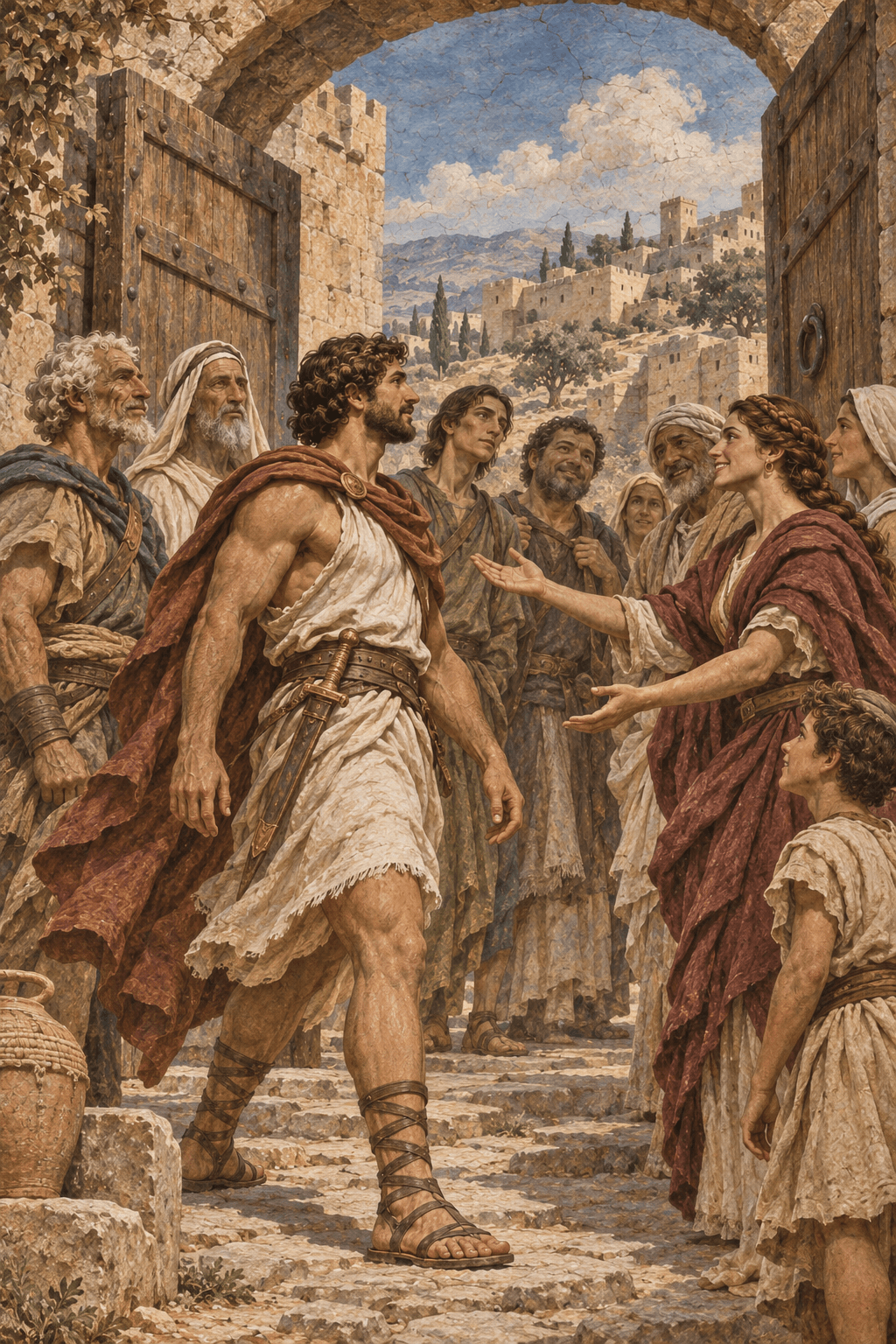
In the previous chapter Caleb the son of Jephunneh the Kenezite claimed his right, which the Lord had promised him through the mouth of Moses: possession of the mountain with its fortified cities, and Hebron, which means “union” or “marriage.” Now, having received “Hebron,” also called “Kirjath-arba,” “Caleb drove thence the three sons of Anak, Sheshai, and Ahiman, and Talmai, the children of Anak” [14].
If Caleb the son of Jephunneh the Kenezite points — as we said — to the heart that turned from contempt and entered into glory, and received Hebron as his reward, entering into a holy and spiritual union or marriage in which the soul is united with her Bridegroom forever, Hebron is on the other hand called Kirjath-arba (“the city of four”). The number 4 points to the world with its four directions — east, west, north and south — and so also to the body, taken from this earth or this world.
So the one with the holy heart, who has turned to his eternal Bridegroom, rules over his body, driving out of it the three sons of Anak, so that the Lord may reign in it too. It is not enough that our hearts or our inner life be holy; we must look on our bodies with a holy view. As we offer the Bridegroom our inner hearts, so we offer Him our bodies, and the whole person works in harmony. Saint Gregory of Nyssa likens the whole person to a harp with different strings, which by the Holy Spirit produces a harmonious piece of music that gladdens the heart of God.
Origen sees that “Anak” means “arrogant” or “not humble”; “Sheshai” means “outside of,” that is, outside the saints and outside the true God Himself; “Ahiman” means “my brother is far from wisdom”; and “Talmai” means “hanging over the abyss.” [230] Through these meanings we can say that when our Hebron, our earthy body, is dominated by Anak, the spirit of pride and lack of humility, three of his offspring rule over it as kings working together: departure from the true God, and consequently distance from wisdom, which drives a person to be suspended over the abyss or sliding into it.
Would that we might be like Caleb, driving pride, the root of the disease, out of our body, so that we are no longer outside God, the secret of our life, nor deprived of divine wisdom, and therefore do not slide into the abyss; but on the contrary return to God, enjoy His wisdom, and rise by Him from the abyss to eternal life.
3. Caleb and Kirjath-sepher (Debir)
KJV · Verses 15–19
15 And he went up thence to the inhabitants of Debir: and the name of Debir before was Kirjathsepher. 16 And Caleb said, He that smiteth Kirjathsepher, and taketh it, to him will I give Achsah my daughter to wife. 17 And Othniel the son of Kenaz, the brother of Caleb, took it: and he gave him Achsah his daughter to wife. 18 And it came to pass, as she came unto him, that she moved him to ask of her father a field: and she lighted off her ass; and Caleb said unto her, What wouldest thou? 19 Who answered, Give me a blessing; for thou hast given me a south land; give me also springs of water. And he gave her the upper springs, and the nether springs.
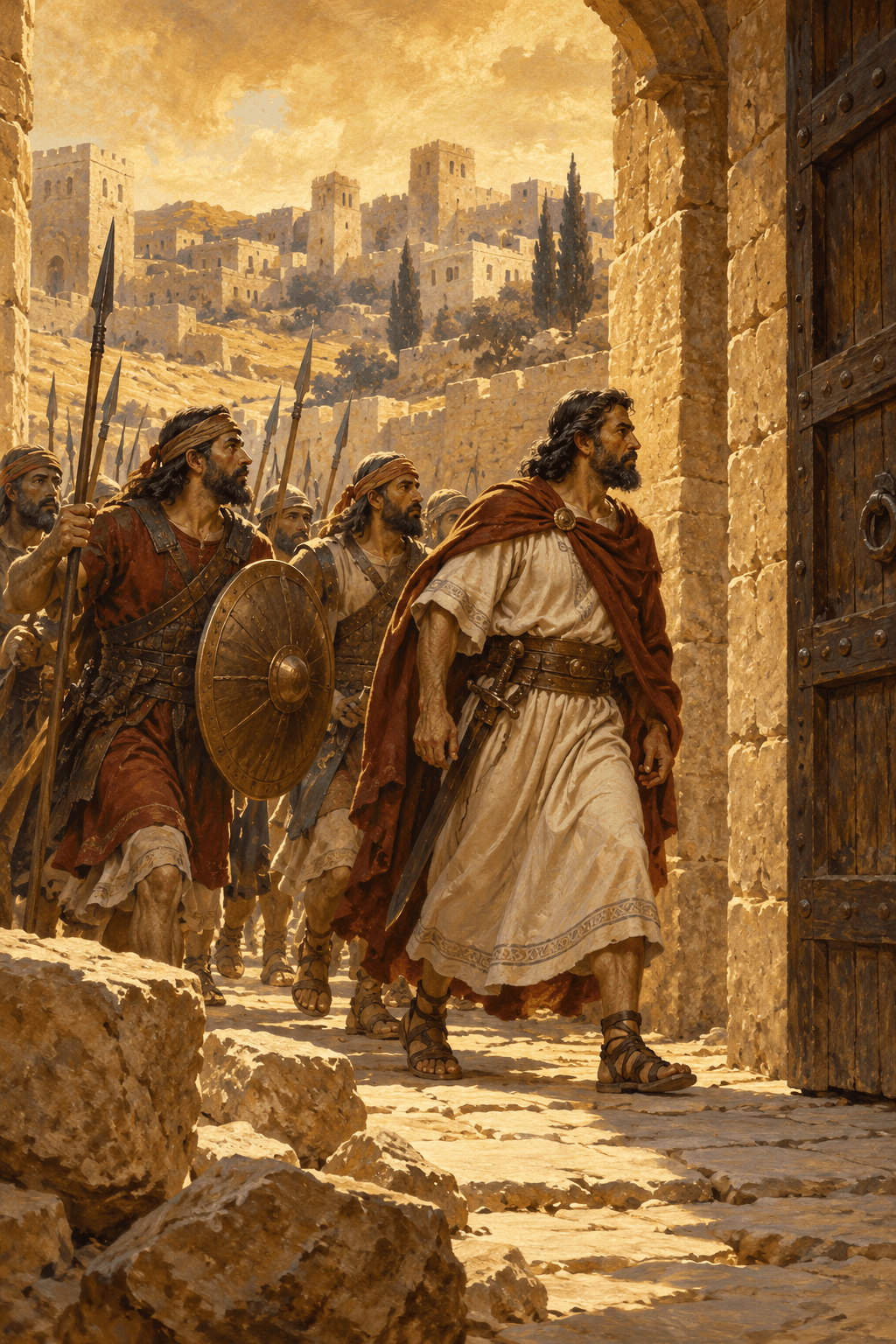
Caleb, as the representative of the holy heart, asked whether anyone would smite Kirjath-sepher (“the city of the book”) and take it, promising to give him his daughter Achsah to wife. His brother’s son, Othniel the son of Kenaz, did so; he took Kirjath-sepher, which became Debir, that is, “utterance” or “ordering,” and married Achsah. Othniel means “the Lord answered.” No one can approach the city of Holy Scripture or understand its deep mysteries unless the Lord answers him; our understanding of the Scripture is the gift and grace of God which He grants to those who ask Him.
When Othniel obtained the book, that is, Kirjath-sepher, it became Debir for him; that is, it changed from a literal book into inner utterance and understanding and a living ordering within him … it changed from the killing letter of the law into the life-giving Spirit. His marriage to Achsah, Caleb’s daughter, means his cleaving to the daughter of the holy life, who asks mankind to enter the city of the book so that God may reveal its mysteries to them.
Achsah herself, as the daughter of the holy life in the Lord, also points to the knowledge of spiritual mysteries; it is as if Othniel cleaved to the mysteries of the book not only as a city in which he lives, but as a wife, the partner of his life!
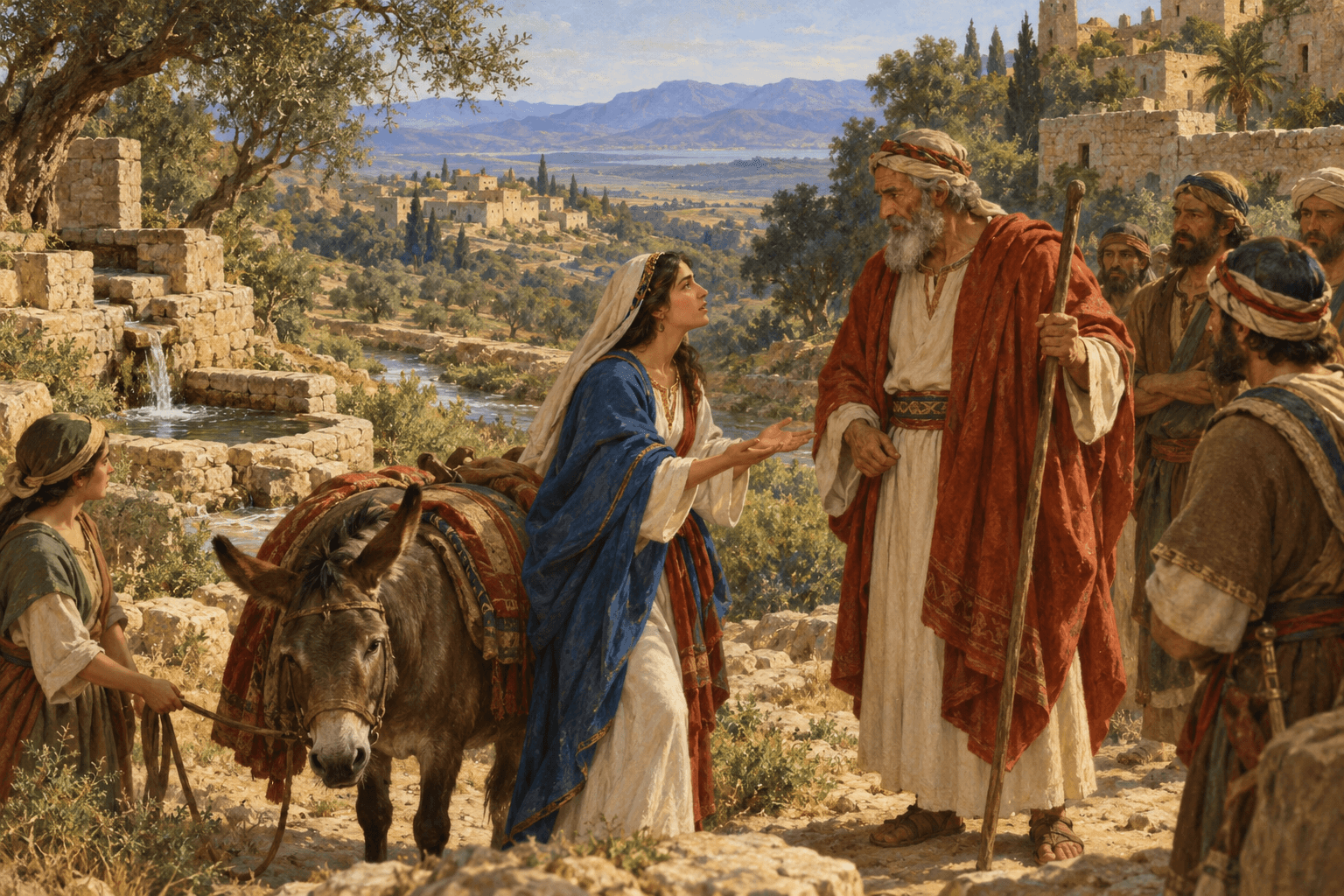
What did Achsah — the mysteries of the divine word — do for her husband Othniel, whose request the Lord had answered? She received from her father a field as a blessing to give to her husband, then got down from her ass to ask for springs of water for her husband, and her father gave her the upper springs and the nether springs. What a wonderful picture of the soul that cleaves to spiritual knowledge, the daughter of the holy life!
Through this daughter the soul enjoys the field, that is, entering into Holy Scripture as the field in which it works for God and rejoices in the fruit of the Spirit. It also sees inner knowledge getting down from the ass, that is, coming down from care for the body, to ask for springs of water, that is, the fruits of the Spirit. Fruits are given to it on a heavenly, lofty level, and it also enjoys the fruit by which it lives here on earth, accompanying it in the time of its sojourning (the nether springs).
4. The Names of the Cities
KJV · Verses 20–62
20 This is the inheritance of the tribe of the children of Judah according to their families. 21 And the uttermost cities of the tribe of the children of Judah toward the coast of Edom southward were Kabzeel, and Eder, and Jagur, 22 And Kinah, and Dimonah, and Adadah, 23 And Kedesh, and Hazor, and Ithnan, 24 Ziph, and Telem, and Bealoth, 25 And Hazor, Hadattah, and Kerioth, and Hezron, which is Hazor, 26 Amam, and Shema, and Moladah, 27 And Hazargaddah, and Heshmon, and Bethpalet, 28 And Hazarshual, and Beersheba, and Bizjothjah, 29 Baalah, and Iim, and Azem, 30 And Eltolad, and Chesil, and Hormah, 31 And Ziklag, and Madmannah, and Sansannah, 32 And Lebaoth, and Shilhim, and Ain, and Rimmon: all the cities are twenty and nine, with their villages: 33 And in the valley, Eshtaol, and Zoreah, and Ashnah, 34 And Zanoah, and Engannim, Tappuah, and Enam, 35 Jarmuth, and Adullam, Socoh, and Azekah, 36 And Sharaim, and Adithaim, and Gederah, and Gederothaim; fourteen cities with their villages: 37 Zenan, and Hadashah, and Migdalgad, 38 And Dilean, and Mizpeh, and Joktheel, 39 Lachish, and Bozkath, and Eglon, 40 And Cabbon, and Lahmam, and Kithlish, 41 And Gederoth, Bethdagon, and Naamah, and Makkedah; sixteen cities with their villages: 42 Libnah, and Ether, and Ashan, 43 And Jiphtah, and Ashnah, and Nezib, 44 And Keilah, and Achzib, and Mareshah; nine cities with their villages: 45 Ekron, with her towns and her villages: 46 From Ekron even unto the sea, all that lay near Ashdod, with their villages: 47 Ashdod with her towns and her villages, Gaza with her towns and her villages, unto the river of Egypt, and the great sea, and the border thereof: 48 And in the mountains, Shamir, and Jattir, and Socoh, 49 And Dannah, and Kirjathsannah, which is Debir, 50 And Anab, and Eshtemoh, and Anim, 51 And Goshen, and Holon, and Giloh; eleven cities with their villages: 52 Arab, and Dumah, and Eshean, 53 And Janum, and Bethtappuah, and Aphekah, 54 And Humtah, and Kirjatharba, which is Hebron, and Zior; nine cities with their villages: 55 Maon, Carmel, and Ziph, and Juttah, 56 And Jezreel, and Jokdeam, and Zanoah, 57 Cain, Gibeah, and Timnah; ten cities with their villages: 58 Halhul, Bethzur, and Gedor, 59 And Maarath, and Bethanoth, and Eltekon; six cities with their villages: 60 Kirjathbaal, which is Kirjathjearim, and Rabbah; two cities with their villages: 61 In the wilderness, Betharabah, Middin, and Secacah, 62 And Nibshan, and the city of Salt, and Engedi; six cities with their villages.
Holy Scripture lists the names of the cities within the border of Judah, as if divine inspiration wished to affirm that the inheritance is wide for whoever wishes, and that in the Father’s house are many mansions … Would that we might believe, and struggle with strong hope that we shall find for ourselves a place in one of these heavenly cities.
5. The Jebusites Remain among Them
KJV · Verses 63
63 As for the Jebusites the inhabitants of Jerusalem, the children of Judah could not drive them out; but the Jebusites dwell with the children of Judah at Jerusalem unto this day.
“Unto this day” in Holy Scripture means “until the end of the day of this world.” Will the Jebusites then dwell in Jerusalem with the children of Judah until the end of the world? If we interpret it spiritually, this truth is bitter but real: the tares (the Jebusites) remain with the wheat (the children of Judah) in the Church, that is, Jerusalem, until the end of the world, when the time of harvest comes and the tares are separated from the wheat. The Lord Christ counseled us: “Let both grow together until the harvest: lest while ye gather up the tares, ye root up also the wheat with them” (Matthew 13:29–30). Origen says:
“As we hear in the Gospel that the wheat grows with the tares, so in the same way there are in Jerusalem, that is, the Church, Jebusites who lead an evil life, corrupt in their faith as in their works and their whole way of life. It is impossible for the Church to be wholly purified while she is on earth; it is impossible for her to be so purified that there is not a single sinner or unbeliever, but all in her are saints without the least sin. This can be applied to those whose sins are hidden, or about whom we are doubtful; but we do not say that we should not expel from the Church those who are openly wicked. [231]”
If the word “Jebusite” means “treading underfoot,” [232] let each of us beware lest there be in his heart something that tramples us underfoot, that is, a particular sin that humiliates the heart and defiles its hidden sanctuary. May there be no Jebusites within us, who behave in the heart like swine that trample our pearls under their feet and turn again and rend us, as the Lord of glory said (Matthew 7:6)!
Notes and References
[221] Origen, Homilies on Joshua 19:1. (The PDF adds here: Jerome, Homilies on the Psalms 34.)
[222] By the author: Commentary on Ezekiel (Arabic).
[223] Augustine, quoted in Thoughts of a Philosopher (Arabic), p. 234.
[224] Commentary on Numbers (Arabic), 1981.
[225] Augustine, quoted in Thoughts of a Philosopher (Arabic), pp. 238–239.
[226] Origen, Homilies on Joshua 19:3.
[227] Origen, ibid. 19:4.
[228] Augustine, On the Psalms 122.
[229] McKenzie, Dictionary of the Bible, p. 431.
[230] Origen, Homilies on Joshua 15:20 [as given in the source].
[231] Origen, ibid. 21:1.
[232] Origen, ibid.