
When Joshua had occupied the central and southern regions, Jabin king of Hazor sent to the kings around him, especially the kings of the northern and eastern regions, so that all might go out together at once to fight Joshua. But the Lord delivered them into his hand and gave him all their land as an inheritance.
1. Jabin and the great conspiracy (1).
2. Jabin’s allies (2–4).
3. The battle at the waters of Merom (5–8).
4. Houghing their horses (9).
5. The utter destruction of evil (10–22).
6. The land rested (23).
1. Jabin and the Great Conspiracy
KJV · Verses 1
1 And it came to pass, when Jabin king of Hazor had heard those things, that he sent to Jobab king of Madon, and to the king of Shimron, and to the king of Achshaph,
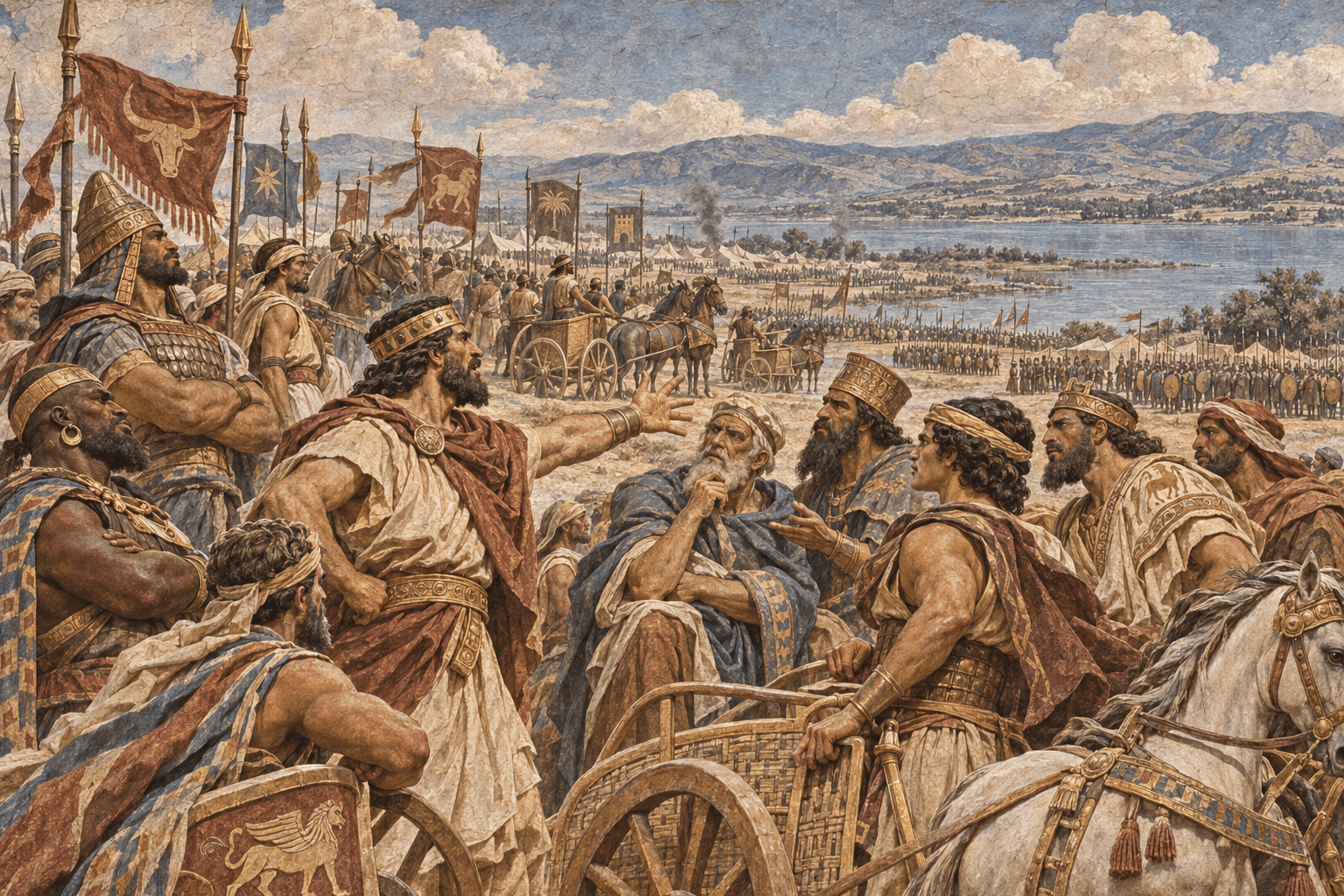
When Jabin king of Hazor heard of Joshua’s victories, he sent to the kings around him in the north and the east, and the armies gathered together, much people, as the sand that is upon the sea shore, with horses and chariots very many, to fight Joshua and his men.
The word “Jabin,” in the opinion of some, is a title belonging to all the kings of Canaan, like “Pharaoh” for the kings of Egypt, Abimelech in Philistia, and Harith for the kings of northern Arabia. In Canaanite the word means “God observes,” though Origen sees it as meaning “thoughts” or “skill.” The town of “Hazor” means in Hebrew “enclosure,” and in Origen’s opinion “palace.” Some believe that this city lay on the waters of Merom; perhaps it is Tell el-Qedah, four miles west of the Bridge of the Daughters of Jacob, where remains of the city from the Canaanite and Hebrew periods have been discovered.
Origen sees what Jabin king of Hazor did as a symbol of what Satan, or satanic thoughts, does in stirring up spiritual wars in the world as though it were his palace or his fold. He gives as an example these thoughts which he cast into the heart of the king of Babylon when he fell into pride, determined to tear down the strongholds of the peoples and plunder their treasures. He also sees in Jabin a symbol of the serpent, the most subtle of the beasts of the earth, which was able to corrupt the life of mankind, destroy its peace and make it lose Paradise!
So Jabin, meaning thoughts or skill, points to the arrogant thoughts of Satan, or his tricks and skill in deceiving mankind. As for “Hazor,” that is, “enclosure” or “palace,” Origen says:
“The whole earth is the palace of this king, who received authority over the whole earth as if it were his palace: he is Satan! … It is written in the Gospels that the strong man sleeps in his palace in safety until one stronger than he comes, binds him in chains and takes away his goods. So the king of the palace is the prince of this world. [190]”
2. Jabin’s Allies
KJV · Verses 2–4
2 And to the kings that were on the north of the mountains, and of the plains south of Chinneroth, and in the valley, and in the borders of Dor on the west, 3 And to the Canaanite on the east and on the west, and to the Amorite, and the Hittite, and the Perizzite, and the Jebusite in the mountains, and to the Hivite under Hermon in the land of Mizpeh. 4 And they went out, they and all their hosts with them, much people, even as the sand that is upon the sea shore in multitude, with horses and chariots very many.
Jabin stirred up the other kings to fight. It is as if satanic thoughts, arrogant and full of deceit, stir up all the energies of man and the circumstances around him to work for their kingdom instead of working for the kingdom of the true Joshua. Among these kings:
First: Jobab king of Madon. “Jobab” in Hebrew means “crying out,” and “Madon” in Canaanite means “strife”; it is probably Khirbet Madin near Hattin in Galilee. Origen sees “Jobab” as meaning “enmity” and “Madon” as meaning “bitterness.” He says:
“Satan (Jabin) sends to another hostile power, belonging of course to the rebellious angels, that is, to the king of bitterness. From this king and his works bitterness and hardships come upon the poor, perishing sons of men. Truly all kinds of sins are bitter; there is nothing more bitter than they, even if at the beginning they carry some sweetness, as Solomon wrote … On the contrary, righteousness seems bitter at first, but its end is sweeter than honey, when it yields the fruits of virtue. [191]”
So, since the devil bears a nature of hatred and loathing, especially against man — the weaker vessel, the object of God’s love, who occupies the position the devil and his hosts held before their fall — he does not cease to stir up everything bitter against them, to rob them of their joy in the Lord, their spiritual delight and their inner peace.
Second: the king of Shimron. In Origen’s opinion “Shimron” means “hearing,” and he compares Shimron with Samuel: the latter is the fruit of God’s hearing the voice of man and his prayers (1 Samuel 1:20), while the former, Shimron, represents “hearing the voice of the devil and his commandments.” Thus the devil strives with all his energy to establish a kingdom for himself among men, subject to his law, whose essence is injustice and defilement!
Third: the king of Achshaph. This is the third king whom Jabin king of Hazor summons. In Origen’s opinion “Achshaph” means “how quickly this passes away!” It is as if the devil’s kingdom in reality rests on what is quickly passing; yet he uses all his deceits to draw mankind into his kingdom, to give them what is passing and quickly perishing! If Shimron draws man to hear the devil’s voice, the king of Achshaph offers from his own store what is in reality nothing! Origen says:
“These are the very words of the devil: ‘All these things will I give thee, if thou wilt fall down and worship me’ (Matthew 4:9). If you serve Jesus, answer him thus: ‘I worship my Lord and God, and no other besides Him.’ But the helpers of the devil listen to him, as did the king of Shimron, who listened to Jabin and went to fight Joshua. [192]”
But what did Shimron gain from listening to Jabin’s voice and his enticements but destruction and death? And we too, if we listen to the voice of the enemy, seeking earthly pleasures and resisting the work of our true Jesus, what shall we gain? Origen says: “How quickly pleasures pass away, and how near their end, which sinners think are lasting!” [193]
Fourth: the kings that were in the mountains on the north. Just as the holy mountains point to the kingdom of God, on which stands the city of God that cannot be hid, and on which the Lord was transfigured before His prophets and disciples, the men of the Old and New Testaments, the departed and the living — so the demons have known mountains over which they reign: the thoughts of lofty pride, to which they lead souls in order to send them down from there into the abyss.
Fifth: the king of the plains south of Chinneroth. Origen sees that the word “Arabah” (plain) means “treachery,” and the word “Chinneroth” means “like lamps.” It is as if the devil uses every kind of crookedness to deceive us, appearing as a shining lamp or an angel of light, though in reality he is darkness! He says: “He summons the powers of treachery, not to attack men’s souls openly, but to surprise them by crooked ways … if we can say with Paul: we are not ignorant of his devices.” [194]
Sixth: the king of Dor on the west, whether in the valley or in the heights. Origen sees that “Dor” means “guidance” — but not guidance from evil to good; rather, a guidance stirred up by Jabin to turn believers away from the truth under the cover of the Gospel, as happened in Galatia. The Apostle says:
“I marvel that ye are so soon removed from him that called you into the grace of Christ unto another gospel … But though we, or an angel from heaven, preach any other gospel unto you than that which we have preached unto you, let him be accursed” (Galatians 1:6–8). This is the work of the inhabitants of Dor: to fight believers secretly through the Gospel, presenting wrong and perverted ideas far from the spirit of truth.
Seventh: the Canaanites. Jabin king of Hazor sends to the kings of the Canaanites to attack Joshua’s men. “Canaanites” means “agitation,” that is, those who create an atmosphere of turmoil and agitation in every circumstance, so that believers lose their inner peace and live as in the midst of the waves. [195]
Eighth: the Amorites. “Amorites” means “becoming bitter.” The work of the enemy of good is to embitter the souls of believers, to rob them of every spiritual sweetness within, and crush them with despair and weariness.
So at the call of Jabin king of Hazor these kings gathered with their armies, “much people, even as the sand that is upon the sea shore in multitude, with horses and chariots very many” [4]. The spiritual wars are fierce, violent and bitter, for the enemies are very many and violent, with their horses and their various chariots. Some come forward in strife and enmity to embitter our lives, like Jobab king of Madon; some use every means to make us listen to the voice of the enemy, like the king of Shimron; some entice us with passing things, like the king of Achshaph; some puff us up with thoughts of vainglory and pride, like the kings in the mountains; some deceive us like shining lamps, like the king of the plains south of Chinneroth; some stir up troubles around us, like the Canaanites, or embitter the circumstances surrounding us, like the Amorites …
How many are the tricks of the devil our enemy, for he uses every means to destroy us!
That is why the Apostle Peter says: “Be sober, be vigilant; because your adversary the devil, as a roaring lion, walketh about, seeking whom he may devour: whom resist stedfast in the faith” (1 Peter 5:8–9).
3. The Battle at the Waters of Merom
KJV · Verses 5–8
5 And when all these kings were met together, they came and pitched together at the waters of Merom, to fight against Israel. 6 And the Lord said unto Joshua, Be not afraid because of them: for to morrow about this time will I deliver them up all slain before Israel: thou shalt hough their horses, and burn their chariots with fire. 7 So Joshua came, and all the people of war with him, against them by the waters of Merom suddenly; and they fell upon them. 8 And the Lord delivered them into the hand of Israel, who smote them, and chased them unto great Zidon, and unto Misrephothmaim, and unto the valley of Mizpeh eastward; and they smote them, until they left them none remaining.
If with every victory the powers of darkness rage, then with every raging of the powers of darkness the Lord affirms anew that He grants a new victory on a greater level … In fact the Book of Joshua is a series of successive wars, or more precisely a series of successive victories, through which the believer goes from glory to glory until he reaches “the measure of the stature of the fulness of Christ” (Ephesians 4:13), and the whole Church is adorned and prepared in glory for the eternal wedding.
The Lord assures Joshua: “Be not afraid because of them.” In our spiritual warfare God wants us to be full of confidence in Him that He is the Victor, and that through Him we conquer. He wants to work through His believers, not through unbelievers; He supports the souls that lean on Him, not those that tremble.
Why does the Lord say, “For to morrow about this time will I deliver them up all slain …” [6]? Because “to morrow” points to what lies beyond this age. Though we gain successive victories and enjoy a spiritual authority over darkness that grows with our spiritual growth, we remain in a war that does not end until the morrow comes, when the devil is cast into the lake burning with fire. Origen says:
“It is the appointed time in which all the hostile power perishes, when it is utterly defeated. That is when you see those on the left being told: ‘Depart from me, ye cursed, into everlasting fire, prepared for the devil and his angels’ (Matthew 25:41). It is the very time in which we too, if we are victorious — that is, if we have been able to gain the victory in following Jesus our Captain — shall have the kingdom which He has prepared for His saints who have carried out the Lord’s teachings and done righteousness; we shall enjoy it from the hands of our Lord Jesus Christ, to whom be glory and power for ever and ever. Amen. [196]”
“So Joshua came, and all the people of war with him, against them by the waters of Merom suddenly; and they fell upon them. And the Lord delivered them into the hand of Israel, who smote them, and chased them unto great Zidon, and unto Misrephoth-maim, and unto the valley of Mizpeh eastward; and they smote them, until they left them none remaining” [7–8].
Victory was accomplished for Joshua and his men by smiting Jabin and all his followers until none remained. We observe in this battle the following:
First: as the hostile kings gathered under the leadership of Jabin king of Hazor, so the men of war gathered with Joshua under his leadership. Our spiritual war is for our true Captain, Jesus Christ our Lord. If we go into battle under His leadership we conquer and triumph; but if we rely on ourselves, our skill, our ability and our weapons, we fall and are defeated. Let us cry continually to our Joshua, for He alone knows the devil’s tricks in all their details and has the authority to tear them down completely.
Second: though this war points to the spiritual war within the heart, it is nevertheless not an individual war against each of us alone; it is the war of the devil’s kingdom against the whole Church as the kingdom of God. So, as all the men of war gathered with Joshua, it befits us in our spiritual struggle to carry the communal spirit. In my struggle I ask the prayers of my brethren who struggle, and of my fathers and brethren who have conquered and departed!
Every victory accomplished in the depths of my soul is a victory of the whole Church, through which she enters a greater perfection and a more wonderful beauty; and conversely, every weakness into which I fall is at the community’s expense! Let us struggle in the spirit of the community, the spirit of unity and love in Christ Jesus.
Third: Joshua and his men waged an offensive war against Jabin and his men; they came upon them suddenly and fell upon them. It is as if the Lord Christ wants us not to stand waiting for sin and, when it attacks us, defend ourselves; rather, we should begin with all our energy to attack every sin first, before it has a place in us and gains authority over us. Let us not stand in fear and weakness before sin, but in strength and power, so that we conquer and triumph and drive it to great Zidon, that is, to the place of hunting.
Let us catch it before it catches us, and leave none of it to escape into our senses or our inner heart, but crush it completely.
Fourth: Scripture says, “and chased them unto great Zidon.” The word “Zidon” means “hunting”; so the region of Zidon points to the place where the enemy hunts the souls of believers, as the Psalmist says:
“They have prepared a net for my steps” (Psalm 57:6). That is why God allowed the devil (Jabin) and his followers to be driven to great Zidon, as if he falls into the great snares he set for the believers. He sets the snare for us, and it is he who falls into it. By the blows the enemy aims at us to destroy us, we as believers gain triumph and victory and become worthy of the crown, while he fills up the cup of his wickedness and falls into destruction.
4. Houghing Their Horses
KJV · Verses 9
9 And Joshua did unto them as the Lord bade him: he houghed their horses, and burnt their chariots with fire.
“And Joshua did unto them as the Lord bade him: he houghed their horses, and burnt their chariots with fire” [9]. Origen asks why the divine command was to hough their horses, that is, to hamstring them, without ordering the horses to be taken as spoil; whereas in the days of Moses, when they overcame Midian, they “took the spoil of all their cattle, and all their flocks, and all their goods” (Numbers 31:9), and when the spoil was counted there were among it 61,000 asses (Numbers 31:32–34), which they were allowed to take for their personal use, while the horses were killed.
Saint Ambrose sees that man, by falling under the weight of sins, became like the ass. He says:
“The ass is a lazy and stupid animal that can easily be devoured … What lesson does this animal teach us? That we should be more watchful and not live in stupidity, in sluggishness of body and mind! Should we not rather take refuge in the faith that lightens our heavy loads? [197]”
At the same time the same saint warns us against imitating horses: “Why do you deprive yourself of the reason that God has given you …? This is the will of God, that we should not be so, for He says: ‘Be ye not as the horse, or as the mule, which have no understanding’ (Psalm 32:9).” [198]
Origen sees that man uses the ass to carry burdens and to travel, for his service and comfort, but uses the horse in war for destruction. So the ass came to point to mankind, while the horse points to the arrogant, destroying devil. That is why the law cared for asses rather than horses:
“If thou meet thine enemy’s ox or his ass going astray, thou shalt surely bring it back to him again. If thou see the ass of him that hateth thee lying under his burden, and wouldest forbear to help him, thou shalt surely help with him” (Exodus 23:4–5).
And in the Book of Zechariah, while announcing the entry of the Lord Christ riding an ass and a colt the foal of an ass, he affirms the destruction of war chariots and horses as a sign of the coming of peace: “Rejoice greatly, O daughter of Zion; shout, O daughter of Jerusalem: behold, thy King cometh unto thee: he is just, and having salvation; lowly, and riding upon an ass, and upon a colt the foal of an ass. And I will cut off the chariot from Ephraim, and the horse from Jerusalem, and the battle bow shall be cut off: and he shall speak peace unto the heathen: and his dominion shall be from sea even to sea, and from the river even to the ends of the earth” (Zechariah 9:9–10). Origen says:
“See, according to the prophet, He who rides on the colt cut off the chariot from Ephraim and the horse from Jerusalem. Therefore I believe that the ass and the colt here point to the believers in whom Christ sits, while the horses, on the contrary, represent an image of those who were in heaven and came down because of their pride and haughtiness … those who followed the one who said, ‘I will ascend above the heights of the clouds; I will be like the most High’ (Isaiah 14:14). For this reason, I think, the prophet says: ‘An horse is a vain thing for safety: neither shall he deliver any by his great strength’ (Psalm 33:17). So too it is said of those who trust in Satan: ‘Some trust in chariots, and some in horses: but we will remember the name of the Lord our God’ (Psalm 20:7). The comparison here is not really between chariots (horses) and the Lord as two things to which we pray; rather, it shows that we pray to the true God, while they pray to chariots and horses, that is, to Satan. [199]”
So the horses which Joshua and his men were bound to hough, and the chariots he burned with fire, point to the crushing of the devil’s powers, that is, sin — especially the lusts of the flesh that corrupt the spirit.
We are bound to draw the sword of the Spirit, which is the word of God (Ephesians 6:17), from its sheath and strike with it the evil bodily lusts, as one who houghs horses. If Jabin, that is, the devil, pursues us with his horses — “the carnal mind,” which “is enmity against God” (Romans 8:7) — offering us his arrogant thoughts, which belong to the fleshly mind (Colossians 2:8), let us take refuge in our Joshua, who receives us as spiritual soldiers carrying His weapons, which hough the horses and burn the evil chariots.
In our study of the cherubic chariot that bears the divine throne, we saw it as representing holy “human life,” which by the fiery Holy Spirit has become a throne for God and a holy temple for Him; [200] every detail of the chariot corresponds to our life sanctified in the Lord. On the other side, the chariots of Satan are the defiled hearts that persist in their wickedness and have become a throne for him, carrying his thought and his deceits and working for him … these will burn with him in the fire prepared for the devil and his soldiers!
As long as we are in the world, God is able to turn the hearts of the wicked into a holy temple for Himself by His Holy Spirit, if they accept His fiery work in them, before they are cast into another fire, which does not befit believers and was not prepared for men, but for the devil and his angels!
5. The Utter Destruction of Evil
KJV · Verses 10–22
10 And Joshua at that time turned back, and took Hazor, and smote the king thereof with the sword: for Hazor beforetime was the head of all those kingdoms. 11 And they smote all the souls that were therein with the edge of the sword, utterly destroying them: there was not any left to breathe: and he burnt Hazor with fire. 12 And all the cities of those kings, and all the kings of them, did Joshua take, and smote them with the edge of the sword, and he utterly destroyed them, as Moses the servant of the Lord commanded. 13 But as for the cities that stood still in their strength, Israel burned none of them, save Hazor only; that did Joshua burn. 14 And all the spoil of these cities, and the cattle, the children of Israel took for a prey unto themselves; but every man they smote with the edge of the sword, until they had destroyed them, neither left they any to breathe. 15 As the Lord commanded Moses his servant, so did Moses command Joshua, and so did Joshua; he left nothing undone of all that the Lord commanded Moses. 16 So Joshua took all that land, the hills, and all the south country, and all the land of Goshen, and the valley, and the plain, and the mountain of Israel, and the valley of the same; 17 Even from the mount Halak, that goeth up to Seir, even unto Baalgad in the valley of Lebanon under mount Hermon: and all their kings he took, and smote them, and slew them. 18 Joshua made war a long time with all those kings. 19 There was not a city that made peace with the children of Israel, save the Hivites the inhabitants of Gibeon: all other they took in battle. 20 For it was of the Lord to harden their hearts, that they should come against Israel in battle, that he might destroy them utterly, and that they might have no favour, but that he might destroy them, as the Lord commanded Moses. 21 And at that time came Joshua, and cut off the Anakims from the mountains, from Hebron, from Debir, from Anab, and from all the mountains of Judah, and from all the mountains of Israel: Joshua destroyed them utterly with their cities. 22 There was none of the Anakims left in the land of the children of Israel: only in Gaza, in Gath, and in Ashdod, there remained.
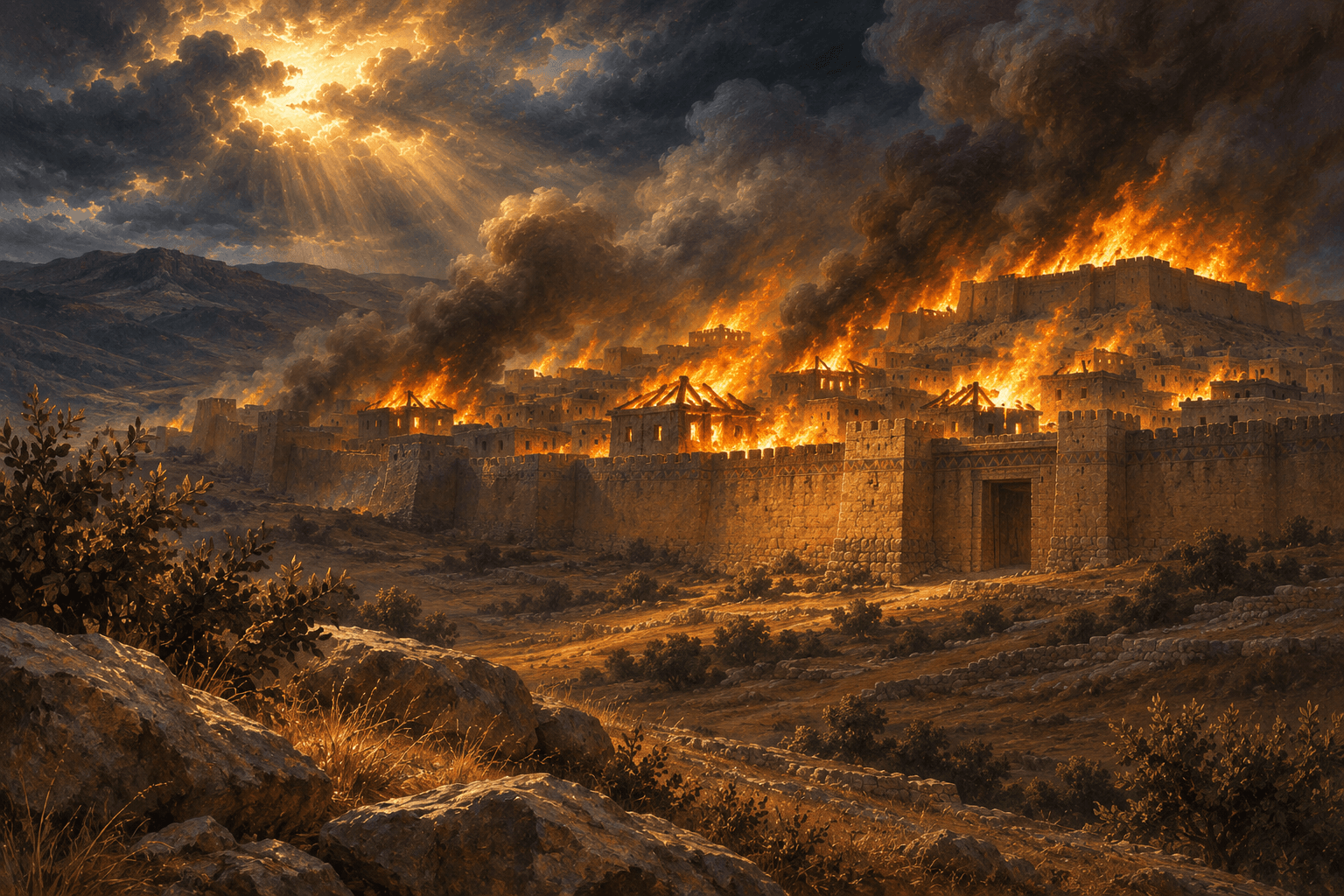
“And Joshua at that time turned back, and took Hazor, and smote the king thereof with the sword: for Hazor beforetime was the head of all those kingdoms. And they smote all the souls that were therein with the edge of the sword, utterly destroying them: there was not any left to breathe: and he burnt Hazor with fire” [10–11].
The matter does not stop at houghing Jabin’s horses and burning his chariots with fire; with boldness and strength Joshua returns with his men to take Hazor, smite its king with the sword, kill every breathing thing in it, and burn it with fire. If Hazor, meaning “the palace,” was the center of Jabin’s kingdom, then after we have overcome the evil lusts of the body by our true Joshua and burned every trace of them, we must return with our Jesus to Hazor — to where the devil used to reign and dominate … to our lives, which the enemy used as the palace of his kingdom — so that we may smite the devil through Jesus Christ our Lord, who alone conquers. As Origen says:
“We were under ‘the reign of sin’ (Romans 6:12), under the reign of evil lusts; that is, sin in general reigned over us, as the Apostle says: ‘For all have sinned, and come short of the glory of God’ (Romans 3:23). In each of us there is a particular king who rules over us and dwells in us: in one man avarice dwells and occupies the kingdom; in another vanity; in another falsehood; in another bodily lusts; in another anger. So the Apostle Paul says: ‘Let not sin therefore reign in your mortal body, that ye should obey it in the lusts thereof’ (Romans 6:12). Before we had faith there was in each of us a kingdom of sin; but with the coming of Jesus all the kings who ruled over us were slain … and He teaches us how to kill them all and let none of them escape. For if we leave one alive, we cannot be counted followers of the sword of Joshua. If the sin of avarice, vanity or bodily lust reigns in you, you are not one of the soldiers of Israel, nor have you followed the command the Lord gave to Joshua. [201]”
The divine command was the complete destruction of evil, leaving no trace of it, so that it might not return to reign over the heart again. This is the command Joshua obeyed, for it is said: “For it was of the Lord to harden their hearts, that they should come against Israel in battle, that he might destroy them utterly, and that they might have no favour, but that he might destroy them, as the Lord commanded Moses” [20]. Origen says:
“It does not say that Joshua seized one in the war and left another, but that he seized them all, that is, took them and killed them all; for the Lord Jesus has cleansed us from every kind of sin and torn them all down. Formerly we were in truth all ‘foolish, disobedient, deceived, serving divers lusts and pleasures, living in malice and envy, hateful, and hating one another’ (Titus 3:3); that is, there were in us all the kinds of sin found in man before faith. But Joshua slew all who went out against the Lord; there is no sin, however great, that God cannot forgive. He is the Word and ‘the wisdom of God’ (1 Corinthians 1:24), who overcomes all things. Do you not agree with me that sin of every kind was taken away from us in the waters of baptism? This is what the Apostle Paul wished to say when, after listing all kinds of sins, he added: ‘And such were some of you: but ye are washed, but ye are sanctified, but ye are justified in the name of the Lord Jesus, and by the Spirit of our God’ (1 Corinthians 6:11). [202]”
Again Origen says:
“How is the word of Scripture fulfilled in us, that there was not any left to breathe (Joshua 11:11) …? Suppose a feeling of anger rises in my heart; this feeling may not reach the point of action for fear of future punishment. But this is not enough; according to the Scriptures, I must behave so that no movement of anger at all remains in me. For if the soul is disturbed, even if the thought does not reach the point of action, this disturbance itself does not befit a soldier of Christ. The soldiers of Joshua must behave so as to leave nothing to trouble their heart. If anything is left, whether a habit or merely a wrong thought, it can grow with time, increase and strengthen, and finally lead us back to our vomit (Proverbs 26:11), so that the last state is worse than the first (Luke 11:26). This is what the prophetic psalm means: ‘Happy shall he be, that taketh and dasheth thy little ones against the stones’ (Psalm 137:9). By the little ones of Babylon he means evil thoughts … which, when we feel them to be small and at their beginning, we must seize and cut off and dash against the rock, which is Christ (1 Corinthians 10:4). We must kill them according to the Lord’s command, and not leave any breath of them to breathe within us. Blessed, then, is he who seizes the little ones of Babylon and dashes them against the rock and kills them while they are still beginning thoughts. [203]”
Scripture says of Joshua and his men that “they smote all the souls that were therein with the edge of the sword, utterly destroying them: there was not any left to breathe: and he burnt Hazor with fire” [11]. The matter does not stop with destroying every breath of evil, so that it never breathes within us; he also burned Hazor — the palace of King Jabin — with fire. What is this fire which Joshua casts on the palace, if not the fire of the Holy Spirit, which burns up in us all the thorns that choke the soul, so that our Hazor is no longer a palace for Jabin but for Joshua?
Instead of the devil’s kingdom, the kingdom of Jesus our Lord is established by His fiery Spirit, who sanctifies our inner depths.
Finally, it was of the Lord that the evil kings were hardened to fight God’s people. In this way the cup of the devil’s wickedness and that of his soldiers is filled, so that they deservedly become fit for destruction and crushing; and at the same time the hearts of God’s children are strengthened for spiritual warfare, so that they are approved in God’s eyes and become worthy of the crowns of victory. The hardening of the kings’ hearts does not mean that God casts hardness into them; rather, He lifts His hand from them so that their hardness, which God had restrained for a time to protect His people, appears.
At the fitting time He leaves them to do the desire of their heart, and they fall into the fruit of their own work.
6. The Land Rested
KJV · Verses 23
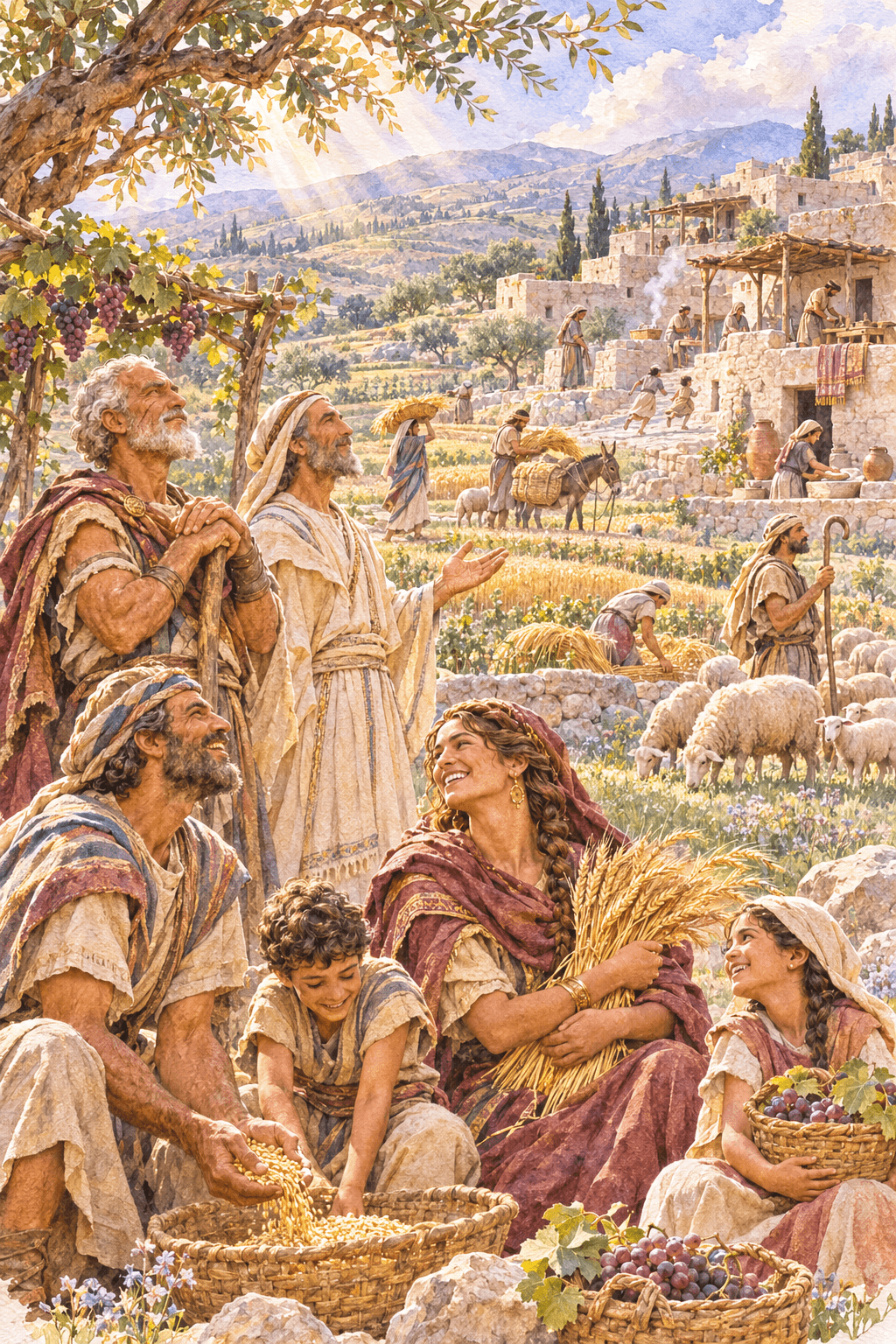
23 So Joshua took the whole land, according to all that the Lord said unto Moses; and Joshua gave it for an inheritance unto Israel according to their divisions by their tribes. And the land rested from war.
Origen says:
“In the days of Moses it was not said, as was said in the days of Joshua: ‘And the land rested from war’ (Joshua 11:23). Certainly this land, full of conflict and wars, could not rest from war except by the gift of the Lord Jesus … For in us there is a dwelling of the whole tribe of vices, working in our souls without leaving us any rest. Yes, within us are the Canaanites, the Perizzites and the Jebusites, whom we drive out with struggle, watchfulness and long patience; and in the end our land rests from war. [204]”
And elsewhere Origen says:
“How is it affirmed to the son of Nun that the land rested from war, though war did not cease in his time? This was fulfilled in the Lord Jesus … If you find in yourself that ‘the flesh lusteth against the Spirit, and the Spirit against the flesh’ (Galatians 5:17), then when you come to Jesus and receive the grace of baptism for the forgiveness of sins, the land that is you rests from war — on condition that you always bear about in the body the dying of the Lord Jesus, that the life also of Jesus might be made manifest in our body (2 Corinthians 4:10). In this way the war ends in you, and you become a peacemaker and are called a child of God (Matthew 5:9). Yes, this will be yours when the war ends and you triumph over your enemies; then you will have rest under your ‘vine,’ which is Jesus Christ, and under the fig tree (Micah 4:4), which is the Holy Spirit; and then you will give thanks to God Almighty, ‘to whom be praise and dominion for ever and ever. Amen’ (1 Peter 4:11). [205]”
Notes and References
[190] Origen, Homilies on Joshua 14:2.
[191] Origen, ibid.
[192] Origen, ibid. 14:3.
[193] Origen, ibid.
[194] Origen, ibid.
[195] Origen, ibid.
[196] Origen, ibid.
[197] Ambrose, Hexameron 6:3.
[198] Ambrose, ibid.
[199] Origen, Homilies on Joshua 15:3.
[200] By the author: Commentary on Ezekiel (Arabic), 1981, pp. 21–38.
[201] Origen, Homilies on Joshua 15:4.
[202] Origen, ibid. 12:5.
[203] Origen, ibid. 15:3.
[204] Origen, ibid. 1:6.
[205] Origen, ibid. 15:7.