
Part One: Spiritual Warfare and Victory (Joshua 1–12)
1. Preparation for the inheritance (Joshua 1–5).
2. The inheritance of the central region (Joshua 6–8).
3. The inheritance of the south (Joshua 9–10).
4. The inheritance of the north (Joshua 11–12).
Preparation for the Inheritance
The Book of Exodus gave us a living picture of the crossing out of the land of bondage and the departure from Pharaoh’s captivity. But that work remains incomplete and without profit unless those who have crossed enter the land of promise and enjoy the promises of God. In its negative side the crossing is an exodus; in its positive side it is an entrance! It is liberation from the captivity of the devil in order to enjoy entering into the divine embrace in Christ Jesus, the true Leader of the spiritual crossing.
Just as the exodus required long preparations — seen in the appearance of Moses as the first leader of the people, in God’s work with him in his dealings with Pharaoh and with the people, and in God’s revelation of salvation through the plagues, especially the plague of the firstborn which required the slaying of the Passover lamb, and the parting of the Red Sea — so also the entrance into the inheritance needed many preparations, which the Book of Joshua records in its first five chapters:
In chapter one, God declares that He is the true Worker in this salvation. It is He who chooses Joshua, and He who supports him and the people by His life-giving word, by the spiritual food He offers them, and by His faithfulness in fulfilling His promises.
In chapter two, the human side stands out in the person of Rahab, the Gentile harlot, who, in spite of her great poverty in the enjoyment of salvation, entered by living faith as a member of the holy congregation; indeed, the Messiah, the Savior, came from her seed.
In chapter three, he presents to us what the Jordan makes possible: Jesus Christ Himself brings us into its sweet waters, so that we turn our backs on the wilderness and look upon the eternal inheritance, not as something strange or far from us! Through holy baptism illumination takes place, and we perceive what cannot otherwise be perceived!
In chapter four, the Church hidden in the waters of the Jordan appears, as the tribes carry twelve stones representing the Church. There is no crossing to the eternal inheritance outside the hidden Church, that is, outside membership in the body of Christ.
Finally, in chapter five, the second circumcision takes place and the Passover is kept. There is no entering the inheritance with the old man; the circumcision of the heart is needed so that the new man may take the place of the old. All this is fulfilled only through Christ Jesus our Passover.
In short, the means given to us for enjoying the eternal inheritance are:
1. Realizing that God is the One who works in us and is our spiritual Leader (Joshua 1).
2. Enjoying a living, practical faith (Rahab the harlot, Joshua 2).
3. Enjoying sonship through baptism (the crossing of the Jordan, Joshua 3).
4. Entering into membership of the Church (Joshua 4).
5. Putting off the old man and putting on the new through the new Passover (Joshua 5).
Chapter One: God Is the Worker — The Choice of Joshua
The book opens with the announcement of Moses’ death and the handing over of the leadership to Joshua. In announcing this transfer of leadership, divine inspiration made it very clear that the true Leader is God, who chooses His servants, grants them help and wisdom, supports them by His law — His divine word — and accompanies them in every work.
1. Moses dies that Joshua may reign (1–2).
2. God’s faithfulness in His promises (3–4).
3. His presence with His servants (5–7).
4. His law as a support for His servants (8–9).
5. The divine provision (10–11).
6. The human role (12–18).
1. Moses Dies That Joshua May Reign
KJV · Verses 1–2
1 Now after the death of Moses the servant of the Lord it came to pass, that the Lord spake unto Joshua the son of Nun, Moses' minister, saying, 2 Moses my servant is dead; now therefore arise, go over this Jordan, thou, and all this people, unto the land which I do give to them, even to the children of Israel.
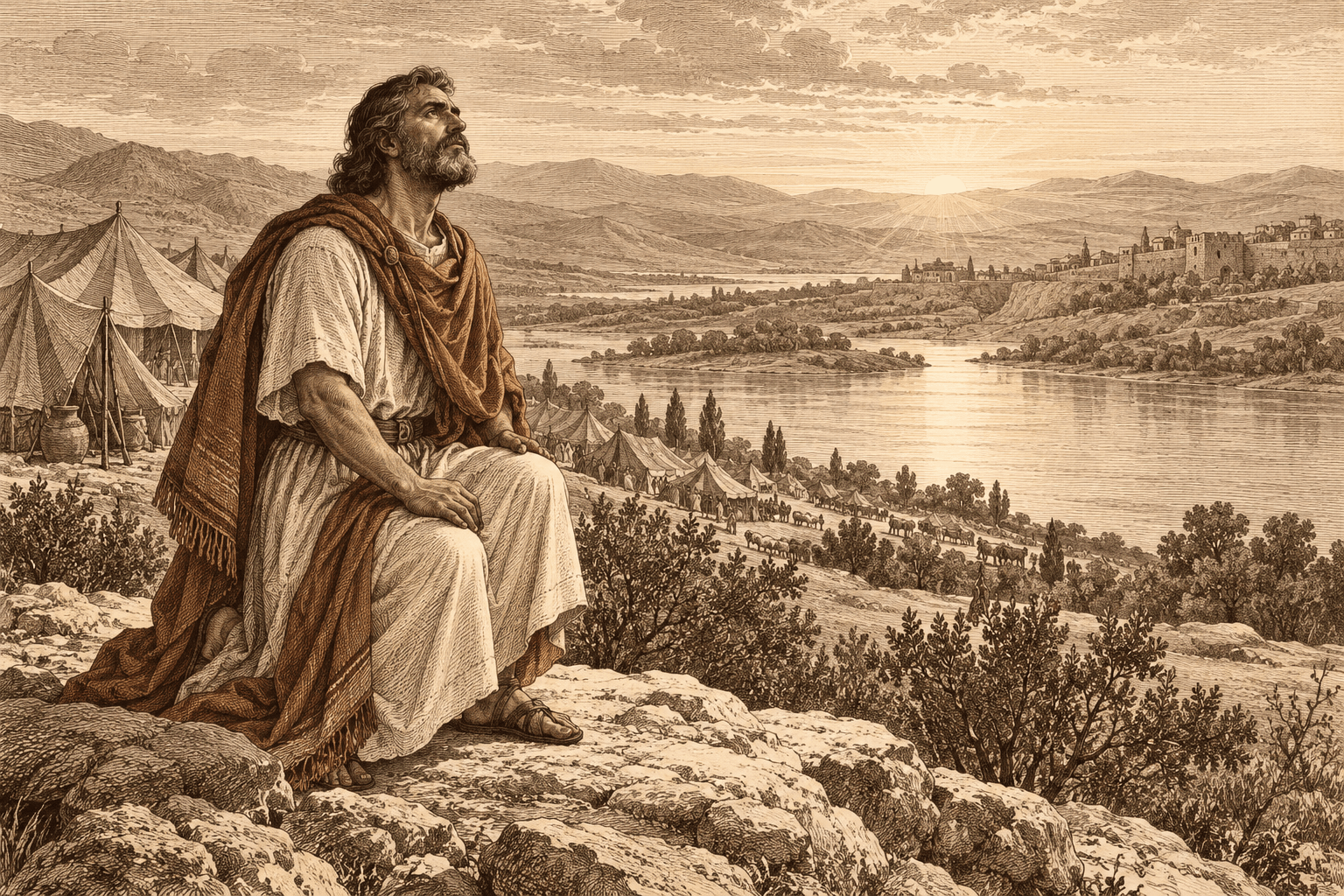
God, who had earlier chosen Moses to lead the people out of the land of bondage to Mount Sinai, so that they might receive the divine law as a guide and help in the wilderness of this world — assuring him, “Certainly I will be with thee” (Exodus 3:12) — is the very One who now announces the death of Moses and raises up Joshua as the leader of the crossing and the one who brings the people into the inheritance. Moses had to die for Joshua to appear; the age of the law had to end so that we might enjoy the covenant of grace.
For God is the Worker in both covenants through His integrated divine plan. The secret of power in the ministry of Moses or of Joshua lies in the call given to them by God to accomplish divine purposes.
The God who chose Moses as a representative of His law is the One who permitted his death in order to raise up Joshua as a representative of Jesus, His only-begotten Son. We have already spoken, in the introduction to this book, of the connection between the death of Moses and the rise of Joshua, that is, the passing away of the law so that we may enjoy grace.
Father Caesarius, Bishop of Arles, says:
“Moses died and Joshua reigned! The old law came to an end, and the true Joshua, that is, Jesus, reigned. Truly the Evangelist bears witness: ‘The law and the prophets were until John’ (Luke 16:16). In the Gospel, ‘Moses’ is used to mean ‘the law,’ as when it is said, ‘They have Moses and the prophets’ (Luke 16:29), that is, they have the law and the prophets. And the Apostle says, ‘But even unto this day, when Moses is read’ (2 Corinthians 3:15), that is, when the law is read. So when the law ceases, Jesus our Lord ascends the throne. [36]”
In other words, Saint Irenaeus says:
“It was fitting that Moses should lead the people out of Egypt, but that Jesus [Joshua] should lead them into the inheritance. Moses, as a figure of the law, had to cease; but Joshua (Jesus), being the Word made flesh, proclaims the good news to the people. [37]”
God, who called Moses to the work, now calls Joshua; or, as the Apostle Paul puts it, God, who spoke to us formerly through the law and the prophets, “hath in these last days spoken unto us by his Son” (Hebrews 1:1–2).
The matter did not stop at the call of Joshua; God remained the true spiritual Leader working through Joshua. He gave him His command: “Arise, go over this Jordan, thou, and all this people, unto the land which I do give to them” [2]. We may venture to say that this divine command represents a symbolic act revealing the relationship between the Father and His beloved Son Jesus. If Jesus “became obedient unto death, even the death of the cross” (Philippians 2:8), the Father raised Him — not as an external gift He bestows on Him, but as a declaration that the cross was accepted, through the will of the Father that the Son should rise — so that He and His people might cross the river Jordan (the waters of baptism), and we might receive a share in the eternal inheritance.
Jesus is “the resurrection” (John 11:25); He had declared of Himself that He has the power to lay down His life unto death and the power to take it again (John 10:18). For our sake He accepts death, and for our sake He receives the resurrection, which is not something external granted to Him, for He is the Giver of life (John 11:25). This is what was revealed symbolically when God said to Joshua, “Arise, go over.” The Son rose in obedience to the Father and carried us across our grave, granting us the power of the resurrection through His baptism, so that we sing: He “hath raised us up together, and made us sit together in heavenly places in Christ Jesus” (Ephesians 2:6).
It was not possible for Moses the prophet to cross the Jordan and enter the land of the inheritance, for he did not bear the power of the resurrection, nor the authority to crush the dragon lying in the waters (Isaiah 27:1). But Joshua bore the figure of Christ Jesus, who crosses over in power, crushing the dragon and breaking the sting of death by His resurrection (1 Corinthians 15:55; Revelation 20:2).
2. God’s Faithfulness in His Promises
KJV · Verses 3–4
3 Every place that the sole of your foot shall tread upon, that have I given unto you, as I said unto Moses. 4 From the wilderness and this Lebanon even unto the great river, the river Euphrates, all the land of the Hittites, and unto the great sea toward the going down of the sun, shall be your coast.
God had already assured Moses that He would give them the land He had promised to the fathers Abraham, Isaac and Jacob. God remains faithful in His promises in spite of our unfaithfulness, as the Apostle says: “For what if some did not believe? shall their unbelief make the faith of God without effect? God forbid: yea, let God be true, but every man a liar” (Romans 3:3–4). Though the generation that came out of Egypt, out of Pharaoh’s bondage, disobeyed God, God remains faithful and fulfills His promises to their children.
He is faithful in His promises, and He knows “the fulness of the time” in which He offers His gifts according to His wise divine plan for our salvation and our good. Because of his human weakness and his attachment to passing time, man wants to see God give him everything at once. But God, who cares for our salvation, not only knows what to give and how much to give, but also fixes the fitting time, so that His gifts may achieve their purpose in us.
Abraham and Sarah asked for a son, perhaps for many years, until they grew old and despaired, so that Sarah asked her husband to raise up offspring through her maidservant. Yet God gave her Isaac from her own womb (which had become as dead), a blessed son who came at the fitting time to fulfill a part of God’s plan for the salvation of all mankind! He gave her what she had not expected or dreamed of, but at the time He Himself appointed!
God is faithful in His promises, even if we think He is late in giving. That is on His side. On our side, it is not fitting for us to meet the positiveness of God’s love toward us with our negativity, or His faithfulness with unfaithfulness. That is why the Lord says to the bishop of the church of Smyrna:
“Be thou faithful unto death, and I will give thee a crown of life” (Revelation 2:10). But how can we bear this mark, the mark of faithfulness, except by our union with the only Faithful One, who is able to grant us His own attributes working in us? The Apostle Paul says: “Faithful is he that calleth you, who also will do it” (1 Thessalonians 5:24). He alone is the Faithful One, able to give us His faithfulness working in us through our communion with Him!
So much for God’s faithfulness and for our commitment to faithfulness through our union with Him. As for the gift He offers, He says: “Every place that the sole of your foot shall tread upon, that have I given unto you” [3].
It is as if God wants to bring us into a race without end. He gives without limit; it is we who set the limits. Let us run swiftly while we are in the world, and let us tread every love of the world under the soles of our feet, for every place the soles of our feet tread upon, God gives us as a possession and a gift from Himself!
Our fathers lived in this race, longing to enjoy the free inheritance through their unceasing struggle in the Lord, as the Apostle says: “Forgetting those things which are behind, and reaching forth unto those things which are before, I press toward the mark for the prize of the high calling of God in Christ Jesus” (Philippians 3:11–14).
As for the inheritance, does God care that we inherit our land, or does He mean the literal sense of treading the ground with the soles of our feet? I do not think so. Though in the Old Testament He promised the people the lands their feet would tread upon, this in its essence carried something greater: our inheritance of heavenly places which we shall enter and dwell in! Some of the Fathers see that these lands point to the position the devil and his hosts held before the fall, when he was a luminous angel near to God, “the morning star,” who fell with his angels; and by his fall he trod our hearts under his feet.
Therefore, under the leadership of the true Joshua, we must recover our land and tread the devil and his hosts under our feet, according to the Lord’s promise that He has given us “power to tread on serpents and scorpions, and over all the power of the enemy” (Luke 10:19). We not only recover our hearts, but we also occupy the position that once belonged to the devil.
On this, Origen says:
“See what Joshua promised his soldiers at that time: ‘Every place that the sole of your foot shall tread upon, that have I given unto you’ (Joshua 1:3). For those who lived then, the promise meant the land of the Canaanites, the Perizzites, the Jebusites and all the nations whose land was taken from them as an inheritance after its unworthy inhabitants were driven out. But for us these words contain other promises. There are powerful satanic races against which we wage war and wrestle fiercely in this life. If we tread these great powers under our feet and overcome them in battle, we occupy their lands, provinces and kingdoms, which the Lord Jesus distributes to us. For these mighty ones were once angels, sharing in the splendor of the kingdom of God. Do we not read in Isaiah what he says of one of them: ‘How art thou fallen from heaven, O Lucifer, son of the morning!’ (Isaiah 14:12)? The dwelling of the prince of demons was once plainly in the heavens; but since he has become a fallen angel, I can overcome him and tread him under my feet. If I am made worthy by the Lord Jesus to crush Satan under my feet (Romans 16:20), I gain the right to enjoy the place of the prince of demons in the heavens. This is how we understand the promise of our Lord Jesus, that every place the soles of our feet tread upon He gives to us. Do not think that we can enjoy this inheritance while we sleep in the slumber of sluggishness and neglect. [38]”
Origen presents to us the demon of anger as an example of what we must humble under our feet, in order to drive it out of the land of promise (our hearts), so that Jesus may reign there in its place. He says:
“Anger cast the angel down from his rank. If you do not conquer it in your heart, if you do not put away from yourself every movement of provocation and wrath, you will not be able to receive as an inheritance the place this angel occupied. But you cannot drive it out of the land of promise while you are slack. So also with pride, envy, selfishness and impurity. All these vices have their harmful angels that suggest evil and incite to it. If you do not conquer them in your heart, cleansing it of them — this heart that was once cleansed by the grace of baptism — you will never enjoy the promised inheritance. [39]”
Origen has another symbolic interpretation: in order to enjoy the eternal spiritual inheritance, the believer must first tread with his feet upon the low places, that is, tread upon the deadening literal interpretation, in order to enjoy the spiritual interpretation that lifts us to the heavens. Whoever walks by the spirit of the literal law lives with an earthly mind, but whoever walks by grace lives spiritually in the heavens. He says:
[…] that treading the land with the feet signifies the soul’s setting out, with its spiritual perceptions, toward spiritual thought and the deep interpretation of the word of God, through a life of faith that is pure and holy in the Lord.“What are these places which the soles of our feet tread upon? It is the letter of the law, lying on the earth and resting in the low depths; it can never rise as long as we walk in the literalness of the law. Therefore, if you wish to rise from the letter to the spirit, and to ascend from the historical meaning to a higher understanding, you will have risen to the lofty places which God gives you as an inheritance. If you can perceive the symbols in what is written and understand divine things, if with your spirit and understanding you ‘seek those things which are above, where Christ sitteth on the right hand of God’ (Colossians 3:1), you inherit these things, as our Savior and Redeemer said: ‘Where I am, there shall also my servant be’ (John 12:26). If by your faith, your life, your purity and your virtue you have reached Christ, who sits at the right hand of God, with the soles of your feet which Jesus washed (John 13:5), you will inherit these places which God gives you, and you will become an heir of God. [40]”
As for the extent of the land they are to inherit, God defines it thus: “From the wilderness and this Lebanon even unto the great river, the river Euphrates” [4]. We observe in this text:
First: its boundaries begin with the wilderness. The land of promise is in truth our hearts, which, by opening themselves to the enemy of good, became like a desolate, lifeless wilderness. The true Joshua enters them, so that they change from a barren wilderness into a fruitful garden that gladdens the heart of God. So the prophet says, “The wilderness and the solitary place shall be glad for them” (Isaiah 35:1), and also, “More are the children of the desolate than the children of the married wife” (Isaiah 54:1). And in the Song of Songs it is said of the bride:
“Who is this that cometh up from the wilderness, leaning upon her beloved?” (Song of Songs 8:5). Saint John Chrysostom says:
“We who were formerly unworthy even of earthly glory now ascend to the kingdom of heaven; we enter heaven and take our place before the divine throne. [41]”
Thus we rise above the wilderness, not to enter an earthly garden or a temporal paradise, but heaven itself, and to stand before the divine throne.
Second: he says, “From the wilderness and this Lebanon.” In the Septuagint it reads “Antilibanus” (the region of Lebanon), not Lebanon itself. The inheritance is given not only to those who were in the wilderness, but also to those who were in “the region of Lebanon.” Origen sees Lebanon as pointing to the Jews, while “the region of Lebanon” points to the Gentiles, who took the place of the Jews through faith. He says:
“If you consider the first nation according to the flesh, Israel, which was the good olive tree (Romans 11:24), understand that it is the true Lebanon. But because of its lack of faith, the kingdom of God was taken from it and ‘given to a nation bringing forth the fruits thereof’ (Matthew 21:43). When you see the nation cast out and the other taking its place in the kingdom, understand that the second nation is ‘the region of Lebanon,’ which is ‘the church of the living God’ (1 Timothy 3:15), gathered also from the Gentiles (Romans 9:24) through Jesus Christ our Lord. [42]”
Third: “Even unto the great river, the river Euphrates … and unto the great sea toward the going down of the sun, shall be your coast” [4]. The river Jordan entered the territory of the Hebrews as the “river of life,” that is, holy baptism, without which we shall not enjoy the inheritance, nor have life. The seer says:
“And he shewed me a pure river of water of life, clear as crystal, proceeding out of the throne of God and of the Lamb” (Revelation 22:1). But the waters of this world, which fill the soul with ruin, do not enter the land of promise — neither the great river nor the great sea. The seer says of eternity:
“And I saw a new heaven and a new earth: for the first heaven and the first earth were passed away; and there was no more sea” (Revelation 21:1). Let the waters of this world remain outside the borders of the land of promise, that they may not enter our hearts or trouble our souls, so that our days may pass in peace!
“Toward the going down of the sun shall be your coast” [4]: as if the Sun of Righteousness will never set upon our land, but will always shine in us, granting us unceasing spiritual illumination!
3. His Presence with His Servants
KJV · Verses 5–7
5 There shall not any man be able to stand before thee all the days of thy life: as I was with Moses, so I will be with thee: I will not fail thee, nor forsake thee. 6 Be strong and of a good courage: for unto this people shalt thou divide for an inheritance the land, which I sware unto their fathers to give them. 7 Only be thou strong and very courageous, that thou mayest observe to do according to all the law, which Moses my servant commanded thee: turn not from it to the right hand or to the left, that thou mayest prosper withersoever thou goest.
If God called Joshua to the work, it was so that God Himself might be the One working through him and in him: “As I was with Moses, so I will be with thee.” It is as if He said to him: “If Moses succeeded in fulfilling his mission, I was the secret of his success; and I will also be with you as the secret of your success!”
Through this divine presence, the servant has no personal enemy; he sees all people as loved ones whose salvation he longs for. If there is an adversary, it is the enemy of good who stirs people up, and not the people themselves. So He says to him: “There shall not any man be able to stand before thee all the days of thy life” [5]. This does not mean that the servant will find no one to resist him, but that he realizes the true adversary is the prince of the kingdom of darkness! On this the Apostle says:
“For we wrestle not against flesh and blood, but against principalities, against powers, against the rulers of the darkness of this world, against spiritual wickedness in high places” (Ephesians 6:12).
Through being with God, man also realizes that he is hidden in God, the true Commander of the battle, so he neither fears nor dreads the powers of darkness, for they are not raging against him but against the divine Commander Himself. That is why God assures Joshua: “I will not fail thee, nor forsake thee. Be strong and of a good courage.” God wants His servants to be full of hope and confidence in Him, as soldiers trust their commander.
We sense this strongly in the words of our teacher Paul the Apostle, who realized that his Master is the true Victor, who conquered as the Head when He came to us in the flesh, and who still conquers the powers of darkness through His body, that is, through His servants and His Church. He says: “Now thanks be unto God, which always causeth us to triumph in Christ, and maketh manifest the savour of his knowledge by us in every place” (2 Corinthians 2:14).
And he also says: “Nay, in all these things we are more than conquerors through him that loved us” (Romans 8:37).
4. His Law as a Support for His Servants
KJV · Verses 8–9
8 This book of the law shall not depart out of thy mouth; but thou shalt meditate therein day and night, that thou mayest observe to do according to all that is written therein: for then thou shalt make thy way prosperous, and then thou shalt have good success. 9 Have not I commanded thee? Be strong and of a good courage; be not afraid, neither be thou dismayed: for the Lord thy God is with thee whithersoever thou goest.
If it is God who chooses the servant, who calls him, supports him and is with him as the secret of his victory, so that no man is able to stand before him all the days of his life — for He hides him within Himself in the face of every attack the devil stirs up — He also gives His law to His servant to meditate on day and night, to be the secret of his sanctification and the secret of the divine wisdom that helps him in his ministry. Therefore God insists to Joshua:
Only be thou strong and very courageous, that thou mayest observe to do according to all the law, which Moses my servant commanded thee: turn not from it to the right hand or to the left, that thou mayest prosper whithersoever thou goest. This book of the law shall not depart out of thy mouth; but thou shalt meditate therein day and night… [7–8]
Two important matters in the life of the servant are emphasized by God in this conversation with Joshua. They are bound together and complete one another:
First: the certainty that God is with him, so that he walks strong and courageous, working with power and much assurance, trusting in God who works through him and with him under all circumstances. The Apostle says: “For our gospel came not unto you in word only, but also in power, and in the Holy Ghost, and in much assurance” (1 Thessalonians 1:5). That is why God repeatedly insists on this with Joshua. In the same spirit He says to Jeremiah the prophet:
“Say not, I am a child … Be not afraid of their faces: for I am with thee to deliver thee, saith the Lord … And they shall fight against thee; but they shall not prevail against thee; for I am with thee, saith the Lord, to deliver thee” (Jeremiah 1:7–8, 19). The more the servant is hidden in God, the less he fears anything else, for he remains at peace in Him. As Saint John Climacus says:
“He who has become a servant of the Lord fears his Master alone; but he who does not fear his Master is often afraid even of his own shadow. [43]”
Second: holding fast to the law of God in practice. Being hidden in God who sent him, he fears God alone; that is, he is afraid of wounding the feelings of His divine fatherhood by breaking His commandment and failing to fulfill His will. So he meditates on the law of the Lord day and night, until it fills his whole heart, mind, feelings and conduct, hidden and visible. In this way the word of God becomes the servant’s food and drink, his weapon and the secret of his rest — or rather, if the expression is permissible, an inseparable part of his life. This is the secret of power in the servant’s inner life and in his preaching. Saint John Chrysostom says:
“It is truly fitting for us not only to seek the help of the written word, but to show a life so pure that the grace of the Spirit takes the place of books for our souls; so that, as books are written with ink, our hearts may be inscribed by the Spirit. [44]”
He also says:
“Ignorance of the Scriptures is the cause of all evils; for we go into battle without weapons, and how then can we conquer? [45]”
Thus Saint John Chrysostom sees the word of God as the true weapon of the servant, received not only through mental knowledge or memorization, but through living by it, so that his life bears practical witness to it. Truly, how much the world needs today spiritual leaders who live the holy life and practice the word of God as the secret of their life before they preach it with their mouths!
5. The Divine Provision
KJV · Verses 10–11
10 Then Joshua commanded the officers of the people, saying, 11 Pass through the host, and command the people, saying, Prepare you victuals; for within three days ye shall pass over this Jordan, to go in to possess the land, which the Lord your God giveth you to possess it.
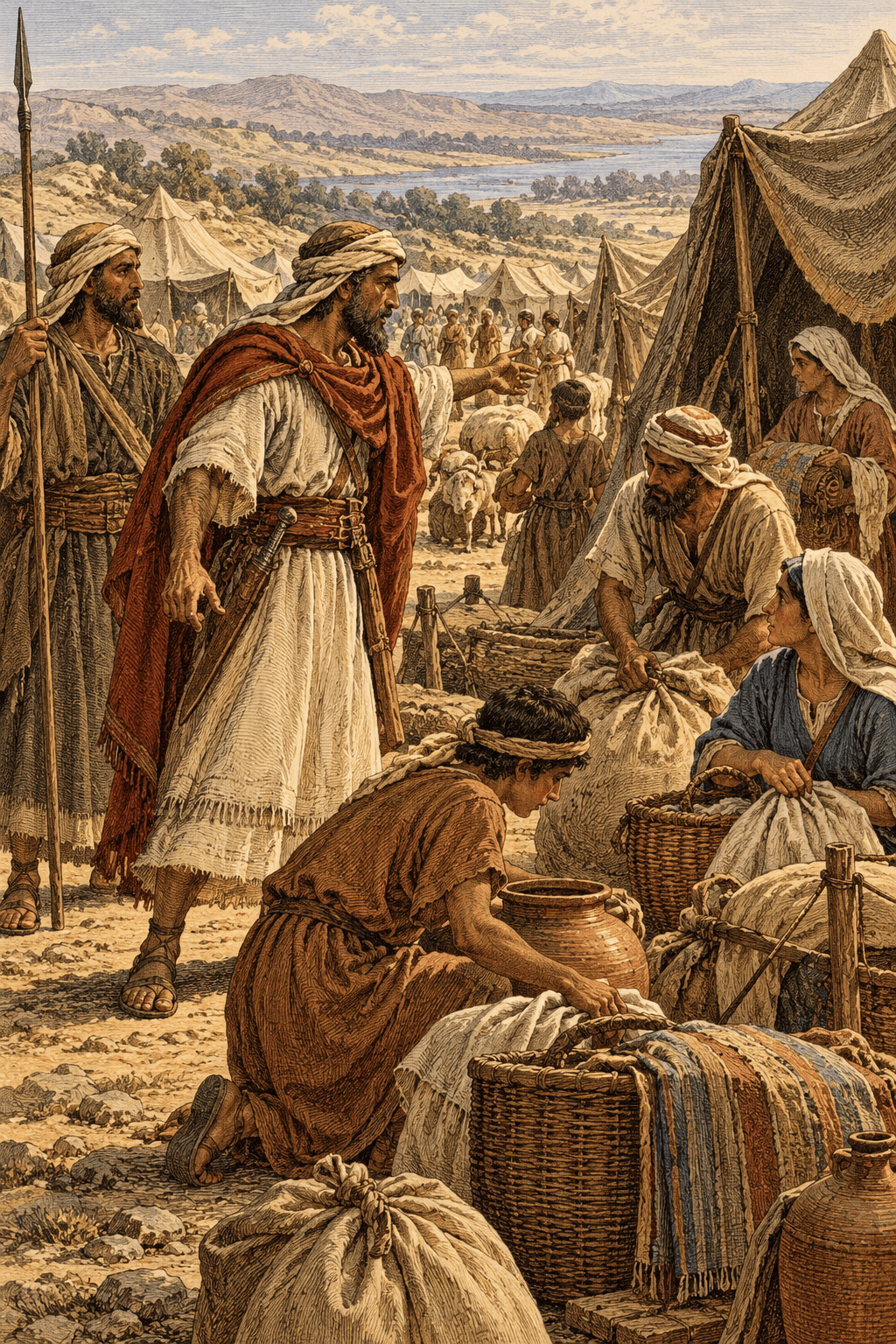
Joshua asked the officers of the people to tell the people not to hurry, but to make ready to cross, carrying victuals with them for three days. Who were these officers? And what are the victuals?
These officers were the overseers who worked under the Egyptian taskmasters in counting the bricks (Exodus 5:6). After the exodus they served as captains over thousands, hundreds and tens to administer justice (Deuteronomy 1:15).
What Are These Victuals?
First: Father Caesarius sees that these victuals for three days, after which they would cross the Jordan to enjoy the inheritance, are faith in the Holy Trinity. He says:
“The third day, as we know, is the mystery of the Trinity. What food must we prepare in order to reach the third day? It seems to me that we should understand the victuals as faith; for Christians reach the sacrament of baptism (the river Jordan) through faith in the Trinity … Truly, brethren, no one will see the true land of promise, that is, eternal blessedness, unless he passes through the sacrament of baptism. [46]”
Second: the same Father sees in the victuals for three days for crossing the Jordan the enjoyment of the virtues of faith, hope and love. He says: “Faith, hope and love.” [47]
Third: Origen sees that the victuals we must carry within us in order to follow our true Joshua and enter the eternal land of promise are the Holy Scriptures, the word of God understood spiritually and revealed practically in our lives. He says:
“After this Joshua says, ‘Prepare you victuals for the journey.’ And today, if you listen, Jesus says to you: ‘If you follow Me, prepare victuals for yourself for the journey.’ The victuals in truth are the works that accompany us on our journey with the Savior along the road ahead. In our study of the Holy Scriptures let us beware of a hasty and careless reading; otherwise, how shall we gather provisions? [48]”
Fourth: we can say that these victuals which remain with us for three days are the possibility of the risen life in Christ Jesus. We know that the number three points to the resurrection, without which we cannot cross the Jordan or enter the land of promise. The victuals we prepare for ourselves are not our own; they are the acquiring of the risen life of Christ as our life. Without it we remain in the wilderness until we become lifeless corpses unable to move. In our study of the Book of Exodus we spoke of the mystery of the three days, when the word to Pharaoh was:
“Let us go, we beseech thee, three days’ journey into the wilderness, that we may sacrifice to the Lord our God” (Exodus 3:18). Pharaoh made every effort to keep them from entering the mystery of the three days, like the devil who wants to deprive man of the power of the resurrection with Christ, so that his worship is not accepted and he does not enjoy the inheritance. Our father Abraham had already experienced this mystery, when he walked three days to offer his son as a sacrifice of love for God (Genesis 22:4), looking toward the sign of the resurrection from the dead.
He offered his beloved son, certain “that God was able to raise him up, even from the dead” (Hebrews 11:19). [49]
6. The Human Role
KJV · Verses 12–18
12 And to the Reubenites, and to the Gadites, and to half the tribe of Manasseh, spake Joshua, saying, 13 Remember the word which Moses the servant of the Lord commanded you, saying, The Lord your God hath given you rest, and hath given you this land. 14 Your wives, your little ones, and your cattle, shall remain in the land which Moses gave you on this side Jordan; but ye shall pass before your brethren armed, all the mighty men of valour, and help them; 15 Until the Lord have given your brethren rest, as he hath given you, and they also have possessed the land which the Lord your God giveth them: then ye shall return unto the land of your possession, and enjoy it, which Moses the Lord's servant gave you on this side Jordan toward the sunrising. 16 And they answered Joshua, saying, All that thou commandest us we will do, and whithersoever thou sendest us, we will go. 17 According as we hearkened unto Moses in all things, so will we hearken unto thee: only the Lord thy God be with thee, as he was with Moses. 18 Whosoever he be that doth rebel against thy commandment, and will not hearken unto thy words in all that thou commandest him, he shall be put to death: only be strong and of a good courage.
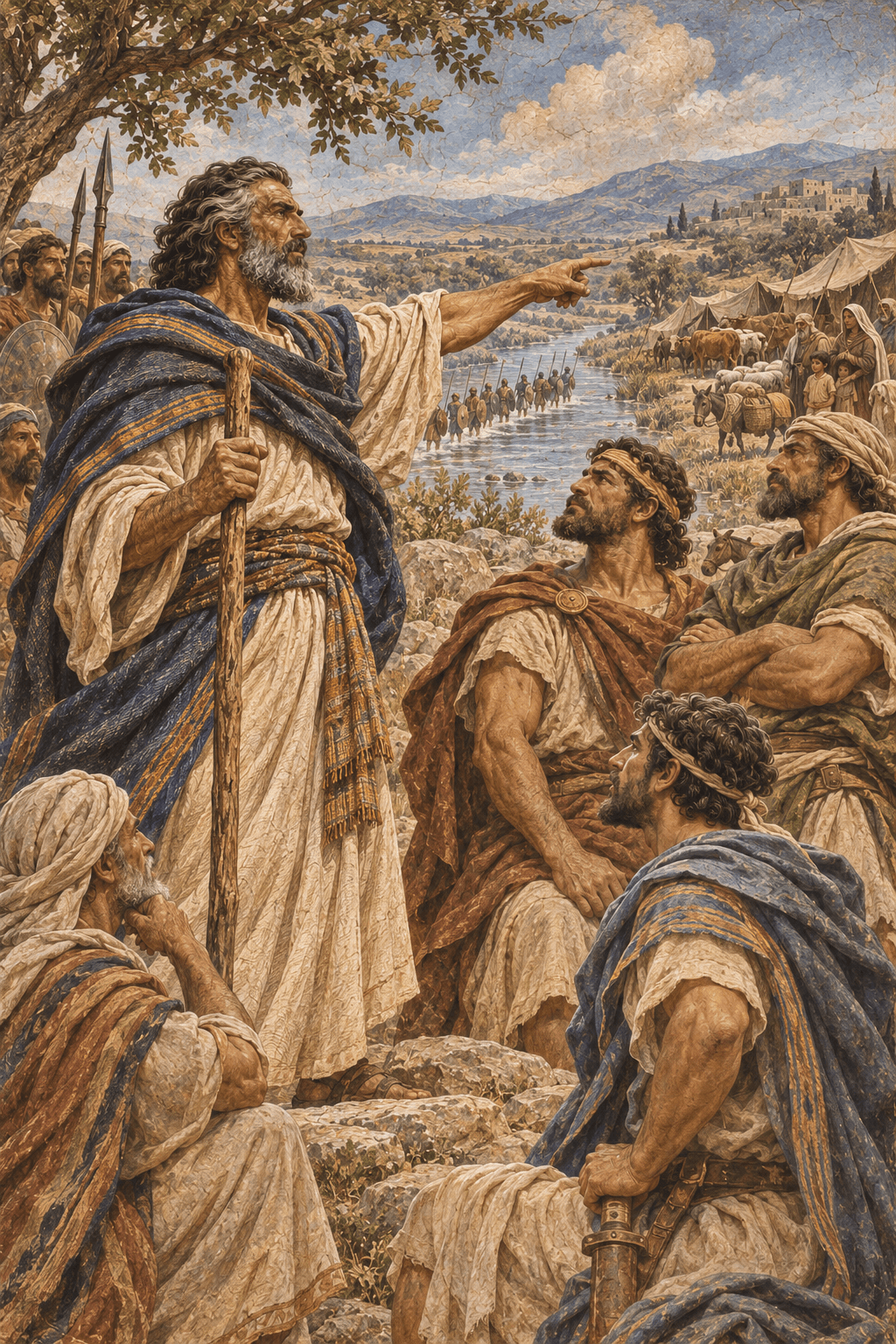
The sign of God’s love for man is not only that He gives to him, but that He makes him His partner in the work, so that God’s transcendent will may be joined with the will of man, which is sanctified by its union with God in His Son. This appears very clearly in God’s conversation with Joshua the son of Nun. If God is the One who works in the entrance, as the Giver of the power of resurrection and crossing, Joshua and the people are bound to arise and cross [2].
God gives the inheritance freely, as He promised, but not to the lazy and the slack; rather, He gives every place the soles of their feet tread upon [3], encouraging them to walk on toward the inheritance. He declares His presence with His servant [5] and His support for him against every attack of the enemy, but the servant is bound to be strong and courageous, fearing no man [6–7]. God gives him His law as a support, but the servant is bound to meditate on it day and night, so that he may make his way prosperous and succeed [8].
He asks them to prepare victuals for themselves, and He Himself provides the victuals! How wonderful! God’s rich love gives everything freely, yet without despising man’s will or ignoring his struggle and his love!
This human side appeared very clearly in Joshua’s dealings with the two tribes and a half (Reuben, Gad and half of Manasseh), who wished to settle on the east side of the river Jordan (Numbers 32:1–5, 33) in the land of Gilead. Moses had agreed to this on condition that they leave their wives, children and cattle in that land, while the men crossed the Jordan with the rest of the tribes, not returning to Gilead until they had completed the whole struggle with their brethren and all had possessed the land of Canaan.
This was a symbol of the two Churches of the Old and New Testaments: the first represented by the two tribes and a half, the second by the nine tribes and a half. We have spoken of this in more detail elsewhere. [50] God was able to save the nine tribes and a half without the struggle of the two tribes and a half … but God sanctifies human work and unity, so He bound them to work with their brethren as long as they had strength to work, as long as they were able to struggle. God does not use miracles except to the extent that there is no other way of escaping the difficulty!
I would like to state clearly that God sanctifies His believers spiritually, intellectually, emotionally and physically. One of the signs of this sanctification is that He uses man for work and struggle, and does not intervene with transcendent miraculous action except when necessary, in the case of human inability! God, who brought the people out with a mighty hand and an outstretched arm, fed them forty years in the wilderness, and worked countless miracles for them, could have given them the land of promise without the struggle of these tribes (the two tribes and a half), or even without the struggle of all the tribes.
But had this happened, the unity of the people as a whole would not have been sanctified, nor would these tribes have received the blessing of God’s working through them. I say that when we ask for our lives to be full of transcendent miraculous works, we are asking to be deprived of God’s esteem for us, for He wants to work through our hearts, minds, feelings and hands, sanctifying all He has given us to work in His hidden way within us, until He brings us crowned into the land of the inheritance.
Notes and References
[36] Caesarius of Arles, Sermon 116:1.
[37] Irenaeus, Fragment 19.
[38] Origen, Homilies on Joshua 1:6.
[39] Origen, ibid.
[40] Origen, ibid. 2:3.
[41] John Chrysostom, quoted in Fr. Tadros Y. Malaty, Divine Love (Arabic), p. 732.
[42] Origen, Homilies on Joshua 2:3.
[43] John Climacus, The Ladder of Divine Ascent, Step [number not given in the source].
[44] John Chrysostom, Homilies on Matthew 1:1.
[45] John Chrysostom, Homilies on Colossians 9.
[46] Caesarius of Arles, Sermon 115:1.
[47] Caesarius of Arles, ibid. 115:2.
[48] Origen, Homilies on Joshua 1:4.
[49] Fr. Tadros Y. Malaty, Commentary on Exodus (Arabic), 1981, pp. 36–38.
[50] Fr. Tadros Y. Malaty, Commentary on Numbers (Arabic), 1981, pp. 210–216.