
In the first meeting Joseph pretended to be rough with them and accused them of being spies. In this meeting they came to him terrified and could not recognize him, until the third meeting came, when his heart yearned toward them, he wept aloud, and revealed himself to them (Genesis 45:2–3). It is as though they meet Joseph the third time through his resurrection on the third day, and know him as the secret of their life and as a true brother to them; while the first two meetings bear much suffering for them.
1. The Need for Food
KJV · Verses 1–13
1 And the famine was sore in the land. 2 And it came to pass, when they had eaten up the corn which they had brought out of Egypt, their father said unto them, Go again, buy us a little food. 3 And Judah spake unto him, saying, The man did solemnly protest unto us, saying, Ye shall not see my face, except your brother be with you. 4 If thou wilt send our brother with us, we will go down and buy thee food: 5 But if thou wilt not send him, we will not go down: for the man said unto us, Ye shall not see my face, except your brother be with you. 6 And Israel said, Wherefore dealt ye so ill with me, as to tell the man whether ye had yet a brother? 7 And they said, The man asked us straitly of our state, and of our kindred, saying, Is your father yet alive? have ye another brother? and we told him according to the tenor of these words: could we certainly know that he would say, Bring your brother down? 8 And Judah said unto Israel his father, Send the lad with me, and we will arise and go; that we may live, and not die, both we, and thou, and also our little ones. 9 I will be surety for him; of my hand shalt thou require him: if I bring him not unto thee, and set him before thee, then let me bear the blame for ever: 10 For except we had lingered, surely now we had returned this second time. 11 And their father Israel said unto them, If it must be so now, do this; take of the best fruits in the land in your vessels, and carry down the man a present, a little balm, and a little honey, spices, and myrrh, nuts, and almonds: 12 And take double money in your hand; and the money that was brought again in the mouth of your sacks, carry it again in your hand; peradventure it was an oversight: 13 Take also your brother, and arise, go again unto the man:
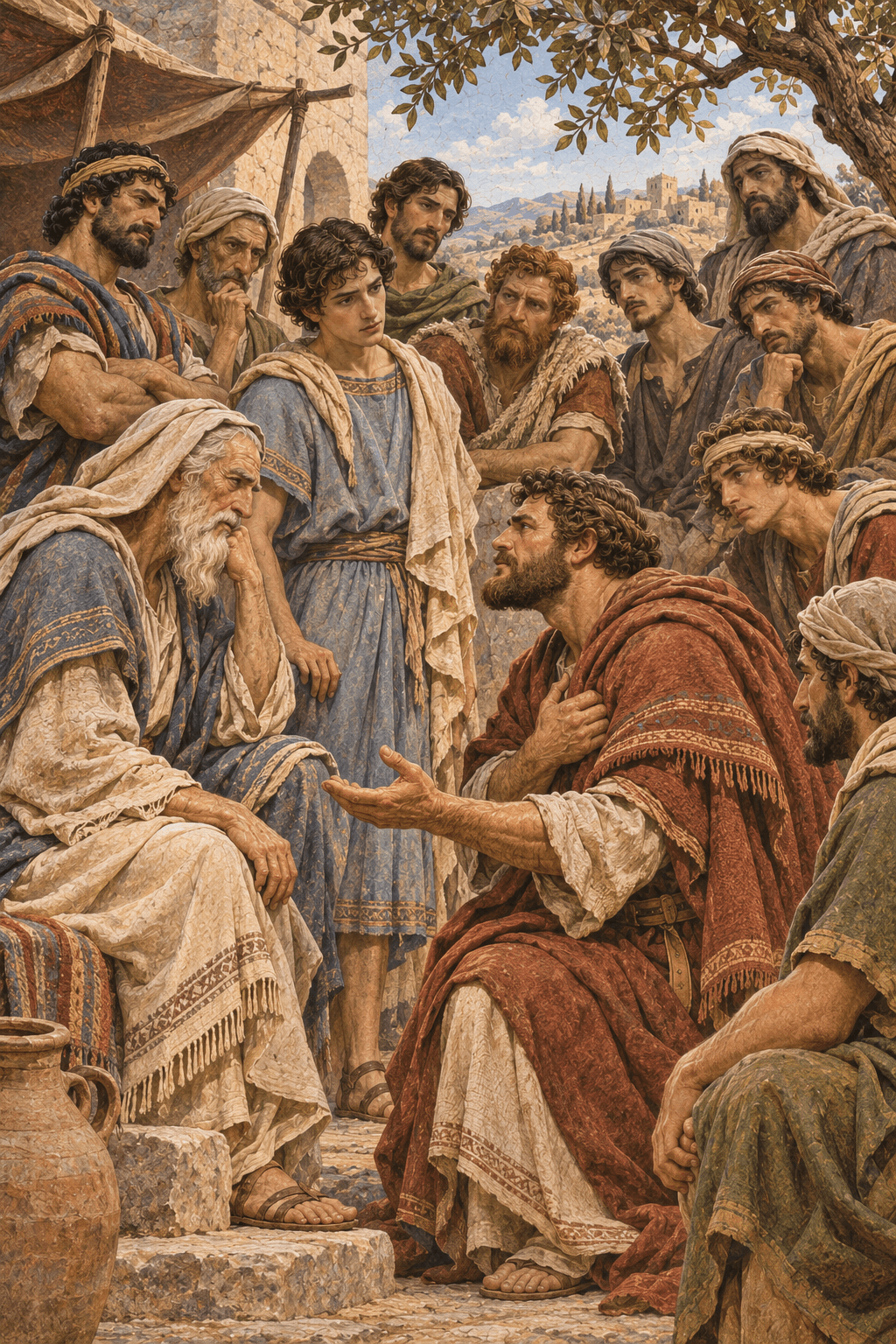
The famine was sore in the land, so that Jacob was compelled to urge them to return to Egypt to buy food for them. Then Judah asked him to allow them to take Benjamin their brother, since the man, the lord of the land, had solemnly protested to them that they would not see his face unless their brother was with them. Israel, displeased with the matter, reproached them for telling the man they had a younger brother; and they told him that he had drawn them out in conversation and learned everything from them. Finally Judah stood as surety for his younger brother, saying to Israel: “Send the lad with me, and we will arise and go; that we may live, and not die, both we, and thou, and also our little ones. I will be surety for him; of my hand shalt thou require him: if I bring him not unto thee, and set him before thee, then let me bear the blame for ever” (8–9).
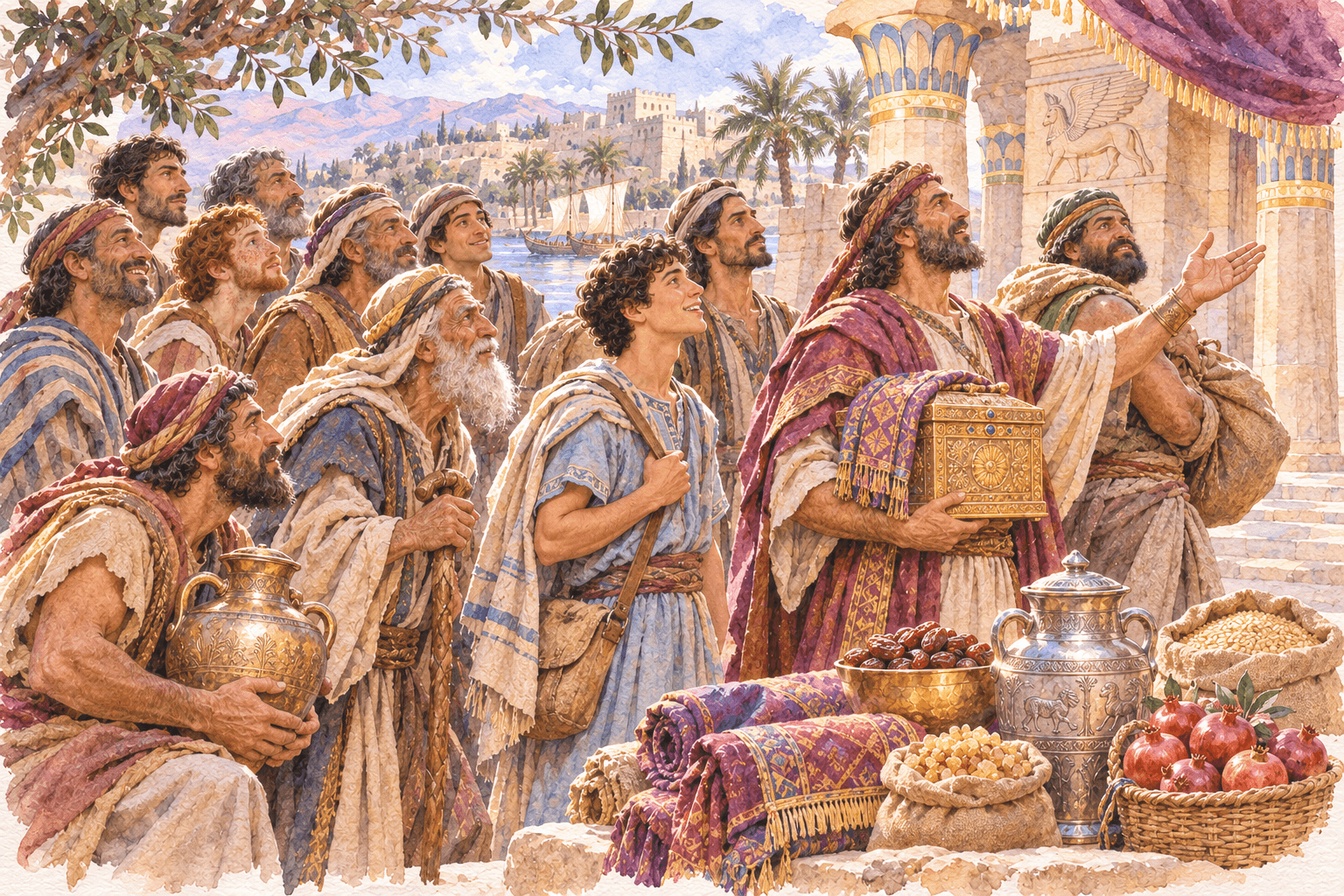
Judah and Benjamin each bore a symbol of the Lord Christ from a certain side. Judah represents the Lord Christ as the surety for his younger brother before his father, bound to bring him back; for the Word of God came incarnate as our firstborn brother, coming forth from the tribe of Judah, to come before the Father as our surety, redeeming us by His blood. Truly we have become the younger — not in relation to the Lord Christ, for He is the Head of all creation and its Maker, but in relation to the rational heavenly creation, for sin brought us very low… Yet in the eyes of God the Father we are like Benjamin, whom He cherishes, offering the Son for our salvation. On the other side, Benjamin presents to us a symbol of the Lord Christ who became “the least,” for He took the last place to embrace all mankind with love. He became the least like Benjamin; unless he set out from Canaan to Egypt, his brothers would not enjoy food… It is as though the Word of God, the beloved only-begotten Son, seated at the right hand of the Majesty, comes down to Egypt as one of us, so that we find in Him the fullness of the spirit.
Joseph says: “Ye shall not see my face, except your brother be with you” (5)… as though it is the Father’s voice to us: we will not see His face, nor enjoy His heavenly bread, nor the fellowship of His glories, unless we appear before Him in Christ Jesus and with Him! Without Him we will not meet the Father nor have a place in His divine bosom, as the Apostle Paul says: “he hath chosen us in him before the foundation of the world, that we should be holy and without blame before him in love” (Ephesians 1:4).
Since there was no other way of salvation, Jacob sent Benjamin to the land of Egypt, and asked his sons to carry of the best fruits of the land in their vessels: a little balm, a little honey, spices (tragacanth, a kind of gum used in medicine and as an adhesive, whose trees are called goat’s-thorn, Astragalus; perhaps called “abundant” because it swells when placed in water), myrrh (ladanum, another kind of gum called Cistus creticus, perhaps a kind of frankincense, commonly called “ladin”), nuts (pistachios), and almonds. He also asked them to return the money they had found in their sacks, and other money as the price of what they would buy.
It is as though, for the sons of Israel to meet Joseph, they must come forward with three things:
First: They take Benjamin with them, without whom they will not see Joseph’s face. As we said, he symbolizes the Lord Christ, in whom and with whom we meet the Father in His heavenly glories.
Second: The gifts, which are the best fruits of the land, are the fruits of the Holy Spirit, which the Father gives us by His Holy Spirit, and which we carry as a gift of love to Him. If He is the one working in us for His good pleasure (Philippians 2:13), we offer Him from His own work what gladdens Him, as David says: “of thine own have we given thee” (1 Chronicles 29:14). Truly the fruit of the Holy Spirit — love, joy, peace, longsuffering, gentleness, goodness, faith, meekness, temperance (Galatians 5:22–23) — is balm that heals the soul, and spices and myrrh used as remedies for it; it is honey bearing sweetness to the heart and delight to the mind; and it is nuts and almonds satisfying the depths as food… We offer what we have enjoyed as the secret of the soul’s healing, fullness, and sweetness, as a gift of love to the Father in His Son, which pleases Him.
Third: Returning the money they found in their sacks points to understanding the symbols and prophecies of the Old Testament, while the new money is the enjoyment of grasping the New Testament and knowing the Gospel of Christ. If the word of God is silver tried (Psalm 12:6), it befits us to meet God by offering this silver, declared in our life and manifested in our conduct, showing forth our spiritual understanding of the Law and our grasp of the Gospel practically every day!
2. A Meeting in Joseph’s House
KJV · Verses 14–34
14 And God Almighty give you mercy before the man, that he may send away your other brother, and Benjamin. If I be bereaved of my children, I am bereaved. 15 And the men took that present, and they took double money in their hand and Benjamin; and rose up, and went down to Egypt, and stood before Joseph. 16 And when Joseph saw Benjamin with them, he said to the ruler of his house, Bring these men home, and slay, and make ready; for these men shall dine with me at noon. 17 And the man did as Joseph bade; and the man brought the men into Joseph's house. 18 And the men were afraid, because they were brought into Joseph's house; and they said, Because of the money that was returned in our sacks at the first time are we brought in; that he may seek occasion against us, and fall upon us, and take us for bondmen, and our asses. 19 And they came near to the steward of Joseph's house, and they communed with him at the door of the house, 20 And said, O sir, we came indeed down at the first time to buy food: 21 And it came to pass, when we came to the inn, that we opened our sacks, and, behold, every man's money was in the mouth of his sack, our money in full weight: and we have brought it again in our hand. 22 And other money have we brought down in our hands to buy food: we cannot tell who put our money in our sacks. 23 And he said, Peace be to you, fear not: your God, and the God of your father, hath given you treasure in your sacks: I had your money. And he brought Simeon out unto them. 24 And the man brought the men into Joseph's house, and gave them water, and they washed their feet; and he gave their asses provender. 25 And they made ready the present against Joseph came at noon: for they heard that they should eat bread there. 26 And when Joseph came home, they brought him the present which was in their hand into the house, and bowed themselves to him to the earth. 27 And he asked them of their welfare, and said, Is your father well, the old man of whom ye spake? Is he yet alive? 28 And they answered, Thy servant our father is in good health, he is yet alive. And they bowed down their heads, and made obeisance. 29 And he lifted up his eyes, and saw his brother Benjamin, his mother's son, and said, Is this your younger brother, of whom ye spake unto me? And he said, God be gracious unto thee, my son. 30 And Joseph made haste; for his bowels did yearn upon his brother: and he sought where to weep; and he entered into his chamber, and wept there. 31 And he washed his face, and went out, and refrained himself, and said, Set on bread. 32 And they set on for him by himself, and for them by themselves, and for the Egyptians, which did eat with him, by themselves: because the Egyptians might not eat bread with the Hebrews; for that is an abomination unto the Egyptians. 33 And they sat before him, the firstborn according to his birthright, and the youngest according to his youth: and the men marvelled one at another. 34 And he took and sent messes unto them from before him: but Benjamin's mess was five times so much as any of their's. And they drank, and were merry with him.
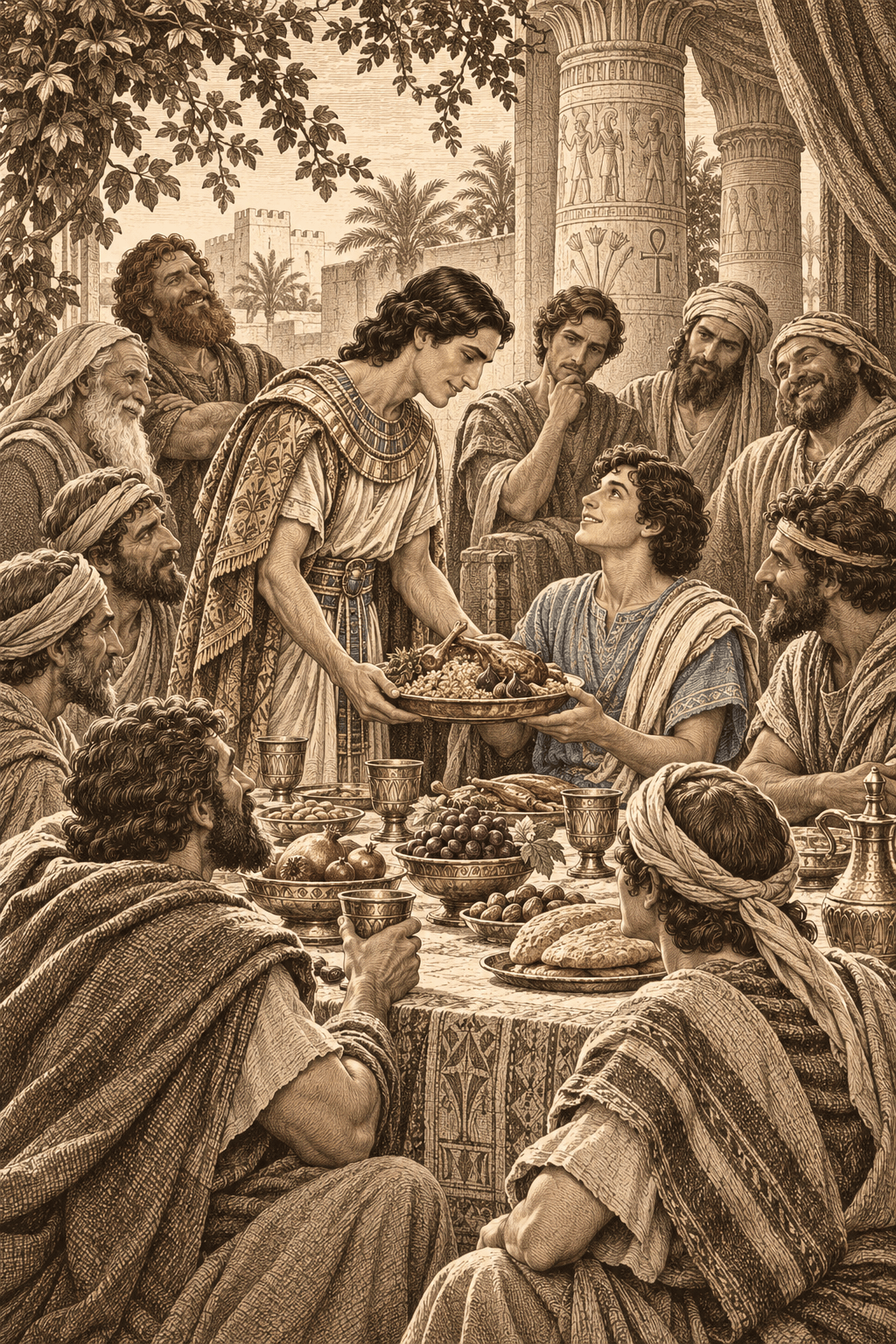
When Joseph saw his brother Benjamin with his brothers, “he said to the ruler of his house, Bring these men home, and slay, and make ready; for these men shall dine with me at noon” (16). Thus Joseph asked the chief of his servants, the steward of his house, to prepare a table for Joseph’s brothers… But when the men were brought into Joseph’s house they thought he had brought them in to seize them and take revenge on them because of the money found in their sacks. The steward reassured them, saying: “Peace be to you, fear not: your God, and the God of your father, hath given you treasure in your sacks: I had your money” (23). It seems Joseph had taught these words to the man to put his brothers’ hearts at ease, especially since the man brought out their brother Simeon to meet them, gave them water to wash their feet, and gave their asses provender. When Joseph came to them in his house, he asked them about their father’s welfare; and when he was sure of Benjamin his brother, “Joseph made haste; for his bowels did yearn upon his brother: and he sought where to weep; and he entered into his chamber, and wept there. And he washed his face, and went out, and refrained himself, and said, Set on bread. And they set on for him by himself, and for them by themselves, and for the Egyptians, which did eat with him, by themselves: because the Egyptians might not eat bread with the Hebrews; for that is an abomination unto the Egyptians. And they sat before him, the firstborn according to his birthright, and the youngest according to his youth: and the men marvelled one at another. And he took and sent messes unto them from before him: but Benjamin’s mess was five times so much as any of theirs. And they drank, and were merry with him” (30–34).
This is the second meeting between Joseph and his brothers, and the difference between his first meeting (Genesis 42) and this one appears clearly. The first presents a shadow of our meeting with the Lord Christ through the sufferings of His crucifixion; here we meet Him in His tomb, so that in the following (third) meeting we may enjoy meeting Him through His resurrection… though we cannot separate the crucifixion, burial, and resurrection, since they represent one integrated saving work that cannot be divided.
In this meeting we sense shadows of the saving work of the Lord Christ from many sides, among them:
First: In the first meeting Joseph appears rough and accuses them of being spies, though Scripture declares he could not bear the bitterness of their souls but “turned himself about from them, and wept” (Genesis 42:24). It is our meeting with the Lord Christ in the moments of the crucifixion, when divine justice was exacting the debt in the body of the Lord Christ and paying it in full, and our eyes were unable to perceive God’s hidden love, which surpasses the mind. But here we find no roughness in the meeting, but tenderness and food… for when the Lord Christ was buried in the tomb, mankind that had departed in hope was able to meet Him, come to know His love, and receive the Savior as spiritual food granting eternal immortality.
The first meeting took place outside Joseph’s house, for the Lord Christ was crucified outside the camp, and the Apostle asks us to go forth with Him bearing His reproach (Hebrews 13:13). But this meeting took place in Joseph’s house, for there was a meeting between those who had departed in hope and the buried Lord Christ in paradise, where He carried them as the spoil of His love into His house, as the Lord said to the thief on the right: “To day shalt thou be with me in paradise” (Luke 23:43).
Second: Joseph entered his chamber and wept there, then washed his face, refrained himself, and said, “Set on bread.” What is this chamber in which the true Joseph wept, then washed His face and went out, but His holy tomb, in which He met death and washed away our death — not with His tears but with His pure blood — and came out by the resurrection to give us His risen body as eternal life?!
Third: Joseph had a table of his own, his Hebrew brothers a table, and the Egyptians a third table. The gathering of all together points to the unity of the Church in the Head, where the men of the Old Testament gather with the men of the New Testament in Christ Jesus. Joseph represents the Head, having his own table as the Firstborn; the Hebrews represent the men of the Old Testament, who received in the Church, the house of Joseph, special food through the Law and the Prophets; and the Egyptians represent the men of the New Testament, that is, the Church of the Gentiles, which enjoyed the table of the Gospel.
Fourth: When the Hebrews sat before Joseph they marveled, looking at one another, for their seating order came according to their ages… Did the man, they wondered, know them?!
Though the Hebrews did not know Joseph, he knew them perfectly and had prepared for each of them a fitting place — like the Lord Christ, who knows us before we knew Him, knows us by our names (John 10:3), and arranges our salvation, offering each of us a special mansion in His Father’s house (John 14:2). He knows us and knows each one’s stature in the spirit, as the Apostle says: “for one star differeth from another star in glory” (1 Corinthians 15:41).
Fifth: He sent messes to them from before him, and Benjamin’s mess was five times as much as any of theirs. What He received of portions in glory He gives us from before Him, for we become partakers with Him in glory (see Romans 8:17; Colossians 3:4).
Perhaps Benjamin’s receiving five times the portions of the others points to God’s gift to us of sanctifying our five senses, so that they are full of fullness and glory by Christ Jesus who satisfies them.
Sixth: For this joyful and satisfying meeting to take place — which gladdened Joseph’s heart, for he could not bear seeing his brothers, especially Benjamin, so that his heart burned with longing and love, and the men were amazed, watching what happened as something beyond their understanding: they were reunited with their brother Simeon, sat with the lord of the land, ate in his house, and he served them from before him — the men had to be prepared thus: entering Joseph’s house, washing their feet with water, giving food to their asses, and sitting at the table.
What is entering Joseph’s house but entering Church membership, so that we truly become in the house of the Lord through the waters of baptism? What is washing the feet with water but offering the repentance that washes our iniquities and the dust that has clung to our souls during our journey? The food for the asses points to the sanctification of the body, which was animal in its lusts, so that we do not let it be satisfied through the pleasures of the world but through the holy life in the house of the Lord. Finally, sitting at the table points to the enjoyment of the sacrifice of the Eucharist… These are all the means of our salvation, which we enjoy in the Church of Christ by the Holy Spirit through the cross.
Seventh: We close our discussion of this meeting with the comment of Saint John Chrysostom on Joseph’s weeping when he saw his brothers:
Let us imitate this man, and grieve and weep over those who harm us; let us not be angry with them, for they truly deserve tears because of the punishment that will befall them and the condemnation into which they cast themselves. [434]
Notes and References
[434] Chrysostom, In 1 Thess. hom. 4.