
When Joseph’s brothers deprived themselves of Joseph by selling him, all Canaan lost the blessing and entered into famine, while Egypt was blessed by Joseph and became a source of fullness for the hungry. Now, when these brothers felt hunger, they were forced to journey to Egypt to buy wheat for themselves. They are like the community of the Jews, which betrayed the Lord Christ and sold Him for a little silver; in the last days, when it feels true hunger, it will leave Canaan and set out for Egypt, that is, for the Church of the Gentiles, seeking what it lost: faith in the Lord Christ. But it cannot meet Him as long as it is zealous for its Zionism and bound to temporal ambitions.
1. Jacob Sends His Sons to Egypt
KJV · Verses 1–4
1 Now when Jacob saw that there was corn in Egypt, Jacob said unto his sons, Why do ye look one upon another? 2 And he said, Behold, I have heard that there is corn in Egypt: get you down thither, and buy for us from thence; that we may live, and not die. 3 And Joseph's ten brethren went down to buy corn in Egypt. 4 But Benjamin, Joseph's brother, Jacob sent not with his brethren; for he said, Lest peradventure mischief befall him.
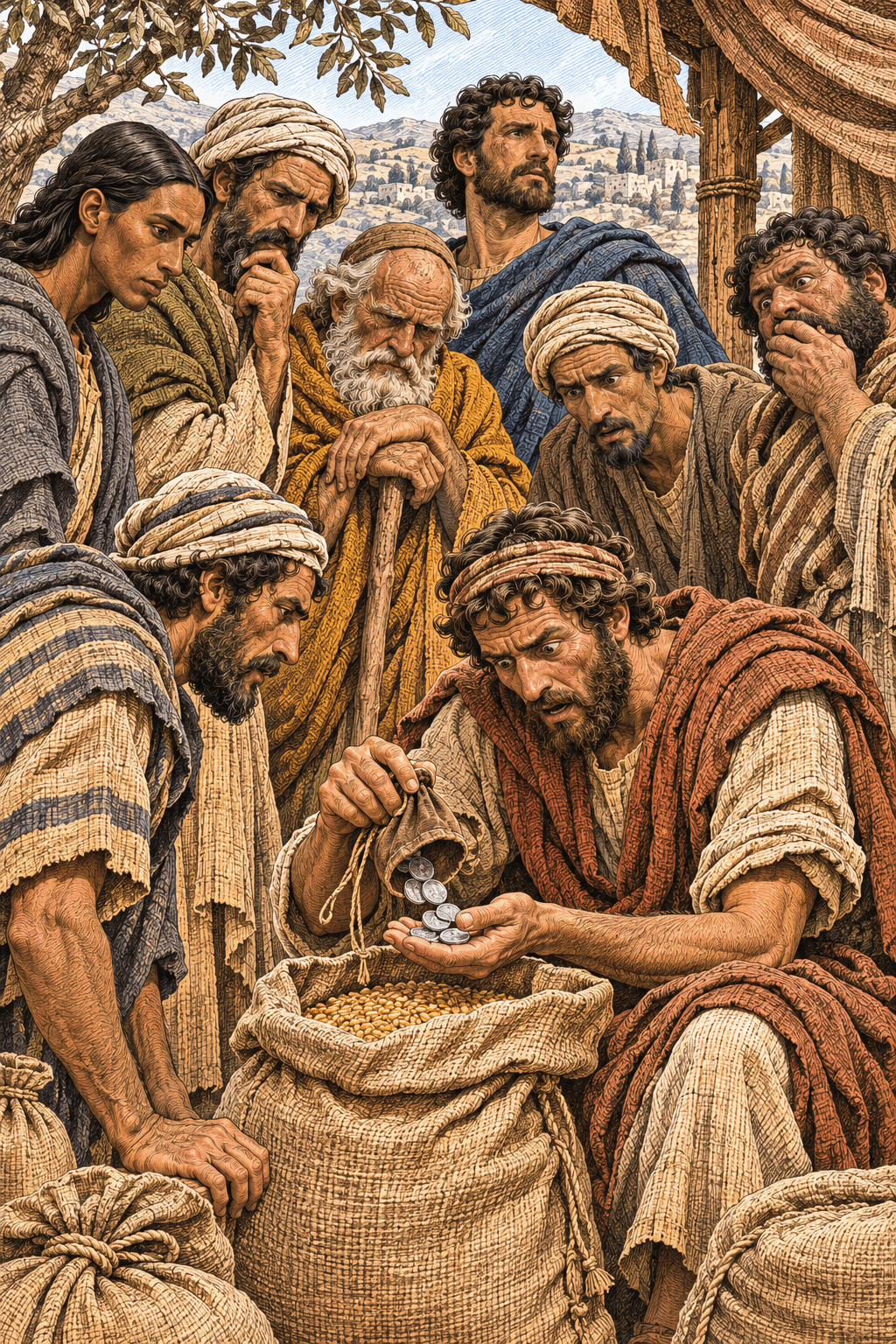
“Now when Jacob saw that there was corn in Egypt, Jacob said unto his sons, Why do ye look one upon another? And he said, Behold, I have heard that there is corn in Egypt: get you down thither, and buy for us from thence; that we may live, and not die” (1–2).
Jacob heard that there was wheat in Egypt — perhaps from the merchants who traded goods with Egypt, or from the surrounding peoples who were forced to go down to Egypt to buy wheat there — so he began urging them to go down to buy wheat. We notice in the text before us the following:
A) It repeats the word “Jacob” more than once and does not say “Israel,” though he had received the promise that he would no longer be called “Jacob” but “Israel.” But Jacob here does not represent the people of God but “the Jews” who lost faith in the Lord Christ, that is, the true Joseph… They are not counted the spiritual Israel nor the people of God because of their unbelief.
B) Now Jacob, through his sons, turns to the land of Egypt that they may live and not die; for the Jews lost the secret of their life — the true Joseph — while the Gentiles (Egypt) received the source of true life.
C) Jacob says to them, “get you down thither,” for the Jews were marked by the pride that drove them to unbelief. So the call comes to every proud soul to come down from its pride and go there, that is, to the Church of the Lord Christ, marked by the spirit of her humble Bridegroom.
D) Jacob says to them: “Why do ye look one upon another?!”… They ought to have looked to the place of fullness, to where Joseph was, instead of looking at one another. It is as though Jacob’s words represent a call to the soul to go out from its closedness and withdrawal into itself to openness toward the Lord Christ. The closed heart lives hungry; but the heart open to God and to people is satisfied with God, the source of all fullness.
E) The number of those going down to Egypt was ten of Joseph’s brothers (3), and Benjamin was not among them, for Jacob feared lest harm befall him as it had his brother Joseph. This first going out of the ten points to setting out toward the Lord Christ through our spiritual perception of the Law (the Ten Commandments of the Law); but we will not meet Joseph on the level of love except with Benjamin (the son of the right hand), that is, by our bond with the Gospel, which gives us the right to enjoy God’s right hand.
2. Standing before Joseph
KJV · Verses 5–28
5 And the sons of Israel came to buy corn among those that came: for the famine was in the land of Canaan. 6 And Joseph was the governor over the land, and he it was that sold to all the people of the land: and Joseph's brethren came, and bowed down themselves before him with their faces to the earth. 7 And Joseph saw his brethren, and he knew them, but made himself strange unto them, and spake roughly unto them; and he said unto them, Whence come ye? And they said, From the land of Canaan to buy food. 8 And Joseph knew his brethren, but they knew not him. 9 And Joseph remembered the dreams which he dreamed of them, and said unto them, Ye are spies; to see the nakedness of the land ye are come. 10 And they said unto him, Nay, my lord, but to buy food are thy servants come. 11 We are all one man's sons; we are true men, thy servants are no spies. 12 And he said unto them, Nay, but to see the nakedness of the land ye are come. 13 And they said, Thy servants are twelve brethren, the sons of one man in the land of Canaan; and, behold, the youngest is this day with our father, and one is not. 14 And Joseph said unto them, That is it that I spake unto you, saying, Ye are spies: 15 Hereby ye shall be proved: By the life of Pharaoh ye shall not go forth hence, except your youngest brother come hither. 16 Send one of you, and let him fetch your brother, and ye shall be kept in prison, that your words may be proved, whether there be any truth in you: or else by the life of Pharaoh surely ye are spies. 17 And he put them all together into ward three days. 18 And Joseph said unto them the third day, This do, and live; for I fear God: 19 If ye be true men, let one of your brethren be bound in the house of your prison: go ye, carry corn for the famine of your houses: 20 But bring your youngest brother unto me; so shall your words be verified, and ye shall not die. And they did so. 21 And they said one to another, We are verily guilty concerning our brother, in that we saw the anguish of his soul, when he besought us, and we would not hear; therefore is this distress come upon us. 22 And Reuben answered them, saying, Spake I not unto you, saying, Do not sin against the child; and ye would not hear? therefore, behold, also his blood is required. 23 And they knew not that Joseph understood them; for he spake unto them by an interpreter. 24 And he turned himself about from them, and wept; and returned to them again, and communed with them, and took from them Simeon, and bound him before their eyes. 25 Then Joseph commanded to fill their sacks with corn, and to restore every man's money into his sack, and to give them provision for the way: and thus did he unto them. 26 And they laded their asses with the corn, and departed thence. 27 And as one of them opened his sack to give his ass provender in the inn, he espied his money; for, behold, it was in his sack's mouth. 28 And he said unto his brethren, My money is restored; and, lo, it is even in my sack: and their heart failed them, and they were afraid, saying one to another, What is this that God hath done unto us?
While Canaan was in plenty, Jacob and his sons did not think of meeting Joseph; perhaps Jacob’s sons forgot Joseph and thought they would never see him again. But God in His love allowed famine in Canaan so that all would meet Joseph. God does not long for our humiliation nor seek hunger for us; but when we lose our inner Joseph, our depths become dry and in drought, and God allows hunger to come upon the land for no other reason than that we discover the inner hunger and seek our Joseph, who satisfies the inner as well as the outer.
Scripture says: “And Joseph was the governor over the land, and he it was that sold to all the people of the land: and Joseph’s brethren came, and bowed down themselves before him with their faces to the earth” (6).
Joseph was the ruler over Egypt, managing its financial affairs. He himself sold the wheat in its storehouses on the eastern frontier — perhaps to be assured about the strangers coming to buy wheat, lest they cause trouble in the land; or perhaps because his longing burned toward his father and brothers, so that he was waiting for them to come buy wheat so he could recognize them. And indeed, when his brothers came he knew them, but made himself strange unto them and spoke roughly with them, that is, spoke with them as a stranger. Joseph’s conduct in this meeting carried many meanings; we mention among them:
A) Since Joseph represents the Lord Christ, he knew his brothers and made himself strange to them, but they did not know him… The Lord Christ came, who knows us by our names; but because He bore our nature and was found in fashion as a man, His brothers the Jews could not know Him, as the Apostle says: “for had they known it, they would not have crucified the Lord of glory” (1 Corinthians 2:8).
B) He spoke roughly with them and even accused them of being spies — not to take revenge on them, for his heart was burning within him… When he heard them speaking bitterly, remembering what they had done to him, not knowing that he was Joseph, “he turned himself about from them, and wept” (24). His purpose in this roughness was that they not recognize him quickly lest they be afraid of him; and on the other hand he wanted to inquire about his father and his brother Benjamin indirectly, while planning to bring them all to live with him in his good things. Joseph succeeded in fulfilling all these purposes, even though at first he put on the appearance of roughness.
God in His love for us sometimes seems harsh — not to deprive us of His tenderness, but to accomplish His purpose in us and bring us into His mysteries and the enjoyment of His graces in His divine way, which surpasses our understanding.
C) Joseph remembered the dreams he had dreamed about them (9)… The time may grow long for us, and we may think God’s promises impossible to fulfill, but He grants us the fulfillment of His promises at the appointed time and in a surpassing way we did not expect.
D) He ordered them to be put in ward three days… as though he wished to discipline them, but with tenderness, that they might remember their sin concerning his innocent blood. On the third day he spoke with them gently: “This do, and live; for I fear God: if ye be true men, let one of your brethren be bound in the house of your prison: go ye, carry corn for the famine of your houses: but bring your youngest brother unto me; so shall your words be verified, and ye shall not die” (18–20). He wanted to reassure them that he would not tyrannize them, for he feared God; but he sought to verify the truth of their words by having the youngest son brought, for his heart burned to see him. And the sign of his tenderness is that he allowed them to take wheat for their houses, saying, “ye shall not die”… He also put their money in their sacks, for he did not ask them for a price for the food he gave.
Joseph had earlier been imprisoned, and now he confines his brothers three days, so that they come out to find Joseph giving them wheat for themselves and their families, asking them to be faithful and bring their youngest brother. It is the language of the Lord Christ, who was buried in the tomb as in a prison and has granted us to be buried with Him three days so as to enjoy the power of His resurrection. Then we receive Him as heavenly bread satisfying us and all our families, that is, satisfying the soul together with the body and mind and all that is ours.
As for his asking for the youngest son, it is a call to work. The heart of the Lord Christ will not rest concerning the Church unless she brings Him the youngest, that is, seeks every soul to acquire it for Him… The Lord Christ continues to ask His Church to work to bring Him Benjamin, that is, to present all as sons at God’s right hand. In this spirit Saint John Chrysostom says:
God is so greatly pleased with this work that even if a man performed all austerities, subdued his body with every asceticism, fasted all his life and slept on the ground, and distributed all his possessions to the poor and needy, all these would not equal zeal for the salvation of a soul. [431]
E) Joseph’s words to them were: “This do, and live… ye shall not die” (18, 20). This is the call of the risen Lord Christ: He wants us to be buried with Him to enjoy the risen life so that we do not die. As the Apostle Paul says: “Therefore we are buried with him by baptism into death: that like as Christ was raised up from the dead by the glory of the Father, even so we also should walk in newness of life. For if we have been planted together in the likeness of his death, we shall be also in the likeness of his resurrection” (Romans 6:4–5).
F) Why did Joseph bind Simeon before their eyes (24)? Without doubt he did not bind him out of grudge or revenge… perhaps he loosed his bonds and treated him well after his brothers departed. Rather he wanted to stir them to hasten to bring Benjamin, so that their brother Simeon’s bonds would be loosed and his freedom restored. On the other hand, the word “Simeon” means “hearing,” so he points to listening to God’s voice, or obedience to Him; therefore his being bound reveals the Jews’ loss of the spirit of listening to God’s voice and obeying Him.
Some think Simeon was very harsh toward Joseph and was the one who proposed killing him (Genesis 37:19–20), so he deserved discipline, that he might feel his sin and repent of his conduct.
Reuben (“son of vision”) rebuked his brothers: “Spake I not unto you, saying, Do not sin against the child; and ye would not hear? therefore, behold, also his blood is required” (22). He represents the “son of vision,” that is, the insight that opens to perceive the error a person has committed and drives him to repentance for what he did. As Saint John Chrysostom says:
When you see something happening to you, remember your sin “that brought this upon you.” [432]
3. The Return to Canaan
KJV · Verses 29–38
29 And they came unto Jacob their father unto the land of Canaan, and told him all that befell unto them; saying, 30 The man, who is the lord of the land, spake roughly to us, and took us for spies of the country. 31 And we said unto him, We are true men; we are no spies: 32 We be twelve brethren, sons of our father; one is not, and the youngest is this day with our father in the land of Canaan. 33 And the man, the lord of the country, said unto us, Hereby shall I know that ye are true men; leave one of your brethren here with me, and take food for the famine of your households, and be gone: 34 And bring your youngest brother unto me: then shall I know that ye are no spies, but that ye are true men: so will I deliver you your brother, and ye shall traffick in the land. 35 And it came to pass as they emptied their sacks, that, behold, every man's bundle of money was in his sack: and when both they and their father saw the bundles of money, they were afraid. 36 And Jacob their father said unto them, Me have ye bereaved of my children: Joseph is not, and Simeon is not, and ye will take Benjamin away: all these things are against me. 37 And Reuben spake unto his father, saying, Slay my two sons, if I bring him not to thee: deliver him into my hand, and I will bring him to thee again. 38 And he said, My son shall not go down with you; for his brother is dead, and he is left alone: if mischief befall him by the way in the which ye go, then shall ye bring down my gray hairs with sorrow to the grave.
Joseph’s brothers returned without Simeon to their father in the land of Canaan to tell him all that had befallen them: how they were accused of being spies, and that the man, “the lord of the country,” said to them: “Hereby shall I know that ye are true men; leave one of your brethren here with me, and take food for the famine of your households, and be gone: and bring your youngest brother unto me: then shall I know that ye are no spies, but that ye are true men: so will I deliver you your brother, and ye shall traffick in the land” (33–34)… Jacob’s comment was: “Me have ye bereaved of my children: Joseph is not, and Simeon is not, and ye will take Benjamin away: all these things are against me” (36). And Reuben said to his father: “Slay my two sons, if I bring him not to thee: deliver him into my hand, and I will bring him to thee again” (37).
Jacob’s sons returned without Simeon, and their depths, which had been hidden, appeared: they showed that in their hearts they did not bear “listening to God”… So the outward, which represented bitterness for all, revealed the inner position they had ignored for a long time.
They called Joseph “the lord of the country” without knowing him, and so bore witness behind his back that in him the dreams they could not bear to remember had been fulfilled… This lord is not a tyrant, but asks for their faithfulness in bringing his brother Benjamin to him.
Jacob refused to hand over his son Benjamin lest harm befall him on the way like his brother Joseph; then, as he says, “then shall ye bring down my gray hairs with sorrow to the grave” (38)… These are the feelings of true fatherhood: the fall of any son of ours, however small, brings our gray hairs down with sorrow as to the grave. These feelings the Apostle Paul expressed when he said: “Who is weak, and I am not weak? who is offended, and I burn not?” (2 Corinthians 11:29). Saint John Chrysostom spoke much of this tender fatherhood toward every soul in Christ Jesus. [433]
But Jacob says, “ye shall bring down my gray hairs with sorrow to the grave,” for the door of paradise had not yet been opened… so death for him was a descent!!
Notes and References
[431] Chrysostom, in Brotherly Love (Arabic, 1964), p. 73.
[432] Chrysostom, In Acts hom. 12.
[433] See the author’s Saint John Chrysostom (Arabic), p. 169 ff.