
Joseph entered prison not for a sin he had committed but as the price of the lust of Potiphar’s wife. So the Lord came down to us and trod the winepress, not for evil He had done but as a ransom for defiled mankind. And in the prison he met the king’s two officers, like the Lord Christ between two thieves.
1. The Officers in Prison
KJV · Verses 1–4
1 And it came to pass after these things, that the butler of the king of Egypt and his baker had offended their lord the king of Egypt. 2 And Pharaoh was wroth against two of his officers, against the chief of the butlers, and against the chief of the bakers. 3 And he put them in ward in the house of the captain of the guard, into the prison, the place where Joseph was bound. 4 And the captain of the guard charged Joseph with them, and he served them: and they continued a season in ward.
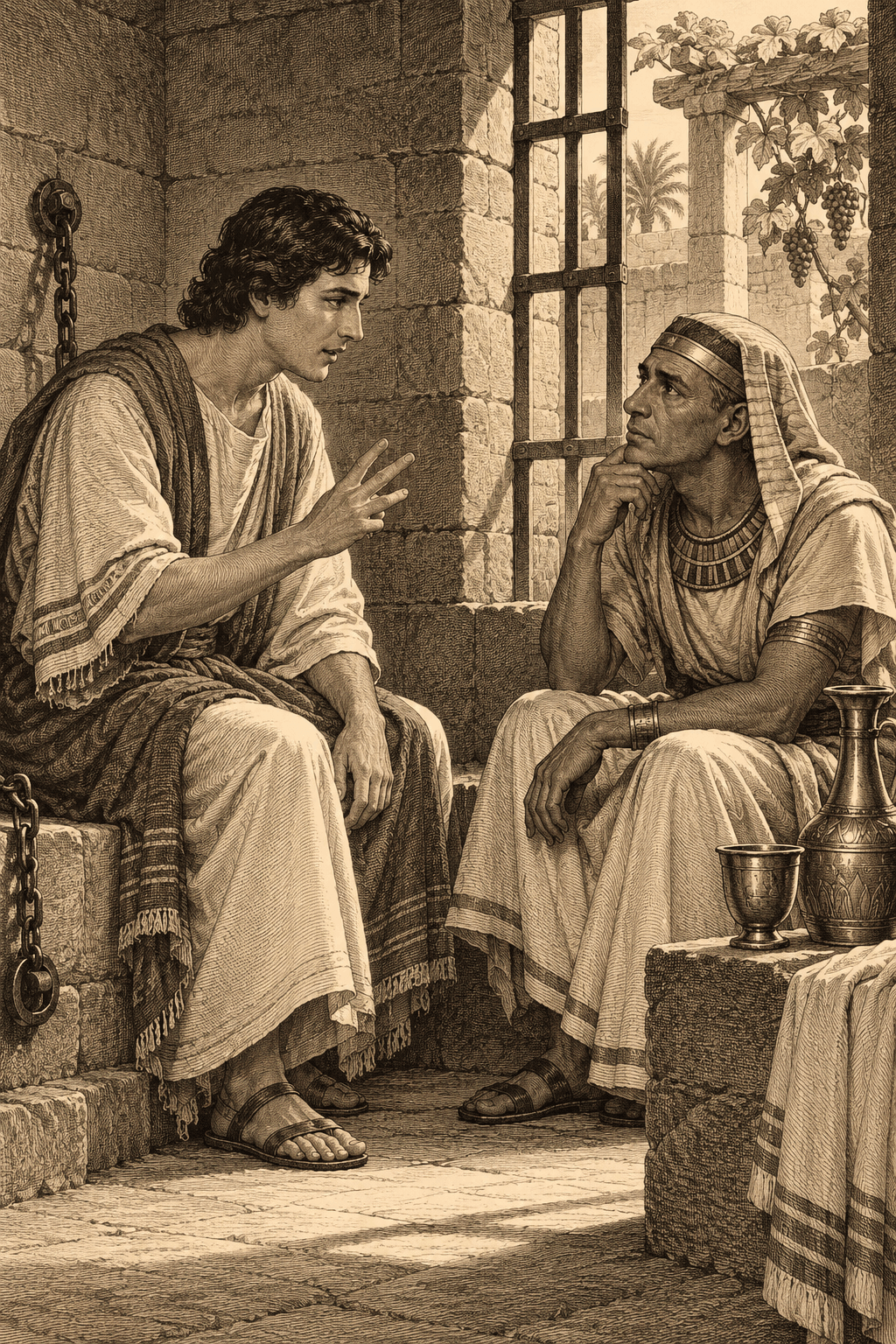
When Pharaoh was wroth against his two officers, the chief of the butlers and the chief of the bakers, and put them in ward in the house of the captain of the guard, into the prison, they found no one to serve them with faithfulness and gentleness like Joseph. Joseph lived in the prison — as Saint John Chrysostom says — as in his own house, caring for the prisoners as members with him in one house. He was marked by meekness, gentleness, and obedience. He was not ashamed of his slavery nor of his imprisonment, but was kind to all, serving even the harshest prisoners. So Joseph succeeded wherever he was. [422]
2. The Two Officers’ Dreams
KJV · Verses 5–19
5 And they dreamed a dream both of them, each man his dream in one night, each man according to the interpretation of his dream, the butler and the baker of the king of Egypt, which were bound in the prison. 6 And Joseph came in unto them in the morning, and looked upon them, and, behold, they were sad. 7 And he asked Pharaoh's officers that were with him in the ward of his lord's house, saying, Wherefore look ye so sadly to day? 8 And they said unto him, We have dreamed a dream, and there is no interpreter of it. And Joseph said unto them, Do not interpretations belong to God? tell me them, I pray you. 9 And the chief butler told his dream to Joseph, and said to him, In my dream, behold, a vine was before me; 10 And in the vine were three branches: and it was as though it budded, and her blossoms shot forth; and the clusters thereof brought forth ripe grapes: 11 And Pharaoh's cup was in my hand: and I took the grapes, and pressed them into Pharaoh's cup, and I gave the cup into Pharaoh's hand. 12 And Joseph said unto him, This is the interpretation of it: The three branches are three days: 13 Yet within three days shall Pharaoh lift up thine head, and restore thee unto thy place: and thou shalt deliver Pharaoh's cup into his hand, after the former manner when thou wast his butler. 14 But think on me when it shall be well with thee, and shew kindness, I pray thee, unto me, and make mention of me unto Pharaoh, and bring me out of this house: 15 For indeed I was stolen away out of the land of the Hebrews: and here also have I done nothing that they should put me into the dungeon. 16 When the chief baker saw that the interpretation was good, he said unto Joseph, I also was in my dream, and, behold, I had three white baskets on my head: 17 And in the uppermost basket there was of all manner of bakemeats for Pharaoh; and the birds did eat them out of the basket upon my head. 18 And Joseph answered and said, This is the interpretation thereof: The three baskets are three days: 19 Yet within three days shall Pharaoh lift up thy head from off thee, and shall hang thee on a tree; and the birds shall eat thy flesh from off thee.
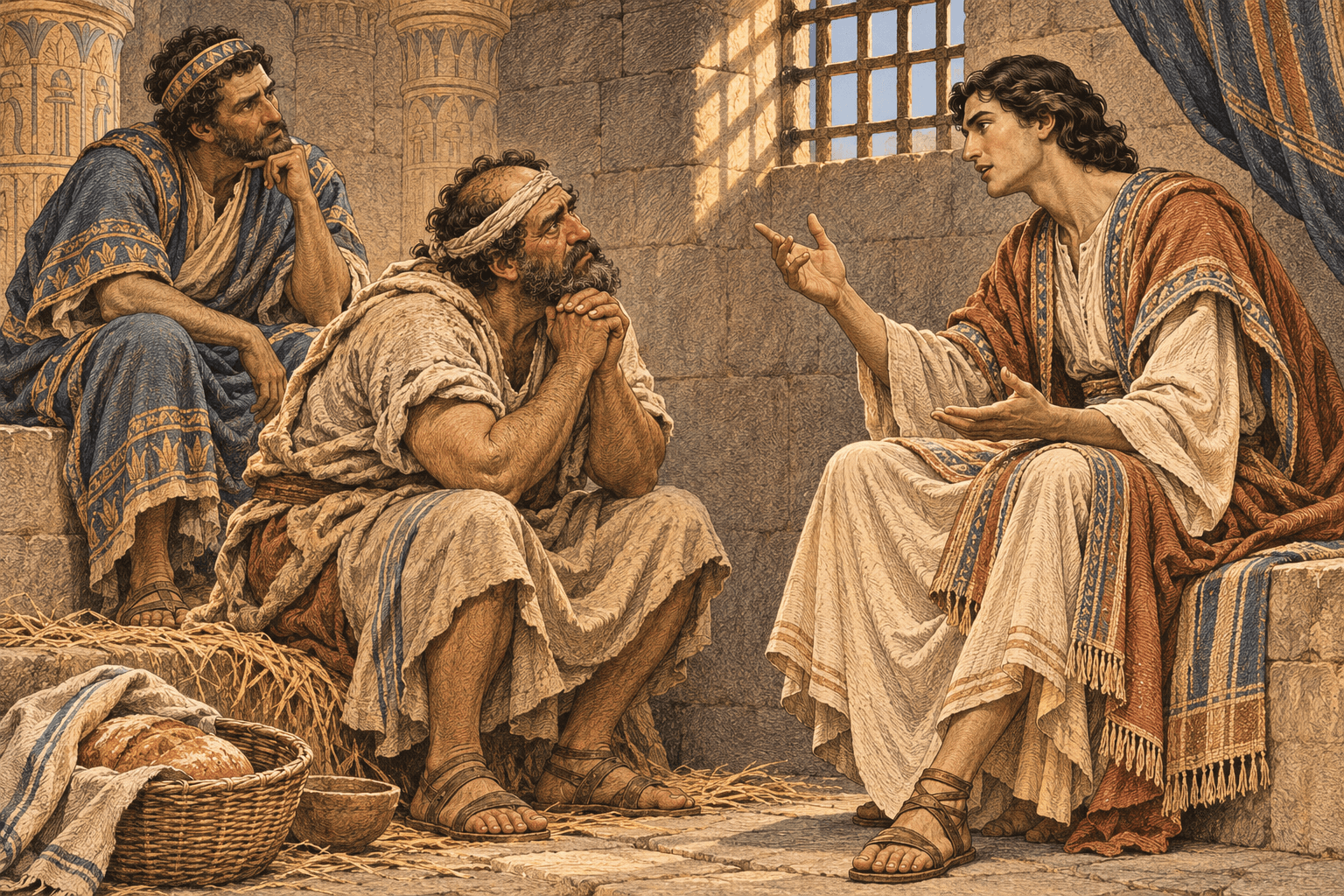
We said earlier that “officer” (eunuch) here does not bear the literal meaning but points to a high position in Pharaoh’s court. The two dreamed in one night and in one place, and both were sad… but Joseph, by God, was able to distinguish between them, saying: “Do not interpretations belong to God? tell me them, I pray you” (8).
What does this mean?
First: Perhaps the two officers point to the two thieves who were around the crucified Lord Christ [423] — the true Joseph — reviling Him. But the thief on the right returned and declared his repentance and seized paradise to remain with the Lord, while the thief on the left remained in his evil and his reviling and lost his temporal life and his eternity. The two officers point to the fallen human race: one part by faith passes through the wrath and crosses over to the kingdom, and the other in its unbelief loses its life eternally.
Who is it that seized God’s mercies but the chief of the butlers, who carried the juice of the grape in the cup to offer to the king? He is like the community of believers who receive the blood of the Lord Christ in the cup of their life and pass with Him by faith through the winepress, so that the Father is pleased with the sacrifice of His Son, which is able to save. But the chief of the bakers carried all manner of bakemeats for Pharaoh, and the birds ate them out of the basket upon his head. It seems to me that this food, which the birds snatch, points to the works of the Law on which the Jews leaned through their literal worship, or works of self-righteousness — works not bound to faith, which the enemy of good snatches away and which are not an object of God’s pleasure.
Second: The two officers point to the wise and foolish virgins (Matthew 25:1–13). The chief butler was an officer (eunuch), that is, like a virgin, and he offered in his cup the juice of the vine, as though he were like the wise virgins bearing their lamps full of the oil of living faith working by love. [424]
Third: The chief butler saw a vine with three branches, which budded, its blossoms shot forth, and its clusters brought forth ripe grapes (10); and the chief baker saw in his dream three white baskets on his head… And Joseph interpreted the number “3” as three days, at the end of which the first would enjoy honor and the second death.
In our study of the books of Exodus and Joshua we saw that the number 3 points to the resurrection from the dead with the Lord Christ, risen on the third day; [425] as though the dream, in the case of the chief butler, points to the resurrection of the Lord Christ (and our resurrection with Him), and what was fulfilled in the case of the chief baker points to the death of the Lord Christ (for we are also buried with Him). It began with the resurrection so that we would not be terrified of death and burial — as the Apostle Paul did when he said: “That I may know him, and the power of his resurrection, and the fellowship of his sufferings, being made conformable unto his death” (Philippians 3:10).
Perhaps the chief butler points to the community of true believers who have received the marks of the resurrection within them as a savor of life, while the chief baker points to those for whom Christ’s work became a savor of death because of their unbelief. As the Apostle says: “Now thanks be unto God, which always causeth us to triumph in Christ, and maketh manifest the savour of his knowledge by us in every place. For we are unto God a sweet savour of Christ, in them that are saved, and in them that perish: to the one we are the savour of death unto death; and to the other the savour of life unto life” (2 Corinthians 2:14–16).
Yet, with all the surpassing height Joseph had reached, becoming a type of the Lord Christ in His death and resurrection and in His crucifixion between the two thieves, in human weakness he leaned on a human arm, asking the chief butler to remember him before Pharaoh — though he spoke with courtesy, not wounding the feelings of Potiphar or his wife, for he said: “For indeed I was stolen away out of the land of the Hebrews: and here also have I done nothing that they should put me into the dungeon” (15).
God, in His love for Joseph, disciplined him for this act. As Saint John Chrysostom says:
Because Joseph was in a hurry to escape from the prison, he was left there for a time… that he might learn not to place his hope or trust in men, but in God alone. [426]
3. The Fulfillment of the Two Dreams
KJV · Verses 20–23
20 And it came to pass the third day, which was Pharaoh's birthday, that he made a feast unto all his servants: and he lifted up the head of the chief butler and of the chief baker among his servants. 21 And he restored the chief butler unto his butlership again; and he gave the cup into Pharaoh's hand: 22 But he hanged the chief baker: as Joseph had interpreted to them. 23 Yet did not the chief butler remember Joseph, but forgat him.
The two dreams were fulfilled on the third day, as Joseph had said — Pharaoh’s birthday, when he made a feast for all his servants. The chief butler received pardon and returned to his office, while the chief baker was hanged, as Joseph had interpreted. It is a day of new birth, in which the new man lives (the chief butler) who has passed through the winepress, while the arrogant old man dies, for he put the bread in the uppermost basket.
Notes and References
[422] Chrysostom, In Tit. hom. 4.
[423] Asterius of Amasea, On Ps. 5, hom. 19.
[424] Augustine, Sermons on N.T. Lessons 43:1–5.
[425] See the author’s commentaries on Exodus 2:2; 5:3; Joshua 1:11.
[426] Chrysostom, In Tit. hom. 6.