
This chapter speaks of bringing Aaron and his sons near as priests (1), making the priestly garments (2–5), the ephod (6–14), the breastplate (15–29), the Urim and Thummim (30), the robe (31–35), the golden plate and the mitre (36–38), the embroidered coat (39), and the girdle, bonnets, and breeches (40–43).
1. Bringing Aaron and His Sons Near as Priests
KJV · Verses 1
1 And take thou unto thee Aaron thy brother, and his sons with him, from among the children of Israel, that he may minister unto me in the priest's office, even Aaron, Nadab and Abihu, Eleazar and Ithamar, Aaron's sons.
After God revealed to Moses the prophet the heavenly tabernacle, that he might set up a pattern of it, the tabernacle of meeting, He commanded him to bring Aaron and his sons near as priests to Him. For the worship connected with the house of God is a worship of reconciliation, in which the priestly work of the Lord Christ appears in reconciling us with the Father. As the tabernacle as a whole and in its details came bearing witness to the Lord Christ and His pastoral work with us, so the priesthood, with all the details of its garments and the rite of its worship, carried a wonderful image of the same thing.
This is our understanding of the Jewish priesthood: it is a symbol of the priesthood of the Lord Christ, the great High Priest and “Bishop of your souls” (1 Peter 2:25). The Christian priesthood is the hiding of those who work in His spiritual house in this great High Priest, who alone, in the bosom of the Father, is able by His pure blood to intercede for us and bring us into this divine bosom.
The Christian priest works for Christ and in His name, not for himself. [366] On this Saint John Chrysostom says:
The steward manages the affairs of his master well, without attributing to himself what belongs to his master; on the contrary, he attributes what he has to his master… Do you want to see an example of faithful stewards? Hear what Saint Peter the Apostle says: “Why look ye so earnestly on us, as though by our own power or holiness we had made this man to walk?” (Acts 3:12). And at Cornelius’ house he also said: “Stand up; I myself also am a man” (Acts 10:26)… And Saint Paul the Apostle is no less faithful in saying: “But I laboured more abundantly than they all: yet not I, but the grace of God which was with me” (1 Corinthians 15:10). And when the Apostle resisted those unfaithful people, he said: “And what hast thou that thou didst not receive?” (1 Corinthians 4:7). [367]
2. Making the Priestly Garments
KJV · Verses 2–5
2 And thou shalt make holy garments for Aaron thy brother for glory and for beauty. 3 And thou shalt speak unto all that are wise hearted, whom I have filled with the spirit of wisdom, that they may make Aaron's garments to consecrate him, that he may minister unto me in the priest's office. 4 And these are the garments which they shall make; a breastplate, and an ephod, and a robe, and a broidered coat, a mitre, and a girdle: and they shall make holy garments for Aaron thy brother, and his sons, that he may minister unto me in the priest's office. 5 And they shall take gold, and blue, and purple, and scarlet, and fine linen.
These holy priestly garments cannot be understood except through our Lord Jesus Christ, for they were made “for glory and for beauty” (2), not for the personal glory and beauty of the priest, but for the glory of the Lord Christ, whom the priest is conformed to, whose marks he bears, and in whom he is hidden.
One of the fathers heard of the asceticism and austerity of Saint Basil the Great, bishop of Caesarea, and went to visit him; but he was surprised to find him wearing splendid garments during the liturgy. When signs of astonishment appeared on him, the saint, by divine guidance, was compelled to reveal to him the truth of the matter: that he wore sackcloth underneath, but put on the splendid garments for the splendor of the priesthood of the Lord Christ Himself!
Saint John Chrysostom compares the splendor of the priests in the Old Covenant through their holy garments with the splendor of the priests of the New Covenant, saying:
The things that belonged to the time before grace were awesome and fearful indeed… such as the pomegranates, the stones on the breastplate, the ephod, the girdle, the mitres, and (the plate of) the holy of holies… But whoever wishes to examine the things of the covenant of grace will find them few, yet fearful and full of awe. You see (in the covenant of grace) the Lord lying as a ransom on the altar, the priest standing and praying over the sacrifice, and all the worshippers touching that precious blood. Do you then imagine, O priest, that you are still among men, that you are still standing on earth?! Are you not passed over into heaven directly, cutting off every carnal thought far from the spirit?! Are you not now, with a spirit stripped of the body and a pure mind, contemplating heavenly things?! Oh, what a wonder!! Oh, how great is God’s love for man!! He who sits on high with the Father is held at that hour in the hands of all, and gives Himself to those who wish to embrace and receive Him…!! Can you despise these things, or be proud over them?! [368]
Saint Athanasius the Apostolic [369] sees that Aaron put on priestly garments in order to work as a priest; and this was a symbol of the Son of God, who put on a body in order to serve for our sake as a Priest who intercedes for us by His blood.
3. The Ephod
KJV · Verses 6–14
6 And they shall make the ephod of gold, of blue, and of purple, of scarlet, and fine twined linen, with cunning work. 7 It shall have the two shoulderpieces thereof joined at the two edges thereof; and so it shall be joined together. 8 And the curious girdle of the ephod, which is upon it, shall be of the same, according to the work thereof; even of gold, of blue, and purple, and scarlet, and fine twined linen. 9 And thou shalt take two onyx stones, and grave on them the names of the children of Israel: 10 Six of their names on one stone, and the other six names of the rest on the other stone, according to their birth. 11 With the work of an engraver in stone, like the engravings of a signet, shalt thou engrave the two stones with the names of the children of Israel: thou shalt make them to be set in ouches of gold. 12 And thou shalt put the two stones upon the shoulders of the ephod for stones of memorial unto the children of Israel: and Aaron shall bear their names before the Lord upon his two shoulders for a memorial. 13 And thou shalt make ouches of gold; 14 And two chains of pure gold at the ends; of wreathen work shalt thou make them, and fasten the wreathen chains to the ouches.
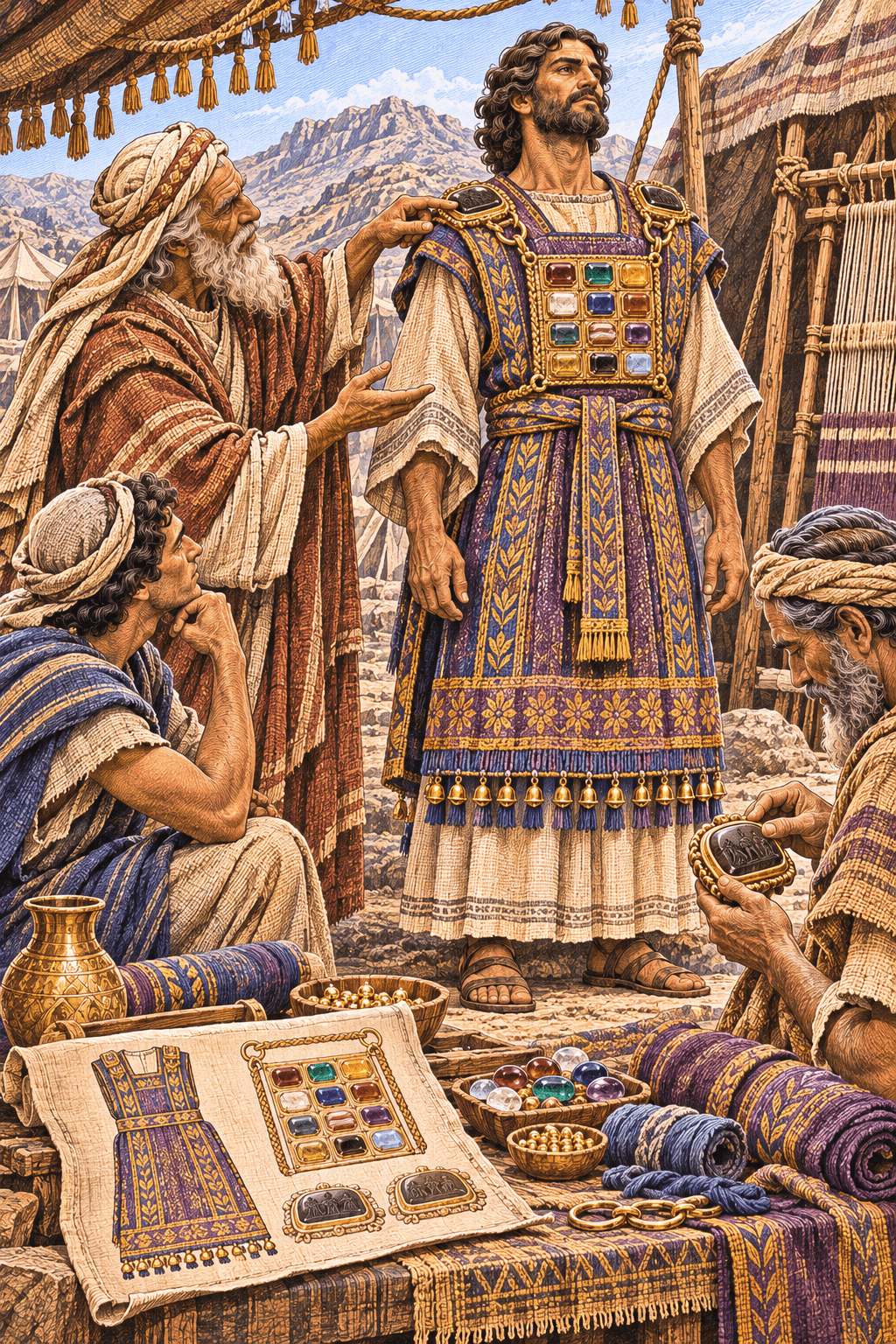
It is the outer garment. It seems to have been a short tunic joined only at the shoulders and open at the sides, bound with an embroidered girdle attached to the ephod itself (8).
Wonderfully, the ephod, like the girdle, is made of the same materials as the tabernacle, that is, fine twined linen, blue, purple, and scarlet, with the addition of gold, which was found in abundance in the tabernacle. It is as if the priestly work is bound to the Church, presenting a living picture of the marks of the Lord Christ Himself: purity (the linen), the heavenly life (the blue and the gold), the royal mind (the purple), and sanctification by the precious blood (the scarlet).
Whenever the fathers perceived this truth they trembled and felt the gravity of any priest’s falling into sin. I quote here some of their words:
In truth there is no beast in the world as savage and cruel as the priest of shameful conduct who will not mend his ways! The honor of the priesthood is great, but if priests sin, their destruction is terrible. The priest is not saved because of his honor, but if he walks worthily of his honor. (Saint Jerome) [370]
God is not dishonored by anyone as much as by those who shine with the honor of the priesthood, if they sin; for the sin of the priest becomes worse and heavier because of the ingratitude he shows toward God, who has graced him with this dignity so lofty. How should the hand of the priest which touches the Body of the Lord, and that mouth which is filled with heavenly fire, and that tongue which is reddened with the blood of Christ, not shine with the rays of holiness more than the sun?! (Saint John Chrysostom) [371]
The priest who serves the divine altar must above all be adorned with purity. (Origen) [372]
Returning to the ephod of the high priest, we find two onyx stones placed on the shoulders of the ephod, engraved with the names of the tribes of the children of Israel (9–12). It is as if the high priest, as a symbol of the Lord Christ, has placed on his shoulders all the needs of his people; every soul asks of him! He is a father bound to responsibility for his children. Saint John Chrysostom has delightful and practical discourses about this binding fatherhood, the fruit of the experience of faithful shepherding for long years. [373]
The priest, whatever his personality and however great his abilities, cannot carry the burdens of his people on his shoulders. So when he places their names on his shoulders as part of the rite of worship, he brings in the burden to cast it on the shoulders of Christ personally. Therefore in every Divine Liturgy the priest cries in his heart more than once: “Accept this sacrifice for my sins and the ignorances of Your people,” as if he casts the burdens of himself and of his people on the Lord, who alone is able to bear and to help!
4. The Breastplate
KJV · Verses 15–29
15 And thou shalt make the breastplate of judgment with cunning work; after the work of the ephod thou shalt make it; of gold, of blue, and of purple, and of scarlet, and of fine twined linen, shalt thou make it. 16 Foursquare it shall be being doubled; a span shall be the length thereof, and a span shall be the breadth thereof. 17 And thou shalt set in it settings of stones, even four rows of stones: the first row shall be a sardius, a topaz, and a carbuncle: this shall be the first row. 18 And the second row shall be an emerald, a sapphire, and a diamond. 19 And the third row a ligure, an agate, and an amethyst. 20 And the fourth row a beryl, and an onyx, and a jasper: they shall be set in gold in their inclosings. 21 And the stones shall be with the names of the children of Israel, twelve, according to their names, like the engravings of a signet; every one with his name shall they be according to the twelve tribes. 22 And thou shalt make upon the breastplate chains at the ends of wreathen work of pure gold. 23 And thou shalt make upon the breastplate two rings of gold, and shalt put the two rings on the two ends of the breastplate. 24 And thou shalt put the two wreathen chains of gold in the two rings which are on the ends of the breastplate. 25 And the other two ends of the two wreathen chains thou shalt fasten in the two ouches, and put them on the shoulderpieces of the ephod before it. 26 And thou shalt make two rings of gold, and thou shalt put them upon the two ends of the breastplate in the border thereof, which is in the side of the ephod inward. 27 And two other rings of gold thou shalt make, and shalt put them on the two sides of the ephod underneath, toward the forepart thereof, over against the other coupling thereof, above the curious girdle of the ephod. 28 And they shall bind the breastplate by the rings thereof unto the rings of the ephod with a lace of blue, that it may be above the curious girdle of the ephod, and that the breastplate be not loosed from the ephod. 29 And Aaron shall bear the names of the children of Israel in the breastplate of judgment upon his heart, when he goeth in unto the holy place, for a memorial before the Lord continually.
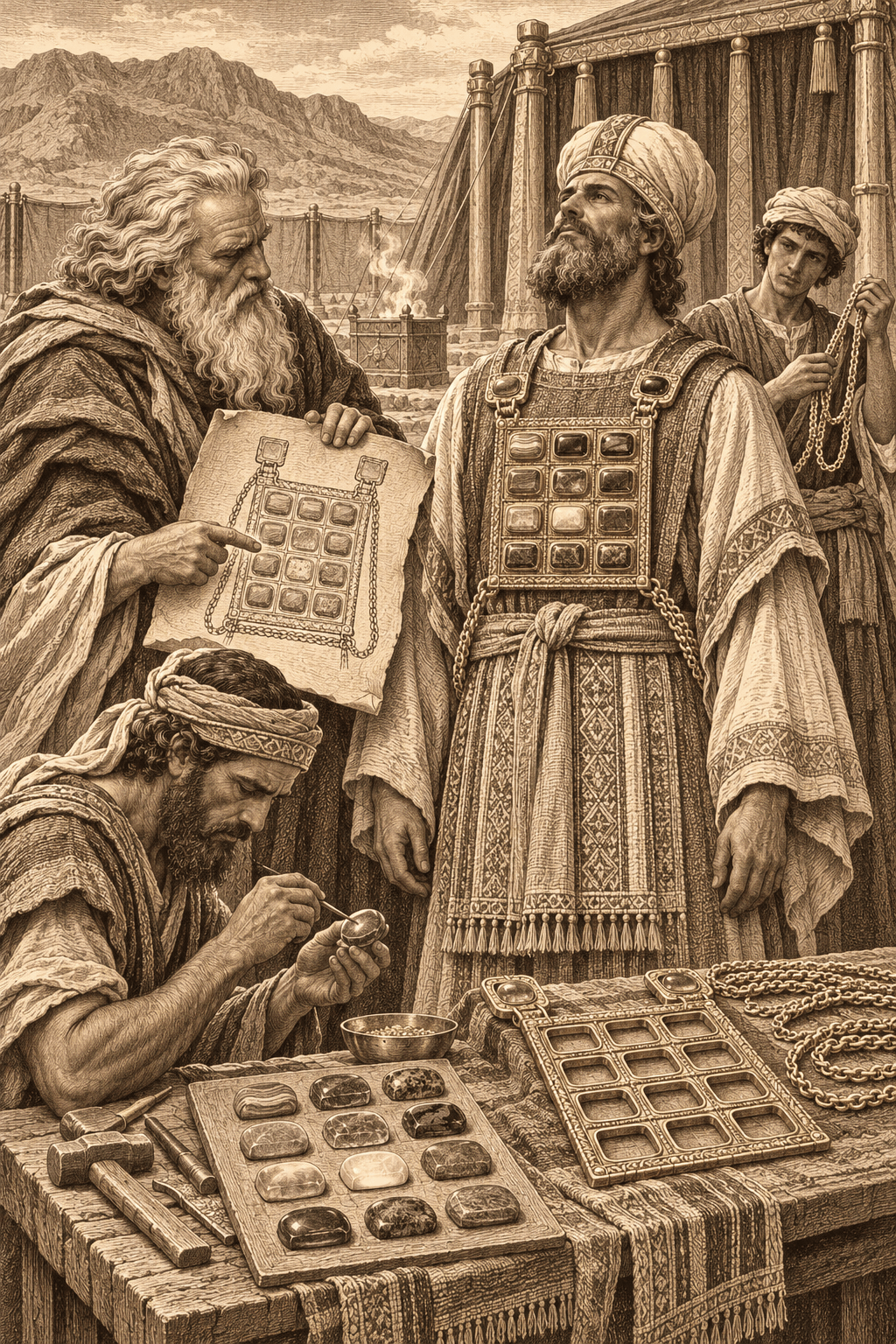
It is a square piece of the same cloth as the ephod (15), doubled at the lower end so that its thickness is twofold (16). It is set with twelve precious stones, three stones in each row, and on each stone is engraved the name of one of the tribes of the children of Israel (17–21). Its two upper corners were bound to the ephod with golden chains, and the breastplate was not to be loosed from the ephod (28); its two lower corners were bound to it through the girdle. The rings and the rest of its fastenings were made of gold or embroidery. It was called “a memorial” (12, 29), for in this position the stones are on the breast of the high priest, that is, in his heart; he cannot forget any of them. If the two onyx stones point to responsibility and his commitment to their needs, the breastplate points to his carrying them in his inner bowels, as Paul the Apostle said of Onesimus: “that is, mine own bowels” (Philemon 12).
It was also called a memorial because, as the priest put on these garments, he remembered his commitment to pray for all his people. If the Lord Christ is the High Priest and the continual Intercessor for His people (Hebrews 7:25) before the Father through His blood, then the priest, being hidden in the Lord Christ, is called “presbyter,” that is, an “intercessor,” whose chief work is continual prayer for his brethren and his spiritual children. On this Saint John Chrysostom says:
The priest, since he is the representative of God, must care for all people, for he is a father to the whole world. [374]
And Saint Jerome says:
The Savior wept over Jerusalem because its inhabitants did not repent (Luke 19:41)… And Jeremiah too lamented his unrepentant people, saying: “Oh that my head were waters, and mine eyes a fountain of tears, that I might weep day and night for the slain of the daughter of my people!” (Jeremiah 9:1), giving the reason for his grief: “Weep ye not for the dead, neither bemoan him: but weep sore for him that goeth away: for he shall return no more” (Jeremiah 22:10)… So it is fitting for us to weep for those who, because of their crimes and sins, have cut themselves off from the Church… In this sense the prophet calls the servants of the Church “walls and towers,” saying to each of them: “O wall… let tears run down like a river” (Lamentations 2:18)… By your tears the hearts of sinners are softened, so that they too weep. [375]
In the New Covenant the high priest wears a breastplate on which the twelve disciples are depicted in two vertical rows, so that he may resemble the apostles and disciples, remembering the need to remember his people with tears, carrying them in his bowels.
5. The Urim and the Thummim
KJV · Verses 30
30 And thou shalt put in the breastplate of judgment the Urim and the Thummim; and they shall be upon Aaron's heart, when he goeth in before the Lord: and Aaron shall bear the judgment of the children of Israel upon his heart before the Lord continually.
The literal meaning of the two words is “lights and perfections.” Some have thought that they are two small things (perhaps two precious stones) placed in the breastplate (30), so that the high priest might know the will of God in important priestly and national matters. Some think that the two words indicate that the light of guidance and its perfection come from God, and that this is done through the twelve stones set in the breastplate; for where the stones are mentioned the Urim and Thummim are not, and where the Urim and Thummim are mentioned the stones are not (Exodus 39:10; Leviticus 8:8).
Jewish scholars say that God spoke to the people through the Urim and Thummim in the tabernacle, but after Solomon’s temple was built He spoke to them through the prophets.
In any case, “the Urim and the Thummim” affirm in the priest’s life that he should not rely in his service on human arms and human counsels, but should first take refuge at the altar, pouring himself out before God, asking that His divine light shine in his heart and make up every weakness in him. The priest’s many, grave, and intertwined obligations, as he guides people in the most precious thing they have, the salvation of their souls, and deals with different kinds of people under varied circumstances, make him need to be in continual contact with God his Guide, lest a soul perish because of his ignorance or his inability to do the work.
Saint John Chrysostom spoke of the responsibility of the priest or shepherd for every failure that befalls the service, or loss that befalls any soul because of his lack of wisdom, and he cannot offer an excuse. King Saul did not take the throne of himself, yet when he acted in the kingdom without wisdom he could not excuse himself by saying that Samuel the prophet anointed him without any inner desire of his own. Nor could Eli the priest excuse the fault of his two sons by saying that he inherited the priesthood against his will. Even blessed Moses himself, in spite of all his attempts to escape the work of leadership, when he erred at the waters of Meribah, these attempts could not intercede for him. And Judas could not be saved, though it was the Lord who chose him for the apostleship… Therefore the priest must be wise, always seeking divine counsel, lest he fall under judgment. [376]
6. The Robe
KJV · Verses 31–35
31 And thou shalt make the robe of the ephod all of blue. 32 And there shall be an hole in the top of it, in the midst thereof: it shall have a binding of woven work round about the hole of it, as it were the hole of an habergeon, that it be not rent. 33 And beneath upon the hem of it thou shalt make pomegranates of blue, and of purple, and of scarlet, round about the hem thereof; and bells of gold between them round about: 34 A golden bell and a pomegranate, a golden bell and a pomegranate, upon the hem of the robe round about. 35 And it shall be upon Aaron to minister: and his sound shall be heard when he goeth in unto the holy place before the Lord, and when he cometh out, that he die not.
It is made entirely of blue, worn directly under the ephod (31). It is as if it points to the priest’s inner nature, which is the heavenly mind. He bears heaven not as material for preaching or talk; it fills his heart within and occupies all his thoughts. Saint John Chrysostom says:
Whoever takes a leading role must be more radiant than any shining star, so that his life is blameless, all look to him, and imitate his conduct. [377]
Perhaps the robe reached a little below the knees, without sleeves and open only at the top, and perhaps woven without seam (32).
On the hem of the robe were woven pomegranates of beautiful colors, with golden bells between them (33–34). The pomegranates point to the necessity of fruit in the priest’s life: the priest appears fruitful in his deep words of preaching, in his silence, in his discussions, in his guidance, and in his conduct with everyone! The bells point to the proclamation of the voice of preaching the Gospel wherever he moves, warning all to repent for the sake of the kingdom of heaven.
Saint Justin Martyr sees that the number of the bells was twelve, a sign of the twelve disciples, who relied on the power of the Lord Christ, the eternal Priest, so that their voices reached the ends of the earth with the glory of God and the spreading of His word. And Origen sees that:
These bells must ring continually, a symbol that the priest does not keep silent from speaking of the last times and the end of the world. [378]
7. The Golden Plate and the Mitre
KJV · Verses 36–38
36 And thou shalt make a plate of pure gold, and grave upon it, like the engravings of a signet, Holiness To The Lord. 37 And thou shalt put it on a blue lace, that it may be upon the mitre; upon the forefront of the mitre it shall be. 38 And it shall be upon Aaron's forehead, that Aaron may bear the iniquity of the holy things, which the children of Israel shall hallow in all their holy gifts; and it shall be always upon his forehead, that they may be accepted before the Lord.
The Golden Plate
On this plate is engraved “HOLINESS TO THE LORD,” and it is placed on the mitre (36–37). What is this golden plate but the declaration of the Lord Christ, the Firstborn whom the Father accepted on our behalf? The Lord sanctified His life to the Father in our name, that we too might become holy in Him, for He says: “And for their sakes I sanctify myself, that they also might be sanctified through the truth” (John 17:19).
The priest enters the sanctuary, the divine throne, not by any righteousness in himself nor for the sake of his own struggle, but hidden in Him who is the delight of the Father, the Messiah, the secret of his sanctification. Therefore Saint John Chrysostom says:
When you see the priest offering the sacrifice, consider the hand of the Lord Christ stretched out invisibly. [379]
And Saint Ambrose says:
Believe, then, that the Lord Jesus is present during the prayers of the priest… For if He said, “For where two or three are gathered together in my name, there am I in the midst of them” (Matthew 18:20), how much more does He grant us His presence when the Church is gathered and the mysteries are celebrated?! [380]
The Mitre
Its purpose is that the golden plate be placed on it; it is as if the crown with which the priest is graced and crowned is his bearing of the Lord Christ Himself, “Holiness to the Lord.” The crown worn by the bishop corresponds to this mitre; it was not originally known in the Coptic Church, but was taken from the Byzantine rite.
8. The Embroidered Coat
KJV · Verses 39
39 And thou shalt embroider the coat of fine linen, and thou shalt make the mitre of fine linen, and thou shalt make the girdle of needlework.
It is made of white linen, worn under the blue robe, so that it appears only on the arms and below the robe at the feet. If the blue robe points to the inner heavenly heart, the woven linen coat points to the pure, clean, angelic life, which works within but appears on the arms, that is, is reflected in outward conduct; and it appears from below the loins to the feet, as if purity also covers all a person’s walk (the feet): wherever he goes, he walks in purity!
9. The Girdle, the Bonnets, and the Breeches
KJV · Verses 40–43
40 And for Aaron's sons thou shalt make coats, and thou shalt make for them girdles, and bonnets shalt thou make for them, for glory and for beauty. 41 And thou shalt put them upon Aaron thy brother, and his sons with him; and shalt anoint them, and consecrate them, and sanctify them, that they may minister unto me in the priest's office. 42 And thou shalt make them linen breeches to cover their nakedness; from the loins even unto the thighs they shall reach: 43 And they shall be upon Aaron, and upon his sons, when they come in unto the tabernacle of the congregation, or when they come near unto the altar to minister in the holy place; that they bear not iniquity, and die: it shall be a statute for ever unto him and his seed after him.
When offering the sacrifice the high priest puts on the girdle, a belt of cloth for girding and binding the waist during the service, a sign of the need for the shepherd’s watchfulness (Luke 12:35; Ephesians 6:14; 1 Peter 1:13). We have already spoken of “girding” in eating the Passover lamb.
Girding is the work of servants who serve their masters; it is as if the priest in his service feels that he is a servant of his Master’s children, not a ruler or a lord over them.
Girding points to the work of a soldier: the priest, as a good soldier, struggles spiritually in the army of salvation.
Girding is the work of travelers, in readiness to depart: the priest feels that he is a stranger on earth, seeking not earthly things but heavenly things.
In the Book of Revelation we saw the people represented by the golden girdle around the breast of the Lord Christ (Revelation 1:13), so that they may feed on His breasts, that is, the New and Old Covenants. So the priest carries his people around his breast and offers his whole life in Christ Jesus for his people.
As for the breeches, God Himself declares that they are to cover the priest’s nakedness (42)… Therefore Saint Ambrose says:
Some of us still observe this; but most interpret it in a spiritual way, and suppose that it was said so that the priests should observe modesty and keep purity. [381]
The breeches point to the priest’s modesty, not only in his dress; he must be modest (1 Timothy 3) in all his conduct and words. The following are two sayings of the fathers on this matter:
The voice of the priest should not be slack and faint, or “womanish” in its tone, as many are accustomed. (Saint Ambrose) [382]
One hour of drunkenness stripped Noah naked, after he had been covered with dignity for sixty years (Genesis 9:20–27). (Saint Jerome) [383]
Notes and References
[366] See the sayings of the fathers on this matter in our book Pastoral Love, pp. 23–31.
[367] Fr. Tadros Yacoub Malaty, Pastoral Love (Arabic, 1965), p. 17.
[368] Fr. Tadros Yacoub Malaty, Pastoral Love (Arabic, 1965), p. 46, 47.
[369] St. Athanasius, Discourses Against the Arians 2:7, 8.
[370] Fr. Tadros Yacoub Malaty, Pastoral Love (Arabic, 1965), p. 147.
[371] Fr. Tadros Yacoub Malaty, Pastoral Love (Arabic, 1965), p. 145.
[372] Fr. Tadros Yacoub Malaty, Pastoral Love (Arabic, 1965), p. 145.
[373] See his sayings on this matter in our book Saint John Chrysostom (Arabic), the chapter on his pastoral method.
[374] Fr. Tadros Yacoub Malaty, Pastoral Love (Arabic, 1965), p. 546.
[375] Fr. Tadros Yacoub Malaty, Pastoral Love (Arabic, 1965), p. 560.
[376] Fr. Tadros Yacoub Malaty, Pastoral Love (Arabic, 1965), p. 643–650.
[377] Fr. Tadros Yacoub Malaty, Pastoral Love (Arabic, 1965), p. 654.
[378] Origen, In Exod. hom. 9:4.
[379] Fr. Tadros Yacoub Malaty, Pastoral Love (Arabic, 1965), p. 27.
[380] Fr. Tadros Yacoub Malaty, Pastoral Love (Arabic, 1965), p. 27.
[381] St. Ambrose, Duties of the Clergy 1:18.
[382] Fr. Tadros Yacoub Malaty, Pastoral Love (Arabic, 1965), p. 666.
[383] Fr. Tadros Yacoub Malaty, Pastoral Love (Arabic, 1965), p. 668.