
This chapter speaks of the bronze altar (1–8), the court of the tabernacle (9–19), and the lighting of the lampstand (20–21).
1. The Bronze Altar
KJV · Verses 1–8
1 And thou shalt make an altar of shittim wood, five cubits long, and five cubits broad; the altar shall be foursquare: and the height thereof shall be three cubits. 2 And thou shalt make the horns of it upon the four corners thereof: his horns shall be of the same: and thou shalt overlay it with brass. 3 And thou shalt make his pans to receive his ashes, and his shovels, and his basons, and his fleshhooks, and his firepans: all the vessels thereof thou shalt make of brass. 4 And thou shalt make for it a grate of network of brass; and upon the net shalt thou make four brasen rings in the four corners thereof. 5 And thou shalt put it under the compass of the altar beneath, that the net may be even to the midst of the altar. 6 And thou shalt make staves for the altar, staves of shittim wood, and overlay them with brass. 7 And the staves shall be put into the rings, and the staves shall be upon the two sides of the altar, to bear it. 8 Hollow with boards shalt thou make it: as it was shewed thee in the mount, so shall they make it.
We have spoken of the inner holy things of the tabernacle, those of the holy of holies (the ark of the covenant) and of the holy place (the table of shewbread, the lampstand, and the altar of incense). But there is no passing over to the holy things except through the bronze altar and the laver. The bronze altar means the shedding of the blood of animals and offering them as sacrifices to the Lord.
The Epistle to the Hebrews compares the bronze altar, ever burning with fire to consume daily sacrifices without ceasing, with the Cross of the Lord Christ, which bore one sacrifice at the end of the ages.
Concerning the bronze altar, the Apostle says that the high priest entered the holy of holies once a year, but “not without blood, which he offered for himself, and for the errors of the people” (Hebrews 9:7). His entering once every year is a sign of the inadequacy of the work, and his offering sacrifices, the blood of animals, for his sins and the errors of his people is a sign of his continual weakness. But the Lord Christ, the great High Priest, entered not into the symbols or shadows of the heavenly holy places, but into heaven itself; “Neither by the blood of goats and calves, but by his own blood he entered in once into the holy place, having obtained eternal redemption for us” (Hebrews 9:12). He offered His own blood on the Cross, and so gave a possibility on an eternal level, without repeating the act of the Cross! The first high priest suffered again and again by offering the blood of animals every year, a sign of his inability to abolish sin; but the new High Priest, “after he had offered one sacrifice for sins for ever, sat down on the right hand of God” (Hebrews 10:12).
That concerns the high priest. As for the priests, their daily work was this: “And every priest standeth daily ministering and offering oftentimes the same sacrifices” (Hebrews 10:11). The Apostle sees in the daily repetition of the work a sign of the inability of the blood of goats and calves to cleanse the soul by taking away sin (Hebrews 10:11); it sanctified only “to the purifying of the flesh” (Hebrews 9:13). That is, it carried a symbolic work, until the one sacrifice should come which is able to purge the conscience (Hebrews 9:14).
The Material and Dimensions of the Altar
The altar is made of shittim wood (1), as a symbol of the Cross, the tree of life. It is overlaid with brass (2), not gold, for on the Cross the Son accepts the price of the sin we committed with perfect steadfastness, like brass, which is a sign of patience and perseverance.
We find no trace of gold outside the tabernacle, for the heavenly glories remain within; but we find brass and silver. Brass (2–4, 6…), that we may share with the Lord Christ His patience, His sufferings, and His perseverance, for He appears thus in the Book of Revelation: “And his feet like unto fine brass, as if they burned in a furnace” (Revelation 1:15). When we put on the Lord Christ, we have the brass with which we crush all toils and tribulations and walk toward heaven with perseverance, without slackness. And the presence of silver (10–11) is a sign of our need for the word of God as a support in our struggle and perseverance.
The altar is overlaid with brass; all its vessels are of brass, its grate is of brass, its rings are of brass, and the two staves to carry it are overlaid with brass.
The length of the altar is five cubits and its breadth likewise (1), as if the sacrifice is offered for the sanctification of our five senses, so that we may be prepared to enter the hidden holy things. The number five also reminds us of the sacrifices and offerings given in the Book of Leviticus, which are five in number, for all of them symbolize the sacrifice of the Cross, a matter we explained before in the introduction to the Book of Leviticus.
The height of the bronze altar is three cubits (1). It is as if the altar points not only to the Cross, but bears the symbol of the resurrection (the number 3). The power of the sacrifice is that it brings us into the Cross in order to pass us over to the resurrection, so that our thoughts, words, and deeds (the number 3) are raised; that is, we practice the mystery of the number 3 by entering into suffering, burial, and resurrection. In this way the altar lifts us up three cubits.
2. The Court of the Tabernacle
KJV · Verses 9–19
9 And thou shalt make the court of the tabernacle: for the south side southward there shall be hangings for the court of fine twined linen of an hundred cubits long for one side: 10 And the twenty pillars thereof and their twenty sockets shall be of brass; the hooks of the pillars and their fillets shall be of silver. 11 And likewise for the north side in length there shall be hangings of an hundred cubits long, and his twenty pillars and their twenty sockets of brass; the hooks of the pillars and their fillets of silver. 12 And for the breadth of the court on the west side shall be hangings of fifty cubits: their pillars ten, and their sockets ten. 13 And the breadth of the court on the east side eastward shall be fifty cubits. 14 The hangings of one side of the gate shall be fifteen cubits: their pillars three, and their sockets three. 15 And on the other side shall be hangings fifteen cubits: their pillars three, and their sockets three. 16 And for the gate of the court shall be an hanging of twenty cubits, of blue, and purple, and scarlet, and fine twined linen, wrought with needlework: and their pillars shall be four, and their sockets four. 17 All the pillars round about the court shall be filleted with silver; their hooks shall be of silver, and their sockets of brass. 18 The length of the court shall be an hundred cubits, and the breadth fifty every where, and the height five cubits of fine twined linen, and their sockets of brass. 19 All the vessels of the tabernacle in all the service thereof, and all the pins thereof, and all the pins of the court, shall be of brass.
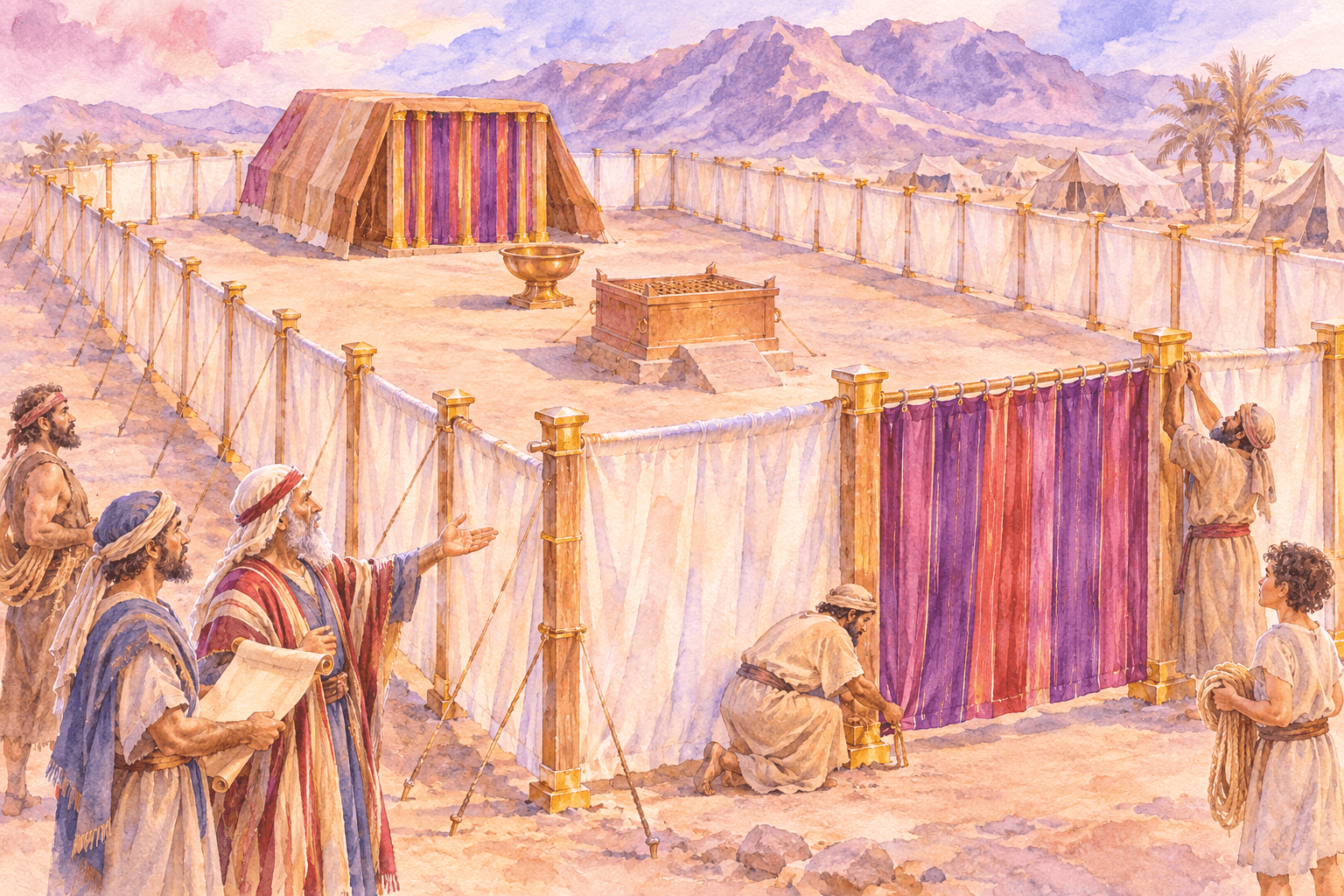
We described it in the previous chapter, where we learned that it is a hundred cubits long and fifty cubits wide, its linen curtains standing on boards or pillars: twenty pillars on each of the two sides, ten pillars at the back; and on the east side three pillars on the right and three pillars on the left, while the hanging of the entrance stands on four pillars.
Note that in the court of the tabernacle there is also no gold; the pillars stand on sockets of brass, and their hooks and fillets are of silver, so what we said of the bronze altar applies to it.
All the curtains (except the hanging of the gate) are of fine twined linen only, standing on pillars each five cubits high (18). It is as if the outer court wanted to emphasize purity (the linen) and cleanness, standing on pillars of continual perseverance and leaning on the word of God (the silver). The height of the pillar points to the need for purity in all five senses.
The hanging of the gate could not be of linen alone, but of blue, purple, and scarlet with the linen (16), for there is no entering into the life of purity (the linen), no ability to persevere (the brass), and no understanding of the word of God (the silver), except through the Lord Christ, who is the door of the fold.
This hanging, which symbolizes our life in Christ, or our entering the court through Christ, stands on four pillars, for it is accomplished through our struggle on earth in the inhabited world (the four corners of the world). But if we look to the right or to the left we see three pillars (14–15); it is as if, as we enter through Christ here on earth into the divine spiritual dwelling, we must enter by the power of His resurrection.
3. The Lighting of the Lampstand
KJV · Verses 20–21
20 And thou shalt command the children of Israel, that they bring thee pure oil olive beaten for the light, to cause the lamp to burn always. 21 In the tabernacle of the congregation without the vail, which is before the testimony, Aaron and his sons shall order it from evening to morning before the Lord: it shall be a statute for ever unto their generations on the behalf of the children of Israel.
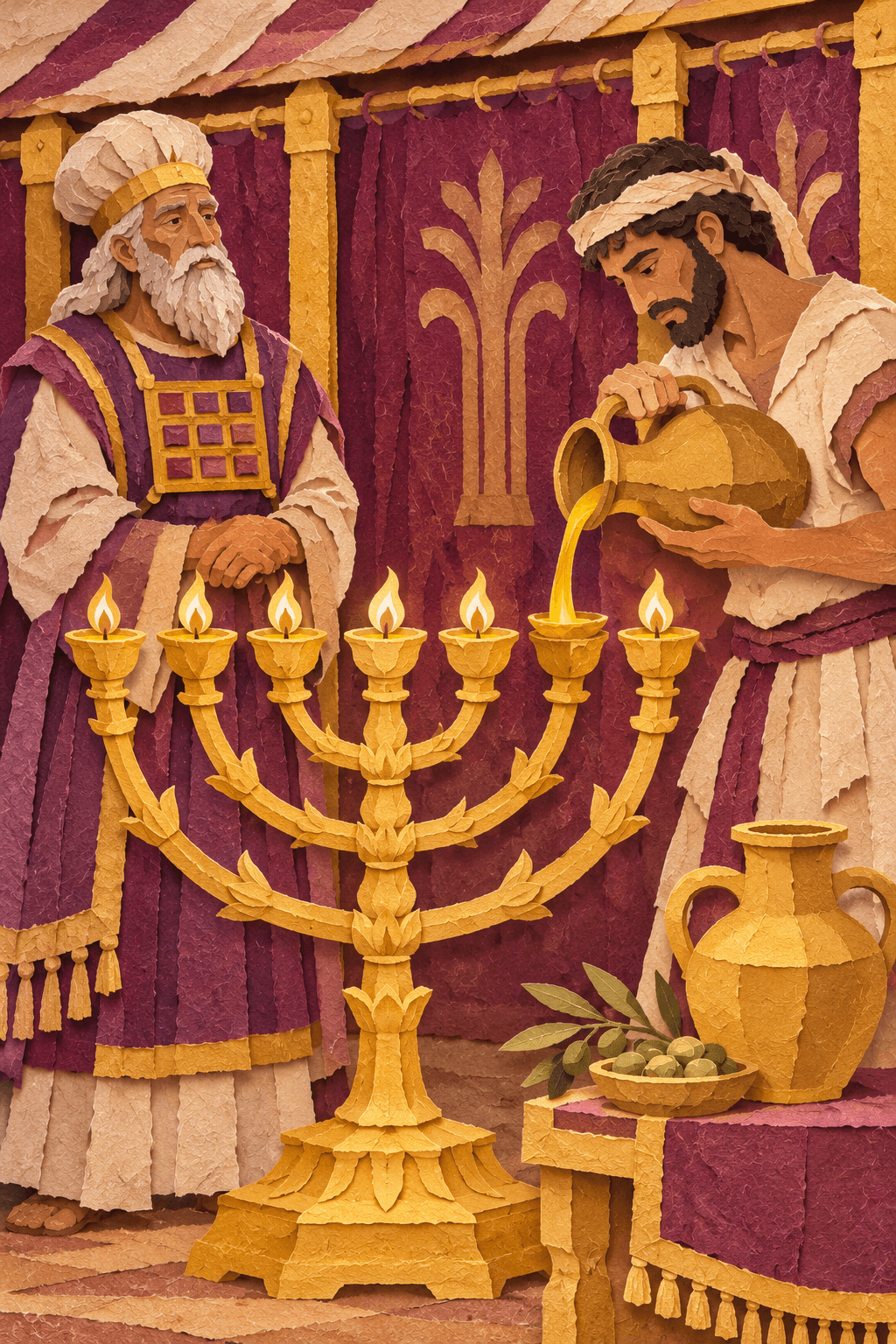
He affirms again that the lampstand is not merely for lighting, but a sign of a covenant in which we receive divine enlightenment, for He commands the use of “pure oil olive beaten for the light,” and that it be “a statute for ever” (20–21).