
This chapter speaks of: an introduction to the Ten Commandments; the Law between the letter and the spirit; “I am not come to destroy, but to fulfil”; the ten commandments one by one (1–17); the people’s fear and trembling (18–21); and a warning against idol worship (22–26).
1. Introduction to the Ten Commandments
KJV · Verses 1–2
1 And God spake all these words, saying, 2 I am the Lord thy God, which have brought thee out of the land of Egypt, out of the house of bondage.
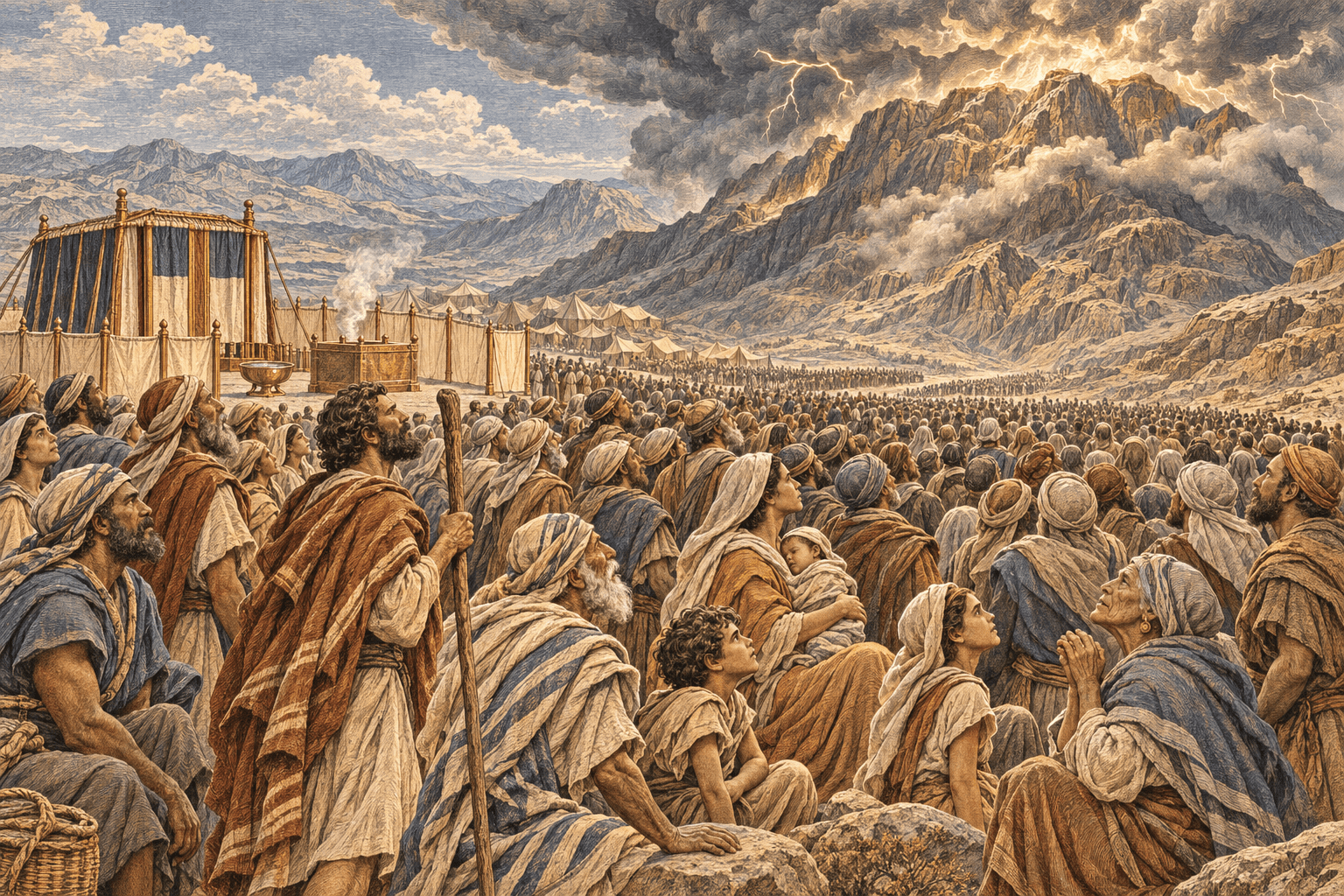
The people could not have received the divine commandments or tasted the Law while in the land of bondage. Therefore the Lord brought them out into the wilderness to give them the Law there, beginning with the words: “I am the LORD thy God, which have brought thee out of the land of Egypt, out of the house of bondage” (2). Although this phrase came as an introduction to the commandments and not in the form of a commandment, the Jews considered it part of the first commandment.
The Ten Commandments are called the Ten Words, the Decalogue (Exodus 34:28; Deuteronomy 4:13; 10:4). They were written on two tables of stone (Exodus 32:15), and are called “the words of the covenant” (Deuteronomy 29:1), “the two tables of testimony” (Exodus 31:18), and “the testimony” (Exodus 25:16).
The text of these commandments appears again in Deuteronomy (Deuteronomy 5:6–21). The difference between them is that the text in Exodus gives as the reason for the commandment to keep the Sabbath holy that God rested on the seventh day after creation, while in Deuteronomy it rests on its being a memorial of the deliverance from the land of bondage and the entry into rest.
The Ten Commandments are not numbered in Holy Scripture, so two kinds of division have appeared:
First: The ancient division known to the Jews, given by Josephus [267] and Philo, [268] adopted by Origen, and still followed by the non-Lutheran Protestant churches. This division distinguishes between the commandment forbidding many gods (3) and the commandment against setting up idol worship (4), counting them as the first and second commandments, while counting “Thou shalt not covet thy neighbour’s wife…” as part of the commandment forbidding coveting the neighbor’s possessions (17).
By this division the first four commandments concern man’s relationship with the Lord, and the remaining six concern man’s relationship with his brother. This view held that each table carried five commandments, so the fifth commandment, concerning honoring parents, was engraved with the commandments concerning man’s relationship with God on the first table. Those who hold this view justify it by saying that the Jews saw honoring parents as absolute and unconditional (Mark 7:10–13), as if the commandment concerning it were an extension of the commandments concerning man’s relationship with God. Note that when Paul the Apostle grouped the last five commandments together he did not include this commandment, though he left room for its inclusion (Romans 13:9); but the Lord Christ included it in the same group (Mark 10:19).
Second: The division held by the Catholic Church and the Lutheran churches. The Church relied on Saint Augustine, who considered that the commandment against many gods includes the commandment against idol worship, while he made the commandment not to covet the neighbor’s wife a commandment separate from not coveting the neighbor’s possessions. In this way he sees that the commandments concerning man’s relationship with God are three, and those concerning man’s relationship with his neighbor are seven: the first table contained the first three commandments, and the second the last seven.
Note that the Ten Commandments carry a negative side, except for the commandments to keep the Sabbath holy and to honor parents; and the commandment to honor parents is the only commandment with a promise.
The Lord Christ summed up all these commandments in the commandment of “love for God and neighbor” (Matthew 22:37; Romans 13:9; Galatians 5:14; James 2:8).
The Law Between the Letter and the Spirit
Since we are speaking of the Ten Commandments, the core of the Law, we must study it in the light of the words of our teacher Paul the Apostle: “Forasmuch as ye are manifestly declared to be the epistle of Christ ministered by us, written not with ink, but with the Spirit of the living God; not in tables of stone, but in fleshy tables of the heart. And such trust have we through Christ to God-ward: Not that we are sufficient of ourselves to think any thing as of ourselves; but our sufficiency is of God; Who also hath made us able ministers of the new testament; not of the letter, but of the spirit: for the letter killeth, but the spirit giveth life. But if the ministration of death, written and engraven in stones, was glorious, so that the children of Israel could not stedfastly behold the face of Moses for the glory of his countenance; which glory was to be done away: How shall not the ministration of the spirit be rather glorious? For if the ministration of condemnation be glory, much more doth the ministration of righteousness exceed in glory” (2 Corinthians 3:3–9).
Many of the fathers were concerned to explain the phrase, “the letter killeth, but the spirit giveth life.” Here I will be content with some quotations from Saint Augustine, from his treatise On the Spirit and the Letter, a book he sent to Marcellinus in sixty-six chapters, in which he made clear the following points:
1. By the Law sin was revealed but not healed: “The letter of the Law, which teaches us not to commit sin, kills if the Spirit who gives life is absent; for it makes us know sin without avoiding it, and makes it increase rather than decrease, since it adds to evil lust (which the Law forbids us) our transgression of the Law itself.” [269] Though the Law is good in itself, it increases evil lust when it forbids it. It is like rushing water that always flows in a certain direction: if it meets a barrier, by overcoming the barrier its force increases and it hurtles down more quickly (becoming a mighty waterfall). In a somewhat similar way, what we desire becomes very dear when we are forbidden it; and this is the sin that deceives and kills by means of the commandment, “for where no law is, there is no transgression” (Romans 4:15). [270]
2. The Law declared the need for a physician: “‘The law entered, that the offence might abound’ (Romans 5:20). By its presence (man) appeared guilty and confused, in need not of a physician but of God Himself as his helper, to direct his steps so that sin should not have dominion over him. To be healed he had to give himself up to the help of divine mercy. So, where sin abounded, grace must much more abound (Romans 5:20), not through the merit of the sinner but through the intervention of God who helps him.” [271] “In fact, the Law, by issuing commandments with threats and justifying no one, shows that man’s justification is a gift of God by the help of the Holy Spirit… being justified freely by His grace (Romans 3:24).” [272]
3. The Law is good and the commandment just: As Christians we are bound to the Ten Commandments (observing the Sabbath as a figure of Sunday), for he says: “The Ten Commandments are useful and beneficial to those who do them; indeed, no one can enjoy life unless he keeps them.” [273] But they bring sorrow to the literal man, for they do not free him from sin; therefore it is said, “He that increaseth knowledge increaseth sorrow” (Ecclesiastes 1:18). But for one who keeps the Law spiritually, according to the inner man, the Law becomes a joy. Saint Augustine says:
If there is faith which worketh by love (Galatians 5:6), a man begins to delight in the law of God after the inward man (Romans 7:22). This is the gift of the Holy Spirit, not of the letter, even though there is another law in our members warring against the law of our mind; for we are changed from our old state and go on being renewed from day to day, that is, by the grace of God our inner man is set free from the body of this death through our Lord Jesus Christ. [274]
4. The Law and the New Covenant: Saint Augustine says:
Notice this also in the testimony which the prophet gives more clearly on this matter, for he says: “Behold, the days come, saith the LORD, that I will make a new covenant with the house of Israel, and with the house of Judah: Not according to the covenant that I made with their fathers in the day that I took them by the hand to bring them out of the land of Egypt; which my covenant they brake… But this shall be the covenant that I will make with the house of Israel; After those days, saith the LORD, I will put my law in their inward parts, and write it in their hearts; and will be their God, and they shall be my people. And they shall teach no more every man his neighbour, and every man his brother, saying, Know the LORD: for they shall all know me, from the least of them unto the greatest of them, saith the LORD: for I will forgive their iniquity, and I will remember their sin no more” (Jeremiah 31:31–34)… What difference has God shown between the two covenants, the Old and the New…? The change came about because of the life-giving Spirit, without whom the letter kills… [275]
He sees that the Old Covenant was called “old” because the sin of the old man was at work in man, and the letter of the Law could not heal it; but the New Covenant was so called because of the gift of the Spirit of the living God (2 Corinthians 3:3), who engraved the commandment in a new way, not in tables of stone but in fleshy tables of the heart. [276] In the Old Covenant the commandment came warning from outside; but in the New Covenant we have received the grace of the life-giving Holy Spirit in the heart, within. On this he says: “The difference between the Old and New Covenants is that the first was written on tables to warn, from outside, while the second delights within. By the first man became a transgressor through the killing letter; by the second he became alive through the life-giving Spirit.” [277]
Saint Augustine also sees that the Lord Christ summed up the whole Law in love for God and neighbor. If before we heard commandments that we were unable to carry out, in the New Covenant love is shed abroad in our hearts by the Holy Spirit who is given to us (Romans 5:5). In this way carrying out the commandments of the Law becomes possible and easy, for this is the work of the Holy Spirit, who pours love into us and so fulfills the whole Law.
I Am Not Come to Destroy, but to Fulfil
The Lord Christ affirmed that He did not come to destroy the Law but to fulfil it (Matthew 5:17). On one side, He revealed the depths of the Law and brought us from its letter into its hidden spirit, so that the Law is no longer merely commandments and orders, but a meeting with the hidden “Word of God.” As Saint Mark the Ascetic says:
The Lord is hidden in His commandments; whoever seeks Him finds Him in them. Do not say, I have kept the commandments and have not found the Lord; for whoever seeks Him truly finds peace. [278]
On another side, in the New Covenant the Lord commanded us to slay the head of sins. He did not only ask us not to kill, but not to be angry, which is the beginning of the road to murder; and He did not only ask us to abstain from adultery, but not to look at a woman with evil intent, which is the beginning of falling into adultery, and so on…
He also gave us the ability to carry it out. Of old the commandment, or the Law, declared man’s utter inability to sanctify and justify himself; so the Lord Christ came to give us the grace of the Holy Spirit, who is able to sanctify our souls and bodies, so that the commandment that was impossible becomes the law of our new man.
The number ten: The number 10 points to completeness on earth. The whole world is likened to ten virgins (Matthew 25:1), and to ten servants of God to whom He gave ten pounds to trade with (Luke 19:13). The Church is likened to a woman who has ten pieces of silver (Luke 15:8). And the commandment of tithes assumes that a person owns ten units, which are all his wealth, of which he offers one part (one tenth) to God. [279]…
Finally, as I speak of the Ten Commandments, I will make every effort to be brief, hoping the reader will turn to the book The Ten Commandments in the Christian Understanding by His Holiness Pope Shenouda III.
2. The First Commandment: No Other Gods
KJV · Verses 3
3 Thou shalt have no other gods before me.
The Ten Commandments begin thus: “I am the LORD thy God, which have brought thee out of the land of Egypt, out of the house of bondage. Thou shalt have no other gods before me… for I the LORD thy God am a jealous God” (2–5).
His saying, “Thou shalt have no other gods before me,” does not mean that other gods exist; He warns His people against falling into worship of the gods of the pagans alongside their worship of God. Saint Athanasius the Apostolic sees that:
God gave us this commandment to draw men away from the false and irrational imaginings of idol worship… not as though there were other gods from which He kept them, but He commanded this lest they turn away from the true God and make gods for themselves out of nothing, as the poets and writers did. [280]
Though we are not now exposed to idol worship, God warns us against the other gods that reign in the heart, as with one who loves the world, or honor, or the praise of men, or lusts… And there are those “whose God is their belly” (Philippians 3:19).
He wants us to love Him so that He reigns completely over the heart, not because He wants to enslave or humiliate us, but because He is “a jealous God”… Therefore He insisted on describing Himself thus: “I the LORD thy God am a jealous God.” Saint John Chrysostom commented on this phrase:
God said this so that we might learn the intensity of His love. So let us love Him as He loves us, for He has offered such a store of love. If we leave Him, He keeps calling us to Himself; and if we do not change, He disciplines us with His anger, not for the sake of discipline itself. See what He said in Ezekiel about the city, His beloved, who despised Him: “Behold, therefore I will gather all thy lovers… against thee… and I will also give thee into their hand… and they shall stone thee with stones, and thrust thee through… So will I make my fury toward thee to rest, and my jealousy shall depart from thee, and I will be quiet, and will be no more angry” (see Ezekiel 16:37–42). What more could be said than this by a burning lover, despised by his beloved, who yet returns and loves her again fervently?! God has done everything so that we might love Him, so that He did not spare His Son that we might love Him; and yet we are slack and fierce. [281]
Origen comments on the same phrase:
See the love of God: He bears the weaknesses of men to teach us and lead us to perfection… Every woman bound to her husband submits to him, or else she becomes an adulteress, seeking freedom to sin. And whoever goes to a harlot knows that he goes in to a harlot who gives herself to all who come to her, so he is not angry if he sees others with her. But the lawfully married man cannot bear to see his wife sin, but works constantly to guard the purity of his marriage, so as to be sure that he is the lawful father (of the child, the fruit of his marriage). If you understand this example, you can say that the soul defiles itself with the demons and the many other lovers. Usually the spirit of fornication enters her, and when it goes out the spirit of avarice enters, then the spirit of pride, then the spirit of anger, the love of adornment, and vainglory; and many others enter and commit fornication with the faithless soul without one being jealous of another… and one does not drive out another; on the contrary, each introduces the other… As we have seen the evil spirit of which the Gospel says that when it goes out of a man it returns, taking with it seven other spirits more wicked than itself (Luke 11:24–26), and dwells in that soul. So, in the soul that sells herself to fornication with the demons, one is not jealous of another.
But if the soul is united with a lawful husband, the Bridegroom to whom Paul betroths souls, saying: “For I have espoused you to one husband, that I may present you as a chaste virgin to Christ” (2 Corinthians 11:2), this marriage of which the Gospel spoke, saying that “a certain king… made a marriage for his son” (Matthew 22:2), then the soul gives herself to Him and is lawfully bound to Him. Even if in her past she was a sinner and behaved as a harlot, once she is bound to Him she pledges not to sin again. The soul that has chosen Him as her Bridegroom cannot bear to play with adulterers; and He too is jealous over her and defends the purity of His married life.
God is called “a jealous God” because He cannot bear that the soul which has given herself to Him be bound to the demons…
If we have come to know Him, after we have been enlightened by His divine words and received baptism, after the confession of faith and being bound to such great mysteries, He does not want us to sin again, and cannot bear to see the souls for whom He was called Bridegroom and Husband playing with the demons, committing fornication with unclean spirits, and wallowing in the mire of iniquity. And if this calamity happens, He at least wants her to return and repent.
This is a new kind of His love for us: that He accepts the soul that returns to Him after fornication, having repented with all her heart, as the prophet says: “They say, If a man put away his wife, and she go from him, and become another man’s, shall he return unto her again? shall not that land be greatly polluted? but thou hast played the harlot with many lovers; yet return again to me, saith the LORD” (Jeremiah 3:1). Then He says: “She is gone up upon every high mountain and under every green tree, and there hath played the harlot. And I said after she had done all these things, Turn thou unto me. But she returned not” (Jeremiah 3:6–7).
So the jealous God seeks you and longs for your soul to be bound to Him; He keeps you from sin, corrects you, disciplines you, and is angry with you… In short, if He uses a kind of jealousy toward you, be sure that for you He is the hope of your salvation. [282]
Finally, this marital love that binds the soul to her Bridegroom drew the hearts of sinners and fornicators to repentance, and also drew the hearts of many to the life of virginity and monasticism, for they saw in the heavenly Bridegroom what satisfies the heart abundantly. This “love” has held first place in the spiritual writings of the fathers.
3. The Second Commandment: No Graven Image
KJV · Verses 4–6
4 Thou shalt not make unto thee any graven image, or any likeness of any thing that is in heaven above, or that is in the earth beneath, or that is in the water under the earth. 5 Thou shalt not bow down thyself to them, nor serve them: for I the Lord thy God am a jealous God, visiting the iniquity of the fathers upon the children unto the third and fourth generation of them that hate me; 6 And shewing mercy unto thousands of them that love me, and keep my commandments.
The commandment came thus: “Thou shalt not make unto thee any graven image, or any likeness of any thing that is in heaven above, or that is in the earth beneath, or that is in the water under the earth: Thou shalt not bow down thyself to them, nor serve them: for I the LORD thy God am a jealous God” (4–5). We have spoken of this commandment at length before, [283] and said that the Church is without doubt bound to carry out this commandment, but she keeps the spirit of the commandment, not its letter.
The spirit of the commandment is to stop idol worship from creeping into the people, not to forbid the use of images in themselves. The Jewish people were known to be prone to two kinds of pagan deviation:
A) Imitating the pagans around them, as King Solomon fell into the worship of foreign gods when he married pagan women.
B) Mixing pagan worship with the worship of the living God, as appears from their worship of the calf, intending to worship the living God through this symbolic act (Exodus 32:5).
That is on one side. On another, as Father John of Damascus says:
The prohibition of images in the Old Covenant rested essentially on the inability of the Jewish people to distinguish between worship (latreia), which belongs to God alone, and veneration (proskynesis), which may be offered to others than God. [284]
This appears clearly from God’s command to His people of old to set up certain images which He Himself defined, not as ornaments to adorn the house of the Lord, but as a living part of the rite of worship. The tabernacle of meeting itself, and later the temple, came by a divine pattern, a masterly icon depicting heavenly things (Exodus 25:40; Hebrews 8:5), and they contained images such as the two cherubim on the cover of the ark of the covenant… Moses and all the people bowed down before the ark, and the Lord spoke with them from between the cherubim (Exodus 25:22; Numbers 10:35–36). The cherub was also depicted on the veil of the tabernacle between the holy of holies and the holy place. The image of the cherub became a recurring artistic motif carved on the walls of the temple and on its two doors (1 Kings 6:27–29, 32; 2 Chronicles 3:7), a sign of God’s dwelling in His holy house.
God commanded Moses to make a bronze image of a fiery serpent and set it on a pole in the wilderness, to be the secret of healing for everyone who looked at it (Numbers 21:8–9).
So God forbade icons and images only out of fear that they would fall into pagan deviations. But when this fear passed, icons came to play a teaching role, as a universal language that every person understands, whatever his race, and a spiritual role… On this Father John of Damascus says: “If a pagan asks you to tell him about your faith, take him to the church and stand him before the icons.” And Pope Gregory the Great wrote a letter to Serenus, bishop of Marseilles, who had ordered the icons destroyed to prevent what he saw as an evil practice. In it he said:
It has come to our knowledge that you have destroyed images of saints with an inconceivable zeal, and you have justified this on the ground that images may not be worshipped. Your forbidding their worship deserves praise; but your destroying them deserves blame. To worship an image is one thing; to use it to remember its subject is another. For a picture is to the unlearned what writing is to the learned. Pictures are used in churches so that at least the unlearned may read on the walls, by looking at them, what they cannot read in books.
Father John of Kronstadt says: “Icons in homes and churches are not works of art for display or decoration; they are a help to us in realizing the life of prayer through visible things.”
And Father Leontius says: “Just as in honoring the book of the Law you do not bow to the leather or the ink, but to the words of God contained in it, so when I honor the icon of Christ I do not give honor to the wood and the paint, God forbid!” [285]…
Visiting the Iniquity of the Fathers upon the Children
Some are frightened when they hear the Lord say, “visiting the iniquity of the fathers upon the children” (5), and they say: What is the children’s fault, that they should bear the wages of what their fathers did? We answer as follows:
First: We do not deny that children bear the fruits of their parents’ mistakes. The fetus nourished throughout pregnancy on the blood of an angry and agitated mother carries the fruit of this anger in its bodily and psychological health; it often comes out bearing some bodily illnesses and harsh traits… But God has assured us that He does not repay a person for the mistakes of his parents. Many with fiery temperaments have become saints through repentance and received a greater blessing than others.
God affirmed this by the mouth of Jeremiah the prophet, who said: “In those days they shall say no more, The fathers have eaten a sour grape, and the children’s teeth are set on edge. But every one shall die for his own iniquity: every man that eateth the sour grape, his teeth shall be set on edge” (Jeremiah 31:29–30).
Second: The Lord’s words do not mean that God takes revenge on the children for what their fathers did… but He wants to affirm His long-suffering. He leaves the wicked to repent year after year and generation after generation; and when a person insists on doing evil, he is disciplined in the third or fourth generation, not for the sins of his fathers, but for the children’s insistence on walking in evil in the way of their fathers.
On this Saint John Chrysostom says:
This does not mean that a person bears the punishment of crimes committed by another; but as long as this person commits many sins and does not mend his ways, he is doing what his fathers did, so he justly deserves punishment too. [286]
Saint Augustine says:
Whoever is changed in Christ ceases to be the son of the evil father, for he no longer imitates his evil; so the evils of his fathers are not visited upon him. [287]
So when the Jews said, “His blood be on us, and on our children” (Matthew 27:25), they spoke truly, for their children bear this blood which their fathers shed, as long as they persist in denying this blood. But if they accept the Savior, they are no longer the children of those who shed the blood of Christ, but children of God.
4. The Third Commandment: Not Taking the Lord’s Name in Vain
KJV · Verses 7
7 Thou shalt not take the name of the Lord thy God in vain; for the Lord will not hold him guiltless that taketh his name in vain.
The first and second commandments concern the worship of the living God, far from every pagan deviation; the third commandment concerns “the name of God.” [288]
Since God feared that His people would swear by the names of other gods, the Lord allowed them to swear by His name, as a declaration of the name of their God and a mark that distinguished them (Deuteronomy 6:13; 10:20; Psalm 63:11; Isaiah 48:1). He also commanded them: “That ye come not among these nations… neither make mention of the name of their gods, nor cause to swear by them, neither serve them, nor bow yourselves unto them” (Joshua 23:7).
He required them not to swear by the name of the Lord falsely (Leviticus 19:12), and to fulfill what they had sworn by the name of the Lord.
That concerns oaths. As for repeating the name of God, He asked them not to repeat it in vain, that is, without an essential reason, for His name is holy (Luke 1:49), reverend (Psalm 111:9), great among the heathen (Malachi 1:11), and excellent in all the earth (Psalm 8:9)… We must fear and revere it, and utter it only with awe and all reverence. Moses the prophet commanded us, saying: “That thou mayest fear this glorious and fearful name, THE LORD THY GOD” (Deuteronomy 28:58). It is the object of our love, our satisfaction, and our prayers: “I will lift up my hands in thy name. My soul shall be satisfied as with marrow and fatness” (Psalm 63:4–5); His name is beloved, our meditation all the day (compare Psalm 119:97)…
In the New Covenant the believer has reached spiritual maturity, so it is fitting that he not swear at all, as the Lord said: “But let your communication be, Yea, yea; Nay, nay: for whatsoever is more than these cometh of evil” (Matthew 5:37). And we have come to know the name of the Lord Christ the Savior: “For whosoever shall call upon the name of the Lord shall be saved” (Romans 10:13). For His name’s sake we endure with patience and do not faint (Revelation 2:3); for His sake we are put to shame and rejoice (Acts 5:41); in His name demons are cast out (Mark 16:17), and signs and wonders are done (Acts 4:29–30).
5. The Fourth Commandment: Keeping the Sabbath Holy
KJV · Verses 8–11
8 Remember the sabbath day, to keep it holy. 9 Six days shalt thou labour, and do all thy work: 10 But the seventh day is the sabbath of the Lord thy God: in it thou shalt not do any work, thou, nor thy son, nor thy daughter, thy manservant, nor thy maidservant, nor thy cattle, nor thy stranger that is within thy gates: 11 For in six days the Lord made heaven and earth, the sea, and all that in them is, and rested the seventh day: wherefore the Lord blessed the sabbath day, and hallowed it.
We have spoken of this commandment before at some length, so I ask the reader to turn to that study to avoid repetition. [289]
We said that it is an eternal commandment which the Church is bound to carry out, by entering into the true “Sabbath,” that is, “rest,” which has become ours through the resurrection of the Lord Christ. If God rested on the seventh day after finishing the work of creation, our rest has come with the beginning of the new creation, which has become ours through our resurrection with the Lord Christ. The following are some sayings of the fathers on this matter:
We keep the eighth day with joy, the day on which the Lord rose from the dead, to reveal Himself as ascending into the heavens. (The Epistle of Barnabas, second century) [290]
He gave us the seventh day as a rest because of the toil of life, for we have a body that needs rest; but God does not grow weary, nor is He touched by pain or need. We hold fast to the spiritual Sabbath (Sunday) until the coming of the Savior, for we have rested from sin. (Saint Clement of Alexandria) [291]
Those who lived according to the old order of things to come do not keep the Sabbath but keep the Lord’s Day, the day on which our life rose through Christ by His death. (Saint Ignatius) [292]
Saint Basil the Great says: “Many things we have received from the tradition which the apostles laid down alongside the written teachings, among them the sanctification of the first day (Sunday) of the week.” The Lord Christ was accustomed, after His resurrection, to meet His disciples on the first day of the week (Luke 24; John 20:19, 26). And this day was the day of the Church’s common worship in the age of the apostles (Acts 20:7; 1 Corinthians 16:2).
6. The Fifth Commandment: Honoring Parents
KJV · Verses 12
12 Honour thy father and thy mother: that thy days may be long upon the land which the Lord thy God giveth thee.
The Lord placed honoring parents at the head of the commandments concerning our relationship with others; He commands us to honor them before He commands us, “Thou shalt not kill” or “Thou shalt not commit adultery,” and so on… It is the only commandment joined with a reward or promise (Ephesians 6:2). The Law was severe on whoever broke this commandment: “And he that smiteth his father, or his mother, shall be surely put to death… And he that curseth his father, or his mother, shall surely be put to death” (Exodus 21:15–17). Whoever was stubborn and would not obey the voice of his father or the voice of his mother, all the men of his city were to stone him with stones until he died (Deuteronomy 21:18–21). And whoever “setteth light by his father or his mother” falls under the curse (Deuteronomy 27:16).
It seems that the Jews exploited these commandments, and some behaved badly in dealing with their children, wanting absolute obedience without regard for the children’s inner life and personality. So the Lord Christ came to reveal the deep meanings of this commandment. While the Lord was subject to Saint Mary and Saint Joseph (Luke 2:51), He to whom all the heavenly powers are subject (Philippians 2:10), and while He cared for His mother on the Cross, though occupied with the salvation of the whole world and fallen under sufferings, entrusting her to His disciple Saint John (John 19:27)… He set a new understanding of this obedience when His mother reproached Him, saying: “Son, why hast thou thus dealt with us? behold, thy father and I have sought thee sorrowing.” He answered her: “How is it that ye sought me? wist ye not that I must be about my Father’s business?” (Luke 2:48–49). The evangelist comments on this answer: “And they understood not the saying which he spake unto them” (Luke 2:50).
The Lord Christ’s answer was like a revolution in the world of childhood, for He gave children the right to reason with their parents, and obedience “in the Lord” (Ephesians 6:1), not the absolute obedience as the Jews understood it, and as mankind at that time understood it.
This evangelical understanding extended to obedience to the spiritual father, for Paul the Apostle says: “But though we, or an angel from heaven, preach any other gospel unto you than that which we have preached unto you, let him be accursed” (Galatians 1:8), giving his spiritual children the right not to obey if it is not in the Lord.
Saint Jerome speaks of obedience in the Lord:
The commandment says, “Honour thy father,” but only if he does not separate you from your true Father. Remember the bond of blood, as long as your father knows his Creator; but if he does not, David will sing to you: “Hearken, O daughter, and consider, and incline thine ear; forget also thine own people, and thy father’s house; So shall the king greatly desire thy beauty: for he is thy Lord” (Psalm 45:10–11). In that case the reward is great for your forgetting your parent, for “the king shall greatly desire thy beauty.” [293]
The meaning of honoring parents is broad. It includes obedience and submission, and Isaac gave a living example of obedience to his father Abraham, who wanted to offer him as a sacrifice to the Lord at God’s command. It also includes love and respect, and we see a living example in Solomon the wise: when his mother came to him, “the king rose up to meet her, and bowed himself unto her, and sat down on his throne, and caused a seat to be set for the king’s mother; and she sat on his right hand” (1 Kings 2:19). Success too is a kind of honoring parents, for Scripture says: “A wise son maketh a glad father: but a foolish son is the heaviness of his mother” (Proverbs 10:1). Supporting them is a practical honoring of parents. As Saint Jerome says:
Do not interpret honor in mere words… but supply them with the necessities of life. The Lord commanded that needy parents be supported by their children, in return for the good deeds done to the children in their childhood. [294]
The Lord Christ rebuked the Pharisees, who had set a tradition contrary to the word of God: they allowed children to give what their parents needed to the treasury of the temple for the poor, and if their parents asked them for something, they would say, “It is a gift” (Matthew 15:5)! So they made the commandment of the Lord of none effect by their evil tradition. [295]
Finally, if this commandment carries honoring the parents according to the flesh, and the spiritual fathers, how much more is it to be carried out toward our spiritual parents: God our Father and the Church our mother. Saint Clement of Alexandria sees that the parents here are God, as our Father and Lord, and the mother is true knowledge and wisdom, which gives birth to the righteous. [296]
7. The Sixth Commandment: Thou Shalt Not Kill
KJV · Verses 13
13 Thou shalt not kill.
“Thou shalt not kill” (13).
God cannot bear to see innocent blood shed without guilt, for He says to Cain: “The voice of thy brother’s blood crieth unto me from the ground” (Genesis 4:10). He cannot even bear the shedding of the blood of the wicked, for He says: “Whosoever slayeth Cain, vengeance shall be taken on him sevenfold. And the LORD set a mark upon Cain, lest any finding him should kill him” (Genesis 4:15). His hatred of bloodshed appears in His words to David the prophet, whom He loved: “Thou hast shed blood abundantly, and hast made great wars: thou shalt not build an house unto my name” (1 Chronicles 22:8).
The God who commanded not to kill permitted it in the case of adulterers (Leviticus 20:10–16), the murderer himself (Exodus 21:14), one who strikes or curses his father or mother (Exodus 21:15, 17), the Sabbath-breaker (Exodus 31:15), and the blasphemer of the name of the Lord (Leviticus 24:16)… and He commanded it in some wars with the pagans. All this suited the Old Covenant, for man could not yet distinguish between the sinner and the sin, between the idol worshipper and idol worship; by putting to death He wanted to affirm His total rejection of sin and of the idol worship of the nations. But in the New Covenant, since the faithful have entered into spiritual maturity, death is no longer the punishment of the sinner; rather, he must be saved from sin, the cause of his death.
Killing does not mean merely shedding blood. There is one who kills with his tongue, as Scripture says: “Their tongue is as an arrow shot out” (Jeremiah 9:8); “His words were softer than oil, yet were they drawn swords” (Psalm 55:21). There is killing by intention: “Whosoever hateth his brother is a murderer” (1 John 3:15). There is killing by responsibility, as when a man leaves his goring ox to gore another and kill him (Exodus 21:28–29). And there is killing of the spirit, as Scripture says: “The letter killeth” (2 Corinthians 3:6). Saint Clement of Alexandria considered heretics worse than murderers, for he says:
Murder is certain destruction; so whoever wishes to set aside the true teaching concerning God and immortality… is more harmful than the murderer. [297]
8. The Seventh Commandment: Thou Shalt Not Commit Adultery
KJV · Verses 14
14 Thou shalt not commit adultery.
“Thou shalt not commit adultery” (14). [298]
The Apostle says: “Flee fornication. Every sin that a man doeth is without the body; but he that committeth fornication sinneth against his own body” (1 Corinthians 6:18). By fornication we wrong our bodies, which are the members of Christ (1 Corinthians 6:15) and the temple of the Holy Spirit (1 Corinthians 6:19).
There is no sin as hideous, and as hateful to God, as fornication, so that Scripture calls it “uncleanness” (2 Peter 2:10). By it women are defiled (Ezekiel 18:11), a man defiles his body (2 Peter 2:10), his garments are defiled (Revelation 3:4), and they defile the land (Jeremiah 3:6–9). Because of its hideousness, idol worship was called fornication (Jeremiah 3:6–9). Because of it the Lord punished the earth with the flood (Genesis 6:1–2), burned Sodom and Gomorrah (Genesis 19:24–25), and almost destroyed the whole tribe of Benjamin (Judges 20). Paul the Apostle imposed a severe discipline, so that the fornicator was almost swallowed up with overmuch sorrow (1 Corinthians 5:3, 5); and the Lord considered it the only cause for loosing the holy bond of marriage (Matthew 5:32).
The Lord Christ wanted to keep us from it completely, so He commanded us not to look on a woman to lust after her, as if He wanted to shut the door from the beginning of the way.
The canons of the Church are severe in this matter: the priest who falls into it is punished by being deprived of his priestly work all the days of his life.
Saint Clement of Alexandria sees that fornication has a wider meaning than the common one, for he says: “Whoever leaves the true ecclesiastical knowledge and faith in God and runs after his own vanity commits fornication.” [299]
The fathers wrote much about the life of chastity and purity, both for the married and for virgins. [300]
9. The Eighth Commandment: Thou Shalt Not Steal
KJV · Verses 15
15 Thou shalt not steal.
“Thou shalt not steal” (15).
Stealing is not merely taking what belongs to another, but robbing him. When the disciples were hungry they plucked the ears of grain in the field, and the Law says: “When thou comest into thy neighbour’s vineyard, then thou mayest eat grapes thy fill at thine own pleasure; but thou shalt not put any in thy vessel. When thou comest into the standing corn of thy neighbour, then thou mayest pluck the ears with thine hand; but thou shalt not move a sickle unto thy neighbour’s standing corn” (Deuteronomy 23:24–25).
The charge against Jacob of stealing Laban’s gods was considered a hideous thing (Genesis 31:30, 32), as was the charge against Joseph’s brothers of stealing the cup (Genesis 44:7–9).
This sin grows more hideous if the one robbed is in need, like the widow (Mark 12:40); or in lending at usury to the needy, or taking someone’s garment or covering as a pledge (Exodus 22:25–27); or if the thing stolen is among the holy things.
God considered whoever refuses to pay tithes a robber (Malachi 3:8–10)! And Saint Clement of Alexandria considered that whoever attributes something to one who is not its owner steals, [301] like one who steals the thoughts of others and attributes them to himself.
10. The Ninth Commandment: No False Witness
KJV · Verses 16
16 Thou shalt not bear false witness against thy neighbour.
“Thou shalt not bear false witness against thy neighbour” (16).
False witness means lying, and Satan is “a liar, and the father of it” (John 8:44); whoever lies does the works of his father, Satan.
Since false witness is dangerous to the community, the Law laid down: “At the mouth of two witnesses, or at the mouth of three witnesses, shall the matter be established” (Deuteronomy 19:15).
Holy Scripture has given attention to holy silence, for in the multitude of words there wanteth not sin (Proverbs 10:19), and haste in speaking may push a person into lying without intending it.
11. The Tenth Commandment: Thou Shalt Not Covet
KJV · Verses 17
17 Thou shalt not covet thy neighbour's house, thou shalt not covet thy neighbour's wife, nor his manservant, nor his maidservant, nor his ox, nor his ass, nor any thing that is thy neighbour's.
“Thou shalt not covet thy neighbour’s house, thou shalt not covet thy neighbour’s wife, nor his manservant, nor his maidservant, nor his ox, nor his ass, nor any thing that is thy neighbour’s” (17; Deuteronomy 5:21).
This commandment revealed the depth of the Law: it wanted to kill sin at its root; [302] but the Jews did not understand.
Some ask: The Mosaic Law commanded, “Thou shalt not covet,” and the New Covenant commanded the same commandment; so what is the difference? The Law commanded, but it did not give the remedy; it revealed man’s inability to carry out the commandment so that he would seek the remedy. But the New Covenant gave us the ability to carry it out by the Holy Spirit working in us. On this Saint Augustine says:
The Law says, Thou shalt not covet, so that, finding ourselves fallen into this sickly state, we may seek the remedy. By this commandment we know in which direction we must aim our struggle! [303]
He also says:
By the law of works God says to us, Do what I command you (Thou shalt not covet); but by the law of faith we say to God, Give what Thou commandest. [304]
Lust does not stop at the things of bodily desire; there is also the lust of possession and the love of money. Saint Ambrose says:
The love of money is an ancient and old vice, which showed itself even at the declaration of the Law, for the Law came to curb it. [305]
12. The People’s Fear and Trembling
KJV · Verses 18–21
18 And all the people saw the thunderings, and the lightnings, and the noise of the trumpet, and the mountain smoking: and when the people saw it, they removed, and stood afar off. 19 And they said unto Moses, Speak thou with us, and we will hear: but let not God speak with us, lest we die. 20 And Moses said unto the people, Fear not: for God is come to prove you, and that his fear may be before your faces, that ye sin not. 21 And the people stood afar off, and Moses drew near unto the thick darkness where God was.
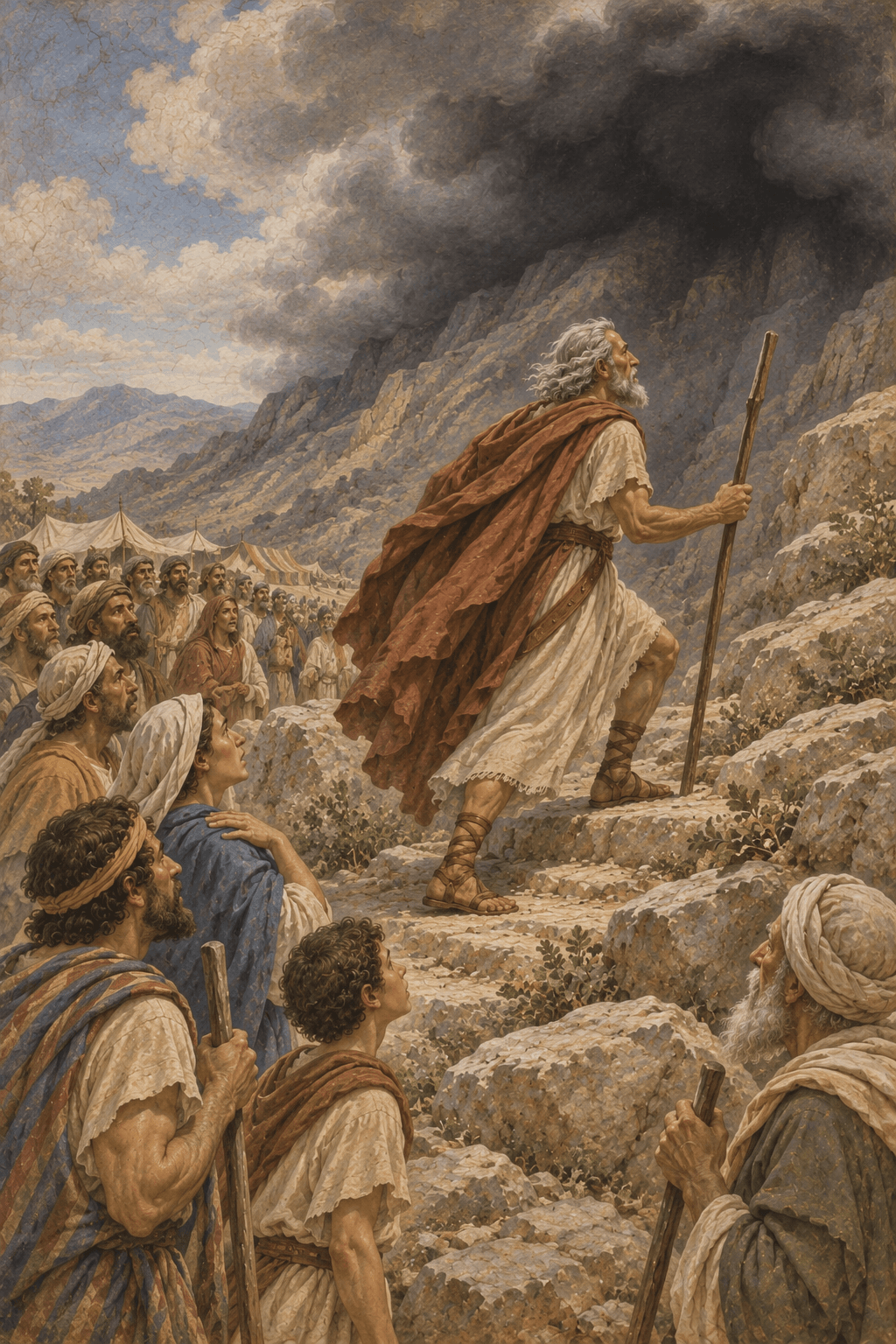
In the previous chapter we spoke of the lightnings, the thunders, and the mountain that smoked, and we spoke of the thick darkness which Moses approached, where God was. Here I will be content to give a comparison between the people’s trembling and fear as Moses received the Law, and the scene of the upper room in the New Covenant, where the Holy Spirit came down upon the Church, in the words of Saint Augustine:
In the Old Covenant the people were kept by dreadful terror from approaching the place where the Law was; but in the second case the Holy Spirit came upon those who were gathered together waiting for the gift of God which He had promised. There the finger of God worked on tables of stone; here it worked in the hearts of men. There the Law was given outwardly, so that the wicked might be terrified; here it was given inwardly, so that they might be justified (Acts 2:1–47). For this, “Thou shalt not commit adultery, Thou shalt not kill, Thou shalt not steal, Thou shalt not bear false witness, Thou shalt not covet; and if there be any other commandment, it is briefly comprehended in this saying, namely, Thou shalt love thy neighbour as thyself. Love worketh no ill to his neighbour: therefore love is the fulfilling of the law” (Romans 13:9–10). And this is not written on tables of stone, but “is shed abroad in our hearts by the Holy Ghost which is given unto us” (Romans 5:5). So love is the law of God… and when this love is poured out in the hearts of the faithful, then we have the law of faith and the Spirit who gives life, that we may love. [306]
13. A Warning Against Idol Worship
KJV · Verses 22–26
22 And the Lord said unto Moses, Thus thou shalt say unto the children of Israel, Ye have seen that I have talked with you from heaven. 23 Ye shall not make with me gods of silver, neither shall ye make unto you gods of gold. 24 An altar of earth thou shalt make unto me, and shalt sacrifice thereon thy burnt offerings, and thy peace offerings, thy sheep, and thine oxen: in all places where I record my name I will come unto thee, and I will bless thee. 25 And if thou wilt make me an altar of stone, thou shalt not build it of hewn stone: for if thou lift up thy tool upon it, thou hast polluted it. 26 Neither shalt thou go up by steps unto mine altar, that thy nakedness be not discovered thereon.
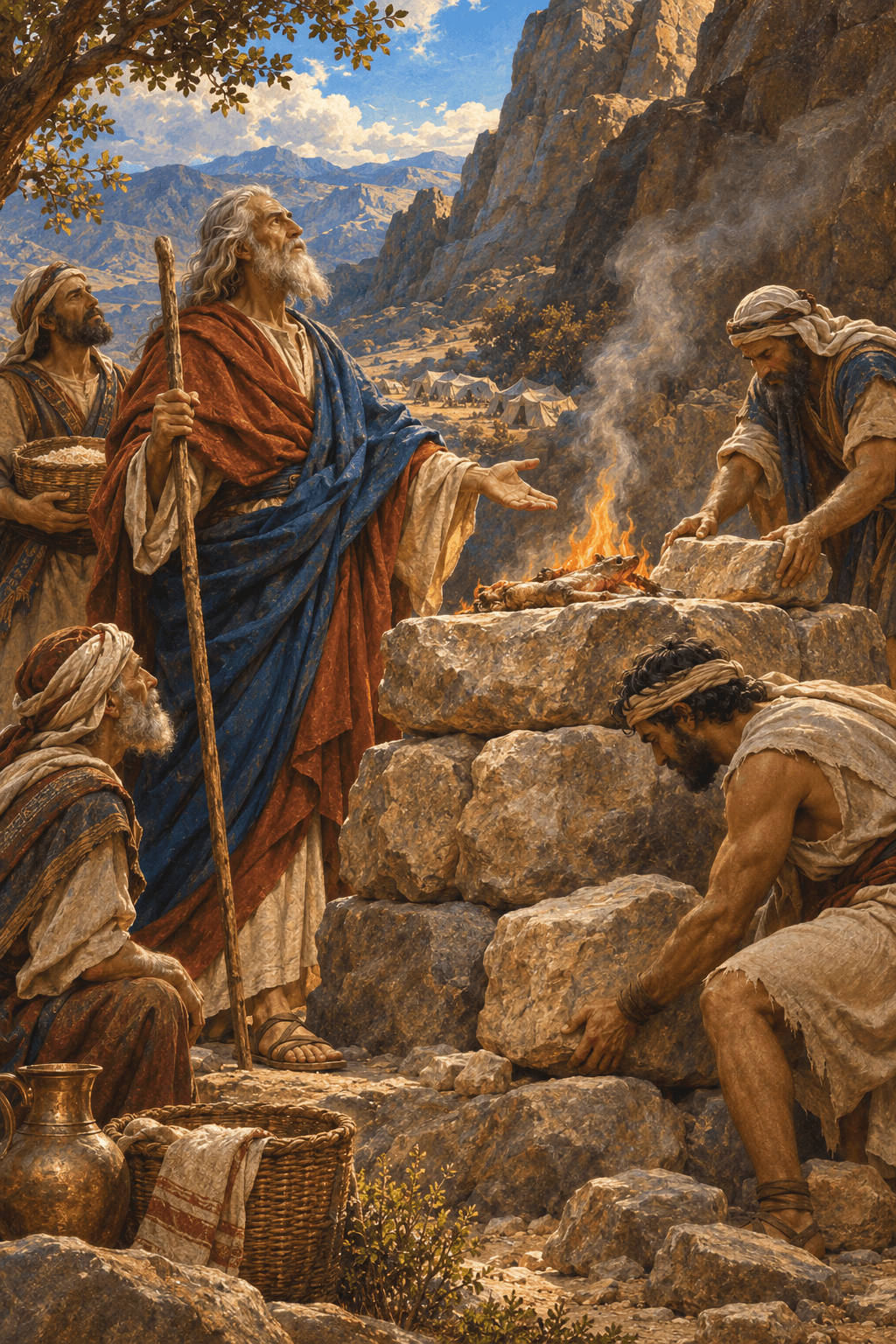
As God opened His speech in the commandments by affirming that He is the one God, with whom no other is to be worshipped, so after He concluded the commandments the Lord warned Moses lest the children of Israel turn aside into idol worship…
Notes and References
[267] Josephus, Antiquities 3:5:5.
[268] Philo, On the Decalogue.
[269] St. Augustine, On the Spirit and the Letter, ch. 8.
[270] Ibid., ch. 6.
[271] Ibid., ch. 9.
[272] Ibid. 15.
[273] Ibid. 24.
[274] Ibid. 26.
[275] Ibid. 33, 34.
[276] Ibid. 35.
[277] Ibid. 42.
[278] Fr. Tadros Yacoub Malaty, The Philokalia (Arabic, 1966), p. 130.
[279] See Pope Shenouda III, The Ten Commandments in the Christian Understanding (Arabic), pp. 7–8.
[280] St. Athanasius, Against the Heathen.
[281] St. John Chrysostom, In Rom. hom. 23.
[282] Origen, In Exod. hom. 8:5.
[283] Fr. Tadros Yacoub Malaty, The Church, the House of God (Arabic, 1979), pp. 171–179.
[284] St. John of Damascus, On the Divine Images.
[285] For a study of icons, see our book The Church, the House of God, pp. 167–300.
[286] St. John Chrysostom, In Matt. hom. 74:2.
[287] St. Augustine, On Psalm 109.
[288] Pope Shenouda III, The Ten Commandments in the Christian Understanding, the third commandment.
[289] Fr. Tadros Yacoub Malaty, Christ in the Mystery of the Eucharist (Arabic, 1973), pp. 115–136.
[290] Epistle of Barnabas 15.
[291] Clement of Alexandria, Stromata 6:16; Library of Fathers of the Church, vol. 43.
[292] St. Ignatius, To the Magnesians 5:1.
[293] St. Jerome, Epistle 54:3.
[294] St. Jerome, Epistle 123:6.
[295] Origen, Commentary on Matthew 9:9.
[296] Clement of Alexandria, Stromata 6:16.
[297] Ibid.
[298] Pope Shenouda III, The Ten Commandments in the Christian Understanding, the seventh commandment.
[299] Clement of Alexandria, Stromata 6:16.
[300] I have translated the book On Continence by St. Augustine, and spoken of chastity and purity in the life of the young man in the book To You, My Young Brother, and also in the book Love: Its Meaning and Its Degrees.
[301] Clement of Alexandria, Stromata 6:16.
[302] Clement of Alexandria says: “God always cuts off the roots of sins in a wonderful way; for as He says, ‘Thou shalt not commit adultery’ (14), He also says, ‘Thou shalt not covet’ (17), for adultery is the fruit of lust, which is its evil root.”
[303] St. Augustine, On Marriage and Concupiscence.
[304] St. Augustine, On the Spirit and the Letter 22.
[305] St. Ambrose, Duties of the Clergy 2:26.
[306] St. Augustine, On the Spirit and the Letter 29.