
In the previous chapter he spoke of the believer as a true soldier who enters the battle under the command of God Himself, fighting evil with all strength and firmness, while bearing the Spirit of God, the Giver of love, so that he is gentle even with the trees and does not destroy them during his battle. Now he takes us into the sphere of mercy, giving us through his law living examples of true mercy, which cannot be separated from justice lest it turn into a kind of laxity. The lawgiver wanted to affirm two important truths in this chapter: the value of human life, and care for human rights, especially of those unable to enjoy their rights.
Here he speaks of the rejected, despised, or wronged groups, so that we may take a fitting stand of faith toward them. He speaks of the blood of an unknown slain man, of the captive woman taken as a wife and then sent away by her husband, of the firstborn son of the hated mother, of the father whose son rebels against him, and of the body of one sentenced to death and hanged on a tree. These are varied examples of rejected or wronged groups.
1. One Slain by an Unknown Hand
KJV · Verses 1–9
1 If one be found slain in the land which the Lord thy God giveth thee to possess it, lying in the field, and it be not known who hath slain him: 2 Then thy elders and thy judges shall come forth, and they shall measure unto the cities which are round about him that is slain: 3 And it shall be, that the city which is next unto the slain man, even the elders of that city shall take an heifer, which hath not been wrought with, and which hath not drawn in the yoke; 4 And the elders of that city shall bring down the heifer unto a rough valley, which is neither eared nor sown, and shall strike off the heifer’s neck there in the valley: 5 And the priests the sons of Levi shall come near; for them the Lord thy God hath chosen to minister unto him, and to bless in the name of the Lord; and by their word shall every controversy and every stroke be tried: 6 And all the elders of that city, that are next unto the slain man, shall wash their hands over the heifer that is beheaded in the valley: 7 And they shall answer and say, Our hands have not shed this blood, neither have our eyes seen it. 8 Be merciful, O Lord, unto thy people Israel, whom thou hast redeemed, and lay not innocent blood unto thy people of Israel’s charge. And the blood shall be forgiven them. 9 So shalt thou put away the guilt of innocent blood from among you, when thou shalt do that which is right in the sight of the Lord.

No one can grasp the value of this law concerning blood shed by an unknown hand except one who studies the customs of the nations at that time, when human blood in their eyes was worthless. Here, however, it is counted a crime on earth and a sin in the sight of heaven that cannot be forgiven unless the community is serious in searching for the killer. The life of every person is the object of God’s own care.
He had already given the law concerning the deliberate killer (Deuteronomy 19:11), and how he is handed over to the avenger of blood to die, so that the guilt of innocent blood is put away from Israel. In this chapter he deals with the case when the killer is not known. If a person is found slain, the matter is not to be taken lightly; the killer must be sought seriously, lest the land be defiled by the shedding of innocent blood. As is said in the Book of Isaiah: “For, behold, the Lord cometh out of his place to punish the inhabitants of the earth for their iniquity: the earth also shall disclose her blood, and shall no more cover her slain” (Isaiah 26:21). The whole community around the place where a person is found slain by an unknown hand is counted guilty toward him and before God, unless it does all it can to discover the killer and judge him. For this reason the elders and judges of the neighboring cities gather to examine the matter. [234]
God inclined His ears to hear the voice of Abel’s blood crying to Him from the ground (Genesis 4:10). He cannot bear to hear human excuses: “I know not: Am I my brother’s keeper?” (Genesis 4:9).
The law affirms the following:
A) A serious search for the killer, examining witnesses and studying the circumstances of the crime, so that the one who committed it may be discovered. But if no one is able to identify the criminal, no one may be hastily accused, lest anyone be wronged.
B) The elders perform the following rite:
And it shall be, that the city which is next unto the slain man, even the elders of that city shall take an heifer, which hath not been wrought with, and which hath not drawn in the yoke; And the elders of that city shall bring down the heifer unto a rough valley, which is neither eared nor sown, and shall strike off the heifer’s neck there in the valley: [3–4]
It is said in the Book of Exodus: “And every firstling of an ass thou shalt redeem with a lamb; and if thou wilt not redeem it, then thou shalt break his neck” (Exodus 13:13). This rite is not a sacrifice offered to God, but a symbolic act in which the elders of the city nearest the slain man affirm that if the killer falls into their hands they will break his neck without hesitation. Their choice of a valley neither plowed nor sown points to the fact that because of this crime the land becomes desolate and unfit for sowing. Some Jews hold that if the killer was not discovered and killed, the land where the heifer’s neck was broken was left barren and not sown.
C) “And the priests the sons of Levi shall come near; for them the Lord thy God hath chosen to minister unto him, and to bless in the name of the Lord; and by their word shall every controversy and every stroke be tried” (5).
So the shedding of a person’s blood stirs up all the rulers (the elders), the judges, and the priests to work together to discover the killer.
“The priests the sons of Levi” come forward as servants of God, the King of Israel, obliged to see that the divine Law is carried out with all faithfulness. Here the priests living in the Levitical city nearest the place where the slain man was found are present. Their presence also gives the situation its holiness and reveals its gravity; they declare the presence of God Himself to decide the case. God Himself cares for this matter.
D) The elders wash their hands:
And all the elders of that city, that are next unto the slain man, shall wash their hands over the heifer that is beheaded in the valley: And they shall answer and say, Our hands have not shed this blood, neither have our eyes seen it. Be merciful, O Lord, unto thy people Israel, whom thou hast redeemed, and lay not innocent blood unto thy people of Israel’s charge. And the blood shall be forgiven them. So shalt thou put away the guilt of innocent blood from among you, when thou shalt do that which is right in the sight of the Lord. [6–9]
When all the elders wash their hands over the heifer whose neck was broken, they declare that they are innocent of shedding the blood, and that the whole city is obliged to declare the truth and reveal the killer. It is as though they say with the Psalmist: “I will wash mine hands in innocency: so will I compass thine altar, O Lord” (Psalm 26:6); “Verily I have cleansed my heart in vain, and washed my hands in innocency” (Psalm 73:13). They confess that not only did they not shed this innocent blood, but they were also unable to identify the killer to hand him over to the avenger of blood. Pilate, however, washed his hands, saying: “I am innocent of the blood of this just person” (Matthew 27:24). But his words did not free him from responsibility, for he could not stand before God and say: “Our hands have not shed this blood, neither have our eyes seen it.” Washing his hands did not make him innocent of shedding the blood of the Lord Christ.
E) The elders (and the priests) pray that God may forgive His people, so that the people do not bear this crime because of a killer who committed his crime secretly and fled. Though each person is responsible for his own sin and not for the sins of others, the community as a whole is obliged to work and pray for the holy communal life. When the people of Corinth grieved because of one man who fell into the sin of fornication, the Apostle said: “For behold this selfsame thing, that ye sorrowed after a godly sort, what carefulness it wrought in you, yea, what clearing of yourselves, yea, what indignation, yea, what fear, yea, what vehement desire, yea, what zeal, yea, what revenge! In all things ye have approved yourselves to be clear in this matter” (2 Corinthians 7:11).
Who is this slain man but mankind, destroyed by sin?! Who takes away its guilt but the sacrifice of the righteous Lord Christ?!
We do not wonder at the pressure the Law places on the leaders of the cities near the scene of the crime, for in modern criminal psychology scientists have discovered that the criminal often hovers around the scene of the crime; so the culprit is often discovered by quietly watching the scene and noting those who come to it.
Murders are usually committed in secret, for they are the work of the enemy of good, the prince of the kingdom of darkness; therefore the Law required that the search for the culprit be public, in the light, so that matters may proceed rightly.
2. The Captive Woman Taken as a Wife
KJV · Verses 10–14
10 When thou goest forth to war against thine enemies, and the Lord thy God hath delivered them into thine hands, and thou hast taken them captive, 11 And seest among the captives a beautiful woman, and hast a desire unto her, that thou wouldest have her to thy wife; 12 Then thou shalt bring her home to thine house, and she shall shave her head, and pare her nails; 13 And she shall put the raiment of her captivity from off her, and shall remain in thine house, and bewail her father and her mother a full month: and after that thou shalt go in unto her, and be her husband, and she shall be thy wife. 14 And it shall be, if thou have no delight in her, then thou shalt let her go whither she will; but thou shalt not sell her at all for money, thou shalt not make merchandise of her, because thou hast humbled her.
In dealing with marriage to captive women, the Law made clear the rights of wives if there was more than one wife, though such plurality was not acceptable. We may say that because of the hardness of their hearts the soldiers were permitted, under the Law of Moses, to marry a woman taken captive in war, if a soldier wished. This was permitted so that he would not fall into defilement with her without marriage, so that there would be something forbidden in the midst of Israel and the Lord’s wrath would come upon the whole army. But they were not to abuse this permission, for laws and limits were set for it.
Clearly, as the Jews say, the man here is married, and he is permitted the captive woman as a second wife. Here the soldier’s heart is drawn after his eyes, which look at a woman, find her beautiful, and desire her. But in the New Testament the look of lust is counted the sin of adultery, for the law of Christ asks us not to lust, so that the heart is not drawn after the sinful look.
A) Whatever the soldier’s desire, and however beautiful the captive woman, he must not hasten to cleave to her, but must first take her to himself as a wife (11).
When thou goest forth to war against thine enemies, and the Lord thy God hath delivered them into thine hands, and thou hast taken them captive, And seest among the captives a beautiful woman, and hast a desire unto her, that thou wouldest have her to thy wife; [10–11]
B) If the woman is a captive, he has the right to marry her without asking her parents’ consent. But he is obliged not to come near her until a month has passed, for it is said:
Then thou shalt bring her home to thine house, and she shall shave her head, and pare her nails; And she shall put the raiment of her captivity from off her, and shall remain in thine house, and bewail her father and her mother a full month: and after that thou shalt go in unto her, and be her husband, and she shall be thy wife. [12–13]
Shaving her head was a symbol of mourning at that time in the eastern lands. This was commanded, first, so that beauty would not be the reason for marrying her; for when she shaves her hair and pares her nails, the decision to marry is not hasty because of bodily beauty. On the other hand, he does not satisfy his bodily desire at the expense of her feelings, but leaves her alone for a month to lament her condition and weep for the parents she has lost. Some see in the shaving of her head a sign of her renouncing her pagan worship and entering faith in the living God; for with the outward change in her appearance she must accept an inner change through right faith. Therefore the Jews hold that a captive woman who refuses to accept the faith cannot be accepted as a wife. Paring the nails, which women in the East used to adorn with henna, especially at marriage, meant her grief at leaving her family. She does not weep for being deprived of practicing pagan worship, but for being deprived of cleaving to her parents, of receiving their approval and blessing on her marriage, and of the rest of her family.
The length of her weeping is a full month; the literal translation is “a month of days.” The period of mourning was forty days (Genesis 50:3). If the number 40 points to all the days of our sojourning, so that Moses the prophet, Elijah, and the Lord Christ fasted forty days as a symbol of the ascetic life all the days of our sojourning, then the captive’s weeping for less than forty days points to not ignoring her human feelings by allowing her to weep, but not for the whole period, because her husband will make up for this grief and care for her happiness. Let her grieve, but in the hope that her new life will make up for what she has lost, perhaps more than what she was deprived of, for she is treated not as a captive but as a wife and a member of the family. She enters into membership of God’s people.
And it shall be, if thou have no delight in her, then thou shalt let her go whither she will; but thou shalt not sell her at all for money, thou shalt not make merchandise of her, because thou hast humbled her. [14]
Because he accepted her as a wife, if he has no delight in her he may not treat her as a piece of furniture to be sold, or as a slave or a captive to be handed to another; he must let her go in full freedom. She has the right to return to her country, because he humbled her and grieved her.
Some Fathers, such as Origen the Scholar and Saint Jerome, see this beautiful captive woman as worldly philosophy and human wisdom. The believer may use this philosophy or wisdom on condition that he removes all the false, dead ideas it carries; the shaving of the hair and paring of the nails point to this.
Saint Jerome says:
“We read in Deuteronomy the command given by the voice of the Lord that the captive woman’s head is to be shaved, her eyebrows and all her hair, and her nails pared; after that she may become a wife. Is this a wonder? I too, admiring the beauty of the form of worldly wisdom and the grace of its eloquence, and longing to make my captive and handmaid a wife for the true Israel, shave and cut away all that is dead in it, whether idolatry, pleasure, error, or lust, and take it pure and clean, so that from it I may beget servants for the Lord of Sabaoth. Isaiah the prophet speaks of a razor that shaves ‘the head, and the hair of the feet’ of sinners (Isaiah 7:20), and Ezekiel shaves his head as a symbol of Jerusalem, which had become a harlot, as a sign of the obligation to remove all in it that is without feeling and life. [235]”
No doubt wars cause much confusion during the battles and afterward. But this does not give the soldier an excuse to behave unfittingly with the captive girl. Let the confusion be outside, but it must not touch his heart, his mind, or his conduct. Let everything be balanced and wise… Let the war not enter his heart nor corrupt his principles and values.
There is no comparison between what is given here about the rights of the captive woman chosen as a wife and what the nations did to captive women. The Law gave the utmost that could be borne by a man who had acquired a captive girl, so that he would respect her dignity. Since she becomes his wife, he must realize that she is not a doll to play with according to his bodily whims, but respect her as a daughter of Israel, sharing his worship of the living God, his love for God, and his submission to the divine Law. If he does not grant her these rights, let him leave her to enjoy the most precious human gift: “freedom from bondage.”
The Law laid a living foundation for man’s later acceptance of the Christian thought that in Christ Jesus there is “neither male nor female,” but all are members equal in dignity in the one body of Christ.
This law gives us a living picture of the power of love. Even in wars, where anger and love of bloodshed rule many, when a captive girl falls into the hands of a soldier and stirs love in him, love sets her free! Love removes the spirit of slavery so that freedom takes its place!
If the love of a hostile soldier and enemy takes away from a woman the spirit of slavery and brings her into “the house of Israel” to live in complete freedom, what will divine love do with the soul subject to the bondage of sin? God’s love has freed us from the bondage of the devil and brought us into “the household of God.”
3. The Right of the Firstborn
KJV · Verses 15–17
15 If a man have two wives, one beloved, and another hated, and they have born him children, both the beloved and the hated; and if the firstborn son be hers that was hated: 16 Then it shall be, when he maketh his sons to inherit that which he hath, that he may not make the son of the beloved firstborn before the son of the hated, which is indeed the firstborn: 17 But he shall acknowledge the son of the hated for the firstborn, by giving him a double portion of all that he hath: for he is the beginning of his strength; the right of the firstborn is his.
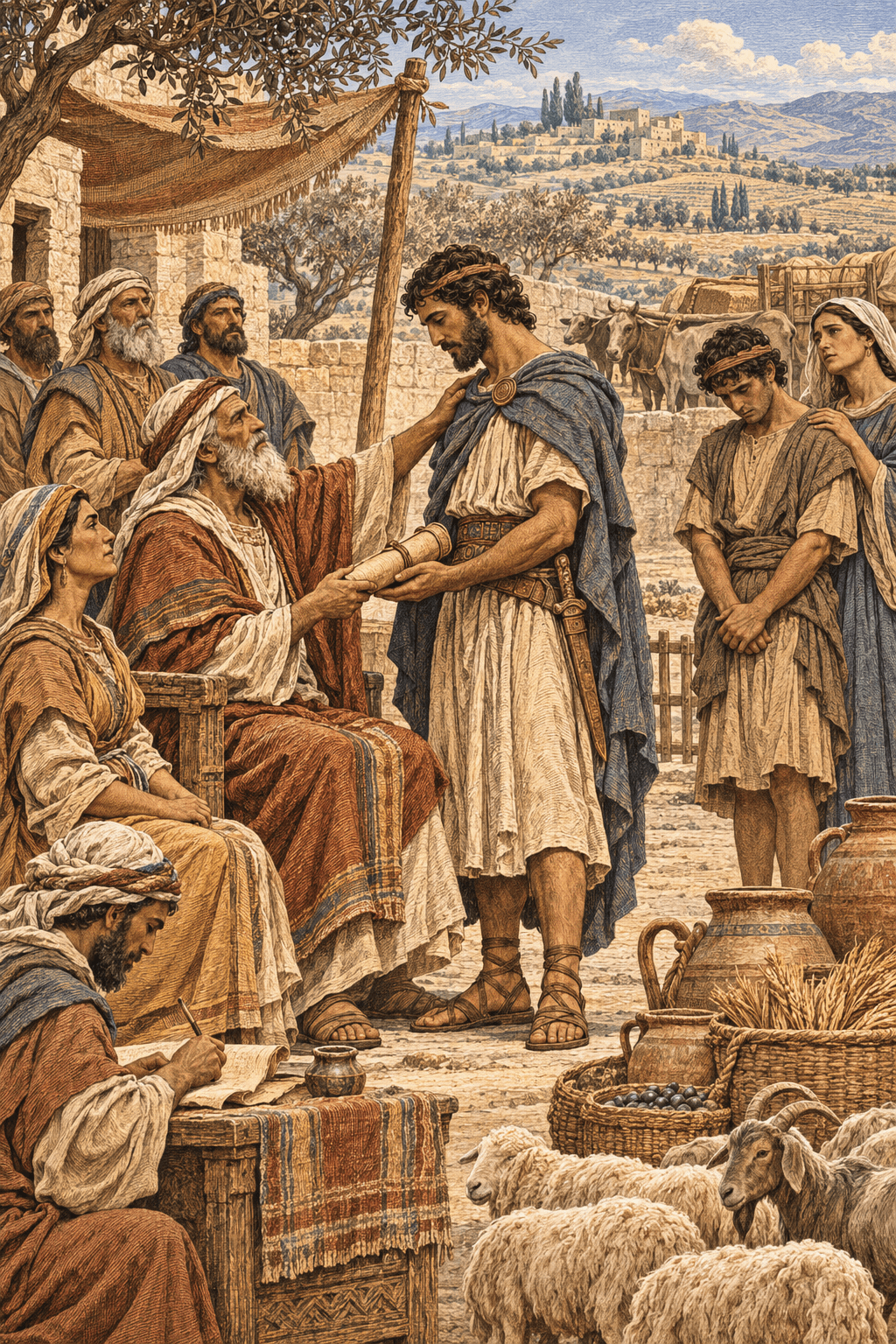
After speaking of the rights of the captive woman whom a believer loves, he points to the rights of the firstborn son born of a wife hated by her husband. In a spirit of justice the man does not treat his eldest son according to his feelings toward the boy’s mother; the father is obliged to respect the right of the firstborn.
(See verses 15–17 above.)
A) This law shows the evils of having more than one wife, how it causes a man trouble even in his relationship with his children.
B) This law shows God’s wonderful care, for God often gives a man his firstborn son by the wife he hates, so that he may love her for the sake of his firstborn son or his children. We see this in the story of Jacob, who loved Rachel and hated Leah (Genesis 29:31); God opened her womb and gave Leah children, and she became the mother of his firstborn.
C) Parents ought not to deal with their children with partiality. Jacob did deprive his firstborn Reuben of the birthright, but not because he hated his mother, but because the son dishonored his birthright by his conduct. If the parents are unable to practice perfect love toward one another, which is very serious even for the children, they must at least not lose the spirit of justice in dealing with their children, even in deciding the inheritance after their departure from this world. They ought to be just when they write a will concerning the inheritance.
D) The father “may not” choose the son of the beloved wife and count him the firstborn, ignoring the true firstborn born of the hated one. The translation “he may not” also carries the sense “he cannot,” meaning that the divine Law makes him unable to carry out his wrong feelings. Note also that some nations gave the firstborn the right to take the whole inheritance, and he became like a father to his brothers, all of them working under his shadow in a large household (a mass family).
E) The spiritual person loves others as his firstborn children, and so wants to give them a double portion in his farewell will; indeed his spiritual beloved boldly long to receive this inheritance. This is what Elisha the prophet longed for, asking his teacher Elijah the prophet: “let a double portion of thy spirit be upon me” (2 Kings 2:9).
If Israel became like a hated wife because of her persistence in her sins, so that God gave her a bill of divorce through the prophets, the Lord Christ came as a son of this nation: “He came unto his own, and his own received him not” (John 1:11). Yet He is the true firstborn heir; whoever is joined to Him inherits with Him, even if his family or parents are wicked. So let us not fear belonging to an unholy father and mother, for in the eyes of the heavenly Father we are firstborn children with the right to a double inheritance.
The believer prizes his birthright, for he has become a member of the Church of the firstborn. Saint Clement of Alexandria says:
“This is the firstborn Church (Hebrews 12:23), which includes many good children; these are the firstborn who are enrolled in heaven and keep a high festival with myriads of angels. We too are firstborn children, raised up by God; we are the true friends of the Firstborn, who receive the knowledge of God first of all. [236]”
4. The Rebellious Son
KJV · Verses 18–21
18 If a man have a stubborn and rebellious son, which will not obey the voice of his father, or the voice of his mother, and that, when they have chastened him, will not hearken unto them: 19 Then shall his father and his mother lay hold on him, and bring him out unto the elders of his city, and unto the gate of his place; 20 And they shall say unto the elders of his city, This our son is stubborn and rebellious, he will not obey our voice; he is a glutton, and a drunkard. 21 And all the men of his city shall stone him with stones, that he die: so shalt thou put evil away from among you; and all Israel shall hear, and fear.
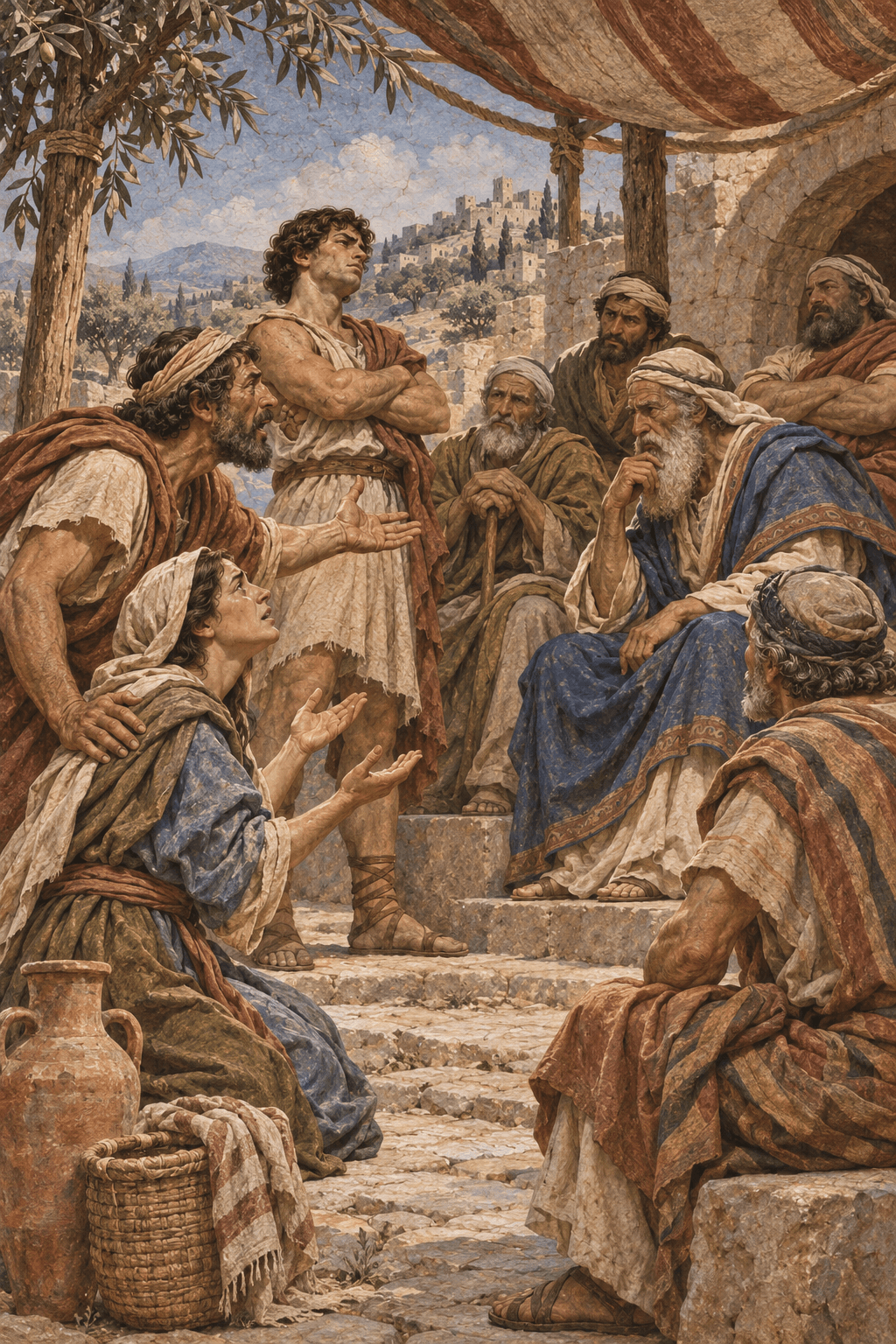
This law concerning the trial of the disobedient son came only after the Law had said much about the parents’ responsibility to practice true love, to behave as a holy family, and to present their lives as a living example to their children, creating an atmosphere suitable for an upbringing fitting for the children. The Law focused on the parents’ responsibility before condemning the children.
This law came to affirm an important truth: in every society and every generation there are good children and wicked children. If all were good there would be no need for this law, and if all were wicked it would be of no use either.
We have already spoken of the punishment for dishonoring parents. [237] Origen the Scholar saw that stubbornness toward one’s bodily parents is a shadow of stubbornness toward the heavenly parents, God the Father and the Jerusalem above, our mother. He says:
“If such is the judgment on one who curses his bodily family, how much more on those who insult God with words of cursing and deny that He is the Creator of the world?! Or on whoever wrongs the heavenly Jerusalem, which is the mother of us all (Galatians 4:26)?! [238]”
Disobedience with stubbornness is like blasphemy and must be punished with the same punishment; it is supposed that this takes place after the parents have failed to correct him. Note the following in the punishment here:
A) The crime of rebellion is not because of the son’s inability to carry out his parents’ requests or his failure to understand them, but because of an evil will and stubbornness. He hates to reform himself, or is ashamed of belonging to his parents or family, which grieves and crushes their hearts.
B) It focuses on the sin of gluttony and drunkenness (20), for it makes the son lose his mind and behave stubbornly, resisting his parents. Drunkenness makes a person forget all laws. Therefore the mother’s command to her son King Lemuel was: “It is not for kings, O Lemuel, it is not for kings to drink wine; nor for princes strong drink: Lest they drink, and forget the law, and pervert the judgment of any of the afflicted” (Proverbs 31:4–5). The text links stubbornness with gluttony and drunkenness, which in the eyes of the Jews was a great crime. When the Lord Christ spoke of the prodigal son, He mentioned that he wasted his inheritance with riotous living. And in the Book of Proverbs woe is given to “They that tarry long at the wine; they that go to seek mixed wine” (Proverbs 23:30). It is also said: “Whoso keepeth the law is a wise son: but he that is a companion of riotous men shameth his father” (Proverbs 28:7).
C) Neither the father nor the mother alone brings the complaint against the son; the two must agree together that he is stubborn, a glutton, and a drunkard. And even in their agreement they cannot judge him without turning to the elders; they go to the place of judgment, and the elders study the matter and verify it before the sentence is given.
D) The parents bring the complaint to the elders, “And all the men of his city shall stone him with stones, that he die: so shalt thou put evil away from among you; and all Israel shall hear, and fear” (21). It is very hard for parents to accuse their rebellious son knowing that he will be sentenced to stoning to death. But God allowed this in the Old Testament so that all would realize the seriousness of raising children. If man, by his natural feelings, finds it hard to accept this, what will be his position when he realizes that by his negligence he hands his children over, not to stoning, but to eternal fire?! What occupies God’s mind is not bare human feelings, but eternal salvation and man’s final destiny. The Law required that the trial be public and conducted by the elders; this gives the people of the city the opportunity to testify whether this disobedience was caused by the parents’ negligence, violence, or dissoluteness, so that the children are not wronged.
E) This law was set so that man would examine himself: if stubbornness toward parents leads a person to stoning, what of stubbornness toward God Himself?!
F) Sin, especially stubbornness, corrupts the land; therefore it is said: “so shalt thou put evil away from among you.” As the Psalmist says: “I will early destroy all the wicked of the land; that I may cut off all wicked doers from the city of the Lord” (Psalm 101:8). The sin of disobedience with gluttony and drunkenness is directed not only against the parents but against the whole community; therefore the punishment of one who persists in disobedience takes place publicly before the whole community against which the disobedient son sins. The disobedient person destroys the peace of his home and passes this epidemic to his companions, corrupting others. The Apostle Paul warned us against the behavior of fathers that causes this epidemic, saying: “ye fathers, provoke not your children to wrath” (Ephesians 6:4). The child needs to live in an atmosphere of love so as not to turn aside to violence and corruption. It is the parents’ responsibility.
G) The disobedient son is sentenced to stoning (Deuteronomy 21:18–21); so the seriousness of disobedience is revealed.
5. One Hanged on a Tree
KJV · Verses 22–23
22 And if a man have committed a sin worthy of death, and he be to be put to death, and thou hang him on a tree: 23 His body shall not remain all night upon the tree, but thou shalt in any wise bury him that day; (for he that is hanged is accursed of God;) that thy land be not defiled, which the Lord thy God giveth thee for an inheritance.
The punishment of death with leaving the body hanging on a tree, a post, or a cross for a time was meant to reveal the gravity and horror of the crime. I think the Law allowed the criminal’s body to be hanged on the tree not to shame him, but to be a lesson to others: the sight of the criminal hanging on a tree is not heard about but seen, and all fear. Yet the Law affirms its esteem for bodies, for it did not allow the body of the criminal hanged on a tree to be left until after sunset; it had to be buried.
Many scholars think that hanging on a tree took place after the death of the criminal, not as a means of putting him to death.
When the people began to commit fornication with the daughters of Moab, who drew the people to sacrifice to idols, and Israel joined himself to Baalpeor, the divine command came to Moses the prophet: “Take all the heads of the people, and hang them up before the Lord against the sun, that the fierce anger of the Lord may be turned away from Israel” (Numbers 25:4).
The custom of hanging on a tree was widespread among the nations. When Joseph interpreted the dream of Pharaoh’s baker, he said to him: “Yet within three days shall Pharaoh lift up thy head from off thee, and shall hang thee on a tree; and the birds shall eat thy flesh from off thee” (Genesis 40:19). It is clear here that the sentence was first to cut off his head and then to hang his body. This law was given for the following reasons:
First: However horrible the sin, God cares that bodies be buried in graves. God wanted to preserve the honor of human bodies, even of the worst criminals. God allows discipline, but within limits, so that human nature is not degraded; He allows scourging, but within limits, and allows execution when necessary, but the body is not to remain more than one day.
Second: If the body is allowed to be left hanging during the day, God wants us not to exaggerate our fear of sin, nor let it dominate us. Let us remember our sins so as to repent, but let them also be buried, and let us be occupied with God, who forgives sin.
Third: This law presents a religious rite, for according to the Law the body of the dead carries defilement, because death came into the world as the fruit of sin. So the body is not left unburied, lest the land of the whole city be defiled.
Fourth: This law touches the subject of our salvation. There was no shame more degrading than this for Christ our Savior to descend to (Galatians 3:13), and the rulers of the Jews tried in vain to keep the curse away by holding to the letter of this law (John 19:31). The Lord Christ accepted to die by crucifixion, for He who knew no sin became sin for us. The Giver of blessing came to bear the curse of the Law for us, and hung on the cross as one unworthy to be in heaven or on earth; but He was buried before sunset, so as to kill the curse and give us in Him the risen life. As the Apostle Paul says: “Christ hath redeemed us from the curse of the law, being made a curse for us: for it is written, Cursed is every one that hangeth on a tree: That the blessing of Abraham might come on the Gentiles through Jesus Christ; that we might receive the promise of the Spirit through faith” (Galatians 3:13–14). Our Christ accepted the curse for our sanctification. And Saint Peter the Apostle says: “Who his own self bare our sins in his own body on the tree, that we, being dead to sins, should live unto righteousness” (1 Peter 2:24). And as Saint John the Baptist says: “Behold the Lamb of God, which taketh away the sin of the world” (John 1:29).
Our Savior took our place so that we might take His; He accepted the cross with joy: “Looking unto Jesus the author and finisher of our faith; who for the joy that was set before him endured the cross, despising the shame, and is set down at the right hand of the throne of God” (Hebrews 12:2). This wonderful redemptive work is the object of the pleasure of the Father, who offered His beloved Son as a sin offering, to bear the curse for us and bring us into His righteousness and glory.
The Evangelist John tells us: “The Jews therefore, because it was the preparation, that the bodies should not remain upon the cross on the sabbath day, (for that sabbath day was an high day,) besought Pilate that their legs might be broken, and that they might be taken away” (John 19:31).
Pope Athanasius the Apostolic says:
“If any of our own people should ask, not from love of argument but from love of learning, ‘Why did He not endure death in some other way than the cross?’ let him be told that no other way was of profit to us, and that it was good that the Lord endured this for our sakes. For He came Himself to bear the curse that lay upon us; and how could He become a curse (Galatians 3:13) unless He received the death that bears the curse? This is the cross. [239]”
Saint Augustine says:
“Death on the cross was in their eyes a great defilement, for they did not perceive that it was a prophecy… This death of ours, whose origin is found in sin, He bore Himself and nailed to the tree. [240]”
Finally, what this chapter affirms about all the cases mentioned is that even in the Old Testament God cares for every person personally. For the blood of one slain man His wrath comes upon all the neighboring cities if they neglect to search for the killer; and for the body of a criminal left hanging on a tree until night the whole land is defiled! So God affirms His care for every person personally. In the New Testament the Lord Christ declared that it is not the will of our Father that one of these little ones should perish (Matthew 18:14), that the angels of God rejoice over one sinner who repents (Luke 15:10), and that whoever receives one such child in His name receives Him (Matthew 18:5).
The Lord Christ was not distracted by the crowds pressing Him from Zacchaeus; He stopped the whole procession to invite Himself into the house of Zacchaeus, who sought to see who Jesus was (Luke 19:2). He cared for the woman with the issue of blood in the midst of the crowds and said: “Who touched me?” (Luke 8:45). Peter and those with him said: “Master, the multitude throng thee and press thee, and sayest thou, Who touched me?”
6. A Meditation on Deuteronomy 21
Let Me Meet You Through the Rejected!
Let me meet You through the rejected!
Let me meet You, who were crucified outside the camp,
and became cast out and rejected!
So the cast out and the rejected meet You,
and those who find no one to ask after them.
I see You meeting me,
for there is none to embrace me but You.
You seek out my weakness, I the rejected one;
let me also seek and find You among the rejected,
and meet You among the outcasts!
You care for innocent blood shed by an unknown hand!
You do not let injustice defile the land.
You ask Your people to care for the blood that was shed,
and at the same time not to accuse anyone hastily!
Let all wash their hands in innocence,
not covering up for the one who shed blood,
nor accusing anyone unjustly.
Sin killed me and cast me to the ground;
I became a lifeless corpse!
There was none to look at me or ask after me.
You came down to me and looked upon me;
You avenged my blood by Your cross,
You nailed sin and made a show of the enemy of good.
You breathed life into me and granted me resurrection!
I am no longer a corpse cast in its blood on the ground,
but have become a son of God enjoying glories!
You care for the feelings of a captive pagan woman who lost her family and country!
You ask her to weep for her parents and not for her idols.
You keep her rights, so that the one who captured her does not crush her!
How wise and gentle a God You are!
You care for my soul;
sin took it captive and the enemy of good humbled it.
You set me free and carried me into Your chamber.
You poured Your splendor upon me,
and made me a queen!
You care for the wife not loved by her husband;
often You give her the firstborn son,
and You care for her son’s feelings!
You made me firstborn, O Only and Unique in birthright.
My mother the Church is greatly beloved by her Bridegroom;
all her children have become firstborn,
enjoying a double eternal inheritance.
You care for the salvation of the rebellious son.
You allow great firmness with him for the sake of his eternity.
You declare to his parents the danger of his eternal destruction.
His parents hand him over to the elders, and he is put to death.
But You took away my disobedience;
You carried me not to the elders to judge me,
but to the heavenly Father, to settle in His bosom!
You clothed me with Your righteousness and made me a partner in Your obedience!
I confess to You that I broke Your Law;
I fell under the curse of the Law,
and came under the sentence of death, imprisoned in the circle of the curse.
In Your love You entered the circle of the curse by the cross;
You burst the curse and broke its barriers,
You set me free and blessed.
You lifted from me the curse of the Law,
and granted me the blessings of eternal glory!
A criminal may deserve to be hanged on a tree,
but You care even for his body, that it not remain until sunset.
You assure us of Your esteem not for the soul alone, but for the body too.
You care for the whole man, O our Creator.
Millions upon millions of heavenly and earthly beings throng You,
yet in Your love You care for me personally.
I say with Your saint Augustine:
it is as though I see in the world nothing but You and my lowliness!
You give me all love,
and I give You all my heart.
Is there anyone You love like me?!
Is there anyone who loves You like me?!
I am my Beloved’s, and You are mine, O desire of my heart!
Notes and References
[234] Josephus, Antiquities, 4:8:16.
[235] St. Jerome, Letter 70:2.
[236] St. Clement of Alexandria, Paedagogus, 1:5.
[237] See the author’s commentary on Leviticus, pp. 208–209.
[238] Origen, Homilies on Leviticus, 11:2.
[239] St. Athanasius, On the Incarnation of the Word, 25:1–2.
[240] St. Augustine, On the Psalms, 38.