
When the hour drew near for which Israel had endured troubles all the days of his life, and for which he had long waited, Joseph hastened to bring his two sons for his father to bless them. Jacob strengthened himself and blessed the younger with his right hand and the elder with his left.
1. Jacob’s Sickness
KJV · Verses 1–2
1 And it came to pass after these things, that one told Joseph, Behold, thy father is sick: and he took with him his two sons, Manasseh and Ephraim. 2 And one told Jacob, and said, Behold, thy son Joseph cometh unto thee: and Israel strengthened himself, and sat upon the bed.
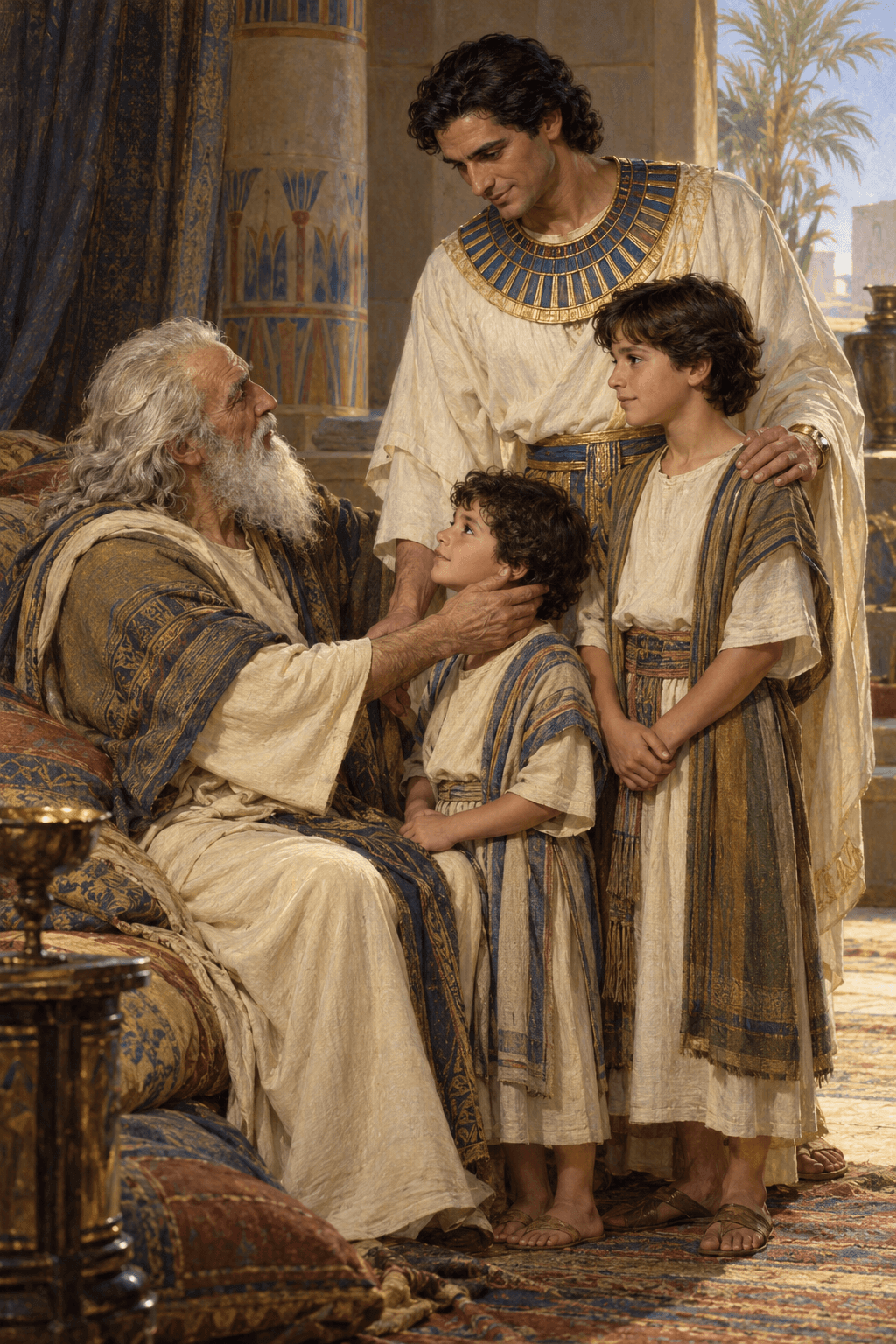
“And it came to pass after these things, that one told Joseph, Behold, thy father is sick: and he took with him his two sons, Manasseh and Ephraim. And one told Jacob, and said, Behold, thy son Joseph cometh unto thee: and Israel strengthened himself, and sat upon the bed” (1–2).
When Joseph felt that his father was sick unto death, he hastened with his two sons Manasseh and Ephraim, that they might receive their father’s blessing and enjoy his hope in the Savior; and he wished that the elder would receive the blessing by Jacob’s right hand…
The sick Israel heard the news of Joseph’s coming, so he strengthened himself and sat upon the bed to receive him, offering him the farewell charge and the blessing.
2. Jacob Blesses Joseph
KJV · Verses 3–7
3 And Jacob said unto Joseph, God Almighty appeared unto me at Luz in the land of Canaan, and blessed me, 4 And said unto me, Behold, I will make thee fruitful, and multiply thee, and I will make of thee a multitude of people; and will give this land to thy seed after thee for an everlasting possession. 5 And now thy two sons, Ephraim and Manasseh, which were born unto thee in the land of Egypt before I came unto thee into Egypt, are mine; as Reuben and Simeon, they shall be mine. 6 And thy issue, which thou begettest after them, shall be thine, and shall be called after the name of their brethren in their inheritance. 7 And as for me, when I came from Padan, Rachel died by me in the land of Canaan in the way, when yet there was but a little way to come unto Ephrath: and I buried her there in the way of Ephrath; the same is Bethlehem.
In blessing Joseph, Jacob declared the following:
First: At the beginning of his speech Jacob declared God’s appearance to him at Luz (Bethel) in the land of Canaan, where He blessed him when he set out fleeing from his brother Esau, and again on his return from his uncle Laban (Genesis 28–35), as though he wished to assure Joseph that the blessing he gives is the blessing of the Lord Himself working in him, especially in the time of the distress of his soul.
If Jacob, as we said, symbolizes the Church, then the blessings she gives are not of her own; she gives what she enjoys from God, the Giver of blessing, who overwhelms her with His gifts, especially in the time of her sufferings. This blessing is fulfilled at Luz in the land of Canaan, that is, it is fulfilled in the word of God (the almond) as our mind sets out to the heavenly Canaan.
Second: Jacob asked Joseph that his two sons Ephraim and Manasseh be reckoned to Jacob, so that Joseph thereby received double his brothers, becoming two tribes while each of his brothers became one tribe. Perhaps by this he wished to make Joseph a firstborn in place of Reuben, who lost his birthright by defiling his father’s bed (Genesis 35:22).
Jacob counted the two sons Ephraim and Manasseh as his sons, while the rest of Joseph’s children would be reckoned to Joseph and would not be tribes but would belong to the tribes of Ephraim and Manasseh (6), having no independent inheritance.
Third: As Jacob blesses Joseph in his two sons, he does not forget his mother Rachel, so he tells him of her death and burial on the way to Ephrath, which is Bethlehem (7), as though to his last breath he does not forget his beloved wife. Perhaps Jacob wished to draw his beloved son’s heart to Canaan, so that neither his Egyptian wife, nor his many children, nor his wealth would make him forget the land of promise.
3. Jacob Blesses Ephraim and Manasseh
KJV · Verses 8–20
8 And Israel beheld Joseph's sons, and said, Who are these? 9 And Joseph said unto his father, They are my sons, whom God hath given me in this place. And he said, Bring them, I pray thee, unto me, and I will bless them. 10 Now the eyes of Israel were dim for age, so that he could not see. And he brought them near unto him; and he kissed them, and embraced them. 11 And Israel said unto Joseph, I had not thought to see thy face: and, lo, God hath shewed me also thy seed. 12 And Joseph brought them out from between his knees, and he bowed himself with his face to the earth. 13 And Joseph took them both, Ephraim in his right hand toward Israel's left hand, and Manasseh in his left hand toward Israel's right hand, and brought them near unto him. 14 And Israel stretched out his right hand, and laid it upon Ephraim's head, who was the younger, and his left hand upon Manasseh's head, guiding his hands wittingly; for Manasseh was the firstborn. 15 And he blessed Joseph, and said, God, before whom my fathers Abraham and Isaac did walk, the God which fed me all my life long unto this day, 16 The Angel which redeemed me from all evil, bless the lads; and let my name be named on them, and the name of my fathers Abraham and Isaac; and let them grow into a multitude in the midst of the earth. 17 And when Joseph saw that his father laid his right hand upon the head of Ephraim, it displeased him: and he held up his father's hand, to remove it from Ephraim's head unto Manasseh's head. 18 And Joseph said unto his father, Not so, my father: for this is the firstborn; put thy right hand upon his head. 19 And his father refused, and said, I know it, my son, I know it: he also shall become a people, and he also shall be great: but truly his younger brother shall be greater than he, and his seed shall become a multitude of nations. 20 And he blessed them that day, saying, In thee shall Israel bless, saying, God make thee as Ephraim and as Manasseh: and he set Ephraim before Manasseh.
If Jacob confesses God’s blessings upon him when he comes forward to bless his sons and grandsons, Joseph his son, like his father, confesses that his two sons are God’s gift to him (8).
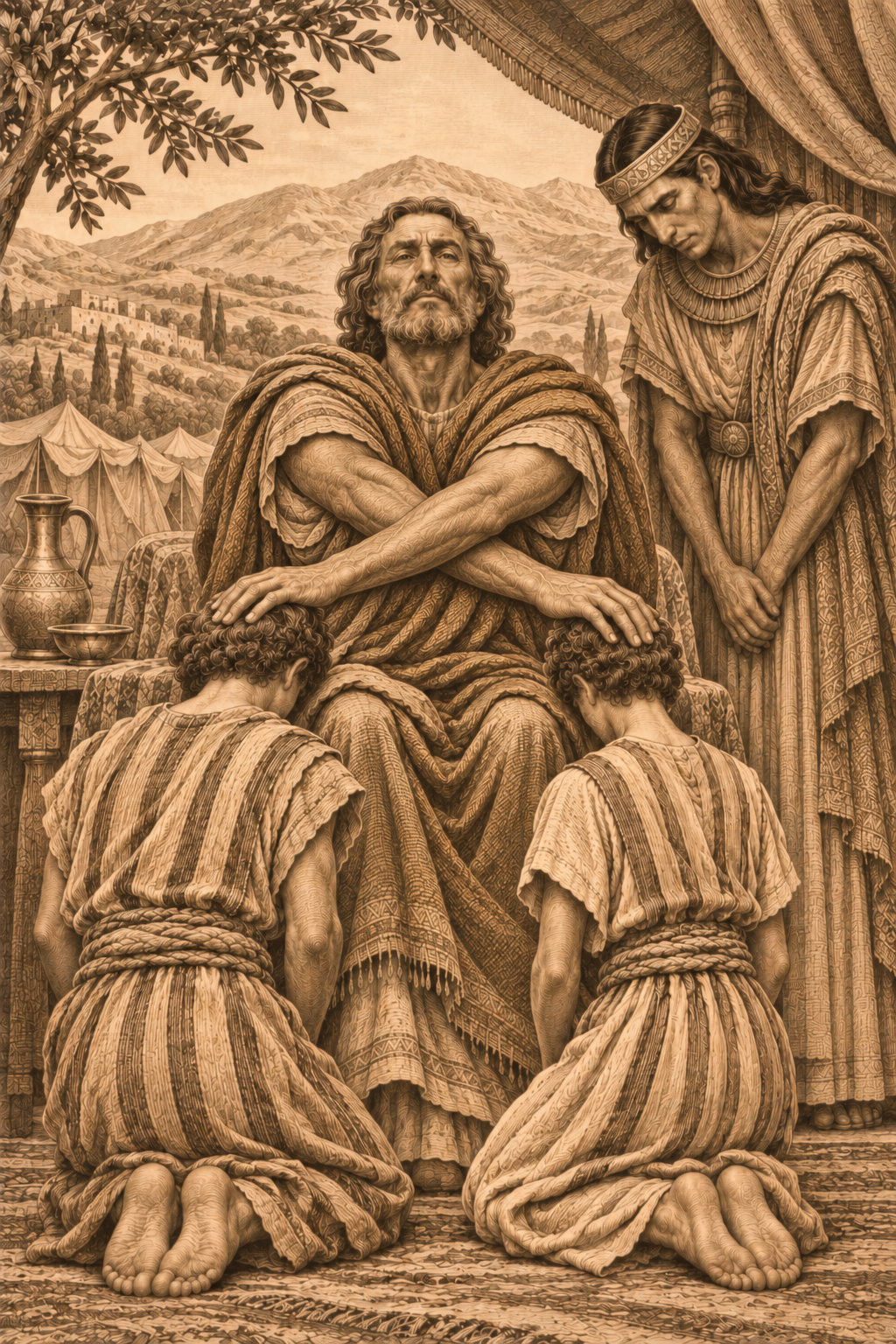
Jacob asked Joseph to bring his two sons to him; and when he brought them near, he kissed them and embraced them, while they bowed with their father Joseph before Jacob. Jacob stretched out his right hand upon Ephraim the younger, whom Joseph had placed at Jacob’s left, and stretched out his left hand to lay it on the head of the elder, Manasseh, standing at his right; and he blessed them with the blessing of God, the God of his fathers Abraham and Isaac. In the blessing he asked the following:
First: That God’s blessing rest upon Joseph through his two sons (the lads); so the blessing was counted to Joseph, though his hands were stretched over Ephraim and Manasseh. It is as though every divine blessing extends into the life of Ephraim (abundant fruit) and Manasseh (forgetting the world). God’s blessing appears in the life of continual growth and increasing fruit, as it appears in our forgetting the love of the world; that is, it is manifested in the positive side as in the negative.
Second: That the blessing of the Angel who redeemed him from all evil in the time of distress rest upon them… for God declares His care most in the midst of sufferings. He does not remove tribulations from His children but supports and delivers them.
Third: That the name of Jacob and the names of Abraham and Isaac be named on them; and this was fulfilled, for each of them became a tribe reckoned to Jacob son of Isaac son of Abraham.
Fourth: He asked for them that they grow into a multitude in the midst of the earth (16).
Though Joseph rejoiced greatly in the blessing he received from his father in the person of his two sons, the matter displeased him, and he held up his father’s hands to move his right hand to Manasseh the elder and his left to Ephraim, thinking he was correcting a position his father had not noticed. But the latter refused to change, assuring his son that God had revealed to him the secret of the younger’s greatness, saying: “I know it, my son, I know it: he also shall become a people, and he also shall be great: but truly his younger brother shall be greater than he, and his seed shall become a multitude of nations” (19). What does Jacob mean by this?
A) Jacob knew that Ephraim the younger would be greater than Manasseh, for his seed would be a great multitude. This was fulfilled in the first census made in the days of Moses, where the number of those enrolled from Ephraim was 40,500, while from Manasseh it was 32,200 (Numbers 1:33, 35). Manasseh also lived divided, half east of the Jordan and the other half west of it, which was the cause of its fragmentation and weakness; and the mixing of the part dwelling east of the Jordan with the pagan peoples made it more exposed to idol worship than others (2 Chronicles 15:9; 30:1). But Ephraim was strong, so that the northern kingdom (Israel) was often called by the name “Ephraim.” From this tribe came Joshua the son of Nun (Numbers 13:8); they had notable activity in the era of the Judges, in the days of Deborah the prophetess, Gideon, and Jephthah; and Samuel the prophet came from them (Judges 5; 8; 12; 1 Samuel 1)… Shiloh, one of their cities, was the holy place of the tabernacle of meeting for a long period of time, and so on.
B) In laying his hands, Jacob was placing a cross on their heads, as though the secret of true blessing is “the sacrifice of the cross.”
C) The preference of the younger over the elder, as we have seen in many situations, pointed to the coming of the Second Adam, who takes the birthright while the first Adam loses his birthright. God is not concerned with the birthright of the flesh, but seeks the work of the spirit… So God accepted the sacrifice of Abel, the younger son, and rejected the offering of the elder son Cain (Genesis 4); Jacob himself enjoyed the birthright and his father Isaac’s blessing in the Lord, while his firstborn brother Esau was deprived of it; and with the same thought his father Isaac enjoyed the blessing, while Ishmael, the elder in the flesh, did not inherit with him… In our study of the Gospel of Matthew the Evangelist we saw the Lord Christ come from a line most of whom did not bear a fleshly birthright. [449]
Saint Augustine [450] says that Jacob did this, giving a hidden blessing to the younger, by which the first became last and the last first — a prophecy of what happened at the coming of the Lord Christ. Abel was preferred to his elder brother Cain, Isaac to Ishmael, Jacob to Esau, David to his elder brothers, and the Christians to the Jews who preceded them. He also says:
As the two sons of Isaac, Esau and Jacob, were used as symbols of the two peoples, the Jews and the Christians… so the same thing happened with the two sons of Joseph: the elder was a symbol of the Jews and the younger of the Christians. [451]
Manasseh was blessed as representing the Church of the Old Covenant, and became great in God’s eyes, for he lived by faith, receiving the Law, the prophecies, and the divine promises at a time when the world lay in the embrace of paganism and its abominations. But the true Ephraim came, that is, the Church of the New Covenant, which became greater and gathers a multitude of nations and peoples.
Jacob concluded his blessing of them by saying: “In thee shall Israel bless, saying, God make thee as Ephraim and as Manasseh” (20)… as though God blesses mankind through the Churches of the New and Old Covenants, which are in truth one Church, gathered together in Christ Jesus crucified, under the arms of Jacob (in the shape of a cross).
4. Joseph’s Special Portion
KJV · Verses 21–22
21 And Israel said unto Joseph, Behold, I die: but God shall be with you, and bring you again unto the land of your fathers. 22 Moreover I have given to thee one portion above thy brethren, which I took out of the hand of the Amorite with my sword and with my bow.
In conclusion Israel declares to his son Joseph that he is dying, but his heart is attached to God’s promise to him and to his fathers before him that their descendants would inherit the land of promise (21). Israel gave his son Joseph an additional portion above his brothers (22), for he made him the firstborn and received his two sons as two tribes. He also gave him land which he had acquired with his sword and his bow from the Amorites (compare John 4:5–6)… and Joseph also had his bones buried in the field his father had bought (Joshua 24:32).
Notes and References
[449] See the author’s commentary on the Gospel according to Matthew (1983).
[450] Augustine, On Ps. 78.
[451] Augustine, City of God 16:42.