
If Sarah as a wife represents the body in its bond with the soul, then Sarah as the companion of her husband in his spiritual striving does not represent a weight hindering his growth, but a helper supporting him all the days of his sojourning. She set out with him from Ur of the Chaldees to live as a stranger, shared with him in hosting strangers, listened to him and responded to him. She represents the body which, sanctified by the Holy Spirit, does not hinder the soul in its setting out toward heaven but supports it through living practices of prayer, fasting, devotions, and so on… Now Sarah died, and Abraham her husband buried her in the hope of the resurrection.
1. The Death of Sarah
KJV · Verses 1–2
1 And Sarah was an hundred and seven and twenty years old: these were the years of the life of Sarah. 2 And Sarah died in Kirjatharba; the same is Hebron in the land of Canaan: and Abraham came to mourn for Sarah, and to weep for her.
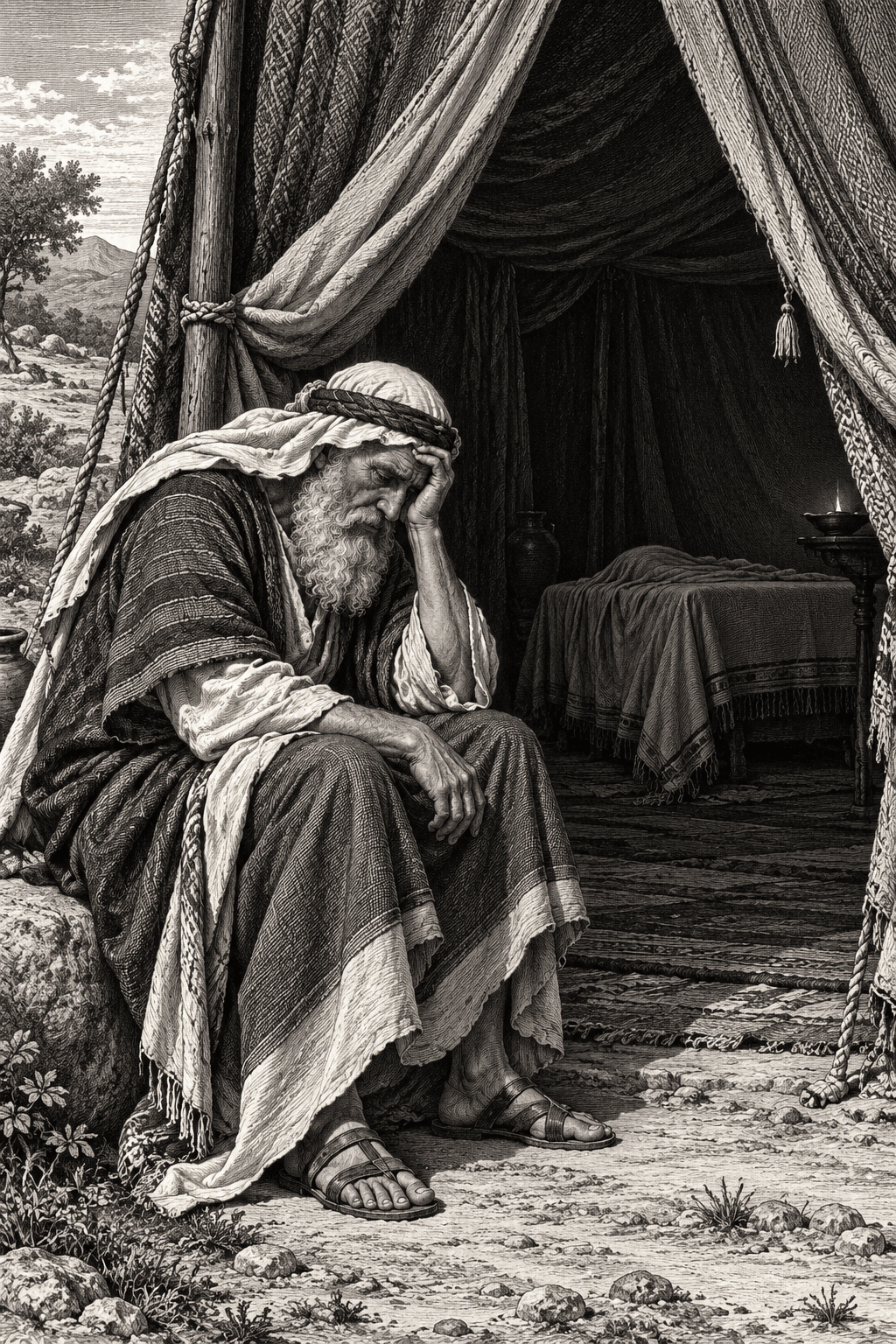
Abraham returned with Isaac alive, as though risen from the dead. Abraham believed in Him who is able to raise from the dead, and received in his son the confirmation of the divine promise with an oath that his seed would be as the stars of heaven… But death had to pass through this blessed family and seize the body of Sarah for a time, so that the heart of Abraham and his seed would remain attached to the Lord, who is able to raise soul and body together.
What draws our attention is that Holy Scripture took care to specify Sarah’s age and to speak of purchasing a tomb in the land of Canaan to bury her… for it says: “And Sarah was an hundred and seven and twenty years old: these were the years of the life of Sarah. And Sarah died in Kirjath-arba; the same is Hebron in the land of Canaan: and Abraham came to mourn for Sarah, and to weep for her” (1–2).
Sarah lived 127 years, all of them fruitful years in the Lord. In her first ninety years she appeared barren as to childbearing, but by faith she appeared as a mother of the believers (Isaiah 51:2), sharing with her husband Abraham (the father of the believers) all the days of his striving, bearing hardships with him and receiving the divine promises with him… She also walked in a spirit of obedience, so that the Apostle Peter asked believing women to imitate her: “Even as Sara obeyed Abraham, calling him lord: whose daughters ye are, as long as ye do well, and are not afraid with any amazement” (1 Peter 3:6).
It seems Abraham was absent from his tent at the moment of her death. When he came and heard the news, he stood before her remembering the decades she had lived with him; she alone remained of his family who had gone out with him from Ur of the Chaldees to live as a stranger wherever he went. He stood before her body not merely to recall long memories, but he was touching his life’s partner, an inseparable part of his being; and he mourned her and wept for her. This is the first time we hear of the venerable old Abraham mourning and weeping. We did not hear that he wept or grieved when he parted from his family in Ur of the Chaldees, nor at the captivity of Lot, nor when he set out for three days to sacrifice his son; but now he stands before Sarah, mourning her and weeping for her.
If Abraham’s faith lifted him above events — by faith he fought the kings to rescue his nephew Lot, and by faith he took his son Isaac to the land of Moriah to sacrifice him — this faith does not conflict with the tender human feelings that burst forth in springs of tears before Sarah’s body! Faith does not strip us of feelings, but sanctifies them and makes them grow in the Lord. This is what we see in our father Abraham, the man of faith, and what we sense in the disciples and apostles — indeed in the Lord Christ Himself, who could not bear the tears of Mary and Martha over their brother Lazarus, and wept (John 11:35), so that the Jews said: “Behold how he loved him!” (John 11:36). The epistles of our teacher Paul the Apostle are filled with holy human feelings; we see him ever remembering the sight of his disciple Timothy weeping at the Apostle’s parting or at his imprisonment (2 Timothy 1:3–4).
2. The Purchase of the Cave of Machpelah
KJV · Verses 3–20
3 And Abraham stood up from before his dead, and spake unto the sons of Heth, saying, 4 I am a stranger and a sojourner with you: give me a possession of a buryingplace with you, that I may bury my dead out of my sight. 5 And the children of Heth answered Abraham, saying unto him, 6 Hear us, my lord: thou art a mighty prince among us: in the choice of our sepulchres bury thy dead; none of us shall withhold from thee his sepulchre, but that thou mayest bury thy dead. 7 And Abraham stood up, and bowed himself to the people of the land, even to the children of Heth. 8 And he communed with them, saying, If it be your mind that I should bury my dead out of my sight; hear me, and intreat for me to Ephron the son of Zohar, 9 That he may give me the cave of Machpelah, which he hath, which is in the end of his field; for as much money as it is worth he shall give it me for a possession of a buryingplace amongst you. 10 And Ephron dwelt among the children of Heth: and Ephron the Hittite answered Abraham in the audience of the children of Heth, even of all that went in at the gate of his city, saying, 11 Nay, my lord, hear me: the field give I thee, and the cave that is therein, I give it thee; in the presence of the sons of my people give I it thee: bury thy dead. 12 And Abraham bowed down himself before the people of the land. 13 And he spake unto Ephron in the audience of the people of the land, saying, But if thou wilt give it, I pray thee, hear me: I will give thee money for the field; take it of me, and I will bury my dead there. 14 And Ephron answered Abraham, saying unto him, 15 My lord, hearken unto me: the land is worth four hundred shekels of silver; what is that betwixt me and thee? bury therefore thy dead. 16 And Abraham hearkened unto Ephron; and Abraham weighed to Ephron the silver, which he had named in the audience of the sons of Heth, four hundred shekels of silver, current money with the merchant. 17 And the field of Ephron which was in Machpelah, which was before Mamre, the field, and the cave which was therein, and all the trees that were in the field, that were in all the borders round about, were made sure 18 Unto Abraham for a possession in the presence of the children of Heth, before all that went in at the gate of his city. 19 And after this, Abraham buried Sarah his wife in the cave of the field of Machpelah before Mamre: the same is Hebron in the land of Canaan. 20 And the field, and the cave that is therein, were made sure unto Abraham for a possession of a buryingplace by the sons of Heth.
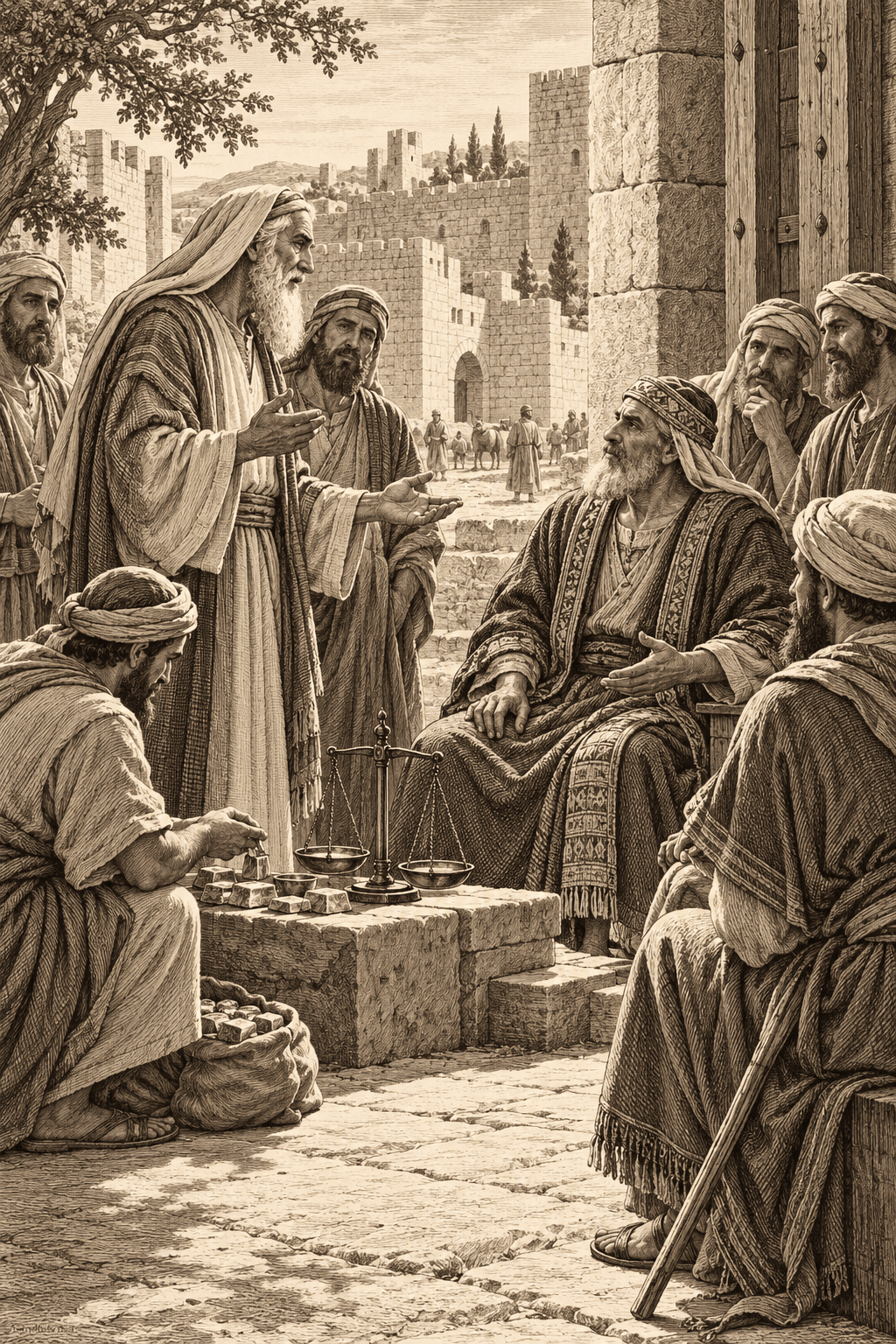
In these bitter moments, when the springs of Abraham’s tears burst forth declaring his feelings toward his wife Sarah, Abraham acted with wisdom and faith. We notice in his conduct the following:
First: Abraham did not think of burying his wife beside his ancestors. If by faith he had gone out with Sarah from Ur of the Chaldees, he continued walking by faith to his last breath. He did not bury his wife there, but acquired a cave in Canaan to bury Sarah, and in which he, Isaac, Rebekah, Jacob, and Leah would be buried.
Second: Scripture says: “And Abraham stood up from before his dead, and spake unto the sons of Heth, saying, I am a stranger and a sojourner with you: give me a possession of a buryingplace with you, that I may bury my dead out of my sight. And the children of Heth answered Abraham, saying unto him, Hear us, my lord: thou art a mighty prince among us: in the choice of our sepulchres bury thy dead… And Abraham stood up, and bowed himself to the people of the land, even to the children of Heth” (3–7).
Holy Scripture brings out Abraham’s humility flowing from his sense of being a stranger… While the sons of Heth looked upon him as a lord and a prince of God among them, he called himself a stranger and sojourner with them, and, unable to contain their love and generosity, he bowed before them as a sign of gratitude. Truly the children of God are made manifest not by love of authority and self-importance, but by the spirit of love, meekness, and humility. Thus is fulfilled the saying: “A city that is set on an hill cannot be hid” (Matthew 5:14) — not the hill of arrogance but the mountain of God, the city standing and founded on the Lord Christ Himself, the Giver of humility!
Abraham lived many years among the tribe of the sons of Heth, the descendants of Heth son of Canaan (Genesis 10:15), who founded the Hittite state. They counted him a prince over them from the Lord — not by his being made king or receiving a prominent leadership position, but through their recognition, submitting to him because of the fellowship with God he enjoyed. He, however, felt a stranger in the depths of his heart, which was revealed at the moment of Sarah’s death. In this spirit lived the true children of Abraham. So David the prophet said in his last days, when he had prepared everything for his son Solomon to build the Temple: “But who am I, and what is my people, that we should be able to offer so willingly after this sort? for all things come of thee, and of thine own have we given thee. For we are strangers before thee, and sojourners, as were all our fathers: our days on the earth are as a shadow, and there is none abiding” (1 Chronicles 29:14–15). And the Apostle Paul sums up the life of the men of faith, the children of Abraham, saying: “These all died in faith, not having received the promises, but having seen them afar off, and were persuaded of them, and embraced them, and confessed that they were strangers and pilgrims on the earth” (Hebrews 11:13).
Third: The sons of Heth were greatly moved by the old man who had lost his wife, and they declared their love and honor for him and their longing to offer him the best of their tombs to be at his disposal. But he did not exploit this love; with purity of heart he asked them that the owner of the cave accept the price. As Saint John Chrysostom says:
Though the inhabitants of that place called him a prince, he resolved to pay the price of the tomb. [330]
May every servant of the Lord and every shepherd in the Church, seeing the people longing to offer love, not exploit this love, but walk with purity of heart in a chaste spirit that desires nothing!
Fourth: Saint Irenaeus brings out the thought of faith which our father Abraham lived and declared strongly by refusing to receive the tomb as a free gift from the hands of man, patiently waiting for his seed to receive the whole land — the land of promise — from the hands of God. He says:
Thus, then, the promise of God to Abraham remained firm, for He said to him: “Lift up now thine eyes, and look from the place where thou art northward, and southward, and eastward, and westward: for all the land which thou seest, to thee will I give it, and to thy seed for ever” (Genesis 13:14–15). And again He said: “Arise, walk through the land in the length of it and in the breadth of it; for I will give it unto thee” (Genesis 13:17). Yet “he gave him none inheritance in it, no, not so much as to set his foot on” (Acts 7:5), but he remained always a stranger and a sojourner there. And at the death of Sarah his wife, when the Hittites wished to give him a place to bury her, he refused to take it as a gift but bought a burial place from Ephron the son of Zohar the Hittite for four hundred shekels of silver. Thus he waited patiently for the fulfillment of God’s promise, and would not appear to receive from men what God had promised to give him, when He said to him also: “Unto thy seed have I given this land, from the river of Egypt unto the great river, the river Euphrates” (Genesis 15:18). If, then, God promised him the inheritance of the land, and he did not receive it all the days of his journey, he must receive it at the resurrection of the just, he and his seed together — that is, those who fear God and believe in Him. This seed of his is the Church, which has enjoyed sonship to God in the Lord, as John the Baptist said: “God is able of these stones to raise up children unto Abraham” (Matthew 3:9). So also the Apostle says in the Epistle to the Galatians: “Now we, brethren, as Isaac was, are the children of promise” (Galatians 4:28). And in the same epistle he declares clearly that those who have believed in Christ receive Christ as the promise that was given… So then they which be of faith are blessed with faithful Abraham, and they are the children of Abraham. [331]
Fifth: Saint Basil the Great sees that Abraham, as a man of faith, acquired nothing; in all his life he acquired only a tomb in which to be buried with his wife and children… as though declaring that he seeks from the earth only that in which the body is buried, awaiting the resurrection from the dead!
Sixth: Abraham bought the cave in which he would be buried with his wife and children with silver. If silver points to the word of God (Psalm 12:6), he insisted on having no possession in the world except the place acquired by the word of God.
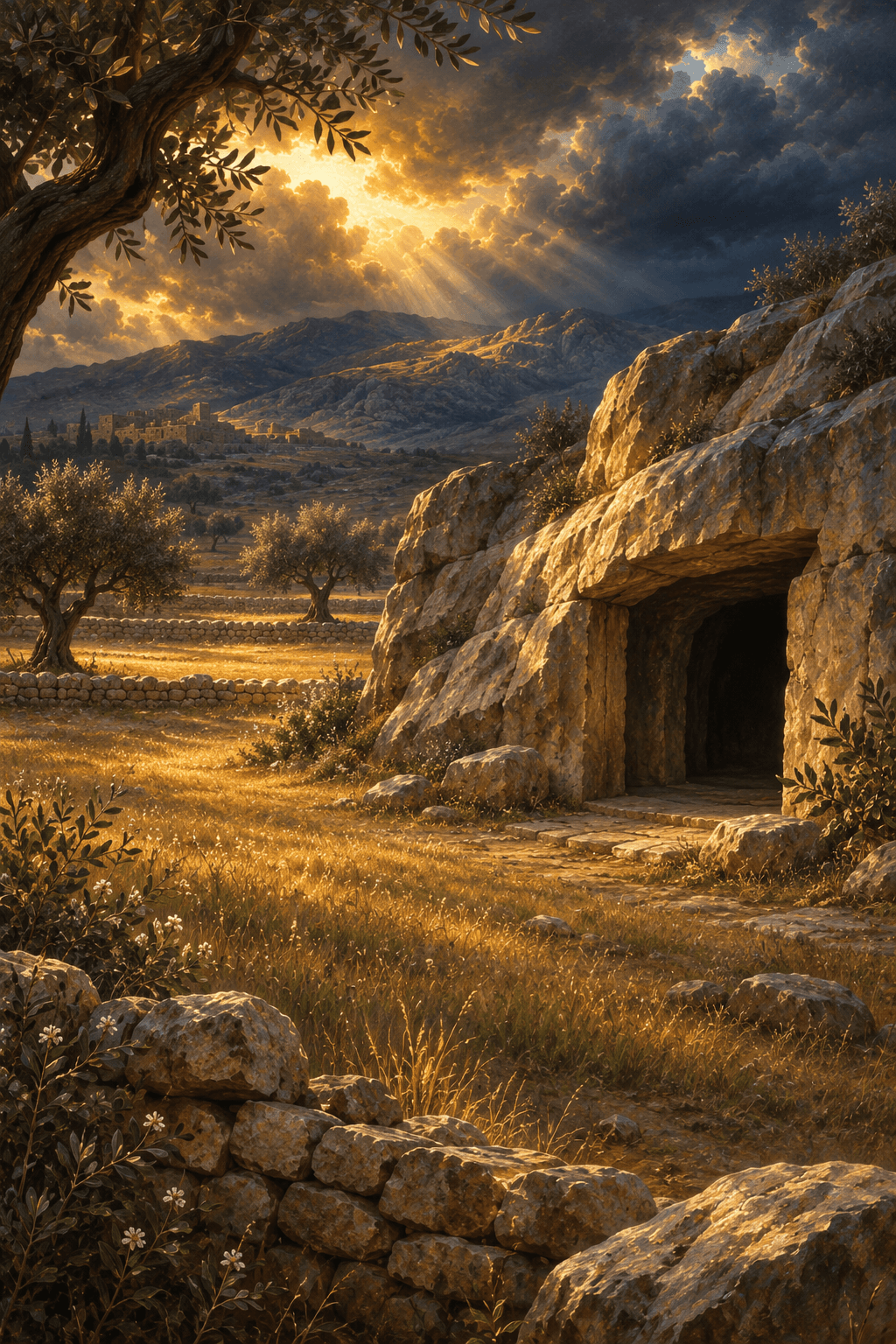
Finally, the cave of Machpelah, that is, the (double) cave, is a cave comprising two caves together, one inner and the other outer, in the city of Hebron. It belonged to Ephron (meaning “like a fawn”), the son of Zohar (“whiteness” or “shining”). It seems Abraham did not know him when he wished to buy the cave, as appears from the context of the conversation between Abraham and the sons of Heth (8–9, 13), but Ephron knew Abraham well and longed to give it to him as a free gift (11) — and to give him also the field adjoining the cave.
Notes and References
[330] Chrysostom, In 1 Cor. hom. 35:10.
[331] Irenaeus, Adv. Haer. 5.32.