
The sequence of events carries a symbolic picture of the events of salvation. If the sacrifice of Isaac, Sarah’s firstborn, points to the cross of Christ and His resurrection, the death of his mother Sarah carries, on one side, the rejection of the Jewish nation, which bore the Lord Christ according to the flesh but did not accept faith in Him. And the sending of the eldest servant of Abraham’s house to bring Rebekah as a wife for Isaac from the city of Nahor in Haran points to the work of the Holy Spirit, who drew the Gentiles from their wicked land — the worshipers of idols — to make them a bride for the true Isaac, our Lord Jesus Christ, in place of Sarah.
1. The Mission of the Eldest Servant of Abraham’s House
KJV · Verses 1–9
1 And Abraham was old, and well stricken in age: and the Lord had blessed Abraham in all things. 2 And Abraham said unto his eldest servant of his house, that ruled over all that he had, Put, I pray thee, thy hand under my thigh: 3 And I will make thee swear by the Lord, the God of heaven, and the God of the earth, that thou shalt not take a wife unto my son of the daughters of the Canaanites, among whom I dwell: 4 But thou shalt go unto my country, and to my kindred, and take a wife unto my son Isaac. 5 And the servant said unto him, Peradventure the woman will not be willing to follow me unto this land: must I needs bring thy son again unto the land from whence thou camest? 6 And Abraham said unto him, Beware thou that thou bring not my son thither again. 7 The Lord God of heaven, which took me from my father's house, and from the land of my kindred, and which spake unto me, and that sware unto me, saying, Unto thy seed will I give this land; he shall send his angel before thee, and thou shalt take a wife unto my son from thence. 8 And if the woman will not be willing to follow thee, then thou shalt be clear from this my oath: only bring not my son thither again. 9 And the servant put his hand under the thigh of Abraham his master, and sware to him concerning that matter.
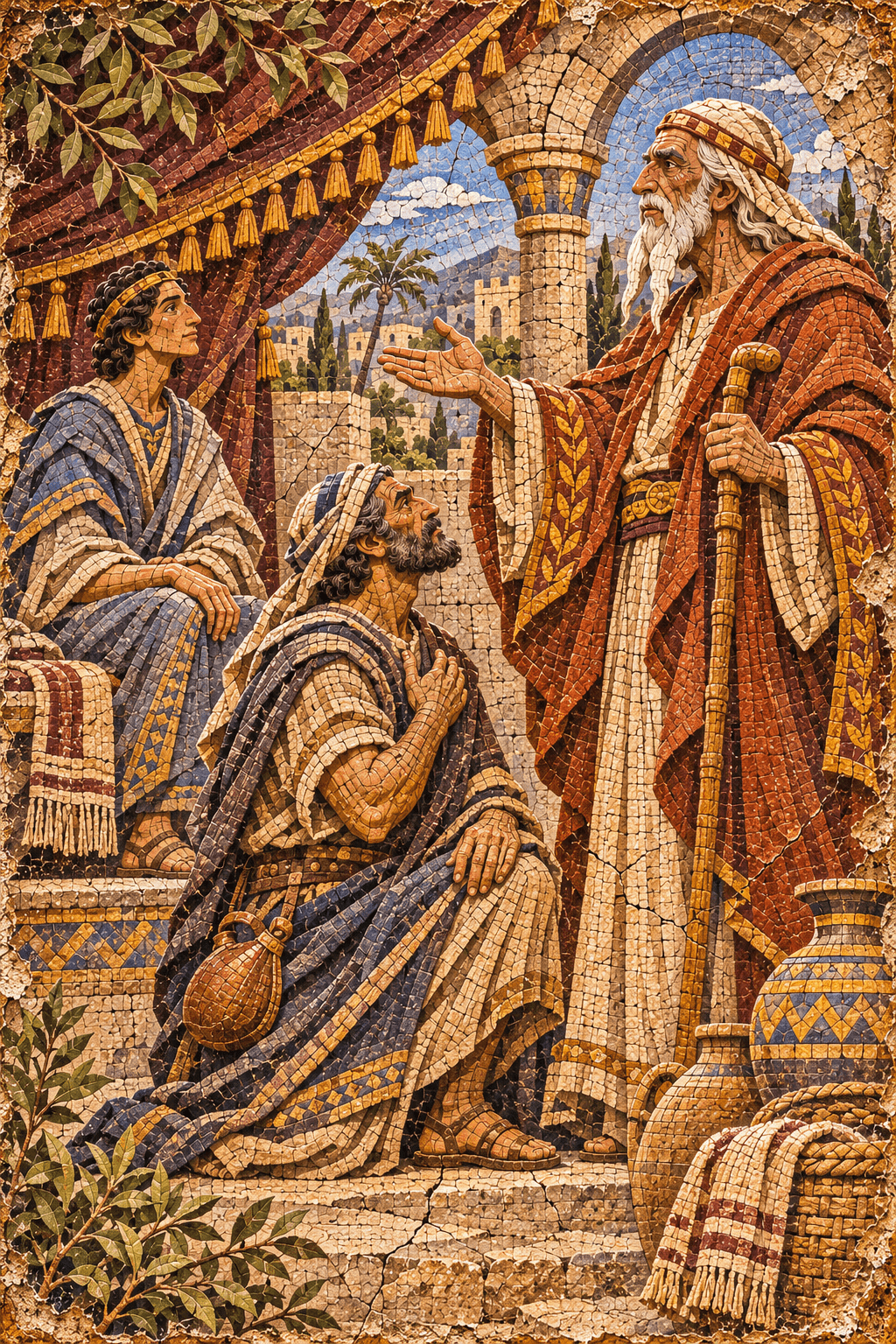
Sarah died at 127 years of age, while Abraham had reached 137… It seems that three years after Sarah’s death Abraham summoned his servant, the eldest of his house who ruled over all he had, and asked him to put his hand under his thigh and swear by the Lord, the God of heaven and the God of the earth, that he would not take a wife for his son from the daughters of the Canaanites among whom he dwelt, but would go to his kindred in Mesopotamia and bring him a wife from his kindred. The man asked him: if the woman refused to follow him to this land (Canaan), should he take his son back to where his kindred were? Abraham answered, declaring his faith in God who had promised him the land, that He would send His angel to prepare a wife for his son, and warning the man against taking his son back to the land from which Abraham had come.
What does placing the hand under Abraham’s thigh mean? Saint Augustine says:
It signifies the oath by the One who would become incarnate from his seed. [332]
It is as though Abraham spoke in the spirit of prophecy, declaring that the Lord, the God of heaven and the God of the earth, would bear flesh from his loins.
Abraham went out from Ur of the Chaldees, from the midst of his kindred, and resolved in his heart, through his obedience to the divine call, never to return there again, nor to bury his wife there, nor to send his son back there to marry. True, he asked that his son marry from his kindred, so that he would not be bound to a Canaanite woman who would draw his heart away from the love of God and distort and corrupt his thoughts; but he firmly refused that his son go there, believing that God who called him would send his son the wife who would help him in the way of the Lord, as Sarah had been a helper to him.
In choosing a wife for his son, Abraham was not concerned that she be rich or beautiful; his first aim was that she be holy and faithful, helping his son in his spiritual life and not being a hindrance to him on the way… Therefore the Lord gave Isaac Rebekah, a woman beautiful in appearance and in spirit, who was a source of comfort and joy to him all the days of his sojourning.
2. In the City of Nahor
KJV · Verses 10–14
10 And the servant took ten camels of the camels of his master, and departed; for all the goods of his master were in his hand: and he arose, and went to Mesopotamia, unto the city of Nahor. 11 And he made his camels to kneel down without the city by a well of water at the time of the evening, even the time that women go out to draw water. 12 And he said O Lord God of my master Abraham, I pray thee, send me good speed this day, and shew kindness unto my master Abraham. 13 Behold, I stand here by the well of water; and the daughters of the men of the city come out to draw water: 14 And let it come to pass, that the damsel to whom I shall say, Let down thy pitcher, I pray thee, that I may drink; and she shall say, Drink, and I will give thy camels drink also: let the same be she that thou hast appointed for thy servant Isaac; and thereby shall I know that thou hast shewed kindness unto my master.
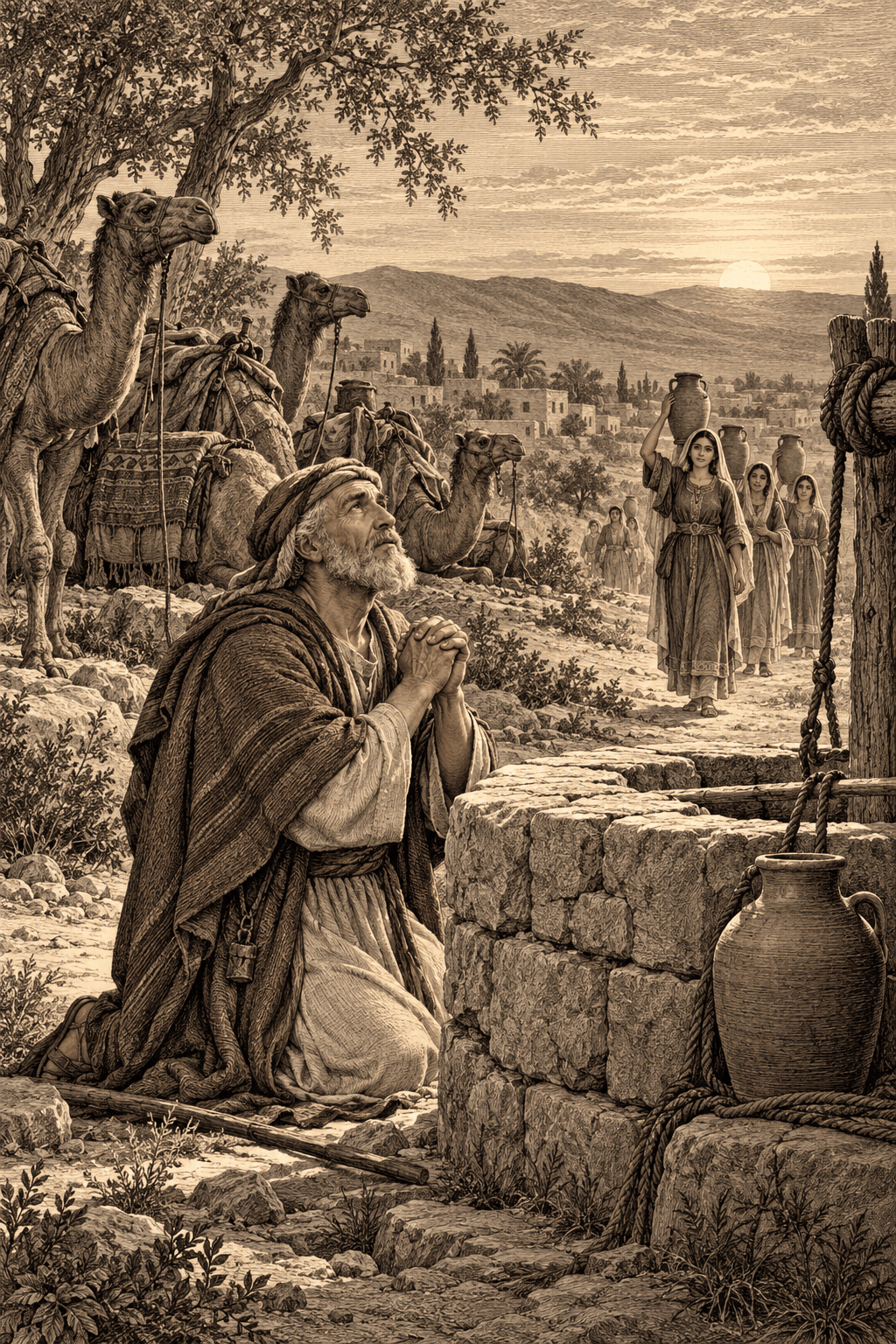
The city of Nahor is near Haran, in northwestern Mesopotamia, known in Assyrian documents and the Mari documents. Perhaps the name was taken from Nahor, Abraham’s grandfather (Genesis 11:22–25), or from his brother, Rebekah’s grandfather (Genesis 11:27–31), or from the name of the tribe as a whole. Nahor also appears as the ancestor of a number of Aramean tribes (Genesis 22:20–24). [333]
Scripture says: “And the servant took ten camels of the camels of his master, and departed; for all the goods of his master were in his hand: and he arose, and went to Mesopotamia, unto the city of Nahor. And he made his camels to kneel down without the city by a well of water at the time of the evening, even the time that women go out to draw water. And he said, O LORD God of my master Abraham, I pray thee, send me good speed this day, and shew kindness unto my master Abraham” (10–12).
If the chief of Abraham’s house points to the Holy Spirit, whom the only-begotten Son sent from the Father, He has come to us in our life as to the city of Nahor, to set out with us from our land on our Lord’s camels to His land — that is, to carry us to His heavens, that we may be with the heavenly Bridegroom forever.
If the number 10 points to the Ten Commandments, the Holy Spirit works in us to carry us through the spiritual divine commandment, offering us “all the goods,” that is, the riches of the Spirit, peace of mind, and fullness of soul, so that we receive the Spirit within us, who sets out with us from glory to glory.
Perhaps the number 10 also points to our temporal life, as the number 1000 points to our heavenly life. The Holy Spirit, setting out with us to the land of promise, the Jerusalem above, offers us in our temporal life of the eternal goods what we can receive and enjoy here as an earnest of the enjoyment of the eternal goods in their perfection. We enjoy a portion of the dowry, not the whole dowry. As Saint John Chrysostom says:
When Christ made a (marriage) contract with us, He appointed a dowry for me — not of money but of blood. This dowry is the earnest of good things: “Eye hath not seen, nor ear heard, neither have entered into the heart of man” (1 Corinthians 2:9). He appointed the following things as my dowry: immortality, the praise of the angels, deliverance from death, freedom from sin, the inheritance of the great kingdom, righteousness, sanctification, deliverance from present evils, the discovery of the blessings to come. Great is my dowry…! He came and took me, and appointed my dowry, saying: I give you My riches. Have you lost paradise? I restore it to you… Yet He did not give me the whole dowry here. Why? So that I may give it to you when you enter the royal state. Did you come to Me? No, it is I who came to you… not that you should remain in your place, but that I may take you with Me and return with you. So do not ask Me for the dowry while you are here in this life, but be filled with hope and faith! [334]
The Holy Spirit comes to us as on ten camels, to present to the Church of the riches of God and to draw her continually toward heaven, that she may enjoy the fullness of glory. What is wonderful is that the man came to the well of water at evening to seek a bride for Isaac. What is this well but the waters of baptism, in which the Lord Christ meets His Church as His bride. As Father Caesarius of Arles says:
Had the Church not come to the waters of baptism, she would not have been joined to Christ. [335]
He also says:
See, brethren: Isaac’s servant found Rebekah at the well, and Rebekah in turn found Isaac at the well (62). For Christ does not find the Church, nor does the Church find Christ, except through the sacrament of baptism. [336]
Origen the scholar sees in the well a reference to Holy Scripture, in which the soul meets her Bridegroom, saying:
Rebekah used to go to the well every day to draw water; so she met Abraham’s servant and was married to Isaac… Learn to come to the well of Scripture every day, to draw the waters of the Holy Spirit without ceasing. [337]
He also says:
Do you wish to be betrothed to Christ? He sends you the servant, that is, the inspired word, without which you cannot receive Him or be married to Him. [338]
Returning to the chief of Abraham’s house, we see him, like his master, trusting in God as the Disposer of all things. Therefore, when he reached the well, he began to pray, committing the matter into God’s hands; and after the choice we find him offering thanks to God who had prospered his way (48). This man, as I said, points to the Holy Spirit who descended upon the Church in the fullness of time to sanctify her as a holy bride for the Lord Christ; though some see in this man a symbol of the apostles, who came preaching among the Gentiles to present them as a bride to the Lord by the Holy Spirit working in them.
3. The Meeting with Rebekah
KJV · Verses 15–27
15 And it came to pass, before he had done speaking, that, behold, Rebekah came out, who was born to Bethuel, son of Milcah, the wife of Nahor, Abraham's brother, with her pitcher upon her shoulder. 16 And the damsel was very fair to look upon, a virgin, neither had any man known her: and she went down to the well, and filled her pitcher, and came up. 17 And the servant ran to meet her, and said, Let me, I pray thee, drink a little water of thy pitcher. 18 And she said, Drink, my lord: and she hasted, and let down her pitcher upon her hand, and gave him drink. 19 And when she had done giving him drink, she said, I will draw water for thy camels also, until they have done drinking. 20 And she hasted, and emptied her pitcher into the trough, and ran again unto the well to draw water, and drew for all his camels. 21 And the man wondering at her held his peace, to wit whether the Lord had made his journey prosperous or not. 22 And it came to pass, as the camels had done drinking, that the man took a golden earring of half a shekel weight, and two bracelets for her hands of ten shekels weight of gold; 23 And said, Whose daughter art thou? tell me, I pray thee: is there room in thy father's house for us to lodge in? 24 And she said unto him, I am the daughter of Bethuel the son of Milcah, which she bare unto Nahor. 25 She said moreover unto him, We have both straw and provender enough, and room to lodge in. 26 And the man bowed down his head, and worshipped the Lord. 27 And he said, Blessed be the Lord God of my master Abraham, who hath not left destitute my master of his mercy and his truth: I being in the way, the Lord led me to the house of my master's brethren.
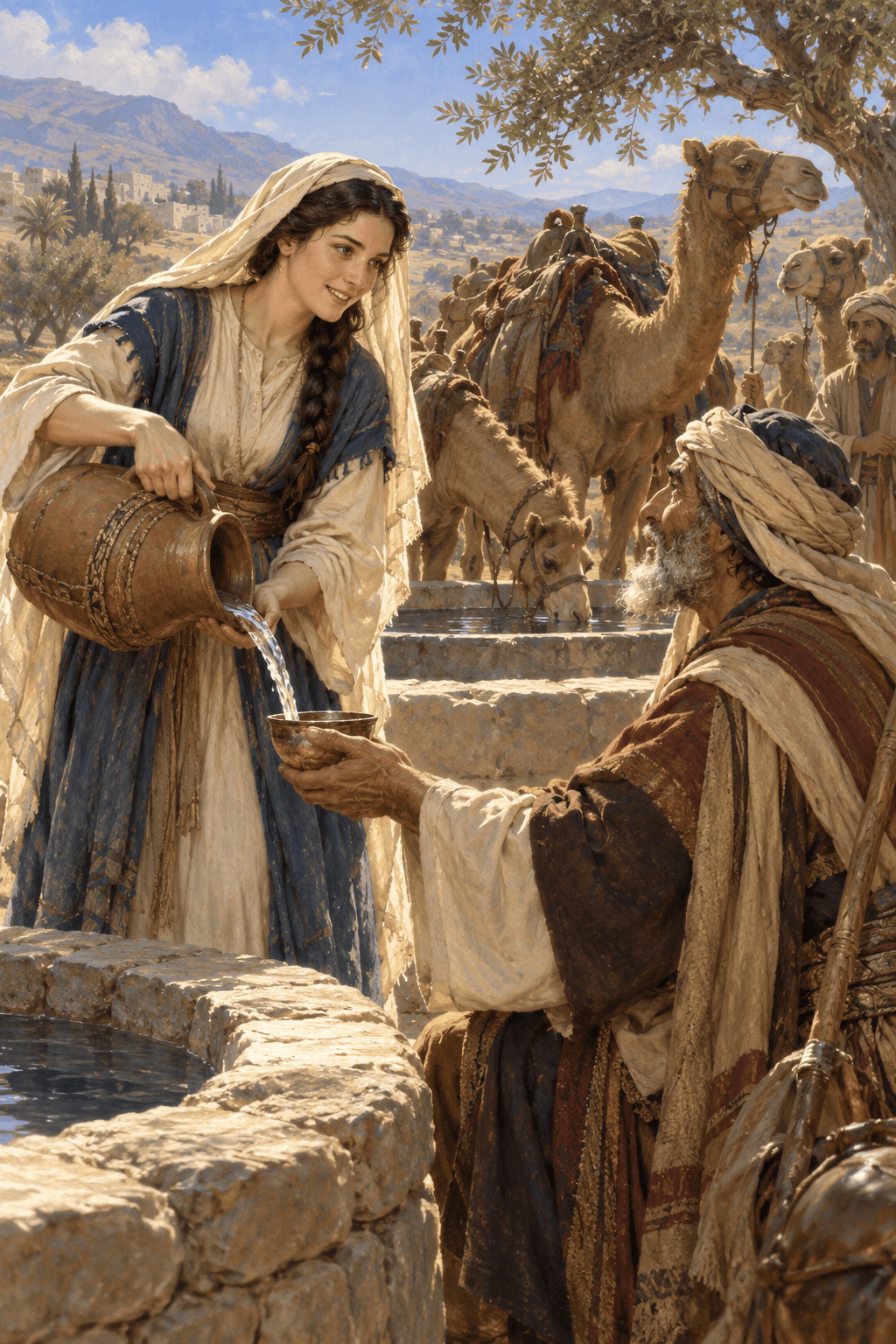
No sooner had the chief of Abraham’s house finished his conversation of faith with God than he found an immediate answer: Rebekah, the granddaughter of Nahor, Abraham’s brother, appeared at the water, having come to draw. Besides her bodily beauty, she was distinguished by gentleness of speech and generosity. When the man asked her to give him water from her pitcher, she hastened and let down her pitcher upon her hand to give him drink, and offered to water his camels as well, without his asking. She saw signs of exhaustion on him and longed to serve him, practicing her love of hospitality to strangers. Through this spirit full of love, Rebekah rose from being a girl living in a pagan land to become the wife of Isaac and the mother of Jacob, the father of all the tribes. By love and meekness Rebekah was exalted and enjoyed what had never entered her mind nor formed any part of her dreams.
As the man contemplated God’s work, he, “wondering at her held his peace, to wit whether the LORD had made his journey prosperous or not” (21). And when he perceived the divine work, “the man took a golden earring of half a shekel weight, and two bracelets for her hands of ten shekels weight of gold” (22).
Some see that the word “Rebekah” is derived from the Hebrew verb meaning “to tie,” perhaps meaning one who binds, captivating by beauty; [339] and Saint Clement of Alexandria sees that it means “the glory of God.” [340] She is the daughter of “Bethuel,” which means “man of God,” and her mother is “Milcah,” which means “queen” or “counsel.” In other words, Rebekah, representing the Church of the Lord Christ and His bride, bears within her “the glory of God” and enjoys a surpassing beauty that captivates those who behold her; and the secret of her beauty is that her father is a man of God and her mother holy counsel. Her beauty truly appeared when she received her bridegroom’s gifts: the golden earring in her ears and the two golden bracelets on her hands.
If gold points to the spiritual character or the heavenly nature, then the Church, receiving God’s work through His servants, has heavenly ears and hands also, so that she listens only to what is divine and works only for the kingdom of heaven. Father Caesarius of Arles says:
The golden earring signifies the divine words, and the two golden bracelets signify good works, for works are indicated by the hands. Let us see, brethren, how Christ offered these gifts to the Church! [341]
Origen the scholar says:
Rebekah does not find her beauty unless Abraham’s servant comes to adorn her. Her hands are adorned only with what Isaac sends her. She wishes to enjoy golden words in her ears and golden works in her hands; but she could not enjoy these things nor be made worthy of them unless she came to draw water from the well. You who do not want to come to the water, nor to place in your ears the golden words of the prophets — how can you bear the adornment of teachings and the beauty of life?! [342]
When the man asked her whether there was room in her father’s house for them to lodge, she answered: “We have both straw and provender enough, and room to lodge in” (25). Nothing glorifies God in our lives like the largeness of heart toward people, so that they find in it food for themselves and their camels and a place to rest. Let us say to the whole world: “We have both straw and provender enough, and room to lodge in.” We seek nothing from the world, but wish to give fullness and rest to all. What Rebekah did as a representative of the Church of the New Covenant, the Apostle Paul practiced as a member of it, saying: “O ye Corinthians, our mouth is open unto you, our heart is enlarged” (2 Corinthians 6:11).
4. In Rebekah’s House
KJV · Verses 28–49
28 And the damsel ran, and told them of her mother's house these things. 29 And Rebekah had a brother, and his name was Laban: and Laban ran out unto the man, unto the well. 30 And it came to pass, when he saw the earring and bracelets upon his sister's hands, and when he heard the words of Rebekah his sister, saying, Thus spake the man unto me; that he came unto the man; and, behold, he stood by the camels at the well. 31 And he said, Come in, thou blessed of the Lord; wherefore standest thou without? for I have prepared the house, and room for the camels. 32 And the man came into the house: and he ungirded his camels, and gave straw and provender for the camels, and water to wash his feet, and the men's feet that were with him. 33 And there was set meat before him to eat: but he said, I will not eat, until I have told mine errand. And he said, Speak on. 34 And he said, I am Abraham's servant. 35 And the Lord hath blessed my master greatly; and he is become great: and he hath given him flocks, and herds, and silver, and gold, and menservants, and maidservants, and camels, and asses. 36 And Sarah my master's wife bare a son to my master when she was old: and unto him hath he given all that he hath. 37 And my master made me swear, saying, Thou shalt not take a wife to my son of the daughters of the Canaanites, in whose land I dwell: 38 But thou shalt go unto my father's house, and to my kindred, and take a wife unto my son. 39 And I said unto my master, Peradventure the woman will not follow me. 40 And he said unto me, The Lord, before whom I walk, will send his angel with thee, and prosper thy way; and thou shalt take a wife for my son of my kindred, and of my father's house: 41 Then shalt thou be clear from this my oath, when thou comest to my kindred; and if they give not thee one, thou shalt be clear from my oath. 42 And I came this day unto the well, and said, O Lord God of my master Abraham, if now thou do prosper my way which I go: 43 Behold, I stand by the well of water; and it shall come to pass, that when the virgin cometh forth to draw water, and I say to her, Give me, I pray thee, a little water of thy pitcher to drink; 44 And she say to me, Both drink thou, and I will also draw for thy camels: let the same be the woman whom the Lord hath appointed out for my master's son. 45 And before I had done speaking in mine heart, behold, Rebekah came forth with her pitcher on her shoulder; and she went down unto the well, and drew water: and I said unto her, Let me drink, I pray thee. 46 And she made haste, and let down her pitcher from her shoulder, and said, Drink, and I will give thy camels drink also: so I drank, and she made the camels drink also. 47 And I asked her, and said, Whose daughter art thou? And she said, the daughter of Bethuel, Nahor's son, whom Milcah bare unto him: and I put the earring upon her face, and the bracelets upon her hands. 48 And I bowed down my head, and worshipped the Lord, and blessed the Lord God of my master Abraham, which had led me in the right way to take my master's brother's daughter unto his son. 49 And now if ye will deal kindly and truly with my master, tell me: and if not, tell me; that I may turn to the right hand, or to the left.
When Laban saw his sister Rebekah adorned with the earring and the bracelets, and she had told him all that had happened, he hastened to the man, saying to him: “Come in, thou blessed of the LORD; wherefore standest thou without? for I have prepared the house, and room for the camels” (31)… When the man came in and ungirded the camels, Laban gave straw and provender for the camels and water to wash his feet and the feet of the men with him, and set food before him to eat; but he said, “I will not eat, until I have told mine errand” (33). The man began to tell Rebekah’s family of the greatness of his master Abraham, of the son of his old age from Sarah, of the charge Abraham had given him concerning the marriage of his son Isaac, and of God’s work with him when he came to the well and met Rebekah. He concluded his speech saying: “And now if ye will deal kindly and truly with my master, tell me: and if not, tell me; that I may turn to the right hand, or to the left” (49).
Here we stand in amazement before God’s wonderful work: not only was Rebekah marked by gentleness and generosity in giving, but her brother Laban bore the same two traits! He was utterly gentle and utterly generous! He calls Abraham’s servant “blessed of the LORD,” and insists on not leaving him outside, offering him a place in his heart as in his house! It is as though God were preparing this wonderful spiritual atmosphere in the midst of a pagan land full of abominations and ingratitude. God was preparing it for the sake of Abraham the patriarch, to set his heart at rest concerning his son Isaac; or God was preparing Rebekah as a spiritual wife for Isaac, made worthy of motherhood for all the people of God! In the midst of the pitch darkness of the city — indeed the darkness of the whole region — God was preparing a girl to fulfill a role on a surpassing level!
If we marvel at the conduct of Rebekah and her family, we shall not overlook the role of the chief of Abraham’s house. He had seen with his own eyes how God prospered his way at the well; and now, entering the house, he feared lest courtesies, whatever their motive, distract him from his mission. Therefore he insisted on not eating until he had set before them the works of God and received from them a word concerning Rebekah, or else they would send him away to go to the right or the left. As a symbol of the Holy Spirit, who works in the world to bring the Church of the Lord Christ, His bride, he always works with a clear divine aim… or, as a symbol of the apostles and disciples preaching by the Holy Spirit to bring every soul into membership in the body of Christ, His holy bride, they are not occupied with human courtesies but seek the fulfillment of the Lord’s purpose in them. For this reason the Lord Christ charged them, saying: “Go not from house to house” (Luke 10:7); “salute no man by the way” (Luke 10:4).
5. The Success of the Servant’s Mission
KJV · Verses 50–60
50 Then Laban and Bethuel answered and said, The thing proceedeth from the Lord: we cannot speak unto thee bad or good. 51 Behold, Rebekah is before thee, take her, and go, and let her be thy master's son's wife, as the Lord hath spoken. 52 And it came to pass, that, when Abraham's servant heard their words, he worshipped the Lord, bowing himself to the earth. 53 And the servant brought forth jewels of silver, and jewels of gold, and raiment, and gave them to Rebekah: he gave also to her brother and to her mother precious things. 54 And they did eat and drink, he and the men that were with him, and tarried all night; and they rose up in the morning, and he said, Send me away unto my master. 55 And her brother and her mother said, Let the damsel abide with us a few days, at the least ten; after that she shall go. 56 And he said unto them, Hinder me not, seeing the Lord hath prospered my way; send me away that I may go to my master. 57 And they said, We will call the damsel, and enquire at her mouth. 58 And they called Rebekah, and said unto her, Wilt thou go with this man? And she said, I will go. 59 And they sent away Rebekah their sister, and her nurse, and Abraham's servant, and his men. 60 And they blessed Rebekah, and said unto her, Thou art our sister, be thou the mother of thousands of millions, and let thy seed possess the gate of those which hate them.
With every step in which the man felt success, he bowed himself to the Lord to the earth (52), offering a sacrifice of thanksgiving to God who arranges the matter by His hands.
All perceived that “the thing proceedeth from the LORD” (50). The servant brought forth jewels of silver and jewels of gold and raiment and gave them to Rebekah (53), and he gave precious things to her brother and her mother… Yet when the procession began to move they said: “We will call the damsel, and enquire at her mouth. And they called Rebekah, and said unto her, Wilt thou go with this man? And she said, I will go” (57–58). For they believed in freedom of choice: no one should compel a young man or woman to marry a particular person, whatever the circumstances! If God honors man and sanctifies the freedom of his will, it befits us to believe in the freedom of our children and our brothers and sisters, not compelling them in anything but advising them and supporting them without coercion.
In complete freedom she said: “I will go”… She accepted the divine work and went out from among her family and her father’s house, to hear them bless her: “Thou art our sister, be thou the mother of thousands of millions, and let thy seed possess the gate of those which hate them” (60). They asked God for growth and fruitfulness, that her seed might be thousands upon thousands and ten thousands upon ten thousands; and they asked strength for her seed, that no enemy might shatter them: “let thy seed possess the gate of those which hate them.”
Rebekah set out with her nurse, very dear to her, called Deborah (Genesis 35:8), for she had been raised by her hands to live like the busy bee (“Deborah”), which gathers the nectar of holy teachings from every book, and God turns it in her depths into honey from the comb that satisfies her life and gives her sweetness.
6. Rebekah, the Wife of Isaac
KJV · Verses 61–67
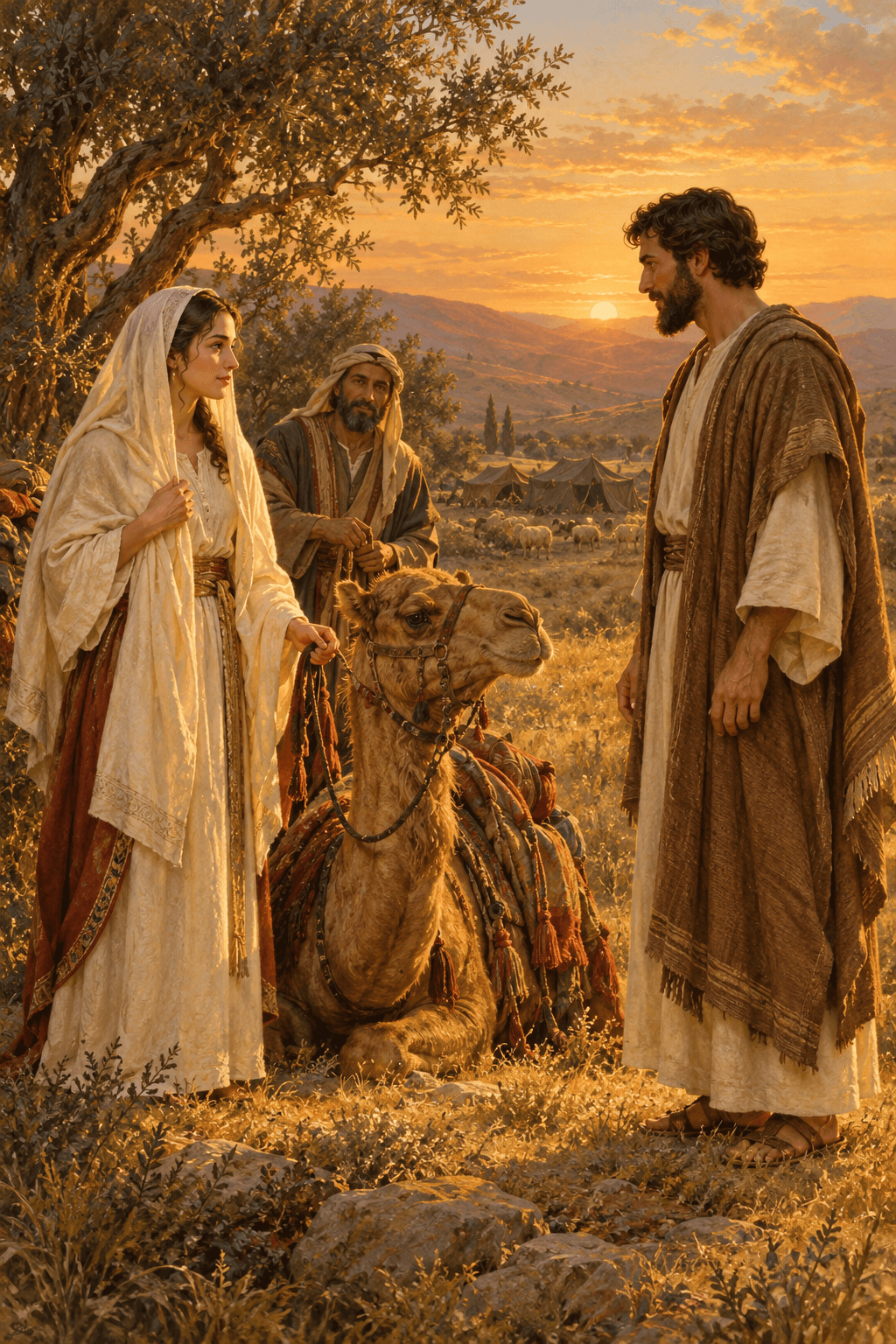
61 And Rebekah arose, and her damsels, and they rode upon the camels, and followed the man: and the servant took Rebekah, and went his way. 62 And Isaac came from the way of the well Lahairoi; for he dwelt in the south country. 63 And Isaac went out to meditate in the field at the eventide: and he lifted up his eyes, and saw, and, behold, the camels were coming. 64 And Rebekah lifted up her eyes, and when she saw Isaac, she lighted off the camel. 65 For she had said unto the servant, What man is this that walketh in the field to meet us? And the servant had said, It is my master: therefore she took a vail, and covered herself. 66 And the servant told Isaac all things that he had done. 67 And Isaac brought her into his mother Sarah's tent, and took Rebekah, and she became his wife; and he loved her: and Isaac was comforted after his mother's death.
Rebekah set out toward her bridegroom Isaac after leaving her kindred and her father’s house, like the Church of the New Covenant, which left what she had inherited before from the pagan world to receive the Lord Christ as her Bridegroom. And as the servant met her at the well, Isaac came out to meet her by the well Lahai-roi, as in the waters of baptism.
Isaac went out to meditate in the field at the eventide (63). Some Jewish scholars hold that it was the custom of some Jews to go out at sunset to pray to God in an open place, contemplating God’s works with them throughout the day — a custom still practiced among many monks of Egypt.
Isaac represents the Lord Christ, who left His glories and went out to the field through the Incarnation to receive the humble Rebekah, who, seeing Him, in turn alighted from the camel so that they might meet together, after she had covered herself with the veil of meekness and modesty… So Isaac brought her into his mother Sarah’s tent, and she became his wife, and he loved her; and Isaac was comforted after his mother’s death (67).
Father Caesarius of Arles comments on this act, saying:
Isaac took Rebekah and brought her into his mother’s tent, and Christ took the Church and set her in place of the synagogue. Through unbelief the synagogue separated from God and died, and by faith the Church was joined to Christ and received life. As the Apostle says, through pride the branches of the olive tree were broken off (Romans 11:17), that the humble wild olive might be grafted in. Therefore it is said: “and he took Rebekah… and he loved her: and Isaac was comforted after his mother’s death.” Christ took the Church and loved her so greatly that by His love for her He was comforted for His grief over the death of His mother, that is, the synagogue. The unbelief of the synagogue grieved Christ, and the faith of the Church gladdened Him! [343]
Notes and References
[332] Augustine, In Ioan. tr. 43:16.
[333] J. McKenzie, Dictionary of the Bible, p. 602.
[334] See the author’s book The Church Loves You (1986), pp. 61–66.
[335] Caesarius of Arles, Serm. 85:3.
[336] Ibid. 85:4.
[337] Origen, In Gen. hom. 10:2.
[338] Ibid.
[339] Strong’s Dictionary of the Hebrew.
[340] Clement of Alexandria, Strom. 4:26.
[341] Caesarius of Arles, Serm. 85:3.
[342] Origen, In Gen. hom. 10:4.
[343] Caesarius of Arles, Serm. 85:5.