
If the star of Abraham the patriarch shone in the sky of the spirit, it was because of his faith, which lifted him above events: gifts increased his thanksgiving to God without attachment to them, and tribulations were a proving of him before all… He lived the years of his sojourning as an unbroken chain of victories. Now, as he rejoiced with his wife Sarah over Isaac, the son of promise whom they had received in their old age as a surpassing divine gift, the Lord asked him for him as a sacrifice of love. As severe as the trial was, so greatly were Abraham and Isaac his son glorified, and they became a living picture of God’s saving work through the sacrifice of the cross and the declaration of the resurrection of the Messiah.
1. God Tests Abraham
KJV · Verses 1–2
1 And it came to pass after these things, that God did tempt Abraham, and said unto him, Abraham: and he said, Behold, here I am. 2 And he said, Take now thy son, thine only son Isaac, whom thou lovest, and get thee into the land of Moriah; and offer him there for a burnt offering upon one of the mountains which I will tell thee of.
The Church cherishes the day of “Great Thursday,” or “Covenant Thursday,” on which we remember the Lord Christ’s offering to His disciples of the sacrifice of the New Covenant, founded on the cross. The Church found no clearer picture than Abraham’s offering of Isaac his son as a burnt offering to the Lord, as a living image of the work of the cross, where the Father offers His Son as a ransom for the salvation of the world. Therefore the “Fraction of the Liturgy of Covenant Thursday” centers on the sacrifice of Isaac. And all generations will continue to see in this act of faith a living and surpassing example revealing the sacrifice of the Lord Christ.
Scripture says: “And it came to pass after these things, that God did tempt Abraham, and said unto him, Abraham: and he said, Behold, here I am. And he said, Take now thy son, thine only son Isaac, whom thou lovest, and get thee into the land of Moriah; and offer him there for a burnt offering upon one of the mountains which I will tell thee of” (1–2).
God’s testing of Abraham does not mean that God did not know Abraham’s heart, for He knows all our inner secrets; but He allowed the trial in order to prove him before all and to declare his hidden, godly faith, so that he might be a living example for others. As Saint Augustine says:
Abraham was tested by the offering of his beloved son Isaac, to prove his pious obedience and make it known, not to God but to the world. Not every trial is for our blame; it may be for our praise. [313]
Origen the scholar sees that this trial revealed Abraham’s depths and his hidden thoughts concerning his faith in the resurrection, saying:
By the Spirit the Apostle Paul knew — as I think — Abraham’s feelings and thoughts, declaring them when he said: “By faith Abraham, when he was tried, offered up Isaac: and he that had received the promises offered up his only begotten son, of whom it was said, That in Isaac shall thy seed be called: accounting that God was able to raise him up, even from the dead” (Hebrews 11:17–19). The Apostle has handed down to us the thoughts of this believing man, for such were his thoughts concerning Isaac; and this is the first time that faith in the resurrection appears, for Abraham hoped in the resurrection of Isaac. [314]
Thus the trial revealed the heart of Abraham the patriarch as a man who believes in the resurrection from the dead. If Abraham entered into the hardest trial an old man can pass through — offering his only, beloved son as a burnt offering with his own hands — he enjoyed in the midst of the trial the vision of our Lord Jesus Christ risen from the dead through a certain sign that filled his heart with rejoicing, as the Lord Himself said: “Your father Abraham rejoiced to see my day: and he saw it, and was glad” (John 8:56). If by faith he set out with his son toward the altar, he returned from the trial bearing Isaac as though risen from the dead — a symbol of the Lord Christ, slain and risen from the dead.
Scripture begins its account of the trial by saying, “And it came to pass after these things” (1), as though God did not allow Abraham the trial until after He had appeared to him at the oaks of Mamre and confirmed the promise concerning Isaac, and after he had made a covenant with Abimelech, showing him how He had given him dignity and awe even before kings. In other words, He prepared him for it in many ways, as the Apostle says: “but God is faithful, who will not suffer you to be tempted above that ye are able; but will with the temptation also make a way to escape, that ye may be able to bear it” (1 Corinthians 10:13). He prepared his heart and mind and made ready his whole life to receive the trial; He also accompanied him during the trial in a hidden way and was his support; and in the end He manifested Himself in his life in one way or another. So with every trial the Lord Himself supports us before the trial, during it, and after it, to accomplish His purpose in us if we accept His work in our lives.
Why did God ask Abraham to offer his son as a sacrifice, when the Mosaic Law later forbade human sacrifices? Without doubt the pagans offered their firstborn as sacrifices to their gods, and these offerings did not carry love on the part of those offering them so much as they revealed the spirit of despair filling their hearts; for they wanted the forgiveness of their sins at any price, and wanted to appease their gods thirsting for blood! Therefore God asked Abraham His friend for this offering, to declare to the pagans the heart of Abraham loving God, ready to offer the most precious thing he had; and at the same time, by providing a ram in place of Isaac, He declared that He does not accept human sacrifices — not because of any dryness in the believers’ love for God, but because of God’s esteem for man, for He does not seek the shedding of his blood and his destruction! God cannot bear human sacrifices, for He is the Lover of mankind, longing for their life and not their destruction, offering His only Son as a ransom for them — He who, though He became man, alone death could not rule over, nor corruption approach!
Saint Augustine says:
Abraham never believed that God accepts human sacrifices; yet when the voice of the divine command (to offer Isaac) sounded, he obeyed without argument. Abraham deserved praise because he believed completely that, offering his son as a burnt offering, he would rise again, as the Lord had said to him when Abraham was unwilling to fulfill his wife’s wish to cast out the maid and her son: “in Isaac shall thy seed be called” (Genesis 21:12)… Therefore, since the father held fast from the beginning to the promise to be fulfilled through this son whom God commanded to be slain, he never doubted that he whose birth he had once not hoped for could rise again after being offered as a burnt offering. [315]
In other words, Abraham perceived the difference between offering his son as a sacrifice and the human sacrifices offered to idols. He believed in God, who gave him Isaac after Sarah’s womb was dead, so that he counted his birth like a resurrection from the dead; it would not be hard for Him to raise him after being offered as a burnt offering. But the pagans offered their firstborn to appease their bloodthirsty gods, offering them without hope!
Finally, He asked him to offer him as a burnt offering in the land of Moriah, at the place He would show him… Some see that the mountain on which Abraham built the altar to offer his son was the threshing floor of Araunah the Jebusite (2 Samuel 24:24; 1 Chronicles 21:24), that is, the place where the Temple was built, where sacrifices were offered without ceasing, awaiting the coming of the unique sacrifice of the Lamb of God, our Lord Jesus Christ. In the Samaritan tradition the land of Moriah is in the region of Mount Gerizim, north of Jerusalem. Father Caesarius of Arles says that Jerome the priest affirmed, through his meetings with Jewish elders, that the Lord was crucified in the very place where Isaac was offered as a burnt offering. [316]
The word “Moriah” means “the Lord sees” or “the Lord provides,” for there the Lord provided the ram for the burnt offering; and perhaps it means “the Lord is teacher”… for He taught us practical love through the sacrifice of His only Son!
2. Isaac on the Way
KJV · Verses 3–8
3 And Abraham rose up early in the morning, and saddled his ass, and took two of his young men with him, and Isaac his son, and clave the wood for the burnt offering, and rose up, and went unto the place of which God had told him. 4 Then on the third day Abraham lifted up his eyes, and saw the place afar off. 5 And Abraham said unto his young men, Abide ye here with the ass; and I and the lad will go yonder and worship, and come again to you. 6 And Abraham took the wood of the burnt offering, and laid it upon Isaac his son; and he took the fire in his hand, and a knife; and they went both of them together. 7 And Isaac spake unto Abraham his father, and said, My father: and he said, Here am I, my son. And he said, Behold the fire and the wood: but where is the lamb for a burnt offering? 8 And Abraham said, My son, God will provide himself a lamb for a burnt offering: so they went both of them together.
“And Abraham rose up early in the morning, and saddled his ass, and took two of his young men with him, and Isaac his son, and clave the wood for the burnt offering, and rose up, and went unto the place of which God had told him” (3).
When Abraham heard the divine command, together with what seemed contradictory to His earlier promises, he rose in obedience to carry out the command. He set out to the work “early” in the morning without slackness on his part, and without argument or doubt about God’s promises. Abraham was wonderful in his obedience, as his son, “the young man,” was also wonderful in his surrender into his father’s hands… for Abraham hastened to the work according to the divine command, and Isaac with him, opposing him in nothing.
Saint John Chrysostom comments on Abraham’s not consulting his wife Sarah in this matter, saying:
Abraham, who had a wonderful wife, when he wished to offer his son, hid it from her, though he did not know what would happen; but he had resolved to offer his son… If we have someone dear to us as a member of the family, let us not show him our works of love unless necessity requires it. [317]
As for Isaac’s positive role in his obedience to his father in the Lord, Saint Ambrose comments, saying:
Isaac feared the Lord, being truly the son of Abraham; so he submitted to his father, such that he would not refuse death lest he oppose his father’s will. Joseph too, though he dreamed that the sun, the moon, and the stars bowed down to him, nevertheless submitted to his father’s will in complete obedience (Genesis 37:12). [318]
Thus, since Abraham was obedient to the Lord with surpassing love and without argument, He gave him Isaac, obedient to him with true love and without argument; as though God rewarded Abraham in his son before granting him the eternal reward.
What is wonderful in Abraham is that he clave the wood early in the morning before going out, so that there would be no hindrance preventing him from fulfilling the Lord’s command. If this wood points to the cross on which the true Isaac is hung, Abraham’s cleaving it with his own hands before going out symbolizes the Father’s revelations about the cross through the types and prophecies of the Old Testament before the Lord Christ carried it and was lifted up on it as a burnt offering! God revealed the mystery of the cross in various ways, though the eyes of many were blinded to beholding it.
“Then on the third day Abraham lifted up his eyes, and saw the place afar off” (4).
Abraham walked not one day nor two but three days until he saw the place afar off. As Origen the scholar says, the third day points to the resurrection of the Lord Christ. It is as though Abraham entered the tomb with the Lord and lived His sufferings with Him until the light of His resurrection broke forth at the dawn of Sunday (the third day), and he lifted up his eyes and saw the place afar off. His eyes before had been relatively lowered and humbled; perhaps the enemy fought him with the thought of Sarah, whom he had now left in the tent without telling her of his going out with his son to slay him; perhaps he fought him with his son… But in any case Abraham did not stop walking on the road for three days, like the children of Israel, whom the Lord asked to offer sacrifice three days’ journey away (Exodus 5:3), for no sacrifice is accepted outside the circle of the resurrection of our Lord Jesus Christ. So on the third day Abraham saw the sign of the resurrection in one way or another, lifted up his eyes, and saw the place afar off. What is this place but the Lord Christ Himself, in whom he sees Isaac his son risen from death with Him and through Him!
We have already spoken of the mystery of the three days, [319] through which we enjoy not the sacrifice of Isaac but the sacrifice of the Lord Christ, risen from the dead. Saint Clement of Alexandria sees that these three days, through which we ought to pass in order to behold the place afar off, are: looking to good things, the good desires of the soul, and the soul’s perception of spiritual things. It is as though the soul cannot behold the mystery of the sacrifice of the cross unless it looks to good things, desires them in its depths, and perceives them; but the One who opens the eyes to behold this mystery is the Lord Christ Himself, for he says:
The eyes of understanding are opened by the Teacher who rose from the dead. [320]
Thus in the midst of the trial, between the pressures of pain and the multitude of cares, Abraham’s soul was filled with the consolation of the opening of his inner insight on the third day to behold the mystery of the Crucified, risen from the dead, and he rejoiced within, for he saw the day of the Lord (John 8:56). The furnace of trial was turned into heavenly dew by the appearance of the crucified and risen Lord Christ before the insight of Abraham the patriarch.
“And Abraham said unto his young men, Abide ye here with the ass; and I and the lad will go yonder and worship, and come again to you” (5).
Father Caesarius of Arles says:
The two servants whom Abraham ordered to remain with the ass point to the Jewish people, who could not go up and reach the place of the sacrifice, because they would not believe in Christ. The ass points to the Jewish synagogue, and the ram caught in the thicket by its horns seems to symbolize the Lord, for Christ was caught among thorns by horns when He was hung on the wood of the cross and nailed to the cross. [321]
The two young men saw Isaac and saw the wood that Abraham clave, but they could not set out to where Isaac was offered as a sacrifice — like the Jewish people who saw the Lord according to the flesh and looked upon the cross, but could not perceive the power of the cross. As the Apostle Paul says: “But we preach Christ crucified, unto the Jews a stumblingblock, and unto the Greeks foolishness… Because the foolishness of God is wiser than men; and the weakness of God is stronger than men” (1 Corinthians 1:23, 25).
The two young men sat with the ass and did not set out with Abraham and Isaac to see God’s mystery. So everyone who is bound to the earthly mind and lives for his belly and the lusts of his body is like one who sits with the ass; he cannot set out to know God’s spiritual mysteries, which lift him up to heavenly things.
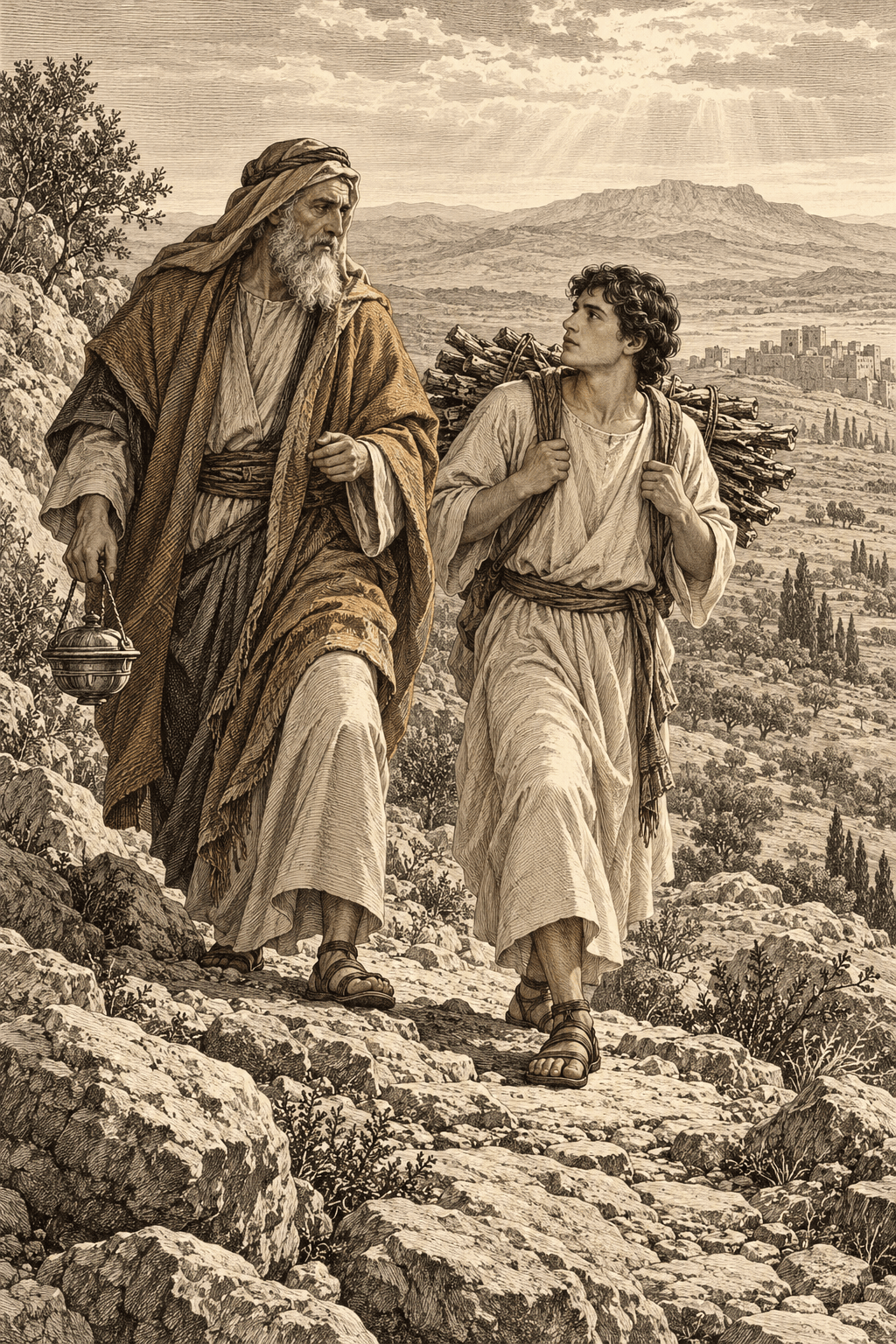
“And Abraham took the wood of the burnt offering, and laid it upon Isaac his son; and he took the fire in his hand, and a knife; and they went both of them together” (6).
Isaac was a young man — some think about twenty-five years old — so Abraham laid the wood on him, and they went both together to the place the Lord had shown him. As Father Caesarius of Arles says:
When Isaac carried the wood for the burnt offering, he symbolized Christ our Lord, who carried the wood of the cross to the place of His passion. This mystery the prophets had foretold, as in the saying: “and the government shall be upon his shoulder” (Isaiah 9:6). For Christ’s government was upon His shoulder when He carried the cross with wonderful humility. It is not unfitting to understand by “government” the cross of Christ, for by it He conquered the devil and called the whole world to the knowledge of Christ and the enjoyment of His grace. [322]
Saint Augustine says:
Isaac carried the wood on which he was to be offered as a burnt offering to the place of sacrifice, as Christ carried His cross. [323]
As for the words, “they went both of them together,” they indicate that this sacrifice is Abraham’s sacrifice as it is Isaac’s. Abraham offered his only son through surpassing love, and the son offered himself through complete obedience, so the sacrifice was counted to the account of both together. So — with the difference — we say that the sacrifice of the Lord Christ is the sacrifice of the Father, who offered His Son as a ransom for us; and it is the sacrifice of the Son, who “became obedient unto death, even the death of the cross”… This is the sacrifice of love which the Father offered in His only-begotten Son, as the Lord Christ Himself affirmed: “For God so loved the world, that he gave his only begotten Son, that whosoever believeth in him should not perish, but have everlasting life” (John 3:16). And the Apostle Paul says: “He that spared not his own Son, but delivered him up for us all, how shall he not with him also freely give us all things?” (Romans 8:32). And just as the Lord Christ in His crucifixion presented the Father’s sacrifice in His Son, He also offered Himself, for it is said: “who loved me, and gave himself for me” (Galatians 2:20); “as Christ also hath loved us, and hath given himself for us an offering and a sacrifice to God for a sweetsmelling savour” (Ephesians 5:2); “even as Christ also loved the church, and gave himself for it” (Ephesians 5:25).
If the words “they went both of them together” point to the setting out of the Father and the Son to the cross to offer the sacrifice of the cross — the Father offering it by His will that loves mankind, and the loving Son offering it by His practical obedience — the phrase also points to God and the Church setting out together toward the cross. God declares His love for man by offering His Son as a ransom for mankind, and the Church declares her love for the Father through her Head who was given up; and the Father smells in the sacrifice of the cross an odor of delight and good pleasure. This is the sacrifice of the Church, who gives her life also through her union with Christ Jesus, who gave His life!
As Isaac walked with Abraham toward the altar, the son began to ask his father: “My father… Behold the fire and the wood: but where is the lamb for a burnt offering?!” As Origen the scholar says:
At this moment the hardest moments of the trial take shape in the son’s word, “My father.” Imagine to what degree the voice of the son who is to be slain could stir his father’s heart! But Abraham’s steadfast faith did not prevent him from answering with a tender word: “Here am I, my son”!! [324]
In faith in Him who is able to raise from the dead, Abraham said: “My son, God will provide himself a lamb for a burnt offering” (8). And the Father saw the true Lamb, Jesus Christ, whom He offered as a ransom not for Isaac alone but for the whole world. In saying “God will provide” (literally, “God will see”), Abraham shows his complete trust in God’s saving plan, which is not of human making but by divine dispensation; God alone sees it, in His own surpassing way.
3. Building the Altar and Offering the Sacrifice
KJV · Verses 9–14
9 And they came to the place which God had told him of; and Abraham built an altar there, and laid the wood in order, and bound Isaac his son, and laid him on the altar upon the wood. 10 And Abraham stretched forth his hand, and took the knife to slay his son. 11 And the angel of the Lord called unto him out of heaven, and said, Abraham, Abraham: and he said, Here am I. 12 And he said, Lay not thine hand upon the lad, neither do thou any thing unto him: for now I know that thou fearest God, seeing thou hast not withheld thy son, thine only son from me. 13 And Abraham lifted up his eyes, and looked, and behold behind him a ram caught in a thicket by his horns: and Abraham went and took the ram, and offered him up for a burnt offering in the stead of his son. 14 And Abraham called the name of that place Jehovahjireh: as it is said to this day, In the mount of the Lord it shall be seen.
Everything was ready: Abraham had reached the place God had appointed, the altar was built, the wood Isaac had carried was laid in order, Isaac was bound by his father’s hands and laid on the altar upon the wood, and Abraham stretched forth his hand and took the knife to slay him… Things proceeded in an atmosphere of inner calm: Abraham believing in God, who would not abandon His promises, and Isaac in his obedience submitting to be slain; only moments remained before the son would be slain and offered as a burnt offering.
Abraham was counted to have offered his son, for he hastened to the work without fear, and his offering was accepted even though it was not fulfilled literally. As Saint Ambrose says:
Truly the father offered his son, for God does not seek blood but fitting obedience. [325]
And Isaac was counted a son of obedience, for he accepted the cross in faith. As Saint Jerome says:
Isaac, in his readiness to die, carried the cross of the Gospel before the coming of the Gospel. [326]
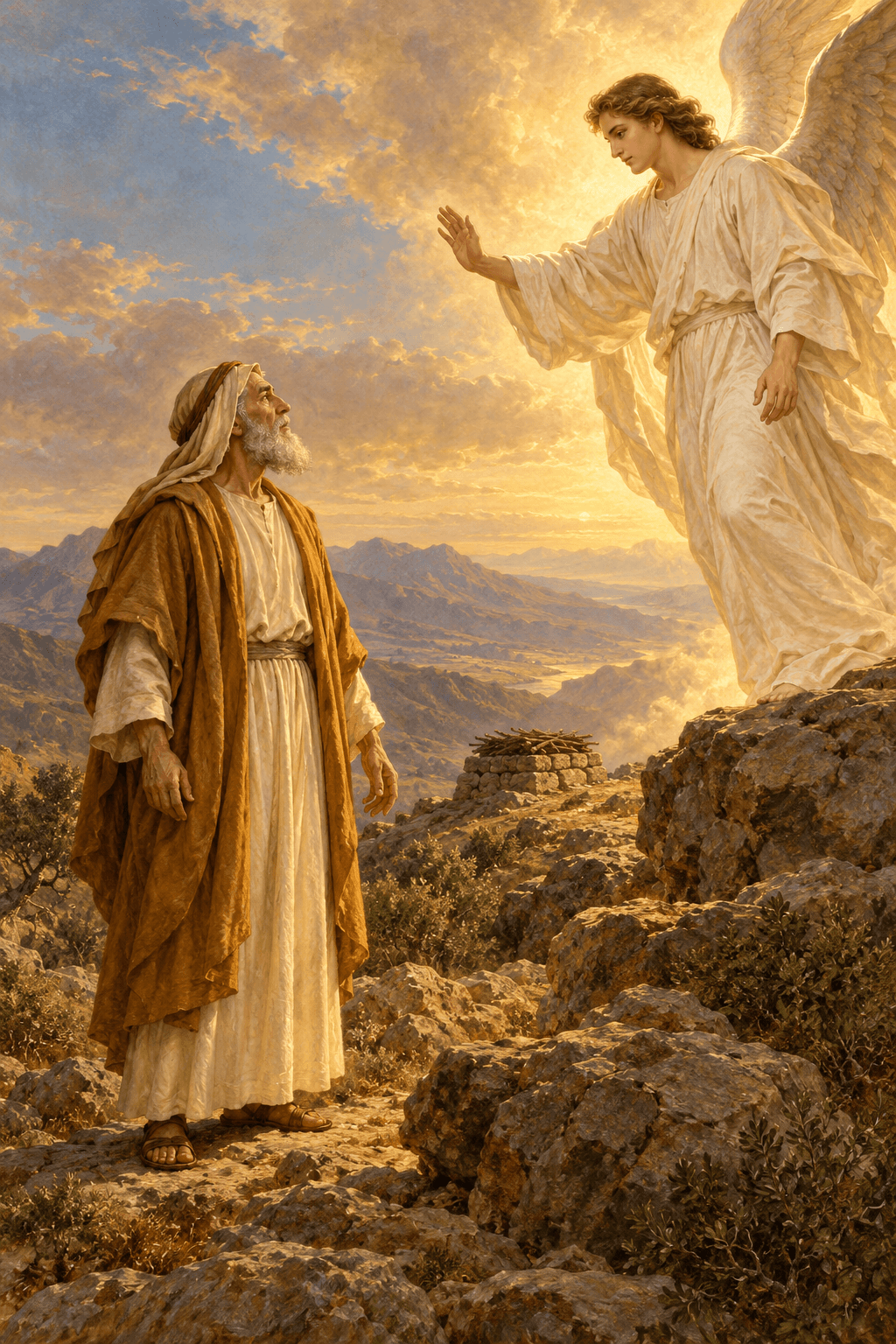
At the decisive moment, amid the deep calm, behold the angel of the Lord calling Abraham: “Abraham, Abraham”… “Lay not thine hand upon the lad, neither do thou any thing unto him: for now I know that thou fearest God, seeing thou hast not withheld thy son, thine only son from me” (11–12). The Lord’s words, “now I know,” as Saint Augustine says:
…do not mean that God had no prior knowledge of what was in Abraham’s heart; rather He wished to reveal to Abraham himself his inner depths. [327]
So Abraham became revealed to himself as a lover of God, and revealed to all generations that the secret of Abraham’s greatness was his lack of attachment to temporal life.
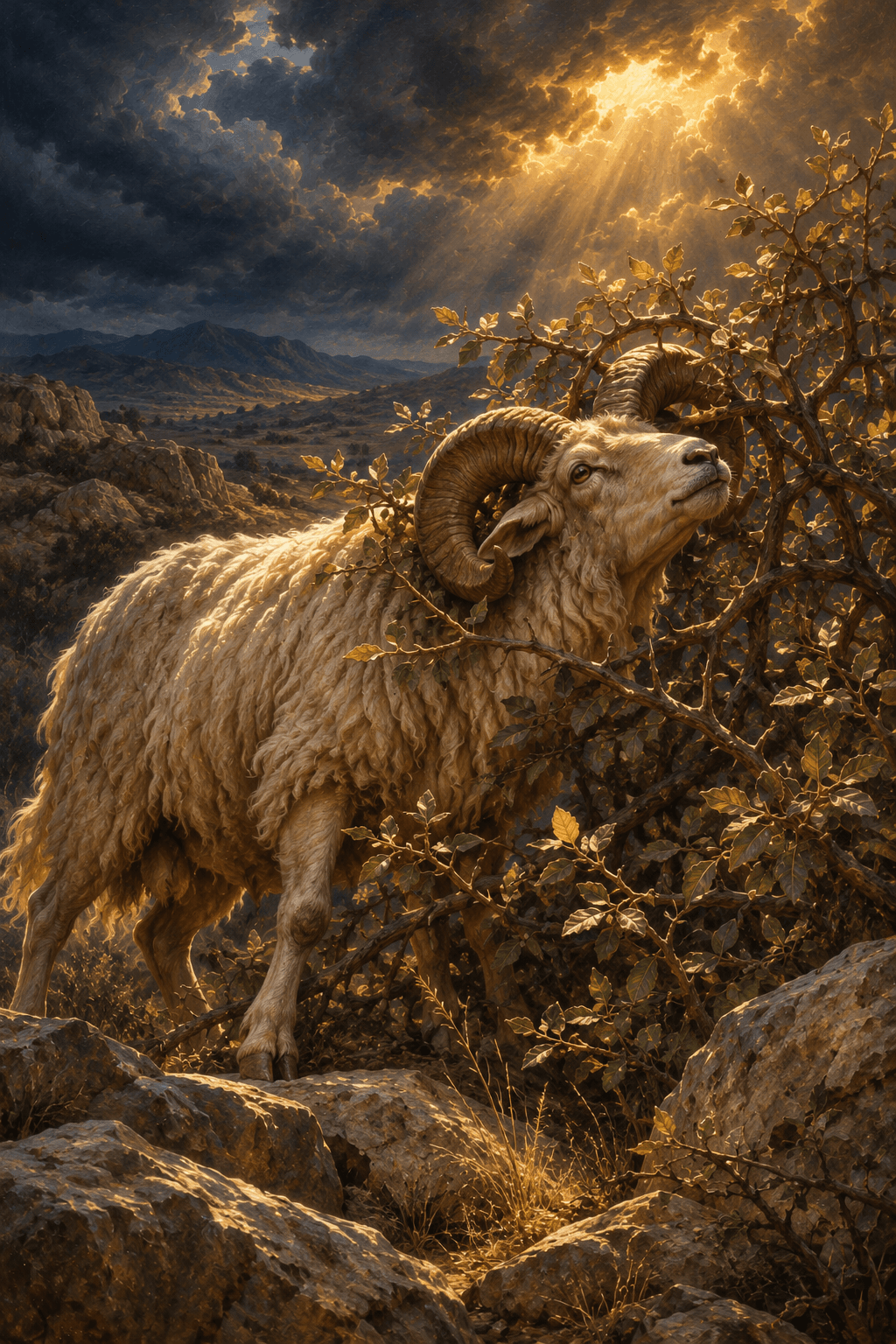
Abraham saw a ram caught in a thicket by its horns, and offered it up as a burnt offering in place of his son — as though a symbol of the Lord Christ, who was hung on the wood of the cross and nailed by His outstretched arms for the salvation of the world.
Abraham called the place “Jehovah-jireh,” that is, “the Lord will be seen.” Thus God appeared to Abraham in the place of sacrifice, for in it reconciliation between God and man was accomplished, and we gained the right to see Him as sons who have a place in the Father’s bosom. Through the sacrifice the Holy Spirit lifts us up and sets out with us to the divine embrace, that we may enjoy a divine vision — not on the level of temporal sight, but the vision of union with God and the eternal enjoyment of fellowship in His glories. Hence the altar in the Church of the New Covenant came to represent heaven itself… the place of God’s meeting with man in the slain Son.
4. The Renewal of the Divine Promise
KJV · Verses 15–19
15 And the angel of the Lord called unto Abraham out of heaven the second time, 16 And said, By myself have I sworn, saith the Lord, for because thou hast done this thing, and hast not withheld thy son, thine only son: 17 That in blessing I will bless thee, and in multiplying I will multiply thy seed as the stars of the heaven, and as the sand which is upon the sea shore; and thy seed shall possess the gate of his enemies; 18 And in thy seed shall all the nations of the earth be blessed; because thou hast obeyed my voice. 19 So Abraham returned unto his young men, and they rose up and went together to Beersheba; and Abraham dwelt at Beersheba.
Through the sacrifice Abraham enjoyed the vision of the Lord, as he also enjoyed the renewal of the promise in a way that surpassed the previous times:
First: Origen the scholar sees that the earlier promises leaned more toward confirming Abraham’s fatherhood of the circumcision, though they did not ignore his spiritual fatherhood of all believers from all nations and peoples; but the promise here brought out his spiritual fatherhood more. He says:
For he was to become the father of “they which be of faith” (Galatians 3:9), and to enter the inheritance through the sufferings and resurrection of Christ… The first promise concerned the first people, when (the divine voice) was on earth, for Scripture says: “And he brought him forth abroad — outside the tent — and said, Look now toward heaven, and tell the stars, if thou be able to number them: and he said unto him, So shall thy seed be” (Genesis 15:5). But in the renewal of the covenant Scripture shows that the voice came from heaven (Genesis 22:11). The first came from earth and the second from heaven. Does there not appear in this a symbol of the Apostle’s saying: “The first man is of the earth, earthy: the second man is the Lord from heaven” (1 Corinthians 15:47)? The promise concerning the people of faith comes from heaven, while that concerning the other (Jewish) people comes from earth. [328]
Second: If the first divine promise pointed more to the inheritance of the land, the voice came from the earth; but the second touches the men of the New Covenant, for an eternal inheritance, so the voice came from heaven… And the latter came confirmed by a divine oath, which stirred the feelings of the Apostle Paul in his Epistle to the Hebrews (Hebrews 6:17).
Third: If God renews the covenant with us, it is to declare our obligation also to renew the covenant with Him, as Origen the scholar [329] teaches. The believer, entering into a covenant with God within the waters of baptism — in which he renounces the devil and all his works and declares his acceptance of God and His saving works, his true membership in the Church, and his expectation of eternal life — renews this covenant daily by continual repentance, saying in the Morning Prayer, “Let us begin well,” counting each morning a new beginning of a deeper life with God his Savior.
When God had renewed His promises to Abraham, he returned to his young men and went with them to Beersheba to dwell there. If Beersheba, as we have seen, points to the waters of baptism and the work of the Holy Spirit through them and in them, then Abraham, having offered the sacrifice and enjoyed the divine promises, set out to his young men — as to his body, submissive to him with its energies and gifts — to settle all his days by the waters of baptism, remembering the work of divine sonship and responding to the work of the Holy Spirit. It is as though baptism is not a rite practiced at the beginning of the road and then ended, but a life the believer lives all the days of his sojourning: he enters the waters to meet the Lord Christ, buried and risen from the dead, and lives all his days by the Holy Spirit, enjoying this life — as though dwelling in Beersheba with Abraham, that is, in the waters of baptism.
When we are taken captive by sin we sit as by the rivers of Babylon to weep, remembering Zion; our tongues are unable to utter words of praise and to sing the songs of Zion (Psalm 137). But having accepted faith in the sacrifice of the true Isaac and enjoyed the new divine promise, we dwell in Beersheba by the waters of baptism with our young men, praising the Lord with the heart as with the tongue.
Perhaps the setting out of the two young men to Beersheba with Abraham and Isaac at the end of the journey points to the return of the Jews to faith in the Lord Christ, the mystery of whose sacrifice they could not behold before… so that in the last times they set out to the waters of baptism and accept Him whom they had denied.
5. The Children of Nahor
KJV · Verses 20–24
20 And it came to pass after these things, that it was told Abraham, saying, Behold, Milcah, she hath also born children unto thy brother Nahor; 21 Huz his firstborn, and Buz his brother, and Kemuel the father of Aram, 22 And Chesed, and Hazo, and Pildash, and Jidlaph, and Bethuel. 23 And Bethuel begat Rebekah: these eight Milcah did bear to Nahor, Abraham's brother. 24 And his concubine, whose name was Reumah, she bare also Tebah, and Gaham, and Thahash, and Maachah.
Scripture mentions the children of Nahor, Abraham’s brother, by his wife Milcah, to reveal the kinship of Rebekah with her husband Isaac: her father was the son of Abraham’s brother, that is, she was the daughter of his cousin. If Scripture is concerned with the men of faith and their genealogy, it is also concerned with the women of faith, their genealogy, and their role in the history of salvation.
Notes and References
[313] Augustine, City of God 16:32.
[314] Origen, In Gen. hom. 8:1.
[315] Augustine, City of God 16:32.
[316] Caesarius of Arles, Serm. 83:5.
[317] Chrysostom, In 1 Tim. hom. 14.
[318] Ambrose, Duties of the Clergy 1:17.
[319] See the author’s commentary on the Book of Exodus (1981), pp. 36–38.
[320] Clement of Alexandria, Strom. 5:11.
[321] Caesarius of Arles, Serm. 84:3.
[322] Ibid. 84:5.
[323] Augustine, City of God 16:32.
[324] Origen, In Gen. hom. 8.
[325] Ambrose, On Belief in the Resurrection 2:98.
[326] Jerome, Ep. 66:7.
[327] Augustine, On Ps. 44.
[328] Origen, In Gen. hom. 9:1.
[329] Ibid. 9:2.