
Though Abraham left Sarah in the hands of the pagan king Abimelech by not declaring the marriage bond that united them, the Lord kept her so that no one touched her, and returned her honored, that she might bear Isaac, the son of promise, in whose seed the nations would be blessed.
1. The Birth of Isaac
KJV · Verses 1–3
1 And the Lord visited Sarah as he had said, and the Lord did unto Sarah as he had spoken. 2 For Sarah conceived, and bare Abraham a son in his old age, at the set time of which God had spoken to him. 3 And Abraham called the name of his son that was born unto him, whom Sarah bare to him, Isaac.
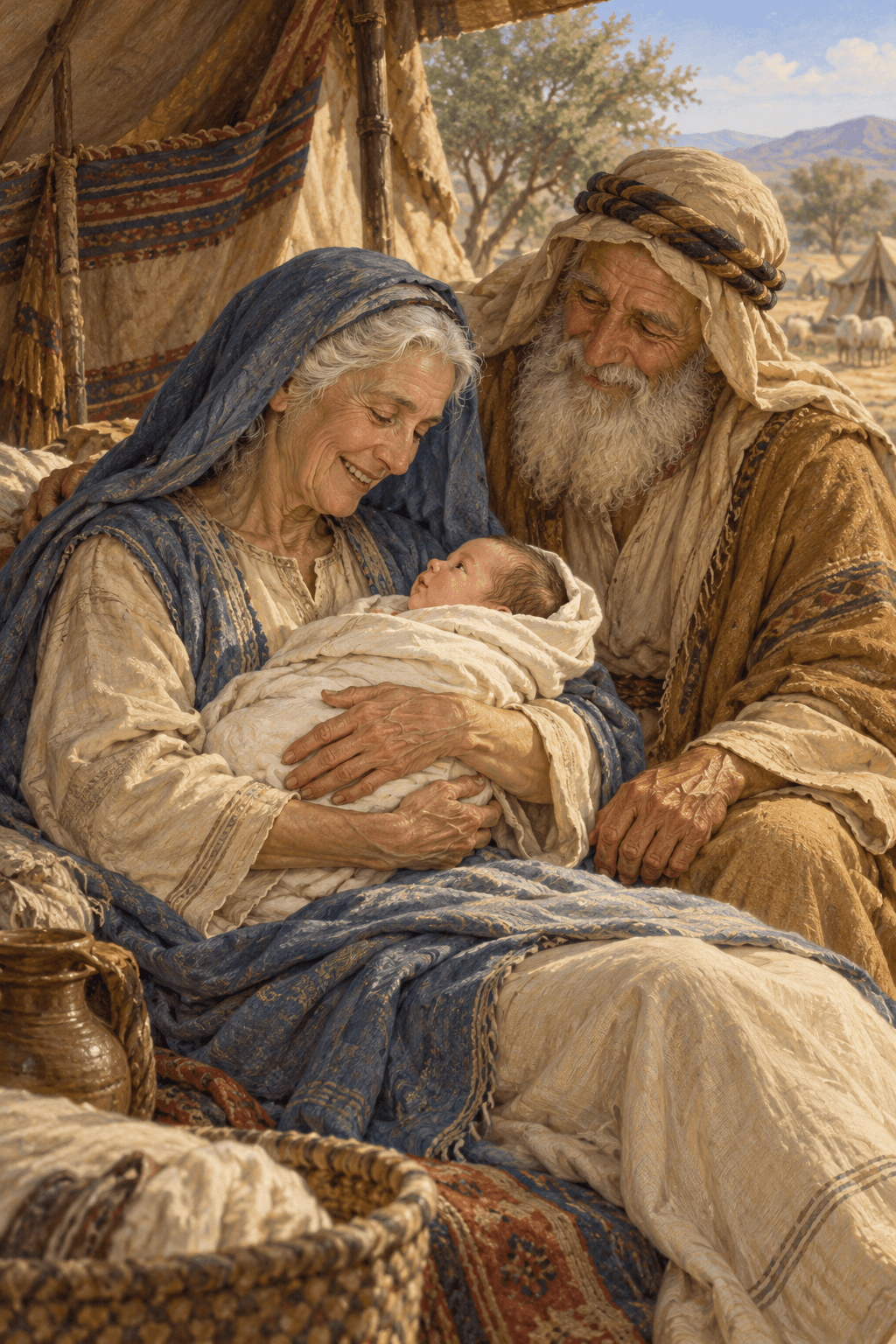
“And the LORD visited Sarah as he had said, and the LORD did unto Sarah as he had spoken. For Sarah conceived, and bare Abraham a son in his old age, at the set time of which God had spoken to him” (1–2).
Though Isaac was of Abraham’s seed and from his loins, in truth he was God’s gift to him and to Sarah, the fruit of the Lord’s visitation of Sarah and of His promises to her and her husband. Therefore the fathers look upon Isaac not as a natural son of Abraham but as “the son of promise.” So Scripture affirms, “the LORD visited Sarah,” and also declares that she “bare Abraham a son in his old age”; that is, he is truly Abraham’s son, but he came in his old age after the Lord, by His visitation of Sarah, removed her barrenness. As we said before, Sarah’s womb was as though dead, or like a stone; from it came Isaac, a symbol of the Church of the New Covenant, born of the new Sarah, whose members came from the Gentiles as from stones. As Saint Cyprian says:
We find in the Gospel children of Abraham raised up from stones (Matthew 3:9), being gathered from the Gentiles. [308]
Abraham and Sarah remained for decades without a child, but God visited her with a child, on a level befitting the divine promise, to gladden their old age — indeed to gladden the hearts of all mankind… He came “at the set time of which God had spoken.” God’s promises are true and faithful; we receive them in their time if we remain faithful, waiting in faith. Therefore the Apostle Paul affirms: “And let us not be weary in well doing: for in due season we shall reap, if we faint not” (Galatians 6:9). We shall reap our true Isaac, that is, the manifestation of the Lord Christ within us, if we do not faint in our spiritual striving, flowing from a living faith that does not grow cold.
2. The Circumcision of Isaac
KJV · Verses 4–7
4 And Abraham circumcised his son Isaac being eight days old, as God had commanded him. 5 And Abraham was an hundred years old, when his son Isaac was born unto him. 6 And Sarah said, God hath made me to laugh, so that all that hear will laugh with me. 7 And she said, Who would have said unto Abraham, that Sarah should have given children suck? for I have born him a son in his old age.
On the eighth day Abraham circumcised Isaac, “as God had commanded him” (4). It is as though Sarah represents the Church, which is filled with joy at the spiritual birth of her children, at their circumcision not according to the flesh but according to the spirit, through the waters of baptism. When a person, by the Holy Spirit, puts off the old man and puts on the new, renewed after the image of his Creator, the Church is filled with spiritual laughter… for she has gained a son who gladdens heaven!
3. The Weaning of Isaac
KJV · Verses 8
8 And the child grew, and was weaned: and Abraham made a great feast the same day that Isaac was weaned.
Abraham did not make a great feast on the day of Isaac’s birth, but on the day of his weaning. Though we cannot deny the intense joy that filled the hearts of Abraham, Sarah, and all who loved them on the day of his birth, Abraham wished to see Isaac growing, passing from one stage to another until he reached full maturity.
May we be like Abraham, rejoicing not only at Isaac’s birth but also at his weaning and maturity; that is, rejoicing at every spiritual growth of our inner man, which is renewed without ceasing, that it may attain “unto the measure of the stature of the fulness of Christ” (Ephesians 4:13).
Origen the scholar comments on Isaac’s weaning, saying:
Isaac means laughter or joy. Who can beget such a son?! The Apostle said to those he had begotten in the Gospel: “For ye are our glory and joy” (1 Thessalonians 2:20). When those who have been born are weaned, we make a feast and there is great joy, for they no longer need milk but strong meat (Hebrews 5:12), and they have “their senses exercised to discern both good and evil” (Hebrews 5:14). Therefore a great feast is made on the day of their weaning. But a feast cannot be made, nor can there be joy, for those of whom the Apostle says: “I could not speak unto you as unto spiritual, but as unto carnal, even as unto babes in Christ. I have fed you with milk, and not with meat: for hitherto ye were not able to bear it, neither yet now are ye able. For ye are yet carnal” (1 Corinthians 3:1–3). [309]
4. The Son of Inheritance and the Son of the Flesh
KJV · Verses 9–13
9 And Sarah saw the son of Hagar the Egyptian, which she had born unto Abraham, mocking. 10 Wherefore she said unto Abraham, Cast out this bondwoman and her son: for the son of this bondwoman shall not be heir with my son, even with Isaac. 11 And the thing was very grievous in Abraham's sight because of his son. 12 And God said unto Abraham, Let it not be grievous in thy sight because of the lad, and because of thy bondwoman; in all that Sarah hath said unto thee, hearken unto her voice; for in Isaac shall thy seed be called. 13 And also of the son of the bondwoman will I make a nation, because he is thy seed.
The great feast which Abraham made on the day of Isaac’s weaning inflamed the feelings of Hagar and her son with distress and resentment. Hagar remembered the bitterness of her flight from Sarai (Genesis 16:6), and until recently she had looked on her son as Abraham’s only heir. These feelings took shape in the life of her son, who began mocking Isaac (Genesis 21:9) with a crude mockery revealing the bitterness of his soul, which was not easy for him to hide — so that the Apostle Paul called this mocking persecution (Galatians 4:29). This stirred Sarah’s soul, and she demanded that Abraham cast him out with his mother, saying: “for the son of this bondwoman shall not be heir with my son, even with Isaac” (10). The word was very grievous in Abraham’s eyes, for he counted it an injustice on Sarah’s part, as he did not disregard his son even though he was from a maid. And God’s voice came to him: “Let it not be grievous in thy sight because of the lad, and because of thy bondwoman; in all that Sarah hath said unto thee, hearken unto her voice; for in Isaac shall thy seed be called. And also of the son of the bondwoman will I make a nation, because he is thy seed” (12–13).
Without doubt Abraham’s heart was attached to his son, whom for many years he had counted his only one, so that when Isaac came it was not easy to cast out the first; but the divine command came clearly that he would not inherit. The Apostle Paul explained to us the symbolic prophecy this command carried. The first and elder son came according to the flesh, while the second came according to God’s promise, representing the children of the spirit. It is as though the first points to the Jews, who held fast to the letter of the Law and its formalities and lived on the level of the flesh, not the spirit, and so were cast out; while the Church of the New Covenant came as the fruit of grace and promise.
Having accepted faith in the Lord Christ, we have become, by the Holy Spirit, children of Sarah (the Church of the New Covenant), the free woman. But if we walk by the killing legalistic letter and formalities without spirit, we revert to the spirit of bondage and belong to the bondwoman. Origen the scholar says:
If you walk according to the flesh, you are sons of Hagar, and consequently you are opposed to those who live by the Spirit. [310]
If we walk according to the killing letter and live in our depths as carnal, we are like the son of the flesh, who represents the first, earthly man; but if we walk by the Spirit, we become firstborn, for Isaac is within us — that is, we bear the spirit of the living Gospel, which casts out the killing letter of the Law!
5. Hagar and the Well of Water
KJV · Verses 14–21
14 And Abraham rose up early in the morning, and took bread, and a bottle of water, and gave it unto Hagar, putting it on her shoulder, and the child, and sent her away: and she departed, and wandered in the wilderness of Beersheba. 15 And the water was spent in the bottle, and she cast the child under one of the shrubs. 16 And she went, and sat her down over against him a good way off, as it were a bow shot: for she said, Let me not see the death of the child. And she sat over against him, and lift up her voice, and wept. 17 And God heard the voice of the lad; and the angel of God called to Hagar out of heaven, and said unto her, What aileth thee, Hagar? fear not; for God hath heard the voice of the lad where he is. 18 Arise, lift up the lad, and hold him in thine hand; for I will make him a great nation. 19 And God opened her eyes, and she saw a well of water; and she went, and filled the bottle with water, and gave the lad drink. 20 And God was with the lad; and he grew, and dwelt in the wilderness, and became an archer. 21 And he dwelt in the wilderness of Paran: and his mother took him a wife out of the land of Egypt.
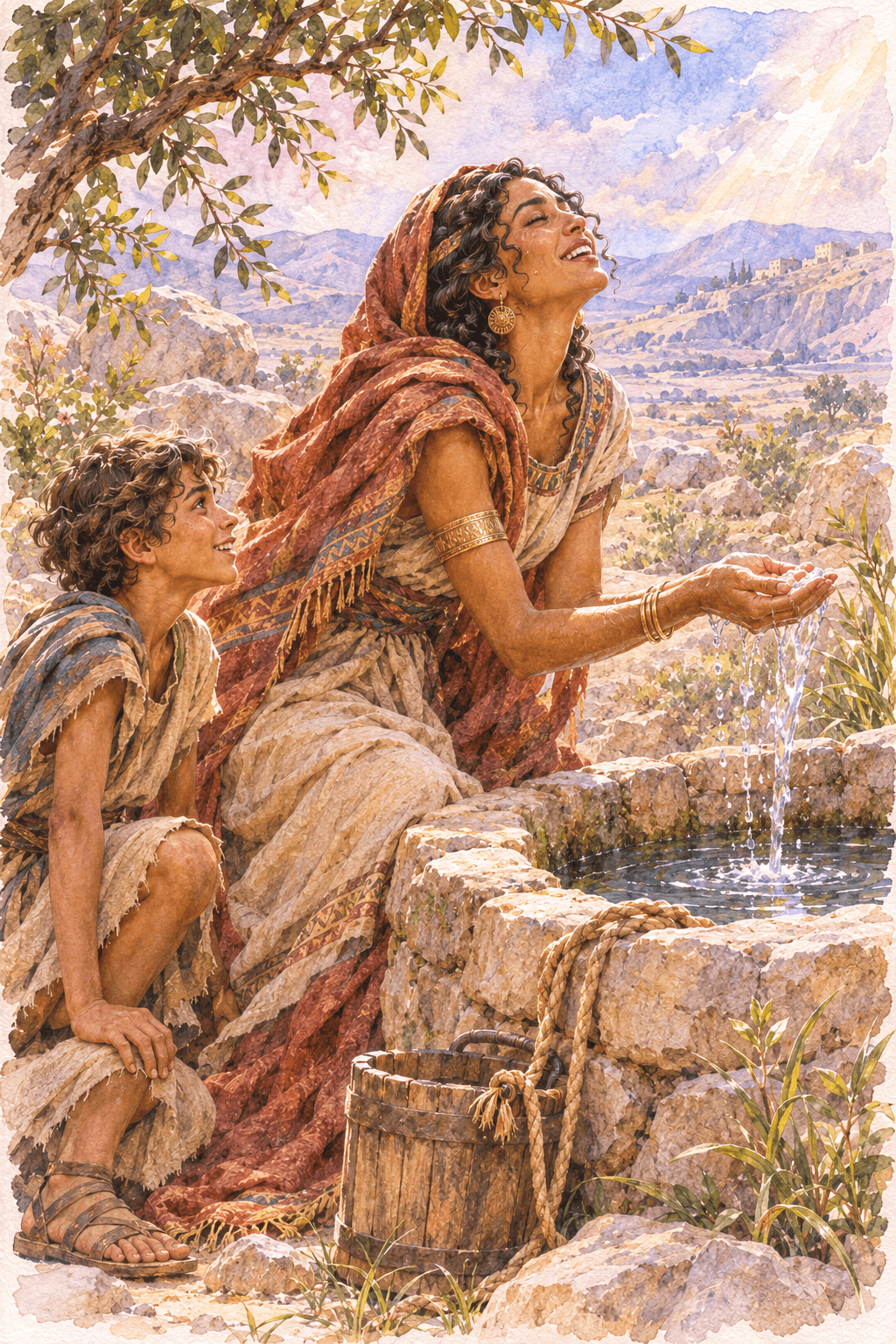
In accordance with the divine command, Abraham sent away Hagar and her son after supplying them with bread and a bottle of water, and bade them farewell early in the morning, that they might find shelter before noon. The lad was about sixteen years old… The two went out into the wilderness heading south, and wandered in the wilderness that was afterward called “Beersheba.” When the water in the bottle was spent, the lad fainted from thirst, and his mother left him cast down in the shade under the shrubs, for she said, “Let me not see the death of the child” (16). And she sat over against him, lifted up her voice, and wept.
While the child Isaac drank without ceasing from the springs of his parents’ love, Hagar’s son drank from a bottle made of the skin of dead animals, which could quench him only a little, so that he remained thirsty and exhausted and drew very near to death. It is a picture revealing the difference between the spirit of the Gospel life and the carnal mind flowing from the literalism of the Law. If we accept the spirit of the Gospel, we dwell in the tent to drink from the springs of the love of God our Father and the Church our Mother, and we become like Isaac, satisfied with the love of Abraham and Sarah. But if we walk by the killing letter, we go out into the wilderness in a state of wandering, drinking from the dead skin water that runs dry, and our inner souls are exposed to spiritual death.
What is wonderful is that Hagar lifted up her voice and wept, while the lad was so exhausted he could not speak; yet the lad’s silence was a voice heard by God more than Hagar’s weeping, for it is said: “And God heard the voice of the lad; and the angel of God called to Hagar out of heaven, and said unto her, What aileth thee, Hagar? fear not; for God hath heard the voice of the lad where he is” (17). If Hagar represents the literalism of the Law, then those who have fallen under the Law, if they perceive the death coming upon them and cry out in their hearts, are heard; their eyes are opened to see a well of water (19), to drink of the living water of which they had deprived themselves. Scripture says: “And God opened her eyes, and she saw a well of water; and she went, and filled the bottle with water, and gave the lad drink” (19). As Origen the scholar says:
Today the Jews are beside the wells, but their eyes are blinded, so they cannot drink from the wells of the Law and the Prophets. [311]
He also says:
Our eyes have been opened, and the veil of the literalism of the Law has been lifted; but I fear that we may close our eyes again ourselves through deep sleep, through not being awake to the spiritual meaning, through neglecting to keep watch and to drive sleep from our eyes so as to contemplate spiritual things and not be deceived; so that we become like a carnal people sitting beside the waters (without seeing them). Let us keep watch, then, with the prophet, saying: “I will not give sleep to mine eyes, or slumber to mine eyelids, until I find out a place for the LORD, an habitation for the mighty God of Jacob” (Psalm 132:4–5). [312]
Finally Ishmael dwelt in the wilderness of Paran as an archer, and he married from the land of Egypt, for his mother took him a wife from the daughters of her own people.
6. A Covenant between Abraham and Abimelech
KJV · Verses 22–34
22 And it came to pass at that time, that Abimelech and Phichol the chief captain of his host spake unto Abraham, saying, God is with thee in all that thou doest: 23 Now therefore swear unto me here by God that thou wilt not deal falsely with me, nor with my son, nor with my son's son: but according to the kindness that I have done unto thee, thou shalt do unto me, and to the land wherein thou hast sojourned. 24 And Abraham said, I will swear. 25 And Abraham reproved Abimelech because of a well of water, which Abimelech's servants had violently taken away. 26 And Abimelech said, I wot not who hath done this thing; neither didst thou tell me, neither yet heard I of it, but to day. 27 And Abraham took sheep and oxen, and gave them unto Abimelech; and both of them made a covenant. 28 And Abraham set seven ewe lambs of the flock by themselves. 29 And Abimelech said unto Abraham, What mean these seven ewe lambs which thou hast set by themselves? 30 And he said, For these seven ewe lambs shalt thou take of my hand, that they may be a witness unto me, that I have digged this well. 31 Wherefore he called that place Beersheba; because there they sware both of them. 32 Thus they made a covenant at Beersheba: then Abimelech rose up, and Phichol the chief captain of his host, and they returned into the land of the Philistines. 33 And Abraham planted a grove in Beersheba, and called there on the name of the Lord, the everlasting God. 34 And Abraham sojourned in the Philistines' land many days.
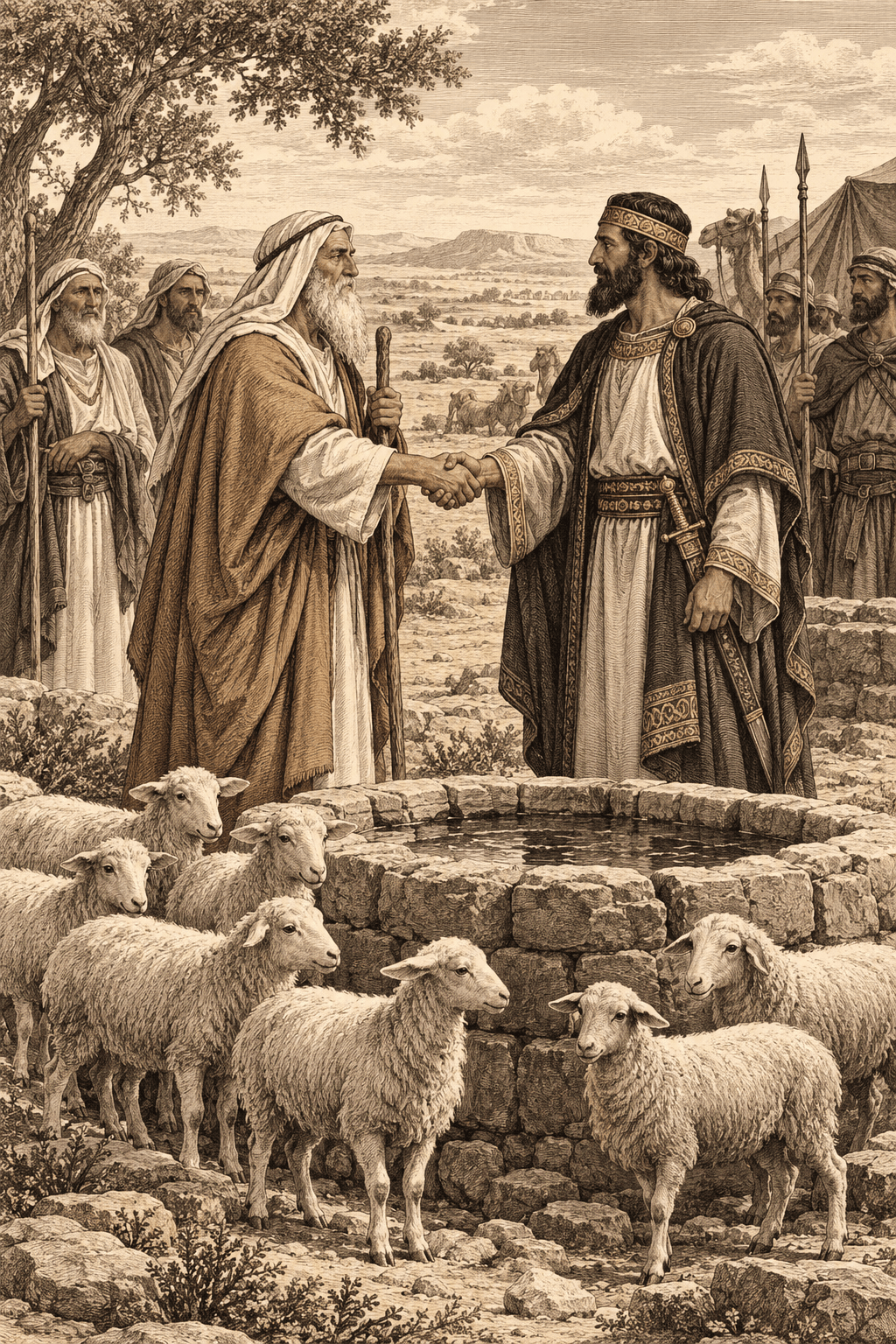
Abimelech king of Gerar honored Abraham greatly and allowed him to remain in his land; but when he saw him become very great, he realized that “God” was the secret of his greatness and success, and he feared him. So he came with Phichol, the captain of his host, to make a covenant with him, lest Abraham deal falsely with him or with his offspring and descendants.
We have already spoken of Abimelech, the pagan king, and how very gentle he was in his dealings with Abraham. When he took Sarah he did not seize her by force but sought her with integrity of heart; he was generous to them and feared God. Now, seeing Abraham prosper and grow, he attributed all success to his relationship with God, and instead of envy or jealousy he came seeking a covenant. He was marked by wisdom and good conduct!
We said that the word “Abimelech” was probably a title of the kings of Gerar, so that the people would perceive the king as a father to them, since the title “Abimelech” means “my father is king.” The captain of the host was titled “Phichol,” which means “mouth of all.” It seems the captain of the host was like a prime minister or chief minister who spoke with the tongue or mouth of all the people.
Abimelech asked to make a covenant with Abraham, and the latter reproved him because Abimelech’s servants had violently taken away a well of water belonging to Abraham. With wisdom and a large heart Abimelech told him that he knew nothing about the well. Abraham gave sheep and oxen to Abimelech as a gift of love at the making of the covenant, and he also set apart seven ewe lambs. When Abimelech asked about these lambs, he said to him: “For these seven ewe lambs shalt thou take of my hand, that they may be a witness unto me, that I have digged this well” (30). So it was called Beersheba, so that whoever asks about the name is told it refers to the seven ewe lambs Abraham gave… and its name remains so to this day.
Wishing to confirm his ownership, he planted a grove (tamarisk trees) there, to shade himself in their shadow and pitch his tents beneath them. “And called there on the name of the LORD, the everlasting God” (33). “And Abraham sojourned in the Philistines’ land many days” (34).
We know of Abraham’s great generosity and his sense of being a stranger, seeking to own nothing; why then did he reprove Abimelech about the well? Why did he insist on receiving it? And why was it called Beersheba, and why did he plant tamarisk trees around it? Without doubt “the well” points to the Church, which overflows with the waters of the Holy Spirit whom the Lord Christ gives from the Father. Therefore Abraham offered the seven ewe lambs as a witness to his acquiring the well, as though he sells everything to acquire membership in the Church and draw from the waters of the Holy Spirit. Its being called Beersheba (“well of seven”) points to the work of the Holy Spirit in the Church, especially in the seven sacraments. The planting of trees around it points to the believers who gather around the waters of the Holy Spirit and enjoy Him within them (Ezekiel 47:7). Thus the everlasting God is glorified in them and His name is called upon them, even if the believers sojourn with Abraham in the world many days.
Notes and References
[308] Cyprian, Ep. 62:4.
[309] Origen, In Gen. hom. 7:1.
[310] Ibid. 7:2.
[311] Ibid. 7:5.
[312] Ibid.