
When the lands east of the Jordan had been divided among the two tribes and a half, Caleb the son of Jephunneh claimed the mountain which Moses had promised him because of his faithfulness and faith when he came to spy out the land about 45 years earlier. He claimed the mountain before Joshua began distributing the lands west of the Jordan.
1. Introduction on the manner of the division (1–5).
2. Caleb asks for his portion (6–9).
3. Caleb above time (10).
4. Caleb the man of struggle (11).
5. Caleb and the holy mountain (12).
6. His enjoyment of Hebron (13–15).
1. Introduction on the Manner of the Division
KJV · Verses 1–5
1 And these are the countries which the children of Israel inherited in the land of Canaan, which Eleazar the priest, and Joshua the son of Nun, and the heads of the fathers of the tribes of the children of Israel, distributed for inheritance to them. 2 By lot was their inheritance, as the Lord commanded by the hand of Moses, for the nine tribes, and for the half tribe. 3 For Moses had given the inheritance of two tribes and an half tribe on the other side Jordan: but unto the Levites he gave none inheritance among them. 4 For the children of Joseph were two tribes, Manasseh and Ephraim: therefore they gave no part unto the Levites in the land, save cities to dwell in, with their suburbs for their cattle and for their substance. 5 As the Lord commanded Moses, so the children of Israel did, and they divided the land.
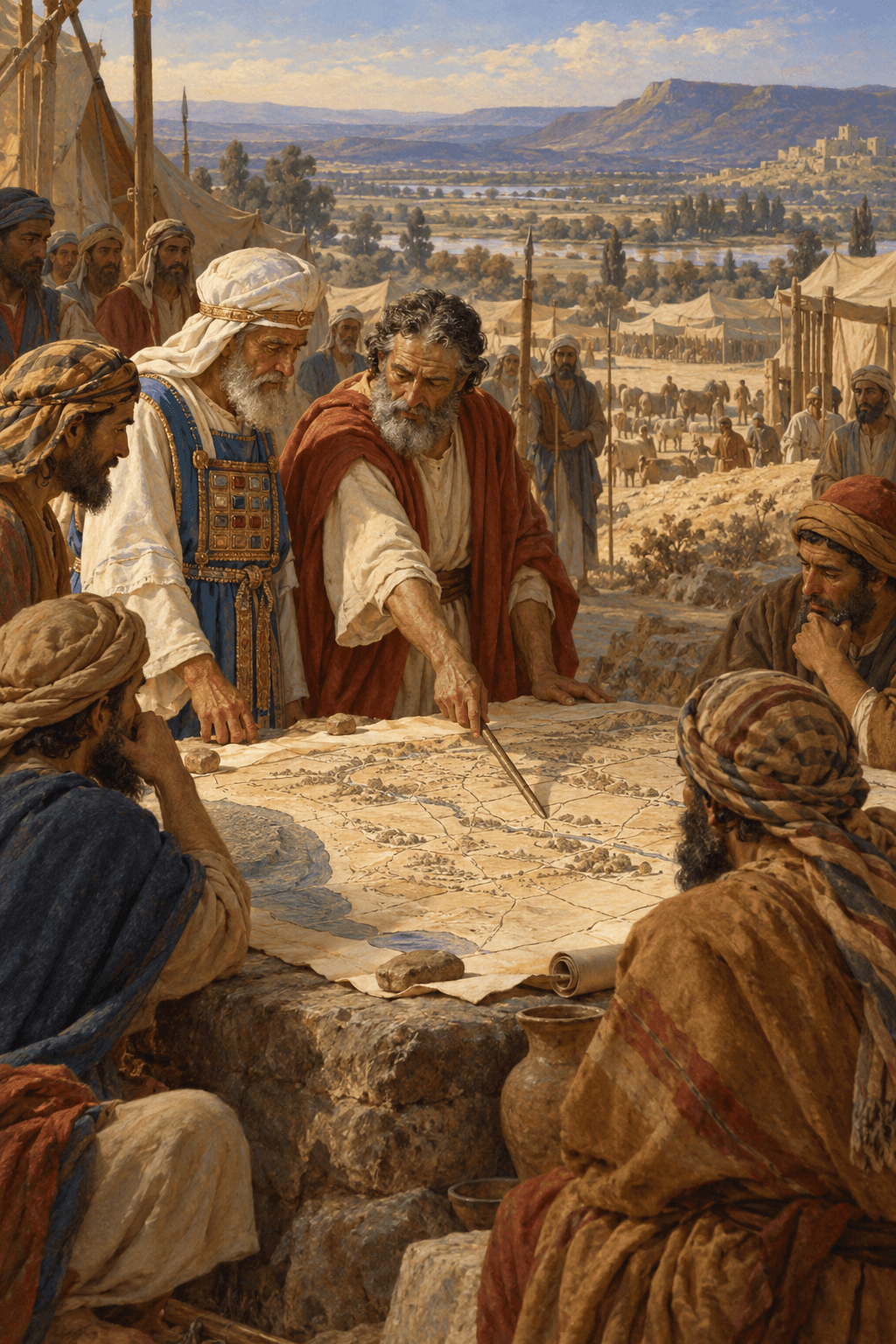
Origen sees that it is impossible that the divine Book should take care to set out precisely, and in some detail, the dimensions of the land of each tribe’s inheritance merely to inform us of each tribe’s situation in the new land. Rather, just as the Jewish rites came as an example and shadow of heavenly things (Hebrews 8:5), so the division of the land, the names of the regions, the cities of refuge, the cities of the Levites, and later the building of the temple in Jerusalem, and so on … all these things in their precise details carry heavenly mysteries which the Spirit reveals to us. He says:
“When you come, O Jew, to Jerusalem and find it destroyed, turned into dust and ashes, do not weep like a child (1 Corinthians 14:20). Do not grieve, but seek a city in heaven instead of the one you seek on earth! Lift your eyes upward and you will find ‘Jerusalem which is above,’ which ‘is free, which is the mother of us all’ (Galatians 4:26). Do not be dejected because the temple is forsaken, nor despair because you find no priest; for in heaven there is an altar, and there are priests of good things to come, who pass before the Lord after the order of Melchisedec (Hebrews 5:10). It is God’s love and mercy that He has taken the earthly inheritance from you, so that you may seek the heavenly one. [212]”
I do not wish to enter into many details, but will be content to present some of the spiritual meanings of the division, leaving the Spirit of the Lord to support and guide you, turning even what seems to concern the ancient land into what concerns salvation and eternity.
In this chapter divine inspiration distinguishes three groups in the division [1–3]:
A) The first group: those who accepted to inherit the land they had possessed in the days of Moses, that is, through the law. It includes the tribes of Reuben and Gad and half the tribe of Manasseh. But this group will not receive the inheritance except at the hands of Joshua. It represents the men of the Old Testament, who also lived through the new Joshua. With some latitude we can say that this group also includes those who are in the age of grace but, sadly, behave as those under the law: literalists in their understanding of the word, legalists in their behavior, and narrow in their thinking.
Poor are they who crossed the Jordan with Joshua but in their life and thought have gone back beyond the Jordan, to live as spiritual children instead of in spiritual maturity. They represent the sick young man who longs for the behavior of childhood, playing with milk and games instead of enjoying strong food and earnestness of conduct.
B) The second group: those who accepted to inherit the land they possessed in the days of Joshua, that is, in the age of grace. It includes nine tribes and a half, and represents the person who has risen from under the law to set out from the letter to the spirit. These do not inherit with the two tribes and a half the land of Gilead, which is for grazing sheep; they inherit the land flowing with milk and honey. The believer sets out from tending sheep, the animal, carnal mind, to the eternal inheritance, where the food is new.
C) The third group: the Levites, who receive no portion among them and have no share in the land, for the Lord Himself is their portion (Joshua 13:14). If we may say so, this is “the group of the perfect,” who live with Joshua not out of desire for land or blessings, even heavenly ones, but seek the Lord Himself as their portion. If the first group represents those who worship for the sake of temporal blessings (those under the law), and the second those who worship for the sake of spiritual blessings, the third seeks nothing but God alone, who is their whole life, their joy and their crown. Origen says:
“The Levites obtained no inheritance from Moses or from Joshua, because the Lord God of Israel is their portion … For a great number of God’s people have a simple faith in the fear of God; they please God by their good works and faithful habits. But few and rare are those to whom wisdom and knowledge are given, who keep their hearts pure and plant in their souls the most beautiful virtues, and whose knowledge is able to light the way for others … Of these, without doubt, it is said that they are Levites and priests, whose portion is the Lord, who is the Wisdom they have chosen above all things. [213]”
Would that we might become like the Levites and the priests: having no portion in the land of the inheritance, but He being our portion, receiving Him within us as the Wisdom of God (1 Corinthians 1:30), for He is our righteousness (Jeremiah 23:6; 1 Corinthians 1:30), our peace (Ephesians 2:14) and our redemption (1 Corinthians 1:30).
2. Caleb Asks for His Portion
KJV · Verses 6–9
6 Then the children of Judah came unto Joshua in Gilgal: and Caleb the son of Jephunneh the Kenezite said unto him, Thou knowest the thing that the Lordsaid unto Moses the man of God concerning me and thee in Kadeshbarnea. 7 Forty years old was I when Moses the servant of the Lord sent me from Kadeshbarnea to espy out the land; and I brought him word again as it was in mine heart. 8 Nevertheless my brethren that went up with me made the heart of the people melt: but I wholly followed the Lord my God. 9 And Moses sware on that day, saying, Surely the land whereon thy feet have trodden shall be thine inheritance, and thy children's for ever, because thou hast wholly followed the Lord my God.
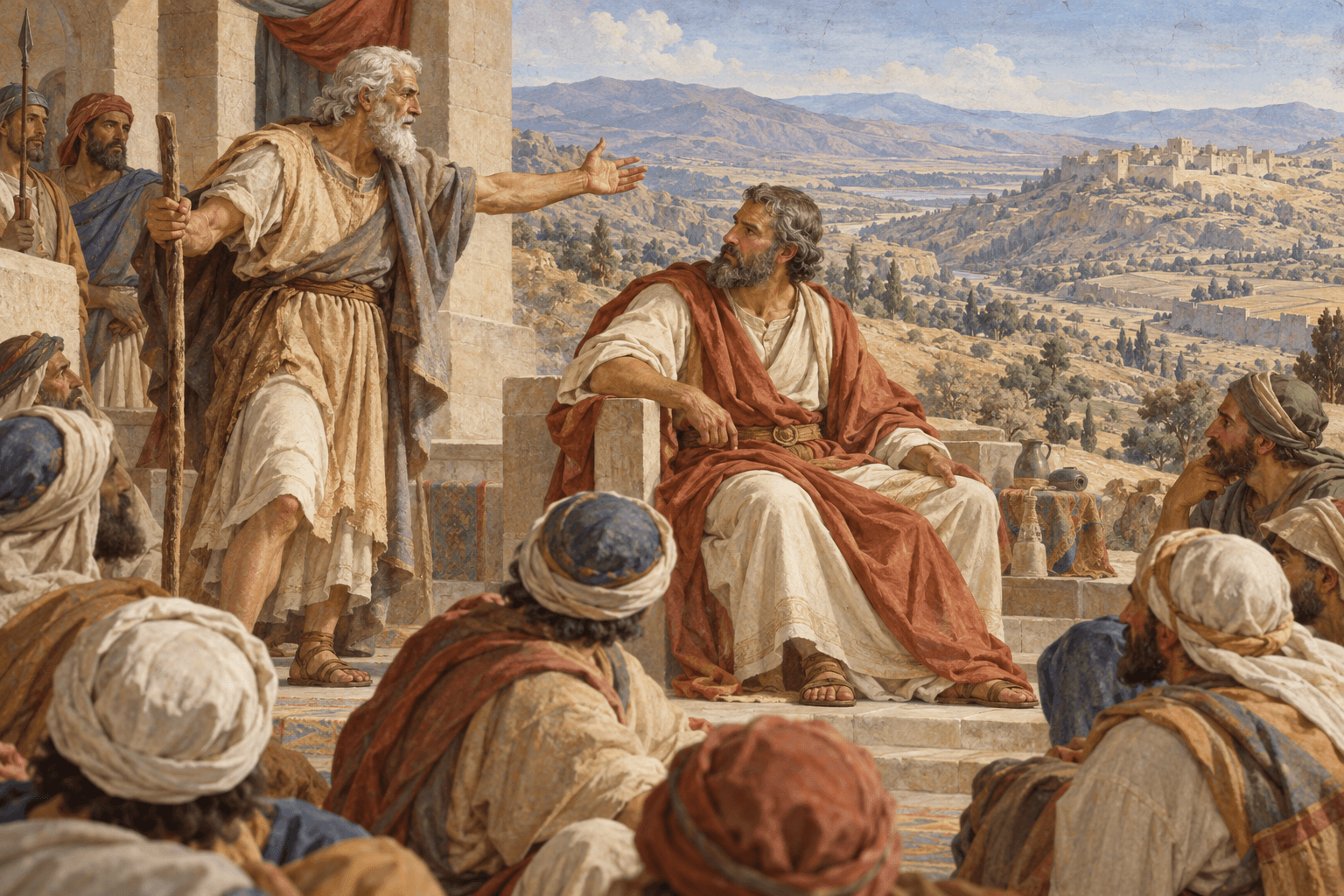
“Then the children of Judah came unto Joshua in Gilgal: and Caleb the son of Jephunneh the Kenezite said unto him, Thou knowest the thing that the Lord said unto Moses the man of God concerning me and thee in Kadesh-barnea. Forty years old was I when Moses the servant of the Lord sent me from Kadesh-barnea to espy out the land …” [6–7].
Before Joshua began to cast lots to distribute the land among the nine tribes and a half, Caleb the son of Jephunneh the Kenezite came forward to Joshua to remind him of the promise he had received forty-five years earlier, when he had returned with him to Moses after spying out the land, the two of them speaking with faithfulness and faith about the land of promise, unlike the rest of the spies, who made the people’s hearts melt with fear.
Caleb did not enter the lot with the rest of the people, but claimed a special privilege which he had received from the Lord personally through the mouth of Moses the prophet. The secret of this privilege is:
First: in our study of the Book of Numbers we saw that the word “Caleb” means “heart,” and that the union of Joshua with Caleb means the union of faith in Jesus the Savior with practical purity of heart for the enjoyment of the eternal inheritance. [214] Origen sees that “Jephunneh” means “turning” and that “Kenezite” means “the despised one.” [215] We can say, then, that Caleb’s privilege is because he represents the heart born of turning away from contempt.
In this he preceded many in receiving the inheritance — not because he was better than they, but because, being despised, he turned from this life to live as a pure heart in the Lord. We are all children of the Kenezite, that is, children of the despised one, for “by one man [our father Adam] sin entered into the world, and death by sin; and so death passed upon all men, for that all have sinned” (Romans 5:12). But Caleb knows how to exchange this one man, who brought him contempt and death, for another Man, our Lord Jesus; so he received the gift of righteousness and enjoyed the right of possession. As the Apostle says of this turning:
“For if by one man’s offence death reigned by one; much more they which receive abundance of grace and of the gift of righteousness shall reign in life by one, Jesus Christ” (Romans 5:17). It is as if the Apostle says in this chapter (Romans 5) that after we had been possessed by death because of our father Adam, we have come through Jesus Christ our Lord to possess life in Him! After we had been an inheritance for sin, we have become heirs of the eternal kingdom.
Truly we have all been descended from the Kenezite, the despised one; but if there is in our lineage a Jephunneh, that is, “turning,” we pass from the bodily fatherhood of Adam to the spiritual fatherhood of God in His Son Jesus Christ, and enjoy the first inheritance.
Second: Caleb’s bond with Joshua. We have already spoken of the bond of the heart with faith: there is no purity of heart outside faith in Jesus, and no victory for it without Him. When we as hearts are bound to our true Joshua, we open ourselves to Him, so that He reigns in our inner man and sits on the heart as on His throne; and as He reigns in us, we reign through Him in His eternal inheritance. Let us be bound to our Joshua, and hand over our life to Him, so that He reigns in us and we reign in Him.
As Saint Augustine says in his soliloquy with his Lord: “Take all my faculties so as to possess them wholly … Restore to me my sovereignty entirely.” [216]
Third: Caleb’s meeting with Joshua was at Kadesh-barnea, and “Kadesh” means “holiness.” Our meeting with our Lord Jesus is not truly a meeting except through the holy life. Many think that they know the Lord and meet Him, perhaps through preaching Him and perhaps through working miracles in His name; but if they do not meet Him in the holy life, He says to them: “Depart from me … I never knew you” …
Fourth: if Caleb received the promise from God through Moses, the representative of the law, the fulfillment of the promise is accomplished only through Joshua, who alone can grant the reward. Origen says:
“Caleb learned first from Moses and afterward from Joshua, who helped him. He says to Joshua: ‘Thou knowest the thing that the Lord said unto Moses the man of God’ [6]. You know the thing the Lord said; for no one can perceive the word the Lord spoke to Moses except Joshua alone. No one has such an understanding of the law as Jesus in His teaching, for it is He who taught us and revealed all things to us, and He who revealed to Paul that ‘the law is spiritual’ (Romans 7:14). [217]”
So our Joshua is the One who knows the commandment through which we receive the reward — not as our own merit, but through Jesus our Lord, who gives us the commandment, supports us in carrying it out, and grants us the reward for it.
Fifth: Caleb realized that his inheritance is a fellowship of inheritance with Joshua, for he says to him: “Thou knowest the thing that the Lord said unto Moses the man of God concerning me and thee.” Our true privilege in enjoying the inheritance is that we are “joint-heirs with Christ” (Romans 8:17). What we receive is the inheritance of Christ Himself, and His glories which we enjoy in Him, that is, through our membership in His body.
We have no merit of the inheritance in ourselves; but our abiding in Christ has given us this merit. The Apostle Paul says:
“Blessed be the God and Father of our Lord Jesus Christ, who hath blessed us with all spiritual blessings in heavenly places in Christ” (Ephesians 1:3), affirming that the glory of His grace, with which He has graced us, is “in the beloved” (Ephesians 1:6). If Christ is the Beloved of the Father, to whom belongs the glory, then since we have come to be in Him, the grace of this glory which is His has become ours! And more clearly still the Apostle continues: “In whom also we have obtained an inheritance” (Ephesians 1:11).
Sixth: if Caleb’s inheritance is the fruit of his union with Joshua, enjoying glory through him and in him, this does not mean that Caleb was passive or slack in fulfilling the commandment, for he says: “But I wholly followed the Lord my God” [8]. It is as if he says: For my part I accepted the commandment of the Lord my God, whom I meet on a personal level, so that He has become “my God,” and I fulfilled His commandment wholly. Though God’s grace is very rich in giving, it is not given to those who are slack in carrying out the divine commandment.
Finally, we say that Caleb calls God “my God.” Whoever accepts God as his own God personally, as belonging to him, also accepts God’s glories as his glories and God’s attributes as his attributes. Our receiving the inheritance is the fruit of our belonging to God and God’s belonging to us: “I am my beloved’s, and my beloved is mine” (Song of Songs 6:3).
3. Caleb above Time
KJV · Verses 10
10 And now, behold, the Lord hath kept me alive, as he said, these forty and five years, even since the Lord spake this word unto Moses, while the children of Israel wandered in the wilderness: and now, lo, I am this day fourscore and five years old.
If the inheritance which the believer enjoys is eternal life, which rises above time, and this inheritance is an extension of a life a person lives here, then in order to enjoy the inheritance we must now enter the circle of eternity, and not cling to the circle of time, whose turning lifts us up and brings us down from one moment to another. Let us live, while still on earth, with a heavenly mind which time cannot corrupt or weaken.
Caleb received the promise at the age of forty, and was strong in the Lord’s work; and now he comes forward to Joshua at eighty-five, still as strong as he was forty-five years before. As we said in the previous chapter, the believer never knows the old age of incapacity; “though our outward man perish, yet the inward man is renewed day by day” (2 Corinthians 4:16).
Origen comments on the words of Caleb the son of Jephunneh, “As my strength was then, even so is my strength now” [11]:
“The saint in truth has the same strength in the present as in the past, in new things as in old, in the Gospels as in the law. It is as if he says that he has the same strength in the days of Joshua as he had in the days of Moses; for the watchful heart perceives the mysteries of both covenants with the same strength. [218]”
4. Caleb the Man of Struggle
KJV · Verses 11
11 As yet I am as strong this day as I was in the day that Moses sent me: as my strength was then, even so is my strength now, for war, both to go out, and to come in.
If Caleb received the promise in the time of Moses, he enjoyed it because in his spiritual strength in the Lord he says, “I wholly followed the Lord my God” [8]; he was strong in carrying out the Lord’s commandment. Receiving the promise only increased his spiritual strength, so that time could not dampen his zeal or slacken his arms. Rather, he says: “Even so is my strength now, for war, both to go out, and to come in” [11].
It is as if he says: I do not ask for the inheritance as an idle man; I have been trained by the Spirit how to struggle spiritually, fighting the powers of darkness, how to go out of the wilderness and come into the land of promise. I succeeded when Moses sent me out to spy, and now I have confidence in the Lord that I will succeed in entering the place I am to inherit … This confidence and this strength are not of himself, for he says: “For thou heardest in that day how the Anakims were there, and that the cities were great and fenced: if so be the Lord will be with me, then I shall be able to drive them out, as the Lord said” [12].
Caleb’s strength is always firm for war, for going out and for coming in; that is, for the spiritual war through which he goes out of the reproach of bondage to come into the glory of freedom. His life is a going out and a coming in as one integrated, unceasing process: a continual going out from the works of the old man, that is, crucifying him, and a coming in to the works of the new man, that is, enjoying his resurrection; a going out from the ego by crucifying it, and a coming into Christ Jesus, the Giver of resurrection; a going out from the love of temporal things, and a coming into the heavenly life.
5. Caleb and the Holy Mountain
KJV · Verses 12
12 Now therefore give me this mountain, whereof the Lord spake in that day; for thou heardest in that day how the Anakims were there, and that the cities were great and fenced: if so be the Lord will be with me, then I shall be able to drive them out, as the Lord said.
“Now therefore give me this mountain, whereof the Lord spake in that day” [12]. Origen says:
“The saint asks for nothing low or base, nor does he ask for something at the bottom of the valleys; he asks for a high mountain, a mountain with great fortified cities on its summit. Scripture truly says: ‘The Anakims were there, and the cities were great and fenced’ [12]. This, then, is the object of his request, for he knew the art of war, as it is written: ‘A wise man scaleth the city of the mighty, and casteth down the strength of the confidence thereof’ (Proverbs 21:22). Do you think that Solomon, by saying this, wanted us to learn that the wise man takes cities and tears down walls built of stones? He meant by the city and the walls the doctrines and arguments with which atheistic philosophers build all the impure opinions opposed to the divine law, which pagans and barbarians use … What are the cities which the wise tear down when they lift up the word of truth? They are the cities of falsehood, which must truly be torn down, as the Apostle says: ‘Casting down imaginations, and every high thing that exalteth itself against the knowledge of God’ (2 Corinthians 10:5). Today Caleb, the very wise, stands before Joshua and promises him that he will be strong in war, ready for the struggle, asking his leave to dispute, so as to attack the wise of this age who assert falsehood instead of truth, to refute them, overcome them and overturn all the buildings of their fallacies. Therefore, when Joshua saw his zeal, he ‘blessed him’ [13] — no doubt blessed him for his will and his boldness! And you too, if you devote your life to the study and meditation of the law of God in the spirit of wisdom, will become a heart (Caleb) meditating in the law of God, able to tear down great fortified cities, that is, the words of the inventors of falsehood; in this way you will be worthy of Joshua’s blessing and receive Hebron in Him. [219]”
This mountain which Caleb acquired is the holy mountain revealed in the last days, to which the nations come and on which the righteous ascend (Psalm 24:3–6; Isaiah 2:2–4) — that is, the Lord Christ Himself! This is our true inheritance, which we long to enjoy!
6. His Enjoyment of Hebron
KJV · Verses 13–15
13 And Joshua blessed him, and gave unto Caleb the son of Jephunneh Hebron for an inheritance. 14 Hebron therefore became the inheritance of Caleb the son of Jephunneh the Kenezite unto this day, because that he wholly followed the Lord God of Israel. 15 And the name of Hebron before was Kirjatharba; which Arba was a great man among the Anakims. And the land had rest from war.
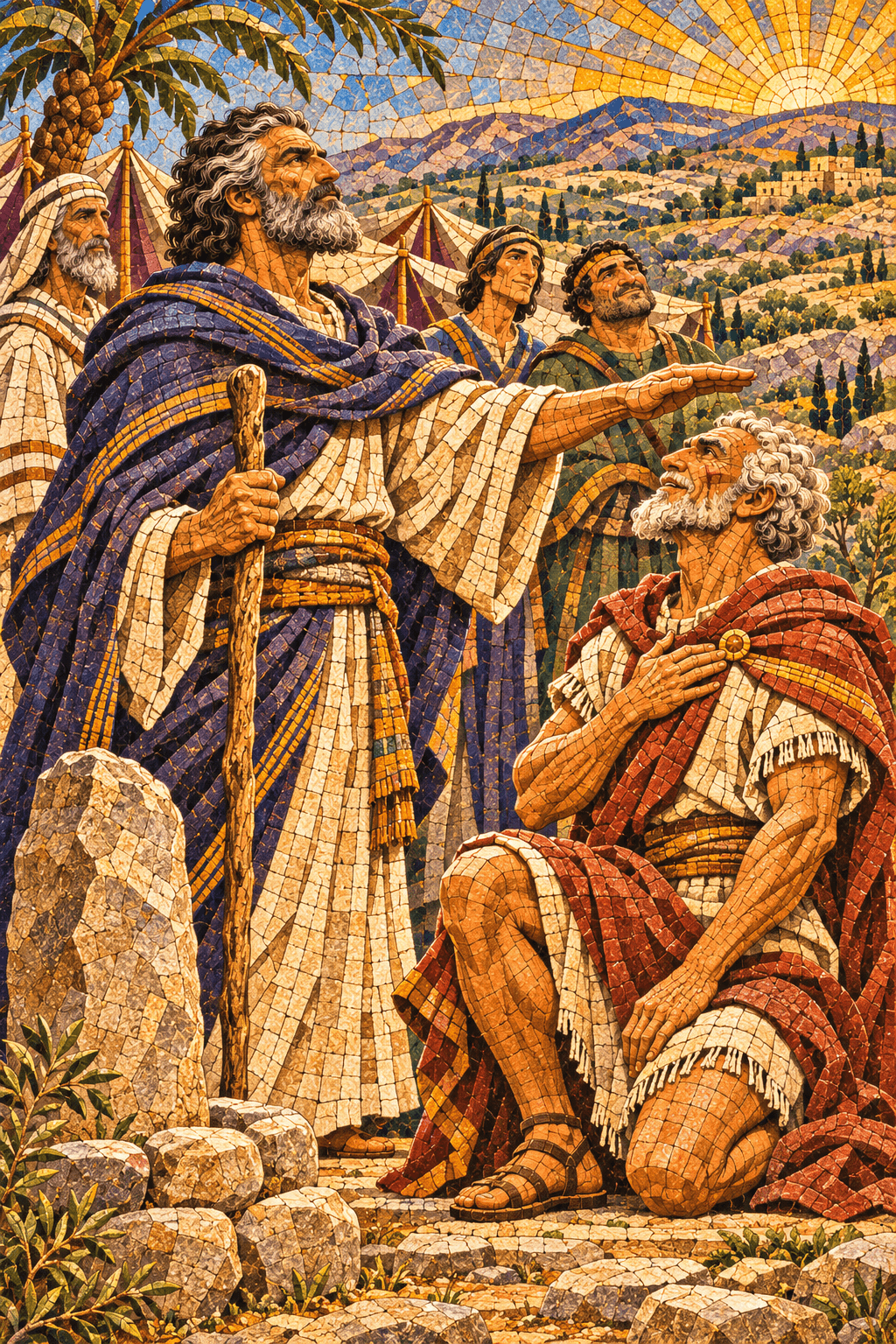
“And Joshua blessed him, and gave unto Caleb the son of Jephunneh Hebron for an inheritance … because that he wholly followed the Lord God of Israel” [13–14]. In our discussion in chapter ten of the cities which Joshua took, we saw him wrest Hebron from its king (Joshua 10:37), and we said that “Hebron” means “union” or “marriage.” After the soul had been bound to Satan as her bridegroom, bearing his evil attributes and sharing in his wicked thoughts and destructive works, she came under the law of Joshua, a bride for him, united to him so as to bear his mind and his attributes!
This is the reward which faithful Caleb receives for following the Lord: he enters into a state of spiritual marriage with our Lord Jesus Christ!
Origen has another comment:
“Hebron means union or marriage, and perhaps this is the meaning of this region. For the double cave which our father Abram prepared is in this city, where the rest of the fathers lie with their wives: Abraham lies there with Sarah (Genesis 23:19), Isaac with Rebekah, and Jacob with Leah. So Caleb was worthy to receive as an inheritance the remains of these fathers. By the wisdom that marked Caleb, his strength in the days of Joshua was as in the days of Moses, and he understood what this union between the fathers and their wives means. He perceived why Sarah alone rested here with Abraham while Hagar and Keturah were deprived of this honor, and why Leah alone lay beside Jacob … [220]”
Perhaps Origen sees that Caleb, by his wisdom, perceived in receiving Hebron that he would receive the eternal inheritance with Christ Jesus on the level of the union between the fathers and their wives, but in a deeper and greater spiritual sense.
Notes and References
[212] Origen, Homilies on Joshua 17:1.
[213] Origen, ibid. 17:2.
[214] By the author: Commentary on Numbers (Arabic).
[215] Origen, Homilies on Joshua 18:2; 20:6.
[216] Augustine, Soliloquies 18.
[217] Origen, Homilies on Joshua 18:2.
[218] Origen, ibid.
[219] Origen, ibid. 18:3.
[220] Origen, ibid.