
Their minds were absorbed in the conquest of the new land, its division and the enjoyment of its good things. But God halted them for a little while at Gilgal to reveal to them an important spiritual truth: victory does not rest on great numbers or strength of arm, but on a holy life in the Lord who gives the inheritance. God gave them the spiritual weapons through which He works in them, so that they might enjoy His free promises in spite of the fierce resistance stirred up by the enemy of good.
1. The nations stirred up against them (1–2).
2. The second circumcision (3–9).
3. Keeping the Passover (10).
4. Eating the produce of the land (11–12).
5. The appearance of the Captain of the Lord’s host (13–15).
1. The Nations Stirred Up Against Them
KJV · Verses 1
1 And it came to pass, when all the kings of the Amorites, which were on the side of Jordan westward, and all the kings of the Canaanites, which were by the sea, heard that the Lord had dried up the waters of Jordan from before the children of Israel, until we were passed over, that their heart melted, neither was there spirit in them any more, because of the children of Israel.
When the people crossed the river Jordan, all the kings of the Amorites and the Canaanites were greatly stirred up against them, and began to band together against them — indeed, against their God! This visible battle bears the image of the original battle between God and the devil. The devil cannot bear the light, and will not accept anyone entering into membership of the kingdom of God. With every spiritual success the enemy rises up and wages war — if not openly, then secretly; if not through strangers, then through relatives; indeed, through the body itself, and sometimes through those who bear the name of servants in the Church … That is why the Lord warns us that “a man’s foes shall be they of his own household” (Matthew 10:36).
Their crossing of the river Jordan was not the end of the struggle but its beginning. Our enjoyment of holy baptism does not mean that we have reached the perfection of victory; it means that we enjoy new divine blessings which stir Satan up against us all the more. With every triumph and every victory the spiritual warfare increases; and so the believer rises from glory to glory through successive victories, while the assault of sin against him continues.
The first thing God made clear to His people after crossing the river Jordan was the existence of adversaries. It is as if the first step we need in our spiritual life is to realize the true situation: a dangerous enemy surrounds us, not of flesh and blood, but, as the Apostle says, “spiritual wickedness in high places” (Ephesians 6:12). This enemy does not cease wrestling with us by every means, visible and hidden, night and day, to destroy our faith and our hope in Christ Jesus.
But as we discover the danger of this enemy and his bitter deceits, we must also realize the power of our true Joshua, who is able to crush the devil, scatter his schemes and withdraw his authority over us. That is why Saint Augustine cries out:
“Behold, the tempter comes against me like a mighty army, but he cannot overcome me, for You have broken his terror and given me courage before him. [99]”
The spiritual weapons that have become ours in Christ Jesus begin with the second circumcision, the circumcision of the heart.
2. The Second Circumcision
KJV · Verses 2–9
2 At that time the Lord said unto Joshua, Make thee sharp knives, and circumcise again the children of Israel the second time. 3 And Joshua made him sharp knives, and circumcised the children of Israel at the hill of the foreskins. 4 And this is the cause why Joshua did circumcise: All the people that came out of Egypt, that were males, even all the men of war, died in the wilderness by the way, after they came out of Egypt. 5 Now all the people that came out were circumcised: but all the people that were born in the wilderness by the way as they came forth out of Egypt, them they had not circumcised. 6 For the children of Israel walked forty years in the wilderness, till all the people that were men of war, which came out of Egypt, were consumed, because they obeyed not the voice of the Lord: unto whom the Lord sware that he would not shew them the land, which the Lord sware unto their fathers that he would give us, a land that floweth with milk and honey. 7 And their children, whom he raised up in their stead, them Joshua circumcised: for they were uncircumcised, because they had not circumcised them by the way. 8 And it came to pass, when they had done circumcising all the people, that they abode in their places in the camp, till they were whole. 9 And the Lord said unto Joshua, This day have I rolled away the reproach of Egypt from off you. Wherefore the name of the place is called Gilgal unto this day.
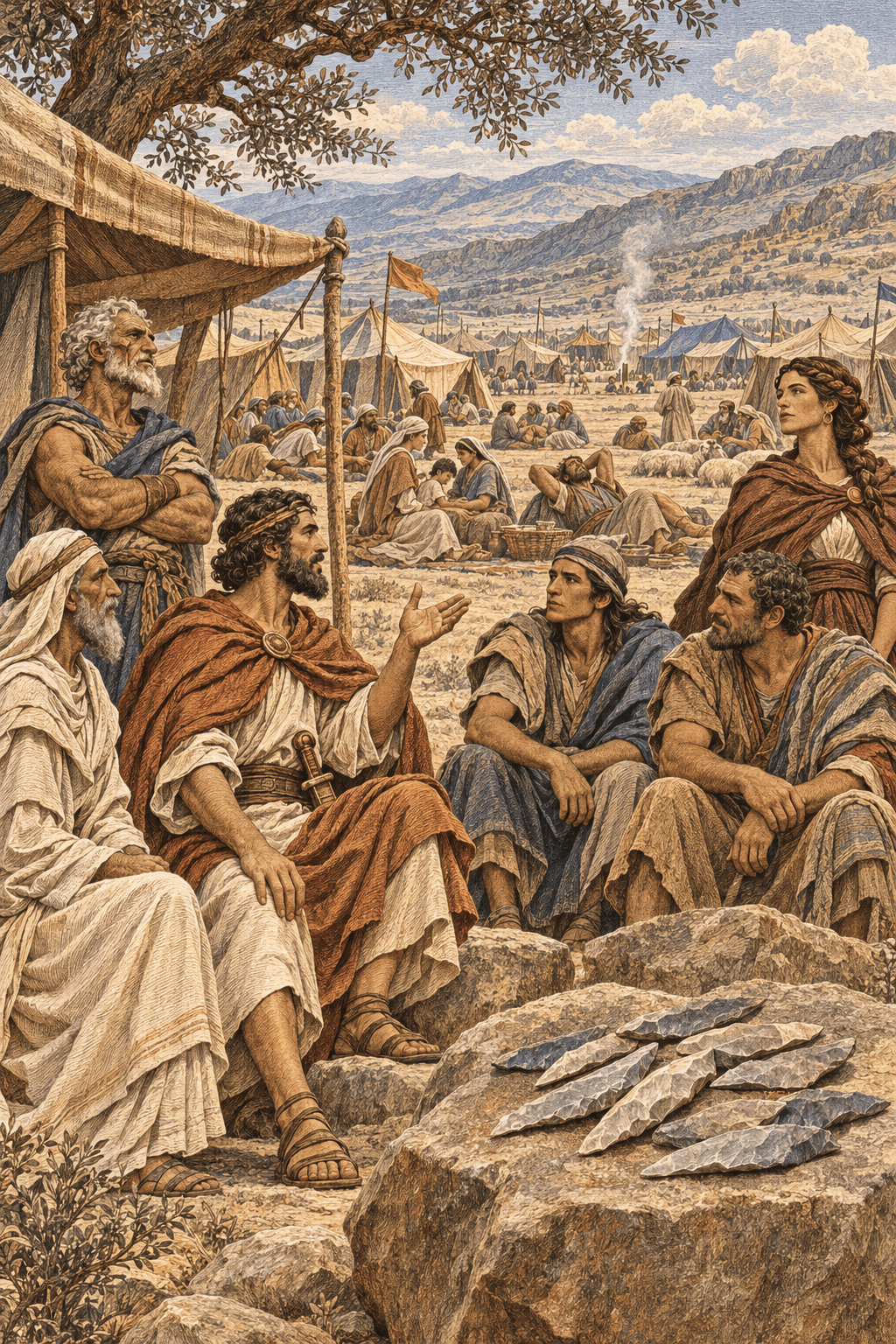
When God promised Abraham the land of Canaan as an everlasting possession for him and his seed (Genesis 17:8), circumcision was the seal of the covenant by which God’s promises would be fulfilled.
Why does God say to Joshua, “Circumcise again the children of Israel the second time”? In truth the children of Israel at that time were not circumcised, for all the males who came out of Egypt perished in the wilderness, and none of them entered Canaan except Joshua and Caleb. So for this seed of Abraham to enjoy the promise, they had to be circumcised at Gilgal, to enter into the holy membership of God’s people. God had warned Abraham:
“And the uncircumcised man child whose flesh of his foreskin is not circumcised, that soul shall be cut off from his people; he hath broken my covenant” (Genesis 17:14). There was an urgent need for them to be circumcised now that they had left the wilderness and suitable conditions for circumcision had been found … But why does He say, “Circumcise … the second time”? Origen answers this question:
“We say of one who has been instructed under the law and received the teachings of Moses, leaving the errors of paganism and forsaking its worship and superstitions, that he has completed the first circumcision, which is according to the law. But if we have passed from the law and the prophets to the Gospel, we are circumcised a second time by ‘that Rock (which) was Christ’ (1 Corinthians 10:4), and then the word of the Lord to Joshua is fulfilled in us: ‘This day have I rolled away the reproach of Egypt from off you’ [9]. [100]”
This is also what Father Lactantius made clear when he said:
“This second circumcision will not be of the flesh, as was the first, which the Jews still practice, but of the heart and the spirit, which Christ, the true Joshua, gives. [101]”
Saint Cyprian turned to this verse among the passages he quoted from the Old and New Testaments to affirm to the Jews the need for circumcision of the spirit and the passing away of circumcision of the flesh. [102]
The second circumcision took place at Gilgal immediately before the capture of the cities of Canaan. This was to affirm to every member of the community that burial in the Jordan and resurrection belong to the Lord Christ Himself, who was buried and rose, so that by our union with Him we are crucified with Him, buried and also risen. It is the fulfillment of baptism on the personal level for each member of the community.
At Gilgal we see the twelve stones carried from the bed of the Jordan representing the body of Christ as a whole, which has enjoyed burial and resurrection; while in circumcision we see each member of the community enjoying burial and resurrection.
Scripture affirms: “And Joshua made him sharp knives, and circumcised the children of Israel at the hill of the foreskins” [3]. If flint, or rock, points to the Lord Christ (1 Corinthians 10:4), these knives point to the cross of the Lord, which the believer accepts in order to be crucified with Him and circumcised from all the works of the old man, enjoying the new man risen from the dead!
Thus circumcision appears as a power of inner life, in which man enjoys practical fellowship with his true Leader, Jesus Christ: he accepts His crucifixion in order to enjoy the power of His resurrection, which grants triumph and victory over the devil, and even over death itself!
“They abode in their places in the camp, till they were whole. And the Lord said unto Joshua, This day have I rolled away the reproach of Egypt from off you. Wherefore the name of the place is called Gilgal unto this day” [8–9].
The word “Gilgal” means “rolling.” God wanted to roll away from them the reproach of bondage that was linked in the minds of the ancient people with Egypt. Origen says:
“Let us draw near to the meaning of this phrase. All people, even if they are under the law and have received the teachings of Moses, have in them the reproach of Egypt, that is, the reproach of sin. Who can be compared with Paul, even in keeping the law? For he says: ‘Touching the righteousness which is in the law, blameless’ (Philippians 3:6). And yet he himself declares: ‘For we ourselves also were sometimes foolish, disobedient, deceived, serving divers lusts and pleasures, living in malice and envy, hateful, and hating one another’ (Titus 3:3). Does this not mean the reproach of Egypt? But Jesus came and gave us the second circumcision ‘by the washing of regeneration’ (Titus 3:5); He purified our spirits, cast this reproach from us, and gave us in its place the promise of a good conscience toward God. So it is the second circumcision that has removed the reproach and cleansed us of our vices and errors … If, then, by faith we have crossed the stream of the Jordan by virtue of the Gospel, and been purified by the second circumcision, we need not fear the reproach of our former sin. Do you hear: ‘This day have I rolled away the reproach of Egypt from off you’? [103]”
He also says:
“This is what the Lord wishes to say in the Gospels when He says, ‘Thy sins be forgiven thee’ (Mark 2:5); but He also says, ‘Sin no more, lest a worse thing come unto thee’ (John 5:14). If you never sin after receiving the forgiveness of sins, the reproach has truly been rolled away from you. But if you commit new sins, you return to the old reproach — indeed, you are in a worse state, for you have ‘trodden under foot the Son of God, and … counted the blood of the covenant … an unholy thing’ (Hebrews 10:29) … Yes, whoever gives himself to fornication after receiving the Gospel has a heavier reproach than one who does so while under the law. For as it is said: ‘Shall I then take the members of Christ, and make them the members of an harlot?’ (1 Corinthians 6:15). Do you see how, through slackness, the reproach returning upon you piles up and weighs you down? Ah! The charge against you will not be impurity only; you will be judged as a profaner of holy things, for it is said of you: ‘Know ye not that the unrighteous shall not inherit the kingdom of God?’ (1 Corinthians 6:9), and ‘If any man defile the temple of God, him shall God destroy’ (1 Corinthians 3:17). [104]”
And he said:
“Add to this that ‘he that committeth fornication sinneth against his own body’ (1 Corinthians 6:18) — not only against his own body, which has become a temple of God, but against the body of the whole Church; for whoever defiles his body, as a member, spreads defilement through the whole body … So, that the second circumcision may be completed in us and the old reproach of Egypt be removed from us, let us separate ourselves entirely from these defilements, so that we may be pure in body and spirit, lifting up ‘holy hands’ (1 Timothy 2:8), with a pure mouth and pure lips, glorifying God with a sincere heart, by our prayers and our works, in Christ Jesus our Lord, to whom be glory and dominion for ever and ever. [105]”
Having come to know our spiritual enemy and acquired the second circumcision, which purifies us from every defilement and frees us from every authority of this enemy, so that he may have no inheritance in our heart, we must also arm ourselves with the new Passover.
3. Keeping the Passover
KJV · Verses 10
10 And the children of Israel encamped in Gilgal, and kept the passover on the fourteenth day of the month at even in the plains of Jericho.
In our study of the Book of Exodus we spoke in some detail about the Passover and the connection between the old Passover and the new. Here, having crossed the Jordan into the land of the inheritance, they were bound, before beginning the struggle, to enjoy the second circumcision, so that when they were healed of their wounds at Gilgal they might keep the new Passover on the fourteenth day of the month at even in the plains of Jericho. Here we observe:
First: the connection of circumcision with the Passover is the connection of baptism with the Eucharist, the new Passover. No believer can enjoy the mystery of the Passover and share in it unless he has been circumcised in heart in baptism. In the waters of baptism we receive membership in the body of Christ, and in the Eucharist we enjoy the holy body, so that we abide in Him and He in us. This connection reminds us of the ancient rite of baptism, when most catechumens received the sacrament of baptism on the night of the glorious feast of Pascha, the feast of victory over death and of receiving the power of the resurrection in Christ Jesus risen from the dead.
The newly baptized came out wearing the white garments of victory and carrying lighted lamps, and entered the choir of the faithful to enjoy communion in the holy mysteries, “the sacrament of the Eucharist,” immediately after baptism. Through baptism they crossed over from the old man to the new man, and through the Eucharist they cross from earth to heaven itself by their union with God in Christ Jesus, our true Passover.
Second: it was not possible for the people to leave their places in the camp and go out to war until they were first healed after their circumcision [8]. If we have received crucifixion with our old man in the waters of baptism, we must take care to be completely healed by putting off our evil habits entirely. As Origen says:
“It is a kind of painful struggle to leave the old habits of sin in order to enter an entirely new way of life … In my opinion, this is the time of which Scripture says we must remain in our places, as in the pain of circumcision, until the healing and recovery are complete. Healing takes place when we carry out our new duties without weariness and grow used to what we formerly thought hard because we were unaccustomed to it. And we say that we are truly healed when our faults disappear by the power of the new habit, and virtue becomes in us a second nature. [106]”
4. Eating the Produce of the Land
KJV · Verses 11–12
11 And they did eat of the old corn of the land on the morrow after the passover, unleavened cakes, and parched corn in the selfsame day. 12 And the manna ceased on the morrow after they had eaten of the old corn of the land; neither had the children of Israel manna any more; but they did eat of the fruit of the land of Canaan that year.
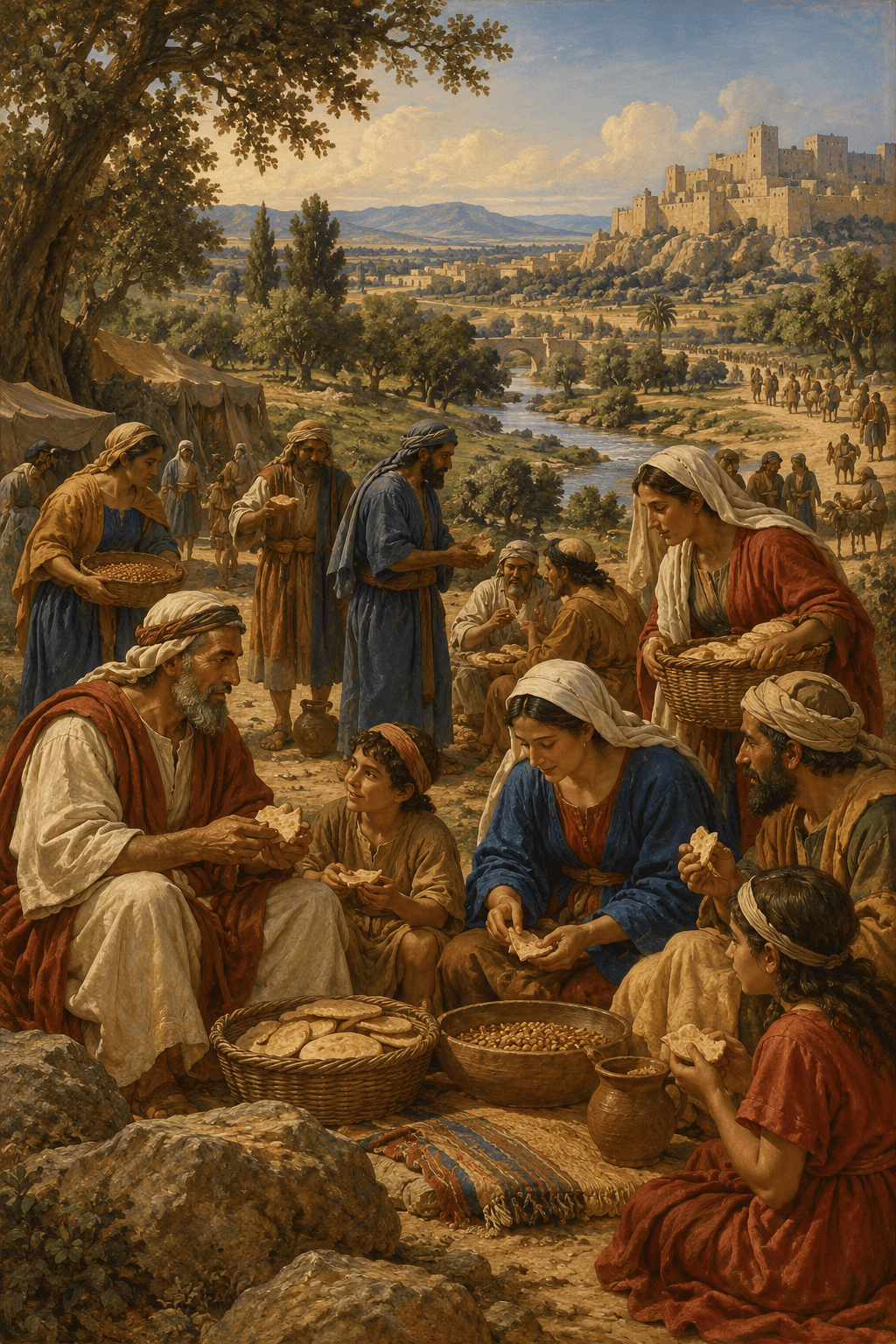
The children of Israel passed through three stages in their food. The first stage was at their going out of Egypt:
“The people took their dough … bound up in their clothes” (Exodus 12:34). When the dough was used up and they had no more bread, they entered the second stage, in which God rained down manna on them from heaven, of which the Lord Christ said:
“Your fathers did eat manna in the wilderness, and are dead” (John 6:49). Finally, when they entered the land of promise, “they did eat of the old corn of the land on the morrow after the passover, unleavened cakes, and parched corn in the selfsame day. And the manna ceased on the morrow after they had eaten of the old corn of the land; neither had the children of Israel manna any more” [11–12].
In the first stage the dough was bound up in their clothes (Exodus 12:34), that is, with their bodies; they ate for the needs of the body, for they were in the stage of spiritual childhood, bound to the body and to earthly things. But when He brought them out into the wilderness He gave them manna from heaven, to assure them that He was the One who sustained them and cared for them spiritually and physically, so that they would not be anxious about their bodies. And in the new land the Word of God offers Himself as the heavenly bread, saying:
“I am the living bread which came down from heaven: if any man eat of this bread, he shall live for ever: and the bread that I will give is my flesh, which I will give for the life of the world” (John 6:51). It is as if the believer passes through three stages: in the first he eats in order to live; in the second he is not troubled, relying on God who feeds him in every way; and in the third he finds in God Himself his eternal, satisfying food!
5. The Appearance of the Captain of the Lord’s Host
KJV · Verses 13–15
13 And it came to pass, when Joshua was by Jericho, that he lifted up his eyes and looked, and, behold, there stood a man over against him with his sword drawn in his hand: and Joshua went unto him, and said unto him, Art thou for us, or for our adversaries? 14 And he said, Nay; but as captain of the host of the Lord am I now come. And Joshua fell on his face to the earth, and did worship, and said unto him, What saith my Lord unto his servant? 15 And the captain of the Lord's host said unto Joshua, Loose thy shoe from off thy foot; for the place whereon thou standest is holy. And Joshua did so.
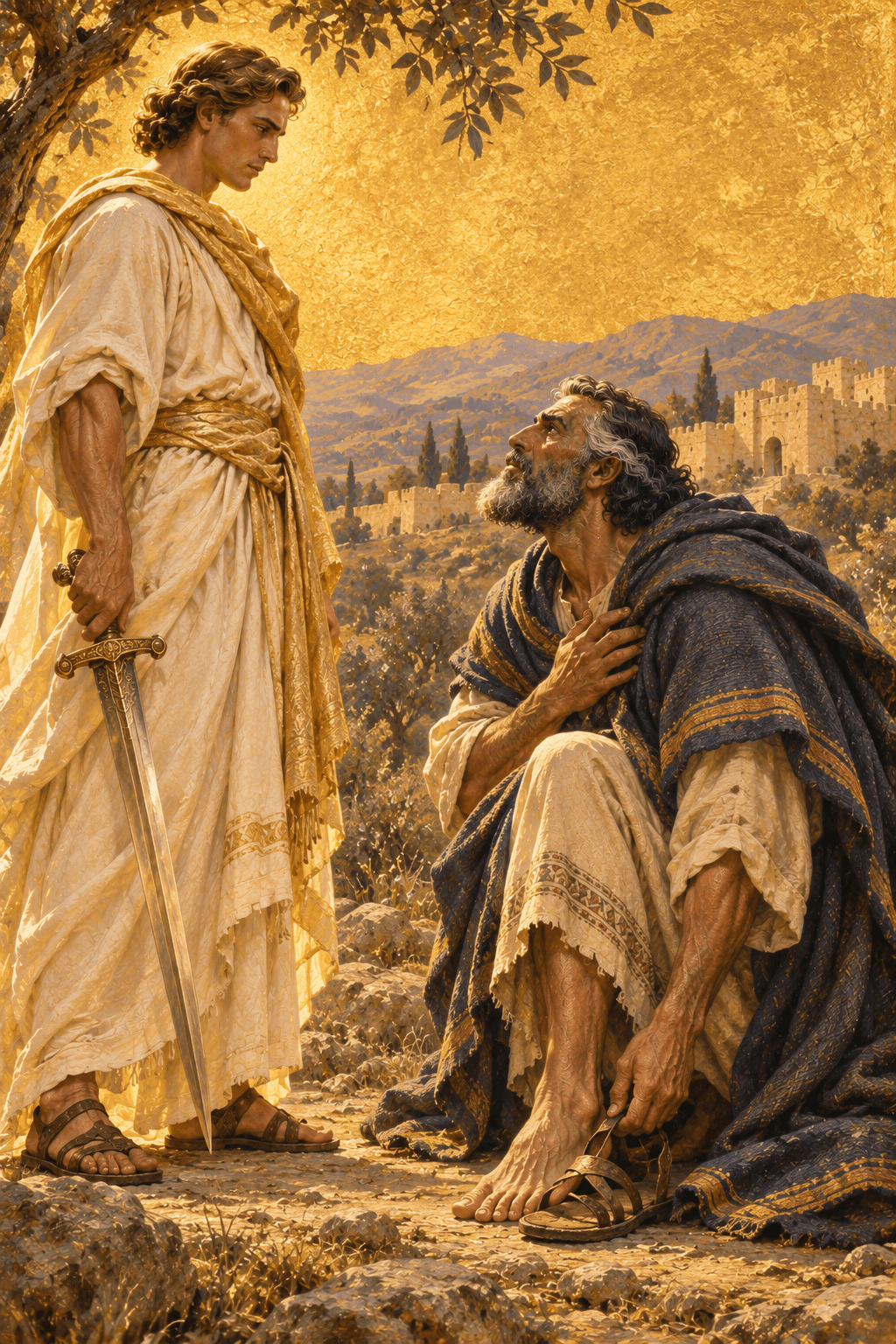
Joshua had led God’s people across the river Jordan and gone to Gilgal to set up the memorial stones; the people had been sanctified by their second circumcision and their enjoyment of the Passover and the new produce … Everything had become new for them … Joshua went forward toward Jericho [13]. Perhaps, being alone, he realized that he was by himself without Moses, facing a war of a new kind: a city with high walls and fortifications able to hold out a long time under siege.
Joshua could not ignore it and go on to another city or village, for it represented an enemy that would remain behind them and strike them from the rear! Perhaps Joshua was also thinking of the uproar of the Canaanite nations and peoples against him [1–2] … In any case Joshua was a man of faith, and so the Word of God came to him as Captain of the Lord’s host to support him!
If God Himself purifies them in heart by the new circumcision, establishes them in Himself by the new Passover and satisfies them with the new produce, He does not refrain from manifesting His living Word in a tangible form to assure Joshua: “As captain of the host of the Lord am I now come” [14]. He is not merely an angel or an archangel, but the Word of God Himself, for He says to him: “Loose thy shoe from off thy foot; for the place whereon thou standest is holy” [15] — the same words spoken to Moses the prophet when the Lord appeared to him in the bush burning with fire (Exodus 3).
We have already seen in more detail that the loosing of the shoes is an affirmation of the need to put off deadly earthly concerns and to leave vainglory, and an affirmation that the servant is not the Bridegroom of the Church but her servant, while the true Bridegroom is Jesus working in us. [107] Origen says:
“Joshua knew by the Spirit not only that He was from God, but that He was God Himself; for he would not have worshipped Him had he not known that He was God. [108]”
His being called Captain of the Lord’s host is not strange for the Word of God, of whom it is said in Isaiah: “Behold, I have given him for a witness to the people, a leader and commander to the people” (Isaiah 55:4). In the Book of Revelation He appears seated on a white horse, clothed with a vesture dipped in blood, and the armies in heaven followed Him upon white horses, clothed in fine linen, white and clean, and out of His mouth goes a sharp sword (Revelation 19:11–15).
Wonderful is the love of God, and great is His care! When He brings His believers into war against the devil and his evil works, He comes to them as Captain of the host, “conquering, and to conquer” through them. And when the enemy of good appears as a roaring lion seeking whom he may devour (1 Peter 5:8), the Word of God also comes forward as “the Lion of the tribe of Juda” (Revelation 5:5). When we hunger He offers Himself as living bread, of which whoever eats shall not hunger.
If we feel lonely He comes as a unique Friend who supports us, indeed as a true spiritual Bridegroom who fills every emptiness in us. If we feel lost He offers Himself as the Way and the Truth; and if death strikes us He comes to us as the Resurrection! In His love He gives us everything, to meet every need in us!
Finally, Saint Anthony the Great sees in the conversation of Joshua the son of Nun with the Captain of the Lord’s host a living example of discerning between heavenly and satanic visions. He says:
“When you see a vision, do not fall down in fear; but whatever it may be, ask boldly: Who are you, and where do you come from? If the vision is holy, you will be assured of it by your fear being turned into joy. But if it is from the devil, the vision at once grows weak before the steadfastness of your mind … So the son of Nun asked, to know who it was that was helping him. [109]”
Notes and References
[99] Augustine, Soliloquies 16.
[100] Origen, Homilies on Joshua 5:5.
[101] Lactantius, Divine Institutes 4:17.
[102] Cyprian, Treatise 12 (Testimonies), to Quirinus 1:8; see also Treatise 12:2:16.
[103] Origen, Homilies on Joshua 5:5.
[104] Origen, ibid.
[105] Origen, ibid.
[106] Origen, ibid. 6:1.
[107] See the commentary on Exodus, chapter 3.
[108] Origen, Homilies on Joshua 3.
[109] Athanasius, Life of Antony 43.