
If the previous chapter is, in its essence, a declaration of the secret of the servant’s victory — that God is the One who works in him — in this chapter we pause at an important truth which Holy Scripture wished to make clear before the enjoyment of the inheritance: salvation is for all, and every true believer enjoys it. Though the Jews came out from the yoke of bondage to enjoy the inheritance, many of them did not enjoy it because of their unbelief, while the Canaanite harlot was able to have a share in the inheritance. It is as if God affirms that He does not reject the Gentiles, but rejects their unbelief and their abominations!
1. Sending the spies (1).
2. The spies and Rahab the harlot (2).
3. The king of Jericho and Rahab (3).
4. The spies on the roof (4–6).
5. Asking for a token of faithfulness (7–21).
6. The spies on the mountain (16, 22).
7. The spies with Joshua (23–24).
1. Sending the Spies
KJV · Verses 1
1 And Joshua the son of Nun sent out of Shittim two men to spy secretly, saying, Go view the land, even Jericho. And they went, and came into an harlot's house, named Rahab, and lodged there.
If Joshua is a symbol of Jesus, the incarnate Word of God, who are the two spies whom Joshua sent to the land and to Jericho to win Rahab the harlot as a believing woman, who opened her house to them and her heart to their God, and asked them for a token of faithfulness for her salvation and the salvation of her household?
First: if Joshua represents Jesus Christ our Lord, the spies sent by him most likely represent the two missions which the Lord sent into the world, that is, the twelve disciples and the seventy apostles, who began with the Jews and were completed among the Gentiles. The Gentile peoples received their message in their hearts as the secret of their salvation.
Saint Jerome sees them as representing the Apostles Peter and Paul, as ministers of the circumcision and of the Gentiles. He says:
“Since Jesus wishes to lead His people to the Gospel, He sends two men secretly to Jericho, one to those of the circumcision and the other to the Gentiles: Peter and Paul. Jericho sought to kill them, but the harlot took them in — she, of course, signifies the Church gathered from the Gentiles, which believed in Jesus. She received them in peace upon her roof and hid them there, where her faith was lifted up on high. She hid them among the stalks of flax, though she was a harlot. [51]”
Second: Bishop Caesarius sees them as pointing to the two commandments of love: the love of God and the love of people. He says:
“Joshua sent two spies, because the true Joshua sends the two commandments of love. What did the men sent by the true Joshua bring to announce to us, except that we should love God and people? [52]”
If the purpose of preaching the Gospel is that we receive the Lord of glory Jesus within us, we receive Him dwelling inside us, granting us His attributes working in us: His love for the Father and His love for mankind!
2. The Spies and Rahab the Harlot
KJV · Verses 2
2 And it was told the king of Jericho, saying, Behold, there came men in hither to night of the children of Israel to search out the country.
Rahab became a living example of faith working in us. When Saint Ambrose wished to urge virgins not to despise married believing women, nor even harlots if they returned and lived in purity, he said:
“Rahab was a harlot, but she believed in God and found salvation. [53]”
Saint John Chrysostom speaks of this effective faith, saying:
“Had she said to herself, ‘How can these captives, exiles, refugees, who live as wandering tribes without cities, overcome us who have a city with walls and towers?’ she would have perished! [54]”
Rahab the harlot, like all the people of the city and indeed all the inhabitants of the region, had heard of God’s work with His people: how He dried up the water of the Red Sea before them when they came out of Egypt about forty years earlier, and how He delivered them from Sihon and Og, the two kings of the Amorites [10]. Yet she alone believed in Him and opened her house to the two messengers, as she opened her mouth to bear witness to God, saying: “I know that the Lord hath given you the land, and that your terror is fallen upon us, and that all the inhabitants of the land faint because of you … And as soon as we had heard these things, our hearts did melt, neither did there remain any more courage in any man, because of you: for the Lord your God, he is God in heaven above, and in earth beneath” [9–11].
She declared her faith in practice, exposing her life to danger, and asked the spies to swear to her that they would save her and all her relatives! A Gentile harlot, living in a condemned city, was able to declare her faith by her works and receive a sure promise of salvation. The Apostle Paul says:
“By faith the harlot Rahab perished not with them that believed not, when she had received the spies with peace” (Hebrews 11:31). And our teacher James says:
“Likewise also was not Rahab the harlot justified by works, when she had received the messengers, and had sent them out another way?” (James 2:25). The Apostle Paul declared her faith and the Apostle James declared her works; in truth, the one cannot be separated from the other!
By faith also Rahab left the way of her harlotry to live holy to the Lord. Saint Jerome sees that “Rahab” means “a broad place” or “pride”; through faith she accepted the narrow way of humility instead of her former broad way. He says:
“Formerly she walked in ‘the broad way that leadeth to destruction’ (Matthew 7:13); her pride dragged her to perdition, but at last she turned to humility.”
And he says in the same homily:
“At one time she was on the broad way leading to destruction, but afterwards she ascended on high, into the remembrance of God. [55]”
While the people of God perished through unbelief and died in the wilderness, behold, the Gentile harlot seized the divine promises by a living, working faith, so that she and her family received a share in the land of promise, and the Messiah, the Savior, came incarnate from her seed (Matthew 1:5). Her actions thus became prophetic deeds. On this Saint Clement of Rome says:
“You see, beloved, that there was not only faith in this woman, but prophecy as well. [56]”
In the spirit of prophecy she spoke with the spies, declaring what would happen to God’s people: “I know that the Lord hath given you the land” [9]. But what is greater is that her actions, and indeed her person, became a prophecy of the rise of the Church of the Gentiles at the coming of the true Joshua. On this Bishop Caesarius says:
“That harlot, dearly beloved, represents the Church, which had been accustomed to commit fornication with many idols before the coming of Jesus. However, when Christ came, He not only freed her from fornication but by a wonderful miracle made her a virgin. The Apostle says of her: ‘For I have espoused you to one husband, that I may present you as a chaste virgin to Christ’ (2 Corinthians 11:2). The soul of each one of us was a harlot, living in the passions and lusts of the flesh; but it received the spies of Joshua, and in it was fulfilled what the Apostle said: ‘For ye were sometimes darkness, but now are ye light in the Lord’ (see Ephesians 5:8). [57]”
Thus Rahab came to represent the Church of the Gentiles, which received the two missions of Christ (the disciples and the apostles) and hid within herself His commandment, “the love of God and the love of people,” and so became His holy Church. What I say of the Church as a whole I say also of each soul among us as a living member of the Church, which was once in the darkness of evil and received the salvation of our Lord Jesus within it.
3. The King of Jericho and Rahab
KJV · Verses 3
3 And the king of Jericho sent unto Rahab, saying, Bring forth the men that are come to thee, which are entered into thine house: for they be come to search out all the country.
When Rahab received the spies with a living faith working by love, the king of Jericho was stirred up against the spies. This is nothing strange or new: with every divine mission or divine work, the enemy of good is stirred up to send a satanic mission with the aim of destroying Rahab’s faith. When God created Eve for Adam as a helper, the enemy of good used the serpent to destroy Adam as well as Eve. When God sent Moses and Aaron to save the people from Pharaoh’s bondage, the enemy sent the two magicians to destroy God’s work.
When God sent His prophets, such as Jeremiah, Ezekiel and Isaiah, the enemy sent false prophets and prophetesses in the same age. And since the Lord Christ has finally come, the Antichrist must appear, resisting the Church of Christ, and so on. In every age, with every spiritual work, there is resistance. Indeed, in the life of every person, whenever he prepares himself for repentance, war rages against him — perhaps from his own body, or from his relatives, and sometimes even from those who serve in the Church!
4. The Spies on the Roof
KJV · Verses 4–6
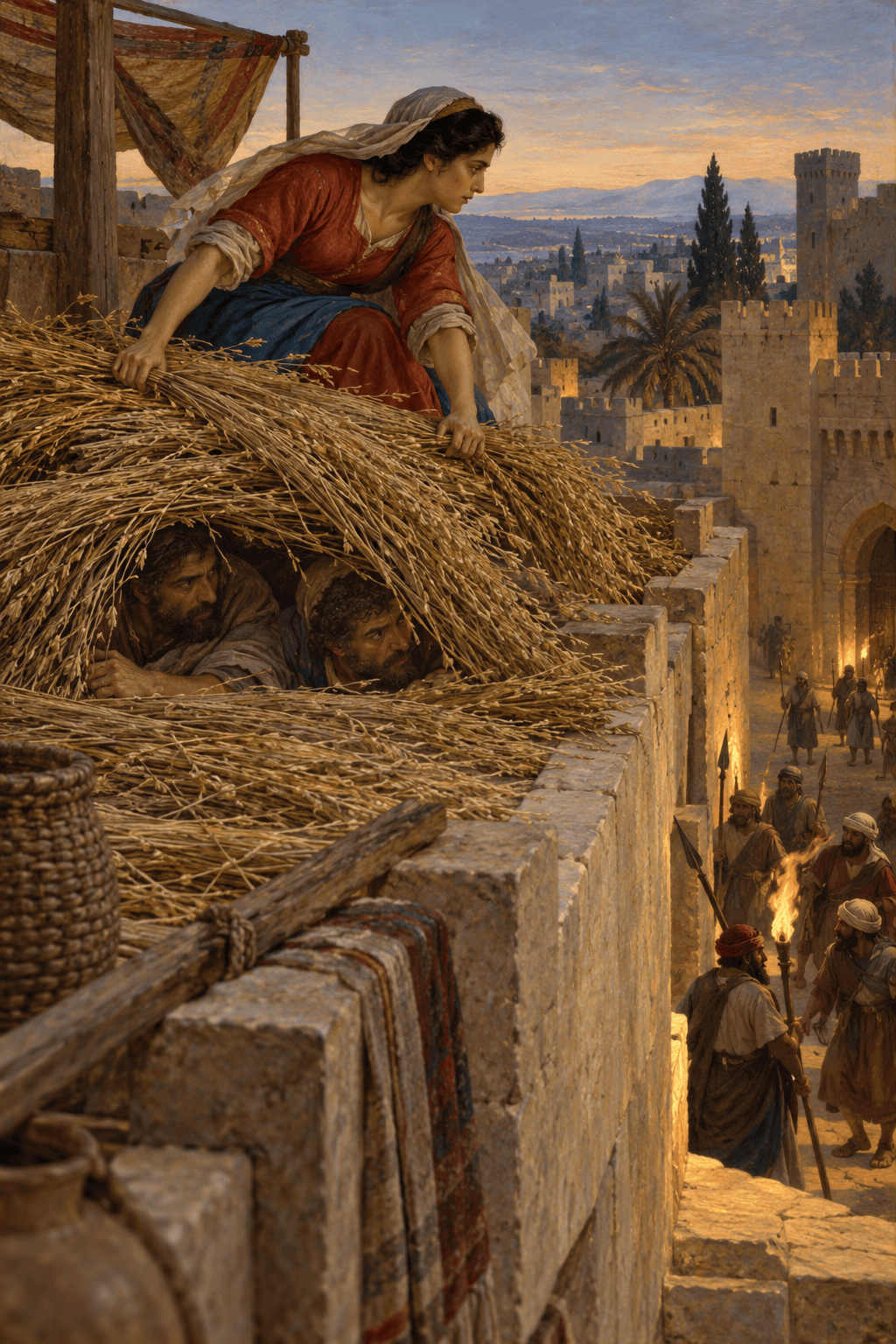
4 And the woman took the two men, and hid them, and said thus, There came men unto me, but I wist not whence they were: 5 And it came to pass about the time of shutting of the gate, when it was dark, that the men went out: whither the men went I wot not: pursue after them quickly; for ye shall overtake them. 6 But she had brought them up to the roof of the house, and hid them with the stalks of flax, which she had laid in order upon the roof.
What did Rahab do with the spies?
A) She hid them in her house.
B) Then she brought them up to the roof, so that her heart was with them, even though in the body she remained talking with the messengers of the king of Jericho.
C) And she hid them among the stalks of flax.
What a wonderful symbolic picture, revealing what happens in the Church of the New Testament! The Gentiles received the mission of Jesus our Lord as two spies, and hid faith in the Savior in their hearts as in the inner rooms of their houses, as Rahab did. And when faith entered their hearts, it carried them up to the roof; that is, it lifted them from the deadening literalness of the law, which drags hearts downward, so that they might rise through the freedom of the Spirit upward, as to the roof.
Their insight was opened to behold heavenly things and perceive the divine glories, through union with the Father in Christ Jesus our Lord by the Holy Spirit.
We can say that the Jews who cling to the letter live on the lower floor, deprived of spiritual illumination, as if they had put a veil over the face of Moses so as not to behold the glory. But when the mission was presented to the Gentiles, the Holy Spirit opened their hearts to receive it within, and carried them as on the wings of a dove from floor to floor — that is, from heavenly glory to glory — until He brought them to the roof, to enjoy being at the summit without veil or hindrance!
He says: “Seeing then that we have such hope, we use great plainness of speech: and not as Moses, which put a vail over his face, that the children of Israel could not stedfastly look to the end of that which is abolished: but their minds were blinded … But even unto this day, when Moses is read, the vail is upon their heart … where the Spirit of the Lord is, there is liberty. But we all, with open face beholding as in a glass the glory of the Lord, are changed into the same image from glory to glory, even as by the Spirit of the Lord” (2 Corinthians 3:12–18).
Bishop Caesarius says:
“They went up to the roof, signifying the Church, which receives the teachings of the apostles not in a lowly but in a lofty way; for she did not follow the killing letter with the Jews, but received the life-giving Spirit who came down from heaven. [58]”
Many have received faith within them as Rahab did, but in spiritual dryness they have refused the work of the Spirit in them, which would lift them from glory to glory until it brought them to the roof, to behold the divine glories. These bear the name of Christ, but in their slackness and negligence they live on the lower floors, as if they wished to turn back to the dry life of the law instead of rising to heavenly things and to communion with the heavenly orders in their praises, their joy and the gladness of their inner hearts.
Rahab covered them on the roof with the stalks of flax, a symbol of the “whiteness” of the pure heavenly life, which no one will obtain while he is slack. Saint Jerome says:
“Flax attains its brilliant whiteness through much labor and care. You know that it is sown in the earth, which is black and without beauty … but first it rises above the earth, then it is broken, twisted and washed, after that it is beaten, and finally combed; and with great care and hard work it at last becomes white. Here we find the meaning: this harlot took the two apostles and covered them with her flax, so that these two workers might turn her flax white. [59]”
The stalks of flax also remind us of the priestly garments in both covenants. If the Church of the New Testament, “Rahab,” having received faith in the Lord Christ and risen in her heart to the roof to live in heavenly things, attains this, it is through priestly work — I mean the priesthood of the Lord Christ as “the great High Priest” who intercedes for us by His blood. As the Apostle Paul says:
“Wherefore he is able also to save them to the uttermost that come unto God by him, seeing he ever liveth to make intercession for them. For such an high priest became us, who is holy, harmless, undefiled, separate from sinners, and made higher than the heavens” (Hebrews 7:25–26). Through this new priesthood, on a transcendent level, He has given us the grace of the priesthood, appearing in His priests and working through them Himself.
As the Apostle Peter says: “Ye also, as lively stones, are built up a spiritual house, an holy priesthood, to offer up spiritual sacrifices, acceptable to God by Jesus Christ … But ye are a chosen generation, a royal priesthood” (1 Peter 2:5, 9). Through the priestly work in Christ Jesus, the great High Priest and the Bishop and Shepherd of our souls, the Church offers the sacrifice of love acceptable to the Father, and lifts her members to share with the heavenly hosts — as on the roof — in their praises and their liturgies. As Saint John Chrysostom says of the liturgy of the Eucharist:
“It is as if man has been taken up to heaven itself; he stands beside the throne of glory, flies with the Seraphim, and sings the holy hymn. [60]”
5. Asking for a Token of Faithfulness
KJV · Verses 7–21
7 And the men pursued after them the way to Jordan unto the fords: and as soon as they which pursued after them were gone out, they shut the gate. 8 And before they were laid down, she came up unto them upon the roof; 9 And she said unto the men, I know that the Lord hath given you the land, and that your terror is fallen upon us, and that all the inhabitants of the land faint because of you. 10 For we have heard how the Lord dried up the water of the Red sea for you, when ye came out of Egypt; and what ye did unto the two kings of the Amorites, that were on the other side Jordan, Sihon and Og, whom ye utterly destroyed. 11 And as soon as we had heard these things, our hearts did melt, neither did there remain any more courage in any man, because of you: for the Lord your God, he is God in heaven above, and in earth beneath. 12 Now therefore, I pray you, swear unto me by the Lord, since I have shewed you kindness, that ye will also shew kindness unto my father's house, and give me a true token: 13 And that ye will save alive my father, and my mother, and my brethren, and my sisters, and all that they have, and deliver our lives from death. 14 And the men answered her, Our life for yours, if ye utter not this our business. And it shall be, when the Lord hath given us the land, that we will deal kindly and truly with thee. 15 Then she let them down by a cord through the window: for her house was upon the town wall, and she dwelt upon the wall. 16 And she said unto them, Get you to the mountain, lest the pursuers meet you; and hide yourselves there three days, until the pursuers be returned: and afterward may ye go your way. 17 And the men said unto her, We will be blameless of this thine oath which thou hast made us swear. 18 Behold, when we come into the land, thou shalt bind this line of scarlet thread in the window which thou didst let us down by: and thou shalt bring thy father, and thy mother, and thy brethren, and all thy father's household, home unto thee. 19 And it shall be, that whosoever shall go out of the doors of thy house into the street, his blood shall be upon his head, and we will be guiltless: and whosoever shall be with thee in the house, his blood shall be on our head, if any hand be upon him. 20 And if thou utter this our business, then we will be quit of thine oath which thou hast made us to swear. 21 And she said, According unto your words, so be it. And she sent them away, and they departed: and she bound the scarlet line in the window.
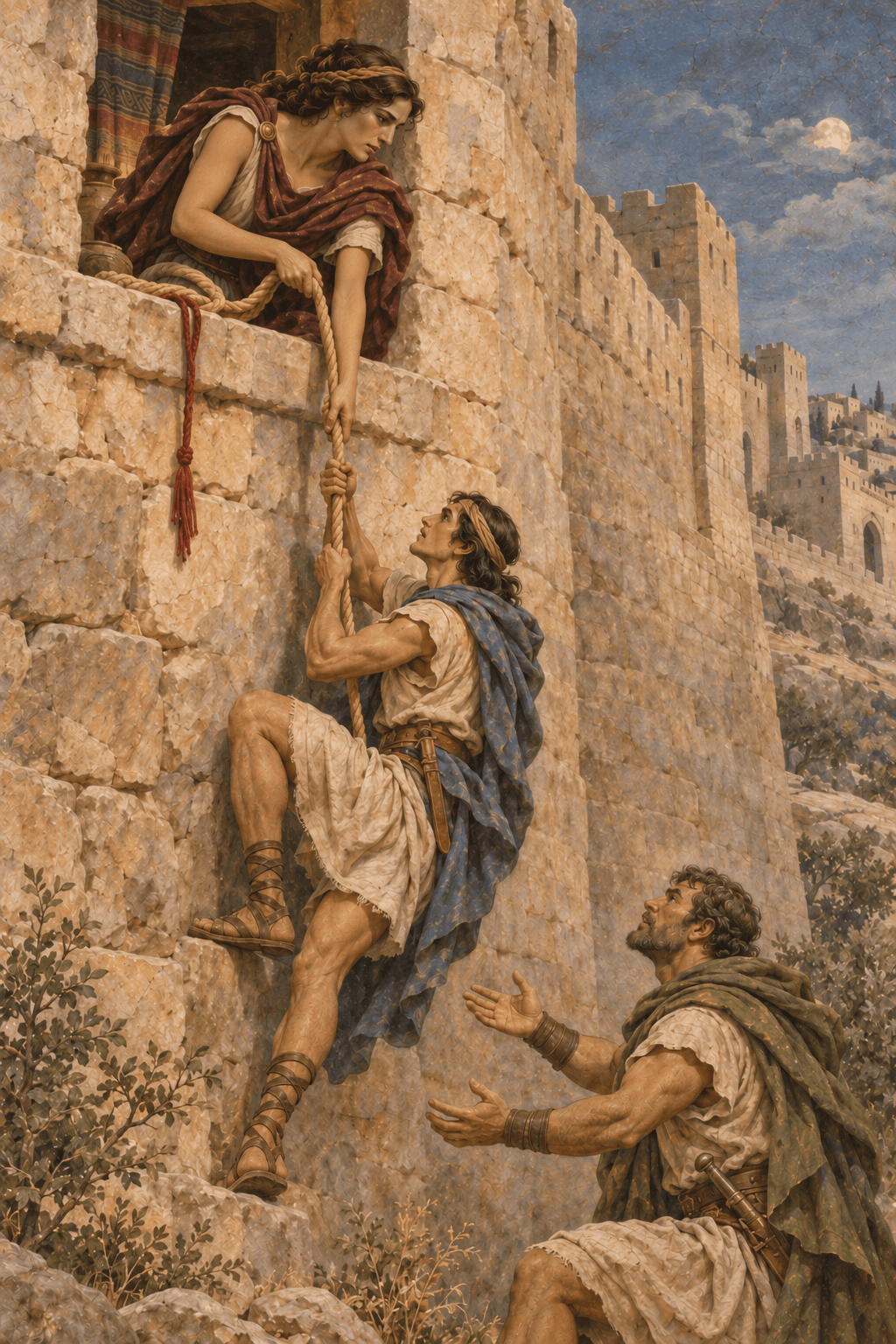
In the spirit of prophecy Rahab the harlot perceived God’s promises to His people. She received the spies so as to live no longer as a harlot, but to rise by faith with them to the roof, wrapped in pure flax, set free from the lusts and passions of the flesh. She wished that she and her family might enjoy a share in these divine promises. Her faith did not stop at trusting in God’s power and His faithfulness to His people; she trusted that He would give to her, too, and to all her household.
Many have faith in God’s work with mankind, but they do not enter into a personal relationship with God at the level of their own inner life and the level of their household.
In the confidence of faith she said:
Now therefore, I pray you, swear unto me by the Lord, since I have shewed you kindness, that ye will also shew kindness unto my father's house, and give me a true token: And that ye will save alive my father, and my mother, and my brethren, and my sisters, and all that they have, and deliver our lives from death. [12–13]
Her faith was personal, with the boldness that gladdens the heart of God, yet not selfish or isolated: she asked on behalf of her father, her mother, her brothers, her sisters and all that they had! This is our living Christian faith, in which the believer meets his Creator and Savior as one who belongs to Him — “My beloved is mine, and I am his: he feedeth among the lilies” (Song of Songs 2:16) — but through his membership in the Church. He does not withdraw from the community, but realizes that he lives with its Christ as a member of it, even if he is a solitary who meets no one in the body!
If we follow the symbolic interpretation, we can also say that our Rahab, that is, our faith, cries out for the salvation of the soul as the father and of the body as the mother, and for the sanctification of the senses, the emotions and every thought as the brothers and sisters, and for the sanctification of every talent for the Lord as “all that they have”!
The answer was:
Behold, when we come into the land, thou shalt bind this line of scarlet thread in the window which thou didst let us down by: and thou shalt bring thy father, and thy mother, and thy brethren, and all thy father's household, home unto thee. And it shall be, that whosoever shall go out of the doors of thy house into the street, his blood shall be upon his head, and we will be guiltless: and whosoever shall be with thee in the house, his blood shall be on our head, if any hand be upon him. [18–19]
The token given was the “line of scarlet thread,” pointing to the blood of the Lord Christ, without which there is no salvation. The Apostle Paul says: “Without shedding of blood is no remission” (Hebrews 9:22). And the Apostle Peter says: “Forasmuch as ye know that ye were not redeemed with corruptible things, as silver and gold, from your vain conversation received by tradition from your fathers; but with the precious blood of Christ, as of a lamb without blemish and without spot” (1 Peter 1:18–19). Saint Ambrose says:
“The harlot lost all hope in (human) means of safety amid the destruction of the city, but her faith prevailed, for she tied a scarlet cord in the window! She raised the sign of her faith and the banner of the Lord’s passion, so that the symbol of the mystical blood that saves the world might be kept in remembrance. [61]”
Neither Rahab nor her household could have enjoyed salvation had they gone out of the house on whose window the scarlet thread was hung, for there is no salvation outside the Church redeemed by the blood of Christ. Saint Cyprian says:
“Do you think you can stand and live if you withdraw from the Church and build for yourselves other homes and different dwellings, when it was said to Rahab: ‘Thou shalt bring thy father, and thy mother, and thy brethren, and all thy father’s household, home unto thee. And it shall be, that whosoever shall go out of the doors of thy house into the street, his blood shall be upon his head, and we will be guiltless’? In this the mystery is declared: those who wish to live and escape the destruction of the world must gather together in one house alone, that is, in the Church. But whoever goes out from among those gathered there — that is, if anyone, though he has received grace in the Church, leaves it and goes outside — his blood shall be upon his own head; he is responsible for his own destruction. This is what Paul made clear when he commanded us to avoid the heretic … [62]”
“Whoever remains outside the Church is outside the camp of Christ. [63]”
“He is not a Christian who is not within the Church of Christ. [64]”
“For how can anyone be with Christ if he does not walk within the Bride of Christ and is not found in His Church? [65]”
Saint Cyprian has his famous saying:
“He cannot have God for his Father who has not the Church for his mother! [66]”
6. The Spies on the Mountain
KJV · Verses 22
22 And they went, and came unto the mountain, and abode there three days, until the pursuers were returned: and the pursuers sought them throughout all the way, but found them not.
Why did Rahab ask them to go to the mountain and stay there three days until the pursuers returned?
When Rahab the harlot received faith in God, the king of Jericho was stirred up and entered into enmity with her, not for her own sake but because of her faith. It was therefore fitting that she should rise by her faith to God’s holy mountain and remain there three days, so that the devil (the king of Jericho) could not reach it with his wicked pursuers.
Perhaps this mountain points to the Lord Christ Himself, of whom Daniel the prophet spoke as the stone “cut out without hands” (Daniel 2:34), “the stone that smote the image became a great mountain, and filled the whole earth” (Daniel 2:35). This is the holy Stone who lifts us up to Himself, who crushes the devil and grinds him to powder like the image, and Himself becomes a mountain to which the company of the Gentiles ascends.
The holy mountain is also the word of God, which lifts us up to heavenly things, so that we do not fall into the snares of the king of Jericho or into the hands of his pursuers, who point to the lusts of the flesh. As Origen says:
“The harlot became exposed to the hatred of the king of Jericho. Why? Because ‘the flesh lusteth against the Spirit, and the Spirit against the flesh’ (Galatians 5:17). It is also written: ‘If the world hate you, ye know that it hated me before it hated you’ (John 15:18). There is, then, a king who is an enemy of this harlot: ‘the prince of this world’ (John 12:31), who pursues the spies of Jesus and wants to be rid of them. But he cannot lay his hand on them, for they walk on the mountain (Joshua 2:22) and seek the heights of the hills and the summits of the mountains. The harlot soul within us cries out: ‘I will lift up mine eyes unto the hills, from whence cometh my help’ (Psalm 121:1). Truly the prince of this world cannot climb these regions and reach Jesus on the heights — although in the temptation he took Him up to a high place and said to Him, ‘Cast thyself down’ (Matthew 4:6) — for he loves only those who fall into the lower depths. There he reigns, there he makes his dwelling, and from there he goes down to hell. [67]”
Caesarius, Bishop of Arles, was influenced by Origen’s interpretation and borrowed many of his expressions. He says:
“The king of Jericho, that is, Satan, followed the track of Joshua’s spies, but he could not capture them, because they went up the mountain. They did not walk in the low places, nor did they delight in the valleys, that is, in pleasures; but they walked on the mountaintops, to say with the Psalmist: ‘I will lift up mine eyes unto the hills, from whence cometh my help.’ The prince of this world cannot rise after them, for he loves what is base and easily broken. That is why he usually leads those who delight in pleasures, reigns over them, makes his dwelling in them, and goes down with them and leads them into the abyss.”
Finally, the two spies hid three days before returning to Joshua [16, 22], as if it were not possible to meet the risen Jesus except by the servant himself entering into the risen life (the number three) … If the king’s pursuers want to kill them, by entering into the mystery of the three days — the mystery of the resurrection with Jesus our Lord — they persevere in their struggle and their ministry until they are able to meet Him!
7. The Spies with Joshua
KJV · Verses 23–24
23 So the two men returned, and descended from the mountain, and passed over, and came to Joshua the son of Nun, and told him all things that befell them: 24 And they said unto Joshua, Truly the Lord hath delivered into our hands all the land; for even all the inhabitants of the country do faint because of us.
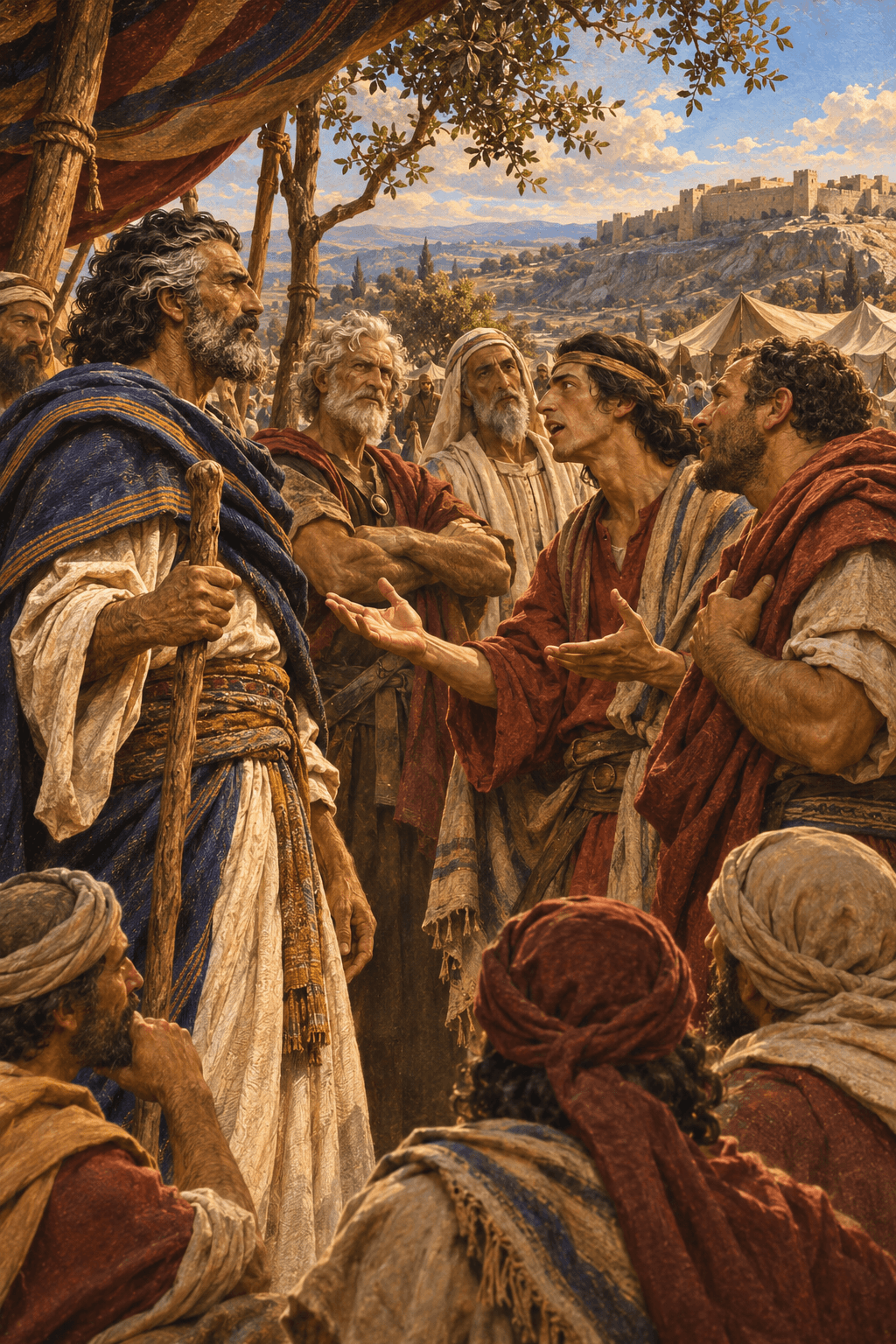
If the two spies point to His mission, or His servants, then the servant, when he walks on the mountains — that is, lives in Holy Scripture as the holy mountain from which he receives help, and on which he rises above all the matters of temporal life to meet the Lord Christ ascending to His heavens from the Mount of Olives, and so on — comes down again and returns to Joshua [23]. It is as if, through the word of God, the high mountain, the servant enters into its depths and discovers the Lord of glory Jesus Himself waiting for him to receive his report of success.
The disciples came to Him rejoicing, saying: “Lord, even the devils are subject unto us through thy name” (Luke 10:17). And He said to them:
“I beheld Satan as lightning fall from heaven … Notwithstanding in this rejoice not, that the spirits are subject unto you; but rather rejoice, because your names are written in heaven” (Luke 10:18–20). They are like Joshua’s spies who came to him declaring their victory in the Lord, and Joshua assured them, “Truly the Lord hath delivered into our hands all the land,” as if to say that He fulfills His promises, that we may inherit the kingdom.
If the Lord Christ, who is not separated from His Father, sometimes spent the whole night in conversation with His Father, how much more fitting is it for us as servants to meet our Jesus — the Leader of the triumphal procession — and give Him a report of every small and great thing, so that His work in us may be fulfilled without hindrance, and He may bring us into the land of His inheritance!
In brief, we can praise Rahab the harlot from many sides:
A) She received the spies secretly; that is, she received the two missions of Jesus by faith in Him secretly in her heart.
B) She brought them up to the roof; that is, her faith turned into a heavenly, lofty life.
C) She hid them among the stalks of flax, a sign of her accepting the pure life instead of harlotry.
D) She asked for a token of faithfulness, for she received the divine promises and believed in them not only as a general gift, but also as a personal gift to her and her household.
E) She asked them to go to the mountain, that is, to walk no longer in base, lowly things.
F) By placing the scarlet thread on her house she became a symbol of the Church of the New Testament, sanctified by the blood.
G) She asked the spies to remain three days on the mountain, so that the messengers of the king of Jericho might not kill them — a declaration of holding fast to rising with Christ, so that the enemy of good may not lay hold of us.
Notes and References
[51] Jerome, Homilies on the Psalms 18.
[52] Caesarius of Arles, Sermon 115:2.
[53] Ambrose, Concerning Virgins 2:4.
[54] John Chrysostom, Homilies on Romans 2.
[55] Jerome, Homilies on the Psalms 18.
[56] Clement of Rome, Epistle to the Corinthians 12.
[57] Caesarius of Arles, Sermon 116:3.
[58] Caesarius of Arles, ibid.
[59] Jerome, Homilies on the Psalms.
[60] John Chrysostom, Homilies on John 46.
[61] Ambrose, On the Christian Faith 5:10.
[62] Cyprian, On the Unity of the Church 8; Epistle 75:4.
[63] Cyprian, Epistle 40, to Cornelius.
[64] Cyprian, Epistle 43, to Antonianus.
[65] Cyprian, Epistle 42, to Cornelius.
[66] Cyprian, On the Unity of the Church 6.
[67] Origen, Homilies on Joshua 1:5.