
As the people were on their way to enjoy the Promised Land according to God’s promise to their fathers, Israel was more a military camp than a kingdom. No doubt the question occupying the minds of all, priests and people, men and women, and perhaps even children, was: “What is our role in the coming battles?” Therefore they needed the Lord to set for them a special conduct for their wars with the nations whose land they were taking, and also with the neighboring nations. At the heart of this conduct one notices an awareness of God’s presence in the midst of His people, to fulfill His plan through them of preparing a holy nation, free of all the abominations the pagan nations practiced, until the Savior of the whole world should come.
The law given here suits the time of the conquest of the land, to remind them that the battle is the Lord’s (1 Samuel 17:47).
Dr. Jamieson makes clear that there is no comparison between what the Law gave here and the conduct of the nations at that time concerning wars and their customs. [228]
1. Going Out to War
KJV · Verses 1–9
1 When thou goest out to battle against thine enemies, and seest horses, and chariots, and a people more than thou, be not afraid of them: for the Lord thy God is with thee, which brought thee up out of the land of Egypt. 2 And it shall be, when ye are come nigh unto the battle, that the priest shall approach and speak unto the people, 3 And shall say unto them, Hear, O Israel, ye approach this day unto battle against your enemies: let not your hearts faint, fear not, and do not tremble, neither be ye terrified because of them; 4 For the Lord your God is he that goeth with you, to fight for you against your enemies, to save you. 5 And the officers shall speak unto the people, saying, What man is there that hath built a new house, and hath not dedicated it? let him go and return to his house, lest he die in the battle, and another man dedicate it. 6 And what man is he that hath planted a vineyard, and hath not yet eaten of it? let him also go and return unto his house, lest he die in the battle, and another man eat of it. 7 And what man is there that hath betrothed a wife, and hath not taken her? let him go and return unto his house, lest he die in the battle, and another man take her. 8 And the officers shall speak further unto the people, and they shall say, What man is there that is fearful and fainthearted? let him go and return unto his house, lest his brethren’s heart faint as well as his heart. 9 And it shall be, when the officers have made an end of speaking unto the people that they shall make captains of the armies to lead the people.
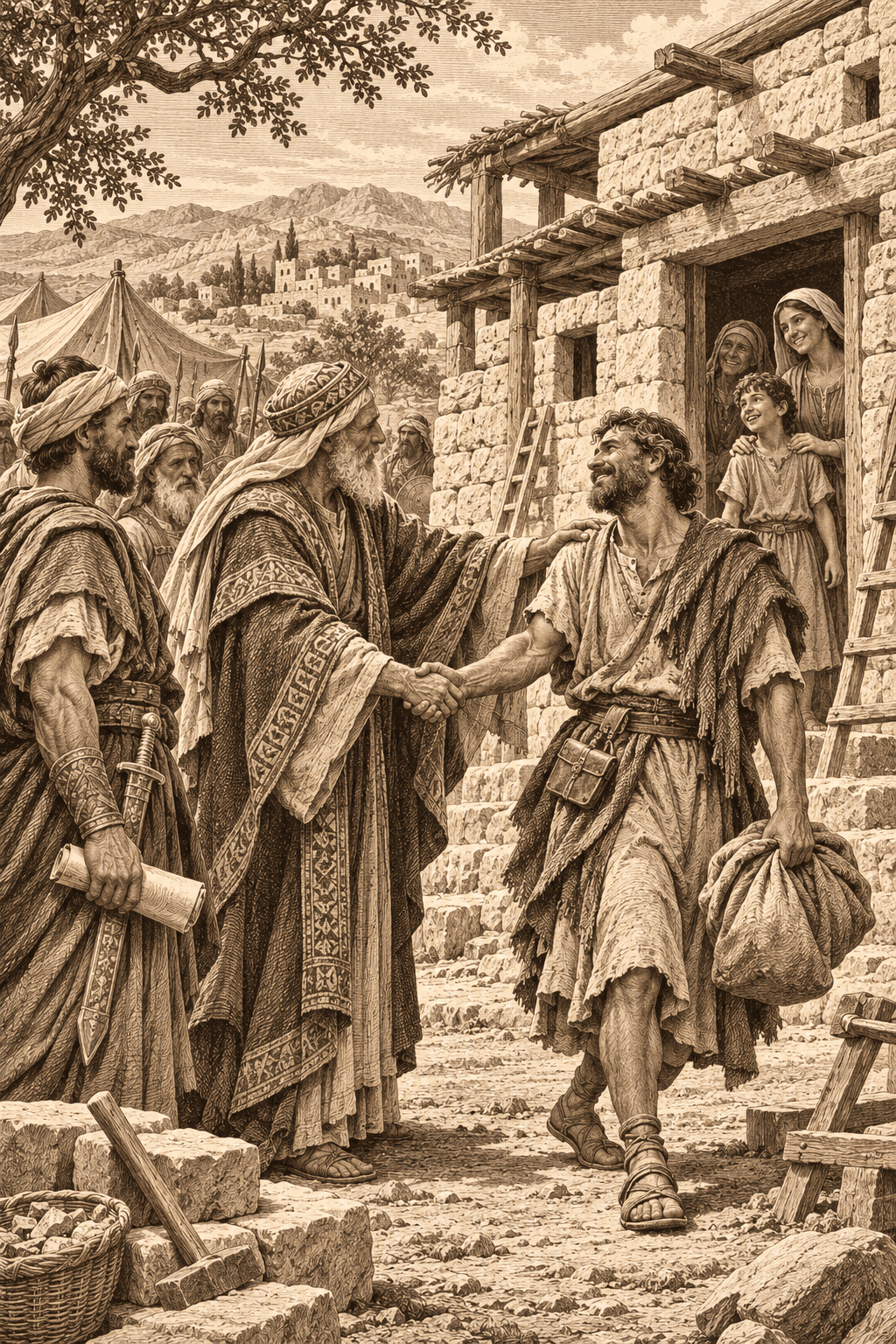
This law concerning wars was given until the people should possess the land in place of the pagan nations; but God’s mind is clear even in the Old Testament that He does not want wars but peace. As the Psalmist says, praising God’s surpassing works: “He maketh wars to cease unto the end of the earth; he breaketh the bow, and cutteth the spear in sunder; he burneth the chariot in the fire. Be still, and know that I am God” (Psalm 46:9–10). And in a vision of Isaiah the prophet concerning the work of the Messiah: “And it shall come to pass in the last days, that the mountain of the Lord’s house shall be established in the top of the mountains… and all nations shall flow unto it… and they shall beat their swords into plowshares, and their spears into pruninghooks: nation shall not lift up sword against nation, neither shall they learn war any more” (Isaiah 2:2–4). And at the birth of the Lord Christ it was said: “on earth peace, good will toward men” (Luke 2:14).
The military law begins with an assurance from God Himself that He is the commander of His people’s army and the Giver of victory (1–4). Therefore He exempts His ministers from military work, not out of contempt for it, but so that they may devote themselves to the worship of God, who gives victory; without them neither the people nor the soldiers are sanctified, and there is no victory (5–9).
Here he speaks of the war undertaken so that the people might inherit the land of Canaan; therefore it may not be applied to political wars. But it applies symbolically to spiritual wars and the struggle for the heavenly Canaan, where the believers take the place of the devil, who fell from among the heavenly orders.
The enemy surpasses God’s people in great numbers and abundant military resources, but none of this should terrify the believers.
When thou goest out to battle against thine enemies, and seest horses, and chariots, and a people more than thou, be not afraid of them: for the Lord thy God is with thee, which brought thee up out of the land of Egypt. [1]
No doubt the people of Israel had no horses or war chariots until the moment of the departure of Moses the prophet, and perhaps until the days of Solomon; so the prophet Moses speaks in general of what would happen later when the people had horses and chariots. The text does not necessarily mean that the people would have fewer horses and chariots, but means military resources in general.
The first principle in spiritual struggle is “not fearing”: “What man is there that is fearful and fainthearted? let him go and return unto his house, lest his brethren’s heart faint as well as his heart” (8). The voice of the fearful melts the hearts of his brothers and crushes them psychologically, while the voice of the Lord of hosts melts the hard mountains, crushes the forces of evil, and grants victory to His believers.
The secret of courage is trust in God, the commander of the spiritual battle: “For the Lord your God is he that goeth with you, to fight for you against your enemies, to save you” (4). The secret of fear is the heart’s attachment to temporal things; therefore whoever has built a new house, or planted a vineyard and not yet eaten of it (that is, offered its firstfruits in the fourth year), or betrothed a wife and not yet married her, is asked to return to his house. It is a symbolic picture of weak souls attached to the world and unable to give themselves spiritually; they are a stumbling block to others.
The commandment “Fear not” is repeated in Holy Scripture, for fear is a mark of lack of faith in God and of trust in His fatherhood, wisdom, and power to save. It is a sin of hidden atheism. Therefore he repeats:
And shall say unto them, Hear, O Israel, ye approach this day unto battle against your enemies: let not your hearts faint, fear not, and do not tremble, neither be ye terrified because of them; [3]
The secret of courage and fearlessness lies in the following:
First: The divine presence in the midst of His people: “for the Lord thy God is with thee” (1); “For the Lord your God is he that goeth with you, to fight for you against your enemies, to save you” (4). As is said in Isaiah the prophet: “Fear thou not; for I am with thee: be not dismayed; for I am thy God: I will strengthen thee; yea, I will help thee; yea, I will uphold thee with the right hand of my righteousness… For I the Lord thy God will hold thy right hand, saying unto thee, Fear not; I will help thee” (Isaiah 41:10, 13).
Second: Our own experiences and our fathers’ past experiences with God our Savior, for he says: “which brought thee up out of the land of Egypt” (1). It is said in the Book of Exodus: “And it came to pass, that in the morning watch the Lord looked unto the host of the Egyptians through the pillar of fire and of the cloud, and troubled the host of the Egyptians, And took off their chariot wheels, that they drave them heavily: so that the Egyptians said, Let us flee from the face of Israel; for the Lord fighteth for them against the Egyptians” (Exodus 14:24–25). “The Lord is a man of war: the Lord is his name. Pharaoh’s chariots and his host hath he cast into the sea” (Exodus 15:3–4). And Miriam sang: “Sing ye to the Lord, for he hath triumphed gloriously; the horse and his rider hath he thrown into the sea” (Exodus 15:21).
Third: All share in this war, each according to his gift and abilities. As the people are obliged to fight, the priest plays his role, coming forward to address the people, affirming the Lord’s presence with them and giving them the Lord’s commandment not to fear. The officers also play their role, separating the fearful from among the men of war so that they do not discourage their brothers. It was the custom of the nations to carry the statues of their gods with them, accompanied by priests as representatives of the gods; every victory achieved was attributed to that nation’s god. So it was necessary for God to declare His presence in the midst of His people during the battle, and for the priests to support them as representatives of God Himself.
And it shall be, when ye are come nigh unto the battle, that the priest shall approach and speak unto the people, And shall say unto them, Hear, O Israel, ye approach this day unto battle against your enemies: let not your hearts faint, fear not, and do not tremble, neither be ye terrified because of them; [2–3]
He speaks here not of the high priest, nor of priests in general, but of the priest who accompanied the army in its battles. We read of the battle against the Midianites in the days of Moses the prophet: “And Moses sent them to the war, a thousand of every tribe, them and Phinehas the son of Eleazar the priest, to the war, with the holy instruments, and the trumpets to blow in his hand” (Numbers 31:6; see also 1 Samuel 4:4; 2 Chronicles 13:12). His main work was to encourage the men of war that God is their commander who supports them and gives them victory.
We ought not to fear in our spiritual war, as Saint John Cassian says:
“Let us learn in everything to feel our natural weakness, and at the same time to perceive His help, so that we say with the saints: ‘Thou hast thrust sore at me that I might fall: but the Lord helped me. The Lord is my strength and song, and is become my salvation’ (Psalm 118:13–14). ‘Unless the Lord had been my help, my soul had almost dwelt in silence. When I said, My foot slippeth; thy mercy, O Lord, held me up’ (Psalm 94:17–18).
“Seeing also that our hearts are strengthened in the fear of the Lord and in patience, we say: ‘the Lord was my stay. He brought me forth also into a large place’ (Psalm 18:18–19). And knowing that knowledge grows by progress in action, we say: ‘For thou wilt light my candle: the Lord my God will enlighten my darkness. For by thee I have run through a troop.’ Then we ourselves feel that we have come to possess courage and patience, and walk in the way of virtue directly and with great ease and without effort, and we say: ‘It is God that girdeth me with strength, and maketh my way perfect. He maketh my feet like hinds’ feet, and setteth me upon my high places. He teacheth my hands to war.’
“We also possess the spirit of discernment, and are strengthened by Him through whom we can overcome our enemies, and cry out to God: ‘Thy discipline has come upon me to the end, and Thy discipline will teach me. Thou hast enlarged my steps under me, that my feet did not slip,’ and because I am thus strengthened by Your help and power, I boldly say these words: ‘I have pursued mine enemies, and overtaken them: neither did I turn again till they were consumed. I have wounded them that they were not able to rise: they are fallen under my feet’ (Psalm 18:37–38).
“Again, we consider our own weakness and know this truth, that while we remain burdened with bodily weakness we cannot overcome such enemies (our sins) without His help, and we say: ‘Through thee will we push down our enemies: through thy name will we tread them under that rise up against us. For I will not trust in my bow, neither shall my sword save me. But thou hast saved us from our enemies, and hast put them to shame that hated us’ (Psalm 44:5–7). And moreover: ‘For thou hast girded me with strength unto the battle: thou hast subdued under me those that rose up against me. Thou hast also given me the necks of mine enemies; that I might destroy them that hate me’ (Psalm 18:39–40). Considering that we cannot conquer with our own weapons, we say: ‘Take hold of shield and buckler, and stand up for mine help. Draw out also the spear, and stop the way against them that persecute me: say unto my soul, I am thy salvation’ (Psalm 35:2–3). ‘Thou hast also given me the shield of thy salvation: and thy right hand hath holden me up’ (Psalm 18:35). Our fathers ‘got not the land in possession by their own sword, neither did their own arm save them: but thy right hand, and thine arm, and the light of thy countenance, because thou hadst a favour unto them’ (Psalm 44:3).
“Finally, with a mind full of zeal we consider all His blessings with thanksgiving, and cry out to Him with deep feelings of the heart for all these things, because we fought and received from Him the light of knowledge, self-control, and discernment; because He supplied us with His own weapons, girded us with virtue, made our enemies flee before us, and gave us strength to crush them and make them as dust before the wind: ‘I will love thee, O Lord, my strength. The Lord is my rock, and my fortress, and my deliverer; my God, my strength, in whom I will trust; my buckler, and the horn of my salvation, and my high tower. I will call upon the Lord, who is worthy to be praised: so shall I be saved from mine enemies’ (Psalm 18:1–3). [229]”
We enter an unbroken chain of wars, followed by successive victories, and a renewed enjoyment of God’s overcoming power through us and in us. The Apostle says: “For the weapons of our warfare are not carnal, but mighty through God to the pulling down of strong holds; Casting down imaginations, and every high thing that exalteth itself against the knowledge of God, and bringing into captivity every thought to the obedience of Christ” (2 Corinthians 10:4–5). And the Psalmist says: “A thousand shall fall at thy side, and ten thousand at thy right hand; but it shall not come nigh thee” (Psalm 91:7). [230]
Saint Gregory of Nyssa sees that Saint Paul resembles David the prophet in his fighting against his enemy, running swiftly before him: “So Paul was a swift and agile fighter; David enlarged his steps as he pursued his enemy; and the Bridegroom in the Song of Songs is likened to a roe leaping swiftly upon the mountains, skipping upon the hills (Song of Songs 2:8–9).” [231]
Saint Augustine says:
“God taught me to be skilled in fighting against the adversaries (the demons), who aim to set up a barrier that hides the kingdom of heaven from me. [232]”
Abba Evagrius of Pontus says:
“When you pray against your passions (your evil lusts) and the demons that attack you, remember the one who said: ‘I have pursued mine enemies, and overtaken them: neither did I turn again till they were consumed. I have wounded them that they were not able to rise: they are fallen under my feet…’ (Psalm 18:37–38). Say this at the decisive moment when you arm yourself against your adversary with humility. [233]”
Excluding the Fearful and Fainthearted
What occupies God’s mind is not the size of the army but the faith of those who join it, for victory is not by numbers or strength, but by the Lord of hosts Himself. Therefore He excluded all the groups that could corrupt the holiness of the army by spreading the spirit of fear and discouragement, for one soldier is better than a thousand full of cowardice and fear.
And the officers shall speak unto the people, saying, What man is there that hath built a new house, and hath not dedicated it? let him go and return to his house, lest he die in the battle, and another man dedicate it. And what man is he that hath planted a vineyard, and hath not yet eaten of it? let him also go and return unto his house, lest he die in the battle, and another man eat of it. And what man is there that hath betrothed a wife, and hath not taken her? let him go and return unto his house, lest he die in the battle, and another man take her. And the officers shall speak further unto the people, and they shall say, What man is there that is fearful and fainthearted? let him go and return unto his house, lest his brethren’s heart faint as well as his heart. And it shall be, when the officers have made an end of speaking unto the people that they shall make captains of the armies to lead the people. [5–9]
The Law required the exemption of four groups from taking part in war, for fear that fear would come upon them and they would be confused during the battle. The fourth group, the fearful and fainthearted, must be excluded completely, for they are like an epidemic that spreads and destroys others. This is what Gideon did with his army, for he proclaimed in the ears of the people as God commanded: “Whosoever is fearful and afraid, let him return and depart early from mount Gilead. And there returned of the people twenty and two thousand; and there remained ten thousand” (Judges 7:3).
The following groups were given the right to withdraw from the camp, so as not to corrupt the morale of the army:
A) Whoever built or bought a new house and had not yet dedicated it (5), that is, had not held a celebration with his friends who come to congratulate him on it, should return home and rest in it, lest he be preoccupied with the house and its celebration during the war. The true soldier has no house to be occupied with, but lives as a stranger on the earth until he settles in God’s bosom, in his heavenly home.
Perhaps the man who built a new house and has not yet dedicated it means one occupied with bodily comfort and temporal blessings, who has not turned his house into a holy church, nor dedicated it and celebrated the Lord’s dwelling in his house; such a one cannot struggle spiritually.
It is clear from the title of Psalm 30, “A Psalm and Song at the dedication of the house of David,” that it was the custom in Israel to dedicate a new house to God with prayer, praise, and thanksgiving. All this affirms the handing over of every house to God, so that He may dwell in the midst of every family and bless it. A believer cannot live in a house and feel safe unless he is sure of God’s care and protection for him. Let us not forget that in many ancient nations the family set apart a part of the house for worship, where they set up idols. For example, the inhabitants of Bonny in Africa often divided their dwellings into three parts: one for the person or family to live in, a second counted a public place for entertaining and feeding others, and a third set apart for the Juju, the serpent-god they worshiped. Even these primitive people believed that in every house their god must find a temple.
Many Copts still have a beautiful tradition: no one lives in a new house without calling the priest and gathering with the family to offer the prayer of “blessing the house,” in which all ask God to dwell in the midst of the family, bless the place, and fulfill the mission of those who live there. Sadly some invite relatives, friends, and neighbors to a party when building or buying a new house, but forget prayer and praise to God. Many Christians, especially in the East, belonging to the apostolic churches, set apart a special room for prayer, or a corner of a room adorned with icons, so that the household feels that the whole house is consecrated to the Lord.
B) Whoever planted a vineyard and spent much on it and has not yet gathered fruit from it. The Hebrew word here means a field or orchard, not necessarily grapevines, but any kind of fruit or olive grove. He longs to enjoy the fruit, and according to the Law he was forbidden to eat its fruit for the first three years (Leviticus 19:23). Such a man, who puts his heart in his stomach and longs to eat and drink with pleasure, even of the labor of his own hands, is not fit to take part in the battle of the Lord Christ. The soldier of Christ ought to have no vineyards, winepresses, or tables to satisfy his lusts, but to eat and drink what he finds at his feet, so as to live and struggle. He is occupied with nothing but readiness to hear the sound of the trumpet calling him to battle.
C) Whoever has betrothed a girl and is preparing the marital home to bring her and marry her: such a man, if his heart is occupied with preparing the house for his bride, is not obliged to go to battle. He represents the person who has not tasted the sweetness of spiritual marital union with God his Savior, and has not yet prepared the place of the heavenly wedding in which to settle; such a person cannot struggle in the spiritual battle. The same book says: “When a man hath taken a new wife, he shall not go out to war, neither shall he be charged with any business: but he shall be free at home one year, and shall cheer up his wife which he hath taken” (Deuteronomy 24:5).
Jewish writers agree that these exemptions were allowed only in wars waged by Israel’s free will; but in those the Lord obliged them to fight, such as fighting Amalek and the Canaanites, all the men were obliged without exception.
When the fearful and fainthearted are removed, the officers appoint captains full of courage and certainty in God’s work with them.
We ought here to distinguish between the person who feels his weakness and inability but trusts in God’s power with him and through him, and the person who is faint and fainthearted. For God works powerfully in the weak, but does not support one who does not trust in Him and lean on Him.
This fear springs from corruption in the conscience; therefore it is said: “Sanctify the Lord of hosts himself; and let him be your fear, and let him be your dread” (Isaiah 8:13). The danger of the faint lies in that when they occupy positions of leadership they spread the spirit of discouragement in others, and their disease seeps into others; they neither do the Lord’s work nor let others do it. The danger of the faint is bitterer and harsher than that of the enemies opposing the truth and the Church of Christ; for of the latter it is said that God judges them with a rod of iron, but the faint take away God’s grace from many and hide His power from them.
The Lord Christ asks us to count the cost before entering any battle: “Or what king, going to make war against another king, sitteth not down first, and consulteth whether he be able with ten thousand to meet him that cometh against him with twenty thousand? Or else, while the other is yet a great way off, he sendeth an ambassage, and desireth conditions of peace” (Luke 14:31–32). Elisha the prophet realized that those with him were more than those against him. And David the prophet sinned greatly when he counted the cost by human calculations, ignoring the element of faith, and took a census of his people (2 Samuel 24:2, etc.).
The aim of this law of war is to affirm that we belong to God: what He loves we love, and the darkness, corruption, and defilement He cannot bear become our enemy. We have nothing in ourselves. Our battles are God’s battle with darkness. We are not a party in it; we hide in God, so that He fights through us and in us, declaring His surpassing victory.
2. Besieging Cities Outside Canaan
KJV · Verses 10–15
10 When thou comest nigh unto a city to fight against it, then proclaim peace unto it. 11 And it shall be, if it make thee answer of peace, and open unto thee, then it shall be, that all the people that is found therein shall be tributaries unto thee, and they shall serve thee. 12 And if it will make no peace with thee, but will make war against thee, then thou shalt besiege it: 13 And when the Lord thy God hath delivered it into thine hands, thou shalt smite every male thereof with the edge of the sword: 14 But the women, and the little ones, and the cattle, and all that is in the city, even all the spoil thereof, shalt thou take unto thyself; and thou shalt eat the spoil of thine enemies, which the Lord thy God hath given thee. 15 Thus shalt thou do unto all the cities which are very far off from thee, which are not of the cities of these nations.
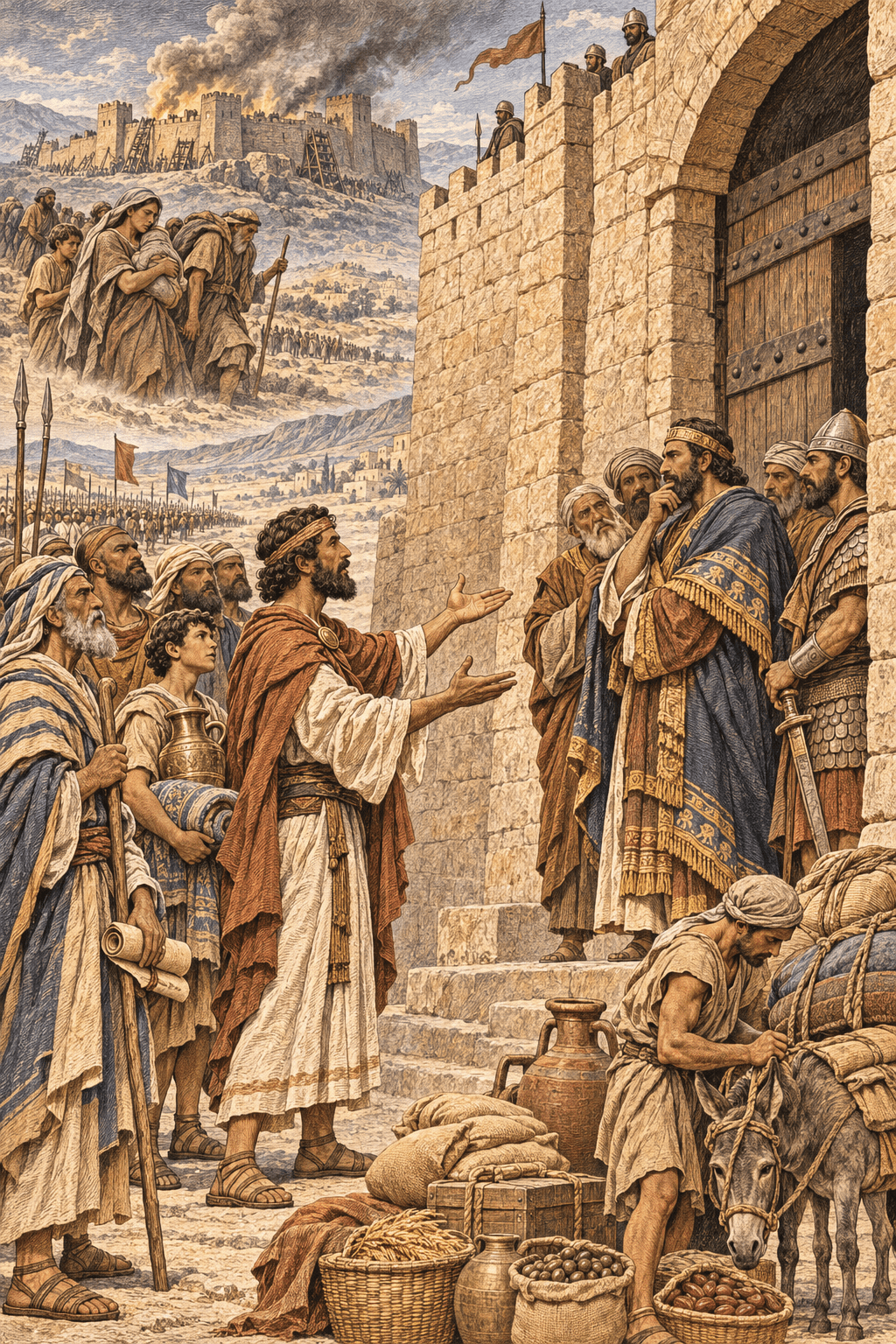
As for distant nations, they send to them to make covenants of peace; if they accept, they serve God and His people (10–15). They may not go into battle with neighbors without first making a public proclamation in which they ask for peace.
(See verses 10–15 above.)
Commentators differ in explaining this passage. Some see that it applies to the lands neighboring the Promised Land and not to the seven nations in Canaan, because leaving any remnant of the seven nations among the people would be a stumbling block to them, drawing them to the worship of pagan gods and the practice of abominations. Others see that it applies to these nations too, where the terms of peace are:
1. Renouncing idol worship and entering the worship of the living God.
2. Submitting to the Jews.
3. Paying an annual tribute.
Whoever did not accept these terms, if the city was of the seven nations, they left nothing alive in it; but if it was of the neighboring cities, they killed the men and kept the women and children with the animals and all its spoil. The reason for the distinction was to leave no trace of idol worship in the midst of the people.
Submission to hard labor was a fulfillment of Noah’s curse on Canaan (Genesis 9:25).
As for distant lands not belonging to the Promised Land, peace could be sought with them and their people made tributaries (Deuteronomy 20:10–15). It is a symbolic picture of the spiritual man’s inner desire for peace, together with turning energies from working for evil into energies submitted to the kingdom of God within us.
3. The Devoted Cities
KJV · Verses 16–18
16 But of the cities of these people, which the Lord thy God doth give thee for an inheritance, thou shalt save alive nothing that breatheth: 17 But thou shalt utterly destroy them; namely, the Hittites, and the Amorites, the Canaanites, and the Perizzites, the Hivites, and the Jebusites; as the Lord thy God hath commanded thee: 18 That they teach you not to do after all their abominations, which they have done unto their gods; so should ye sin against the Lord your God.
As for the nations living in the Promised Land, they had to be fought, lest they draw the people’s hearts to apostasy, pagan worship, and the practice of abominations (16–18). The nations whose land the ancient people came to enjoy symbolized sin, so their destruction points to the crushing of every evil. Historically these peoples were extremely violent, offering children as burnt offerings to the gods and offering women and girls for fornication in the service of the pagan gods, with other horrible abominations; therefore they were a danger of leading God’s people astray (Deuteronomy 20:18). No mercy was used with these nations, because corruption had spread and its inhabitants had destroyed their own eternity, and the matter had become dangerous even for the people of Israel once they occupied it, if any traces of their worship remained.
4. Dealing with the Trees of the Cities
KJV · Verses 19–20
19 When thou shalt besiege a city a long time, in making war against it to take it, thou shalt not destroy the trees thereof by forcing an axe against them: for thou mayest eat of them, and thou shalt not cut them down (for the tree of the field is man’s life) to employ them in the siege: 20 Only the trees which thou knowest that they be not trees for meat, thou shalt destroy and cut them down; and thou shalt build bulwarks against the city that maketh war with thee, until it be subdued.
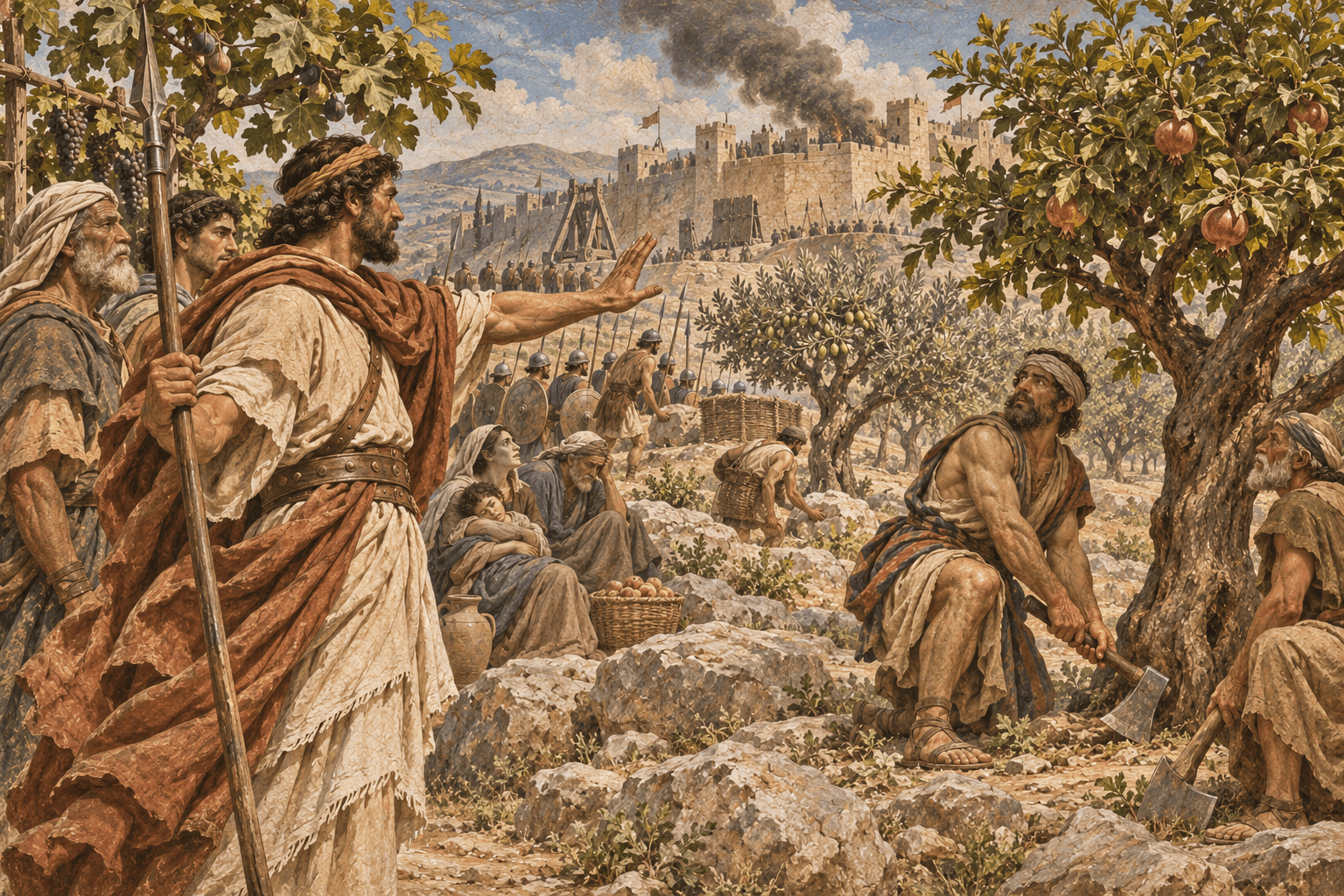
Trees that give fruit for food may not be cut down (Deuteronomy 20:19), for they are God’s good creation. If God cares even for trees, does He not care for man?! So the command to destroy the pagans did not come from harshness in the Law; they put themselves under distress by their evil and the hardness of their hearts.
The obligation to destroy trees that do not bear fruit… was perhaps to remove every trace of idol worship, for the pagans were accustomed to worship under every green tree (Jeremiah 2:20).
(See verses 19–20 above.)
By this God made clear to the people that war should not aim at destruction. Soldiers in their enthusiasm cut down the trees of the field that bear fruit and make them barriers in the road to protect themselves from the enemy, so destroying the trees and fields they would take over, destroying what is for their food and life. The army must control itself and act only in a spirit of wisdom, for what builds them up.
The Jews understood this commandment in a broader sense: it means not only not destroying trees that bear fruit, but also not breaking useful vessels, tearing clothes that could be used, filling in wells, demolishing buildings, and so on. We ought to look to the Lord Christ, who took care to gather the fragments so that society would not lose them.
If life in its essence is a continuous battle, or a series of battles in which the believer enjoys continual victory, he ought to be wise in his struggle. He should not be rash, but know how to discern in the battle what is for building up and what is for tearing down, destroying the unfruitful trees and preserving the fruitful ones.
A person may think himself strong and show off his muscles by cutting down fruitful trees, not realizing that refraining from cutting them down and preserving them during battles requires greater strength, for tearing down is easier than building.
May we, in our spiritual struggle, cause no one to stumble or crush anyone’s spirit, and so uproot a fruitful tree instead of preserving it.
5. A Meditation on Deuteronomy 20
Accept Me as a Soldier in the Army of Your Salvation
Accept me as a soldier in the army of Your salvation.
Accept me as a soldier in the army of Your goodness.
I will never fear all the powers of the devil and his hosts,
for You are the Commander, the Giver of victory.
Behold, the enemy is great in number, strong and deceitful,
but He who is with us is greater and mightier!
I will not retreat, nor will my heart faint, for You dwell in it!
You are in me and I am in You.
You go before me and fight for me.
Let me join the army of Your salvation!
My heart is not occupied with a new house, a vineyard, or a wife.
I have no house to be occupied with but Your Church established in me.
She is old and new, for You dwell in her, O Ancient of Days and Giver of renewal.
You are my home, You are my joy, You are the Bridegroom of my soul!
I do not fear death, for You are my life!
How can I fear, O You who dwell in our midst!
The experiences of our fathers declare Your surpassing victory!
Let me offer every gift and ability You have given me,
and remove all fear from my heart!
Grant me, if possible, to make peace with every human being!
Grant me not to make a covenant with evil!
Let me be gentle with every sinner,
and look at him, and see him coming in glory on the great day of the Lord,
for You are the Savior of sinners!
Grant me not to be gentle with sin,
but to destroy its kingdom that creeps in to occupy my depths!
You asked Your people to be gentle with trees;
grant me a merciful heart that is gentle with all creation, even the inanimate!
You created the world for me, not to destroy it,
but to work in it, that You may bless it with fruits!
Grant me to care for every newly planted tree,
so that Your garden is filled with the trees of the saints bearing the fruits of the Spirit!
Let me be a strong warrior and a gentle soldier.
Let me love the truth and be gentle with every weak one!
Notes and References
[228] Pulpit Commentary, Deuteronomy, p. 331.
[229] St. John Cassian, Institutes, 12:17.
[230] See the author’s commentary on the Psalms, Psalm 18.
[231] St. Gregory of Nyssa, On the Beatitudes, Sermon 2.
[232] St. Augustine, On the Psalms, 17 (18).
[233] Evagrius of Pontus, Chapters on Prayer, 135.