
The prophet Moses did not stop at the negatives, attacking the people’s reliance on their own righteousness, but asked them to walk in a positive spirit. They ought to meditate on the abundance of God’s grace and the riches of His gifts to them. For even after their fall into idolatry, their attachment to the golden calf, and their worship of it, the Lord accepted to forgive them and granted them countless gifts. He mentions four of them: rewriting the two tablets of the Law; preserving the Levitical priesthood after Aaron, the first high priest, had committed a grave error; setting apart the tribe of Levi for His service; and accepting Moses’ intercession for them.
1. Rewriting the Tablets of the Covenant
KJV · Verses 1–5
1 At that time the Lord said unto me, Hew thee two tables of stone like unto the first, and come up unto me into the mount, and make thee an ark of wood. 2 And I will write on the tables the words that were in the first tables which thou brakest, and thou shalt put them in the ark. 3 And I made an ark of shittim wood, and hewed two tables of stone like unto the first, and went up into the mount, having the two tables in mine hand. 4 And he wrote on the tables, according to the first writing, the ten commandments, which the Lord spake unto you in the mount out of the midst of the fire in the day of the assembly: and the Lord gave them unto me. 5 And I turned myself and came down from the mount, and put the tables in the ark which I had made; and there they be, as the Lord commanded me.
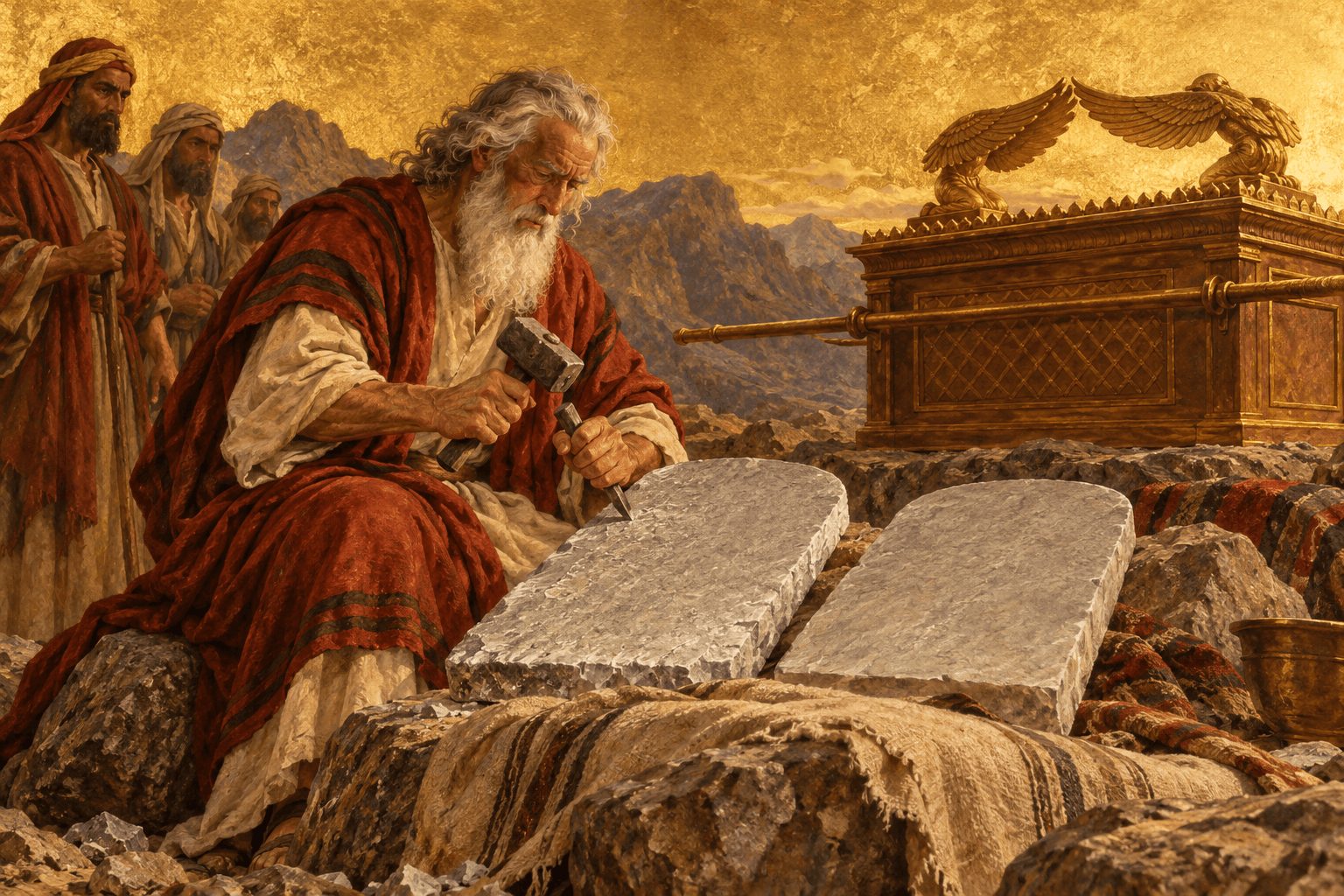
God is wonderful in His love for man and His longing to cleave to him. Despite the horror of what the people did at the most critical moments, as we saw in the previous chapter, in the midst of this corruption He returned to write for them anew with His finger the same commandments on two other tablets of stone, to be placed in the ark of the covenant, declaring His desire for reconciliation and for establishing the covenant as it were anew.
At that time the Lord said unto me, Hew thee two tables of stone like unto the first, and come up unto me into the mount, and make thee an ark of wood. And I will write on the tables the words that were in the first tables which thou brakest, and thou shalt put them in the ark. [1–2]
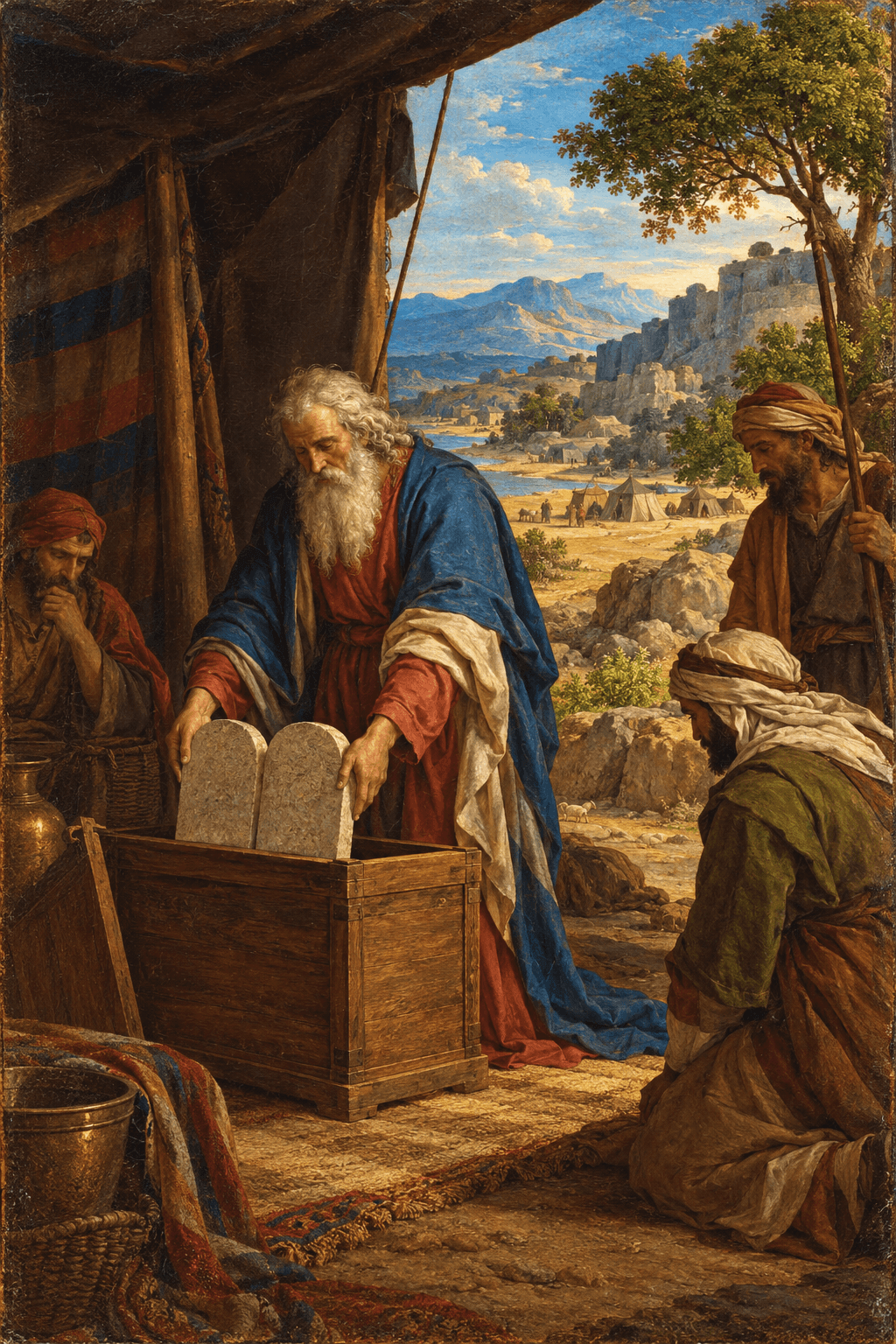
What did God ask of Moses?
First: To hew two tablets of stone. If our hearts have turned to stone because of sin, they must be struck with sharp tools, that is, by the work of the fiery Holy Spirit, who convicts of sin and grants the heart humility and contrition, so that it receives the new commandment within it. Instead of relying on self-righteousness, we should ask the Spirit of the Lord to grant us the spirit of humility; then the Lord stretches out His finger and engraves His commandment in our depths.
Second: To go up to God on the mountain. The Lord speaks with the crowds at the foot of the mountain, but He offers His surpassing mysteries on the high mountains, to the souls that leave the foot of the mountain and ascend by the Spirit of the Lord, as with the Lord Christ Himself, and see Him transfigured on the top of Mount Tabor. The Psalmist cries out: “I will lift up mine eyes unto the hills, from whence cometh my help” (Psalm 121:1). Let us flee to the mountains, as the Lord Christ taught us (Mark 13:14). As Origen the Scholar says: “Whoever flees ought to know the place to which he should flee. [102]” Let us leave all our daily attachments, our joys and our troubles, and go up to the Lord, so that we may meet Him and enjoy the fiery touches of His hand, engraving on our hearts the commandment of fiery divine love.
Third: “Make thee an ark of wood.” The first thing God asked Moses to make, through Bezaleel, when setting up the tabernacle of the congregation was the ark of the covenant. And here He asks him to make an ark of wood overlaid with gold within and without (Exodus 25:10; 37:1). Did He ask Moses to make another ark?!
In any case, Moses could not present the two hewn tablets for God to write on them with His finger unless he had prepared the wooden ark in which to keep them. What is this wooden ark but the cross of our Lord Jesus Christ, in which the commandment is kept without being broken? Whoever cleaves to the cross of Christ and shares His crucifixion receives the commandment and keeps it in his heart.
Fourth: To receive from God the two written tablets and place them in the ark. This is God’s surpassing gift: that we accept His covenant and carry His commandment with all care in our hearts, which share in the cross of Christ, as a living treasury for it.
Fifth: In complete obedience to God and great love for the people, Moses placed the two tablets in the ark and presented them to the people:
And I made an ark of shittim wood, and hewed two tables of stone like unto the first, and went up into the mount, having the two tables in mine hand. And he wrote on the tables, according to the first writing, the ten commandments, which the Lord spake unto you in the mount out of the midst of the fire in the day of the assembly: and the Lord gave them unto me. And I turned myself and came down from the mount, and put the tables in the ark which I had made; and there they be, as the Lord commanded me. [3–5]
What Moses enjoyed of gifts was on behalf of the people; he went down to them and gave them what the Lord had handed to him. So we ought to long for every soul to enter into the experience of the new life that has become ours in Christ Jesus. The loving servant is the one who gives to others, not from what is his own, but from what the Lord has given him.
What He wrote on the tablets was exactly what He had written before on the earlier tablets, for the word of God needs no correction or amendment; it stands forever.
He wrote ten commandments, or words, not ten volumes; for mankind is not saved by many words, but by the word of God mingled with His practical love.
Sixth: Having received the tablets of the covenant, the people were able to move toward Canaan: “And the children of Israel took their journey from Beeroth of the children of Jaakan to Mosera” (6). Together with the commandment they enjoyed wells of water and then moved on. So we accept the Lord’s commandment and enjoy the waters of the Holy Spirit, who leads us toward the heavenly Canaan. We ought to begin our journey from the wells, where the waters of baptism and the enjoyment of sonship to God are, and continue to enjoy these wells: “From thence they journeyed unto Gudgodah; and from Gudgodah to Jotbath, a land of rivers of waters” (7).
“The children of Jaakan”: A Hebrew name meaning “sons of Jaakan,” the name of a tribe probably descended from Seir the Horite. The children of Israel gave this name to the wells, and it was at Beeroth. It is said to be the present-day el-Birein, six miles south of el-Auja (Numbers 33:31–32).
“Mosera” or Moseroth: A Hebrew name meaning “bond” or “bonds,” near Mount Hor (Numbers 33:30–31).
“Gudgodah” or Hor-hagidgad: A Hebrew name meaning “cave of Gidgad” (Numbers 33:32). It may lie at Wadi Ghadaghed, belonging to Wadi Jerafi, north of Kuntilet Jerafi, north-northwest of the Gulf of Aqaba.
“Jotbath”: A Hebrew name meaning “goodness,” one of the encampments of the children of Israel in the wilderness (Numbers 33:33), in the west of the wilderness. It is thought to be Taba, 22 miles north of Aqaba.
2. Preserving the Levitical Priesthood
KJV · Verses 6–7
6 And the children of Israel took their journey from Beeroth of the children of Jaakan to Mosera: there Aaron died, and there he was buried; and Eleazar his son ministered in the priest’s office in his stead. 7 From thence they journeyed unto Gudgodah; and from Gudgodah to Jotbath, a land of rivers of waters.
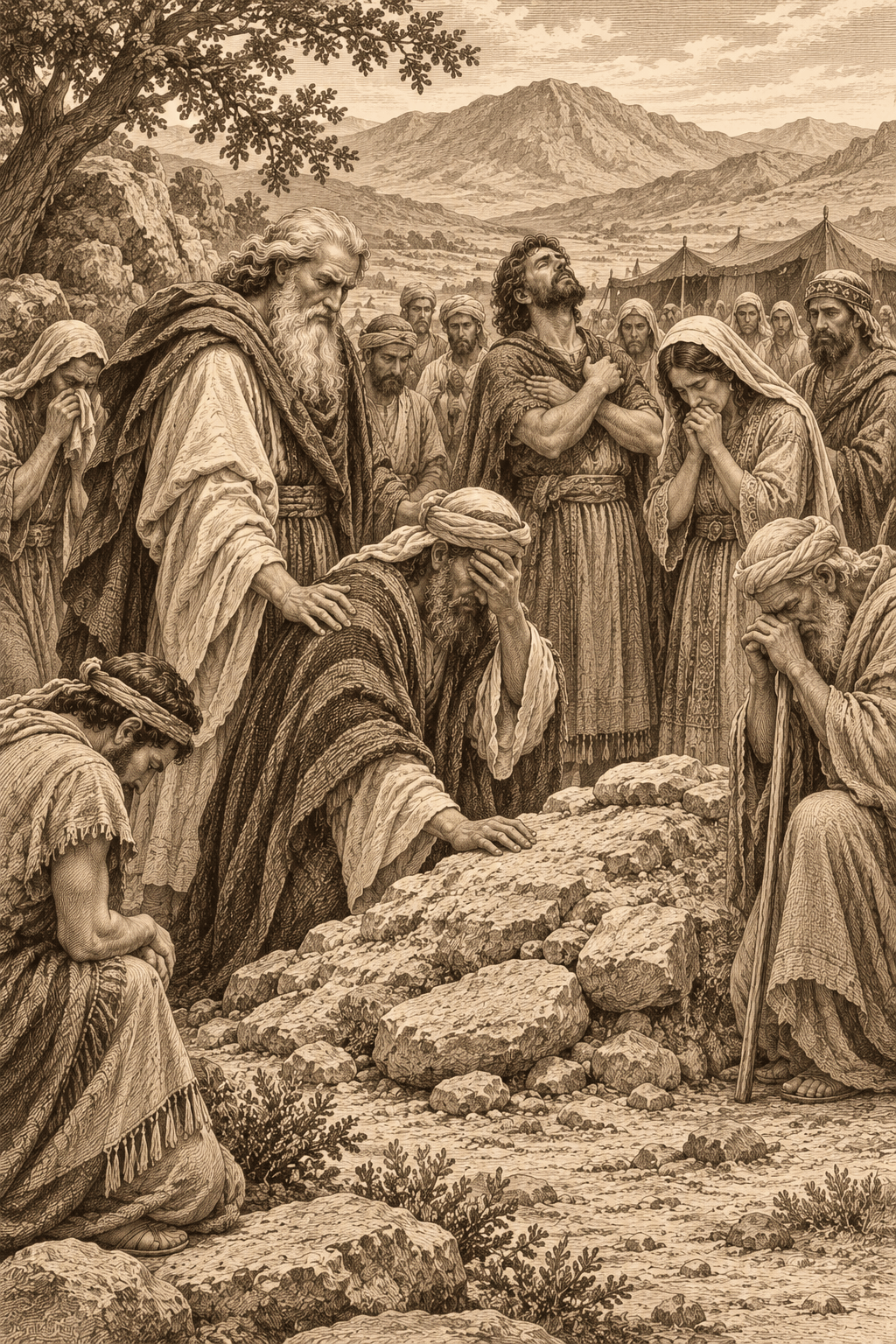
The Lord was very angry with Aaron to destroy him (Deuteronomy 9:20), but his brother Moses prayed for him, and the Lord accepted his prayer for him. Therefore Aaron completed his priestly work, and his son received the work after him.
(See verses 6–7 above.)
In place of Aaron, Eleazar, the new high priest, walked with the people and set out with them toward Canaan, to “a land of rivers of waters” (7). For the work of the high priest is to bring God’s people to the springs of the waters of the Holy Spirit, which transform their barren wilderness into a heavenly paradise bearing the fruits of the Spirit.
3. Setting Apart the Tribe of Levi for His Service
KJV · Verses 8–9
8 At that time the Lord separated the tribe of Levi, to bear the ark of the covenant of the Lord, to stand before the Lord to minister unto him, and to bless in his name, unto this day. 9 Wherefore Levi hath no part nor inheritance with his brethren; the Lord is his inheritance, according as the Lord thy God promised him.
God showed His tenderness toward His people after their fall into the worship of the calf and Moses’ prayer for them, for He again affirmed the setting apart of the tribe of Levi for His service, and that He Himself, not the land, would be their portion.
(See verses 8–9 above.)
God’s choice of Aaron and his sons as priests, so that He Himself would be their portion, is a living picture of God’s free gift of Himself, not on account of self-righteousness.
The tribe of Levi carried the ark of the covenant that kept the tablets of the Law, as if they were carrying the holy divine commandment as the secret of life and blessing for all who receive it working in their lives and dwelling in their hearts.
4. Accepting Moses’ Intercession for Them
KJV · Verses 10–11
10 And I stayed in the mount, according to the first time, forty days and forty nights; and the Lord hearkened unto me at that time also, and the Lord would not destroy thee. 11 And the Lord said unto me, Arise, take thy journey before the people, that they may go in and possess the land, which I sware unto their fathers to give unto them.
Because of the worship of the calf the procession was halted, but Moses remained forty days fasting and praying, interceding for his people so that they would not perish. The Lord accepted his prayer and asked him to move on with the people so that they might enter and possess the land.
(See verses 10–11 above.)
Moses was a symbol of the Lord Christ, who fasted for us and gave Himself to reconcile us with His Father, so that we should not perish, but enter through Him into the bosom of the Father and inherit eternal glory with Christ.
Father Caesarius of Arles says:
“While there is much in the world to be loved, it is better that it be loved through our relationship with Him who created it. The world is beautiful, but He who made it is more beautiful. The world is glorious, but He who founded the world is more delightful. Therefore, dearly beloved, we must strive as far as we can to love the world without being swallowed up by it, and not to love the creature more than the Creator. God gives us earthly possessions so that we may love Him with all our heart and soul. Yet we sometimes provoke God’s anger against us when we love His gifts more than God Himself.
“The same happens in human relationships. Suppose a man gives a special gift to someone under his guardianship, and the one under his care begins to belittle the giver and to love the gift more than the one who gave it; suppose he thinks of the giver not as a friend but as an enemy. So it is in our relationship with God: we love most those who love us for our own sake and not for the sake of our gifts to them. So God is known to love those who love Him more than they love the earthly gifts He grants. [103]”
5. A Call to Fear the Lord and Cleave to Him
KJV · Verses 12–22
12 And now, Israel, what doth the Lord thy God require of thee, but to fear the Lord thy God, to walk in all his ways, and to love him, and to serve the Lord thy God with all thy heart and with all thy soul, 13 To keep the commandments of the Lord, and his statutes, which I command thee this day for thy good? 14 Behold, the heaven and the heaven of heavens is the Lord’s thy God, the earth also, with all that therein is. 15 Only the Lord had a delight in thy fathers to love them, and he chose their seed after them, even you above all people, as it is this day. 16 Circumcise therefore the foreskin of your heart, and be no more stiffnecked. 17 For the Lord your God is God of gods, and Lord of lords, a great God, a mighty, and a terrible, which regardeth not persons, nor taketh reward: 18 He doth execute the judgment of the fatherless and widow, and loveth the stranger, in giving him food and raiment. 19 Love ye therefore the stranger: for ye were strangers in the land of Egypt. 20 Thou shalt fear the Lord thy God; him shalt thou serve, and to him shalt thou cleave, and swear by his name. 21 He is thy praise, and he is thy God, that hath done for thee these great and terrible things, which thine eyes have seen. 22 Thy fathers went down into Egypt with threescore and ten persons; and now the Lord thy God hath made thee as the stars of heaven for multitude.
In the previous chapter he set forth bitterly the horror of what Israel had done from their call to come out of Egypt until the moment Moses was speaking with them. He focused on their fall in casting the golden calf and worshiping it, with the high priest himself sharing in the deed, and he focused too on their continual murmuring, which did not happen once or twice as moments of weakness they passed through, but had become like a nature working in them. Now, in a spirit of joyful hope, he urges them to godliness, that is, to enjoy the fear of the Lord and to cleave to Him, making the following points clear:
First: God does not need man’s service or gifts, but asks for his heart and his sincere love.
And now, Israel, what doth the Lord thy God require of thee, but to fear the Lord thy God, to walk in all his ways, and to love him, and to serve the Lord thy God with all thy heart and with all thy soul, To keep the commandments of the Lord, and his statutes, which I command thee this day for thy good? Behold, the heaven and the heaven of heavens is the Lord’s thy God, the earth also, with all that therein is. [12–14]
The words “the heaven and the heaven of heavens” all come in the plural; what is meant by them? Some think the first refers to the firmament of the sky, the second to outer space with its planets and stars, and the third, “the heaven of heavens,” to the place of the saints in eternity together with the ranks of the heavenly orders.
Saint John Chrysostom says:
“He needs nothing that we can give Him, and this is a special proof of pure love: when He who needs nothing, and has no need of us, does everything so that we may love Him. Therefore Moses says, ‘What doth the Lord thy God require of thee, but to love him, and to be ready to walk after him?’ (12). When He commands you to love Him, He shows above all that He loves you. Nothing secures our salvation like loving Him. [104]”
What Does God Require of You?
This is a question the prophet Moses put to his people near the end of his life on earth. Every believer ought to repeat it in his heart and mind, to examine himself and answer it with all faithfulness.
God had asked the prophet Moses to hew two tablets of stone for Him and to make an ark of wood (1), and God Himself wrote the commandment… What, then, did He ask of the people?
He did not ask them to offer animal sacrifices, nor did He remind them of the laws of purification. This was not because they were unimportant, but because God had established Eleazar the son of Aaron as priest (6) and confirmed the setting apart of the tribe of Levi for His service (8). He knew that the people readily respond to carrying out rites, but He feared that the people would be occupied with outward forms and lose the inner depths of fellowship with God. Therefore the divine commandments in the farewell discourses of the prophet Moses emphasize the believers’ love for God and their fear of Him with all the heart and soul, and obedience to the commandment. He also focused on love of neighbor, especially orphans, widows, and strangers; by this He makes them shining stars in the sky (22).
The answer to the question “What doth the Lord thy God require of thee?” is:
A) He asks nothing for Himself, for the heaven of heavens, the earth, and all that is in it belong to the Lord; He lacks nothing. As the Psalmist says: “Thou art my Lord: my goodness extendeth not to thee” (Psalm 16:2).
Saint Gregory of Nyssa says:
“God does not need our goodness; rather, we need His goodness. [105]”
Saint John Chrysostom says:
“Tell me, what profit is it to God that I am righteous? And what harm does it do Him if I am wicked? Is not His nature incorruptible? It suffers no harm and is above all suffering. Slaves, however rich, have nothing of their own; what they have belongs to their masters. [106]”
B) He asks what is yours: that you fear Him, that is, that you enjoy His fear, which is the beginning of wisdom and a guide for you in your life. It is the fear bound up with love, the fear of a son who is afraid of wounding his father’s feelings.
In this book the prophet Moses often speaks of “the fear of the Lord,” mingling fear with love, as in the preceding words. Abba Martyrius says: “It is fitting that you stand before God with a watchful, alert mind, with trembling and fear, together with a spirit aflame with joy and deep love [107]” (Romans 12:11–12).
The spiritual person, full of love for God, also bears a holy fear that gives him seriousness in his life mingled with peace. Saint John Chrysostom says:
“The one who jests in his dealings is not a saint. For where there is impurity there is jesting; where there is untimely laughter there is jesting. Listen to the prophet’s words: ‘Serve the Lord with fear, and rejoice with trembling’ (Psalm 2:11). Jesting hands the soul over to luxury and sloth. It stirs up the soul in an unseemly way, so that it often inclines to acts of violence and stirs up wars. [108]”
C) That you walk in all His ways, not turning aside to the right hand or to the left, but enjoying the royal divine way. Do not walk according to your own whims, nor according to the ways of people that may lead you astray, but bear the will of God working in you.
D) That you love Him, so that you realize His love for you and experience the true warmth of His fatherhood and friendship.
E) That you serve Him with all your heart and all your soul, so that you gain the honor of standing before Him and fellowship with the heavenly beings in their heavenly life, and that you keep His commandments and statutes as the source of life, satisfaction, delight, and enlightenment!
Second: God desires to cleave to us, so that we may enjoy Him as our life.
Only the Lord had a delight in thy fathers to love them, and he chose their seed after them, even you above all people, as it is this day. [15]
His choice of us is only because He seeks our life, offering Himself as the source of life. Clearly the commandments in this chapter begin with man’s obligations toward God, to love Him, fear Him, and serve Him; then with the obligation toward the neighbor, especially orphans, widows, and strangers; and finally toward man himself, so that he may be counted among the shining stars of heaven.
He affirmed in more than one place that the Lord is the portion of His people, and in this chapter He affirms that He is the portion of His servants the Levites. This is not because He needs them, for to Him belong “the heaven and the heaven of heavens, the earth also, with all that therein is” (14), but so that they may cleave to Him and so live and possess. The Owner of heaven, the heaven of heavens, and all the earth becomes theirs.
Third: God asks for the circumcision of the heart.
Circumcise therefore the foreskin of your heart, and be no more stiffnecked. [16]
Clearly, from the Old Testament on, God did not ask through His statutes and commandments for purely bodily practices, but for what touches our inner being. If He set the circumcision of the body as a sign of accepting the covenant with God, what He asks for is the circumcision of the heart and spirit. He does not ask for cutting off a part of man’s body, but for cutting off the roots of corruption and sin from the depths of the soul. By the circumcision of the heart the believer can fulfill the great commandment, which is to listen to God and love Him with all the heart, all the soul, and all the strength, and so fulfill the whole Law.
As the Apostle Paul says: “For he is not a Jew, which is one outwardly; neither is that circumcision, which is outward in the flesh: But he is a Jew, which is one inwardly; and circumcision is that of the heart, in the spirit, and not in the letter” (Romans 2:28–29).
The prophet links the circumcision of the heart with not being stiffnecked, for whoever accepts spiritual circumcision and practices, by the Spirit, dying to the lusts of the flesh, has his depths bowed in obedience to God with great joy, and is inwardly ready to bear the yoke of Christ with delight and longing.
Fourth: He calls us to belong to God Himself, who is our God, the Lord of lords and God of gods, who longs for us to become lords and gods, bearing His likeness and becoming a living icon of Him, so that He is Lord of lords and God over gods. In this He longs for all to belong to Him, without partiality and not by bribery; rather, He belongs to us when our depths are sanctified.
For the Lord your God is God of gods, and Lord of lords, a great God, a mighty, and a terrible, which regardeth not persons, nor taketh reward: [17]
Note the highest thought of the oneness of God in verse 17, for this idea runs through the whole book and is the cornerstone of its teaching. He is the awesome, mighty God, before whom pagan gods and false lords cannot stand. He longs to be joined to the humble person, not out of weakness, inability, or need, but through love.
Fifth: He calls us to care for the rejected, the needy, the outcast, and strangers, imitating Him.
He doth execute the judgment of the fatherless and widow, and loveth the stranger, in giving him food and raiment. Love ye therefore the stranger: for ye were strangers in the land of Egypt. [18–19]
When the believer experiences God’s mercies and His care for him, especially when he was in need or distress, he must return this love with love toward the needy and those in distress. So the prophet links our love for our brothers with our love for God Himself.
Sixth: The call to fear the Lord, cleave to Him, and take pride in Him, remembering His continual wonders with us.
Thou shalt fear the Lord thy God; him shalt thou serve, and to him shalt thou cleave, and swear by his name. He is thy praise, and he is thy God, that hath done for thee these great and terrible things, which thine eyes have seen. Thy fathers went down into Egypt with threescore and ten persons; and now the Lord thy God hath made thee as the stars of heaven for multitude. [20–22]
We praise God, not only the One we hear about, nor only the One who did wonders with our fathers, but we enjoy the experience of life with Him. As Saint John the Beloved says: “That which we have seen with our eyes, which we have heard with our ears, which our hands have handled, of the Word of life” (1 John 1:1).
It is strange that many of the wicked take pride in belonging to the devil, while some believers are ashamed to declare their faith in God and to speak about Him.
Finally he closes this chapter by affirming God’s work founded on His love and His choice: “Thy fathers went down into Egypt with threescore and ten persons; and now the Lord thy God hath made thee as the stars of heaven for multitude” (22).
Saint Gregory of Nyssa says:
“Those who went down into Egypt were seventy-five souls (Acts 7:14; Genesis 46:27; Deuteronomy 10:22). We understand from this that they were not bare souls but people with bodies; so when we hear that Christ became flesh, or took flesh, He took the whole human nature. [109]”
6. A Meditation on Deuteronomy 10
Make Me a Priest, O Great High Priest
By my abominations I broke my covenant with You,
yet You ask me to hew two stones with Moses.
My heart has turned completely to stone;
who can engrave Your law on it but Your fiery Spirit!
Turn my heart into two tablets of the covenant that I may place in the ark of Your covenant.
Let me carry the ark with the priests, as You sanctify my whole being!
I sinned with Aaron Your high priest and cast an image for myself!
Restore to me the honor of my priesthood
by forgiving me and sanctifying my heart!
I have corrupted the work of the priesthood;
return and work in me,
that I may remember that You are my portion, O You who satisfy my depths!
Moses interceded for Aaron and the whole people.
Your blood intercedes for me and restores Your righteousness to me.
In shame I confess to You:
How many times have I broken Your covenant?
How many times have I marred the beauty of Your work in me?
How many times have I forgotten my priesthood?
Now I return to You in the spirit of godly fear.
Bring me back to You, for You, You are my all.
Notes and References
[102] Origen, Commentary on Matthew, 41.
[103] Fr. Caesarius of Arles, Sermon 159:6.
[104] St. John Chrysostom, Homilies on 2 Corinthians, 30:4.
[105] St. Gregory of Nyssa, Commentary on the Song of Songs, Sermon 4.
[106] St. John Chrysostom, Homilies on 1 Timothy, 16.
[107] Martyrius (Sahdona), Book of Perfection, 2.
[108] St. John Chrysostom, Homilies on Ephesians, 17.
[109] See St. Gregory of Nyssa, Against Eunomius, Book 2:13.