
After defining the holy land and appointing the committee for its division, He declared His care for His ministers, who inherit no land but dwell in certain cities, some of which He set apart as a refuge for those who kill a person unawares (see Deuteronomy 19).
1. The Cities of the Levites
KJV · Verses 1–5
1 And the Lord spake unto Moses in the plains of Moab by Jordan near Jericho, saying, 2 Command the children of Israel, that they give unto the Levites of the inheritance of their possession cities to dwell in; and ye shall give also unto the Levites suburbs for the cities round about them. 3 And the cities shall they have to dwell in; and the suburbs of them shall be for their cattle, and for their goods, and for all their beasts. 4 And the suburbs of the cities, which ye shall give unto the Levites, shall reach from the wall of the city and outward a thousand cubits round about. 5 And ye shall measure from without the city on the east side two thousand cubits, and on the south side two thousand cubits, and on the west side two thousand cubits, and on the north side two thousand cubits; and the city shall be in the midst: this shall be to them the suburbs of the cities.
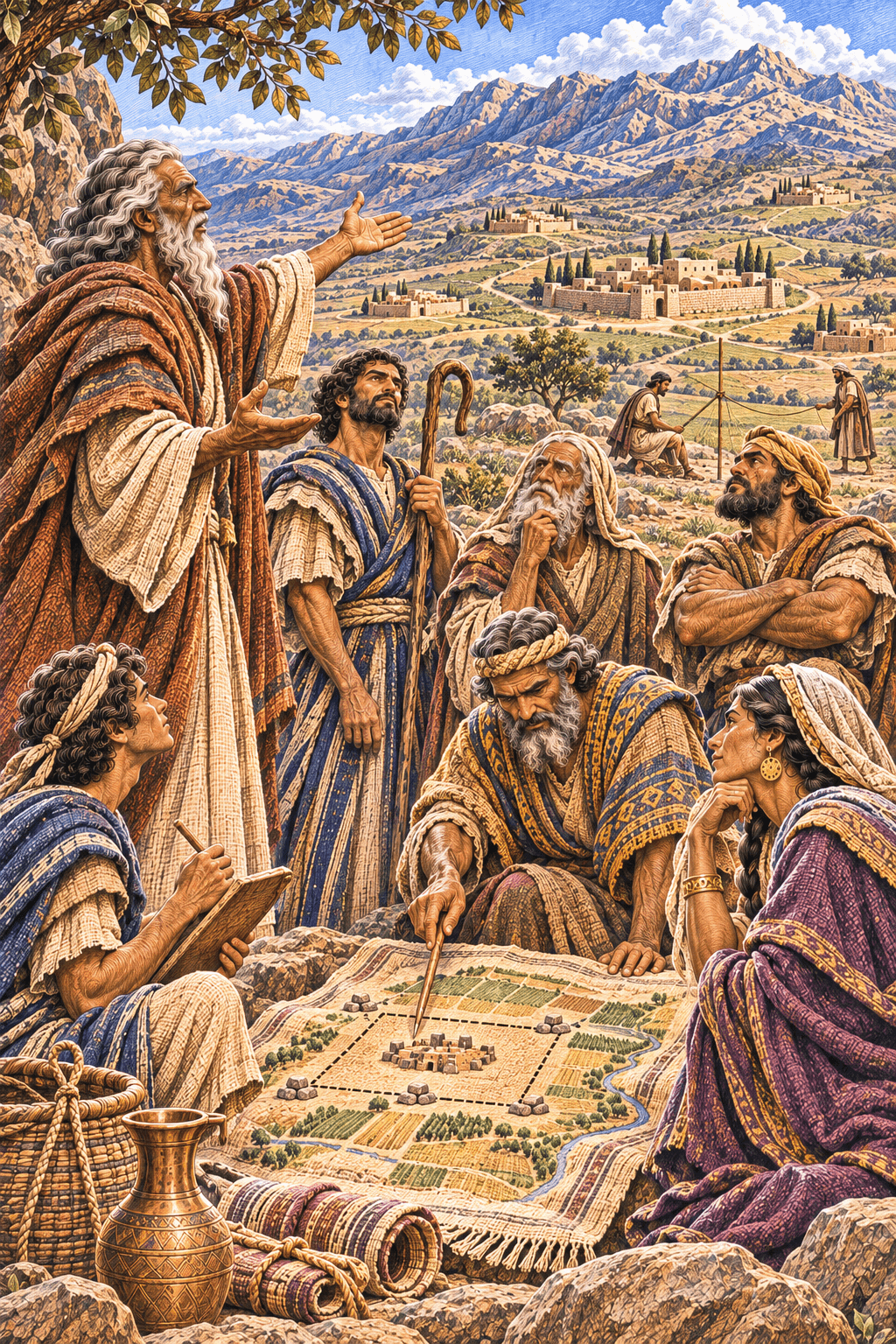
A) The details of the cities of the Levites and their locations will come in the Book of Joshua (Joshua 21). What we want to make clear now is that God, who wants to lift the thoughts of His ministers toward heavenly things, does not forget their temporal needs, for He has promised us: “But seek ye first the kingdom of God, and his righteousness; and all these things shall be added unto you” (Matthew 6:33). He did not accept that His ministers should share with the people in an earthly inheritance, yet He did not leave them without cities, but appointed for them 48 cities, 6 of them as cities of refuge and 42 for themselves. The number 42, as we have seen, points to the forty-two stations at which the people stopped in the wilderness on their journey toward Jerusalem, and to the forty-two generations from Abraham to the birth of Christ the Lord (chapter 33). It is as though these cities too point to the work of the Levites… they are only temporary stations that carry the human soul from glory to glory, or from strength to strength, until it is brought to the heavenly Jerusalem in the bosom of the heavenly Father. This is the work of the ministers: they are only ministers of the word, whose work is to bring every soul into the life of fellowship with God in His Son by the Holy Spirit, through its journey in this life. The disciples would not do otherwise than give themselves “continually to prayer, and to the ministry of the word” (Acts 6:4).
B) God also defined the suburbs of the cities, that is, their open lands: they “shall reach from the wall of the city and outward a thousand cubits round about” (4). In every direction the open land reaches a thousand cubits from the wall. As we have repeated before, the number 1,000 points to the heavenly life; it is as though everything that belongs to the Levites ought to bear the heavenly mark.
2. The Cities of Refuge
KJV · Verses 6–8
6 And among the cities which ye shall give unto the Levites there shall be six cities for refuge, which ye shall appoint for the manslayer, that he may flee thither: and to them ye shall add forty and two cities. 7 So all the cities which ye shall give to the Levites shall be forty and eight cities: them shall ye give with their suburbs. 8 And the cities which ye shall give shall be of the possession of the children of Israel: from them that have many ye shall give many; but from them that have few ye shall give few: every one shall give of his cities unto the Levites according to his inheritance which he inheriteth.
From among the forty-eight cities six cities of refuge were chosen, spread through the land east of the Jordan and in Canaan, with their own law (Deuteronomy 19).
God is the refuge of the soul, as the Psalmist says: “God is my defence” (Psalm 59:9, 17), “thou hast been my defence and refuge” (Psalm 59:16), “thou hast been a shelter for me” (Psalm 61:3), “but thou art my strong refuge” (Psalm 71:7). Therefore six cities were set up, three east of the Jordan and three in Canaan. If the land east of the Jordan points to the Church of the Old Testament, and the land of Canaan, entered by crossing the waters, points to the Church of the New Testament, which crosses the waters of holy Baptism, then man’s refuge, whether in the Old Testament or the New, is the Holy Trinity, the one God of all. The number 6 also points to the full working days of man; it is as though man is exposed in his work to sin, so all the days of his sojourning he finds in God a refuge! God’s arms are open to him all his days; He never closes them.
3. The Law of the Cities of Refuge
KJV · Verses 9–28
9 And the Lord spake unto Moses, saying, 10 Speak unto the children of Israel, and say unto them, When ye be come over Jordan into the land of Canaan; 11 Then ye shall appoint you cities to be cities of refuge for you; that the slayer may flee thither, which killeth any person at unawares. 12 And they shall be unto you cities for refuge from the avenger; that the manslayer die not, until he stand before the congregation in judgment. 13 And of these cities which ye shall give six cities shall ye have for refuge. 14 Ye shall give three cities on this side Jordan, and three cities shall ye give in the land of Canaan, which shall be cities of refuge. 15 These six cities shall be a refuge, both for the children of Israel, and for the stranger, and for the sojourner among them: that every one that killeth any person unawares may flee thither. 16 And if he smite him with an instrument of iron, so that he die, he is a murderer: the murderer shall surely be put to death. 17 And if he smite him with throwing a stone, wherewith he may die, and he die, he is a murderer: the murderer shall surely be put to death. 18 Or if he smite him with an hand weapon of wood, wherewith he may die, and he die, he is a murderer: the murderer shall surely be put to death. 19 The revenger of blood himself shall slay the murderer: when he meeteth him, he shall slay him. 20 But if he thrust him of hatred, or hurl at him by laying of wait, that he die; 21 Or in enmity smite him with his hand, that he die: he that smote him shall surely be put to death; for he is a murderer: the revenger of blood shall slay the murderer, when he meeteth him. 22 But if he thrust him suddenly without enmity, or have cast upon him any thing without laying of wait, 23 Or with any stone, wherewith a man may die, seeing him not, and cast it upon him, that he die, and was not his enemy, neither sought his harm: 24 Then the congregation shall judge between the slayer and the revenger of blood according to these judgments: 25 And the congregation shall deliver the slayer out of the hand of the revenger of blood, and the congregation shall restore him to the city of his refuge, whither he was fled: and he shall abide in it unto the death of the high priest, which was anointed with the holy oil. 26 But if the slayer shall at any time come without the border of the city of his refuge, whither he was fled; 27 And the revenger of blood find him without the borders of the city of his refuge, and the revenger of blood kill the slayer; he shall not be guilty of blood: 28 Because he should have remained in the city of his refuge until the death of the high priest: but after the death of the high priest the slayer shall return into the land of his possession.
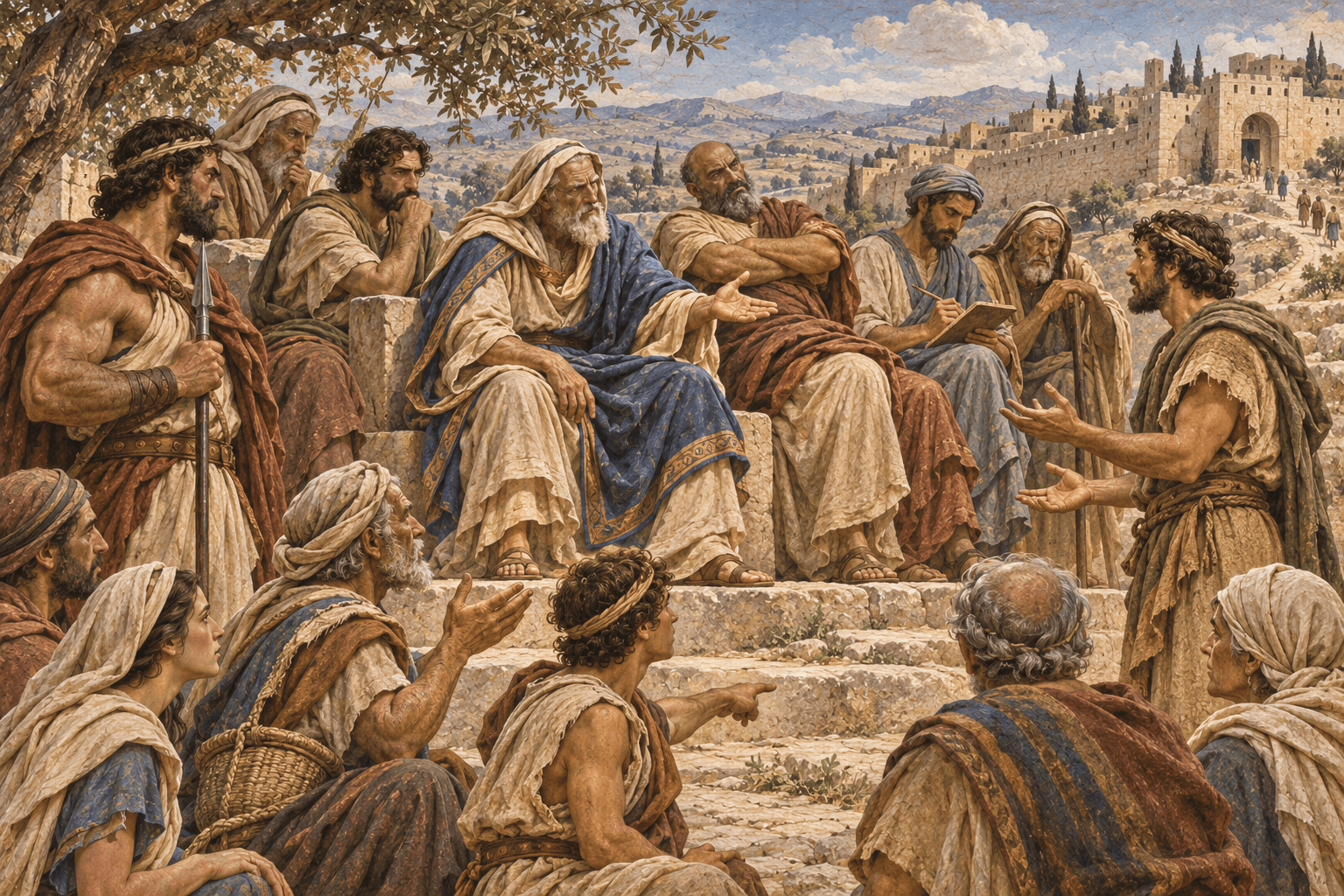
A) The cities of refuge were among the cities of the men of the priesthood, as though God wanted to teach the people that the aim of the priests is to guide them to Christ the Lord, the true “refuge,” in whom the believers hide from evil.
B) The one who killed unawares had to flee quickly to the nearest city of refuge. It was required (Deuteronomy 19:3) that the roads leading to the cities of refuge be kept in good order; it is said that they were about twenty cubits wide, that bridges were set up where water crossed them, and that signs were set up bearing the words “Refuge… refuge.” The cities were spread over the whole land, so that whoever wished to take refuge could flee to them easily. These roads point to Holy Scripture, open to all, leading everyone who wishes to take refuge in God toward the Lord of glory Jesus, to find His arms stretched out to all.
C) After taking refuge in the city he would present his case before the elders of the city, who would receive him if they saw that he had confessed that he had killed and they were sure that the killing had been unawares, not deliberate or with intent to harm. Then he would return to the city of refuge and remain within its walls, and the avenger, that is, the next of kin of the slain, had no right to avenge the blood of the slain. He remained so until the high priest died; then he had the right to leave the city, and the avenger had no right to come near him. If the city points to Christ the Lord, the penitent man remains safe as long as he is within the Lord; but if he flees from Him he is exposed to death. And the death of the high priest points to the death of Christ the Lord, by which He set us free from the wages of sin and gave us complete freedom in Him.
4. The Strictness against Murder
KJV · Verses 29–34
29 So these things shall be for a statute of judgment unto you throughout your generations in all your dwellings. 30 Whoso killeth any person, the murderer shall be put to death by the mouth of witnesses: but one witness shall not testify against any person to cause him to die. 31 Moreover ye shall take no satisfaction for the life of a murderer, which is guilty of death: but he shall be surely put to death. 32 And ye shall take no satisfaction for him that is fled to the city of his refuge, that he should come again to dwell in the land, until the death of the priest. 33 So ye shall not pollute the land wherein ye are: for blood it defileth the land: and the land cannot be cleansed of the blood that is shed therein, but by the blood of him that shed it. 34 Defile not therefore the land which ye shall inhabit, wherein I dwell: for I the Lord dwell among the children of Israel.
Lest anyone think that the law of the cities of refuge means leniency toward the crime of murder, He made clear the crime of murder and its gravity:
A) The crime of murder is not established by the testimony of one person, but of more than one witness, and its penalty is death.
B) No ransom can be accepted for the life of a murderer who is guilty of death, so that the rich man may not think that by his money he can kill and pay a ransom… rather, he who kills shall be killed.
C) Leniency in punishing the murderer is counted a defiling of the land in which they dwell, in the midst of which the Lord Himself dwells.
It is as though He wanted to affirm that the city of refuge does not mean disregard for the lives of others, for salvation does not mean leniency toward sin and taking lightly the committing of it.