
The Lord gave the law of cleansing for whoever touched a dead body, bones or a grave; then He went on to speak to us of the death of Miriam and the death of Aaron. Perhaps by this He wanted to warn the people, lest out of their love and esteem for Miriam and Aaron they touch their bodies or their graves without being cleansed on the third day and the seventh day. He also spoke of the water of Meribah, to reveal the weaknesses of man, not only on the level of the people, but also on the level of Moses, the great among the prophets, and Aaron the high priest. This chapter includes:
1. The Death of Miriam
KJV · Verses 1
1 Then came the children of Israel, even the whole congregation, into the desert of Zin in the first month: and the people abode in Kadesh; and Miriam died there, and was buried there.
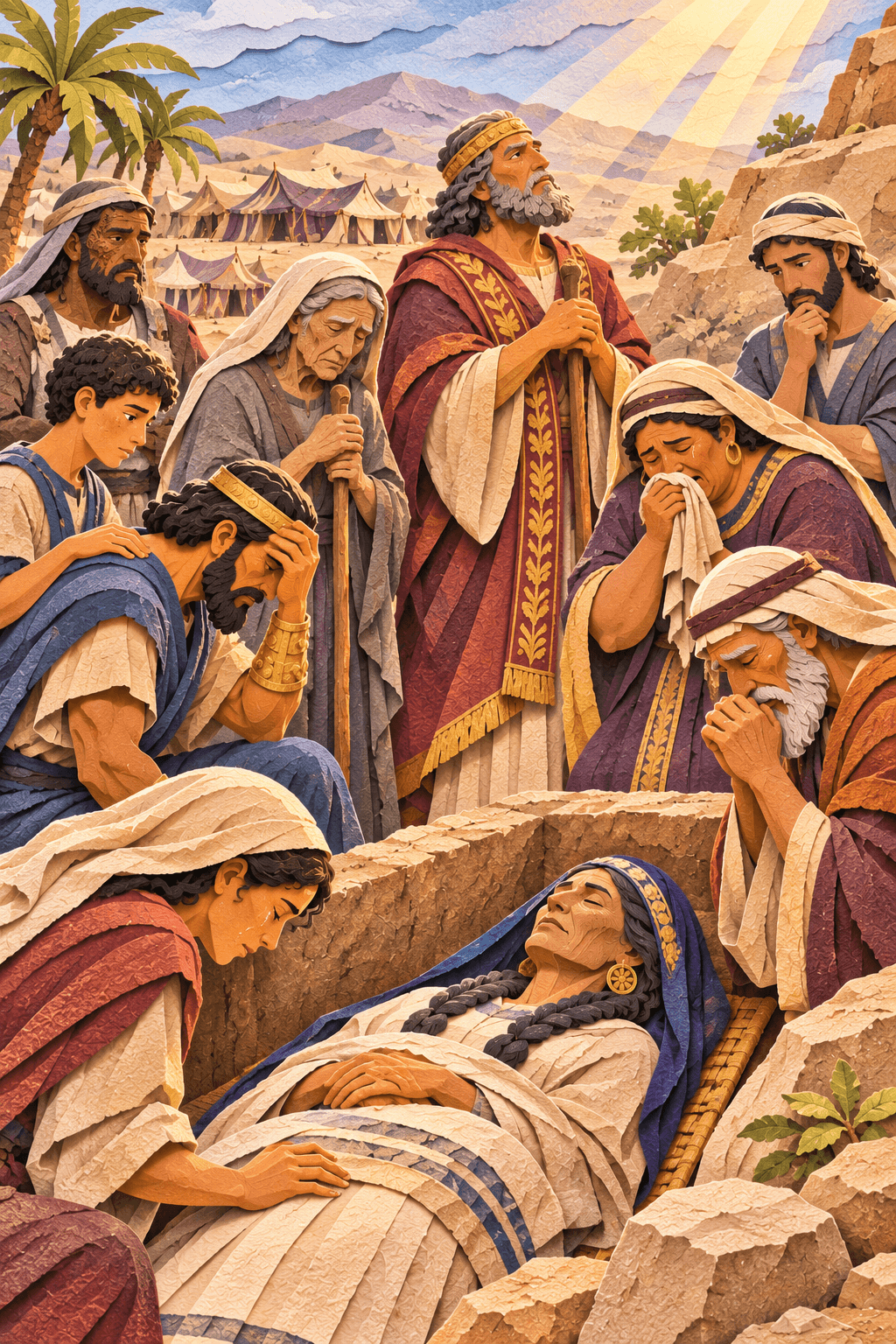
When the people came into the wilderness of Zin, that is, the wilderness of “temptation,” and abode in Kadesh, or the holy place, Scripture says: “and Miriam died there, and was buried there” (1). This is all that Holy Scripture recorded of the end of the life of Miriam the prophetess and singer, the leader of the people in praise (Exodus 15): she died there, and was buried there. Truly she died in the wilderness of Zin, for her death was a harsh and bitter temptation for the people, since many women were attached to her; but she died in Kadesh, that is, in the holy place, to rest from her struggle and labours by entering the divine holy places.
Holy Scripture has recorded nothing of the feelings of Moses the prophet at the parting of his sister, who had accompanied him on this whole journey, especially since a little later Moses with his own hands would strip the priestly garments from his brother Aaron on Mount Hor to put them on his son Eleazar, and Aaron would die there. Nor has Scripture recorded anything of his feelings toward his companion in the service, who bore with him the people’s murmurings against them. The venerable elder Moses the prophet hoped in the resurrection of those who sleep; therefore he was not troubled by the death of his sister and brother. Rather, he grieved and groaned inwardly and fell on his face whenever the people murmured (6) and exposed themselves to God’s wrath and chastisements. He did not grieve over bodily separation, but burned with every soul exposed to death by being deprived of God, the source of its life.
2. The Water of Meribah
KJV · Verses 2–13
2 And there was no water for the congregation: and they gathered themselves together against Moses and against Aaron. 3 And the people chode with Moses, and spake, saying, Would God that we had died when our brethren died before the Lord! 4 And why have ye brought up the congregation of the Lord into this wilderness, that we and our cattle should die there? 5 And wherefore have ye made us to come up out of Egypt, to bring us in unto this evil place? it is no place of seed, or of figs, or of vines, or of pomegranates; neither is there any water to drink. 6 And Moses and Aaron went from the presence of the assembly unto the door of the tabernacle of the congregation, and they fell upon their faces: and the glory of the Lord appeared unto them. 7 And the Lord spake unto Moses, saying, 8 Take the rod, and gather thou the assembly together, thou, and Aaron thy brother, and speak ye unto the rock before their eyes; and it shall give forth his water, and thou shalt bring forth to them water out of the rock: so thou shalt give the congregation and their beasts drink. 9 And Moses took the rod from before the Lord, as he commanded him. 10 And Moses and Aaron gathered the congregation together before the rock, and he said unto them, Hear now, ye rebels; must we fetch you water out of this rock? 11 And Moses lifted up his hand, and with his rod he smote the rock twice: and the water came out abundantly, and the congregation drank, and their beasts also. 12 And the Lord spake unto Moses and Aaron, Because ye believed me not, to sanctify me in the eyes of the children of Israel, therefore ye shall not bring this congregation into the land which I have given them. 13 This is the water of Meribah; because the children of Israel strove with the Lord, and he was sanctified in them.
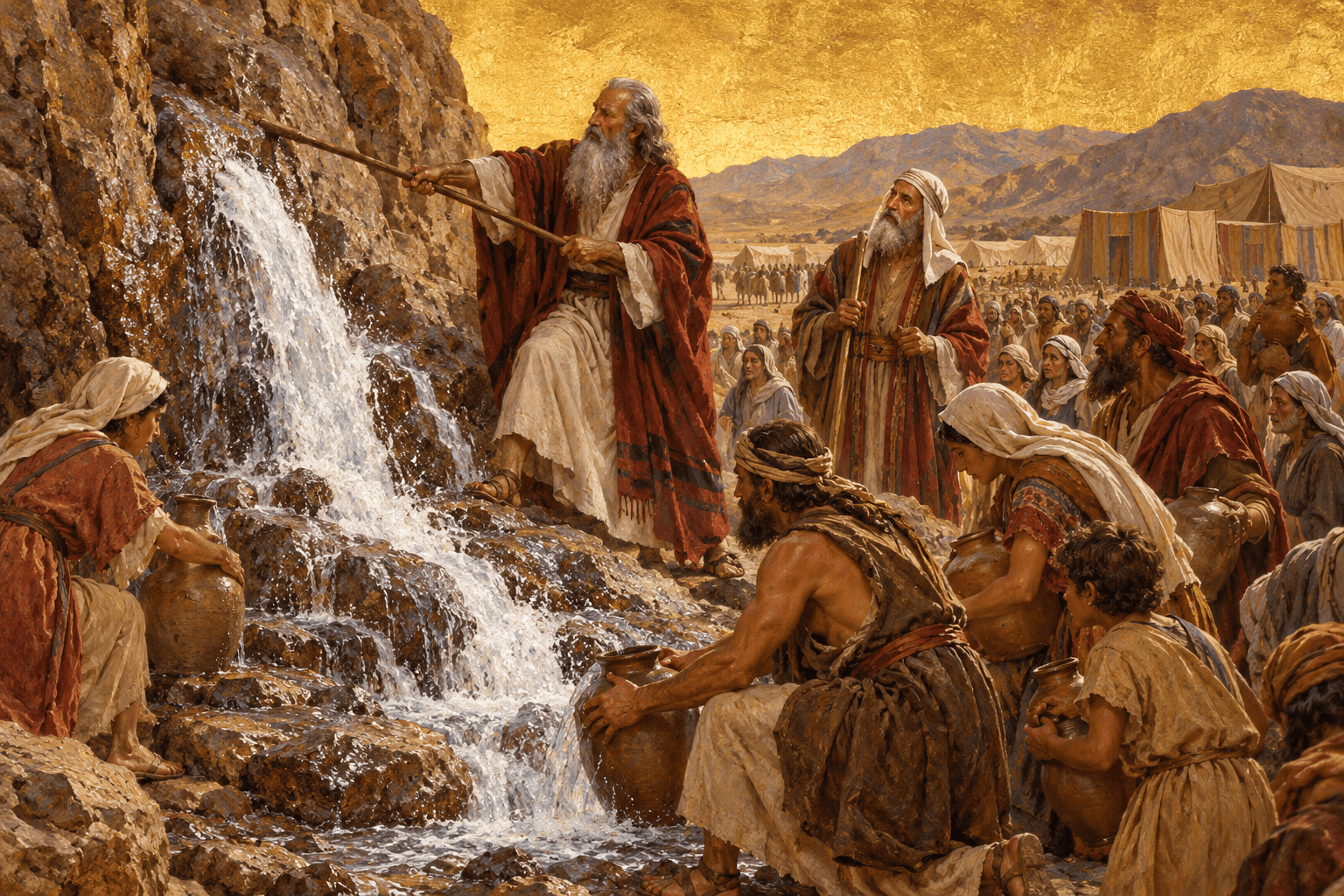
When the people found no water, they did not ask but murmured, wishing for death, even by the plague, falling under wrath as had happened to their brethren before (Numbers 16:49). They said to Moses and Aaron: “Would God that we had died when our brethren died before the LORD! And why have ye brought up the congregation of the LORD into this wilderness, that we and our cattle should die there?… it is no place of seed, or of figs, or of vines, or of pomegranates; neither is there any water to drink” (3–5). When the souls of Moses and Aaron were distressed, “they fell upon their faces: and the glory of the LORD appeared unto them” (6). With every distress they humbled themselves, and the Lord revealed His glories to them and solved their pastoral problems. This time the Lord asked them to speak to the rock before the eyes of the people, so that it would give forth its water, while Moses held the rod. But Moses, instead of speaking to the rock, smote it twice with the rod, after he and Aaron had said to the people: “Hear now, ye rebels; must we fetch you water out of this rock?” (10). And the water came out abundantly, and the congregation drank, and their beasts also (11).
The Fathers [149] looked upon the rock that poured out water to quench the thirsty as Baptism, which burst forth through the rod, that is, through the sacrifice of the cross, and so quenched the thirst of mankind and satisfied its needs. Saint Paul sees that this Rock that followed them is Christ the Lord (1 Corinthians 10:4). If the rod is the cross, then through the crucified Christ the Lord the springs of Baptism were sanctified.
Saint Gregory of Nyssa sees in this bursting rock the mystery of repentance, which is counted a second baptism. For when the people murmured and were exposed to destruction, they needed the waters of the rock, or repentance, so as not to perish. The saint says:
When the people lost hope in the good things promised, as they were on the way through the wilderness, they fell into thirst. Once again Moses made water flow for them in the wilderness. This is understood mystically, for it teaches us what the mystery of repentance is. Those who turn back to the stomach, the flesh and the Egyptian pleasures after once tasting the rock are deprived of the fellowship of good things. By repentance they find the rock they had neglected, and a spring of water is opened for them, and they inherit. The rock gave water to Moses, who believed in the truthfulness of Joshua and not in his opponents (among the spies). Moses looked at the cluster of grapes that was hung for us and shed its blood, and by means of the wood he prepared the water to burst forth from the rock once more. [150]
The saint wanted to affirm our need for repentance through our faith in the blood of Christ the Lord, which atones for our sins, so that we may enjoy abundant springs through the Rock we neglected, that is, Christ, whom we have offended by our falls.
Saint Ambrose comments on this divine work, saying:
Is He not good who by His command made the seas become firm ground under their feet as the waters fled, and the rocks give water to the thirsty? The works of the true Creator appeared when He made the liquid solid and the rock flowing water. Let us understand that this is the work of Christ, as the Apostle says: the Rock is Christ (1 Corinthians 10:4). [151]
Saint Augustine comments on the rock that was smitten twice thus:
He quenched our thirst by means of the rock in the wilderness, for “that Rock was Christ” (1 Corinthians 10:4)… And it was smitten twice with the rod that it might pour out water, because the cross has two beams. So all these things were done as a figure, and they have been revealed to us. [152]
In reproach, “the LORD spake unto Moses and Aaron, Because ye believed me not, to sanctify me in the eyes of the children of Israel, therefore ye shall not bring this congregation into the land which I have given them” (12). The two were deprived of leading the people into the land of promise because they did not sanctify the Lord before the people. Saint Augustine [153] holds that Moses had a doubt at the beginning when he smote the rock, for he said with Aaron: “must we fetch you water out of this rock?” (10); and it is said in the Psalm: “They angered him also at the waters of strife, so that it went ill with Moses for their sakes: Because they provoked his spirit, so that he spake unadvisedly with his lips” (Psalm 106:32–33). Others note that the Lord said to them: “speak ye unto the rock before their eyes; and it shall give forth his water” (8), and did not tell them to smite the rock with the rod.
Perhaps God’s anger with Moses and Aaron was because the rock was smitten twice. For the Lord was crucified once, of His own will, for the salvation of mankind, accepting the sufferings with joy, as the Apostle says: “who for the joy that was set before him endured the cross, despising the shame” (Hebrews 12:2). The second stroke grieves His heart, for it symbolizes crucifying Him a second time through the believer’s falling away from the life of renewal that has become his, as the same Apostle says: “seeing they crucify to themselves the Son of God afresh, and put him to an open shame” (Hebrews 6:6).
In any case, Moses and his brother Aaron fell under chastisement, and all the glorious past of Moses the prophet could not intercede for him. It is as though God gives a warning to the ministers of the Church, especially those who have received a high rank: their works, however great and powerful, will not intercede for them in their falls. Saint John Chrysostom comments on this in the fourth book of On the Priesthood, saying:
Moses, that saint, was so far from clinging to the leadership of the Jews that he begged God to excuse him from it when He commanded him to accept it (Exodus 4), and even provoked the anger of God who appointed him to the work. Nor did it stop there: even after he took up the leadership, he longed for death to be rid of it, saying: “And if thou deal thus with me, kill me, I pray thee, out of hand” (Numbers 11:15). What then? Did this repeated refusal intercede for him when he sinned concerning the water of strife? Could it obtain pardon for him? Why then was he deprived of the land of promise? [154]
3. Edom Refuses Them Passage
KJV · Verses 14–21
14 And Moses sent messengers from Kadesh unto the king of Edom, Thus saith thy brother Israel, Thou knowest all the travail that hath befallen us: 15 How our fathers went down into Egypt, and we have dwelt in Egypt a long time; and the Egyptians vexed us, and our fathers: 16 And when we cried unto the Lord, he heard our voice, and sent an angel, and hath brought us forth out of Egypt: and, behold, we are in Kadesh, a city in the uttermost of thy border: 17 Let us pass, I pray thee, through thy country: we will not pass through the fields, or through the vineyards, neither will we drink of the water of the wells: we will go by the king's high way, we will not turn to the right hand nor to the left, until we have passed thy borders. 18 And Edom said unto him, Thou shalt not pass by me, lest I come out against thee with the sword. 19 And the children of Israel said unto him, We will go by the high way: and if I and my cattle drink of thy water, then I will pay for it: I will only, without doing anything else, go through on my feet. 20 And he said, Thou shalt not go through. And Edom came out against him with much people, and with a strong hand. 21 Thus Edom refused to give Israel passage through his border: wherefore Israel turned away from him.
The Edomites are the descendants of Edom, or Esau (Genesis 36:19). They usually bore enmity toward the Jews, going back to the days of Jacob and Esau, when the former took the birthright from him… Therefore the sons of Edom often allied themselves with other nations against Israel; and in the days of the exile, when Judah was laid waste, Edom exploited the situation and made the lands of Judah pasture for their animals. We have already spoken of Edom in our commentary on the Book of Ezekiel. [155]
Moses the prophet sent to the king of Edom, asking him kindly and in the spirit of brotherhood that bound them as two peoples from the two brothers Jacob and Esau, saying to him: “Thus saith thy brother Israel, Thou knowest all the travail that hath befallen us: How our fathers went down into Egypt, and we have dwelt in Egypt a long time; and the Egyptians vexed us, and our fathers: And when we cried unto the LORD, he heard our voice, and sent an angel, and hath brought us forth out of Egypt: and, behold, we are in Kadesh, a city in the uttermost of thy border: Let us pass, I pray thee, through thy country: we will not pass through the fields, or through the vineyards, neither will we drink of the water of the wells: we will go by the king’s high way, we will not turn to the right hand nor to the left, until we have passed thy borders” (14–17). In these words he spoke with him in the spirit of brotherhood, showing him that they belonged originally to one blood, as though affirming to him that every brother needs his brother. He spoke in the spirit of humility, making clear to him that he and his fathers had suffered at the hands of Pharaoh of Egypt; also in the spirit of faith, that God supported him; and finally in the spirit of obedience to him, that he would walk in a way fixed by the king, not turning from it to the right or to the left. Yet for all this, since Edom heard the news of this people, he remembered the blessing Jacob had received, taking it cunningly from Esau; so he feared him and showed every enmity!
We said that Edom means “bloody” or “shedder of blood”; so he represents Satan, who cannot bear God’s kingdom, being by nature a lover of fighting.
Edom reigned over hearts, so that they became his land, and he did not allow God’s kingdom to pass through it. But Christ the Lord entered the land of the true Edom, Satan, after binding him and crushing him by the cross, opening in the heart a royal way through which the heavenly procession passes, the procession of victory and triumph. Man’s energies, gifts and all his abilities are turned into a procession walking the royal way, going ever toward the heavenly Jerusalem, not turning aside with a right-hand stroke (self-righteousness) or a left-hand stroke (lusts), until it passes beyond the bounds of time and enters eternity. In Christ Jesus Edom has been driven out of our hearts, where he used to reign, and the true evangelical way has been opened within us.
Saint Clement of Alexandria [156] holds that this royal way is the way of the man who lives in righteousness, not by compulsion or from fear, that is, not turning aside to the left, nor for the sake of reward and wages, that is, not turning aside to the right, but going forward on the King’s way, which the King Himself has made smooth, with no stumbling blocks or slopes.
4. The Death of Aaron
KJV · Verses 22–29
22 And the children of Israel, even the whole congregation, journeyed from Kadesh, and came unto mount Hor. 23 And the Lord spake unto Moses and Aaron in mount Hor, by the coast of the land of Edom, saying, 24 Aaron shall be gathered unto his people: for he shall not enter into the land which I have given unto the children of Israel, because ye rebelled against my word at the water of Meribah. 25 Take Aaron and Eleazar his son, and bring them up unto mount Hor: 26 And strip Aaron of his garments, and put them upon Eleazar his son: and Aaron shall be gathered unto his people, and shall die there. 27 And Moses did as the Lord commanded: and they went up into mount Hor in the sight of all the congregation. 28 And Moses stripped Aaron of his garments, and put them upon Eleazar his son; and Aaron died there in the top of the mount: and Moses and Eleazar came down from the mount. 29 And when all the congregation saw that Aaron was dead, they mourned for Aaron thirty days, even all the house of Israel.
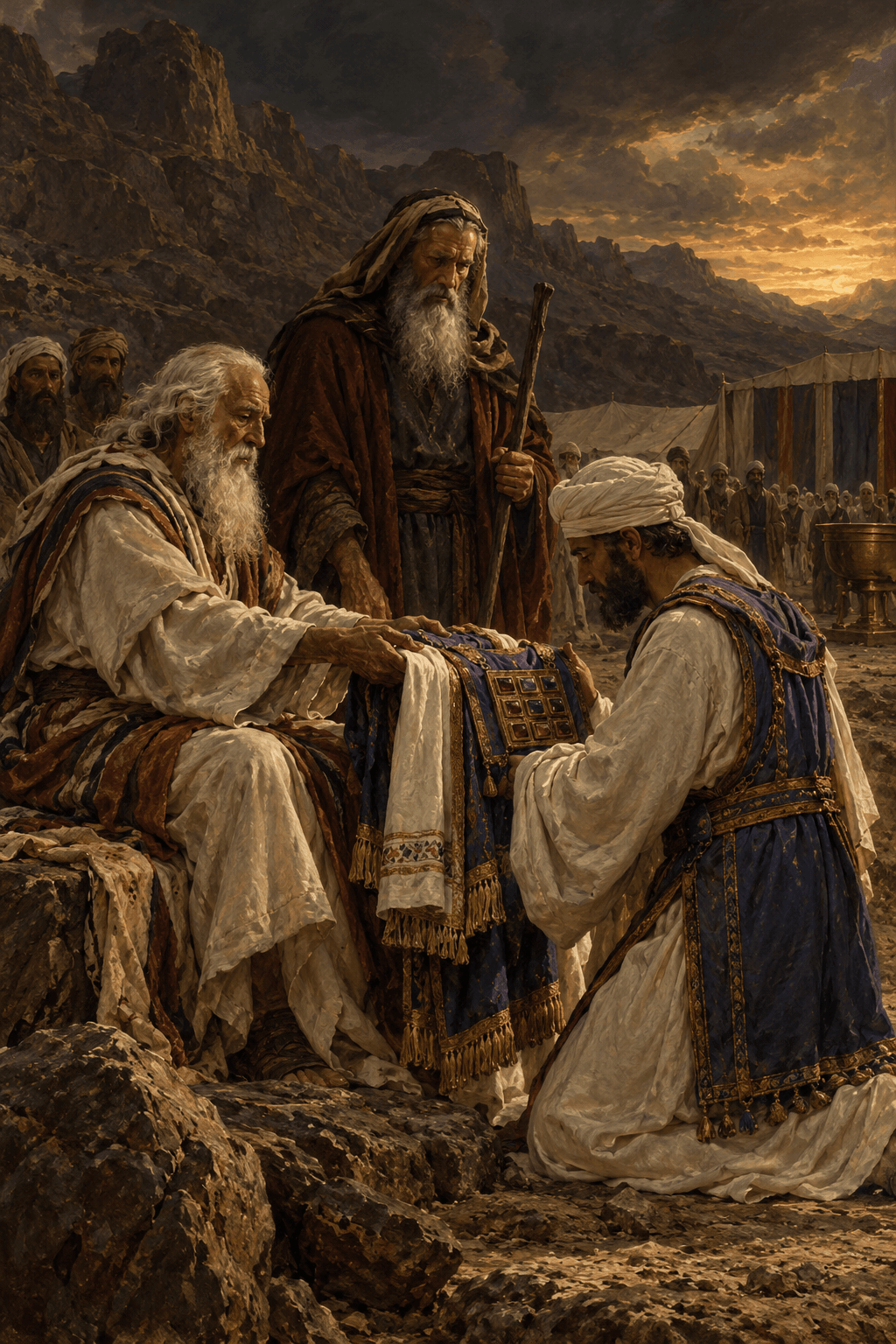
The chapter began with the death of Miriam and ended with the death of Aaron. The former died in Kadesh, that is, she passed over to the divine holy places; and the latter set out for Mount Hor to die there. The word “Hor” means “mountain,” as though God wanted the first high priest to die on a lofty mountain without a name; it is enough that it is a mountain, to declare that in his death he rises upward, ascending, and not as happened with Korah and his false company, who sank beneath the earth. The death of the righteous is a rising and an ascent, while the end of the wicked is a collapse and a descent downward.
Moses went up with his brother Aaron, and with them Eleazar the son of Aaron, where Moses the prophet stripped the priestly garments from his brother before he died and put them on his son Eleazar as the new high priest, something that gladdened the hearts of both Moses and Aaron. It was fitting that Aaron should not die wearing the priestly garments, lest the garments be counted as defiled; rather, his son wore them, to become high priest in his father’s place. In this is a beautiful picture of the Church’s tradition, which one generation hands to the next without deviation. Moses, the receiver of the Law, acting as mediator points to the role of the divine commandment, or Holy Scripture, in tradition: as tradition is handed down through the generations, it must remain evangelical, not separated from the commandment and not deviating from the spirit of Holy Scripture.
Saint Cyprian sees in this act the Lord’s affirmation to the people that the priest is chosen by the Lord, but in the presence of the people, for Scripture affirms: “and they went up into mount Hor in the sight of all the congregation” (27). The saint says:
We observe by divine authority that the priest must be chosen in the presence of the people, before the eyes of all, and be counted worthy and fit for the work by the judgment and testimony of the community. [157]
Finally, the death of Aaron and the passing of his priesthood to his son reveals the inadequacy of the Levitical priesthood. For the high priest has a beginning of days and an end; his work is temporary, for a time, passing from generation to generation until the symbol ends and there comes the One who is “an high priest over the house of God” (Hebrews 10:21), “an high priest, who is set on the right hand of the throne of the Majesty in the heavens” (Hebrews 8:1). The Apostle Paul compared the temporary priesthood of Aaron with the eternal priesthood of Christ the Lord after the order of Melchizedek, who, in respect of His divinity, has neither beginning of days nor end, able to intercede by His blood before His Father to bring us into the heavenly holy places not made with hands; He who was made priest with an oath, the Holy One, harmless and undefiled, ever living to make intercession for sinners (see Hebrews 7).
Notes and References
[149] Tertullian, On Baptism 9; St. Hippolytus. See J. Crehan, Early Christian Baptism and the Creed, London, pp. 172ff. (the source gives 1945).
[150] St. Gregory of Nyssa, The Life of Moses 2.269–270.
[151] St. Ambrose, On the Christian Faith 2.2 (22).
[152] St. Augustine, Tractates on John 28.9.
[153] St. Augustine, On Psalm 106.
[154] St. John Chrysostom, On the Priesthood 4.1.
[155] See the author, Ezekiel, chapter 25.
[156] St. Clement of Alexandria, On Spiritual Perfection (Stromata 7) 73.
[157] St. Cyprian, Epistle 67.4.