
Since Edom had refused to let the people pass through his land, Moses was obliged to lead his people around the land of Edom without entering it, as though the Lord gave them an understanding of overcoming evil by fleeing from it. In this chapter He gives examples of victory, not only over kings and peoples, but over the fiery serpents and inner thirst. He spoke to us here of:
1. The War with the King of Arad
KJV · Verses 1–3
1 And when king Arad the Canaanite, which dwelt in the south, heard tell that Israel came by the way of the spies; then he fought against Israel, and took some of them prisoners. 2 And Israel vowed a vow unto the Lord, and said, If thou wilt indeed deliver this people into my hand, then I will utterly destroy their cities. 3 And the Lord hearkened to the voice of Israel, and delivered up the Canaanites; and they utterly destroyed them and their cities: and he called the name of the place Hormah.
“Arad” is a Hebrew word meaning “wild ass.” It is a town in the southern part of Judea (Joshua 12:14; Judges 1:16).
When the king of Edom refused to let the people pass through his land, the people did not resist him but took their way around Edom, preferring not to resist evil with evil but to flee from evil. This is the spiritual way of the believer: he overturns his natural feelings that love revenge, preferring rather to overcome his own heart and rule over it than to triumph over others and rule over them. But the Canaanite king of Arad, who behaved “like a wild ass,” rose to attack and fight, without even asking them not to pass through his land. He met them as they came by the way of the spies (Atharim), fought them and took some of them prisoners. The word Atharim means “the track,” as though the king of Arad followed their tracks to overtake them and destroy them, so that they would not enjoy the land of promise.
Why did God allow them to be defeated? He wanted the people to realize their own weakness and their human inability to save themselves and to win, so that when they sought God’s hand and vowed to take nothing for themselves but to destroy the cities utterly, and named the place “Hormah,” that is, a devoted area, this would be a lasting witness and memorial that all salvation and victory achieved in the future is by the power of God. So God sometimes allows even the saints to be overcome, perhaps in the least and most trivial sins, so that it becomes for them a reminder of their weakness; and when they conquer in the spiritual war, grow in gifts, and their life and service bear fruit, they do not fall into pride.
Saint Theophan the Recluse says that when a man sometimes falls into a sin he had not fallen into for a long time, but had overcome, and he is greatly troubled, this is a sign of pride in the heart, for the man counts himself always victorious. Therefore one of the beautiful exercises offered to believers who have lived a long time in a state of victory and then fall into a sin that is trivial in their human view is to mingle their repentance and tears with a life of thanksgiving to God, who reveals their weaknesses to them. Instead of being crushed because he fell where he did not expect, he thanks God, who exposed him before his own eyes, asking Him to lift the temptation from him.
2. The Brazen Serpent
KJV · Verses 4–9
4 And they journeyed from mount Hor by the way of the Red sea, to compass the land of Edom: and the soul of the people was much discouraged because of the way. 5 And the people spake against God, and against Moses, Wherefore have ye brought us up out of Egypt to die in the wilderness? for there is no bread, neither is there any water; and our soul loatheth this light bread. 6 And the Lord sent fiery serpents among the people, and they bit the people; and much people of Israel died. 7 Therefore the people came to Moses, and said, We have sinned, for we have spoken against the Lord, and against thee; pray unto the Lord, that he take away the serpents from us. And Moses prayed for the people. 8 And the Lord said unto Moses, Make thee a fiery serpent, and set it upon a pole: and it shall come to pass, that every one that is bitten, when he looketh upon it, shall live. 9 And Moses made a serpent of brass, and put it upon a pole, and it came to pass, that if a serpent had bitten any man, when he beheld the serpent of brass, he lived.
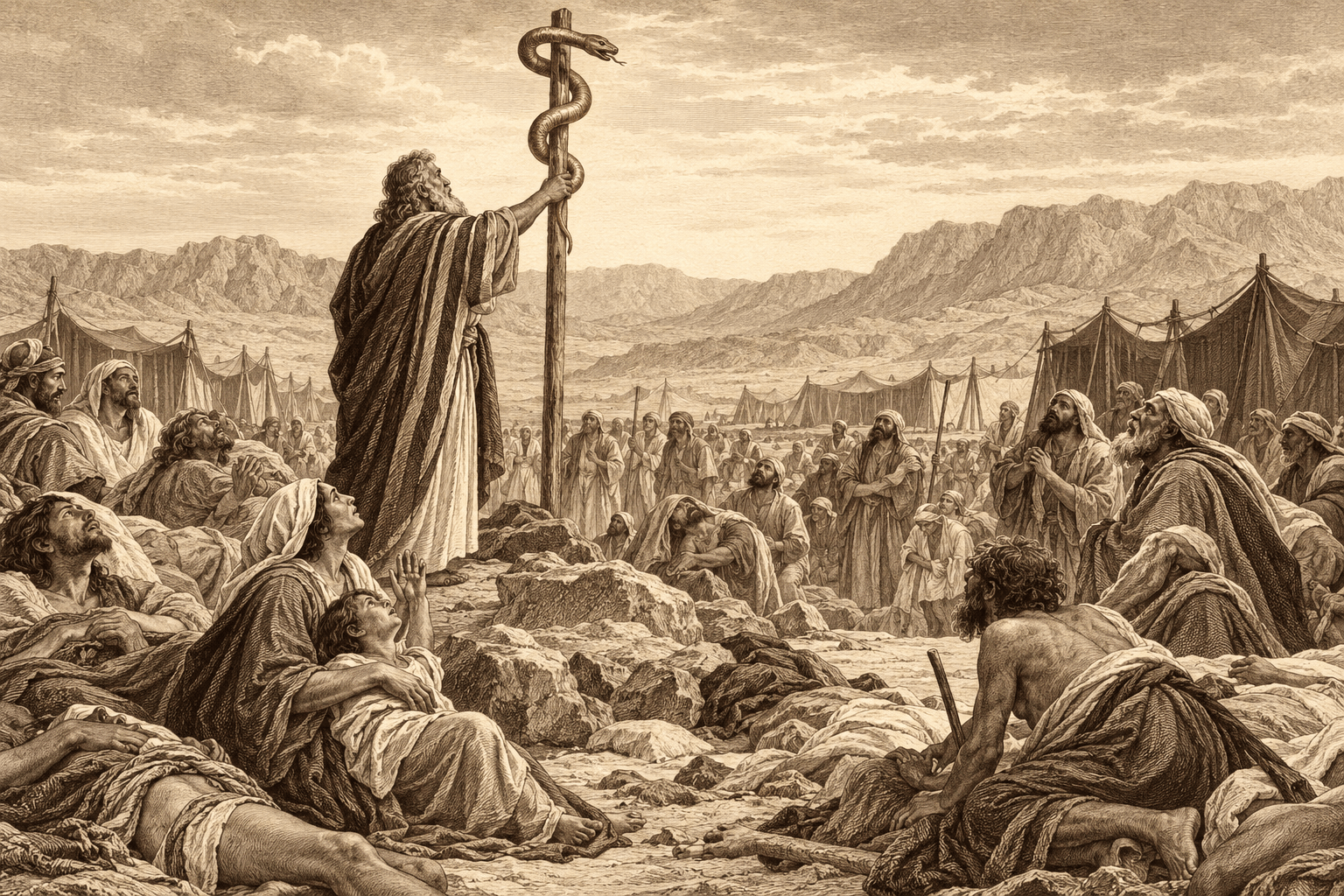
Despite their victory over the king of Arad, who rose up against them like a wild ass, and though they had borne witness to God’s work with them by calling the place “Hormah,” they soon murmured against the Lord because they did not pass through the midst of Edom but went a longer way. The soul of the people was much discouraged because of the way, and they said: “Wherefore have ye brought us up out of Egypt to die in the wilderness? for there is no bread, neither is there any water; and our soul loatheth this light bread” (5). When they murmured because of thirst, God bore with them and did not reproach them with a single word, but commanded Moses and Aaron to bring water out of the rock. But now, after He had given them victory and triumph, having quenched their thirst from the rock, because of their repeated murmuring He chastised them. He sent fiery serpents among them, which bit them and killed them. At the same time, when Moses cried to Him, He did not remove the serpents, but commanded him to set up a brazen serpent upon a pole, so that “every one that is bitten, when he looketh upon it, shall live” (8). He did not remove the temptation, but opened the door of salvation from it. In this way God turned their evil into a blessing, bringing “Out of the eater… meat, and out of the strong… sweetness” (Judges 14:14), offering from this work a symbol of His cross. Saint Augustine says:
Christ was slain so that there might be found on the cross the One to whom those bitten by the serpent look. [158]
He also says:
What is the serpent lifted up? It is the death of Christ on the cross; for as death came by the serpent, its symbol became the image of the serpent. The serpent’s bite was deadly, but the Lord’s death is life-giving… When a man looks at the serpent, the serpent becomes powerless; and whoever looks at death, death becomes powerless over him. [159]
Saint Ignatius says:
When the body of the Word was lifted up, as the serpent was lifted up in the wilderness, He drew mankind to Himself for their eternal salvation. [160]
And it is said in the Epistle of Barnabas:
Moses made a type of Jesus and of His necessary sufferings. When the Israelites were falling, they looked to it and it gave them life. The Lord, to teach Israel that their disobedience had delivered them to the sorrow of death, sent upon them all kinds of serpents to bite them, and they were dying. And though Moses said, You shall have no graven or molten image for the Lord (Deuteronomy 27:15), he did the opposite of what he wrote: he made a brazen serpent and set it up gloriously and called the people. When the people gathered, they asked Moses to offer prayer for their healing, and Moses said to them: When one of you is bitten, let him come to the serpent lifted up on the wood and give himself to hope, believing that the serpent, which has no life in it, can give him life again, and he shall be saved at once. And so they did. The glory of Jesus rests on this: all things are in Him and for Him. [161]
Saint Gregory of Nyssa comments on this, saying:
The rebellious lusts gave birth to serpents breathing out venom that kills those they bite; but the Lawgiver made the real serpents powerless through the image of the serpent… The cross is the Passion; whoever looks upon it, as Scripture says, is not harmed by the passion of the lusts. Looking to the cross means that a man makes his whole life dead and crucified to the world (Galatians 6:14), unmoved by evil. Truly by this you are, as the prophet says, those who have nailed their flesh with the fear of God. The nail is self-control, which restrains the flesh… This form resembles the serpent, but it is not a serpent in itself; as the great Paul says: “in the likeness of sinful flesh” (Romans 8:3). Sin is the real serpent, and whoever flees to sin bears the nature of the serpent… A man is freed from sin through Him who took the form of sin and became like us, and so bore the form of the serpent. He did not kill the beasts (the serpents), but made their bites not deadly… In fact the bites of lust work even in believers; but whoever looks to the One hanging on the cross despises the passion, and he lessens the venom by the fear of the commandment. [162]
Saint Augustine sees in the brazen serpent our acceptance of fellowship in Christ’s sufferings and death with Him, for he says:
Whoever looked at the serpent lifted up was healed of the venom and freed from death; and now whoever is conformed to the likeness of Christ’s death by faith in Him and by His Baptism is freed from sin by being justified, and from death by the resurrection. This is what He means by saying: “That whosoever believeth in him should not perish, but have eternal life” (John 3:15). So there would have been no need for the infant to be conformed to Christ’s death in Baptism, had the venom of the serpent’s bite not seeped into him! [163]
It is as though, since the serpents went out against all, biting them and pouring their venom into them, all, grown men and infants alike, need the waters of holy Baptism to be healed of the death of the serpent’s venom through the cross.
3. Their Journeying
KJV · Verses 10–15
10 And the children of Israel set forward, and pitched in Oboth. 11 And they journeyed from Oboth, and pitched at Ijeabarim, in the wilderness which is before Moab, toward the sunrising. 12 From thence they removed, and pitched in the valley of Zared. 13 From thence they removed, and pitched on the other side of Arnon, which is in the wilderness that cometh out of the coasts of the Amorites: for Arnon is the border of Moab, between Moab and the Amorites. 14 Wherefore it is said in the book of the wars of the Lord, What he did in the Red sea, and in the brooks of Arnon, 15 And at the stream of the brooks that goeth down to the dwelling of Ar, and lieth upon the border of Moab.
If the cross is the way of victory and triumph, it does not prevent the war of Satan, the old serpent, but it scatters his deadly venom. The sign of true victory is the journeying, or continual passing over from one station to another, to enjoy new glories through continual afflictions, with the aim of passing over to the new Canaan. The names of the stations to which they journeyed are Oboth, then Ije-abarim, then the valley of Zared, then across Arnon. Origen holds that Oboth in Hebrew means successive growth, as though the believer, entering the experience of the cross, must live in a state of constant growth without interruption. Ije-abarim, according to Origen, means “the depth of the passing over,” as though through continual growth we must not forget our goal, which is the deep inner passing over from earthly life to heavenly life.
4. The Song of the Well
KJV · Verses 16–20
16 And from thence they went to Beer: that is the well whereof the Lord spake unto Moses, Gather the people together, and I will give them water. 17 Then Israel sang this song, Spring up, O well; sing ye unto it: 18 The princes digged the well, the nobles of the people digged it, by the direction of the lawgiver, with their staves. And from the wilderness they went to Mattanah: 19 And from Mattanah to Nahaliel: and from Nahaliel to Bamoth: 20 And from Bamoth in the valley, that is in the country of Moab, to the top of Pisgah, which looketh toward Jeshimon.
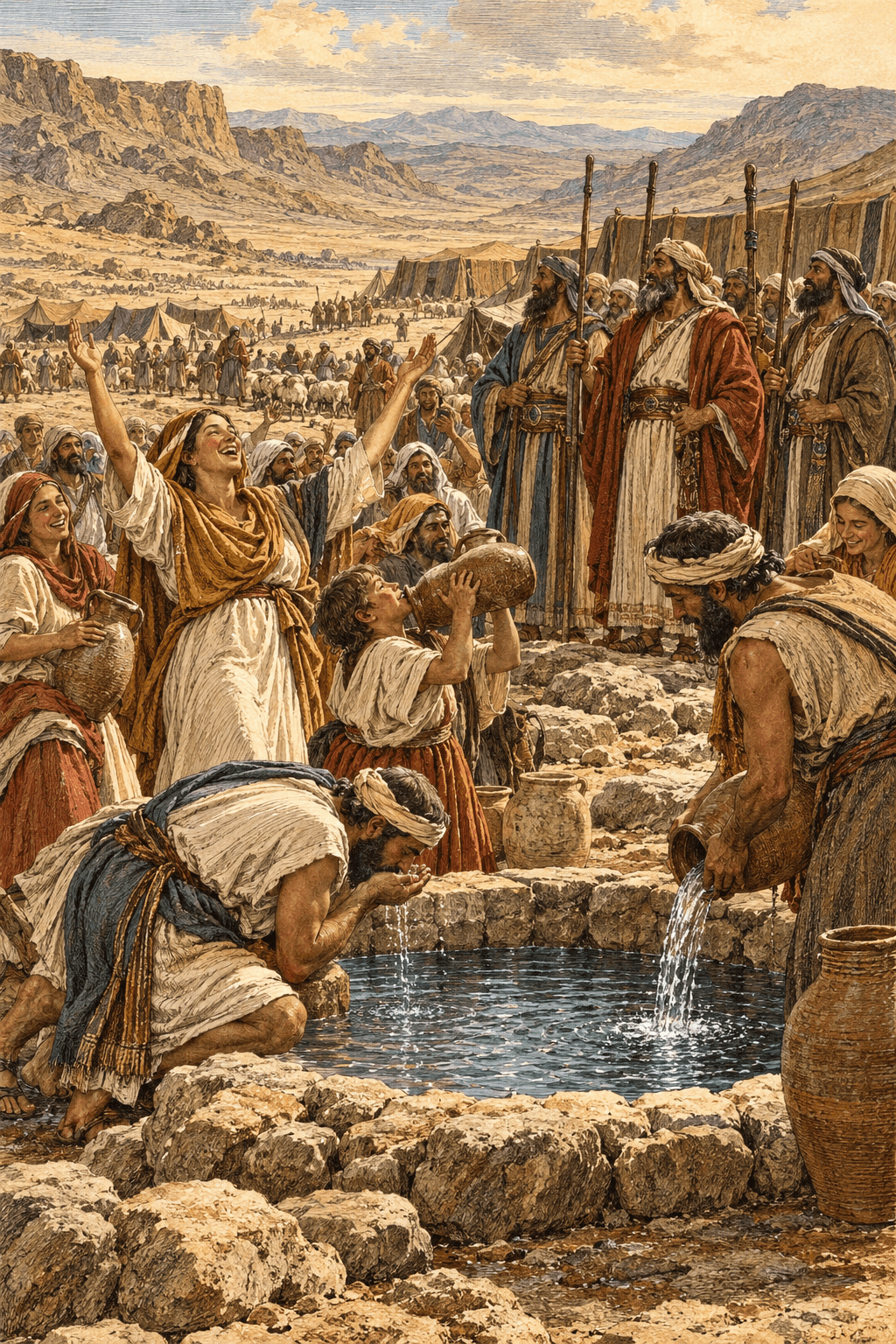
When the people passed on, carrying the marks of the bites in their bodies without carrying their death, passing on with the sign of victory and triumph over the serpents’ bites in their bodies, the Lord commanded Moses to gather the people so that He might give them water from a well to drink. Here Origen [164] is astonished:
What need was there for God to insist that Moses himself gather the people to give them water from a well to drink? Would not the people come of themselves when they felt thirst and drink of the water?
Therefore Origen affirms that if the story were understood in the literal sense it would seem of no great value, but it contains deep mysteries. He says:
The Spirit of God says by the mouth of Solomon in the Book of Proverbs: “Drink waters out of thine own cistern, and running waters out of thine own well. Let not thy fountains be dispersed abroad, nor rivers of waters in the streets” [165] (Proverbs 5:15–16). This means that your waters are yours alone; no one else has a share in them. Each one of us has, symbolically, a well within him… not one well but more than one, not one vessel but many vessels; for Scripture did not say, “Drink waters from your vessel,” but from your “vessels”; nor “running waters from your well,” but from your “wells.” And we have already seen that the fathers had wells: Abraham had wells, and Isaac too, and I think Jacob. [166]
In short, each person has deep inner wells in the soul, which point to the knowledge of God in the heart, in the inner man. Therefore, when Christ the Lord sat at the well at the sixth hour, which is the moment of the crucifixion, He spoke with the Samaritan woman, that is, with the community of the Gentiles, about the inner well, saying to her: “If thou knewest the gift of God, and who it is that saith to thee, Give me to drink; thou wouldest have asked of him, and he would have given thee living water” (John 4:10). The woman, with her material mind, could not go beyond the limits of the visible well, priding herself on the well they had inherited from their father Jacob. But Christ the Lord drew her heart to the inner well, so that the woman left her waterpot at the well and went into the city carrying a living well in the depths of her soul. This is the work of Christ the Lord: to give springs of living water within the believers, for He says: “He that believeth on me, as the scripture hath said, out of his belly shall flow rivers of living water” (John 7:38).
And as Origen says, God has given us not one well but wells and rivers of living water within us, and these point to the knowledge of the Holy Trinity and His work within us:
In my opinion we can understand the knowledge of the unbegotten Father as a well, and the knowledge of the only-begotten Son as another well, for the Father is distinct from the Son, and the Son in His own person is not the Father, for He says in the Gospel: “the Father that sent me beareth witness of me” (John 8:18). It seems to me that we can see a third well in the knowledge of the Holy Spirit, for He is distinct from the Father and the Son, as the Gospel affirms: “he shall give you another Comforter… Even the Spirit of truth” (John 14:16–17). So the distinction of the three Persons, the Father, the Son and the Holy Spirit, is what explains the plural “wells.” But of these wells there is one spring, [167] where there is the unity of the essence and nature of the Trinity. [168]
Through faith in Christ the Saviour we have come to an inner knowledge, through a practical experience which the soul lives with the Holy Trinity. She comes to know the Father as her heavenly Father, the Provider of her life; the only Son as the eternal Bridegroom and the Saviour who carries her in Himself to bring her into the Father’s bosom; and the Holy Spirit as the Giver of sonship and fellowship, who brings us into union with Christ the Lord so that we may enjoy what is His and enjoy His resources as though they were our own.
These are the wells which the Holy Spirit digs deep within us, so that springs of living water burst forth in us. Origen says:
I believe that the Saviour’s words to His disciples, “He that believeth on me” (John 7:38), meant that whoever drinks of the water of His teachings will have in him not a well nor a spring, but rivers of living water springing up in him. From the word of God, that is, the one Well, wells, springs and countless rivers are born. So the soul of man, created in the image of God, can obtain within itself wells, springs and rivers. [169]
These holy rivers spring up in the believer’s heart, as the Psalmist says: “Let the floods clap their hands” (Psalm 98:8). They are the rivers of practical divine knowledge, overflowing by the Holy Spirit in the heart, so that it praises God and bears witness to Him, clapping its hands, that is, turning knowledge into “work.” Saint Augustine says:
Let these rivers clap their hands; let them rejoice in works and bless God. [170]
And Saint Jerome comments on this phrase, saying:
Let them clap their hands; for the works of the saints are praise to God, since Christ the Lord is praised not with words but with works. He cares not for the voice but for the work. [171]
Within us are the wells of the knowledge of the Holy Trinity; but alas, the enemy of good often fills them in with the concerns of temporal life and earthly lusts, so that they need the Holy Spirit Himself to dig them anew and remove from them the earth that has entered them. Origen says:
In truth the wells of our souls need someone to dig them, clean them and remove what is earthly from them, so that the rational thoughts which God has hidden may appear and offer pure and clean streams of water. As long as earth covers the water, the inner channel is hidden and the inner water cannot flow. Therefore it is written: “For all the wells which his father’s servants had digged in the days of Abraham his father, the Philistines had stopped them, and filled them with earth” (Genesis 26:15). But Isaac, who received the blessing from his father, dug the wells again and opened the wells of water (Genesis 26:18) which the Philistines had stopped out of their hatred and filled with earth. [172]
Wonderfully, holy and blessed marriages took place by wells, as though the wells of divine knowledge have as their goal the soul’s entry into union with the heavenly Bridegroom, Christ the Lord, and the enjoyment of His features. Origen says:
By the well and nowhere else Abraham’s servant found “Rebekah,” whose name means “patience” or “endurance,” and she became Isaac’s wife (Genesis 24:67). And when Jacob came to Mesopotamia in obedience to his father, he found Rachel (Genesis 29:10); and Moses found Zipporah by the well (Exodus 2:15, 21). So holy marriages are understood around wells. If you want to marry patience, wisdom and the other virtues, represented in Wisdom’s words, I sought her out to take her for my bride, then go diligently and besiege these wells without ceasing, and you will find a wife for yourself there by the living waters; that is, beside the streams of the living word all the virtues surely dwell. [173]
For the wise man counsels us: “Drink waters out of thine own cistern, and running waters out of thine own well. Let not thy fountains be dispersed abroad, nor rivers of waters in the streets” (Proverbs 5:15–16). He invites us to enjoy the inner marriage, where the soul meets her Bridegroom through the inner knowledge of the Holy Trinity. There she comes to know God’s saving works and receives fellowship with Him, so that she enjoys the Lord’s features, not as outward virtues but as the fruit of the Holy Spirit within the soul. Therefore Christ the Lord says: “But thou, when thou prayest, enter into thy closet, and when thou hast shut thy door, pray to thy Father which is in secret; and thy Father which seeth in secret shall reward thee openly” (Matthew 6:6). He counsels us to open our heart to the Bridegroom secretly, so that our left hand does not know what our right hand does (Matthew 6:3); the world discovers the traces of this fellowship in our conduct and features, but its depths remain a secret of deep love which the soul alone perceives.
Returning to the text before us, we find God insisting that Moses call the congregation to drink from the well, as though this act carries, symbolically, the call of the Law (Moses) to the men of the Old Testament to come to know the Person of the Saviour. Origen says:
The Law of God calls you to come to the well… that is, to faith in Christ. He Himself said: “Moses wrote of me.” For what purpose does it gather us? That we may drink of the water and sing to Him a song of praise, that is, “with the heart man believeth unto righteousness; and with the mouth confession is made unto salvation” [174] (Romans 10:10).
When the congregation drank from the well, that is, came to know the Person of Christ the Lord through Moses and the prophets, they sang “the song of the well,” saying: “Begin to sing to the well: the princes digged it; the kings of the nations hewed it out in the rock, in their kingdom and in their dominion.” [175]
Origen comments on this song, saying:
The princes (nobles) are the prophets, who hid the well and covered it with their prophecies about Christ in the depths of the letter. Therefore one of the prophets says: “But if ye will not hear it, my soul shall weep in secret places” (Jeremiah 13:17); and another prophet says to the Lord: “Thou shalt hide them in the secret of thy presence from the pride of man: thou shalt keep them secretly in a pavilion from the strife of tongues” (Psalm 31:20). So the princes are those who dug the well, while the kings are those who hewed it, that is, cut it in the rock. The nobles, then, are lesser than the kings: they dig wells, that is, go deep into the earth, but to a certain limit; while those called kings are stronger and higher: they did not only dig in the earth but cut into the hardness of the rock to reach greater depths and more exact searching… These are the apostles. One of them says: “But God hath revealed them unto us by his Spirit: for the Spirit searcheth all things, yea, the deep things of God” (1 Corinthians 2:10). By the grace of the Holy Spirit they search the deep things of God and penetrate the mysteries of the well; in this way they have hewn the well in the rock and penetrated the mysteries of hard and difficult knowledge. That the apostles are called kings may be concluded from what is said of the believers: “But ye are a chosen generation, a royal priesthood, an holy nation” (1 Peter 2:9)… For this reason the Lord is called “KING OF KINGS” (Revelation 19:16). [176]
So the true Well, which is Christ the Lord, the Saviour of mankind, was declared by the nobles through the Law and the prophecies, and more clearly the disciples and apostles spoke of it through the Gospels and the apostolic writings. Origen says:
The whole of Holy Scripture, the Law, the Prophets, and the Gospel and Apostolic writings, forms one well, which cannot be dug or searched unless there are kings and nobles… As true kings and true nobles they can clean the ground of the well, lift off the surface of the letter and remove the superficiality of the inner rock, where Christ is, so that the spiritual meaning gushes forth. [177]
Origen distinguishes between the true well dug by the nobles and kings and the well dug by heretics, which gives salt water unfit to drink, for he says:
Do you want to see from Holy Scripture to what well (the heretics) come? They come to a valley of salt, where there are “slimepits” (Genesis 14:10)… It is in a valley, a valley of salt. For where there is sin and iniquity, there is no rising to the heights, but a constant descent to low and base places. Every heretical thought and every sin is found in a valley, a valley of salt and bitterness. What sweetness or pleasantness can sin offer? There is nothing worse than for a man to fall into the thoughts of heretics or into the bitterness of sin, for he falls into many slime pits. The pitch is fuel for fire; if we drink water from these wells and accept the opinions of the heretics, if we accept the bitterness of sin, we prepare in ourselves material for the fire and fuel for Gehenna. To those who will not drink the water of the well dug by the nobles and kings, but want to drink from the well in the valley of sin, which feeds the fire, it is said: “walk in the light of your fire, and in the sparks that ye have kindled” [178] (Isaiah 50:11).
Finally, when the congregation had drunk from the true well, dug by the nobles and kings, it is said that they journeyed “from the wilderness… to Mattanah: And from Mattanah to Nahaliel: and from Nahaliel to Bamoth: And from Bamoth in the valley, that is in the country of Moab, to the top of Pisgah, which looketh toward Jeshimon” (18–20).
Origen comments on this, saying:
These names seem to be those of particular places; but if we go back to the original language for their meanings, they present us with a collection of hidden truths rather than names of places. [179]
First: setting out to Mattanah. If the word Mattanah, as Origen says, means “their gifts,” then the soul that drinks from the well, that is, comes to know the Person of Christ the Lord, to whom Moses led us through the Law and the prophecies and whom the disciples and apostles declared to us, should offer Him its gifts and offerings, which are in truth His own gifts and offerings, for the Lord says: “My offering, and my bread for my sacrifices made by fire, for a sweet savour unto me, shall ye observe to offer unto me in their due season” (Numbers 28:2). Our drinking from the well is accepting God’s gift, as He makes Himself known to us and offers His life to us; so we answer love with love, offering Him our life, as Scripture says: “what doth the LORD thy God require of thee, but to fear the LORD thy God, to walk in all his ways, and to love him, and to serve the LORD thy God with all thy heart and with all thy soul” (Deuteronomy 10:12). We offer Him these gifts from our heart after we have come to know Him, that is, after we have drunk the knowledge of His kindness from the depths of His well. [180]
Second: from Mattanah to Nahaliel, for the word “Nahaliel” means “from God.” [181] When a man offers practical love to God, with gifts and offerings, God returns divine gifts to him. Abraham offered his only son, and he was returned to him alive, and God provided the ram as a ransom! The more our heart is enlarged with practical love, the more God fills the heart by His Holy Spirit with His hidden fruits that satisfy the soul.
Third: from Nahaliel to Bamoth, which means “the coming of death,” where a man longs to pass over in power, victorious over death, looking on it as a setting out toward heavenly places.
God says, I kill, and I make alive (Deuteronomy 32:39). Truly He kills so that we may live with Christ, and He makes alive so that we may live with Him. So we must long to reach Bamoth and hope that this blessed death may come as quickly as possible, so that we may be worthy to live with Christ. [182]
Fourth: from Bamoth to the valley (the height), which means “ascent” or “the top of the mountain.” This is the goal of our journey: to rise to paradise, to enjoy a beautiful dwelling on the summit of the mountain of perfection and enjoy spiritual gladness, saying: “And hath raised us up together, and made us sit together in heavenly places in Christ Jesus” (Ephesians 2:6).
This is the journey: from the well of divine knowledge in Christ Jesus the Saviour, to offering the gift of our love and receiving His divine gifts, so that we may rise to the mountains of His perfection.
5. The Victory over Sihon
KJV · Verses 21–30
21 And Israel sent messengers unto Sihon king of the Amorites, saying, 22 Let me pass through thy land: we will not turn into the fields, or into the vineyards; we will not drink of the waters of the well: but we will go along by the king's high way, until we be past thy borders. 23 And Sihon would not suffer Israel to pass through his border: but Sihon gathered all his people together, and went out against Israel into the wilderness: and he came to Jahaz, and fought against Israel. 24 And Israel smote him with the edge of the sword, and possessed his land from Arnon unto Jabbok, even unto the children of Ammon: for the border of the children of Ammon was strong. 25 And Israel took all these cities: and Israel dwelt in all the cities of the Amorites, in Heshbon, and in all the villages thereof. 26 For Heshbon was the city of Sihon the king of the Amorites, who had fought against the former king of Moab, and taken all his land out of his hand, even unto Arnon. 27 Wherefore they that speak in proverbs say, Come into Heshbon, let the city of Sihon be built and prepared: 28 For there is a fire gone out of Heshbon, a flame from the city of Sihon: it hath consumed ar of Moab, and the lords of the high places of Arnon. 29 Woe to thee, Moab! thou art undone, O people of Chemosh: he hath given his sons that escaped, and his daughters, into captivity unto Sihon king of the Amorites. 30 We have shot at them; Heshbon is perished even unto Dibon, and we have laid them waste even unto Nophah, which reacheth unto Medeba.
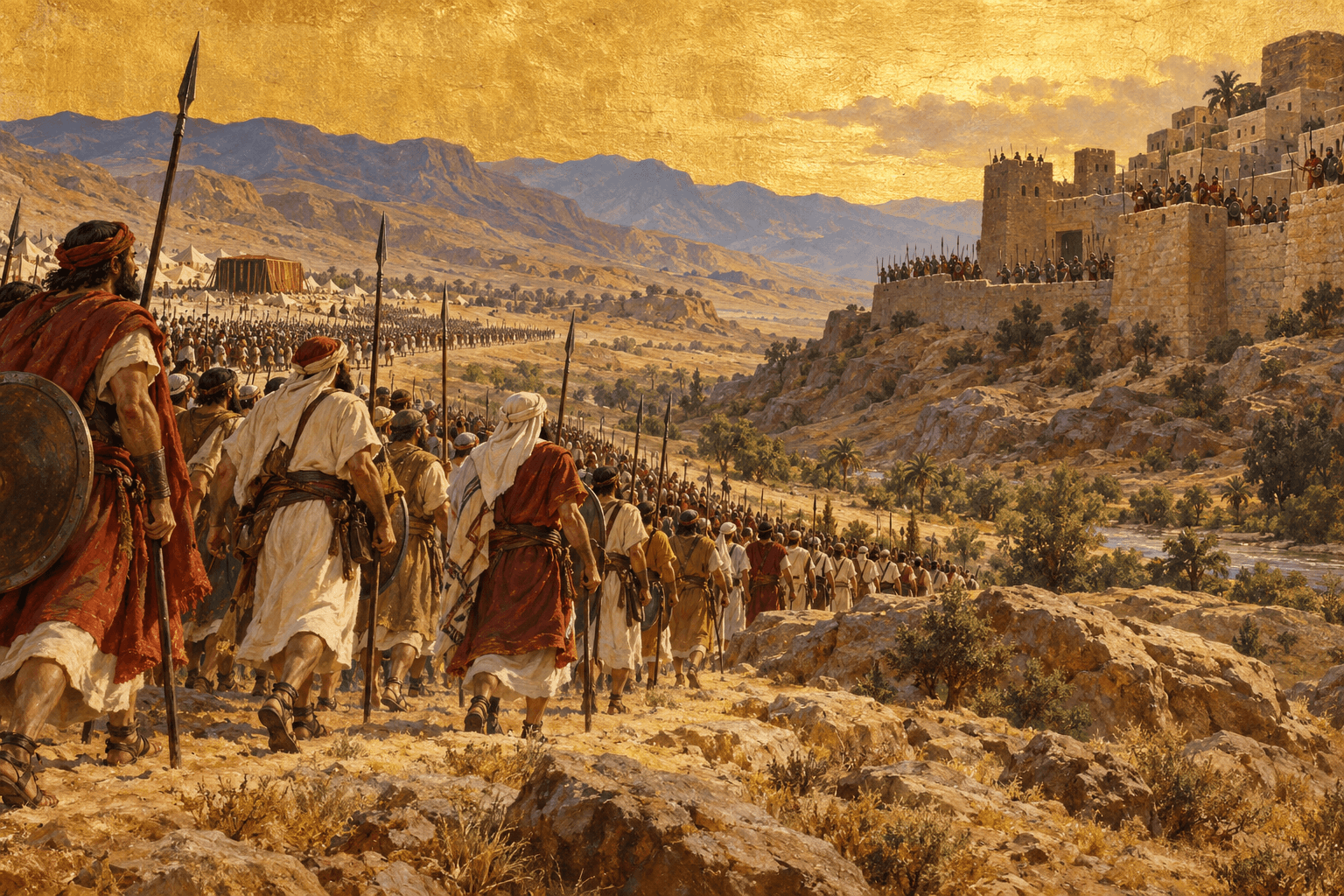
Israel sent to Sihon king of the Amorites, saying: “Let me pass through thy land: we will not turn into the fields, or into the vineyards; we will not drink of the waters of the well: but we will go along by the king’s high way, until we be past thy borders” (22). But Sihon, instead of letting them pass, came to Jahaz and fought against Israel; and Israel defeated Sihon and dwelt in the cities of the Amorites, in Heshbon the capital and its villages.
Origen holds that “Sihon” means “proud” and “a deep tree,” and that the Amorites came from “bitterness.” It is as though Sihon points to the proud Satan, who is without fruit, and his men are “bitterness itself.” He says:
King Sihon represents Satan, because he is proud and barren. I think we should not be surprised that I call him a king, for our Lord and Saviour called him in the Gospel “the prince of this world”: “for the prince of this world cometh, and hath nothing in me” (John 14:30); and He said: “now shall the prince of this world be cast out” (John 12:31). If he is called in the Gospel the prince of this whole world, it should not be thought unfitting to compare him with Sihon king of the Amorites… not because he created the world, but because sinners are many in the world. As the prince of sinners he is called the prince of the world, that is, the prince of those who have not yet left the world to turn toward the Father. In the same sense it is said: “the whole world lieth in wickedness” (1 John 5:19). What does it profit us to say of Christ that He is our Prince, if by our works and conduct we affirm that we are under the authority of Satan? Do you not know clearly to what prince the ungodly, the dissolute and the unjust man belongs? Can such a man say that he is under the authority of Christ, even if outwardly he is numbered under the name of Christ? When Christ is our Prince, we never commit uncleanness or fornication, and the lust of injustice has no place in us. In this sense we should say that Christ is the Prince of the virtues, and Satan the prince of evil and all injustice. [183]
That Sihon is “proud,” a symbol of Satan, is clear from the words of Holy Scripture itself, as Origen says:
He is the one who said: “By the strength of my hand I have done it, and by my wisdom; for I am prudent: and I have removed the bounds of the people, and have robbed their treasures, and I have put down the inhabitants like a valiant man: And my hand hath found as a nest the riches of the people” (Isaiah 10:13–14). With a proud spirit he says: “I will ascend into heaven, I will exalt my throne above the stars of God: I will sit also upon the mount of the congregation, in the sides of the north: I will ascend above the heights of the clouds; I will be like the most High” (Isaiah 14:13–14). Do you still ask whether he is proud and arrogant? Yes, he is proud and arrogant, like his only son, of whom it is written: “Let no man deceive you by any means: for that day shall not come, except there come a falling away first, and that man of sin be revealed, the son of perdition; Who opposeth and exalteth himself above all that is called God, or that is worshipped; so that he as God sitteth in the temple of God, shewing himself that he is God” (2 Thessalonians 2:3–4). Everyone who is proud and arrogant is a son of this proud spirit, or his disciple and imitator. For this reason the Apostle speaks of some, saying: “lest being lifted up with pride he fall into the condemnation of the devil” (1 Timothy 3:6), showing that all pride is judged with a judgment like that of the devil. [184]
With what did the people send to Sihon? They asked to pass through his land without lingering with him, that is, without staying with him, but walking by the king’s highway until they passed his borders, without turning into a field or a vineyard or drinking from a well of his. This is the covenant we made at Baptism, when we renounced Satan and all his evil works, his enticements and his bondage. It is as though we say to him: We will not turn into any of your fields or any vineyard of yours, nor drink a drop of water from your wells. Origen says:
The believer does not take a drop of the knowledge of Satan: astrology, magic and the other sciences opposed to godliness toward God. He has his own springs; he drinks from the springs of Israel, the springs of salvation, not from the well of Sihon. He does not forsake the fountain of life to hew out broken cisterns (Jeremiah 2:13). He declares that he walks in the royal way, the way of Him who said: “I am the way, the truth, and the life” (John 14:6). It is a royal way, for the prophet said of it: “Give the king thy judgments, O God” (Psalm 72:1). We should follow the King’s way without turning aside in any direction, neither to a field nor to satanic works and thoughts. [185]
We have already seen that the believer does not turn aside from the royal way to the right or to the left: he does not turn aside with a right-hand stroke (self-righteousness) nor with a left-hand stroke (sin). We also saw that walking in the royal way means walking toward God, not from fear like slaves, nor for reward like hirelings, but for the sake of God Himself, as sons; in this way we do not turn aside to the right or to the left. [186] Therefore Saint Gregory the Theologian says:
May you walk in the royal way, turning neither to the right nor to the left, but may the Spirit lead you in the straight path. [187]
And Saint Gregory of Nyssa speaks of this royal way, saying:
The Law requires of the man who walks in it not to turn aside to the left or to the right from the way which is narrow and strait, as the Lord says (Matthew 7:14). This teaching shows that virtue is marked by moderation. For every evil naturally works through a deficiency of virtue or an excess of it. In the virtue of courage, cowardice is a deficiency of the virtue and rashness an excess of it. What is pure of both is seen in the middle way between the two neighbouring evils, and that is counted virtue; and so all other things that strive for the better state do so by taking the moderate way between two neighbouring evils. Wisdom takes the middle way between cunning and simplicity: neither the wisdom of serpents nor the simplicity of the dove is praised if a man chooses one of them alone without the other; rather, prudence is counted a virtue when the two are united together in moderation. The man who lacks chastity is counted dissolute, while the one who goes beyond chastity has his conscience seared, as the Apostle says (1 Timothy 4:2); for the one gives himself to the passions without restraint, and the other defiles marriage as though it were adultery. When the disposition is moderate between the two, it is counted temperance. [188]
The believers ask to pass through this world in peace; but the true Sihon, the proud Satan, is all the more enraged because they will not stay with him, nor be occupied with any of his affairs, nor touch any of his possessions, nor drink a drop from his well. His hatred of them grows, his pride is stirred to anger against them, and he rages against them through his soldiers, the evil spirits, who are the Amorites, to pour out every bitterness against the believers. Therefore Scripture says: “but Sihon gathered all his people together, and went out against Israel” (23). It is the spiritual war that Satan stirs up against the kingdom of God!
The place or field of battle is “Jahaz,” which in Origen’s view means the fulfilment of the commandments. For where we enter into the fulfilment of the divine commandments, Satan cannot bear it, but begins to fight us with his evil spirits; yet the battle ends with the believer’s victory over Satan, as the Apostle says: “And the God of peace shall bruise Satan under your feet shortly” (Romans 16:20), for the Lord assured us: “Behold, I give unto you power to tread on serpents and scorpions, and over all the power of the enemy: and nothing shall by any means hurt you” (Luke 10:19). None of these will harm us if we enter into “Jahaz,” that is, keep the divine commandments.
Others hold that “Jahaz” means a place trodden by feet, or open, [189] as though the believers should walk in the spirit of their fathers, on the way they walked before, the way already opened: they enter into war with Satan, but they conquer. It is said in the Book of Jeremiah: “Thus saith the LORD, Stand ye in the ways, and see, and ask for the old paths, where is the good way, and walk therein, and ye shall find rest for your souls” (Jeremiah 6:16).
The life of Sihon, who represents the proud Satan, ended by his being smitten with the sword, which is the word of God, for the Apostle says: “the sword of the Spirit, which is the word of God” (Ephesians 6:17). So when the believer devotes himself to the word of God and His commandment, the devil is destroyed and all his wiles are scattered.
Sihon was slain with the sword, and the believers took possession of all his land from Arnon unto Jabbok, of all the cities, especially the capital Heshbon.
Arnon is a river that separated the border of the Amorites to the north from the Moabites to the south; later it became the boundary between the tribe of Reuben to the north and Moab to the south (Deuteronomy 3:8; Joshua 13:16). Arnon had fords (Isaiah 16:2).
“Jabbok” is an eastern tributary of the Jordan; at that place Jacob wrestled with the Lord until the breaking of the day, after sending over his two wives and his children (Genesis 32:22). It is now known as the river Zerqa. It formed the western border of the children of Ammon, separating them from the Amorites, and later from the tribe of Gad. It divides Gilead into two parts: the southern part belonged to Sihon and became Gad’s, and the northern part was ruled by Og, from whom the half-tribe of Manasseh took it (Deuteronomy 2:36–37; 3:12–13, 16; Joshua 12:2–6).
Heshbon was the city of Sihon king of the Amorites, which had originally been taken from the Moabites. Moses assigned it to the lot of the tribe of Reuben, and this tribe rebuilt it (Numbers 32:37; Joshua 13:17). It became a border between Reuben and Gad (Joshua 13:26). Later Gad possessed it, and it was appointed as a city of Gad given to the Levites (Joshua 21:39; 1 Chronicles 6:81). The children of Moab took it in the days of Isaiah the prophet and Jeremiah the prophet (Isaiah 15:4; 16:8–9; Jeremiah 48:2, 33–34). Later Alexander Jannaeus and Herod the Great took it. [190] It is still known as Hesban, a ruined city on an isolated hill between Arnon and Jabbok, about 6 miles north of Medeba.
Origen holds that Arnon means “curses,” and Jabbok means “wrestling,” for there Jacob wrestled with God. It is as though the borders of Satan’s kingdom begin with curses and end with wrestling. When a man enters his land he is filled with curses, and remains so until he goes out of it through his wrestling, like Jacob, so that the blessing comes upon him and he is freed from the devil’s kingdom. He says:
The kingdom of the proud and barren Sihon begins with curses and ends at Jabbok, that is, wrestling. Whoever wants to go out of Satan’s kingdom and flee from it finds wrestling… If he wrestles and conquers, Jabbok ceases to be a city of Sihon and passes to Israel… [191]
The capital of his kingdom is Heshbon, that is, “reckoning.” Whoever thinks with a material, temporal reckoning, this thought of his becomes the centre of the devil’s kingdom in his life; but if it is freed by the Lord and his reckonings become spiritual, bearing a mind of faith, counting the cost, then this thought of his becomes the centre of his new life in Christ Jesus. The mind passes from the devil’s kingdom to the kingdom of Christ. Perhaps this is what made Origen say that Heshbon points to “thought.” He says:
Why is the capital of King Sihon called Heshbon? Because Heshbon means thought, which is the most important part of Satan’s kingdom, the foundation of his power. And Christ the Lord said: “For from within, out of the heart of men, proceed evil thoughts, adulteries, fornications, murders, Thefts, covetousness, wickedness, deceit, lasciviousness, an evil eye, blasphemy, pride, foolishness: All these evil things come from within, and defile the man” (Mark 7:21–23). Therefore this city must be set on fire and burned with fire, surely the fire of which the Saviour said: “I am come to send fire on the earth; and what will I, if it be already kindled?” (Luke 12:49). [192]
After this comes: “Wherefore they that speak in proverbs say, Come into Heshbon, let the city of Sihon be built and prepared: For there is a fire gone out of Heshbon, a flame from the city of Sihon: it hath consumed Ar of Moab, and the lords of the high places of Arnon. Woe to thee, Moab! thou art undone, O people of Chemosh” (27–29). Who are they that speak in proverbs, who see the fire of the Holy Spirit which Christ the Lord kindled on the earth over which Sihon reigned for a time, longing for it to be rebuilt and restored? Those who speak in proverbs are without doubt the Law and the company of the prophets, who saw through symbols how the devil’s kingdom is destroyed so that the kingdom of Christ may rise by His fiery Holy Spirit; and those who understand these proverbs are the men of the New Testament, who perceived the truth, and to whom what was formerly a symbol and a riddle has been revealed. Origen says:
Who spoke in proverbs but the Law and the Prophets? Hear how David the prophet expresses this, saying: “I will open my mouth in a parable: I will utter dark sayings of old” (Psalm 78:2). Another writer, Isaiah, also speaks in riddles: “And the vision of all is become unto you as the words of a book that is sealed, which men deliver to one that is learned, saying, Read this, I pray thee: and he saith, I cannot; for it is sealed: And the book is delivered to him that is not learned, saying, Read this, I pray thee: and he saith, I am not learned” (Isaiah 29:11–12). It is a sealed book because it is full of proverbs and wrapped in riddles.
These who speak in proverbs say: “Come into Heshbon, let the city… be built.” The first Heshbon has fallen. What shall I say? It was smitten and burned; so it must be built anew, another Heshbon must be built. How is this done? I explain it by an example. If you see a heathen living in shame and religious error, you would say of him without hesitation that he is the city of Heshbon in the kingdom of Sihon, for the barren king, proud in his thoughts, rules over it. If this man draws near to (the new) Israel and becomes a son of the Church, he casts away all resistance to the word of God, taking up against it the sword of the Spirit (Ephesians 6:17); all the ramparts in him, that is, the heathen doctrines, are thrown down, and the pride of his understanding is burned by the fire of truth. In this way it is said that Heshbon, the city of King Sihon, has been destroyed. But it is not left as a desolate wilderness, stripped of the doctrines of the heathen… rather, let good thoughts and the sense of godliness be built in his heart; let the principles of truth be laid in him; let him learn the religious rites and the foundations of life, and let the customs that agree with the Law be set up in him. Then they that speak in proverbs say rightly to one another: “Come into Heshbon, let the city of Sihon be built.” The children of the Church too are called those who speak in proverbs, because they understand by the Spirit the symbols and riddles of the Law. This is what Jeremiah the prophet meant in a symbolic saying, when the Lord God said to him: “Behold, I have put my words in thy mouth. See, I have this day set thee over the nations and over the kingdoms, to root out, and to pull down, and to destroy, and to throw down, to build, and to plant” (Jeremiah 1:9–10). What does he root out? What does he throw down? The city of Heshbon, which King Sihon ruled. What does he root out or throw down in it? Thoughts of unbelief and uncleanness! What does he build anew in it, or plant in it? Thoughts of godliness and chastity. Heshbon must cease to be a city of the Amorites and become a city of the children of (spiritual) Israel. [193]
6. Their Victory over Og King of Bashan
KJV · Verses 31–35
31 Thus Israel dwelt in the land of the Amorites. 32 And Moses sent to spy out Jaazer, and they took the villages thereof, and drove out the Amorites that were there. 33 And they turned and went up by the way of Bashan: and og the king of bashan went out against them, he, and all his people, to the battle at edrei. 34 And the Lord said unto Moses, Fear him not: for I have delivered him into thy hand, and all his people, and his land; and thou shalt do to him as thou didst unto Sihon king of the Amorites, which dwelt at Heshbon. 35 So they smote him, and his sons, and all his people, until there was none left him alive: and they possessed his land.
Origen comments on this, saying:
When they had taken possession of the cities of the Amorites, “they turned and went up by the way of Bashan”; but they did not go down into it, nor send messengers, nor ask to pass through its land; they began at once to fight against him (Og), and defeated him and his sons. What is Bashan? Bashan means “shame.” Rightly he sent no messengers to this people and did not ask to pass through his land, for we must have no passage or way there that leads us into shame. We must attack it and always be on guard against it. On the other hand, “Og,” the king of Bashan, means “crookedness” or “hindrance”; he represents bodily things, the love of which hinders the soul and keeps it far from God. Therefore war must be declared against Og (that is, against the love of temporal things). [194]
He also says:
Concerning the kingdom of Heshbon it is not written, “there was none left him alive” (35), nor concerning the kingdom of Moab; for perhaps we need some of its inhabitants; perhaps some of them must remain for our struggle and training, “for then must ye needs go out of the world” (1 Corinthians 5:10). But as for Bashan, that is, shame, we have no need of anything of it. Nothing in it should be left alive; all works of shame must be destroyed, for shame is not counted good by anyone. [195]
Notes and References
[158] St. Augustine, On Psalm 74.
[159] St. Augustine, Tractates on John 12.11.
[160] St. Ignatius, To the Smyrnaeans 2.
[161] The Epistle of Barnabas 12.5–7 (Arabic translation by Metropolitan Elias Mouawad).
[162] St. Gregory of Nyssa, The Life of Moses 2.272, 277.
[163] St. Augustine, On the Forgiveness of Sins and Baptism 1.61.
[164] Origen, Homilies on Numbers 12.
[165] Septuagint.
[166] Origen, Homilies on Numbers 12.
[167] Proverbs 5:15–16 (Septuagint).
[168] Origen, Homilies on Numbers 12.
[169] Ibid.
[170] St. Augustine, On Psalm 98.
[171] St. Jerome, Homilies on the Psalms 25.
[172] Origen, Homilies on Numbers 12.
[173] Ibid.
[174] Ibid.
[175] Septuagint.
[176] Origen, Homilies on Numbers 12.
[177] Ibid.
[178] Ibid.
[179] Ibid.
[180] Ibid.
[181] Ibid.
[182] Ibid.
[183] Ibid.
[184] Ibid.
[185] Ibid.
[186] See the commentary on the previous chapter.
[187] St. Gregory the Theologian, Panegyric on St. Caesarius (Oration 6.8 in the source).
[188] St. Gregory of Nyssa, The Life of Moses 2.287–289.
[189] The New Westminster Dictionary of the Bible, p. 442.
[190] Josephus, Antiquities 13.15; 15.8.5.
[191] Origen, Homilies on Numbers 13.
[192] Origen, Homilies on Numbers 13.
[193] Ibid.
[194] Ibid.
[195] Ibid.