
Moses the prophet, whose soul was greatly distressed when he saw the people weeping, and who boldly reproached God, asking to be released from the service, appears exceedingly meek when he is accused in his private life: Aaron, and with him their sister Miriam, murmured against their brother because he had married a Cushite woman.
1. The Jealousy of Miriam and Aaron
KJV · Verses 1–3
1 And Miriam and Aaron spake against Moses because of the Ethiopian woman whom he had married: for he had married an Ethiopian woman. 2 And they said, Hath the Lord indeed spoken only by Moses? hath he not spoken also by us? And the Lord heard it. 3 (Now the man Moses was very meek, above all the men which were upon the face of the earth.)
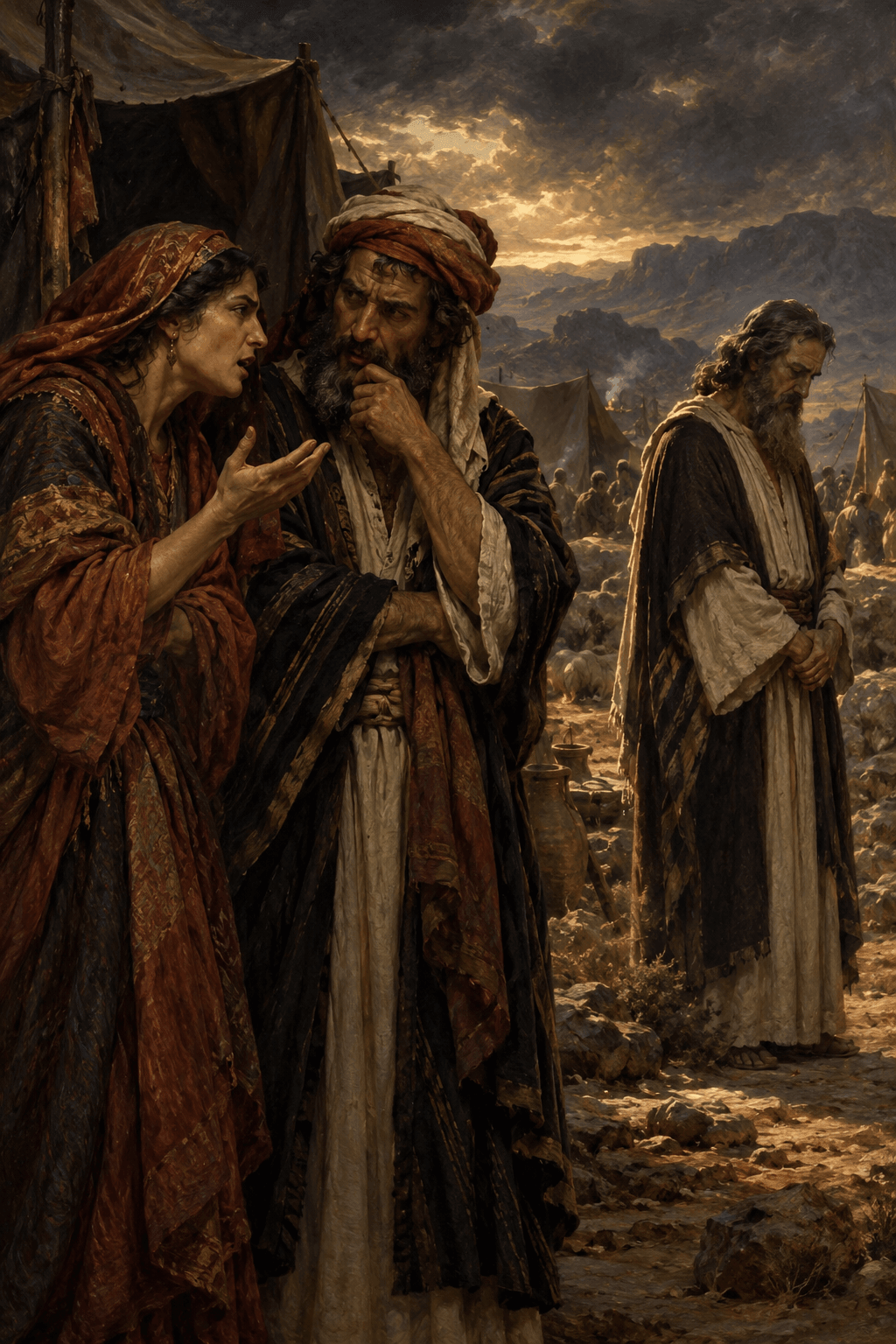
Miriam and Aaron spoke against their brother Moses the prophet because of the Cushite woman whom he had taken as his wife (1). Some explain the secret of their murmuring against him thus: in choosing the seventy elders he perhaps did not consult them, so jealousy crept into them and envy stole into their hearts. They point to their words as evidence: “Hath the LORD indeed spoken only by Moses? hath he not spoken also by us?” (2). Once envy entered their hearts, they found in his marriage to the Cushite woman an occasion to murmur against him. Saint Gregory of Nyssa comments on this envy, saying:
They became like a bow of envy that shoots not arrows but words. [51]
He also says:
Envy is the passion that causes evil. It is the father of death, the first entrance of sin, the root of harm, the son of sorrow, the mother of misfortune, the foundation of disobedience, the beginning of shame! Envy drove us out of paradise, becoming a serpent to oppose Eve! Envy barred us from the tree of life, stripped us of the holy garments, and in shame drove us out to cover ourselves with fig leaves. [52]
And he says:
Envy does not arise because of a disaster that has befallen a man; rather, his disaster is that others have good things. He grieves at the good of others, counting his success not in enjoying good things himself but in misfortunes befalling others. [53]
If we leave the envy of Miriam and Aaron and turn to Moses himself, Holy Scripture bears witness of him: “Now the man Moses was very meek, above all the men which were upon the face of the earth” (3). With this great meekness he faced envy and overcame it and triumphed. Moses was like a deaf man who does not hear; in silence he did not open his mouth, nor even reproach them. On the contrary, when Miriam fell under chastisement he interceded for her before God, saying: “Heal her now, O God, I beseech thee” (13). This is the secret of Moses’ success in leading this people with its constant stubbornness. He bore in his heart love and breadth, for he refused all earthly glory for himself and every private interest; so he was very meek. We have already seen his wonderful meekness in his dealings with his father-in-law Jethro: though he was a great prophet with whom God had worked many wonders, he listened to his father-in-law, a heathen priest, with meekness and humility. [54]
Saint Gregory of Nyssa expressed the weakness of envy before the meekness of Moses the prophet, saying:
When envy attacked this great man, it was broken like an earthen vessel on a rock… He showed himself too high to be struck by the bow…! Envy aimed its arrows at Moses, but they could not reach the height at which Moses stood. [55]
Not only did Moses not move to defend himself against those who wronged him, but he asked God to give them relief. By this he showed, I think, that he was a man well fortified with the armour of virtue, so that the points of the arrows could not hit him. [56]
He could not have done this had he not been standing behind God. [57]
2. The Lord Defends Him
KJV · Verses 4–8
4 And the Lord spake suddenly unto Moses, and unto Aaron, and unto Miriam, Come out ye three unto the tabernacle of the congregation. And they three came out. 5 And the Lord came down in the pillar of the cloud, and stood in the door of the tabernacle, and called Aaron and Miriam: and they both came forth. 6 And he said, Hear now my words: If there be a prophet among you, I the Lordwill make myself known unto him in a vision, and will speak unto him in a dream. 7 My servant Moses is not so, who is faithful in all mine house. 8 With him will I speak mouth to mouth, even apparently, and not in dark speeches; and the similitude of the Lord shall he behold: wherefore then were ye not afraid to speak against my servant Moses?
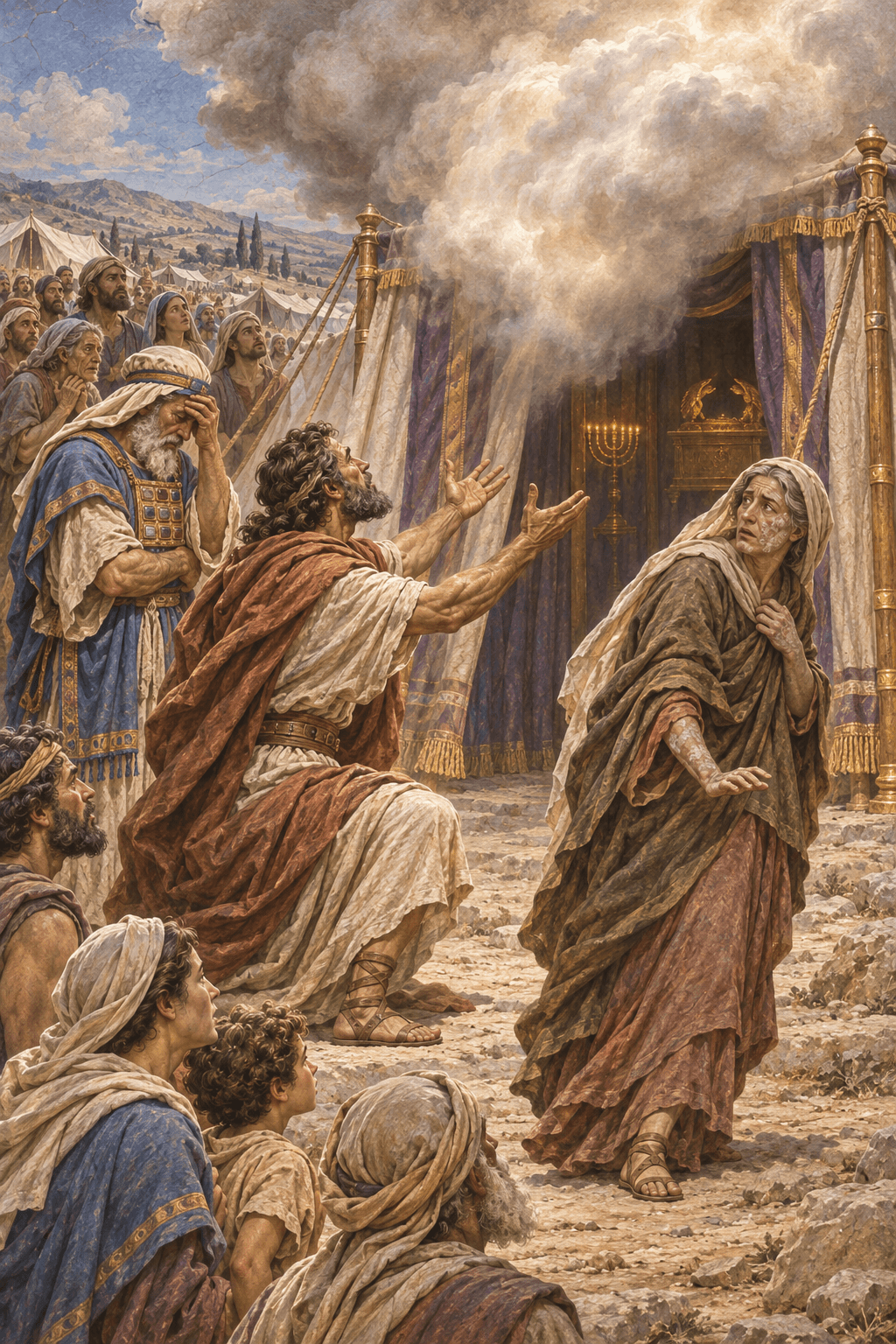
Since Moses was silent, not only with his lips but in his depths, because of his great meekness and long-suffering, “the LORD spake suddenly” (4). Moses did not defend himself, not even before the Lord, nor did he ask God to reveal the truth to restore his honour; he kept silent in love. So God hastened to summon the three, to defend His servant Moses, saying to Aaron and Miriam: “If there be a prophet among you, I the LORD will make myself known unto him in a vision, and will speak unto him in a dream. My servant Moses is not so, who is faithful in all mine house. With him will I speak mouth to mouth, even apparently, and not in dark speeches; and the similitude of the LORD shall he behold: wherefore then were ye not afraid to speak against my servant Moses?” (6–8).
Moses was worthy of this great honour, to be counted faithful in all God’s house, and that God should speak with him mouth to mouth, and speak with him openly, and reveal His glory to him… all this because of the humility that marked him and the meekness for which he was known. On this Saint Ignatius of Antioch says:
Moses, who was meeker than all men, said to God: “I am slow of speech, and of a slow tongue” (Exodus 4:10). So be humble in spirit and you will be glorified, “For whosoever exalteth himself shall be abased; and he that humbleth himself shall be exalted” (Luke 14:11). [58]
And Saint Clement of Rome says:
Moses was called “faithful in all his house” (Numbers 12:7; Hebrews 3:2), and through his ministry God punished Egypt with plagues and afflictions. Yet he was not proud, despite the great honour he received; rather, he said before the bush: “Who am I, that I should go?… I am slow of speech, and of a slow tongue” (Exodus 3:11; 4:10). And he also said: I am but smoke from a pot (compare Psalm 119:83). [59]
And Saint John Chrysostom says:
Since Moses was exceedingly gentle and meek… he became acceptable and beloved, so that it is said of him that God spoke with him face to face and mouth to mouth, as a man speaks with his friend. [60]
So by humility Moses rose in honour, and came to speak with God face to face, or as Saint Basil says:
He was counted worthy to see Him face to face like the angels, and to tell us what he learned from God. [61]
God speaks with him as a man speaks with his friend; or, as Tertullian says, this was fulfilled at the Transfiguration, [62] where Moses and Elijah appeared and spoke with Christ the Lord.
Saint Gregory the Theologian comments on Moses the prophet being called God’s servant (Numbers 12:7; Hebrews 3:2), saying:
Moses was a god to Pharaoh (Exodus 7:1), yet he is God’s servant, as it is written. For the stars that light up the night are hidden before the sun, so that you would not know they exist in the light of day. [63]
But someone may ask: Why did Moses marry the Cushite woman?
This act was a prophetic, symbolic work, pointing to God the Word’s acceptance of our Cushite nature: He unites Himself with us, who were once in darkness, to bring us into His divine light and the beauty of His nature. This is what we saw in our commentary on “I am black, but comely, O ye daughters of Jerusalem” (Song of Solomon 1:5). On this Origen says:
When he married her, the Lord said: “With him will I speak mouth to mouth, even apparently, and not in dark speeches” (8). He speaks in truth; for Moses (Christ the Lord) came and united Himself with our Cushite nature, and then the revelation of the divine Law through parables and figures came to an end, for it is offered to us in the fullness of truth. What was formerly declared through parables has become true reality. [64]
And Saint Jerome says:
Your Bridegroom is not proud or disdainful of others; He marries a Cushite woman. [65]
Moses’ marriage to the Cushite woman points to Christ the Lord’s acceptance of His bride, the Church, from the community of the Gentiles; while Miriam’s attitude toward him is the attitude of the Jewish community, which rejected Christ the Lord and would not accept the entry of the Gentiles into the faith.
Origen says:
Miriam is the present community of the Jews; she murmured together with Aaron, that is, the priests and Pharisees. The people still lack respect for the Moses who stands with us now, and this matter seems shameful to them, because He does not teach circumcision of the flesh, keeping the Sabbath and offering blood sacrifices; but He commands us to circumcise the heart, to cease from sin, to keep the feasts with the unleavened bread of sincerity and truth (Romans 2:29; 1 Corinthians 5:8; Ephesians 2:11; Colossians 2:9), and to offer sacrifices of thanksgiving (Psalm 50:14), not animal sacrifices but the slaying of vices. [66]
Origen speaks in the voice of the Church of the Gentiles, addressing the Jews:
Truly I marvel, O daughters of Jerusalem, that you reproach me for the blackness of my skin. Have you forgotten what is in your Law, and what Miriam meant when she spoke against Moses because he had taken to himself a black Cushite woman? Do you not know that this has been truly fulfilled? I am the Cushite woman! Truly I am black because of the baseness of my origin, but I am comely through repentance and faith. I have taken to myself the Son of God. I have received “the Word” who “was made flesh” (John 1:14); I have come to Him who is “the image of the invisible God, the firstborn of every creature” (Colossians 1:15), who is “the brightness of his glory, and the express image of his person” (Hebrews 1:3), and I have become comely! What are you doing? Do you reproach one who has left her sin, which the Law itself forbids? Do you seek the glory of the Law while you violate it? [67]
3. Miriam’s Leprosy
KJV · Verses 9–15
9 And the anger of the Lord was kindled against them; and he departed. 10 And the cloud departed from off the tabernacle; and, behold, Miriam became leprous, white as snow: and Aaron looked upon Miriam, and, behold, she was leprous. 11 And Aaron said unto Moses, Alas, my lord, I beseech thee, lay not the sin upon us, wherein we have done foolishly, and wherein we have sinned. 12 Let her not be as one dead, of whom the flesh is half consumed when he cometh out of his mother's womb. 13 And Moses cried unto the Lord, saying, Heal her now, O God, I beseech thee. 14 And the Lord said unto Moses, If her father had but spit in her face, should she not be ashamed seven days? let her be shut out from the camp seven days, and after that let her be received in again. 15 And Miriam was shut out from the camp seven days: and the people journeyed not till Miriam was brought in again.
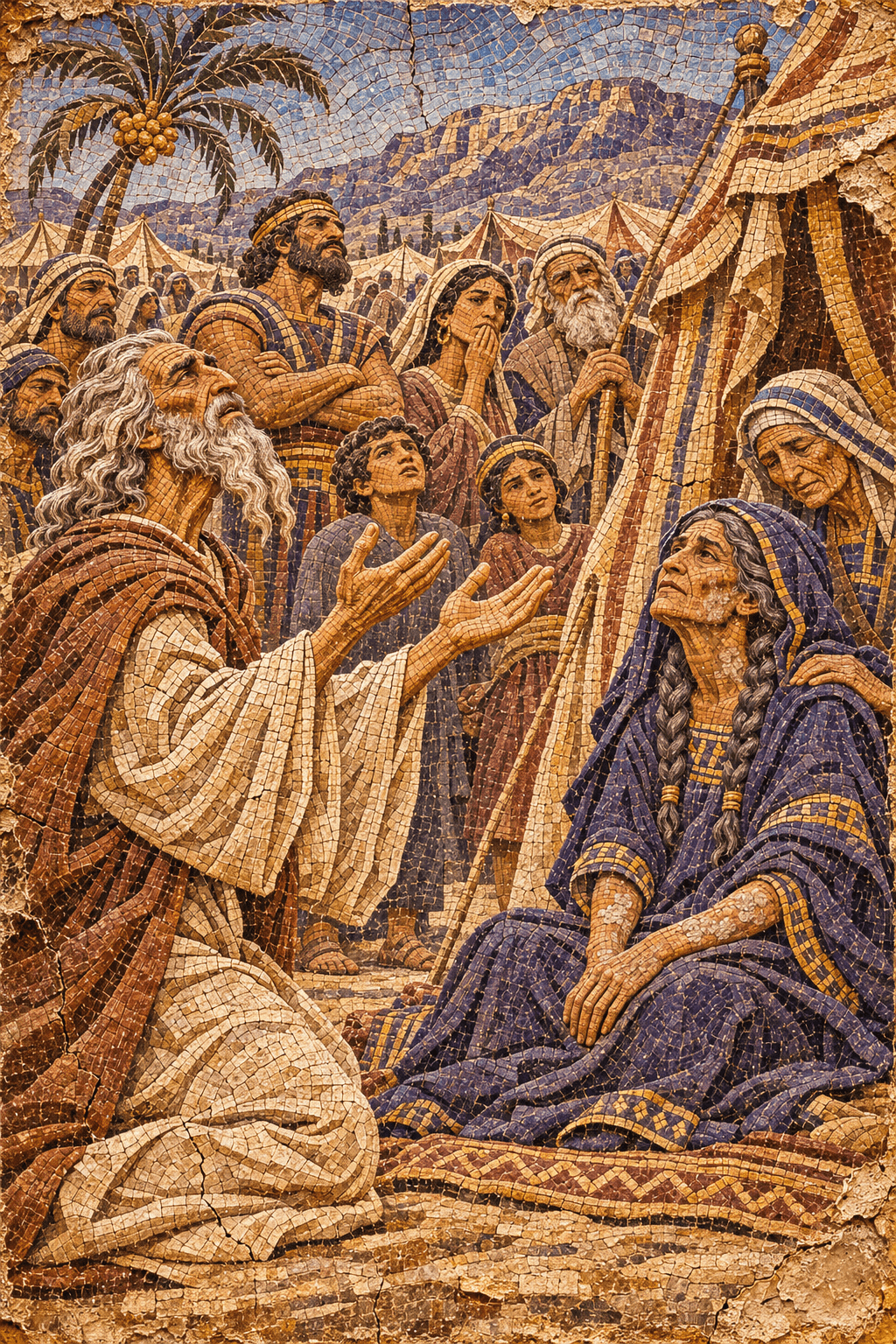
Scripture says: “And the anger of the LORD was kindled against them; and he departed. And the cloud departed from off the tabernacle; and, behold, Miriam became leprous, white as snow” (9–10). Truly, how dangerous it is to speak against God’s ministers, especially if it springs from inner envy! We ought not to choose them except after seeking God’s counsel and knowing that they are blameless; but once they are chosen, it is not for us to judge them. They have superiors, and there are those who can examine their conduct; as for us, let us not lose the kingdom because of them, or more precisely, because of our judging them. The Lord departed from Aaron and Miriam, and the cloud was taken up from the tabernacle; then Aaron looked at his sister and found her leprous, white as snow.
Origen comments on this divine chastisement, saying:
You must not despise your brother or your neighbour, nor open your mouth in evil. I do not say this concerning the saints only, but concerning any man; for I see God’s wrath and vengeance come because of this sin. For it is said in the Psalms: “Thou sittest and speakest against thy brother; thou slanderest thine own mother’s son” (Psalm 50:20); “Whoso privily slandereth his neighbour, him will I cut off” (Psalm 101:5). Cut off this vice with the help of these commandments in Holy Scripture, as with a two-edged sword (Revelation 1:16). Avoid judging our brethren and reviling the saints; for whoever judges his brother and speaks evil of him is struck with leprosy. [68]
We note the following in Miriam’s chastisement with leprosy:
A) The leprosy came upon her after the cloud left the tabernacle. It is as though leprosy, which symbolizes sin and its uncleanness, is the sign of distance from God and deprivation of fellowship with Him. Therefore Origen warns us:
Let us fear lest we move away from the cloud by our evil words, our defiled works and our unclean thoughts, so that the leprosy of sin appears in us when the grace of God leaves us. [69]
B) Miriam sinned, and it harmed the whole congregation: the cloud was taken up from the tabernacle and leprosy took hold of Miriam, so she was shut out from the congregation a whole week, during which the whole procession stopped its march toward the promised land and the tabernacle did not move from its place. It is a bitter picture of man, especially the one in responsibility, when he sins: he does not harm himself alone, but causes blasphemy against God’s holy name, halts the procession and causes many to stumble, like a diseased member that harms the other members.
C) Someone may ask: Why did Aaron not fall under the same chastisement with his sister? Saint Irenaeus answers:
Perhaps because Aaron had some excuse as the elder brother, and he was adorned with the honour of the priesthood. Leprosy, according to the Law, is uncleanness; and since the root and foundation of the priesthood was in Aaron, the Lord did not allow a similar chastisement to fall on him, lest this matter take hold of all his (priestly) seed. But God awakened his fears and taught him the same lesson through his sister; for his sister’s punishment affected him so that he took refuge with Moses, the one who had been wronged, that he might intercede for her so that this grief might be removed from her. [70]
D) Some see in Miriam’s leprosy a symbolic picture of what happened with the Jews. They refused to believe in Christ the Lord, who accepted His bride from among the Gentiles (the Cushite woman); so the cloud left them, the leprosy of unbelief took hold of them, the Spirit of the Lord departed from them, and they became stricken. Miriam’s going outside the camp seven days and then returning points to the return of the Jews to faith in Christ at the end of the ages, so that they may enter once again into the new holy tabernacle and the leprosy of unbelief be taken from them; [71] and so they will no longer cling to their old, literal, legal mind.
E) Origen comments on Aaron’s words to Moses the prophet: “Let her not be as one dead, of whom the flesh is half consumed when he cometh out of his mother’s womb” (12). Miriam, having become leprous, had become one with the stillborn, that is, without life. In this is a reference to the community of the Jews, who because of their unbelief became like a stillborn child without life; but Moses came to travail with them in birth, to bring them forth alive and that Christ might be formed in them (Galatians 4:19). Origen says:
The ancient people were in their mother’s womb, that is, in the temple, unable to reach the full and perfect result… They remained for a time in their mother’s womb, that is, in the school of the Jewish temple; but because of their sins they could not attain the complete form so as to enter into life. Therefore they were rejected like an untimely birth not fully grown, born before its time. [72]
F) Moses interceded for his sister, saying: “Heal her now, O God, I beseech thee” (13). And the Lord’s answer was: “If her father had but spit in her face, should she not be ashamed seven days?” (14). Spitting here points to being forsaken: the grace of God left this people, and they came into reproach and shame, without temple or sacrifices, as Origen says. And Saint John Chrysostom explains this divine answer, saying:
What He meant is this: If she had a father and he had driven her from his presence, would she not accept the rebuke? I value in you your brotherly devotion, your meekness and your nobility; but I know the proper time to end the chastisement. [73]
In any case, the goodness of Moses the prophet stood out in his attitude, full of love, as he prayed for her. Saint Gregory the Theologian says:
Moses was praised because he killed the Egyptian who wronged the Israelite; but he became much more admired when by his prayer he healed Miriam, who was struck with leprosy because of her murmuring against him. [74]
G) God delayed Miriam’s healing so that we might not lean on the prayers and intercessions of others for us without offering repentance on our own part. Saint John Chrysostom says:
Do not look to others with open mouths (asking for their prayers); for the prayers of the saints truly have great power, on condition of our repentance and the amendment of our souls. For even Moses, who rescued his brother and six hundred thousand men from the wrath that was about to come upon them (Exodus 32), was not able to rescue his sister. [75]
4. From Hazeroth to Paran
KJV · Verses 16
16 And afterward the people removed from Hazeroth, and pitched in the wilderness of Paran.
Origen holds that Paran means “the visible mouth,” pointing to the passage to “the divine Incarnation.” For with Miriam’s healing from the leprosy of unbelief, the procession sets out toward faith in the divine Incarnation as the way of entry into the kingdom.
Notes and References
[51] St. Gregory of Nyssa, The Life of Moses 2.260.
[52] Ibid. 2.256.
[53] Ibid. 2.258.
[54] The author, The Book of Exodus, 1981, pp. 113–114.
[55] St. Gregory of Nyssa, The Life of Moses 2.259–260.
[56] Ibid. 2.261.
[57] Ibid. 2.263.
[58] St. Ignatius of Antioch, To the Magnesians 12.
[59] St. Clement of Rome, First Epistle to the Corinthians 17.5.
[60] St. John Chrysostom, Homilies on Matthew 78.4.
[61] St. Basil the Great, Hexaemeron, Homily 1.1.
[62] Tertullian, Against Praxeas 14.
[63] St. Gregory the Theologian, Epistle 101 (To Cledonius the Priest, against Apollinarius); the source cites “Epis. 150”.
[64] Origen, Homilies on Numbers 7.
[65] St. Jerome, Epistle 22.1.
[66] Origen, Homilies on Numbers 6.
[67] Origen, Commentary on the Song of Songs 2.1.
[68] Origen, Homilies on Numbers 7.1.
[69] Ibid. 7.2.
[70] St. Irenaeus, Fragment 32.
[71] Origen, Homilies on Numbers 6; St. Ambrose, Epistle 63.57.
[72] Origen, Homilies on Numbers 7.3.
[73] St. John Chrysostom, Homilies on the Statues 20.10.
[74] St. Gregory the Theologian, Epistle 77.
[75] St. John Chrysostom, Homilies on Matthew 5.7.